

Speaker:
00:00:02
Welcome to Farsight Chats, your guide to navigating complex and important
Speaker:
00:00:07
conversations on workplace culture.
Speaker:
00:00:09
I'm your host, Farah Bala, founder and CEO of Farsight.
Speaker:
00:00:14
We specialize in leadership and organizational development, focusing
Speaker:
00:00:18
on equity, diversity, and inclusion as core leadership competencies.
Speaker:
00:00:24
Join us in these conversations that aim to foster understanding,
Speaker:
00:00:28
growth, and positive change.
Speaker:
00:00:31
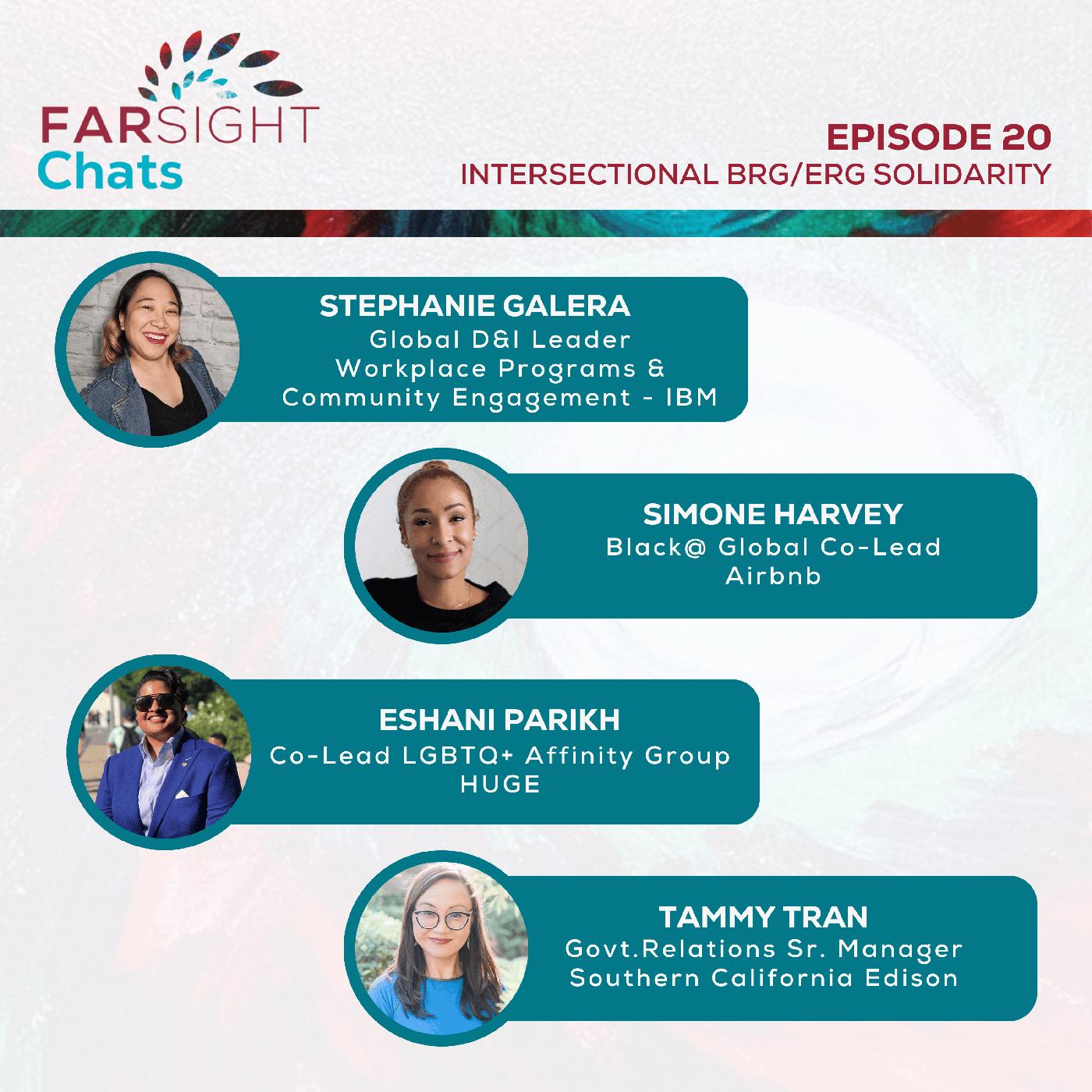
Today's episode is about intersectional BRG and ERG solidarity.
Speaker:
00:00:36
That's Business Resource and Employee Resource Groups.
Speaker:
00:00:39
I am joined by preeminent ERG leaders Stephanie Gallera, Simone Harvey,
Speaker:
00:00:45
Ishani Parikh, and Tammy Tran.
Speaker:
00:00:47
When we recorded this in the spring of 2021 , I wanted to dive deeper into
Speaker:
00:00:53
the intersectionality of BRGs and what it really takes to be an upstander or ally
Speaker:
00:00:59
for each other within an organization.
Speaker:
00:01:02
We also explored how to engage the company in your BRG and
Speaker:
00:01:06
leverage it to develop leadership.
Speaker:
00:01:09
A key aspect of this is to create opportunities, not just for the
Speaker:
00:01:13
employees, but also for the leaders.
Speaker:
00:01:16
The sponsors, which will inevitably lead to a company's overall growth and success.
Speaker:
00:01:22
So as you listen in today, we invite you to consider
Speaker:
00:01:26
what are some ways your own ERGs or BRGs have helped you feel more
Speaker:
00:01:31
included within your company?
Speaker:
00:01:33
How may it have expanded your exposure to a larger network and
Speaker:
00:01:37
your own professional development?
Speaker:
00:01:40
And what have you learned about being a good ally to
Speaker:
00:01:42
other ERGs within your company?
Speaker:
00:01:45
Join us on this journey of learning and unlearning in
Speaker:
00:01:49
today's episode of Farsight Chats.
Speaker:
00:01:53
Friends, please join me in welcoming our very esteemed guests.
Speaker:
00:01:58
I am so honored that all of you said yes to this conversation and
Speaker:
00:02:04
Stephanie Galera, Simone Harvey.
Speaker:
00:02:07
Ishani Parikh, Tammy Tran.
Speaker:
00:02:09
I'd love to ask you to introduce yourselves, please.
Speaker:
00:02:14
. Hello, everybody.
Speaker:
00:02:14
My name is Nathan Galera.
Speaker:
00:02:16
My pronouns are she and her.
Speaker:
00:02:18
I have been with IBM since 2008.
Speaker:
00:02:21
I had joined ABRG for LGBT our community, in 2008 and started leading one in
Speaker:
00:02:27
2015 . After that, then I've had the unique opportunity To become the DNI
Speaker:
00:02:33
partner, so a bit of the HR side of DNI, for the Philippines, and then had
Speaker:
00:02:40
a short stint in talent before I moved back to DNI, where my heart is and where
Speaker:
00:02:47
my soul is, as it pertains to my current role, Global DNI Leader for Workplace
Speaker:
00:02:52
Programs and Community Engagement.
Speaker:
00:02:55
So my name is Simone Harvey.
Speaker:
00:02:56
I am one of the two global black at co leads for Airbnb.
Speaker:
00:03:04
I have been in that role for about a year I took over early last year when you know
Speaker:
00:03:09
there were some changes in the company, but I had previously worked with black
Speaker:
00:03:13
at as a chief of staff for pretty much since I started at Airbnb three years ago.
Speaker:
00:03:18
And in my day job, in my regular job, I am a senior program manager in
Speaker:
00:03:23
the business operations and strategy group, and there I'm responsible
Speaker:
00:03:27
for strategy and program governance.
Speaker:
00:03:31
Hi, I'm Ishani.
Speaker:
00:03:32
I'm one of the co leads of the LGBTQ ERG at HUGE, which is an
Speaker:
00:03:38
advertising agency based in Brooklyn.
Speaker:
00:03:41
In my day job, I am also project manager like Simone, but I focus more
Speaker:
00:03:46
on integrated marketing campaigns, and brand marketing campaigns.
Speaker:
00:03:50
And before I joined huge, I was in the sports industry working
Speaker:
00:03:54
in baseball for six years.
Speaker:
00:03:57
Hi, everybody.
Speaker:
00:03:58
My name is Tammy Tran.
Speaker:
00:03:59
I'm glad to be part of this, the session today from California.
Speaker:
00:04:03
I'm currently a senior manager in local public affairs at Southern California
Speaker:
00:04:08
Edison, which is an electric utility.
Speaker:
00:04:10
I currently serve as a senior advisor for, our strategic advisor for our API,
Speaker:
00:04:16
, business resource group and previously served, in the role as president.
Speaker:
00:04:20
Very happy to be a part of today's conversation.
Speaker:
00:04:25
Thank you all.
Speaker:
00:04:26
So this topic, intersectional BRG, ERG, employee network, there
Speaker:
00:04:31
are so many terms, , solidarity.
Speaker:
00:04:33
, why this topic?
Speaker:
00:04:34
Why now?
Speaker:
00:04:35
For me, personally, in the work that I've been doing, The personal and political got
Speaker:
00:04:41
intersected and intertwined if it already wasn't in a very deep way this past
Speaker:
00:04:46
year, , between working from home between, having home at work and work at home.
Speaker:
00:04:54
, We have, there has been a lot of overlap.
Speaker:
00:04:57
This has also been the year where our communities have been experiencing an
Speaker:
00:05:02
escalation of violence and oppression.
Speaker:
00:05:04
And this is an attempt to explore what does.
Speaker:
00:05:09
This space of coming together look like and what happens when we are there.
Speaker:
00:05:14
The term intersectionality originally coined by Kimberly Crenshaw, a black
Speaker:
00:05:19
woman, and within her definition is what happens when we are at the intersection.
Speaker:
00:05:26
It's not as much necessarily coming to the intersection but when we are there.
Speaker:
00:05:31
How do we go forward together?
Speaker:
00:05:33
And that's the complexity and nuance that I keep thinking about.
Speaker:
00:05:37
And, would love to socialize in this conversation.
Speaker:
00:05:40
What I love about this group is that you all are, representing yourselves and
Speaker:
00:05:47
A very wide spectrum of organization.
Speaker:
00:05:50
We have a small to midsize ad agency to a global conglomerate.
Speaker:
00:05:54
, we have public sector and private sector.
Speaker:
00:05:56
We have, , a relatively start small startup, which was, , less
Speaker:
00:06:01
than a decade ago now into a burgeoning, organization globally.
Speaker:
00:06:06
And so again, this speaks to, what we are going to discuss.
Speaker:
00:06:11
It transcends.
Speaker:
00:06:13
the organization that we come from.
Speaker:
00:06:15
I want to acknowledge that not all communities and BRGs are represented
Speaker:
00:06:20
in this panel and our speakers today.
Speaker:
00:06:23
We have so many identities and so many communities that inform BRGs at
Speaker:
00:06:28
different organizations in different ways.
Speaker:
00:06:30
For example, we have our Native and Indigenous communities, our
Speaker:
00:06:34
disabled communities, our Latinx communities, faith based communities.
Speaker:
00:06:39
And, what is,, front and center for all of us is also the heightened mental
Speaker:
00:06:45
health challenges that we're all facing as professionals and in the workplace,
Speaker:
00:06:50
and the complexity, and intersection that forms within our identities.
Speaker:
00:06:55
So I want to acknowledge that and name that we're holding space for all of
Speaker:
00:06:59
that within this conversation as well.
Speaker:
00:07:02
So friends, my first question for you, how are you?
Speaker:
00:07:06
How have you been this past year?
Speaker:
00:07:08
This has been quite the year.
Speaker:
00:07:09
How have you been impacted, personally, professionally,
Speaker:
00:07:14
and what has kept you going?
Speaker:
00:07:16
Especially in these crucial escalating situations.
Speaker:
00:07:20
Yeah,, it's a very like a very layered question.
Speaker:
00:07:24
Of course, this past year has been difficult for everybody.
Speaker:
00:07:27
, for me, , I live in Brooklyn, as I said, and the height of one, , the
Speaker:
00:07:34
pandemic at the beginning,, of the U. S. resurgence was April and May
Speaker:
00:07:39
in New York, where, there's sirens, going off at all hours of the day.
Speaker:
00:07:43
, and then, after the peak of that, the George Floyd protest started,
Speaker:
00:07:48
, right outside, my window, basically.
Speaker:
00:07:50
, It was definitely, , a year of a lot of, reflection, , frustration, , but
Speaker:
00:07:56
also, , some areas of hope where there are people that are, , on the
Speaker:
00:08:00
front lines marching and protesting and things like that, which, , it
Speaker:
00:08:04
does give me a bit of hope, but.
Speaker:
00:08:06
It's also, , it was , very tough year, a full range of emotions, but, , things
Speaker:
00:08:11
, that keep me grounded is just, , my community , I know that I have people,
Speaker:
00:08:14
, to reach out to, if I , have, , need to just cry or, , need to talk about
Speaker:
00:08:18
anything, , especially, , my fiance and my family, , people like that, and also,
Speaker:
00:08:25
. Therapy helped a lot, honestly, , that kind of that, that definitely helps me
Speaker:
00:08:30
a lot and just staying grounded, , just talking things out and also knowing
Speaker:
00:08:34
that, think there are a lot of things that I can't control, but the things I
Speaker:
00:08:37
can control are, Within my community or just, , doing things like, , donating
Speaker:
00:08:42
to causes and, , sharing resources of, , articles or organizations that are,
Speaker:
00:08:49
, around the globe, really, , especially as far as you mentioned, like , with
Speaker:
00:08:52
the India, , devastation now, it's difficult to be here in the U. S.
Speaker:
00:08:57
and not be able , to physically help.
Speaker:
00:08:59
, Just doing what I can to spread awareness of what is actually happening over
Speaker:
00:09:03
there and to Just using the resources that I have to help as much as I can.
Speaker:
00:09:10
Um, Ashani, I feel like you shared my sentiments and oftentimes
Speaker:
00:09:15
when people ask, how are you?
Speaker:
00:09:17
, at various times throughout the past year, I probably would
Speaker:
00:09:20
have said different things.
Speaker:
00:09:21
But I feel like today I can say I really don't have anything to complain about.
Speaker:
00:09:25
And I'm so hopeful about the days ahead.
Speaker:
00:09:28
, and I say that I don't have anything to complain about.
Speaker:
00:09:30
Not that I haven't,, haven't faced the same challenges, but
Speaker:
00:09:33
there are so many people that have it so much harder than we do.
Speaker:
00:09:36
And I feel like that's something that has really, I really thought about,
Speaker:
00:09:40
over the past couple of months and the past year is, we're all in this.
Speaker:
00:09:44
pandemic, multiple pandemics together, but how we're experiencing is very different.
Speaker:
00:09:51
And I often think about the kids that my, my children go to school with
Speaker:
00:09:55
and they go to a title one school, they're in a dual immersion program.
Speaker:
00:09:59
And there are kids that have not reported to class.
Speaker:
00:10:02
They have not reported to zoom.
Speaker:
00:10:03
And I wonder often about, what is going on in their homes.
Speaker:
00:10:06
And so I feel, , burdened by the fact that there's so much suffering around us.
Speaker:
00:10:12
But I'm hopeful that there's so many things that we can do.
Speaker:
00:10:15
And in particular, when we look at our business resource groups and the companies
Speaker:
00:10:19
that we work for, I'm very grateful that I've been able to work remotely.
Speaker:
00:10:23
I've been grateful to have been able to be at home with my kids
Speaker:
00:10:26
and spend the time with them.
Speaker:
00:10:27
Despite, the lost learning they may have in certain respects.
Speaker:
00:10:31
But , I'm just very grateful and I'm also very grateful like Ishani about
Speaker:
00:10:34
the community that we're a part of and seeing how the unrest that has taken
Speaker:
00:10:38
hold in our country across, , but across our country, but there's so
Speaker:
00:10:42
many examples and so many things we've seen of people coming together, and
Speaker:
00:10:46
listening to each other and the dialogue that has happened over the past couple
Speaker:
00:10:49
months that haven't happened before.
Speaker:
00:10:51
over the past couple of years, I want to give a quick shout
Speaker:
00:10:54
out to a mentor of mine.
Speaker:
00:10:56
Linda Akutagawa, , she's the head, the CEO and president of leadership
Speaker:
00:11:00
education for Asian pacifics.
Speaker:
00:11:01
And it's examples of people like her who are out there bringing communities
Speaker:
00:11:06
together, talking about diversity, equity and inclusion that really keep me going.
Speaker:
00:11:11
So the way that I'm thinking about this is.
Speaker:
00:11:13
I love to travel and I think whenever you go to new places, you leave the
Speaker:
00:11:19
comforts of your home behind the way that you like to do things and the things
Speaker:
00:11:24
that give you , the calm and the rest that you need in order to feel safe
Speaker:
00:11:29
and when you first go to a new place, it's super disorienting and you're just
Speaker:
00:11:33
like, where's my blankie or whatever or , where are my favorite pillows?
Speaker:
00:11:38
, but then after a while you adjust and you integrate this new information in this new
Speaker:
00:11:41
context and then you settle in and then maybe even after 10 days, if you're like
Speaker:
00:11:45
me, you're like, oh, I could live here.
Speaker:
00:11:47
, and so that's how I feel about like this whole experience of the pandemic is that,
Speaker:
00:11:52
, many of my comforts have been taken away.
Speaker:
00:11:55
Many of the things that I do to feel connected, to feel fed, to
Speaker:
00:11:59
feel rested have been taken away.
Speaker:
00:12:01
And a lot of that has to do with connecting with other people.
Speaker:
00:12:03
, but I think over time, what happens is that you settle
Speaker:
00:12:06
into a new understanding of.
Speaker:
00:12:08
where you fit within that environment and what it means, and then you still have
Speaker:
00:12:12
days where you just feel crazy and you're like, why are the mosquitoes, killing me?
Speaker:
00:12:16
And why is it always, why am I always the target?
Speaker:
00:12:18
So not to say that I've had this super consistent experience where I've
Speaker:
00:12:22
always been happy and healthy and.
Speaker:
00:12:26
, without tears, but I've seen it as a necessary sort of condition as
Speaker:
00:12:33
like this as part of this larger, really extreme experience that we're
Speaker:
00:12:37
in , and the fact that we're in a collective trauma as a planet.
Speaker:
00:12:41
. I think that the piece that feeds me is that I'm still I have this level of
Speaker:
00:12:46
responsibility for my community at Airbnb.
Speaker:
00:12:49
And so the intersection that I'm navigating as an individual is between the
Speaker:
00:12:55
conservation of my resources and the way that I want to participate in this battle.
Speaker:
00:12:59
And so what I've decided is I'm going to invest in the folks that, share this
Speaker:
00:13:04
experience with me, in the folks that, feel like they are part of my community,
Speaker:
00:13:09
part of my family, part of the people that I am responsible for in some capacity.
Speaker:
00:13:15
And I think that , gives it meaning, even , if the larger environment feels crazy
Speaker:
00:13:19
and arbitrary and unpredictable, I have a place where I can point my motivation,
Speaker:
00:13:25
my focus, my vision for a better future.
Speaker:
00:13:27
And so that's, what's kept me going is this connection to, to purpose , for
Speaker:
00:13:32
the black people at my company.
Speaker:
00:13:34
For me in particular, there is an added complexity to how we dealt with the
Speaker:
00:13:39
pandemic in the last year because my spouse and I had actually adopted a four
Speaker:
00:13:44
year old boy , last year in August, so we are at a point where he can't go out
Speaker:
00:13:51
because right now we're still on lockdown.
Speaker:
00:13:54
We were in lockdown the entire Time in April, and now they're
Speaker:
00:13:58
extending it because the numbers are getting higher and higher.
Speaker:
00:14:02
And we, as new parents, are having difficulties dealing with the emotions
Speaker:
00:14:08
that come with feeling that your son isn't able to go out and experience the world.
Speaker:
00:14:13
, and , that's a really difficult thing, , because even though here in the
Speaker:
00:14:16
Philippines, we're very removed from the situation, because of course we're amongst
Speaker:
00:14:21
fellow Filipinos, but being in a global role, you get to see what's happening and
Speaker:
00:14:26
you get to empathize with your friends.
Speaker:
00:14:28
, just recently we realized one of our friends, has been rejected eight times
Speaker:
00:14:33
by a car service just for looking at the way they do . Which is really scary.
Speaker:
00:14:39
It initially in our heads and ask these things happen being
Speaker:
00:14:43
very removed in a situation.
Speaker:
00:14:45
You can imagine that happening here, and it's really scary, but
Speaker:
00:14:48
there was another situation where we were driving in the highway.
Speaker:
00:14:52
And then it starts to creep in.
Speaker:
00:14:55
And then it's starting to happen because everything that happens in a specific
Speaker:
00:14:59
area now because of socialization and because of social media, we
Speaker:
00:15:03
get to experience them as well in the highway while we were driving.
Speaker:
00:15:08
It's a car that had a lot of hate, banners of hate in it, and it had
Speaker:
00:15:14
at the back of it, , a yellow mask with horns and had blaring music
Speaker:
00:15:18
that we didn't really hear off.
Speaker:
00:15:20
And that, which is very unheard of here in the Philippines.
Speaker:
00:15:23
, that, that doesn't necessarily happen because we try to be as, , as peaceful as
Speaker:
00:15:30
we could when it comes to our protests.
Speaker:
00:15:32
And.
Speaker:
00:15:33
What we're really grateful for, my spouse is also an IBMer, , by the
Speaker:
00:15:37
way , and also in the D& I organization.
Speaker:
00:15:39
So what we're really, what we're really thankful for in terms of dealing with
Speaker:
00:15:43
all of these situations, is that the organization is actually helping us
Speaker:
00:15:48
build resources to, to build resilience.
Speaker:
00:15:52
And just last year, what we built was like a DRG kinder cafe.
Speaker:
00:15:57
Where it was built by PRG members, for all PRG members, and the focus really
Speaker:
00:16:01
was not to talk about so many different kinds of things that are very official,
Speaker:
00:16:07
very, very, like a presentation and stuff, because we have a lot of faculty.
Speaker:
00:16:12
fatigue on that.
Speaker:
00:16:13
it's just getting together, bringing , your own drink and talking
Speaker:
00:16:17
about how you build resilience.
Speaker:
00:16:19
So we've got topics around, it could be as easy as, what do you do when your
Speaker:
00:16:23
work workspace is really small and you have to share that with somebody else?
Speaker:
00:16:27
Or what do you do when you have children around or pets
Speaker:
00:16:30
around and so on and so forth?
Speaker:
00:16:32
And it's a good way for the community to connect and share best practices
Speaker:
00:16:37
because we actually learn from each other.
Speaker:
00:16:40
So we're, very fortunate that we have that kind of support.
Speaker:
00:16:44
Want to move to the evolution of BRGs.
Speaker:
00:16:48
And I know that we've had a slice of this conversation earlier.
Speaker:
00:16:53
And Tammy, I want to include something that you said specifically
Speaker:
00:16:56
around your experience in the API community where, initially it was
Speaker:
00:16:59
about celebrating heritage and acknowledging all of where we come from.
Speaker:
00:17:04
And it's now moving to how do we Establish and create our connection
Speaker:
00:17:10
and pipeline to leadership and really develop our people for access.
Speaker:
00:17:16
I might have been very inaccurate in translating exactly what you said,
Speaker:
00:17:19
but I want to use that sentiment of evolution and explore with you all.
Speaker:
00:17:25
Understand from your perspective, what is the opportunity to move forward from here?
Speaker:
00:17:31
And in this, spirit of intersection, around including the disability community.
Speaker:
00:17:36
How do you suggest we encourage more colleagues with disabilities
Speaker:
00:17:40
to self identify and participate in each session of your teams?
Speaker:
00:17:46
So I know that was a lot.
Speaker:
00:17:47
But the under the umbrella of evolution and the intersection your thoughts,
Speaker:
00:17:55
I really think about black at as a strategic partner to the business.
Speaker:
00:18:02
And as such, I wanted to develop in that same capacity, almost like as if
Speaker:
00:18:07
you're standing up a business unit.
Speaker:
00:18:09
So I think there's both the opportunity to collaborate and partner with the
Speaker:
00:18:14
larger company, understanding what the priorities are , for leadership overall.
Speaker:
00:18:19
And Seeing how, like, how can we weave what we're trying to do into that?
Speaker:
00:18:24
And that's really starting to happen.
Speaker:
00:18:25
And that's probably the most exciting projects that we are working on are
Speaker:
00:18:29
the ones that have longer term impacts on the entirety of the company.
Speaker:
00:18:33
So that's one way that I'm thinking about it is like, how do you start to
Speaker:
00:18:36
manage these groups more like an active participant in how the business is run
Speaker:
00:18:40
and not just a social club or a place for
Speaker:
00:18:43
. For highlighting heritage.
Speaker:
00:18:45
I think the way that our experience as groups that are marginalized
Speaker:
00:18:50
or disenfranchised is going to change is if there's actually a
Speaker:
00:18:53
lot more participation in like conventional, running of the business.
Speaker:
00:18:58
So I think that's the piece of like evolution.
Speaker:
00:19:00
And I'm not sure that , we have figured out this piece around how
Speaker:
00:19:04
do we give voice and include it.
Speaker:
00:19:07
, folks that have maybe invisible ways in which they are
Speaker:
00:19:11
marginalized or disenfranchised or left out of the conversation.
Speaker:
00:19:15
But we did do a campaign.
Speaker:
00:19:18
What's the February?
Speaker:
00:19:19
This feels like six months ago.
Speaker:
00:19:21
, that we called humans of black at and we basically did profiles of all the
Speaker:
00:19:27
different intersections of a number of black people in the company.
Speaker:
00:19:29
And it went from the CIO to folks who are working at the front line.
Speaker:
00:19:33
We didn't really call out people's roles or like where they are in the hierarchy.
Speaker:
00:19:37
And what ended up happening is that we got a lot of different
Speaker:
00:19:39
facets of people's experience.
Speaker:
00:19:42
And there was a couple of in there that, a couple of them in there that talked about
Speaker:
00:19:46
what it felt like for them to be disabled, how has it framed their perspective on
Speaker:
00:19:51
themselves and on their lives and what, how is it connected to their blackness?
Speaker:
00:19:54
And so I think giving opportunities for storytelling, I think is
Speaker:
00:19:57
important so that our concept.
Speaker:
00:20:00
Of the realities where people exist expands, but I think it's also an
Speaker:
00:20:04
opportunity to create more intimacy and more connection within our groups.
Speaker:
00:20:08
And so we just need to think about , how do we create the psychological safety?
Speaker:
00:20:12
How do we surface these topics?
Speaker:
00:20:14
How do we make sure the folks that we're speaking to are aware that , there's
Speaker:
00:20:18
actually a very broad Broad experience that people are having, and everybody
Speaker:
00:20:22
exists on a continuum, and how do we facilitate more of that to be surfaced
Speaker:
00:20:26
when we're bringing people together?
Speaker:
00:20:29
I think what,, my experience at Southern California Edison and, , the
Speaker:
00:20:32
evolution , of these groups, , the affinity groups was, it, the,
Speaker:
00:20:36
and , I'll speak to our Asian Pacific Islander group, , and a number of our
Speaker:
00:20:40
ERGs were once known as inclusive.
Speaker:
00:20:43
. The evolution is that they're now widely known as business resource
Speaker:
00:20:46
groups at Southern California Edison.
Speaker:
00:20:49
And so I feel like in that sense, it's also an evolution in terms
Speaker:
00:20:53
of how we're seeing, , within the company, the organization,
Speaker:
00:20:56
but also, how we see ourselves.
Speaker:
00:20:59
As having a voice within the company, , all of us go to work every day and we
Speaker:
00:21:03
have our jobs, we have our goals, we have our managers and our teams and their
Speaker:
00:21:07
specific goals, but the work that we do as a part of a BRG is more transformational.
Speaker:
00:21:13
And being able to understand that is.
Speaker:
00:21:15
Is I think, an ongoing effort, for not only the leaders , for all of its members.
Speaker:
00:21:19
, and I feel like that's the evolution is understanding that your impact in
Speaker:
00:21:23
your workplace is not just in the work that you do, . It's also in how you use
Speaker:
00:21:27
your voice and how you come together.
Speaker:
00:21:29
, our heritage or the fact that we share certain abilities or
Speaker:
00:21:32
disabilities, that's what brings us together, but how we use our voice.
Speaker:
00:21:37
How we make an impact, how we influence is how we move forward.
Speaker:
00:21:41
And I think that's really key to what a business resources group is, right?
Speaker:
00:21:45
We have to acknowledge that we are a resource to the company in order
Speaker:
00:21:48
for the company to be able to,, to gain, greater profits or to meet
Speaker:
00:21:52
their goals or exceed their goals.
Speaker:
00:21:53
It's the greatest asset is.
Speaker:
00:21:55
people.
Speaker:
00:21:55
And I think if we understand that at a very foundational, then I
Speaker:
00:21:59
feel like, I feel like , that's really what the evolution is.
Speaker:
00:22:03
And I'll speak to my personal experience.
Speaker:
00:22:05
, I came into the company, I had a Pacific job and I happened
Speaker:
00:22:08
to be able to get involved with these business resource groups.
Speaker:
00:22:10
And I feel like that's the best part of my work because that's where I'm able
Speaker:
00:22:13
to influence things that are beyond my.
Speaker:
00:22:15
function, right?
Speaker:
00:22:17
I'm able to help lift other people.
Speaker:
00:22:19
I'm able to, , to weigh in when the company talked about making a stand , for
Speaker:
00:22:24
a greater racial equity, acknowledging that there is systematic discrimination.
Speaker:
00:22:29
, these are things that, , cannot be discussed or acknowledged alone.
Speaker:
00:22:33
It's, it has to be a movement.
Speaker:
00:22:34
It has to be a movement with, within the workplace.
Speaker:
00:22:37
And I feel like that's what BRGs really are a value.
Speaker:
00:22:41
To the organization.
Speaker:
00:22:43
Yeah, I agree with both what Simone and Tammy just said.
Speaker:
00:22:46
I , I think, \ , there has been especially, I think, in the past, , 55
Speaker:
00:22:50
years, like more of a shift of . Not just having these BRGs to just check
Speaker:
00:22:56
a box, , it's more of using these as actual resources, using these as not
Speaker:
00:23:01
just one to celebrate the culture within these communities, but to, , push those
Speaker:
00:23:06
like, policy , within a company or.
Speaker:
00:23:08
push, for example, in advertising, we have a lot of affinity groups.
Speaker:
00:23:12
, not for, we have a black and brown, , affinity group.
Speaker:
00:23:16
We have a parents group and immigrants group and API group.
Speaker:
00:23:19
, and all of us are just trying to, at the end of the day, just make
Speaker:
00:23:23
a better experience for all types of people, but also have that.
Speaker:
00:23:28
\ , seep into the work that we're doing and advertising, especially, , representation,
Speaker:
00:23:32
of course, matters everywhere.
Speaker:
00:23:33
So making sure that, , if we're making a marketing campaign that we're not just
Speaker:
00:23:38
including, , certain type of people, , that, , we're looking at, , All types
Speaker:
00:23:42
of diversity in terms of the talent, but not just in the talent, but our
Speaker:
00:23:46
production partners and things like that.
Speaker:
00:23:48
So we're working with not just, the same kind of company over and over again.
Speaker:
00:23:52
We're working with black owned businesses, black producers, black directors, black
Speaker:
00:23:56
photographers, et cetera, et cetera.
Speaker:
00:23:58
, so we try and at least, make it known that, , what kind
Speaker:
00:24:02
of resources are out there.
Speaker:
00:24:03
And a lot of that is, is within our communities building, even just like
Speaker:
00:24:07
Google spreadsheets of , , black owned businesses , within our communities
Speaker:
00:24:11
, or queer owned, , businesses within our communities that, putting our,
Speaker:
00:24:15
putting the money where our mouth is thing, and making sure that.
Speaker:
00:24:19
, others that are not just in our communities know that these resources
Speaker:
00:24:22
exist and encouraging them to utilize it
Speaker:
00:24:26
definitely agree with everybody's sentiment there in my head when it comes
Speaker:
00:24:30
to leadership and building pipeline and during the evolution, or maybe more
Speaker:
00:24:35
appropriate terms, the revolution of BRGs.
Speaker:
00:24:38
is, , it really depends on how the businesses define or considers what is
Speaker:
00:24:43
valuable and what is impactful right now.
Speaker:
00:24:46
And what the good thing about , what's happening is that the business,
Speaker:
00:24:49
we're seeing a shift in how the businesses see our resources and
Speaker:
00:24:54
coming from , an initial here.
Speaker:
00:24:57
Here's a number of volunteers.
Speaker:
00:24:59
, these are the things that they can do for us.
Speaker:
00:25:01
These are the things that they can do for profit and so on and so forth.
Speaker:
00:25:05
We're seeing that ship into a more employee centric experience.
Speaker:
00:25:10
, and the pandemic has accelerated that by all of the things that are happening.
Speaker:
00:25:14
So we're also seeing.
Speaker:
00:25:16
A mixed kind of feelings about what the pandemic is bringing in.
Speaker:
00:25:20
, we started with in terms of the revolution, we started with
Speaker:
00:25:24
no data at all, , very little data when it comes to targeting.
Speaker:
00:25:29
Talent and pipeline.
Speaker:
00:25:30
We started with no data to , many resources where we can actually
Speaker:
00:25:34
use data as a business case to talk to the leadership and say,
Speaker:
00:25:40
These are the right things to do.
Speaker:
00:25:41
These are the right populations to focus on.
Speaker:
00:25:44
And then these are the right leaders to build.
Speaker:
00:25:46
So it becomes a more collaborative, more efficient way to actually
Speaker:
00:25:53
build pipeline for the communities.
Speaker:
00:25:55
Because of that kind of visibility that we have, , and in speaking off,
Speaker:
00:25:59
, self identification, that's always a challenge for a lot of organizations.
Speaker:
00:26:03
, it's a difficult business case to say, I want you to self identify.
Speaker:
00:26:08
And then people would say, so what do I gain by self identification?
Speaker:
00:26:13
And it more so when it comes to, , persons with disability or
Speaker:
00:26:17
what we call them diverse abilities.
Speaker:
00:26:20
And what I would say there is that there's still strength in numbers.
Speaker:
00:26:25
And when it comes to intersectionality also, and I'll connect that with
Speaker:
00:26:28
intersectionality, we become allies of each other and that actually amplifies
Speaker:
00:26:33
our voice and , makes it louder.
Speaker:
00:26:35
And I'll give you a really good story with regard to
Speaker:
00:26:37
intersectionality that we've done.
Speaker:
00:26:40
We do a lot of online forums and one of the forums was actually , a
Speaker:
00:26:46
combination of different engagement things like polling and then mural.
Speaker:
00:26:49
Mural is our tool of choice when it comes to collaboration.
Speaker:
00:26:53
And then we have all VRT members.
Speaker:
00:26:56
That was actually a VRT kinder cafe session.
Speaker:
00:26:59
And, we created a safe space where people who, are neurodiverse were able
Speaker:
00:27:05
to come to us and say, Mural is really terrible for me because with everybody
Speaker:
00:27:11
coming in and moving stickies around, I'm having a headache, I had to leave
Speaker:
00:27:16
a session, and so on and so forth, and ask people in this organization
Speaker:
00:27:20
with influence to change that.
Speaker:
00:27:22
That's where we start and make, , to make changes.
Speaker:
00:27:27
We should also recognize that there are , BRGs or ERGs that
Speaker:
00:27:31
have varying levels of engagement.
Speaker:
00:27:35
, some of them are more mature, some of them are more successful than the rest.
Speaker:
00:27:40
So, as an advocacy, in my head, when it comes to intersectionality, what we want
Speaker:
00:27:46
to do is we don't leave anybody behind.
Speaker:
00:27:49
If someone is suffering and they're not able to do, but we
Speaker:
00:27:52
do have best practices to share.
Speaker:
00:27:54
That's a, all really a trigger for us to say, , let's get together.
Speaker:
00:27:58
Let's speak.
Speaker:
00:27:59
Let's find out why you're unable to engage , your BRGs.
Speaker:
00:28:03
So it's, it creates a conversation, a safe space where people can have a
Speaker:
00:28:07
conversation, a candid conversation about, what's the problem?
Speaker:
00:28:10
What's the difference between your community and my community?
Speaker:
00:28:13
How can we integrate that?
Speaker:
00:28:15
So that we are at the same level of engagement, the same level of passion,
Speaker:
00:28:19
the same level of, , commitment that we have for our communities.
Speaker:
00:28:23
And in the terms of safe spaces, I think we all wish for safe spaces, but the
Speaker:
00:28:29
reality is that we do not have them.
Speaker:
00:28:30
We, as part of a marginalized group, as a part of a oppressed
Speaker:
00:28:36
group, we do not have safe spaces.
Speaker:
00:28:38
We can do our best to try and cultivate them, but the specter of white supremacy
Speaker:
00:28:44
means that Anybody who falls outside of the norm of what's considered normal or
Speaker:
00:28:50
average or interesting or successful, there will be some kind of consequence.
Speaker:
00:28:58
I think the point of our, our activism, our engagement, our advocacy
Speaker:
00:29:06
is to function in spite of that.
Speaker:
00:29:09
, to be able to continue to make progress.
Speaker:
00:29:13
And acquire more power and more influence and to be able to direct
Speaker:
00:29:17
the powers that be in spite of the consequences that we may be
Speaker:
00:29:21
experiencing because we're belonging.
Speaker:
00:29:23
We belong to a group like this, right?, I could draw a parallel by
Speaker:
00:29:26
saying , okay, it's obvious that I'm black or to most people, it's obvious.
Speaker:
00:29:30
, But if I, , but if people are saying, oh, bring your full , self to work, like
Speaker:
00:29:34
this is a, this is a. Whatever culture where people can show up as they are.
Speaker:
00:29:38
It's , no, I can't, because if I do that, I'm going to alienate half the people
Speaker:
00:29:42
in the room and scare some of them.
Speaker:
00:29:43
. So , you can tell me that it's a safe space, but that doesn't mean
Speaker:
00:29:46
that's what's actually happening.
Speaker:
00:29:48
And so I think the whole point of any kind of revolutionary act of any kind
Speaker:
00:29:53
of transformation means that it can't happen at the surface and it means
Speaker:
00:29:56
there's going to be negative consequences.
Speaker:
00:29:58
It means that there's going to be conflict.
Speaker:
00:30:00
And so that's a hit that we all have to take if we're trying to operate
Speaker:
00:30:04
space, and while we can do the best to try and negotiate this safe space for
Speaker:
00:30:09
each other and support each other, the reality is that we have to be able to
Speaker:
00:30:13
deliver and make progress in spite of it.
Speaker:
00:30:16
You know, at Southern California Edison, we have something
Speaker:
00:30:18
called space for dialogue.
Speaker:
00:30:20
And I think that's what we all need, right?
Speaker:
00:30:22
Space for dialogue and it's ongoing space for dialogue.
Speaker:
00:30:25
It's not something that's one and done.
Speaker:
00:30:26
, and , Stephanie, you were talking about how there's different levels of engagement
Speaker:
00:30:30
with our BRGs and that is so true.
Speaker:
00:30:32
And I've seen that in just five short years because the folks that are often
Speaker:
00:30:35
at the front lines often get exhausted.
Speaker:
00:30:38
And I will say that, one of the things I've noticed with, my
Speaker:
00:30:41
fellow black employees, , who are really good friends to me is Yeah.
Speaker:
00:30:45
, oftentimes, and I didn't recognize this before.
Speaker:
00:30:48
, and I see it now is, when we talk about diversity, equity, inclusion,
Speaker:
00:30:52
or things like that, it's often, the black leader, the black person
Speaker:
00:30:56
that has to speak up, right?
Speaker:
00:30:58
And that's something I take very personally, because I feel like
Speaker:
00:31:01
now, with all the stuff that we see with stop Asian, with Asian hate
Speaker:
00:31:05
that can't be just us speaking up.
Speaker:
00:31:07
. It has to be others as well.
Speaker:
00:31:09
And just like for our black employees, the discrimination that they have felt,
Speaker:
00:31:12
it can't be just them speaking up, right?
Speaker:
00:31:14
We all have to speak up because if there's discriminated discrimination
Speaker:
00:31:17
against one particular group, it's a discrimination against everybody.
Speaker:
00:31:22
And on the flip side, if one group is able to advance right and to be
Speaker:
00:31:26
visible, then we're all advancing.
Speaker:
00:31:28
We're all more visible.
Speaker:
00:31:30
So I think back to your question for about what we need for the disability community.
Speaker:
00:31:33
The API community is one.
Speaker:
00:31:35
We need space for dialogue.
Speaker:
00:31:37
We need to be visible and we need to be brave.
Speaker:
00:31:40
, are what my good friend of mine who's in diversity, equity,
Speaker:
00:31:43
inclusion, that's her career.
Speaker:
00:31:45
She will often say that comfort and growth cannot coexist.
Speaker:
00:31:49
And I think that's true for us.
Speaker:
00:31:50
And I think it's true for others who are used to being successful,
Speaker:
00:31:55
, average and seeing that they can't grow if they're not uncomfortable.
Speaker:
00:32:01
And I think we have to make sure that we have these very difficult
Speaker:
00:32:04
and uncomfortable conversations in the workplace in order for us
Speaker:
00:32:07
to be able to push it forward.
Speaker:
00:32:08
And I think the BRGs has a role in that.
Speaker:
00:32:11
In the workplace.
Speaker:
00:32:13
Yeah, I agree 100 percent with everything Tammy is saying.
Speaker:
00:32:16
I think, the yeah, like the comfort piece is that's exactly it.
Speaker:
00:32:22
, we can only do so much by ourselves, but we do need allies.
Speaker:
00:32:26
We need advocates outside of our communities.
Speaker:
00:32:29
And part of that comes with a lot of unlearning of, , things you just have
Speaker:
00:32:33
not even noticed about, , there's a lot of unconscious bias going around
Speaker:
00:32:37
and, , after last summer, a lot of people just learning that, like racism exists,
Speaker:
00:32:44
, wow, the concept that but they've never had to experience that before.
Speaker:
00:32:47
And then it makes them uncomfortable that, wow, , I can't believe
Speaker:
00:32:50
I didn't even know this.
Speaker:
00:32:51
I can't believe I didn't learn this, especially in school.
Speaker:
00:32:53
We don't learn about Black Wall Street in school.
Speaker:
00:32:55
We don't learn about Stonewall in school.
Speaker:
00:32:57
There's, there are things that we need to do on it in our own selves and in our
Speaker:
00:33:02
own communities to, to learn about what's actually going on and not just, The
Speaker:
00:33:08
past of like Simone saying that, , white supremacist culture that is so ingrained
Speaker:
00:33:13
, in our societies in the US, at least.
Speaker:
00:33:15
, but yeah, it takes everybody and it takes and, it's a shame what Susie
Speaker:
00:33:20
was saying that people don't feel like that they have that belonging
Speaker:
00:33:23
because that's at the end of the day, that's what we are here for, right?
Speaker:
00:33:27
Is it.
Speaker:
00:33:27
Yeah.
Speaker:
00:33:28
One community and two to just advocate, for everybody.
Speaker:
00:33:32
And, but we need allies and we need people outside of, again,
Speaker:
00:33:36
outside of our own communities.
Speaker:
00:33:37
And if the organization that you belong in is not fostering that, kind
Speaker:
00:33:42
of comfort and those safe spaces, that's very dangerous and , especially.
Speaker:
00:33:47
How much time we all spend at work.
Speaker:
00:33:49
It's super important, that it's recognized that we, if you don't feel
Speaker:
00:33:54
comfortable at work, that's something a lot of people don't experience, but
Speaker:
00:33:59
when you do, it's all you think about.
Speaker:
00:34:01
, and if your employer and , is not accepting everybody and not encouraging
Speaker:
00:34:07
everybody , to make , that community within themselves, it's super dangerous.
Speaker:
00:34:12
And it, it does take everybody bottom up top down to, to make that change.
Speaker:
00:34:17
, it's up to everybody.
Speaker:
00:34:18
It's not just, up to ERG leaders.
Speaker:
00:34:20
It's not just, up to people in the community.
Speaker:
00:34:22
It's up to everybody.
Speaker:
00:34:23
Yeah, Ishani, maybe I can also drag your point.
Speaker:
00:34:27
I , really do agree with your point on allyship.
Speaker:
00:34:31
And maybe a good example is, we have been working with the Autism Society of
Speaker:
00:34:35
the Philippines for a, very long time.
Speaker:
00:34:37
And no matter how prepared, their interns are or their workforce are, in terms of
Speaker:
00:34:44
skills, in terms of Of everything that they need to do to enter the workforce.
Speaker:
00:34:49
If the workforce is not prepared to accept,.
Speaker:
00:34:51
People with autism.
Speaker:
00:34:54
Then it's going to be a difficult situation for all of us.
Speaker:
00:34:58
So it's the same for all kinds of diversities.
Speaker:
00:35:01
If your population, if your allies do not have the right tools, do not have
Speaker:
00:35:06
the right education to accept people in their organization, then it's not
Speaker:
00:35:12
going to be a safe space for sure
Speaker:
00:35:15
. Thank you.
Speaker:
00:35:16
, I want to uplift a couple of things.
Speaker:
00:35:19
The unlearning.
Speaker:
00:35:20
That is needed.
Speaker:
00:35:21
The discomfort, , because learning only happens in our discomfort space.
Speaker:
00:35:26
And, the resistance, the challenge, , if we cannot challenge each
Speaker:
00:35:31
other to do better to be better.
Speaker:
00:35:33
We stay siloed.
Speaker:
00:35:35
And for me, that is what I think y'all are speaking to is what
Speaker:
00:35:40
happens at the intersection.
Speaker:
00:35:42
What does it take to move that needle?
Speaker:
00:35:45
And then the other piece that y'all have brought in is structures and
Speaker:
00:35:50
systems that have been historically oppressive and supremacist.
Speaker:
00:35:55
And it is not enough to make a statement or put out a black square on Instagram.
Speaker:
00:36:02
But it is about looking inward and actively changing
Speaker:
00:36:06
your systems and structures.
Speaker:
00:36:08
It is not enough to say we celebrate everyone and everyone is welcome here.
Speaker:
00:36:13
If your existing spaces are not accommodating of the needs
Speaker:
00:36:18
of your diverse populations.
Speaker:
00:36:20
I personally have a pet peeve with the word diversity because of that.
Speaker:
00:36:24
It's not enough to invite diversity and applaud diversity.
Speaker:
00:36:27
It's what is the environment.
Speaker:
00:36:30
That enables diversity to thrive.
Speaker:
00:36:33
So I want to take all of that all of this.
Speaker:
00:36:36
I'm literally just reflecting what I'm hearing from all of you.
Speaker:
00:36:40
Want to talk about ally fatigue that a lot of us, if not all of
Speaker:
00:36:44
us have felt in this last year.
Speaker:
00:36:47
And I will go ahead and make some gross generalizations that may or
Speaker:
00:36:51
may not be accurate, but I've been in conversation where it's, , when there
Speaker:
00:36:56
is something brought up about, , we need to show up for this community.
Speaker:
00:37:01
And yes, but what about us and our oppression?
Speaker:
00:37:05
Or yes, but we've just come out of this and we are tired, the yes, but
Speaker:
00:37:10
and the space of Looking out for us.
Speaker:
00:37:14
And what I think about is grassroots community building and spaces
Speaker:
00:37:19
of belonging, that come from our global cultures and histories
Speaker:
00:37:24
are about collectivism are about community are about togetherness.
Speaker:
00:37:31
And our systems and structures highlight, celebrate, reward individuality
Speaker:
00:37:38
and those are by default set up for all of these marginalized, our
Speaker:
00:37:44
marginalized oppressed communities to be pitted against each other.
Speaker:
00:37:48
How do we dismantle that?
Speaker:
00:37:50
How do we disrupt that in the work that we do in BRGs?
Speaker:
00:37:55
I'm in a position of power, right?
Speaker:
00:37:58
I'm in a position of power leading my ERG, having all these relationships
Speaker:
00:38:02
with executives, having their ear.
Speaker:
00:38:05
And so it is up to me in this position to make sure I'm bringing other folks along.
Speaker:
00:38:10
I'm highlighting other voices.
Speaker:
00:38:12
Whenever we do events.
Speaker:
00:38:13
It's never the same people that are going to be facilitating those events or
Speaker:
00:38:17
that get visibility across the company.
Speaker:
00:38:20
, it's my responsibility to use my position as a developmental
Speaker:
00:38:23
opportunity for people's skill sets and to find avenues for them to
Speaker:
00:38:27
be able to, evolve in that role.
Speaker:
00:38:30
So I think part of it is like how we share power.
Speaker:
00:38:32
If one of us makes it out, how do we share power?
Speaker:
00:38:35
What does that look like?
Speaker:
00:38:36
What does it look like to be a servant leader, right?
Speaker:
00:38:40
And, what are the responsibilities that I have as a leader to do that?
Speaker:
00:38:43
I think a couple of other pieces.
Speaker:
00:38:46
One.
Speaker:
00:38:47
Sometimes it can look really tactical, it can be like, hey, , we have a
Speaker:
00:38:52
group called , Asians At is trying to pull together a particular campaign.
Speaker:
00:38:57
How can Black At tactically support something that needs to
Speaker:
00:39:01
be delivered at a certain time?
Speaker:
00:39:03
So , this is not culture wars, this is not thought leadership,
Speaker:
00:39:06
this is like literally, I'm just going to get my hands dirty.
Speaker:
00:39:09
Trying to help you deliver this thing, right?
Speaker:
00:39:12
It could be very tactical things like that on a day to day basis, especially in a
Speaker:
00:39:15
work context that could be super helpful.
Speaker:
00:39:18
I have a project manager on my team who is not part of Blackat,
Speaker:
00:39:22
but who has been supporting, the production and the delivery of a
Speaker:
00:39:25
number of big projects for Blackat.
Speaker:
00:39:28
And that has been a really meaningful contribution because it is something
Speaker:
00:39:32
that we need in order to be able to, deliver, on these events.
Speaker:
00:39:36
And then I think, it's just understanding that historically,
Speaker:
00:39:40
there's always communities that have been at the forefront of a fight.
Speaker:
00:39:43
And of course, I'm thinking about Black people and I'm thinking about,
Speaker:
00:39:46
like, all of , the civil rights.
Speaker:
00:39:49
Struggles and all of the, , battles for social and racial justice
Speaker:
00:39:54
that black people have fought.
Speaker:
00:39:56
And then lots of other communities have benefited from, and we're still
Speaker:
00:39:59
in this schism of being called to action when another group of, , people
Speaker:
00:40:05
of color are struggling or are under attack or are, , experiencing like
Speaker:
00:40:09
similar, , levels of like violence and discrimination, but at the same time
Speaker:
00:40:13
. The anti blackness and the racism against black people hasn't gone away.
Speaker:
00:40:17
And so how do we build connection between our communities when there's
Speaker:
00:40:22
constantly, these opposing forces.
Speaker:
00:40:25
, even at the microcosm of like between our communities.
Speaker:
00:40:29
From my perspective, it's really about looking at interests,
Speaker:
00:40:33
shared interests versus positions.
Speaker:
00:40:35
We all have.
Speaker:
00:40:36
Positions about where our communities are suffering the most, what our unique
Speaker:
00:40:40
challenges are, what we're most interested in, but what we should be focusing on
Speaker:
00:40:44
is like, where do all of our interests coincide or intersect, if you like, and
Speaker:
00:40:50
do we galvanize a movement, a coalition to try and have more impact towards that.
Speaker:
00:40:55
And that's probably in a company context, we're probably
Speaker:
00:40:59
struggling with the same thing.
Speaker:
00:41:01
We're probably, getting blocked, seeing obstacles, experiencing
Speaker:
00:41:05
interference in the same arenas.
Speaker:
00:41:07
And so that's where a place I think on a really tactical level, we
Speaker:
00:41:10
can work together to look at what are our shared interests and how
Speaker:
00:41:15
do we fight, for a common goal.
Speaker:
00:41:17
Yeah, I agree with all that.
Speaker:
00:41:19
And at the day, , it's about that collaboration between the groups
Speaker:
00:41:22
and, like advocating for each other.
Speaker:
00:41:25
, like Simone saying, sharing the message across the board, just if you're not,
Speaker:
00:41:30
, just because you're just, , part of, my affinity group, LGBTQ, and you're not
Speaker:
00:41:35
part of, the API group, I want you to know that they're hosting this event
Speaker:
00:41:39
or they're sharing these resources or, these things are going on, you're, you
Speaker:
00:41:43
may not be thinking about it, but you should be and just encouraging that,
Speaker:
00:41:47
crossing of the lines, if you will, but, at the end of the day, I think
Speaker:
00:41:51
it's, , going back , to that mentality.
Speaker:
00:41:52
That's that Simone mentioned that, just because our group is struggling, there
Speaker:
00:41:57
are also so many other groups that are struggling and why not work together to
Speaker:
00:42:01
just dismantle the system at the end of the day, it's going to help all of us.
Speaker:
00:42:06
, who are not, straight white males, essentially, that, if you're not
Speaker:
00:42:10
trying to help and collaborate, with other marginalized groups of people,
Speaker:
00:42:14
you're doing a disservice to your own community by not doing that.
Speaker:
00:42:17
For me, disruption is really, related to being agile our
Speaker:
00:42:21
ability to change and pivot.
Speaker:
00:42:23
If we're seeing something wrong, we'll play a really huge factor
Speaker:
00:42:27
in us becoming successful.
Speaker:
00:42:29
So , it's really very uncomfortable to recognize that we can be wrong, in the
Speaker:
00:42:33
past, we used to have VRG structured as you've got a president, a vice president.
Speaker:
00:42:38
So on and so forth, which are, very traditional roles, we had to pivot very
Speaker:
00:42:42
quickly to make it a more collaborative role, a collaborative organization
Speaker:
00:42:47
where you now have co leaders who are leading in the same level that they are.
Speaker:
00:42:53
And Agile is really, if it doesn't work, then we need to change it.
Speaker:
00:42:58
And not everyone has the openness to change and it can be, very difficult and
Speaker:
00:43:02
it's something that you need to recognize.
Speaker:
00:43:04
But it's the same with the pandemic.
Speaker:
00:43:06
The world had to pivot, very quickly to address changes in the workplace.
Speaker:
00:43:11
And that's also something that we need to have the foresight to do with
Speaker:
00:43:14
our BRGs to become, really successful.
Speaker:
00:43:17
The only thing I would add to that, , I agree with everything that everybody
Speaker:
00:43:20
said, especially around the idea of servant leadership and making sure
Speaker:
00:43:24
that, , progress and the work that we're working on isn't predicated on
Speaker:
00:43:27
one person or one group of leaders.
Speaker:
00:43:30
And they're all , there should always be a pipeline of people that we're
Speaker:
00:43:34
bringing up right new employees, or even pulling in employees that
Speaker:
00:43:37
have been at the company for a long time, because it's also important
Speaker:
00:43:40
to make sure that there's diversity.
Speaker:
00:43:42
of thoughts, right?
Speaker:
00:43:43
And experiences within a particular workplace, because what someone knew
Speaker:
00:43:47
the company, their perspective is fresh, but then someone who's been there for
Speaker:
00:43:50
a while, they may have other things.
Speaker:
00:43:52
And then there's learning that can be, , and unlearning that can happen
Speaker:
00:43:55
between those different experiences within a company and across different
Speaker:
00:43:59
employees, and different organizations.
Speaker:
00:44:02
, I think that's.
Speaker:
00:44:03
That's the key thing about breaking down the system that wasn't built for
Speaker:
00:44:07
us is making sure that we're looking up and looking behind us, looking
Speaker:
00:44:12
up in terms of making sure that our leaders are involved in the BRG.
Speaker:
00:44:17
And that's one thing that I feel like that I really appreciate at my company
Speaker:
00:44:20
is that, it's not only employees that come together right now, individual
Speaker:
00:44:24
contributors or middle management.
Speaker:
00:44:26
But our the highest leaders of our company are engaged as well, not
Speaker:
00:44:29
just from a listening perspective, but they're also involved and we're
Speaker:
00:44:33
looking to them to also be advocates.
Speaker:
00:44:35
And I'll share one thing about our Asian Pacific Islander ERG.
Speaker:
00:44:37
Our executive sponsor when I was the president was a white man.
Speaker:
00:44:42
And he was our chief information officer, and I thought it was important
Speaker:
00:44:45
to me that he was our executive sponsor because we need to look to
Speaker:
00:44:50
him who, to better understand the API experience, but also be the advocate
Speaker:
00:44:54
in the room when decisions are made.
Speaker:
00:44:57
I had many employees and members that asked him, why don't we just look to
Speaker:
00:45:01
this person, she's Asian, , he is Asian.
Speaker:
00:45:04
And I thought it was very important to me to have a white man serve as.
Speaker:
00:45:08
Our executive sponsor so that he can hear from us and learn from our experience
Speaker:
00:45:12
and be an advocate in that room.
Speaker:
00:45:13
And luckily, I think since then we've had other executive sponsors who are non
Speaker:
00:45:18
Asian, , but we still involve all the other Asian executives in our company.
Speaker:
00:45:22
And I think that's so key is to create those opportunities, not only for our
Speaker:
00:45:25
members, but for our leaders, right?
Speaker:
00:45:28
For our leaders to open up their own learning and perspective as well.
Speaker:
00:45:31
And I'm really lucky to be a part of a company where our, one of our.
Speaker:
00:45:34
Key values is continuous improvement, and that we're never
Speaker:
00:45:37
satisfied with the status quo.
Speaker:
00:45:39
We're never satisfied with what we've done.
Speaker:
00:45:41
Yes, we've made progress, but we can still do better.
Speaker:
00:45:43
We can always do better.
Speaker:
00:45:45
Pretty much all of you said the openness to be wrong.
Speaker:
00:45:48
And the constant improvement the constant assumption that we can do better.
Speaker:
00:45:54
Simone, you mentioned, , and I want to just dig into it a little bit around
Speaker:
00:45:58
working together, especially in areas that we are blocked or we find resistance.
Speaker:
00:46:04
I'd be curious to hear from all of you in your experience
Speaker:
00:46:07
in your professional careers.
Speaker:
00:46:09
What are some very typical systemic blocks that have the opportunity
Speaker:
00:46:15
to evolve moving forward?
Speaker:
00:46:18
Yeah, I think there's a lot of challenges around people's professional development
Speaker:
00:46:22
and their career growth, and I think it's a tricky thing to navigate and
Speaker:
00:46:28
assess because, , as a person of color, you're thinking, okay, am I not advancing
Speaker:
00:46:35
because These people are racist or is it like some part of my personality
Speaker:
00:46:41
that's problematic or, am I immature and I don't really see the ways in
Speaker:
00:46:47
which I am getting in my own way.
Speaker:
00:46:49
I'm not saying that people actually really have this dialogue with themselves, but I
Speaker:
00:46:53
think, , when you're not making progress.
Speaker:
00:46:57
, in any capacity, you probably have a contribution that you're making to that
Speaker:
00:47:02
and that there's probably some part of you that needs to evolve and grow.
Speaker:
00:47:05
But I think that gets much more complicated when you're a person of
Speaker:
00:47:08
color, because you're also getting all these signals about who you are, that
Speaker:
00:47:11
are projections, and that are inaccurate.
Speaker:
00:47:13
And so to try and parse out Which piece of this is me, and which piece
Speaker:
00:47:18
of it is my environment, and what do I take from this in order to like,
Speaker:
00:47:23
continue to grow as a professional?
Speaker:
00:47:26
I think that's a really complicated, scenario, , to navigate.
Speaker:
00:47:29
So a lot of the conversations that we're having around career growth is, how do we
Speaker:
00:47:36
reduce the margin that feels arbitrary?
Speaker:
00:47:40
In people of colors advancement or in black people's advancement by giving
Speaker:
00:47:44
people the tools and by making sure that people have the rigor and the
Speaker:
00:47:47
discipline to do the work that they need to do in order to grow as professionals.
Speaker:
00:47:51
So that's like, how do you have, how confidently and how expertly you talk
Speaker:
00:47:57
about the work that you do in your contributions, you have the language to
Speaker:
00:48:00
be able to articulate the ways in which you have a positive impact on your team
Speaker:
00:48:05
on your company on the larger culture.
Speaker:
00:48:07
How are you document, documenting your accomplishments.
Speaker:
00:48:11
How are you making sure that you have visibility in your organization
Speaker:
00:48:14
for the things that you're doing?
Speaker:
00:48:16
Are you recruiting mentors?
Speaker:
00:48:17
Are you getting feedback on a regular basis?
Speaker:
00:48:19
How are, what are, your, what's your skill set in managing up?
Speaker:
00:48:22
How many executive relationships are you cultivating?
Speaker:
00:48:25
So those are all things that are to a degree within our control.
Speaker:
00:48:27
And , yeah, from my perspective, I think we need to start there.
Speaker:
00:48:31
And then we can reduce the margin and see, okay, what's left.
Speaker:
00:48:33
I've done everything I'm supposed to do in order to, , show up as my
Speaker:
00:48:37
best self in a professional setting.
Speaker:
00:48:40
What's left that's still a, that just seems dissonant.
Speaker:
00:48:44
that doesn't fit, that doesn't make sense.
Speaker:
00:48:46
Is this now about someone's prejudice?
Speaker:
00:48:48
Is this now about someone's projection?
Speaker:
00:48:50
Is there some sense of this where I'm like, some part of this where
Speaker:
00:48:53
I'm not being assessed fairly?
Speaker:
00:48:55
And I think those are the things that I'm working through, with my community.
Speaker:
00:48:59
And I'm pretty sure that those are also The same topics and other
Speaker:
00:49:02
communities that feel disenfranchised.
Speaker:
00:49:05
, and so I think it's important to have those conversations but to be able
Speaker:
00:49:08
to parse out like which piece of this is developmental and it's about your
Speaker:
00:49:11
emotional maturity and how you show up , in a professional setting and all this
Speaker:
00:49:14
stuff and how much of this is structural.
Speaker:
00:49:17
And, once I can take care of, or have a Have a solution or a process to deal
Speaker:
00:49:22
with the developmental pieces, then we can start talking to the company.
Speaker:
00:49:25
Okay, here's what's left.
Speaker:
00:49:27
We have all done all this work to try and advance to get ready for
Speaker:
00:49:30
the next step, and we're still not getting past this hurdle.
Speaker:
00:49:33
What are you going to do on a systemic level to change the situation?
Speaker:
00:49:36
And so that's the way I'm thinking about it from a very tactical perspective.
Speaker:
00:49:40
Yeah, to add to what Simone has been talking about and it talks about a lot.
Speaker:
00:49:45
It talks a lot about skills.
Speaker:
00:49:47
And this is something that we have been experiencing in the
Speaker:
00:49:50
past in the talent organization that I was with a year or so ago.
Speaker:
00:49:57
We have had a lot of opportunities to upskill, reskill, and get new
Speaker:
00:50:02
skills for our workforce, and the next question is always about
Speaker:
00:50:08
, availability of roles, and availability of skills to match those roles.
Speaker:
00:50:13
So it's a chicken and egg conversation where we say, okay, so we now have a
Speaker:
00:50:17
group of people who are very skilled, who are ready for the next role.
Speaker:
00:50:21
But are there available roles for them to move into?
Speaker:
00:50:24
And then you get to a point where now that they're feeling that, I'm so excited
Speaker:
00:50:28
right now, but now that I have the skill, there are no availabilities there.
Speaker:
00:50:32
Now they lose energy.
Speaker:
00:50:34
And then you couple that with sentiments from our BRG communities and leaders
Speaker:
00:50:39
saying that by doing BRG work, I don't see a career path for me.
Speaker:
00:50:44
I don't see any BRG leaders moving into a different role because
Speaker:
00:50:47
of the BRG work that I'm doing.
Speaker:
00:50:49
So it's a double whammy where you say.
Speaker:
00:50:51
There are no available roles, and then for BRG leaders, there
Speaker:
00:50:54
isn't really a clear path.
Speaker:
00:50:56
To those roles that they really want to do, because there's only so many DNI roles
Speaker:
00:51:02
in the organization that you can fill.
Speaker:
00:51:05
So very interested also to hear the rest of the panelists to
Speaker:
00:51:09
hear if they have any kind of recommendations and solutions there.
Speaker:
00:51:14
I, that is also something, Stephanie, that we talk about , as ERG leaders.
Speaker:
00:51:18
And of course, we're doing this work on top of our regular day jobs.
Speaker:
00:51:24
, It takes a lot of time and effort to make an impact on this side, because
Speaker:
00:51:29
we need to carve out that time.
Speaker:
00:51:31
it's not, , it's not carved out for us.
Speaker:
00:51:32
So it is what we make it.
Speaker:
00:51:34
, so that is definitely a question.
Speaker:
00:51:36
I, I am interested in as well.
Speaker:
00:51:40
. But I think going , back to your question, Farah, it's also about, representation
Speaker:
00:51:43
at the top too, I, like I said before, I come from a sports industry background,
Speaker:
00:51:48
a baseball background, which, , as you may know, if you're familiar
Speaker:
00:51:51
, with the sports industry, , it's all , , white male executives at the top.
Speaker:
00:51:54
So, for me coming into that industry was, , definitely a lot of luck, a lot
Speaker:
00:51:59
of, , making good connections, but, , I have to overcompensate myself to do that.
Speaker:
00:52:05
. I have to go out of my way compared to, , another person who
Speaker:
00:52:09
might want that same job, , just put in more effort and there's.
Speaker:
00:52:14
a lot of, , especially in that industry, a lot of kind of just
Speaker:
00:52:17
, nepotism kind of things like that.
Speaker:
00:52:19
So it's just dismantling that is really important.
Speaker:
00:52:22
And there's a big shift, at least in this, in the, at least in that industry
Speaker:
00:52:25
right now, of getting more, Black and brown voices, more LGBTQ voices,
Speaker:
00:52:32
everything across the board, but it's going to take a long time because,
Speaker:
00:52:37
these, this industry has been around for a long time, but we, , it starts to
Speaker:
00:52:43
with somebody at getting to that level.
Speaker:
00:52:45
And then.
Speaker:
00:52:47
Making sure that other people below them have, that opportunity to
Speaker:
00:52:50
eventually rise up and become, a C suite executive, for, a certain
Speaker:
00:52:55
sports league or whatever the case is.
Speaker:
00:52:57
, so it just, yeah, it takes a lot of time.
Speaker:
00:52:59
It takes a lot of work, but it's also up to , the companies that are, have
Speaker:
00:53:02
been around , for a long time too, and the industries that have been around
Speaker:
00:53:06
for a long time to recognize that if.
Speaker:
00:53:10
, they're not one of the industries changing or one of the companies changing then.
Speaker:
00:53:15
Eventually, they're going to get overshadowed by the companies
Speaker:
00:53:19
that give a shit about this stuff.
Speaker:
00:53:21
, and it might not be in the next couple of years, but it's going to take a
Speaker:
00:53:24
long time, but it's just important to have that top down representation.
Speaker:
00:53:29
Ashani is so right.
Speaker:
00:53:30
Leadership matters.
Speaker:
00:53:31
And I think back to the main topic of this session today,
Speaker:
00:53:34
it's about intersectionality.
Speaker:
00:53:36
And it's not just within these ERG or BRG, BRG groups, but across our society,
Speaker:
00:53:42
what happens in government, what happens in corporate, what happens in the
Speaker:
00:53:45
nonprofit, what happens in our schools.
Speaker:
00:53:48
We have to see, these types of diversity, equity, inclusion initiatives.
Speaker:
00:53:52
Happen in their own ways, right?
Speaker:
00:53:53
In these different spaces.
Speaker:
00:53:54
And I feel , I'm a mother of two, so I have a 7-year-old and a 5-year-old.
Speaker:
00:53:57
And , every day I show up to work and I think about , the things that I do
Speaker:
00:54:00
and how it's gonna add to their future.
Speaker:
00:54:02
And I'm, their future is gonna be better than our future and
Speaker:
00:54:04
our workplace, our situation.
Speaker:
00:54:06
, and that's what I look towards , and when I talk about these things to my team
Speaker:
00:54:09
members or other folks that are members of asn, is that, , we're, we may not reap the
Speaker:
00:54:13
rewards now, , the wins may be individual.
Speaker:
00:54:15
Joel, right?
Speaker:
00:54:16
Maybe here and there incremental.
Speaker:
00:54:18
Over time, looking back, , I think the things that we do today, it's
Speaker:
00:54:22
going to add to that progress.
Speaker:
00:54:23
And I think that's key as leaders and our messaging is that, , this is all
Speaker:
00:54:27
work that we're doing to uplift our communities, but it does take time.
Speaker:
00:54:31
And the people who are currently in leadership roles right at
Speaker:
00:54:34
the highest level of leadership.
Speaker:
00:54:35
Government at the highest level of corporate business and non profit.
Speaker:
00:54:39
We need to advocate to make sure that you know that it reflects the
Speaker:
00:54:42
diversity of our community and that they're, , they have the support and
Speaker:
00:54:46
we have their backs in creating the environment where diversity can thrive.
Speaker:
00:54:51
And I think that's key to is once we get folks in these leadership roles, we need
Speaker:
00:54:55
to make sure that we're strategically helping them right strategic backing them.
Speaker:
00:54:59
And so when they speak that there's , not only employees, but communities
Speaker:
00:55:03
and customers and consumers and, a whole, movement behind them when
Speaker:
00:55:07
they're advocating for these change.
Speaker:
00:55:09
And so what happens in the workplace, I feel it nowadays is also a reflection
Speaker:
00:55:13
of what's happening in our society.
Speaker:
00:55:15
And that's exciting.
Speaker:
00:55:16
That's exciting to see.
Speaker:
00:55:17
And we're in a really, challenging time, but I feel like this is where
Speaker:
00:55:20
comfort and growth that, that mantra about comfort and growth cannot coexist.
Speaker:
00:55:24
We're in a very uncomfortable place in history today, right?
Speaker:
00:55:28
In our society.
Speaker:
00:55:29
And that's exciting.
Speaker:
00:55:30
, , that's where we're going to push for change.
Speaker:
00:55:32
I just wanted to add one more thing here.
Speaker:
00:55:35
And, it's about this idea of like positions not being available or like
Speaker:
00:55:40
limitations of our roles, I think.
Speaker:
00:55:42
It's important that we are not naive about the value that we bring to the company.
Speaker:
00:55:48
And if we are in a niche position, In a niche function, we probably have
Speaker:
00:55:54
diminished value to the overall company.
Speaker:
00:55:57
And that's why I mentioned in the beginning, it's so important that we
Speaker:
00:56:00
are strategic partners, that we are a functioning unit of the business
Speaker:
00:56:03
that contributes to the business in a meaningful way, that contributes to the
Speaker:
00:56:07
goals of the business in a meaningful way.
Speaker:
00:56:10
We have to be in a position where.
Speaker:
00:56:13
Our participation is an advantage to the company, and that if they don't
Speaker:
00:56:18
include us, and if they don't have the diversity required, that they
Speaker:
00:56:22
will lose something, that they will feel like they lose something, right?
Speaker:
00:56:25
It's , have you ever tried to plan a party without an event
Speaker:
00:56:28
planner or a wedding, right?
Speaker:
00:56:29
And then the event happens.
Speaker:
00:56:31
And you're like, Oh, snap, nobody has anything to drink
Speaker:
00:56:34
because we didn't think about it.
Speaker:
00:56:35
and then when you're losing something, then you're saying, okay, next time
Speaker:
00:56:38
I plan a wedding, like on my second marriage, I'm going to make sure I
Speaker:
00:56:41
have a wedding planner because I don't want to have a crappy experience.
Speaker:
00:56:47
And it's, and the wedding planner, why is the wedding planner there because
Speaker:
00:56:50
they have this perspective of the , many different pieces that need to be
Speaker:
00:56:55
considered and need to be looked at when you want to put together as when you
Speaker:
00:56:59
want to have a successful outcome, right?
Speaker:
00:57:00
That's what diversity is, really making sure is that we don't have
Speaker:
00:57:03
blind spots , as organizations.
Speaker:
00:57:05
It's making sure that we have a 360 degree view of what needs to happen.
Speaker:
00:57:11
Both in terms of the strategy employed, the impact it has, the way
Speaker:
00:57:15
that we might financially benefit from something that we're doing.
Speaker:
00:57:17
And so it has to be something where the company loses
Speaker:
00:57:21
explicitly if we are not involved.
Speaker:
00:57:24
And that means we have to create the value and we have to create the
Speaker:
00:57:26
contributions that makes the company look at us as key partners in the
Speaker:
00:57:31
goals that they're trying to achieve.
Speaker:
00:57:34
I just want to name one thing that marginalized historically oppressed
Speaker:
00:57:38
communities have to think in this strategic way of how do we become a
Speaker:
00:57:42
business case, and there are other communities who have historically held
Speaker:
00:57:47
privilege, who do not have to think about that their presence is enough.
Speaker:
00:57:51
I just find it important to name that friends I'm cognizant of
Speaker:
00:57:56
time, and I want to end with.
Speaker:
00:57:58
One last question around mental health.
Speaker:
00:58:01
As violence and hate are only escalating, it is taking an increasingly emotional
Speaker:
00:58:05
toll on our black and brown colleagues.
Speaker:
00:58:08
What innovations are you seeing or are you investing in when it comes to
Speaker:
00:58:11
emotional well being and mental health?
Speaker:
00:58:14
And I would actually Extend that question to you.
Speaker:
00:58:17
How are you taking care of yourselves?
Speaker:
00:58:18
You all of you mentioned it a little bit up top, but that is so
Speaker:
00:58:21
important to be able to put that oxygen mark mask on yourself first.
Speaker:
00:58:26
, and then what can leaders be doing more or less off as it related as it relates
Speaker:
00:58:30
to well being in these very painful days.
Speaker:
00:58:33
from my perspective, I think there's a couple of things that we can do, and,
Speaker:
00:58:37
that Scott, Michael and I try and do.
Speaker:
00:58:39
, one, , we're not licensed, , professionals, but at the same time,
Speaker:
00:58:44
highlighting the resources that we have at a company level, , is very
Speaker:
00:58:48
important, , at least , our parent company too has, , like group therapy
Speaker:
00:58:53
sessions and things like that.
Speaker:
00:58:54
So we always try and amplify that to make sure that everybody
Speaker:
00:58:59
knows that, at least on.
Speaker:
00:59:01
Even if it's just something through our health insurance.
Speaker:
00:59:04
, we have these resources that everybody can use.
Speaker:
00:59:07
, and at our office level to, main HR representative is very good about
Speaker:
00:59:12
sending those type of resources.
Speaker:
00:59:14
If you ever need family leave for whatever reason, or things like that.
Speaker:
00:59:18
, offering, , something like, , time off to get your vaccine, like things
Speaker:
00:59:22
like that, that are very important, that go a long way, but people
Speaker:
00:59:25
might just not know about them.
Speaker:
00:59:26
So I think, that's a very important thing.
Speaker:
00:59:30
, And me as, , as a project manager, I think there's a lot of like responsibility
Speaker:
00:59:35
that we might not recognize that we have.
Speaker:
00:59:39
Since we are the gatekeepers to the work that's being done right and
Speaker:
00:59:43
the work that's being delivered.
Speaker:
00:59:45
I think there's a lot of people feel pressure to be at 200 percent when
Speaker:
00:59:53
all these things are going around.
Speaker:
00:59:55
And they, , they just can't perform like they normally would but at the
Speaker:
00:59:59
same time it's up to us to like.
Speaker:
01:00:03
make sure that they know that's okay, , to just reach out to them and make sure that,
Speaker:
01:00:08
if you need to take an hour or two or like a whole day, like just tell me, , it's
Speaker:
01:00:13
the work will go on at the end of the day.
Speaker:
01:00:15
, but just making sure that employees, not just in my project groups,
Speaker:
01:00:19
but in our affinity group are.
Speaker:
01:00:21
Just recognize that, , work isn't everything.
Speaker:
01:00:23
They don't have to, , feel like their cameras need to be on if
Speaker:
01:00:27
they're not feeling like it that day or things like that.
Speaker:
01:00:30
So just, amplifying resources, amplifying that, they have.
Speaker:
01:00:34
We, you recognizing that you can do more than you might think to
Speaker:
01:00:39
help the other people around you.
Speaker:
01:00:41
, and just keeping in mind of that.
Speaker:
01:00:43
I love that you said that Ishani, because it is really important to have a shared
Speaker:
01:00:47
resource that people can go to so that it's ready for them when they need that.
Speaker:
01:00:52
And to add to that for me in particular, , what's important for me and what
Speaker:
01:00:57
I think the community also needs is, , people who can role model.
Speaker:
01:01:01
, these kinds of things.
Speaker:
01:01:03
, I'm very embarrassed to say that I haven't had a talk with my therapist for quite a
Speaker:
01:01:09
few months, and that's something that I also usually talk about with everybody.
Speaker:
01:01:15
, when I talk about mental health, not necessarily that I'm an SME on it
Speaker:
01:01:20
or that I'm licensed to do anything there but I talk about the resources
Speaker:
01:01:25
that you have, as you mentioned, and the experience that I have with my
Speaker:
01:01:28
therapist, and how that kind of helped me.
Speaker:
01:01:31
, , and.
Speaker:
01:01:32
And trying to remove the stigma that.
Speaker:
01:01:35
You know it's okay to seek help if you need it.
Speaker:
01:01:37
And as our therapist would usually say, if you're taking your, , taking
Speaker:
01:01:41
care of yourself through the food that you eat, through the exercises,
Speaker:
01:01:46
regimen, , that you do, it's also the same for your mental health.
Speaker:
01:01:49
, you have to also , carve out time to be able to manage, , your
Speaker:
01:01:54
emotions and your mental health.
Speaker:
01:01:56
, it needs to be with all.
Speaker:
01:01:58
The elements that you do to take care of yourself.
Speaker:
01:02:01
One of the things I will often say to my team members or others, , is
Speaker:
01:02:04
that it's okay to not be okay.
Speaker:
01:02:07
I think there's an article on that too that I read recently, and I feel, we often
Speaker:
01:02:11
will talk to people like, How are you?
Speaker:
01:02:13
And the immediate thing people will say is, I'm good.
Speaker:
01:02:15
That's probably not the case, right?
Speaker:
01:02:17
And so I think it's important for us to, whether it's within our organization,
Speaker:
01:02:21
in a formal setting, in a meeting, or one on one, is to let people
Speaker:
01:02:25
know it's okay if you're not okay.
Speaker:
01:02:28
Very tangible things that I know we're doing in our workplace is that, we're
Speaker:
01:02:32
telling people they need to take vacation.
Speaker:
01:02:34
And I think that's something that's really important, and especially
Speaker:
01:02:36
in this pandemic, when you're working from home, you're remote.
Speaker:
01:02:39
You're managing several things during the day.
Speaker:
01:02:42
And so you feel like it's a, you need to work into the evenings because
Speaker:
01:02:45
you're in a meetings all day long, , that you need to take your vacation.
Speaker:
01:02:48
I think that's important to remind ourselves and each other, and then
Speaker:
01:02:51
set that example to you by taking that time off, and unplugging.
Speaker:
01:02:56
I feel like because we're so digital, we're so attached to, our laptops,
Speaker:
01:02:59
our phones, that, our zooms that.
Speaker:
01:03:02
Just taking that time away can really give people fresh perspective,
Speaker:
01:03:06
and the other thing I will often say, and I've learned this too, is
Speaker:
01:03:09
focusing on the win, not necessary win in a literal sense, but what.
Speaker:
01:03:15
What's important now?
Speaker:
01:03:17
So for the win, so always focusing on the win.
Speaker:
01:03:19
What's important now?
Speaker:
01:03:21
So
Speaker:
01:03:22
I am in a really magical place in this company that I work for because we have
Speaker:
01:03:28
a ton of resources And I think what's happened over the past year is that people
Speaker:
01:03:32
have gotten a lot more honest about where they are Emotionally, and I do think that
Speaker:
01:03:37
modeling that behavior is really important , people who know me know that I am all
Speaker:
01:03:41
feelings , and I will cry on camera.
Speaker:
01:03:45
, if I'm having a day I will cry on camera I will, , let people know I've been
Speaker:
01:03:49
crying all morning so I'm very transparent in a contained way about , where I am.
Speaker:
01:03:57
, and really I do this.
Speaker:
01:03:59
To give other people permission to do the same and to make room for a
Speaker:
01:04:05
range of like sort of emotional states that people are in, , with my team
Speaker:
01:04:10
that looks like us actually having conversations about how they're feeling.
Speaker:
01:04:14
So it's not necessarily all centered around work because I think if I can
Speaker:
01:04:17
ground them and I can get them to a place where they're feeling more centered,
Speaker:
01:04:21
then, , they're going to do better work and they're going to be more comfortable.
Speaker:
01:04:23
pair.
Speaker:
01:04:24
I'm also in this unique situation where I have two clinicians on my team,
Speaker:
01:04:27
which is like the best thing ever.
Speaker:
01:04:28
So if you're ever wondering like who you should hire, just
Speaker:
01:04:31
hire therapists for everything.
Speaker:
01:04:33
, that will solve a lot of your problems because like I like to say,
Speaker:
01:04:37
everybody likes to talk to therapists.
Speaker:
01:04:39
Nobody wants to go to therapy, but they are , very popular women.
Speaker:
01:04:43
, in the sense that they contribute a lot of, in a lot of
Speaker:
01:04:45
different ways to our culture.
Speaker:
01:04:46
And I think it's normalized.
Speaker:
01:04:49
A lot more , having conversations around these topics and being much
Speaker:
01:04:53
more real, much more transparent about where people are on an emotional level.
Speaker:
01:04:56
And so I think it has to start with authenticity so that people
Speaker:
01:04:59
feel like they have the space to process and to take the time to
Speaker:
01:05:03
process if they need to.
Speaker:
01:05:05
Thank you.
Speaker:
01:05:05
I want to bring into the space cannot check who is a mental health advocate
Speaker:
01:05:10
and was one of our guests in our disability advocacy conversation , she
Speaker:
01:05:14
made a point that Historically, culturally, mental health has been a
Speaker:
01:05:20
taboo, has been a negative, has been, and globally, , as a South Asian identifying
Speaker:
01:05:25
professional, I know what I needed to unlearn about mental health and therapy
Speaker:
01:05:29
concepts, et cetera, once I moved.
Speaker:
01:05:32
And my immigrant journey here.
Speaker:
01:05:34
, and the point she made was that mental health is something that we need
Speaker:
01:05:39
to assume as part of our processes.
Speaker:
01:05:43
It cannot be something that we wait to be told that we need to work on.
Speaker:
01:05:48
, and this is again that continued intersectional thread of
Speaker:
01:05:51
how do we create, space for that, , for the disability voice.
Speaker:
01:05:56
. And again, \ , the other point that they had made that conversation
Speaker:
01:05:59
is clearly very present for me.
Speaker:
01:06:01
The other point that they made was that people are at different
Speaker:
01:06:04
levels of mental health.
Speaker:
01:06:07
They are at different levels of their own abilities and disabilities, and
Speaker:
01:06:11
because of a lack of acceptance.
Speaker:
01:06:14
And because of our own perceptions that are negative around it, the
Speaker:
01:06:17
environment for folk who identify in that way becomes unsafe.
Speaker:
01:06:23
Simone, Ishani, Stephanie, heartfelt thank you to each of you for your time, for your
Speaker:
01:06:28
willingness to have this conversation with us, and for the incredible generosity of
Speaker:
01:06:34
your thoughts, your strategy, your spirit.
Speaker:
01:06:39
We continue the exploration of workplace culture with our next
Speaker:
01:06:42
episode, Inclusive Leadership.
Speaker:
01:06:45
Thank you for listening to Farsight Chats.
Speaker:
01:06:48
I hope that this episode is the start to future conversations you have with
Speaker:
01:06:51
your colleagues, teams, and communities.
Speaker:
01:06:54
Subscribe now to Farsight Chats wherever you get your podcasts.
Speaker:
01:06:58
And don't forget to follow us on Instagram and Facebook at
Speaker:
01:07:01
GoFarsight, LinkedIn at the Farsight Agency, and check out our website.
Speaker:
01:07:06
GoFarsight.
Speaker:
01:07:07
com to know more about who we are and what we do.
Speaker:
01:07:11
Thank you for answering the call to do more, do better, and do different.
00:00:02
Welcome to Farsight Chats, your guide to navigating complex and important
Speaker:
00:00:07
conversations on workplace culture.
Speaker:
00:00:09
I'm your host, Farah Bala, founder and CEO of Farsight.
Speaker:
00:00:14
We specialize in leadership and organizational development, focusing
Speaker:
00:00:18
on equity, diversity, and inclusion as core leadership competencies.
Speaker:
00:00:24
Join us in these conversations that aim to foster understanding,
Speaker:
00:00:28
growth, and positive change.
Speaker:
00:00:31
Today's episode is about intersectional BRG and ERG solidarity.
Speaker:
00:00:36
That's Business Resource and Employee Resource Groups.
Speaker:
00:00:39
I am joined by preeminent ERG leaders Stephanie Gallera, Simone Harvey,
Speaker:
00:00:45
Ishani Parikh, and Tammy Tran.
Speaker:
00:00:47
When we recorded this in the spring of 2021 , I wanted to dive deeper into
Speaker:
00:00:53
the intersectionality of BRGs and what it really takes to be an upstander or ally
Speaker:
00:00:59
for each other within an organization.
Speaker:
00:01:02
We also explored how to engage the company in your BRG and
Speaker:
00:01:06
leverage it to develop leadership.
Speaker:
00:01:09
A key aspect of this is to create opportunities, not just for the
Speaker:
00:01:13
employees, but also for the leaders.
Speaker:
00:01:16
The sponsors, which will inevitably lead to a company's overall growth and success.
Speaker:
00:01:22
So as you listen in today, we invite you to consider
Speaker:
00:01:26
what are some ways your own ERGs or BRGs have helped you feel more
Speaker:
00:01:31
included within your company?
Speaker:
00:01:33
How may it have expanded your exposure to a larger network and
Speaker:
00:01:37
your own professional development?
Speaker:
00:01:40
And what have you learned about being a good ally to
Speaker:
00:01:42
other ERGs within your company?
Speaker:
00:01:45
Join us on this journey of learning and unlearning in
Speaker:
00:01:49
today's episode of Farsight Chats.
Speaker:
00:01:53
Friends, please join me in welcoming our very esteemed guests.
Speaker:
00:01:58
I am so honored that all of you said yes to this conversation and
Speaker:
00:02:04
Stephanie Galera, Simone Harvey.
Speaker:
00:02:07
Ishani Parikh, Tammy Tran.
Speaker:
00:02:09
I'd love to ask you to introduce yourselves, please.
Speaker:
00:02:14
. Hello, everybody.
Speaker:
00:02:14
My name is Nathan Galera.
Speaker:
00:02:16
My pronouns are she and her.
Speaker:
00:02:18
I have been with IBM since 2008.
Speaker:
00:02:21
I had joined ABRG for LGBT our community, in 2008 and started leading one in
Speaker:
00:02:27
2015 . After that, then I've had the unique opportunity To become the DNI
Speaker:
00:02:33
partner, so a bit of the HR side of DNI, for the Philippines, and then had
Speaker:
00:02:40
a short stint in talent before I moved back to DNI, where my heart is and where
Speaker:
00:02:47
my soul is, as it pertains to my current role, Global DNI Leader for Workplace
Speaker:
00:02:52
Programs and Community Engagement.
Speaker:
00:02:55
So my name is Simone Harvey.
Speaker:
00:02:56
I am one of the two global black at co leads for Airbnb.
Speaker:
00:03:04
I have been in that role for about a year I took over early last year when you know
Speaker:
00:03:09
there were some changes in the company, but I had previously worked with black
Speaker:
00:03:13
at as a chief of staff for pretty much since I started at Airbnb three years ago.
Speaker:
00:03:18
And in my day job, in my regular job, I am a senior program manager in
Speaker:
00:03:23
the business operations and strategy group, and there I'm responsible
Speaker:
00:03:27
for strategy and program governance.
Speaker:
00:03:31
Hi, I'm Ishani.
Speaker:
00:03:32
I'm one of the co leads of the LGBTQ ERG at HUGE, which is an
Speaker:
00:03:38
advertising agency based in Brooklyn.
Speaker:
00:03:41
In my day job, I am also project manager like Simone, but I focus more
Speaker:
00:03:46
on integrated marketing campaigns, and brand marketing campaigns.
Speaker:
00:03:50
And before I joined huge, I was in the sports industry working
Speaker:
00:03:54
in baseball for six years.
Speaker:
00:03:57
Hi, everybody.
Speaker:
00:03:58
My name is Tammy Tran.
Speaker:
00:03:59
I'm glad to be part of this, the session today from California.
Speaker:
00:04:03
I'm currently a senior manager in local public affairs at Southern California
Speaker:
00:04:08
Edison, which is an electric utility.
Speaker:
00:04:10
I currently serve as a senior advisor for, our strategic advisor for our API,
Speaker:
00:04:16
, business resource group and previously served, in the role as president.
Speaker:
00:04:20
Very happy to be a part of today's conversation.
Speaker:
00:04:25
Thank you all.
Speaker:
00:04:26
So this topic, intersectional BRG, ERG, employee network, there
Speaker:
00:04:31
are so many terms, , solidarity.
Speaker:
00:04:33
, why this topic?
Speaker:
00:04:34
Why now?
Speaker:
00:04:35
For me, personally, in the work that I've been doing, The personal and political got
Speaker:
00:04:41
intersected and intertwined if it already wasn't in a very deep way this past
Speaker:
00:04:46
year, , between working from home between, having home at work and work at home.
Speaker:
00:04:54
, We have, there has been a lot of overlap.
Speaker:
00:04:57
This has also been the year where our communities have been experiencing an
Speaker:
00:05:02
escalation of violence and oppression.
Speaker:
00:05:04
And this is an attempt to explore what does.
Speaker:
00:05:09
This space of coming together look like and what happens when we are there.
Speaker:
00:05:14
The term intersectionality originally coined by Kimberly Crenshaw, a black
Speaker:
00:05:19
woman, and within her definition is what happens when we are at the intersection.
Speaker:
00:05:26
It's not as much necessarily coming to the intersection but when we are there.
Speaker:
00:05:31
How do we go forward together?
Speaker:
00:05:33
And that's the complexity and nuance that I keep thinking about.
Speaker:
00:05:37
And, would love to socialize in this conversation.
Speaker:
00:05:40
What I love about this group is that you all are, representing yourselves and
Speaker:
00:05:47
A very wide spectrum of organization.
Speaker:
00:05:50
We have a small to midsize ad agency to a global conglomerate.
Speaker:
00:05:54
, we have public sector and private sector.
Speaker:
00:05:56
We have, , a relatively start small startup, which was, , less
Speaker:
00:06:01
than a decade ago now into a burgeoning, organization globally.
Speaker:
00:06:06
And so again, this speaks to, what we are going to discuss.
Speaker:
00:06:11
It transcends.
Speaker:
00:06:13
the organization that we come from.
Speaker:
00:06:15
I want to acknowledge that not all communities and BRGs are represented
Speaker:
00:06:20
in this panel and our speakers today.
Speaker:
00:06:23
We have so many identities and so many communities that inform BRGs at
Speaker:
00:06:28
different organizations in different ways.
Speaker:
00:06:30
For example, we have our Native and Indigenous communities, our
Speaker:
00:06:34
disabled communities, our Latinx communities, faith based communities.
Speaker:
00:06:39
And, what is,, front and center for all of us is also the heightened mental
Speaker:
00:06:45
health challenges that we're all facing as professionals and in the workplace,
Speaker:
00:06:50
and the complexity, and intersection that forms within our identities.
Speaker:
00:06:55
So I want to acknowledge that and name that we're holding space for all of
Speaker:
00:06:59
that within this conversation as well.
Speaker:
00:07:02
So friends, my first question for you, how are you?
Speaker:
00:07:06
How have you been this past year?
Speaker:
00:07:08
This has been quite the year.
Speaker:
00:07:09
How have you been impacted, personally, professionally,
Speaker:
00:07:14
and what has kept you going?
Speaker:
00:07:16
Especially in these crucial escalating situations.
Speaker:
00:07:20
Yeah,, it's a very like a very layered question.
Speaker:
00:07:24
Of course, this past year has been difficult for everybody.
Speaker:
00:07:27
, for me, , I live in Brooklyn, as I said, and the height of one, , the
Speaker:
00:07:34
pandemic at the beginning,, of the U. S. resurgence was April and May
Speaker:
00:07:39
in New York, where, there's sirens, going off at all hours of the day.
Speaker:
00:07:43
, and then, after the peak of that, the George Floyd protest started,
Speaker:
00:07:48
, right outside, my window, basically.
Speaker:
00:07:50
, It was definitely, , a year of a lot of, reflection, , frustration, , but
Speaker:
00:07:56
also, , some areas of hope where there are people that are, , on the
Speaker:
00:08:00
front lines marching and protesting and things like that, which, , it
Speaker:
00:08:04
does give me a bit of hope, but.
Speaker:
00:08:06
It's also, , it was , very tough year, a full range of emotions, but, , things
Speaker:
00:08:11
, that keep me grounded is just, , my community , I know that I have people,
Speaker:
00:08:14
, to reach out to, if I , have, , need to just cry or, , need to talk about
Speaker:
00:08:18
anything, , especially, , my fiance and my family, , people like that, and also,
Speaker:
00:08:25
. Therapy helped a lot, honestly, , that kind of that, that definitely helps me
Speaker:
00:08:30
a lot and just staying grounded, , just talking things out and also knowing
Speaker:
00:08:34
that, think there are a lot of things that I can't control, but the things I
Speaker:
00:08:37
can control are, Within my community or just, , doing things like, , donating
Speaker:
00:08:42
to causes and, , sharing resources of, , articles or organizations that are,
Speaker:
00:08:49
, around the globe, really, , especially as far as you mentioned, like , with
Speaker:
00:08:52
the India, , devastation now, it's difficult to be here in the U. S.
Speaker:
00:08:57
and not be able , to physically help.
Speaker:
00:08:59
, Just doing what I can to spread awareness of what is actually happening over
Speaker:
00:09:03
there and to Just using the resources that I have to help as much as I can.
Speaker:
00:09:10
Um, Ashani, I feel like you shared my sentiments and oftentimes
Speaker:
00:09:15
when people ask, how are you?
Speaker:
00:09:17
, at various times throughout the past year, I probably would
Speaker:
00:09:20
have said different things.
Speaker:
00:09:21
But I feel like today I can say I really don't have anything to complain about.
Speaker:
00:09:25
And I'm so hopeful about the days ahead.
Speaker:
00:09:28
, and I say that I don't have anything to complain about.
Speaker:
00:09:30
Not that I haven't,, haven't faced the same challenges, but
Speaker:
00:09:33
there are so many people that have it so much harder than we do.
Speaker:
00:09:36
And I feel like that's something that has really, I really thought about,
Speaker:
00:09:40
over the past couple of months and the past year is, we're all in this.
Speaker:
00:09:44
pandemic, multiple pandemics together, but how we're experiencing is very different.
Speaker:
00:09:51
And I often think about the kids that my, my children go to school with
Speaker:
00:09:55
and they go to a title one school, they're in a dual immersion program.
Speaker:
00:09:59
And there are kids that have not reported to class.
Speaker:
00:10:02
They have not reported to zoom.
Speaker:
00:10:03
And I wonder often about, what is going on in their homes.
Speaker:
00:10:06
And so I feel, , burdened by the fact that there's so much suffering around us.
Speaker:
00:10:12
But I'm hopeful that there's so many things that we can do.
Speaker:
00:10:15
And in particular, when we look at our business resource groups and the companies
Speaker:
00:10:19
that we work for, I'm very grateful that I've been able to work remotely.
Speaker:
00:10:23
I've been grateful to have been able to be at home with my kids
Speaker:
00:10:26
and spend the time with them.
Speaker:
00:10:27
Despite, the lost learning they may have in certain respects.
Speaker:
00:10:31
But , I'm just very grateful and I'm also very grateful like Ishani about
Speaker:
00:10:34
the community that we're a part of and seeing how the unrest that has taken
Speaker:
00:10:38
hold in our country across, , but across our country, but there's so
Speaker:
00:10:42
many examples and so many things we've seen of people coming together, and
Speaker:
00:10:46
listening to each other and the dialogue that has happened over the past couple
Speaker:
00:10:49
months that haven't happened before.
Speaker:
00:10:51
over the past couple of years, I want to give a quick shout
Speaker:
00:10:54
out to a mentor of mine.
Speaker:
00:10:56
Linda Akutagawa, , she's the head, the CEO and president of leadership
Speaker:
00:11:00
education for Asian pacifics.
Speaker:
00:11:01
And it's examples of people like her who are out there bringing communities
Speaker:
00:11:06
together, talking about diversity, equity and inclusion that really keep me going.
Speaker:
00:11:11
So the way that I'm thinking about this is.
Speaker:
00:11:13
I love to travel and I think whenever you go to new places, you leave the
Speaker:
00:11:19
comforts of your home behind the way that you like to do things and the things
Speaker:
00:11:24
that give you , the calm and the rest that you need in order to feel safe
Speaker:
00:11:29
and when you first go to a new place, it's super disorienting and you're just
Speaker:
00:11:33
like, where's my blankie or whatever or , where are my favorite pillows?
Speaker:
00:11:38
, but then after a while you adjust and you integrate this new information in this new
Speaker:
00:11:41
context and then you settle in and then maybe even after 10 days, if you're like
Speaker:
00:11:45
me, you're like, oh, I could live here.
Speaker:
00:11:47
, and so that's how I feel about like this whole experience of the pandemic is that,
Speaker:
00:11:52
, many of my comforts have been taken away.
Speaker:
00:11:55
Many of the things that I do to feel connected, to feel fed, to
Speaker:
00:11:59
feel rested have been taken away.
Speaker:
00:12:01
And a lot of that has to do with connecting with other people.
Speaker:
00:12:03
, but I think over time, what happens is that you settle
Speaker:
00:12:06
into a new understanding of.
Speaker:
00:12:08
where you fit within that environment and what it means, and then you still have
Speaker:
00:12:12
days where you just feel crazy and you're like, why are the mosquitoes, killing me?
Speaker:
00:12:16
And why is it always, why am I always the target?
Speaker:
00:12:18
So not to say that I've had this super consistent experience where I've
Speaker:
00:12:22
always been happy and healthy and.
Speaker:
00:12:26
, without tears, but I've seen it as a necessary sort of condition as
Speaker:
00:12:33
like this as part of this larger, really extreme experience that we're
Speaker:
00:12:37
in , and the fact that we're in a collective trauma as a planet.
Speaker:
00:12:41
. I think that the piece that feeds me is that I'm still I have this level of
Speaker:
00:12:46
responsibility for my community at Airbnb.
Speaker:
00:12:49
And so the intersection that I'm navigating as an individual is between the
Speaker:
00:12:55
conservation of my resources and the way that I want to participate in this battle.
Speaker:
00:12:59
And so what I've decided is I'm going to invest in the folks that, share this
Speaker:
00:13:04
experience with me, in the folks that, feel like they are part of my community,
Speaker:
00:13:09
part of my family, part of the people that I am responsible for in some capacity.
Speaker:
00:13:15
And I think that , gives it meaning, even , if the larger environment feels crazy
Speaker:
00:13:19
and arbitrary and unpredictable, I have a place where I can point my motivation,
Speaker:
00:13:25
my focus, my vision for a better future.
Speaker:
00:13:27
And so that's, what's kept me going is this connection to, to purpose , for
Speaker:
00:13:32
the black people at my company.
Speaker:
00:13:34
For me in particular, there is an added complexity to how we dealt with the
Speaker:
00:13:39
pandemic in the last year because my spouse and I had actually adopted a four
Speaker:
00:13:44
year old boy , last year in August, so we are at a point where he can't go out
Speaker:
00:13:51
because right now we're still on lockdown.
Speaker:
00:13:54
We were in lockdown the entire Time in April, and now they're
Speaker:
00:13:58
extending it because the numbers are getting higher and higher.
Speaker:
00:14:02
And we, as new parents, are having difficulties dealing with the emotions
Speaker:
00:14:08
that come with feeling that your son isn't able to go out and experience the world.
Speaker:
00:14:13
, and , that's a really difficult thing, , because even though here in the
Speaker:
00:14:16
Philippines, we're very removed from the situation, because of course we're amongst
Speaker:
00:14:21
fellow Filipinos, but being in a global role, you get to see what's happening and
Speaker:
00:14:26
you get to empathize with your friends.
Speaker:
00:14:28
, just recently we realized one of our friends, has been rejected eight times
Speaker:
00:14:33
by a car service just for looking at the way they do . Which is really scary.
Speaker:
00:14:39
It initially in our heads and ask these things happen being
Speaker:
00:14:43
very removed in a situation.
Speaker:
00:14:45
You can imagine that happening here, and it's really scary, but
Speaker:
00:14:48
there was another situation where we were driving in the highway.
Speaker:
00:14:52
And then it starts to creep in.
Speaker:
00:14:55
And then it's starting to happen because everything that happens in a specific
Speaker:
00:14:59
area now because of socialization and because of social media, we
Speaker:
00:15:03
get to experience them as well in the highway while we were driving.
Speaker:
00:15:08
It's a car that had a lot of hate, banners of hate in it, and it had
Speaker:
00:15:14
at the back of it, , a yellow mask with horns and had blaring music
Speaker:
00:15:18
that we didn't really hear off.
Speaker:
00:15:20
And that, which is very unheard of here in the Philippines.
Speaker:
00:15:23
, that, that doesn't necessarily happen because we try to be as, , as peaceful as
Speaker:
00:15:30
we could when it comes to our protests.
Speaker:
00:15:32
And.
Speaker:
00:15:33
What we're really grateful for, my spouse is also an IBMer, , by the
Speaker:
00:15:37
way , and also in the D& I organization.
Speaker:
00:15:39
So what we're really, what we're really thankful for in terms of dealing with
Speaker:
00:15:43
all of these situations, is that the organization is actually helping us
Speaker:
00:15:48
build resources to, to build resilience.
Speaker:
00:15:52
And just last year, what we built was like a DRG kinder cafe.
Speaker:
00:15:57
Where it was built by PRG members, for all PRG members, and the focus really
Speaker:
00:16:01
was not to talk about so many different kinds of things that are very official,
Speaker:
00:16:07
very, very, like a presentation and stuff, because we have a lot of faculty.
Speaker:
00:16:12
fatigue on that.
Speaker:
00:16:13
it's just getting together, bringing , your own drink and talking
Speaker:
00:16:17
about how you build resilience.
Speaker:
00:16:19
So we've got topics around, it could be as easy as, what do you do when your
Speaker:
00:16:23
work workspace is really small and you have to share that with somebody else?
Speaker:
00:16:27
Or what do you do when you have children around or pets
Speaker:
00:16:30
around and so on and so forth?
Speaker:
00:16:32
And it's a good way for the community to connect and share best practices
Speaker:
00:16:37
because we actually learn from each other.
Speaker:
00:16:40
So we're, very fortunate that we have that kind of support.
Speaker:
00:16:44
Want to move to the evolution of BRGs.
Speaker:
00:16:48
And I know that we've had a slice of this conversation earlier.
Speaker:
00:16:53
And Tammy, I want to include something that you said specifically
Speaker:
00:16:56
around your experience in the API community where, initially it was
Speaker:
00:16:59
about celebrating heritage and acknowledging all of where we come from.
Speaker:
00:17:04
And it's now moving to how do we Establish and create our connection
Speaker:
00:17:10
and pipeline to leadership and really develop our people for access.
Speaker:
00:17:16
I might have been very inaccurate in translating exactly what you said,
Speaker:
00:17:19
but I want to use that sentiment of evolution and explore with you all.
Speaker:
00:17:25
Understand from your perspective, what is the opportunity to move forward from here?
Speaker:
00:17:31
And in this, spirit of intersection, around including the disability community.
Speaker:
00:17:36
How do you suggest we encourage more colleagues with disabilities
Speaker:
00:17:40
to self identify and participate in each session of your teams?
Speaker:
00:17:46
So I know that was a lot.
Speaker:
00:17:47
But the under the umbrella of evolution and the intersection your thoughts,
Speaker:
00:17:55
I really think about black at as a strategic partner to the business.
Speaker:
00:18:02
And as such, I wanted to develop in that same capacity, almost like as if
Speaker:
00:18:07
you're standing up a business unit.
Speaker:
00:18:09
So I think there's both the opportunity to collaborate and partner with the
Speaker:
00:18:14
larger company, understanding what the priorities are , for leadership overall.
Speaker:
00:18:19
And Seeing how, like, how can we weave what we're trying to do into that?
Speaker:
00:18:24
And that's really starting to happen.
Speaker:
00:18:25
And that's probably the most exciting projects that we are working on are
Speaker:
00:18:29
the ones that have longer term impacts on the entirety of the company.
Speaker:
00:18:33
So that's one way that I'm thinking about it is like, how do you start to
Speaker:
00:18:36
manage these groups more like an active participant in how the business is run
Speaker:
00:18:40
and not just a social club or a place for
Speaker:
00:18:43
. For highlighting heritage.
Speaker:
00:18:45
I think the way that our experience as groups that are marginalized
Speaker:
00:18:50
or disenfranchised is going to change is if there's actually a
Speaker:
00:18:53
lot more participation in like conventional, running of the business.
Speaker:
00:18:58
So I think that's the piece of like evolution.
Speaker:
00:19:00
And I'm not sure that , we have figured out this piece around how
Speaker:
00:19:04
do we give voice and include it.
Speaker:
00:19:07
, folks that have maybe invisible ways in which they are
Speaker:
00:19:11
marginalized or disenfranchised or left out of the conversation.
Speaker:
00:19:15
But we did do a campaign.
Speaker:
00:19:18
What's the February?
Speaker:
00:19:19
This feels like six months ago.
Speaker:
00:19:21
, that we called humans of black at and we basically did profiles of all the
Speaker:
00:19:27
different intersections of a number of black people in the company.
Speaker:
00:19:29
And it went from the CIO to folks who are working at the front line.
Speaker:
00:19:33
We didn't really call out people's roles or like where they are in the hierarchy.
Speaker:
00:19:37
And what ended up happening is that we got a lot of different
Speaker:
00:19:39
facets of people's experience.
Speaker:
00:19:42
And there was a couple of in there that, a couple of them in there that talked about
Speaker:
00:19:46
what it felt like for them to be disabled, how has it framed their perspective on
Speaker:
00:19:51
themselves and on their lives and what, how is it connected to their blackness?
Speaker:
00:19:54
And so I think giving opportunities for storytelling, I think is
Speaker:
00:19:57
important so that our concept.
Speaker:
00:20:00
Of the realities where people exist expands, but I think it's also an
Speaker:
00:20:04
opportunity to create more intimacy and more connection within our groups.
Speaker:
00:20:08
And so we just need to think about , how do we create the psychological safety?
Speaker:
00:20:12
How do we surface these topics?
Speaker:
00:20:14
How do we make sure the folks that we're speaking to are aware that , there's
Speaker:
00:20:18
actually a very broad Broad experience that people are having, and everybody
Speaker:
00:20:22
exists on a continuum, and how do we facilitate more of that to be surfaced
Speaker:
00:20:26
when we're bringing people together?
Speaker:
00:20:29
I think what,, my experience at Southern California Edison and, , the
Speaker:
00:20:32
evolution , of these groups, , the affinity groups was, it, the,
Speaker:
00:20:36
and , I'll speak to our Asian Pacific Islander group, , and a number of our
Speaker:
00:20:40
ERGs were once known as inclusive.
Speaker:
00:20:43
. The evolution is that they're now widely known as business resource
Speaker:
00:20:46
groups at Southern California Edison.
Speaker:
00:20:49
And so I feel like in that sense, it's also an evolution in terms
Speaker:
00:20:53
of how we're seeing, , within the company, the organization,
Speaker:
00:20:56
but also, how we see ourselves.
Speaker:
00:20:59
As having a voice within the company, , all of us go to work every day and we
Speaker:
00:21:03
have our jobs, we have our goals, we have our managers and our teams and their
Speaker:
00:21:07
specific goals, but the work that we do as a part of a BRG is more transformational.
Speaker:
00:21:13
And being able to understand that is.
Speaker:
00:21:15
Is I think, an ongoing effort, for not only the leaders , for all of its members.
Speaker:
00:21:19
, and I feel like that's the evolution is understanding that your impact in
Speaker:
00:21:23
your workplace is not just in the work that you do, . It's also in how you use
Speaker:
00:21:27
your voice and how you come together.
Speaker:
00:21:29
, our heritage or the fact that we share certain abilities or
Speaker:
00:21:32
disabilities, that's what brings us together, but how we use our voice.
Speaker:
00:21:37
How we make an impact, how we influence is how we move forward.
Speaker:
00:21:41
And I think that's really key to what a business resources group is, right?
Speaker:
00:21:45
We have to acknowledge that we are a resource to the company in order
Speaker:
00:21:48
for the company to be able to,, to gain, greater profits or to meet
Speaker:
00:21:52
their goals or exceed their goals.
Speaker:
00:21:53
It's the greatest asset is.
Speaker:
00:21:55
people.
Speaker:
00:21:55
And I think if we understand that at a very foundational, then I
Speaker:
00:21:59
feel like, I feel like , that's really what the evolution is.
Speaker:
00:22:03
And I'll speak to my personal experience.
Speaker:
00:22:05
, I came into the company, I had a Pacific job and I happened
Speaker:
00:22:08
to be able to get involved with these business resource groups.
Speaker:
00:22:10
And I feel like that's the best part of my work because that's where I'm able
Speaker:
00:22:13
to influence things that are beyond my.
Speaker:
00:22:15
function, right?
Speaker:
00:22:17
I'm able to help lift other people.
Speaker:
00:22:19
I'm able to, , to weigh in when the company talked about making a stand , for
Speaker:
00:22:24
a greater racial equity, acknowledging that there is systematic discrimination.
Speaker:
00:22:29
, these are things that, , cannot be discussed or acknowledged alone.
Speaker:
00:22:33
It's, it has to be a movement.
Speaker:
00:22:34
It has to be a movement with, within the workplace.
Speaker:
00:22:37
And I feel like that's what BRGs really are a value.
Speaker:
00:22:41
To the organization.
Speaker:
00:22:43
Yeah, I agree with both what Simone and Tammy just said.
Speaker:
00:22:46
I , I think, \ , there has been especially, I think, in the past, , 55
Speaker:
00:22:50
years, like more of a shift of . Not just having these BRGs to just check
Speaker:
00:22:56
a box, , it's more of using these as actual resources, using these as not
Speaker:
00:23:01
just one to celebrate the culture within these communities, but to, , push those
Speaker:
00:23:06
like, policy , within a company or.
Speaker:
00:23:08
push, for example, in advertising, we have a lot of affinity groups.
Speaker:
00:23:12
, not for, we have a black and brown, , affinity group.
Speaker:
00:23:16
We have a parents group and immigrants group and API group.
Speaker:
00:23:19
, and all of us are just trying to, at the end of the day, just make
Speaker:
00:23:23
a better experience for all types of people, but also have that.
Speaker:
00:23:28
\ , seep into the work that we're doing and advertising, especially, , representation,
Speaker:
00:23:32
of course, matters everywhere.
Speaker:
00:23:33
So making sure that, , if we're making a marketing campaign that we're not just
Speaker:
00:23:38
including, , certain type of people, , that, , we're looking at, , All types
Speaker:
00:23:42
of diversity in terms of the talent, but not just in the talent, but our
Speaker:
00:23:46
production partners and things like that.
Speaker:
00:23:48
So we're working with not just, the same kind of company over and over again.
Speaker:
00:23:52
We're working with black owned businesses, black producers, black directors, black
Speaker:
00:23:56
photographers, et cetera, et cetera.
Speaker:
00:23:58
, so we try and at least, make it known that, , what kind
Speaker:
00:24:02
of resources are out there.
Speaker:
00:24:03
And a lot of that is, is within our communities building, even just like
Speaker:
00:24:07
Google spreadsheets of , , black owned businesses , within our communities
Speaker:
00:24:11
, or queer owned, , businesses within our communities that, putting our,
Speaker:
00:24:15
putting the money where our mouth is thing, and making sure that.
Speaker:
00:24:19
, others that are not just in our communities know that these resources
Speaker:
00:24:22
exist and encouraging them to utilize it
Speaker:
00:24:26
definitely agree with everybody's sentiment there in my head when it comes
Speaker:
00:24:30
to leadership and building pipeline and during the evolution, or maybe more
Speaker:
00:24:35
appropriate terms, the revolution of BRGs.
Speaker:
00:24:38
is, , it really depends on how the businesses define or considers what is
Speaker:
00:24:43
valuable and what is impactful right now.
Speaker:
00:24:46
And what the good thing about , what's happening is that the business,
Speaker:
00:24:49
we're seeing a shift in how the businesses see our resources and
Speaker:
00:24:54
coming from , an initial here.
Speaker:
00:24:57
Here's a number of volunteers.
Speaker:
00:24:59
, these are the things that they can do for us.
Speaker:
00:25:01
These are the things that they can do for profit and so on and so forth.
Speaker:
00:25:05
We're seeing that ship into a more employee centric experience.
Speaker:
00:25:10
, and the pandemic has accelerated that by all of the things that are happening.
Speaker:
00:25:14
So we're also seeing.
Speaker:
00:25:16
A mixed kind of feelings about what the pandemic is bringing in.
Speaker:
00:25:20
, we started with in terms of the revolution, we started with
Speaker:
00:25:24
no data at all, , very little data when it comes to targeting.
Speaker:
00:25:29
Talent and pipeline.
Speaker:
00:25:30
We started with no data to , many resources where we can actually
Speaker:
00:25:34
use data as a business case to talk to the leadership and say,
Speaker:
00:25:40
These are the right things to do.
Speaker:
00:25:41
These are the right populations to focus on.
Speaker:
00:25:44
And then these are the right leaders to build.
Speaker:
00:25:46
So it becomes a more collaborative, more efficient way to actually
Speaker:
00:25:53
build pipeline for the communities.
Speaker:
00:25:55
Because of that kind of visibility that we have, , and in speaking off,
Speaker:
00:25:59
, self identification, that's always a challenge for a lot of organizations.
Speaker:
00:26:03
, it's a difficult business case to say, I want you to self identify.
Speaker:
00:26:08
And then people would say, so what do I gain by self identification?
Speaker:
00:26:13
And it more so when it comes to, , persons with disability or
Speaker:
00:26:17
what we call them diverse abilities.
Speaker:
00:26:20
And what I would say there is that there's still strength in numbers.
Speaker:
00:26:25
And when it comes to intersectionality also, and I'll connect that with
Speaker:
00:26:28
intersectionality, we become allies of each other and that actually amplifies
Speaker:
00:26:33
our voice and , makes it louder.
Speaker:
00:26:35
And I'll give you a really good story with regard to
Speaker:
00:26:37
intersectionality that we've done.
Speaker:
00:26:40
We do a lot of online forums and one of the forums was actually , a
Speaker:
00:26:46
combination of different engagement things like polling and then mural.
Speaker:
00:26:49
Mural is our tool of choice when it comes to collaboration.
Speaker:
00:26:53
And then we have all VRT members.
Speaker:
00:26:56
That was actually a VRT kinder cafe session.
Speaker:
00:26:59
And, we created a safe space where people who, are neurodiverse were able
Speaker:
00:27:05
to come to us and say, Mural is really terrible for me because with everybody
Speaker:
00:27:11
coming in and moving stickies around, I'm having a headache, I had to leave
Speaker:
00:27:16
a session, and so on and so forth, and ask people in this organization
Speaker:
00:27:20
with influence to change that.
Speaker:
00:27:22
That's where we start and make, , to make changes.
Speaker:
00:27:27
We should also recognize that there are , BRGs or ERGs that
Speaker:
00:27:31
have varying levels of engagement.
Speaker:
00:27:35
, some of them are more mature, some of them are more successful than the rest.
Speaker:
00:27:40
So, as an advocacy, in my head, when it comes to intersectionality, what we want
Speaker:
00:27:46
to do is we don't leave anybody behind.
Speaker:
00:27:49
If someone is suffering and they're not able to do, but we
Speaker:
00:27:52
do have best practices to share.
Speaker:
00:27:54
That's a, all really a trigger for us to say, , let's get together.
Speaker:
00:27:58
Let's speak.
Speaker:
00:27:59
Let's find out why you're unable to engage , your BRGs.
Speaker:
00:28:03
So it's, it creates a conversation, a safe space where people can have a
Speaker:
00:28:07
conversation, a candid conversation about, what's the problem?
Speaker:
00:28:10
What's the difference between your community and my community?
Speaker:
00:28:13
How can we integrate that?
Speaker:
00:28:15
So that we are at the same level of engagement, the same level of passion,
Speaker:
00:28:19
the same level of, , commitment that we have for our communities.
Speaker:
00:28:23
And in the terms of safe spaces, I think we all wish for safe spaces, but the
Speaker:
00:28:29
reality is that we do not have them.
Speaker:
00:28:30
We, as part of a marginalized group, as a part of a oppressed
Speaker:
00:28:36
group, we do not have safe spaces.
Speaker:
00:28:38
We can do our best to try and cultivate them, but the specter of white supremacy
Speaker:
00:28:44
means that Anybody who falls outside of the norm of what's considered normal or
Speaker:
00:28:50
average or interesting or successful, there will be some kind of consequence.
Speaker:
00:28:58
I think the point of our, our activism, our engagement, our advocacy
Speaker:
00:29:06
is to function in spite of that.
Speaker:
00:29:09
, to be able to continue to make progress.
Speaker:
00:29:13
And acquire more power and more influence and to be able to direct
Speaker:
00:29:17
the powers that be in spite of the consequences that we may be
Speaker:
00:29:21
experiencing because we're belonging.
Speaker:
00:29:23
We belong to a group like this, right?, I could draw a parallel by
Speaker:
00:29:26
saying , okay, it's obvious that I'm black or to most people, it's obvious.
Speaker:
00:29:30
, But if I, , but if people are saying, oh, bring your full , self to work, like
Speaker:
00:29:34
this is a, this is a. Whatever culture where people can show up as they are.
Speaker:
00:29:38
It's , no, I can't, because if I do that, I'm going to alienate half the people
Speaker:
00:29:42
in the room and scare some of them.
Speaker:
00:29:43
. So , you can tell me that it's a safe space, but that doesn't mean
Speaker:
00:29:46
that's what's actually happening.
Speaker:
00:29:48
And so I think the whole point of any kind of revolutionary act of any kind
Speaker:
00:29:53
of transformation means that it can't happen at the surface and it means
Speaker:
00:29:56
there's going to be negative consequences.
Speaker:
00:29:58
It means that there's going to be conflict.
Speaker:
00:30:00
And so that's a hit that we all have to take if we're trying to operate
Speaker:
00:30:04
space, and while we can do the best to try and negotiate this safe space for
Speaker:
00:30:09
each other and support each other, the reality is that we have to be able to
Speaker:
00:30:13
deliver and make progress in spite of it.
Speaker:
00:30:16
You know, at Southern California Edison, we have something
Speaker:
00:30:18
called space for dialogue.
Speaker:
00:30:20
And I think that's what we all need, right?
Speaker:
00:30:22
Space for dialogue and it's ongoing space for dialogue.
Speaker:
00:30:25
It's not something that's one and done.
Speaker:
00:30:26
, and , Stephanie, you were talking about how there's different levels of engagement
Speaker:
00:30:30
with our BRGs and that is so true.
Speaker:
00:30:32
And I've seen that in just five short years because the folks that are often
Speaker:
00:30:35
at the front lines often get exhausted.
Speaker:
00:30:38
And I will say that, one of the things I've noticed with, my
Speaker:
00:30:41
fellow black employees, , who are really good friends to me is Yeah.
Speaker:
00:30:45
, oftentimes, and I didn't recognize this before.
Speaker:
00:30:48
, and I see it now is, when we talk about diversity, equity, inclusion,
Speaker:
00:30:52
or things like that, it's often, the black leader, the black person
Speaker:
00:30:56
that has to speak up, right?
Speaker:
00:30:58
And that's something I take very personally, because I feel like
Speaker:
00:31:01
now, with all the stuff that we see with stop Asian, with Asian hate
Speaker:
00:31:05
that can't be just us speaking up.
Speaker:
00:31:07
. It has to be others as well.
Speaker:
00:31:09
And just like for our black employees, the discrimination that they have felt,
Speaker:
00:31:12
it can't be just them speaking up, right?
Speaker:
00:31:14
We all have to speak up because if there's discriminated discrimination
Speaker:
00:31:17
against one particular group, it's a discrimination against everybody.
Speaker:
00:31:22
And on the flip side, if one group is able to advance right and to be
Speaker:
00:31:26
visible, then we're all advancing.
Speaker:
00:31:28
We're all more visible.
Speaker:
00:31:30
So I think back to your question for about what we need for the disability community.
Speaker:
00:31:33
The API community is one.
Speaker:
00:31:35
We need space for dialogue.
Speaker:
00:31:37
We need to be visible and we need to be brave.
Speaker:
00:31:40
, are what my good friend of mine who's in diversity, equity,
Speaker:
00:31:43
inclusion, that's her career.
Speaker:
00:31:45
She will often say that comfort and growth cannot coexist.
Speaker:
00:31:49
And I think that's true for us.
Speaker:
00:31:50
And I think it's true for others who are used to being successful,
Speaker:
00:31:55
, average and seeing that they can't grow if they're not uncomfortable.
Speaker:
00:32:01
And I think we have to make sure that we have these very difficult
Speaker:
00:32:04
and uncomfortable conversations in the workplace in order for us
Speaker:
00:32:07
to be able to push it forward.
Speaker:
00:32:08
And I think the BRGs has a role in that.
Speaker:
00:32:11
In the workplace.
Speaker:
00:32:13
Yeah, I agree 100 percent with everything Tammy is saying.
Speaker:
00:32:16
I think, the yeah, like the comfort piece is that's exactly it.
Speaker:
00:32:22
, we can only do so much by ourselves, but we do need allies.
Speaker:
00:32:26
We need advocates outside of our communities.
Speaker:
00:32:29
And part of that comes with a lot of unlearning of, , things you just have
Speaker:
00:32:33
not even noticed about, , there's a lot of unconscious bias going around
Speaker:
00:32:37
and, , after last summer, a lot of people just learning that, like racism exists,
Speaker:
00:32:44
, wow, the concept that but they've never had to experience that before.
Speaker:
00:32:47
And then it makes them uncomfortable that, wow, , I can't believe
Speaker:
00:32:50
I didn't even know this.
Speaker:
00:32:51
I can't believe I didn't learn this, especially in school.
Speaker:
00:32:53
We don't learn about Black Wall Street in school.
Speaker:
00:32:55
We don't learn about Stonewall in school.
Speaker:
00:32:57
There's, there are things that we need to do on it in our own selves and in our
Speaker:
00:33:02
own communities to, to learn about what's actually going on and not just, The
Speaker:
00:33:08
past of like Simone saying that, , white supremacist culture that is so ingrained
Speaker:
00:33:13
, in our societies in the US, at least.
Speaker:
00:33:15
, but yeah, it takes everybody and it takes and, it's a shame what Susie
Speaker:
00:33:20
was saying that people don't feel like that they have that belonging
Speaker:
00:33:23
because that's at the end of the day, that's what we are here for, right?
Speaker:
00:33:27
Is it.
Speaker:
00:33:27
Yeah.
Speaker:
00:33:28
One community and two to just advocate, for everybody.
Speaker:
00:33:32
And, but we need allies and we need people outside of, again,
Speaker:
00:33:36
outside of our own communities.
Speaker:
00:33:37
And if the organization that you belong in is not fostering that, kind
Speaker:
00:33:42
of comfort and those safe spaces, that's very dangerous and , especially.
Speaker:
00:33:47
How much time we all spend at work.
Speaker:
00:33:49
It's super important, that it's recognized that we, if you don't feel
Speaker:
00:33:54
comfortable at work, that's something a lot of people don't experience, but
Speaker:
00:33:59
when you do, it's all you think about.
Speaker:
00:34:01
, and if your employer and , is not accepting everybody and not encouraging
Speaker:
00:34:07
everybody , to make , that community within themselves, it's super dangerous.
Speaker:
00:34:12
And it, it does take everybody bottom up top down to, to make that change.
Speaker:
00:34:17
, it's up to everybody.
Speaker:
00:34:18
It's not just, up to ERG leaders.
Speaker:
00:34:20
It's not just, up to people in the community.
Speaker:
00:34:22
It's up to everybody.
Speaker:
00:34:23
Yeah, Ishani, maybe I can also drag your point.
Speaker:
00:34:27
I , really do agree with your point on allyship.
Speaker:
00:34:31
And maybe a good example is, we have been working with the Autism Society of
Speaker:
00:34:35
the Philippines for a, very long time.
Speaker:
00:34:37
And no matter how prepared, their interns are or their workforce are, in terms of
Speaker:
00:34:44
skills, in terms of Of everything that they need to do to enter the workforce.
Speaker:
00:34:49
If the workforce is not prepared to accept,.
Speaker:
00:34:51
People with autism.
Speaker:
00:34:54
Then it's going to be a difficult situation for all of us.
Speaker:
00:34:58
So it's the same for all kinds of diversities.
Speaker:
00:35:01
If your population, if your allies do not have the right tools, do not have
Speaker:
00:35:06
the right education to accept people in their organization, then it's not
Speaker:
00:35:12
going to be a safe space for sure
Speaker:
00:35:15
. Thank you.
Speaker:
00:35:16
, I want to uplift a couple of things.
Speaker:
00:35:19
The unlearning.
Speaker:
00:35:20
That is needed.
Speaker:
00:35:21
The discomfort, , because learning only happens in our discomfort space.
Speaker:
00:35:26
And, the resistance, the challenge, , if we cannot challenge each
Speaker:
00:35:31
other to do better to be better.
Speaker:
00:35:33
We stay siloed.
Speaker:
00:35:35
And for me, that is what I think y'all are speaking to is what
Speaker:
00:35:40
happens at the intersection.
Speaker:
00:35:42
What does it take to move that needle?
Speaker:
00:35:45
And then the other piece that y'all have brought in is structures and
Speaker:
00:35:50
systems that have been historically oppressive and supremacist.
Speaker:
00:35:55
And it is not enough to make a statement or put out a black square on Instagram.
Speaker:
00:36:02
But it is about looking inward and actively changing
Speaker:
00:36:06
your systems and structures.
Speaker:
00:36:08
It is not enough to say we celebrate everyone and everyone is welcome here.
Speaker:
00:36:13
If your existing spaces are not accommodating of the needs
Speaker:
00:36:18
of your diverse populations.
Speaker:
00:36:20
I personally have a pet peeve with the word diversity because of that.
Speaker:
00:36:24
It's not enough to invite diversity and applaud diversity.
Speaker:
00:36:27
It's what is the environment.
Speaker:
00:36:30
That enables diversity to thrive.
Speaker:
00:36:33
So I want to take all of that all of this.
Speaker:
00:36:36
I'm literally just reflecting what I'm hearing from all of you.
Speaker:
00:36:40
Want to talk about ally fatigue that a lot of us, if not all of
Speaker:
00:36:44
us have felt in this last year.
Speaker:
00:36:47
And I will go ahead and make some gross generalizations that may or
Speaker:
00:36:51
may not be accurate, but I've been in conversation where it's, , when there
Speaker:
00:36:56
is something brought up about, , we need to show up for this community.
Speaker:
00:37:01
And yes, but what about us and our oppression?
Speaker:
00:37:05
Or yes, but we've just come out of this and we are tired, the yes, but
Speaker:
00:37:10
and the space of Looking out for us.
Speaker:
00:37:14
And what I think about is grassroots community building and spaces
Speaker:
00:37:19
of belonging, that come from our global cultures and histories
Speaker:
00:37:24
are about collectivism are about community are about togetherness.
Speaker:
00:37:31
And our systems and structures highlight, celebrate, reward individuality
Speaker:
00:37:38
and those are by default set up for all of these marginalized, our
Speaker:
00:37:44
marginalized oppressed communities to be pitted against each other.
Speaker:
00:37:48
How do we dismantle that?
Speaker:
00:37:50
How do we disrupt that in the work that we do in BRGs?
Speaker:
00:37:55
I'm in a position of power, right?
Speaker:
00:37:58
I'm in a position of power leading my ERG, having all these relationships
Speaker:
00:38:02
with executives, having their ear.
Speaker:
00:38:05
And so it is up to me in this position to make sure I'm bringing other folks along.
Speaker:
00:38:10
I'm highlighting other voices.
Speaker:
00:38:12
Whenever we do events.
Speaker:
00:38:13
It's never the same people that are going to be facilitating those events or
Speaker:
00:38:17
that get visibility across the company.
Speaker:
00:38:20
, it's my responsibility to use my position as a developmental
Speaker:
00:38:23
opportunity for people's skill sets and to find avenues for them to
Speaker:
00:38:27
be able to, evolve in that role.
Speaker:
00:38:30
So I think part of it is like how we share power.
Speaker:
00:38:32
If one of us makes it out, how do we share power?
Speaker:
00:38:35
What does that look like?
Speaker:
00:38:36
What does it look like to be a servant leader, right?
Speaker:
00:38:40
And, what are the responsibilities that I have as a leader to do that?
Speaker:
00:38:43
I think a couple of other pieces.
Speaker:
00:38:46
One.
Speaker:
00:38:47
Sometimes it can look really tactical, it can be like, hey, , we have a
Speaker:
00:38:52
group called , Asians At is trying to pull together a particular campaign.
Speaker:
00:38:57
How can Black At tactically support something that needs to
Speaker:
00:39:01
be delivered at a certain time?
Speaker:
00:39:03
So , this is not culture wars, this is not thought leadership,
Speaker:
00:39:06
this is like literally, I'm just going to get my hands dirty.
Speaker:
00:39:09
Trying to help you deliver this thing, right?
Speaker:
00:39:12
It could be very tactical things like that on a day to day basis, especially in a
Speaker:
00:39:15
work context that could be super helpful.
Speaker:
00:39:18
I have a project manager on my team who is not part of Blackat,
Speaker:
00:39:22
but who has been supporting, the production and the delivery of a
Speaker:
00:39:25
number of big projects for Blackat.
Speaker:
00:39:28
And that has been a really meaningful contribution because it is something
Speaker:
00:39:32
that we need in order to be able to, deliver, on these events.
Speaker:
00:39:36
And then I think, it's just understanding that historically,
Speaker:
00:39:40
there's always communities that have been at the forefront of a fight.
Speaker:
00:39:43
And of course, I'm thinking about Black people and I'm thinking about,
Speaker:
00:39:46
like, all of , the civil rights.
Speaker:
00:39:49
Struggles and all of the, , battles for social and racial justice
Speaker:
00:39:54
that black people have fought.
Speaker:
00:39:56
And then lots of other communities have benefited from, and we're still
Speaker:
00:39:59
in this schism of being called to action when another group of, , people
Speaker:
00:40:05
of color are struggling or are under attack or are, , experiencing like
Speaker:
00:40:09
similar, , levels of like violence and discrimination, but at the same time
Speaker:
00:40:13
. The anti blackness and the racism against black people hasn't gone away.
Speaker:
00:40:17
And so how do we build connection between our communities when there's
Speaker:
00:40:22
constantly, these opposing forces.
Speaker:
00:40:25
, even at the microcosm of like between our communities.
Speaker:
00:40:29
From my perspective, it's really about looking at interests,
Speaker:
00:40:33
shared interests versus positions.
Speaker:
00:40:35
We all have.
Speaker:
00:40:36
Positions about where our communities are suffering the most, what our unique
Speaker:
00:40:40
challenges are, what we're most interested in, but what we should be focusing on
Speaker:
00:40:44
is like, where do all of our interests coincide or intersect, if you like, and
Speaker:
00:40:50
do we galvanize a movement, a coalition to try and have more impact towards that.
Speaker:
00:40:55
And that's probably in a company context, we're probably
Speaker:
00:40:59
struggling with the same thing.
Speaker:
00:41:01
We're probably, getting blocked, seeing obstacles, experiencing
Speaker:
00:41:05
interference in the same arenas.
Speaker:
00:41:07
And so that's where a place I think on a really tactical level, we
Speaker:
00:41:10
can work together to look at what are our shared interests and how
Speaker:
00:41:15
do we fight, for a common goal.
Speaker:
00:41:17
Yeah, I agree with all that.
Speaker:
00:41:19
And at the day, , it's about that collaboration between the groups
Speaker:
00:41:22
and, like advocating for each other.
Speaker:
00:41:25
, like Simone saying, sharing the message across the board, just if you're not,
Speaker:
00:41:30
, just because you're just, , part of, my affinity group, LGBTQ, and you're not
Speaker:
00:41:35
part of, the API group, I want you to know that they're hosting this event
Speaker:
00:41:39
or they're sharing these resources or, these things are going on, you're, you
Speaker:
00:41:43
may not be thinking about it, but you should be and just encouraging that,
Speaker:
00:41:47
crossing of the lines, if you will, but, at the end of the day, I think
Speaker:
00:41:51
it's, , going back , to that mentality.
Speaker:
00:41:52
That's that Simone mentioned that, just because our group is struggling, there
Speaker:
00:41:57
are also so many other groups that are struggling and why not work together to
Speaker:
00:42:01
just dismantle the system at the end of the day, it's going to help all of us.
Speaker:
00:42:06
, who are not, straight white males, essentially, that, if you're not
Speaker:
00:42:10
trying to help and collaborate, with other marginalized groups of people,
Speaker:
00:42:14
you're doing a disservice to your own community by not doing that.
Speaker:
00:42:17
For me, disruption is really, related to being agile our
Speaker:
00:42:21
ability to change and pivot.
Speaker:
00:42:23
If we're seeing something wrong, we'll play a really huge factor
Speaker:
00:42:27
in us becoming successful.
Speaker:
00:42:29
So , it's really very uncomfortable to recognize that we can be wrong, in the
Speaker:
00:42:33
past, we used to have VRG structured as you've got a president, a vice president.
Speaker:
00:42:38
So on and so forth, which are, very traditional roles, we had to pivot very
Speaker:
00:42:42
quickly to make it a more collaborative role, a collaborative organization
Speaker:
00:42:47
where you now have co leaders who are leading in the same level that they are.
Speaker:
00:42:53
And Agile is really, if it doesn't work, then we need to change it.
Speaker:
00:42:58
And not everyone has the openness to change and it can be, very difficult and
Speaker:
00:43:02
it's something that you need to recognize.
Speaker:
00:43:04
But it's the same with the pandemic.
Speaker:
00:43:06
The world had to pivot, very quickly to address changes in the workplace.
Speaker:
00:43:11
And that's also something that we need to have the foresight to do with
Speaker:
00:43:14
our BRGs to become, really successful.
Speaker:
00:43:17
The only thing I would add to that, , I agree with everything that everybody
Speaker:
00:43:20
said, especially around the idea of servant leadership and making sure
Speaker:
00:43:24
that, , progress and the work that we're working on isn't predicated on
Speaker:
00:43:27
one person or one group of leaders.
Speaker:
00:43:30
And they're all , there should always be a pipeline of people that we're
Speaker:
00:43:34
bringing up right new employees, or even pulling in employees that
Speaker:
00:43:37
have been at the company for a long time, because it's also important
Speaker:
00:43:40
to make sure that there's diversity.
Speaker:
00:43:42
of thoughts, right?
Speaker:
00:43:43
And experiences within a particular workplace, because what someone knew
Speaker:
00:43:47
the company, their perspective is fresh, but then someone who's been there for
Speaker:
00:43:50
a while, they may have other things.
Speaker:
00:43:52
And then there's learning that can be, , and unlearning that can happen
Speaker:
00:43:55
between those different experiences within a company and across different
Speaker:
00:43:59
employees, and different organizations.
Speaker:
00:44:02
, I think that's.
Speaker:
00:44:03
That's the key thing about breaking down the system that wasn't built for
Speaker:
00:44:07
us is making sure that we're looking up and looking behind us, looking
Speaker:
00:44:12
up in terms of making sure that our leaders are involved in the BRG.
Speaker:
00:44:17
And that's one thing that I feel like that I really appreciate at my company
Speaker:
00:44:20
is that, it's not only employees that come together right now, individual
Speaker:
00:44:24
contributors or middle management.
Speaker:
00:44:26
But our the highest leaders of our company are engaged as well, not
Speaker:
00:44:29
just from a listening perspective, but they're also involved and we're
Speaker:
00:44:33
looking to them to also be advocates.
Speaker:
00:44:35
And I'll share one thing about our Asian Pacific Islander ERG.
Speaker:
00:44:37
Our executive sponsor when I was the president was a white man.
Speaker:
00:44:42
And he was our chief information officer, and I thought it was important
Speaker:
00:44:45
to me that he was our executive sponsor because we need to look to
Speaker:
00:44:50
him who, to better understand the API experience, but also be the advocate
Speaker:
00:44:54
in the room when decisions are made.
Speaker:
00:44:57
I had many employees and members that asked him, why don't we just look to
Speaker:
00:45:01
this person, she's Asian, , he is Asian.
Speaker:
00:45:04
And I thought it was very important to me to have a white man serve as.
Speaker:
00:45:08
Our executive sponsor so that he can hear from us and learn from our experience
Speaker:
00:45:12
and be an advocate in that room.
Speaker:
00:45:13
And luckily, I think since then we've had other executive sponsors who are non
Speaker:
00:45:18
Asian, , but we still involve all the other Asian executives in our company.
Speaker:
00:45:22
And I think that's so key is to create those opportunities, not only for our
Speaker:
00:45:25
members, but for our leaders, right?
Speaker:
00:45:28
For our leaders to open up their own learning and perspective as well.
Speaker:
00:45:31
And I'm really lucky to be a part of a company where our, one of our.
Speaker:
00:45:34
Key values is continuous improvement, and that we're never
Speaker:
00:45:37
satisfied with the status quo.
Speaker:
00:45:39
We're never satisfied with what we've done.
Speaker:
00:45:41
Yes, we've made progress, but we can still do better.
Speaker:
00:45:43
We can always do better.
Speaker:
00:45:45
Pretty much all of you said the openness to be wrong.
Speaker:
00:45:48
And the constant improvement the constant assumption that we can do better.
Speaker:
00:45:54
Simone, you mentioned, , and I want to just dig into it a little bit around
Speaker:
00:45:58
working together, especially in areas that we are blocked or we find resistance.
Speaker:
00:46:04
I'd be curious to hear from all of you in your experience
Speaker:
00:46:07
in your professional careers.
Speaker:
00:46:09
What are some very typical systemic blocks that have the opportunity
Speaker:
00:46:15
to evolve moving forward?
Speaker:
00:46:18
Yeah, I think there's a lot of challenges around people's professional development
Speaker:
00:46:22
and their career growth, and I think it's a tricky thing to navigate and
Speaker:
00:46:28
assess because, , as a person of color, you're thinking, okay, am I not advancing
Speaker:
00:46:35
because These people are racist or is it like some part of my personality
Speaker:
00:46:41
that's problematic or, am I immature and I don't really see the ways in
Speaker:
00:46:47
which I am getting in my own way.
Speaker:
00:46:49
I'm not saying that people actually really have this dialogue with themselves, but I
Speaker:
00:46:53
think, , when you're not making progress.
Speaker:
00:46:57
, in any capacity, you probably have a contribution that you're making to that
Speaker:
00:47:02
and that there's probably some part of you that needs to evolve and grow.
Speaker:
00:47:05
But I think that gets much more complicated when you're a person of
Speaker:
00:47:08
color, because you're also getting all these signals about who you are, that
Speaker:
00:47:11
are projections, and that are inaccurate.
Speaker:
00:47:13
And so to try and parse out Which piece of this is me, and which piece
Speaker:
00:47:18
of it is my environment, and what do I take from this in order to like,
Speaker:
00:47:23
continue to grow as a professional?
Speaker:
00:47:26
I think that's a really complicated, scenario, , to navigate.
Speaker:
00:47:29
So a lot of the conversations that we're having around career growth is, how do we
Speaker:
00:47:36
reduce the margin that feels arbitrary?
Speaker:
00:47:40
In people of colors advancement or in black people's advancement by giving
Speaker:
00:47:44
people the tools and by making sure that people have the rigor and the
Speaker:
00:47:47
discipline to do the work that they need to do in order to grow as professionals.
Speaker:
00:47:51
So that's like, how do you have, how confidently and how expertly you talk
Speaker:
00:47:57
about the work that you do in your contributions, you have the language to
Speaker:
00:48:00
be able to articulate the ways in which you have a positive impact on your team
Speaker:
00:48:05
on your company on the larger culture.
Speaker:
00:48:07
How are you document, documenting your accomplishments.
Speaker:
00:48:11
How are you making sure that you have visibility in your organization
Speaker:
00:48:14
for the things that you're doing?
Speaker:
00:48:16
Are you recruiting mentors?
Speaker:
00:48:17
Are you getting feedback on a regular basis?
Speaker:
00:48:19
How are, what are, your, what's your skill set in managing up?
Speaker:
00:48:22
How many executive relationships are you cultivating?
Speaker:
00:48:25
So those are all things that are to a degree within our control.
Speaker:
00:48:27
And , yeah, from my perspective, I think we need to start there.
Speaker:
00:48:31
And then we can reduce the margin and see, okay, what's left.
Speaker:
00:48:33
I've done everything I'm supposed to do in order to, , show up as my
Speaker:
00:48:37
best self in a professional setting.
Speaker:
00:48:40
What's left that's still a, that just seems dissonant.
Speaker:
00:48:44
that doesn't fit, that doesn't make sense.
Speaker:
00:48:46
Is this now about someone's prejudice?
Speaker:
00:48:48
Is this now about someone's projection?
Speaker:
00:48:50
Is there some sense of this where I'm like, some part of this where
Speaker:
00:48:53
I'm not being assessed fairly?
Speaker:
00:48:55
And I think those are the things that I'm working through, with my community.
Speaker:
00:48:59
And I'm pretty sure that those are also The same topics and other
Speaker:
00:49:02
communities that feel disenfranchised.
Speaker:
00:49:05
, and so I think it's important to have those conversations but to be able
Speaker:
00:49:08
to parse out like which piece of this is developmental and it's about your
Speaker:
00:49:11
emotional maturity and how you show up , in a professional setting and all this
Speaker:
00:49:14
stuff and how much of this is structural.
Speaker:
00:49:17
And, once I can take care of, or have a Have a solution or a process to deal
Speaker:
00:49:22
with the developmental pieces, then we can start talking to the company.
Speaker:
00:49:25
Okay, here's what's left.
Speaker:
00:49:27
We have all done all this work to try and advance to get ready for
Speaker:
00:49:30
the next step, and we're still not getting past this hurdle.
Speaker:
00:49:33
What are you going to do on a systemic level to change the situation?
Speaker:
00:49:36
And so that's the way I'm thinking about it from a very tactical perspective.
Speaker:
00:49:40
Yeah, to add to what Simone has been talking about and it talks about a lot.
Speaker:
00:49:45
It talks a lot about skills.
Speaker:
00:49:47
And this is something that we have been experiencing in the
Speaker:
00:49:50
past in the talent organization that I was with a year or so ago.
Speaker:
00:49:57
We have had a lot of opportunities to upskill, reskill, and get new
Speaker:
00:50:02
skills for our workforce, and the next question is always about
Speaker:
00:50:08
, availability of roles, and availability of skills to match those roles.
Speaker:
00:50:13
So it's a chicken and egg conversation where we say, okay, so we now have a
Speaker:
00:50:17
group of people who are very skilled, who are ready for the next role.
Speaker:
00:50:21
But are there available roles for them to move into?
Speaker:
00:50:24
And then you get to a point where now that they're feeling that, I'm so excited
Speaker:
00:50:28
right now, but now that I have the skill, there are no availabilities there.
Speaker:
00:50:32
Now they lose energy.
Speaker:
00:50:34
And then you couple that with sentiments from our BRG communities and leaders
Speaker:
00:50:39
saying that by doing BRG work, I don't see a career path for me.
Speaker:
00:50:44
I don't see any BRG leaders moving into a different role because
Speaker:
00:50:47
of the BRG work that I'm doing.
Speaker:
00:50:49
So it's a double whammy where you say.
Speaker:
00:50:51
There are no available roles, and then for BRG leaders, there
Speaker:
00:50:54
isn't really a clear path.
Speaker:
00:50:56
To those roles that they really want to do, because there's only so many DNI roles
Speaker:
00:51:02
in the organization that you can fill.
Speaker:
00:51:05
So very interested also to hear the rest of the panelists to
Speaker:
00:51:09
hear if they have any kind of recommendations and solutions there.
Speaker:
00:51:14
I, that is also something, Stephanie, that we talk about , as ERG leaders.
Speaker:
00:51:18
And of course, we're doing this work on top of our regular day jobs.
Speaker:
00:51:24
, It takes a lot of time and effort to make an impact on this side, because
Speaker:
00:51:29
we need to carve out that time.
Speaker:
00:51:31
it's not, , it's not carved out for us.
Speaker:
00:51:32
So it is what we make it.
Speaker:
00:51:34
, so that is definitely a question.
Speaker:
00:51:36
I, I am interested in as well.
Speaker:
00:51:40
. But I think going , back to your question, Farah, it's also about, representation
Speaker:
00:51:43
at the top too, I, like I said before, I come from a sports industry background,
Speaker:
00:51:48
a baseball background, which, , as you may know, if you're familiar
Speaker:
00:51:51
, with the sports industry, , it's all , , white male executives at the top.
Speaker:
00:51:54
So, for me coming into that industry was, , definitely a lot of luck, a lot
Speaker:
00:51:59
of, , making good connections, but, , I have to overcompensate myself to do that.
Speaker:
00:52:05
. I have to go out of my way compared to, , another person who
Speaker:
00:52:09
might want that same job, , just put in more effort and there's.
Speaker:
00:52:14
a lot of, , especially in that industry, a lot of kind of just
Speaker:
00:52:17
, nepotism kind of things like that.
Speaker:
00:52:19
So it's just dismantling that is really important.
Speaker:
00:52:22
And there's a big shift, at least in this, in the, at least in that industry
Speaker:
00:52:25
right now, of getting more, Black and brown voices, more LGBTQ voices,
Speaker:
00:52:32
everything across the board, but it's going to take a long time because,
Speaker:
00:52:37
these, this industry has been around for a long time, but we, , it starts to
Speaker:
00:52:43
with somebody at getting to that level.
Speaker:
00:52:45
And then.
Speaker:
00:52:47
Making sure that other people below them have, that opportunity to
Speaker:
00:52:50
eventually rise up and become, a C suite executive, for, a certain
Speaker:
00:52:55
sports league or whatever the case is.
Speaker:
00:52:57
, so it just, yeah, it takes a lot of time.
Speaker:
00:52:59
It takes a lot of work, but it's also up to , the companies that are, have
Speaker:
00:53:02
been around , for a long time too, and the industries that have been around
Speaker:
00:53:06
for a long time to recognize that if.
Speaker:
00:53:10
, they're not one of the industries changing or one of the companies changing then.
Speaker:
00:53:15
Eventually, they're going to get overshadowed by the companies
Speaker:
00:53:19
that give a shit about this stuff.
Speaker:
00:53:21
, and it might not be in the next couple of years, but it's going to take a
Speaker:
00:53:24
long time, but it's just important to have that top down representation.
Speaker:
00:53:29
Ashani is so right.
Speaker:
00:53:30
Leadership matters.
Speaker:
00:53:31
And I think back to the main topic of this session today,
Speaker:
00:53:34
it's about intersectionality.
Speaker:
00:53:36
And it's not just within these ERG or BRG, BRG groups, but across our society,
Speaker:
00:53:42
what happens in government, what happens in corporate, what happens in the
Speaker:
00:53:45
nonprofit, what happens in our schools.
Speaker:
00:53:48
We have to see, these types of diversity, equity, inclusion initiatives.
Speaker:
00:53:52
Happen in their own ways, right?
Speaker:
00:53:53
In these different spaces.
Speaker:
00:53:54
And I feel , I'm a mother of two, so I have a 7-year-old and a 5-year-old.
Speaker:
00:53:57
And , every day I show up to work and I think about , the things that I do
Speaker:
00:54:00
and how it's gonna add to their future.
Speaker:
00:54:02
And I'm, their future is gonna be better than our future and
Speaker:
00:54:04
our workplace, our situation.
Speaker:
00:54:06
, and that's what I look towards , and when I talk about these things to my team
Speaker:
00:54:09
members or other folks that are members of asn, is that, , we're, we may not reap the
Speaker:
00:54:13
rewards now, , the wins may be individual.
Speaker:
00:54:15
Joel, right?
Speaker:
00:54:16
Maybe here and there incremental.
Speaker:
00:54:18
Over time, looking back, , I think the things that we do today, it's
Speaker:
00:54:22
going to add to that progress.
Speaker:
00:54:23
And I think that's key as leaders and our messaging is that, , this is all
Speaker:
00:54:27
work that we're doing to uplift our communities, but it does take time.
Speaker:
00:54:31
And the people who are currently in leadership roles right at
Speaker:
00:54:34
the highest level of leadership.
Speaker:
00:54:35
Government at the highest level of corporate business and non profit.
Speaker:
00:54:39
We need to advocate to make sure that you know that it reflects the
Speaker:
00:54:42
diversity of our community and that they're, , they have the support and
Speaker:
00:54:46
we have their backs in creating the environment where diversity can thrive.
Speaker:
00:54:51
And I think that's key to is once we get folks in these leadership roles, we need
Speaker:
00:54:55
to make sure that we're strategically helping them right strategic backing them.
Speaker:
00:54:59
And so when they speak that there's , not only employees, but communities
Speaker:
00:55:03
and customers and consumers and, a whole, movement behind them when
Speaker:
00:55:07
they're advocating for these change.
Speaker:
00:55:09
And so what happens in the workplace, I feel it nowadays is also a reflection
Speaker:
00:55:13
of what's happening in our society.
Speaker:
00:55:15
And that's exciting.
Speaker:
00:55:16
That's exciting to see.
Speaker:
00:55:17
And we're in a really, challenging time, but I feel like this is where
Speaker:
00:55:20
comfort and growth that, that mantra about comfort and growth cannot coexist.
Speaker:
00:55:24
We're in a very uncomfortable place in history today, right?
Speaker:
00:55:28
In our society.
Speaker:
00:55:29
And that's exciting.
Speaker:
00:55:30
, , that's where we're going to push for change.
Speaker:
00:55:32
I just wanted to add one more thing here.
Speaker:
00:55:35
And, it's about this idea of like positions not being available or like
Speaker:
00:55:40
limitations of our roles, I think.
Speaker:
00:55:42
It's important that we are not naive about the value that we bring to the company.
Speaker:
00:55:48
And if we are in a niche position, In a niche function, we probably have
Speaker:
00:55:54
diminished value to the overall company.
Speaker:
00:55:57
And that's why I mentioned in the beginning, it's so important that we
Speaker:
00:56:00
are strategic partners, that we are a functioning unit of the business
Speaker:
00:56:03
that contributes to the business in a meaningful way, that contributes to the
Speaker:
00:56:07
goals of the business in a meaningful way.
Speaker:
00:56:10
We have to be in a position where.
Speaker:
00:56:13
Our participation is an advantage to the company, and that if they don't
Speaker:
00:56:18
include us, and if they don't have the diversity required, that they
Speaker:
00:56:22
will lose something, that they will feel like they lose something, right?
Speaker:
00:56:25
It's , have you ever tried to plan a party without an event
Speaker:
00:56:28
planner or a wedding, right?
Speaker:
00:56:29
And then the event happens.
Speaker:
00:56:31
And you're like, Oh, snap, nobody has anything to drink
Speaker:
00:56:34
because we didn't think about it.
Speaker:
00:56:35
and then when you're losing something, then you're saying, okay, next time
Speaker:
00:56:38
I plan a wedding, like on my second marriage, I'm going to make sure I
Speaker:
00:56:41
have a wedding planner because I don't want to have a crappy experience.
Speaker:
00:56:47
And it's, and the wedding planner, why is the wedding planner there because
Speaker:
00:56:50
they have this perspective of the , many different pieces that need to be
Speaker:
00:56:55
considered and need to be looked at when you want to put together as when you
Speaker:
00:56:59
want to have a successful outcome, right?
Speaker:
00:57:00
That's what diversity is, really making sure is that we don't have
Speaker:
00:57:03
blind spots , as organizations.
Speaker:
00:57:05
It's making sure that we have a 360 degree view of what needs to happen.
Speaker:
00:57:11
Both in terms of the strategy employed, the impact it has, the way
Speaker:
00:57:15
that we might financially benefit from something that we're doing.
Speaker:
00:57:17
And so it has to be something where the company loses
Speaker:
00:57:21
explicitly if we are not involved.
Speaker:
00:57:24
And that means we have to create the value and we have to create the
Speaker:
00:57:26
contributions that makes the company look at us as key partners in the
Speaker:
00:57:31
goals that they're trying to achieve.
Speaker:
00:57:34
I just want to name one thing that marginalized historically oppressed
Speaker:
00:57:38
communities have to think in this strategic way of how do we become a
Speaker:
00:57:42
business case, and there are other communities who have historically held
Speaker:
00:57:47
privilege, who do not have to think about that their presence is enough.
Speaker:
00:57:51
I just find it important to name that friends I'm cognizant of
Speaker:
00:57:56
time, and I want to end with.
Speaker:
00:57:58
One last question around mental health.
Speaker:
00:58:01
As violence and hate are only escalating, it is taking an increasingly emotional
Speaker:
00:58:05
toll on our black and brown colleagues.
Speaker:
00:58:08
What innovations are you seeing or are you investing in when it comes to
Speaker:
00:58:11
emotional well being and mental health?
Speaker:
00:58:14
And I would actually Extend that question to you.
Speaker:
00:58:17
How are you taking care of yourselves?
Speaker:
00:58:18
You all of you mentioned it a little bit up top, but that is so
Speaker:
00:58:21
important to be able to put that oxygen mark mask on yourself first.
Speaker:
00:58:26
, and then what can leaders be doing more or less off as it related as it relates
Speaker:
00:58:30
to well being in these very painful days.
Speaker:
00:58:33
from my perspective, I think there's a couple of things that we can do, and,
Speaker:
00:58:37
that Scott, Michael and I try and do.
Speaker:
00:58:39
, one, , we're not licensed, , professionals, but at the same time,
Speaker:
00:58:44
highlighting the resources that we have at a company level, , is very
Speaker:
00:58:48
important, , at least , our parent company too has, , like group therapy
Speaker:
00:58:53
sessions and things like that.
Speaker:
00:58:54
So we always try and amplify that to make sure that everybody
Speaker:
00:58:59
knows that, at least on.
Speaker:
00:59:01
Even if it's just something through our health insurance.
Speaker:
00:59:04
, we have these resources that everybody can use.
Speaker:
00:59:07
, and at our office level to, main HR representative is very good about
Speaker:
00:59:12
sending those type of resources.
Speaker:
00:59:14
If you ever need family leave for whatever reason, or things like that.
Speaker:
00:59:18
, offering, , something like, , time off to get your vaccine, like things
Speaker:
00:59:22
like that, that are very important, that go a long way, but people
Speaker:
00:59:25
might just not know about them.
Speaker:
00:59:26
So I think, that's a very important thing.
Speaker:
00:59:30
, And me as, , as a project manager, I think there's a lot of like responsibility
Speaker:
00:59:35
that we might not recognize that we have.
Speaker:
00:59:39
Since we are the gatekeepers to the work that's being done right and
Speaker:
00:59:43
the work that's being delivered.
Speaker:
00:59:45
I think there's a lot of people feel pressure to be at 200 percent when
Speaker:
00:59:53
all these things are going around.
Speaker:
00:59:55
And they, , they just can't perform like they normally would but at the
Speaker:
00:59:59
same time it's up to us to like.
Speaker:
01:00:03
make sure that they know that's okay, , to just reach out to them and make sure that,
Speaker:
01:00:08
if you need to take an hour or two or like a whole day, like just tell me, , it's
Speaker:
01:00:13
the work will go on at the end of the day.
Speaker:
01:00:15
, but just making sure that employees, not just in my project groups,
Speaker:
01:00:19
but in our affinity group are.
Speaker:
01:00:21
Just recognize that, , work isn't everything.
Speaker:
01:00:23
They don't have to, , feel like their cameras need to be on if
Speaker:
01:00:27
they're not feeling like it that day or things like that.
Speaker:
01:00:30
So just, amplifying resources, amplifying that, they have.
Speaker:
01:00:34
We, you recognizing that you can do more than you might think to
Speaker:
01:00:39
help the other people around you.
Speaker:
01:00:41
, and just keeping in mind of that.
Speaker:
01:00:43
I love that you said that Ishani, because it is really important to have a shared
Speaker:
01:00:47
resource that people can go to so that it's ready for them when they need that.
Speaker:
01:00:52
And to add to that for me in particular, , what's important for me and what
Speaker:
01:00:57
I think the community also needs is, , people who can role model.
Speaker:
01:01:01
, these kinds of things.
Speaker:
01:01:03
, I'm very embarrassed to say that I haven't had a talk with my therapist for quite a
Speaker:
01:01:09
few months, and that's something that I also usually talk about with everybody.
Speaker:
01:01:15
, when I talk about mental health, not necessarily that I'm an SME on it
Speaker:
01:01:20
or that I'm licensed to do anything there but I talk about the resources
Speaker:
01:01:25
that you have, as you mentioned, and the experience that I have with my
Speaker:
01:01:28
therapist, and how that kind of helped me.
Speaker:
01:01:31
, , and.
Speaker:
01:01:32
And trying to remove the stigma that.
Speaker:
01:01:35
You know it's okay to seek help if you need it.
Speaker:
01:01:37
And as our therapist would usually say, if you're taking your, , taking
Speaker:
01:01:41
care of yourself through the food that you eat, through the exercises,
Speaker:
01:01:46
regimen, , that you do, it's also the same for your mental health.
Speaker:
01:01:49
, you have to also , carve out time to be able to manage, , your
Speaker:
01:01:54
emotions and your mental health.
Speaker:
01:01:56
, it needs to be with all.
Speaker:
01:01:58
The elements that you do to take care of yourself.
Speaker:
01:02:01
One of the things I will often say to my team members or others, , is
Speaker:
01:02:04
that it's okay to not be okay.
Speaker:
01:02:07
I think there's an article on that too that I read recently, and I feel, we often
Speaker:
01:02:11
will talk to people like, How are you?
Speaker:
01:02:13
And the immediate thing people will say is, I'm good.
Speaker:
01:02:15
That's probably not the case, right?
Speaker:
01:02:17
And so I think it's important for us to, whether it's within our organization,
Speaker:
01:02:21
in a formal setting, in a meeting, or one on one, is to let people
Speaker:
01:02:25
know it's okay if you're not okay.
Speaker:
01:02:28
Very tangible things that I know we're doing in our workplace is that, we're
Speaker:
01:02:32
telling people they need to take vacation.
Speaker:
01:02:34
And I think that's something that's really important, and especially
Speaker:
01:02:36
in this pandemic, when you're working from home, you're remote.
Speaker:
01:02:39
You're managing several things during the day.
Speaker:
01:02:42
And so you feel like it's a, you need to work into the evenings because
Speaker:
01:02:45
you're in a meetings all day long, , that you need to take your vacation.
Speaker:
01:02:48
I think that's important to remind ourselves and each other, and then
Speaker:
01:02:51
set that example to you by taking that time off, and unplugging.
Speaker:
01:02:56
I feel like because we're so digital, we're so attached to, our laptops,
Speaker:
01:02:59
our phones, that, our zooms that.
Speaker:
01:03:02
Just taking that time away can really give people fresh perspective,
Speaker:
01:03:06
and the other thing I will often say, and I've learned this too, is
Speaker:
01:03:09
focusing on the win, not necessary win in a literal sense, but what.
Speaker:
01:03:15
What's important now?
Speaker:
01:03:17
So for the win, so always focusing on the win.
Speaker:
01:03:19
What's important now?
Speaker:
01:03:21
So
Speaker:
01:03:22
I am in a really magical place in this company that I work for because we have
Speaker:
01:03:28
a ton of resources And I think what's happened over the past year is that people
Speaker:
01:03:32
have gotten a lot more honest about where they are Emotionally, and I do think that
Speaker:
01:03:37
modeling that behavior is really important , people who know me know that I am all
Speaker:
01:03:41
feelings , and I will cry on camera.
Speaker:
01:03:45
, if I'm having a day I will cry on camera I will, , let people know I've been
Speaker:
01:03:49
crying all morning so I'm very transparent in a contained way about , where I am.
Speaker:
01:03:57
, and really I do this.
Speaker:
01:03:59
To give other people permission to do the same and to make room for a
Speaker:
01:04:05
range of like sort of emotional states that people are in, , with my team
Speaker:
01:04:10
that looks like us actually having conversations about how they're feeling.
Speaker:
01:04:14
So it's not necessarily all centered around work because I think if I can
Speaker:
01:04:17
ground them and I can get them to a place where they're feeling more centered,
Speaker:
01:04:21
then, , they're going to do better work and they're going to be more comfortable.
Speaker:
01:04:23
pair.
Speaker:
01:04:24
I'm also in this unique situation where I have two clinicians on my team,
Speaker:
01:04:27
which is like the best thing ever.
Speaker:
01:04:28
So if you're ever wondering like who you should hire, just
Speaker:
01:04:31
hire therapists for everything.
Speaker:
01:04:33
, that will solve a lot of your problems because like I like to say,
Speaker:
01:04:37
everybody likes to talk to therapists.
Speaker:
01:04:39
Nobody wants to go to therapy, but they are , very popular women.
Speaker:
01:04:43
, in the sense that they contribute a lot of, in a lot of
Speaker:
01:04:45
different ways to our culture.
Speaker:
01:04:46
And I think it's normalized.
Speaker:
01:04:49
A lot more , having conversations around these topics and being much
Speaker:
01:04:53
more real, much more transparent about where people are on an emotional level.
Speaker:
01:04:56
And so I think it has to start with authenticity so that people
Speaker:
01:04:59
feel like they have the space to process and to take the time to
Speaker:
01:05:03
process if they need to.
Speaker:
01:05:05
Thank you.
Speaker:
01:05:05
I want to bring into the space cannot check who is a mental health advocate
Speaker:
01:05:10
and was one of our guests in our disability advocacy conversation , she
Speaker:
01:05:14
made a point that Historically, culturally, mental health has been a
Speaker:
01:05:20
taboo, has been a negative, has been, and globally, , as a South Asian identifying
Speaker:
01:05:25
professional, I know what I needed to unlearn about mental health and therapy
Speaker:
01:05:29
concepts, et cetera, once I moved.
Speaker:
01:05:32
And my immigrant journey here.
Speaker:
01:05:34
, and the point she made was that mental health is something that we need
Speaker:
01:05:39
to assume as part of our processes.
Speaker:
01:05:43
It cannot be something that we wait to be told that we need to work on.
Speaker:
01:05:48
, and this is again that continued intersectional thread of
Speaker:
01:05:51
how do we create, space for that, , for the disability voice.
Speaker:
01:05:56
. And again, \ , the other point that they had made that conversation
Speaker:
01:05:59
is clearly very present for me.
Speaker:
01:06:01
The other point that they made was that people are at different
Speaker:
01:06:04
levels of mental health.
Speaker:
01:06:07
They are at different levels of their own abilities and disabilities, and
Speaker:
01:06:11
because of a lack of acceptance.
Speaker:
01:06:14
And because of our own perceptions that are negative around it, the
Speaker:
01:06:17
environment for folk who identify in that way becomes unsafe.
Speaker:
01:06:23
Simone, Ishani, Stephanie, heartfelt thank you to each of you for your time, for your
Speaker:
01:06:28
willingness to have this conversation with us, and for the incredible generosity of
Speaker:
01:06:34
your thoughts, your strategy, your spirit.
Speaker:
01:06:39
We continue the exploration of workplace culture with our next
Speaker:
01:06:42
episode, Inclusive Leadership.
Speaker:
01:06:45
Thank you for listening to Farsight Chats.
Speaker:
01:06:48
I hope that this episode is the start to future conversations you have with
Speaker:
01:06:51
your colleagues, teams, and communities.
Speaker:
01:06:54
Subscribe now to Farsight Chats wherever you get your podcasts.
Speaker:
01:06:58
And don't forget to follow us on Instagram and Facebook at
Speaker:
01:07:01
GoFarsight, LinkedIn at the Farsight Agency, and check out our website.
Speaker:
01:07:06
GoFarsight.
Speaker:
01:07:07
com to know more about who we are and what we do.
Speaker:
01:07:11
Thank you for answering the call to do more, do better, and do different.
