

WEBVTT
00:00:00.239 --> 00:00:01.600
So hello everybody.
00:00:01.760 --> 00:00:04.959
Welcome to the Eastern Frontline Group podcast.
00:00:05.200 --> 00:00:10.480
And today we are here two representatives of Eastern Frontline.
00:00:10.640 --> 00:00:16.239
I'm Brian Spozniak from Latvia, member of the Parliament, and my colleague Rassa.
00:00:17.280 --> 00:00:17.679
Yes.
00:00:18.000 --> 00:00:22.399
Yeah, from Lithuania, also a member of European Parliament.
00:00:22.640 --> 00:00:32.560
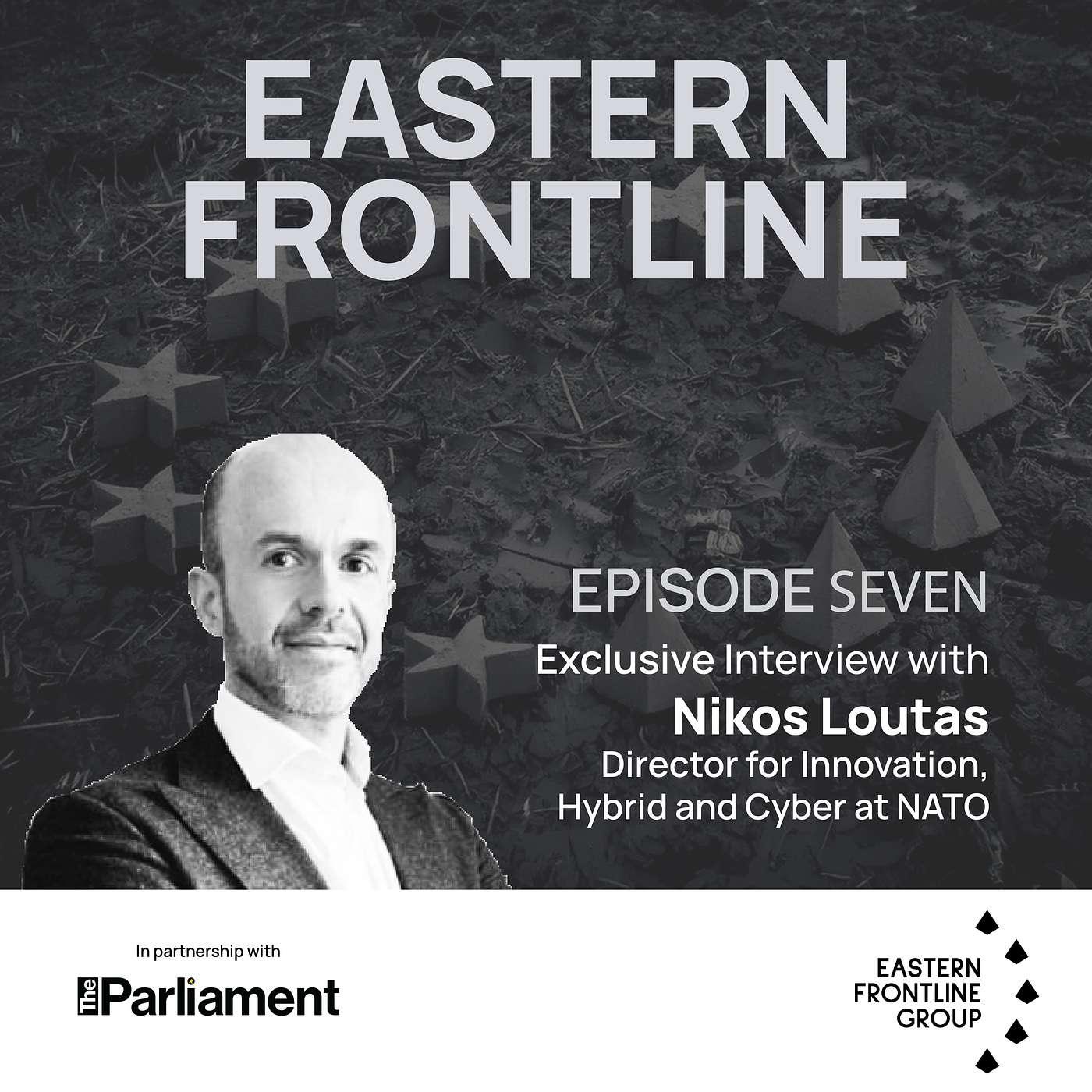
And probably one of the most uh one of the key persons those days in the NATO, uh Nikos Lutas, director of innovations.
00:00:32.960 --> 00:00:34.320
Thank you very much for hosting me.
00:00:34.399 --> 00:00:39.359
Uh it's a pleasure being here uh to talk about uh drones and innovation with you today.
00:00:39.600 --> 00:00:41.840
Yeah, thank you very much really for your initiative.
00:00:42.159 --> 00:00:48.960
Yeah, so uh it's a lot of work in in the innovations field those days, right?
00:00:49.039 --> 00:00:50.159
In in in NATO.
00:00:50.719 --> 00:00:56.880
It's it's a lot of work, it's also uh you know very very important work, uh I believe, and also very exciting work.
00:00:56.960 --> 00:01:17.680
And normally when I speak in public like that, I always say that I believe I have one of the most exciting jobs at NATO because we're uh cracking really important problems that can uh help our allies meet their uh their capability targets faster and more affordably, and I think that's what we need today more than ever.
00:01:17.840 --> 00:01:21.439
So I'm really happy to be there and also very honored to be in this role.
00:01:22.000 --> 00:01:30.560
But of course, a lot a lot of people are are worried, and especially those who are like, no what's going on, and what's happening in in Ukraine.
00:01:30.719 --> 00:01:37.439
Like, where are we now at in in NATO with with innovations, drones, kontr drones.
00:01:38.640 --> 00:01:41.840
We've we've gone a long way, I have to say.
00:01:42.000 --> 00:02:15.120
So the last years already, NATO has been stepping up our work on innovation both in the policy field by exploring different uh critical technology areas, emerging disruptive technologies, and understanding what are the actions that defense forces and militaries need to take in order to adopt those technologies and to develop them further, but also through the establishment of very practical innovation instruments that help create a uh shape a defense tech market.
00:02:15.360 --> 00:02:23.919
And I think the establishment of Diana and the NATO Innovation Fund uh three years ago in 2023 were really key in that journey.
00:02:24.080 --> 00:02:42.800
That those two organizations help us actually bridge the gap between this really strong innovation ecosystem on both sides of the Atlantic and bring them closer to our needs and our problems, but also uh support them uh through significant financial and other means.
00:02:43.120 --> 00:02:46.479
So a lot is happening, but of course, a lot more needs to happen.
00:02:46.560 --> 00:03:10.080
And I think the mindset uh changed and the urgency changed with the war in Ukraine, where we saw that the because of the absence of uh traditional platforms at the very beginning, the Ukrainians very quickly turned to new technologies and repurposed them uh in order to effectively take commercial technology and use it for their defense.
00:03:10.479 --> 00:03:28.159
And we observe uh all of us all these efforts very carefully and very closely, and I think one of the first conclusions drawn early on is that those new technologies are there to stay, and those new technologies can deliver serious and significant effects in the battlefield.
00:03:28.240 --> 00:03:29.680
So they're not toys.
00:03:29.840 --> 00:03:41.360
Um, they can work very nicely and complement our traditional platforms, uh, they can uh help us use the traditional platforms for what they are really meant to be.
00:03:41.520 --> 00:03:50.479
I mean, typical traditional military platforms are very very expensive equipment and capabilities, they should be used really for what they're meant to be.
00:03:50.560 --> 00:03:59.919
But then, if you look at drones as an example, uh they can deliver comparable effects to that of missiles at a fraction of the cost.
00:04:00.080 --> 00:04:07.039
So, economics play a role as well, then in that, uh, and uh and that's something we we learned from uh Ukraine.
00:04:07.120 --> 00:04:27.759
And I think the uh maybe the the last point so that I this doesn't turn into a monologue that we learned was how quickly those products and technologies can be adapted and adopted in the battlefield, embedded in the way the Ukrainians fight uh for uh their freedom.
00:04:28.079 --> 00:04:39.040
Uh we saw innovation cycles starting at the beginning of the war in you know a kind of six-month time frames, and today being down to two weeks.
00:04:39.680 --> 00:04:42.319
So we have learned a lot from the Ukrainians.
00:04:42.480 --> 00:04:48.160
The Russians have also learned a lot from the Ukrainians and how they adopt innovation, and we have to be very aware of that.
00:04:50.399 --> 00:04:58.240
Yeah, first of all, I think uh we have some I will uh turn maybe more on political level, not on technologies.
00:04:58.560 --> 00:05:13.600
Of course, it's uh more than clear that uh we have to develop all kinds of technologies we need, and our air space, air defense, be it say European Union or NATO, because for very many countries it's the same.
00:05:13.839 --> 00:05:19.519
Uh is our most fragile, I would say, part of our defense.
00:05:20.000 --> 00:05:25.839
And especially when we see that the uh wars are going up, I have to say.
00:05:26.160 --> 00:05:33.439
Wars are going up, and we know even not only drones, but we had in Lithuania problems with balloons.
00:05:33.680 --> 00:05:37.759
But was uh balloons like size of the this room.
00:05:37.920 --> 00:05:58.319
It's not like uh best day balloons, but those who don't know balloons they are using those balloons as meteorological balloons, but they were used from Belarusian uh side to Lithuania to use for smuggling cigarettes and tobacco and the and mainly those issues.
00:05:58.480 --> 00:06:17.519
So that was really an issue for our airport, despite that it's not military action, not military drone or something like that, but also they can be used as military very cheap one by the way, but can be used as military in in military purposes.
00:06:17.680 --> 00:06:23.199
So this is just an example that our war is becoming a very different one.
00:06:23.519 --> 00:07:08.079
And here replying what did you say and in a very right way about Ukraine, uh as politicians uh we have to um convince European societies that not only Ukraine needs us for their membership in EU and in NATO, by the way, but us, we need them as well very much as uh important part of our defense because their experience, they have now armed forces mainly um I uh we have experience in the battlefield, no one more European Union or NATO.
00:07:08.240 --> 00:07:36.800
Yes, there are different uh countries, not only EU member states, are so experienced now, and they are de facto now acting like members of EU and even with more uh income how to say, more uh doing more effective uh defending us effectively from from Russia than many other countries maybe members doing this.
00:07:37.040 --> 00:07:51.519
And also not only Ukraine now, uh when we speak about air defense or drones or missiles, uh what we are lack of, look what's happening now in Iran.
00:07:51.920 --> 00:08:05.680
And Iran is also other countries, they realized that uh this is really our uh big problem and what we need to do to be united, to understand each other very well.
00:08:06.240 --> 00:08:15.920
Uh today, while we're speaking in our political group here in the European Parliament, we had a debate on the situation, and of course Cyprus was mentioned.
00:08:17.199 --> 00:08:26.480
Cyprus now they are facing exactly the same threats we hear uh when we were talking about Eastern Front Frontline problems.
00:08:26.720 --> 00:08:29.199
Many countries were a little bit relaxed, you know.
00:08:29.439 --> 00:08:41.200
Oh, those Eastern front line far away, societies maybe are not so engaged and they don't understand in Spain or somewhere the same way uh the threats from Russia.
00:08:41.360 --> 00:08:50.399
But now the threats are coming from from also uh other parts, other part of I would say the same axis of evil.
00:08:51.279 --> 00:09:09.200
Because this is very much interconnected what's going on now uh in uh in the Middle East and in Ukraine because those uh um uh actors, main actors on another side are uh the same coalition Russia, Iran.
00:09:09.360 --> 00:09:11.759
We don't know what will happen later with China.
00:09:12.000 --> 00:09:16.559
China is really uh doing a lot in in defense.
00:09:16.720 --> 00:09:27.840
So my conclusion is that it's no doubts we EU and NATO, we have to be together, not to duplicate but uh complement each other.
00:09:28.399 --> 00:09:42.639
We have to do more uh in speed, in uh producing, to engage our industries, to engage engage our SMEs, to engage all possible, but most important is speed.
00:09:42.879 --> 00:09:54.399
Sometimes I feel that many politicians also they think more about the next election, which is most important, of course, for every politician, but less about the next generations.
00:09:55.039 --> 00:09:57.039
And this is our maybe problem.
00:09:57.279 --> 00:09:58.639
Putin knows this.
00:09:58.879 --> 00:10:01.919
The he he he he he don't have any election.
00:10:02.000 --> 00:10:04.879
For him it's not a problem, election, you know, to be elected.
00:10:05.120 --> 00:10:08.799
So he can do what he is thinks is necessary to do.
00:10:08.960 --> 00:10:20.240
But here is first is election, and if people don't like spendings for defense, if people don't like draw to talk about drones, if they don't feel uh this threat.
00:10:20.480 --> 00:10:26.960
So many politicians are saying, well, look, okay, maybe we don't need this, maybe that education, of course, education important.
00:10:27.200 --> 00:10:29.120
So it's a lot, a lot to do.
00:10:29.200 --> 00:10:35.679
We are on the crossroads in European Union especially, and we have to and we are doing, by the way, a lot.
00:10:35.759 --> 00:10:38.480
Now it's a different situation, totally different.
00:10:38.639 --> 00:10:44.320
But nevertheless, don't live in the mood that we live in the peacetime.
00:10:44.559 --> 00:10:52.879
We live in wartime as Ukraine next to us, but in pre-war time as uh ourselves.
00:10:53.279 --> 00:10:53.919
Yes.
00:10:54.639 --> 00:11:14.960
Absolutely, I agree, but um about the innovations and and new new new technologies, basically, I think that the big switch is that before Ukraine, I saw we had like like classical old school military industry, like which like did all the innovations that I had.
00:11:15.039 --> 00:11:23.120
But now, in this era, there is a lot of innovations from outside the military industry, basically from from civil industry.
00:11:23.279 --> 00:11:46.639
And and I know that it's it's quite challenging for basically we need to create like kind of new new era defense industry uh and companies with with innovations, but it's difficult for them like to because defense industry it takes you know clearances, certifications, all that kind of of things.
00:11:46.799 --> 00:12:02.320
How how you're dealing with with that, how to like make easier for SMEs, and especially in technologies, SMEs very often are like in the front of development, how to make it easier for them to become a part of defense industry.
00:12:02.559 --> 00:12:04.320
Yeah, I think that's that's a really good question.
00:12:04.399 --> 00:12:13.440
And I again I think we learned a lot from how this has been approached in Ukraine, but also in some of our more forward-leaning allies over the last years.
00:12:13.679 --> 00:12:20.639
So um what we um and and I think integrated air missile defense is a really good example.
00:12:20.799 --> 00:12:28.879
So uh, I mean we all know about the really ambitious capability targets that allies agreed uh in the last summit uh in The Hague.
00:12:29.279 --> 00:12:34.159
Uh a lot of money is also now on the table with the 5% defense investment commitment.
00:12:34.240 --> 00:12:39.440
But this also means that there has been a significant increase in in our demand, right?
00:12:39.519 --> 00:12:44.080
And a lot of that is classified and it has been communicated through classified means to allies.
00:12:44.240 --> 00:12:55.679
But a really telling example in air and missile defense is that we are seeing a 400% increase in our needs in that specific field.
00:12:56.000 --> 00:13:17.519
So if you if you think about that, uh, and if you also think about what uh Secretary General Rutte always says, that you know there is no defense without defense industry, uh it's it's really easy to see that if you take only our traditional defense industry and ask them to fulfill this challenge, it's really really hard for them.
00:13:17.759 --> 00:13:25.919
Their production lines are already um full, they are at they're they're doing new they're making investments, but this is uh not enough.
00:13:26.080 --> 00:13:39.120
So, what we actually need because of this emerging um breed of new companies that can develop alternative solutions is to help bring those companies into the uh the defense industrial base.
00:13:39.200 --> 00:13:41.600
We need to broaden our defense industrial base.
00:13:41.840 --> 00:13:51.679
Uh, and there with uh within NATO we're doing a couple of very practical things, and I think Counter UAS is a really interesting uh example as a domain.
00:13:51.840 --> 00:14:10.000
So the first thing we're uh doing is we are creating uh opportunities for them and also facilities together with allies for them to be able to experiment and mature their solutions in real-life conditions together with uh the armed forces.
00:14:10.240 --> 00:14:13.200
There are uh this is what we call the NATO innovation ranges.
00:14:13.279 --> 00:14:17.360
We have such examples in Finland, but also in Latvia and elsewhere.
00:14:17.519 --> 00:14:23.120
So places where uh companies can go and experiment and try to solve specific problems.
00:14:23.600 --> 00:14:52.000
Um, the the second thing we are doing is in order to be able to communicate our demand signal more broadly, in addition to the classified demand signal that was communicated uh last year to defense industry, we are working now on an unclassified version of that that would allow us to communicate more broadly what we need so that industry knows practically where to invest and and what to uh produce.
00:14:54.639 --> 00:15:11.519
The third uh element that you mentioned, of course, is uh the issue of um uh of financing and and supporting uh those companies, and I this is where, of course, Diana and the NATO innovation fund from our side play a really key role.
00:15:11.679 --> 00:15:16.080
The EU has also significant initiatives in this field like uh UDIS and HEDI.
00:15:16.480 --> 00:15:30.960
But what is also very encouraging, and that's really a complete uh change of mind, a complete shift in Europe, is that we also see significant private capital being invested in Europe in this type of SMEs.
00:15:31.200 --> 00:15:50.720
So I think the latest figures for last year uh show that uh we are close to almost 9 billion euro that has been invested in defense, security, and resilience uh uh companies, companies that are actually not in early stages but in more mature stages, which means they can develop and deliver solutions to the militaries.
00:15:51.360 --> 00:16:03.200
So we help companies test, we uh try to be as clear as much as possible with what we need, noting, of course, security uh considerations.
00:16:03.360 --> 00:16:04.799
This is still about defense.
00:16:05.039 --> 00:16:13.440
Uh we see there's significant financing coming both from private investors and of course from our allies with the uh with the 5%.
00:16:14.000 --> 00:16:15.279
So, what is the missing piece?
00:16:15.360 --> 00:16:18.960
I think in my view, uh, it's actually contracts.
00:16:19.120 --> 00:16:33.279
So we now uh look forward to seeing uh governments picking up uh on all this that's already there on the table, uh and and finding the right mix of traditional solutions and new solutions that can help meet their targets.
00:16:33.600 --> 00:16:52.559
But that that one of the uh issues is like in Europe, because also have Europe Defense Agency which invests a lot of money uh in innovations, but the issue is that uh um that uh very rarely innovations turn into the product.
00:16:52.879 --> 00:16:56.480
So, how do you manage with with that in in the NATO?
00:16:56.559 --> 00:17:03.679
Because uh I know that NATO is much more successful in in turning innovations into the product than EU.
00:17:04.559 --> 00:17:06.319
So that's that's a really good question.
00:17:06.400 --> 00:17:12.319
So the way we uh try to approach it, at least from my perspective, is or at least from from what I'm doing.
00:17:12.480 --> 00:17:15.440
Of course, uh there are two elements I think, right?
00:17:15.519 --> 00:17:29.680
There's first of all all the research and development that is happening within um universities and research centers, and that's really important because we need to make sure that we have a strong funnel of innovation and new solutions coming in.
00:17:29.839 --> 00:17:34.079
Um, in Europe, we do have a commercialization and a scaling problem.
00:17:34.160 --> 00:17:39.519
We know that it's not specific to defense, I think it's across our technology sector.
00:17:39.839 --> 00:17:55.359
Um so what we are now doing at uh NATO from the innovation agenda, at least from my team, is we're focusing more on those uh on companies that have already gone that have already spun out of the research lab, let's say.
00:17:55.519 --> 00:18:10.559
They might be earlier in their lifetime or they might be later in their lifetime, and depending on where they are, their maturity, and what they can already offer, uh, we have different um frameworks and mechanisms to help them.
00:18:10.720 --> 00:18:25.279
So if it's a deep tech company that uh has a really promising solution uh that uh needs um significant funding to scale, then probably that's something more for the innovation fund to look at with venture capital funding.
00:18:25.519 --> 00:18:35.759
If it's a company that wants to understand the defense market um and get mentoring and enter in the market, Diana is a better um tool for that.
00:18:35.839 --> 00:18:38.960
Uh, and of course, all those things uh work together.
00:18:39.200 --> 00:18:56.400
Um and then what we're also doing is we are also organizing um problem-specific challenges that sometimes look at more mature solutions, more mature dual-use solutions uh that we can quickly take, adopt, and adapt in a military context.
00:18:56.480 --> 00:19:09.119
And for example, if I look at counter-UES and our collaboration with Ukraine, uh we have launched um earlier this year a program that is called Unite Braves NATO.
00:19:09.519 --> 00:19:15.759
Uh, it's um a total of uh 50 million euro uh co-funded by NATO and Ukraine.
00:19:15.920 --> 00:19:29.519
Uh, what we're doing there is we're using that to foster collaboration between companies from NATO countries and companies from Ukraine that will come together to develop uh solutions that are ready to be used.
00:19:29.599 --> 00:19:40.799
So our first competition there is focusing on uh counter UES, and we're looking for solutions uh that are in a very mature stage to be part of that.
00:19:42.000 --> 00:19:49.599
On innovations, um what Europe uh has uh money.
00:19:50.400 --> 00:20:06.880
I think European Union is uh in the composition of our common defense, be it uh under the NATO umbrella or be it European Union as institutions and also member states both member members of both uh institutions.
00:20:06.960 --> 00:20:09.839
Uh of course they are they have money.
00:20:10.160 --> 00:20:14.960
If comparing with the Ukraine and Russia, uh it's nothing to compare.
00:20:15.039 --> 00:20:25.279
It's I don't know, ten times or how how many more times we can we are more capable to develop innovations and also military industries.
00:20:25.440 --> 00:20:37.039
But uh now we are on the crossroad how to push the process in the most fastest uh uh way and time is uh ticking, of course.
00:20:37.200 --> 00:20:48.079
So but European Union, you mentioned several NATO projects, but in European Union, look, many people uh like to criticize that European Union is doing nothing, blah blah blah, but it's not true.
00:20:48.319 --> 00:20:58.400
Because what happened even over the last year with Rearm Europe, 800 billion uh possibility to uh for loans, but but that's can be real money.
00:20:58.559 --> 00:21:20.880
Also, SAFE program, very successful one, when countries can use this this money not not only for themselves to develop innovations as well uh in military in military uh uh I mean um uh area, but also to help Ukraine because Ukraine, what they need, they have this innovational appetite.
00:21:21.039 --> 00:21:37.119
They are doing a lot, especially when we speak about drones, but they need money, they need support, they need that our countries would be able to have some joint procurement issues, like Denmark, by the way, is doing, uh, or other countries and to to to work together.
00:21:37.200 --> 00:21:45.519
So this is not to invest how to say, we say in Lithuania a new bicycle, you know, just to use what we already already have.
00:21:45.759 --> 00:23:19.759
So those uh also at EDIP uh European defence industry program uh was uh adopted in a very high speed uh if we can compare with previous uh um uh documents uh European Union was uh discussing debating years and years so this was really very good speed but nevertheless even uh too slow so competitiveness defense security now is on our agenda as the main priorities and when you ask me about innovation innovations um I am not expert on artificial intelligence but nevertheless when I sometimes listen experts or hear from those who uh are following artificial intelligence um uh developments uh here also I think in in nearest years somebody will be seated here and we'll be talking about defense related so much to artificial intelligence that maybe we cannot even imagine how uh close we are to those technologies we even don't know uh how they will change reshape defense everything even more than drones already reshaped so I am not expert I just can ask questions on experts like you or our industries or those from uh this area are we ready?
00:23:20.000 --> 00:23:27.839
I don't think so that we in the European continent are ready to take those challenges they are in front of us.
00:23:30.160 --> 00:23:57.039
I think we're uh we're getting ready uh I I want to really touch upon one of the points that you raised because it's very close to my heart uh innovation is not always about creating something new uh of course it's a lot about that otherwise you never have something new right but very often it's really having this commercial first mindset and saying okay what is there out today that we can actually use and and meet our needs by configuring or whatever.
00:23:57.200 --> 00:23:59.680
Artificial intelligence is a great example there.
00:23:59.839 --> 00:24:03.599
It is there it's it's literally the technology is there today.
00:24:03.839 --> 00:24:26.960
Drones is another great example so one of our work strands at NATO at the moment is not only to focus on fostering the development of technology but it's also to look at how this should be reflected in the way capabilities are being developed, doctrine is being developed what does it mean for standards and interoperability?
00:24:27.359 --> 00:24:36.079
What will it mean for how the future forces might look like how will humans and machines be able to work together or humanoids?
00:24:36.480 --> 00:24:37.599
Or I mean you never know.
00:24:37.680 --> 00:24:47.920
So all those things you know the thing I mean today we have drones that are piloted by people I think you know it's it's not gonna take too long until we have autonomous drones.
00:24:48.000 --> 00:27:26.400
We will have to figure out how these will work with our command and control systems but also how they will work with our army did you see did you see the presentation when Merz was in China Chinese presented him humanoids in in the in front of him like artificial intelligence model you know I don't know it's in in armed forces but maybe somebody says that yes it will be but there is I was not so long at one AI event and and if I understand correctly that there is at this point kind of like a moral debate about the AI about responsible usage and the debate is where where to be responsible or at the phase of development like do not develop things that can act themselves or still um leave it like to the end user be be responsible because it can get out of the thing is that we know that our enemy will definitely not be responsible and so what what's what's your uh so when we um when we did our first artificial intelligence strategy that was already in 2021 um we agreed as part of the strategy also a set of um principles for the responsible use of AI and responsible use of AI in the military context uh relates to a to a number of things for me right so the first is lawfulness is what you're doing you know according to international law it's accountability who is accountable uh and then there's a number of technical elements that relate to the AI itself which is a software system right so is the system reliable is it trustworthy uh is the data uh of good quality um so responsible AI from my point of view I mean it can be a very interesting philosophical conversation but I think it does not help us in the military context or when we talk about our defense there we really need to unpack it and say okay when we talk about responsible AI we want to make sure that what we do is of course lawful that this system um is fed with data that we can control but it's also cyberproof so that no one can go and and tweak it and and turn it against us that it's reliable so that our commanders can trust it and then we all I mean we within the military we have people flag officers that are there you know to to to carry certain responsibility accountability and I think we we do have a framework.
00:27:27.200 --> 00:27:38.559
And we have to be uh far in fr in front of those bad guys who will not care international law as we see today.
00:27:38.799 --> 00:28:17.279
International law is something like you know what does it mean to have approvement from United Nations Security Council where China and Russia is there and of course so I don't know it's it's it's really a lot of challenges in front but what I know for sure that we have to uh to to develop uh all those innovative technologies be it IA drones everything for me as politician most important to uh to open the doors for those who can do this and still European Union maybe we are not yet uh um not enough.
00:28:17.440 --> 00:29:28.960
Of course now we have in the parliament just to know those different kind of omnibuses uh it means that we are trying our commission came to the parliament showing uh uh trying to uh delete all those not necessary obstacles to develop uh military industry or uh in in in in green technologies or everything you know all all kind of so this is uh where we went I think wrong way with some kind I'm sorry I will now jump into the politics with some kind left uh policy which was uh control control restrictions control rules and rules and rules of course we have to live under the rules but uh when it's um uh it's not helpful for uh to develop our competitiveness uh and this is also what is on our agenda here in European Parliament and I think when I compare with previous uh term of the Parliament I was uh here is a huge step forward uh when we speak about this when we are uh trying to change uh our our rest all those restrictions and this is I think very important as well for innovations for innovations.
00:29:29.519 --> 00:30:35.279
We're in a race in innovation and of course uh in whenever you're in a race you have to make sure you are uh first in in that race um as I said in western societies we do have the guardrails necessary I think we shouldn't be worrying about that uh what we should be worrying about is the risk of inaction and that's the biggest risk that we might face okay but now the the next question you mentioned already is that innovation cycle is like two weeks especially when you talk about drones and Ukraine experience what about our uh procurement system as what do you think it needs some adjustments there is room for improvement uh so one of the things that we did um last year uh we so we put out what we call NATO's Rapid Adoption Action Plan which is all about how can allies adopt new technology faster and one of the things we wanted to look at there is how do allies procure.
00:30:35.599 --> 00:33:33.039
So we actually ran a cross-jurisdictional study across the 32 countries that gave us a lot of insights into how procurement works a lot of insights into existing best practices actually that are being used to work within the current legal frameworks in the 32 countries and there are two main uh findings I from from that study at least the way I read it the first is that of course our procurement rules um sometimes can be restrictive or sometimes can add unnecessary delays and that is something we need uh to tackle and it's not NATO that will tackle it we don't have this mandate but this is a national and in some cases a European Union mandate and they are looking into the review of the Defense Procurement Regulation so that that is one element of course we we can always improve the way procurement runs make it more agile review also the way we somehow collaborate with our vendors throughout the procurement process move a bit away from this kind of buyer seller approach where we say that's what we need and someone needs to read our mind and give us the perfect product but what we also saw and that's very encouraging actually is that within the current legal framework many of our allies and NATO as an organization as well have come up with really flexible really fast procurement vehicles that can be used and can be used both for single or joint procurement I mean obviously at NATO we're always more interested in joint procurement it creates economies of scale and and gives a lot of flexibility but there are such examples across many of our allies uh including many of our EU allies uh but I will just maybe mention one example that we have closer to home at NATO where practically we um we we took so we have Diana that uh selects companies based on a very competitive process so for the last uh call actually we had over 3600 submissions and out of that we selected 150 companies so it's really tough to get in and then those 150 companies are taken through a six month acceleration process so we took this uh beat and we said well actually this process that these companies go through can actually be seen as a pre-procurement process so basically like a vendor's list exactly somehow and then we gave authorities to our procurement agency N SPA so at the end actually after six months if an ally comes and says well this company performed really well in this uh exercise or or experiment and I would like to contract them tomorrow they can literally contract them tomorrow and they can do it jointly with other allies or uh one-on-one so there are there are ways to within the current framework until we improve it to do things better.
00:33:34.400 --> 00:34:02.480
You know first uh I think very many people as I see around me here in the European Parliament in SEDI Committee which is Security and Defence Committee in the Parliament in in commissioner for for defense and many others they understand how important is speed and to change this procurement system but you know it's it's sometimes very difficult to move a very slow moving train.
00:34:02.799 --> 00:34:09.760
We used to long procedures we used to of course we need to fight to have transparent process.
00:34:10.480 --> 00:34:22.159
Sometimes when speed is very high some people with the not best how to say moral can do something and then it will be scandals and everything.
00:34:22.400 --> 00:35:30.079
But nevertheless the war and the security today is the most important challenge people understand this and again experience in Ukraine it shows that if for example take drone drone procurements for example and if we will move the same processes we have now so it can happen then those drones will come outdated you know with those long procedures because you mentioned already and we know that sometimes in two weeks changings are they are changing immediately new kind of technologies are coming or added some new technologies so that is really not k not our our rules are not capable to uh to to for for for for this real new real life so I I didn't say something very special now something very new but that is reality unfortunately so first and this is also I already mentioned what we have to change in our mindset stop acting like we have peacetime timelines.
00:35:31.360 --> 00:35:48.000
All those institutions in my country in other countries in European Commission they live as they lived you know because they have those rules they they used to that and that's why we need how to say to to change our mindset that we don't live in in peacetime anymore.
00:35:48.400 --> 00:36:04.320
Also how to buy faster and smarter I already mentioned drones example for example and also what Ukraine's example is most important all those things are tested in battlefield immediately.
00:36:04.559 --> 00:36:23.119
So we have to test them to you to to live in the situation when those new procurements they immediately are tested be it in during military exercises or not to wait I don't know years and months to to be tested.
00:36:23.760 --> 00:36:38.480
So when I remember my work in the Ministry of Defense and when I speak now it's like different two different worlds because I finished in 2012 so at that time it was really very very different different situation.
00:36:38.880 --> 00:39:31.119
That was great intro to my obviously last question because we have time is is running up but and it it's probably a bit out of your scope in NATO but also when I was in Ukraine last time it was I think in October in November and as we know they have quite quick procurement system compared to to Europe but still we also visited near near basically they have a the the innovations are developing so fast that they have like every military unit has its own drone workshop near the front line like you basically when they come to them they need to be or updated already or adapted to the like city environment or or forest but but basically we need at this time we need not only soldiers at the front line but also engineers and soldiers near the front line is this changing also in in in the NATO this understanding that it's not the the technologies are developing so fast that basically you need engineering on frontline also so these are all lessons and considerations that are being discussed and uh NATO has uh uh established the uh joint um analysis training and exercise center right JTEC which is also the only NATO organization with Ukrainian participation and the main or one of the main purposes of this center is actually to explore many of those lessons learned and see what they would mean for the way uh NATO and and allies organize their forces and uh and the way uh they might fight in the future uh so that's that's a very like active conversation at the moment i i I would I would like to link this a little bit also to the procurement uh question before so we spoke at the very beginning about the need for expanding the defense industrial base our our expanded or extended defense industrial base means that it's also now less homogeneous we no longer have only the big primes but we have companies of different size uh different nature and also companies that are uh more responsive to different business models so we should not think only about purchasing we might think about business models that relate to leasing or capability as a service business models is all those things we have to think about and and maybe last point here that is very close to my heart we should also never forget that some of those SMEs I mean um procurement can be is is long and it's if it's long it can have security implications or or risk what you know it can it can be frustrating but for some of those SMEs it can also be a matter of life and death they might just run out of cash if it takes too long and then they might not be on the market and we might really miss out on excellent solutions.
00:39:31.280 --> 00:39:39.679
So we have to find ways business models and procurement pathways that are adapted to the different parts of our defense industrial base.
00:39:40.000 --> 00:40:09.360
Well I think that the great final final thought and I think that that is the one thing politicians very often don't understand that that time costs a lot of money for for uh especially SMEs if it's speed and speed if we like think that there is no difference we have meeting uh tomorrow or after a month for for some companies it it it costs a lot of money so time is crucial and and we need to understand that and act like that.
00:40:09.519 --> 00:40:18.960
So thank you very much I think we could talk a couple more hours but uh but we don't have uh so much time so again thank you very much for coming very interesting thank you for having us
