
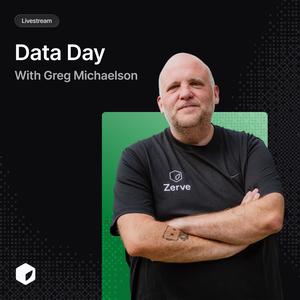

Greg Michaelson: Good morning, welcome back to Day to Day. I'm here with my good friend Darius. Sabas? Sabas or Sabas? Sabas, I don't know. I'm here with my good friend Darius Sabas. We haven't spoken in an age, but we were together at DataRobot for a good long time. Welcome Darius.
Darius Sabas: The first date. Happy to be here. Also, to see you after a while.
Greg Michaelson: Well, hey catch me up. What have you been up to since data robot?
Darius Sabas: how much time do we have? That might take the whole hour. But yeah, long story short ⁓ is when I left the robot at 2020 when the COVID hits ⁓ and I joined a secondhand marketplace ⁓ in Europe called Vinted. I think it's recently entered the US market as well. It's like a secondhand clothing marketplace as head of data science. ⁓
Greg Michaelson: You Yeah.
Darius Sabas: I stayed there for a year and then came back to DataRobot for another three years. So actually from 2021 to 2024, I think I was back in DataRobot. ⁓ kind of, kind of, to be honest, it's kind of difficult to match that level of excitement and cutting edge after you leave a company like that, especially when you're going in house. ⁓
Greg Michaelson: Is that some Stockholm syndrome?
Darius Sabas: But yeah, I came back for three years, then I was working in the Nordics, then for Central Europe, and then last year and a bit was in Middle East. So got to experience all that part of the world through the robot eyes. And then, yeah, like I mentioned before we started the conversation, I got two kids in 2024, then decided to take some time off to rethink my... work-life balance because the robots traveling across Europe or across Middle East that was just unsustainable with the family. So I joined another company right after called Abacus AI. Maybe you heard of them. They're kind of, ⁓ I think they're West Coast based, but they're mostly focused on US markets. It's like DataRobot just for LLMs for lack of better parallel. ⁓
Greg Michaelson: Yeah.
Darius Sabas: So I stayed there for one year and then for the last year or so, I came back to the region where I'm actually physically based out of and I joined a company called Ovocall, which is another marketplace ⁓ for secondhand car parts. So it's my third marketplace that I'm actually now leading the analytics team. And ⁓ it has been seven months now. It's actually quite a nice journey and I'm quite proud of where we are.
Greg Michaelson: Stop. Well tell me more about that. What kind of data science are you guys doing at Aboco?
Darius Sabas: ⁓ Right now it's mostly analytics ⁓ and we're getting there. So for the last year and a half, we've been mostly stuck on migration issues. So we moved over from Redshift, we spoke architecture to more snowflake and more streamlined. So we are acquiring the right tools for data ingestion, ⁓ data exports. We added a ⁓ analytics tool next to Looker, which was already in the company before we also added Mixpanel, which is like Looker just for product analytics. Mixpanel, so like mixed and panel, yeah. So now we have two BI tools that are being rolled out as we speak. Now I'm also...
Greg Michaelson: What is it? Nix panel? ⁓ mix panel. Mixed analyst tool? I've never heard of it. Tell me about it.
Darius Sabas: ⁓ So it's a little bit like Looker just for product analytics. So all the customer journeys, you can drill down all the way down into individual interaction. Looker is much more BI focused for aggregate data, for the facts, sales, marketing, et cetera. But Mixpanel is mostly focused on actually user touch points and user journeys. So all the events data coming in, as you can imagine, being a two-sided marketplace, there's plenty of events coming around. And if you want to... For most analysis, you don't need to go all the way down, but as soon as you do, Looker becomes a bit of a megalith.
Greg Michaelson: Yes, I think post-hoc instead of that tool. But I think it's the same idea, right? Capturing application events and such.
Darius Sabas: Yeah, kind of. can mention the one that you've mentioned again? I think I over talked you. Post? Postdoc. Okay. I'll take a look at it as well. I haven't touched it myself. ⁓ Well, it's always good to look around.
Greg Michaelson: Post hog? Well, it's not an endorsement, you know, it's all these they're all they're all they have their own challenges, I guess.
Darius Sabas: Well, so far we're quite happy with Maxpanel. It does the job. The adoption is very straightforward and it's more focused towards non-analytics, project managers, engineers, designers, etc. The goal is to enable self-service to actually free up the time for the actual data science and analytics we want to be doing as an analytics team. So right now we're like 10 people. So for a company size of 300, it's... quite a broad scope of questions and requests we have. So we need to first free up a bit of our time to actually focus on the added value services we can offer to the company once the basics are out of the way. Because right now we're kind of in the maturity stage of reporting and more like backwards looking piece. We really want to go down forward looking. So we're planning to roll out like A-B testing a bit more extensively. I mean, we have something now, but we want to rework it over the next few months. And then the basics will be covered. And then I really want to focus on like that. developing data products, know, like ML, AI and all of that sexy stuff.
Greg Michaelson: Sure, yeah, that makes sense. That totally makes sense. Now, what kind of stack do you guys use for your data science work?
Darius Sabas: So data science right now is a little bit niche right now in our company, I would say. So there is, we do have some embedded machine learning engineers in certain product teams, but they are mostly focused on like embedded product data predictive models. So some things like background removers, some automatic text. cleanup and categorization. So those are mostly the same stack as the engineering team. So that's a bit of a mixture of, to be honest, I don't really know the exact details of the engineering stack, but it's not a data science stack for lack of better ⁓ equivalency. But those are not, so go ahead.
Greg Michaelson: What do you mean by it's not a data science stack? The machine learning engineers, they're working with data,
Darius Sabas: Yeah, yeah, they are working with data, but it's mostly like operational ⁓ use cases around like not, not really a classical machine learning where, you know, the data is stabilized, it goes through the ⁓ data warehousing, et cetera. It's mostly using operational data. So it's embedded directly within, within the product teams. ⁓
Greg Michaelson: They're like working with like VS code or some sort of scripting tools to write whatever there is they're writing.
Darius Sabas: Yeah, I don't have a high visibility on exactly the stack that they're using right now. I recently joined, so I'm mostly focused on analytics within my peer view. Those one or two engineers are embedded within the product teams. But my goal is to bring some of that knowledge back into the analytics team as well, so that every analyst in data robots, ⁓ ways of thinking, everyone needs to be able to spot the right problems. And even if they don't know how to solve them, at least they need to know the ecosystem of solutions that could exist.
Greg Michaelson: Yeah.
Darius Sabas: And as the company matures a bit more, I want that relationship to get closer. So my vision would be to use the stack that is already existing in analytics space. things like Snowflake has a lot of unutilized capabilities, which are not currently used in the predictive models we do have in the platform. I don't know, as time goes on, if we see the right demand and supply mismatch, maybe even the robot and the likes.
Greg Michaelson: Gotcha. What about like just, you know, pulling a data set and doing an analytics type analysis? What kind of are you guys running? I don't know, like DBT or is it all snowflake?
Darius Sabas: Yes. Yes. So it's a, it's a quite a, I would say innovative way of using Snowflake. It's not out of the box, but we have ⁓ Kafka and Flink for ingestion for all of the data from the operational into the dbt. ⁓ Then dbt for ⁓ the classical structuring and data modeling, but it's using local, mixture of local and cloud compute to kind of decouple. storage and ⁓ processing compute. Then Snowflake for overall access and... ⁓
Greg Michaelson: We have to wait writing locally.
Darius Sabas: ⁓ Well, on a cluster that is not one of the cloud providers, it's kind of a localized cloud in Germany. ⁓ And also a mixture of AWS and GCP on certain parts of the company. I think Snowflake is on AWS, if I'm not mistaken, and the storage is in Kubernetes.
Greg Michaelson: Yeah. Then what? Sorry?
Darius Sabas: In Kubernetes, so yeah, so for your classical interaction with the data, would be mostly through Snowflake exports via 5Tran, know, if it's more recurring. And then that gets connected to, like I mentioned, Looker and Mixpanel for self-service analytics and some ad hoc stuff. ⁓ We don't necessarily have like an MLOps or data science layer. So we're using what's ever natively in Snowflake, such as Cortex-EI and all of that. ⁓ kind of helper functions, but I guess as we mature that we might decide to also add an addition that will be focused on data science, but that's further down the line.
Greg Michaelson: catch. to know like jupyter notebooks or or
Darius Sabas: Oh no, those are within Snowflake, so that comes as a given. Plenty of Jupyter, both on the data processing side, where there's some bespoke functions that needs to be enriching the data, but also just using the airflow for orchestration, that both the mixture of SQL and Python for certain departments require more advanced stuff.
Greg Michaelson: Gotcha. Gotcha. And your team's got 10 people.
Darius Sabas: So the team, it depends on which scope we're talking about. So the data organization or the data team has two functions within it. So analytics is under me. And then I have a colleague, Ernestas, who's responsible for data engineering. So under me, there's soon to be 10 analysts. ⁓ And then under my colleague Ernestas, there's like two analytics engineers who are responsible for kind of the consistency and logic of dbt and the overall organizational consistency. And then we have three data engineers for all the ingestion management stuff, because it's still not, you know, not plug and play. So there's a lot of control we have around how we ingest data, how we process it and how do we control compute.
Greg Michaelson: Gotcha, yeah, I understand that. Okay, well the reason I'm so interested is that, I don't know if you've heard much about Zerve, that's the company that I helped co-found. We're a data science development environment that is cloud-based and connects to Snowflake, for example, and super collaborative, handles cloud orchestration, and it's a major upgrade from something like a Jupiter.
Darius Sabas: Hmm?
Greg Michaelson: it's not sort of like in memory and like there's a bunch of cool things that we do. So I'm always interested in what people stack looks like. Because I'm, you we're trying to at the end of the day solve the problems that that people have with interacting with their data, right?
Darius Sabas: Mm. No, I haven't necessarily explored it a lot. ⁓ I Googled a little bit before our conversation today. I think one of the struggles we face as a company within the Eastern European market is the overall maturity of the market. So a lot of the kind of in-house, localized ethos is ⁓ build versus buy. we slowly as a... as the whole region moving towards a mixture and more buy versus build as you reach a certain scale. So there's not a lot of good best practices or like ⁓ localized knowledge on how to build a combination ecosystems of data that are way more scalable than a small business. And this is one of reasons why we had to perform the migration like a year and a half ago is because the initial startup vibe.
Greg Michaelson: Mm-hmm.
Darius Sabas: Let's make sure that it works as fast as possible, as soon as we can build it. Eventually, once you reach a certain scale, it just no longer is feasible. So we streamlined it a little bit. And I think that's going to be an ongoing process to add the right bits towards the data science piece, as well as maybe even reworking the ingestion of whatever the ecosystem of datasets is before Snowflake and dbt.
Greg Michaelson: sure. Gotcha, gotcha. Yeah, Zerve would be downstream of Snowflake so that you could utilize data sets. But anyway, not trying to hijack the conversation for Zerve. We can talk about Zerve later. What kinds of questions are you being faced with? What is probably the most important use case that you've worked on at your company?
Darius Sabas: Mm. I know, right? ⁓ Well, because right now we're still in the analytics stage as the company maturity ⁓ is progressing, it's mostly those strategic and operational use cases. certain reports, certain... ⁓ Whatever Looker doesn't allow you to do out of the box because Looker is a bit restrictive if you don't have the certain data views for non-technical audience. A lot of that data logic to be fed into Looker. So basic things from churn to user acquisition to... buyer behavior, seller behavior, marketing efficiency, ROIs, et cetera. So those kind of BI style use cases. ⁓ We are still actively developing our product. we're adding new features, things like some of the basics like chats, wallets, et cetera. So we're launching new capabilities that did not exist before. Those questions tend to be much more like, if we don't have the data yet, how can we start tracking it? So all the events logic. hence the mixed panel conversation and we chose to have it in-house. ⁓ A lot of strategic questions as well. So what happens if we open up a new market where we don't have any data? How can we extrapolate some similarities in market research together with the data that we have in-house and maybe extrapolation? ⁓ Recently, as everybody else, the AI boom is reaching every single company. So especially now that we're adding the chat capabilities to our keep. to our platform, now the multi-modal data comes into play. So it's no longer just tables and categoricals and numerics. Now it's how do we analyze the data that we have never tried before? we actually, fun fact, last week we had a hackathon and the whole analytics team just went to a country house for a day and we just hacked around our chat data. So we explore a lot of Snowflake inbuilt capabilities for vectorization, for embeddings, for... ⁓
Greg Michaelson: Huh?
Darius Sabas: just extracting topics, finding inconsistencies. ⁓ The feature was launched like two months ago, so the data is still very, not that much, but it's doubling every single month as you would expect in a startup. So we said, okay, let's hone our skills. Let's learn how to deal with data that we have not dealt with before through the existing toolkit and then identify if we're missing anything. So far, results are quite amazing given that we spent like half a day plus on this. We found... bugs in the data, we found inconsistencies that our product team is now trying to turn into features to improve the product capabilities. Every team that I shared this result with is now hungry, or what about a particular angle on dealing with chat data? Because there's not a lot of experience apart from wipe coding to actually deal with these things on the fly. So all of those kind of operational and emerging issues and... There's lots of backlog ⁓ for hopefully summertime that we want to get into, which will be much more predictive and statistical models. So things like marketing mix, predictive models for shipping, predictive models for customer segmentation and behavior. ⁓ We already have like a multi-touch attribution for marketing, ⁓ but now they also want market mix on top. All the classical, you know... CRM style ⁓ predictive models like lifetime value, churn, upsell, cross-sell, you name it. So all of those are still to be harvested. And that's why I'm really excited to get the basics right and then kind of proceeds as fast as we can in the second half of the year.
Greg Michaelson: Gotcha. Well, that's fascinating. I would love to help you guys along. Once you, once you start doing more analytics and some of the more hardcore data science stuff, Zerf might be a good helpful thing to work with. But I want to talk to me about the marketing mix model stuff. Have you started, have you started working on that at all? Cause I've never actually seen a market, like a market mix model that was actually worth a nickel. You guys done any of that?
Darius Sabas: Fair enough. Some fun historical facts, like before joining Ditter Robot, I was working in quite a few marketing consultancies and I think for three or four years, that's all I did through R and Python. And ⁓ I think e-views was the tool of choice at the time, ⁓ like for marketing mix construction. ⁓ And ⁓ so yeah, I've seen how it can be implemented, that it drives value because companies tend to pay for those anyways. Otherwise they wouldn't. But ⁓ I've seen also lot of companies struggle with that.
Greg Michaelson: Do you think that's true that if it wasn't valuable companies wouldn't pay for it?
Darius Sabas: ⁓ Not really, yes, I understand that angle as well. ⁓ Marketing mix for your audience, I'm not sure how much I should introduce the concept, ⁓ but effectively it's a predictive...
Greg Michaelson: Well, thanks for listening. you don't know it, go ahead and give it to him.
Darius Sabas: Sure. So marketing mix is a roughly speaking, it's a predictive model that tries to forecast sales based on the typical activities that have happened that could influence sales such as non-marketing things like distribution, pricing, you name it, product launches, but also including the marketing variables such as from different channels. So against the when the mix comes from. it could be offline TV, offline TV, online media channels, ⁓ offline outdoor radio. you know, in the older world nowadays, there's like more granularity within the social to brands to performance marketing, et cetera. So combining all of those metrics ⁓ into typically like a weekly or a daily ⁓ forecast model that tries to identify what are the relationships between the inputs and the actual sales. And then what you do once you have that model is you're trying to isolate the effect each of the channels have towards your overall sales. So how much of the sales was driven by a particular channel? And then if you go down deeper, like by a particular campaign or by a particular channel mix or so in a sense, the goal of the model is to give you understanding of which places where you spend money on marketing actually have a positive ROI and what would happen if you would change the marketing mix budget wise between the channels that you control. And typically it's done through like a linear regression. version of a linear regression could be Bayesian, could be a simple linear regression with a few logarithms and other transformations on top. But ⁓ the goal is to ⁓ have that top-down view. ⁓ There's also a sister or a brother ⁓ methodology that is ⁓ called multi-touch attribution, which kind of goes bottoms up. It's typically mostly applied to online channels. where you're for every conversion for every interaction, you're trying to map out what touch points the person had. And ideally you would want that predictive model to then match somewhat the logic of the top down time series approach. So it has a lot of ways to manipulate it and coming back to your point around the value.
Greg Michaelson: Wait, ⁓
Darius Sabas: Both ways. you know, as you go into maybe, you know, you can even empathize if you worked extensively with linear models, the feature engineering can impact how the model takes that feature in and how much weight it assigns to it. So apart from the typical concerns around multicollinearity, how do you isolate the effect, et cetera, is ⁓ because it's a linear model, I've seen in the marketplace ⁓ quite a lot of feature fixing, like fixing coefficients, ⁓ mostly backwards R-squared testing and not necessarily out of sample forward-looking testing. So there's ways to make the model look really good ⁓ on the historical data set and then tell the story that you want. And the typical interaction that I've seen when I was in consulting is that a marketing manager would come to you with an expectation of a certain ROI that they want to see for their channel. And anytime your model doesn't show that, there's a lot of pressure to manipulate the data. And as a consultant, you have to make your client happy to some degree. this is where historically the mistrust comes to marketing mix. If you manipulate it too much where it's not only logical relationships in the data, but you want the outcomes to be hard coded in the model to some degree, then the trust just goes down and the accuracy is all over the place. ⁓
Greg Michaelson: It's... Yes.
Darius Sabas: But there's a lot of challenge for the marketing structure if your model is unbiased, because somebody who didn't have the model before suddenly can say, oh, suddenly my budget has just halved because a different channel is now taking all the glory. How can I make this more kind of equal in a sense? So the model, when it comes into the real world, introduces a lot of political tension. And it's onto the company's
Greg Michaelson: Yes. Hmm.
Darius Sabas: chief marketing officer, head of data science, or whoever is kind of trying to be impartial to make sure that that model is used in a correct way to actually maximize ROI instead of just the maximize allocations to teams who individually typically fight for poor budget. So I've seen both. I've seen it work done well when there's top level impartial leadership, either on the CMO side or on the data side with C-level backing.
Greg Michaelson: Sure.
Darius Sabas: But I also have seen crazy shenanigans regarding manipulation, especially when individual marketing sub-teams like digital marketing or TV team, et cetera, are the ones that are coming to consultancy to build a marketing mix with the framework of make my channel look good. it can go both ways.
Greg Michaelson: Yes. Gotcha. So if sometimes in a larger company it can be more a question of preserving somebody's fiefdom rather than finding out what's actually best for the company.
Darius Sabas: Yeah, when it's done correctly, it's actually quite powerful because it's one of the oldest econometric techniques in terms of application. think it's been alive for at least 45 years that I'm aware of, even before serious compute, because it's a very simple approach, the linear model, ⁓ even with basic computers that was possible. because it's high level, it's featured in a lot of strategic conversations. So when you showcase something to the board, when you showcase something at C level, the fact that you can decompose sales into constituents. That's very powerful as just a, you know, as a tool, not necessarily as a modeling technique. So any tool that can provide that level of split of your activities into effects is as well demanded by top management. And because it's been around for a while, there's like actual boutique consultants that just focus on turning out that one model for every single customer and kind of every marketing team wants a version of that.
Greg Michaelson: Fascinating. How so I'm curious about the secondhand marketplace. You've done two of those now, one on clothing.
Darius Sabas: Two second hands and one non second hand. ⁓ So before joining DataRobot, I spent close to a year in a company called Treatwell. So it's a B2C marketplace for beauty procedures, so suppliers and demand. It's still alive today. It's actually in quite a decent portion of Europe is using Treatwell. ⁓ But...
Greg Michaelson: What was the non-second hand one?
Darius Sabas: Yeah, I was, think the first data scientist in that company. I spent a bit of time there. Sorry.
Greg Michaelson: what's in a marketplace for. What is it a marketplace for again?
Darius Sabas: So for secondhand beauty procedures, sorry, first hand, beauty procedures. So massages, haircuts, you name it, like just booking appointments online. They produce software for the salons, for time management, the bookkeeping, and then obviously the marketplace for Seaside.
Greg Michaelson: Gotcha, gotcha, gotcha, gotcha. Okay, when you're, so you, it sounds like in the secondhand market you've got, you've got a sort of a double marketing problem, right? You've got to market to the sellers and to the buyers both, yeah?
Darius Sabas: ⁓ Yes, and I've seen two companies doing that. So one was Vinted, which is a secondhand clothing ⁓ marketplace. typically your suppliers are both people and potential boutiques, maybe refurbished, et cetera, your sellers. And then your buyers are typically the customers and consumers, not so much businesses. And that is... That's maybe it makes it slightly easier and harder at the same time because your same person can be both a buyer and a seller. But in a sense, you can target the same audience with a consistent message to some degree. Because the tricky part on the secondhand car parts is that there's not that many C2C, let's say, secondhand car supply, at least not in the markets that we're in. A lot of the supply comes from ⁓ I don't know how to call that in English actually, scrapyards, guess, know, dismantlers, et cetera. So there the targeting becomes slightly more focused on whether it's an actual supplier or ⁓ a buyer, because buyers are still out of the time people, but can also be like companies like insurance companies or, you know, automotive shops, et cetera, as well what your supplies almost a hundred percent at the mo- at least at the time.
Greg Michaelson: Yep.
Darius Sabas: that we're speaking is businesses. So, you it needs to be a combination of both to capture, you know, certain marketing works for attracting businesses, way different type of marketing works for attracting actual end consumers. ⁓ And ⁓ that's where the complexity comes in, I would say.
Greg Michaelson: Yeah. Not that. Now it seems like the large language models out there, like you could make it, you would need an agent on the sell side in order to help these ⁓ junkyards or scrapyards build their inventory.
Darius Sabas: Yeah, and both language... So there's just two main value propositions that are coming from Ovocco to the sellers, I would say. So one is obviously the exposure of their stock to a much wider ⁓ audience. But the second one is the actual processes that, you know, lot of scrapyards for historical reasons are not as innovative as ⁓ you would expect maybe in the century. So a lot of the times just coming in with a software that helps you to... showcase, okay, this is how you label your stock. This is how you take photos. This is how you categorize your warehouse for optimal retrieval and allocation. This is how you kind of compute the overall return on assets, because you typically buy a wrecked car and then you dismantle it and you see, is that actually a payoff, paid off or not over time? just that kind of ⁓ warehouse management piece is also a big value, not just the exposure of the actual stock to increase your overall sales. And yeah, AI can bring values to both, I think even more on the warehouse piece. So, know, identifying things like, you know, in order to increase the sell-through rates of your inventory, you need better photos or, you know, you need to imply certain descriptions so that it's way more findable on the marketplace. And nobody who's an actual, you know, hands-on, heap employee spends so much time on the computer.
Greg Michaelson: Thanks
Darius Sabas: predefined the text, catchy messages and in photos, et cetera. those agents that you were talking about, it could be as simple as like a background remover or predefined the photos so that it's way more appealing because not every time it's super clean, et cetera. But also just making the listing nice, like your entire marketing or sales department, which typically don't exist in those scrap heaps. That's where a lot of the value does come from AI and ⁓ it's still semi-tapped market.
Greg Michaelson: ⁓ It seems to me like there's a step before that, right? Like if it were me and I were wanting to buy this product, I would want to be able to go to my agent and say, hey, I just bought a 1998 Volkswagen Passat. And then have the agent sort of figure out like, okay, there are, you 273 parts that are, that are sellable on this vehicle. and let's go through them one by one and you take a photo, tell me if it works, you know, whatever, and then I'll create the listing and sort of make it available, that sort of thing. So it's more guided instead of, you know.
Darius Sabas: Yes, ⁓ that's actually the area that we're investing heavily as a company. So we call it virtual dismantling. So when you're like purchase a car or a wreck, ⁓ you can effectively ask our system to turn it into parts based on the VIN code and some of the other parameters around the information about the damage types that creates virtual parts that you can even start selling on the marketplace before the car is actually dismantled. So you can actually see the demand. coming your way. ⁓ There's also the component of, like you mentioned, like a recommendation of which parts tend to sell best, maybe even computing like an ROI of expected returns. Because there's always, ⁓ for scrap heaps, there's always a dilemma. How deep in the car do I want to go? Because getting down to the each individual tiny parts is not always worth the effort of actually dismantling it if it's going to cost you like three or five euros.
Greg Michaelson: Yeah. down.
Darius Sabas: per for tiny parts, but you know, there's a big ones like the engine the panels the the electronic equipment etc, which definitely you can you can have a higher return But then that's the question of where exactly do I stop which parts do I scrap for metal? Which parts do I kind of try to sell off individually and having a marketplace where you can see for each product part type, what are the sell-through rates what they expect the returns ⁓
Greg Michaelson: you
Darius Sabas: based on the car type, based on the individual car information. ⁓ The goal is for us to then guide ⁓ the scrap heap to say, which cars should you buy in the auction to dismantle in the first place? What should you expect from them in the first month, six months of having them on your stock? And how deep do you want to go into dismantling it in the first place so that you're not wasting time and money?
Greg Michaelson: Do you guys capture the point of sale stuff too? Because it seems like there'd be some really interesting information to be had about like pricing.
Darius Sabas: ⁓ Yes, so because it's a marketplace, we do know what the parts actually sell for. And when we're looking at... even have an initiative to roll out pricing recommendations based... It's already in the product based on the category of the part. This is one of the areas that actually I want to get even further in with analytics and machine learning to make it even more personalized. Because a door panel just based on the car brand doesn't mean much. You have to take a lot of...
Greg Michaelson: ⁓
Darius Sabas: variables into account, the trim level, the year of make and the damage type, et cetera. So we have ⁓ the basics there, but to get it way more prescriptive through predictive means it's still something to unlock. this is one of the reasons why this is the third place that I'm working on that is a marketplace, because in the marketplace, from a data science and analytics perspective, every single conceivable use case exists. because we have logistics, have marketing, we have demand, we have supply, we have product improvements, we have expansion and growth teams. As you can imagine, it's a bit of a goldmine as far as predictive and analytics use cases are concerned. literally I'm super excited about the second half of this year once the basics are out the way, because I can't even, there's not a problem to create a roadmap. The question is, where do we start?
Greg Michaelson: Yeah, exactly. What kind of scale do you guys have? Seems like that would be an obstacle to doing some of this stuff.
Darius Sabas: So the scale, I guess it depends on how you want to measure it. As far as markets is concerned, we're in, I think, majority of the European countries for now, still within the region. When it comes to the size of the company, we recently reached 300 people milestone. So we're kind of decently sized. Like I mentioned, the analytics team is still not maybe as big of a proportion of the organization as we would like it to be. So there's room for improvement there. ⁓ But yeah, in terms of the actual, sorry.
Greg Michaelson: That's why. What is everybody working on if not analytics? Seems like you're an analytics company at heart. Maybe a web design company too, but like, that's funny.
Darius Sabas: Well, hence the big push for self-service and ⁓ the goal is to make the data easily accessible to both product managers and designers and engineers, et cetera. Once we roll out the A-B testing that will be easier to implement than it is right now, we definitely want to make sure that everything is hypothesized and tested before it's rolled out because as a scale that we are right now, I can't mention the revenue numbers because we're still not public, but we're definitely aiming towards unicorn status pretty soon.
Greg Michaelson: Yeah.
Darius Sabas: At least that's what I'm hoping for. And the trajectory supports that. It's not just a hope, it's more of a trajectory. ⁓ So to quote our CEO, ⁓ I quite like the concept that he mentioned to me when one of my first one-on-ones with him is he said, like, I want every team in the business to pay a data tax. And I really liked that data tax concept. that every decision needs to be based on data, every product improvement, every new feature, every expansion opportunity, every marketing decision or budget increase or decrease needs to be kind of based on the data behind. ⁓ by paying the data tax doesn't mean poke your analyst until he tells you or she tells you what the answer is. You need to be able to do it yourself, all the way up from OKRs down to the individual feature releases. So enabling self-service was key. And in DataRobot, we were focusing on self-service predictive and machine learning capabilities. For that to be the case, first, needs to be a self-service of just BI and data access for typical financial and opportunity sizing questions. And I think since we're almost there, to be honest, like a few months from now, all the groundwork will be done for self-service analytics. The next one...
Greg Michaelson: you
Darius Sabas: to tackle will probably be self-service AI plus ML. The world is changing a little bit. So I come from a heavy bias towards machine learning, but now AI simplifies a lot of those concepts. So it will be finding that nice balance between enabling quick prototyping on the business side, but also applying the rigor from the data team so that those ideas don't go completely off the rails.
Greg Michaelson: Yeah. Awesome. Well, that sounds like an outrageously fun challenge to be faced with. Yeah, I'm definitely going to be calling you to show you Zerve here after we get done with this call. Talk to me, about the impact of things like ChatGPT in your personal life and in your sort of day-to-day work pursuits.
Darius Sabas: I'm super excited. looking for ⁓ It's a fun combination, both personal and business, because my previous company that I worked at was Abacus AI. And they're kind of in my eyes, one of the more advanced LLM aggregators and applying the extra logic on top in the agentic space, at least that I have touched with.
Greg Michaelson: Are they a bit like perplexity?
Darius Sabas: ⁓ Kind of. ⁓ It's a funny story because ⁓ they started as DataRobot, with automated ML, MLOps, et cetera. And then they quickly pivoted towards ⁓ LLMs as soon as that became ⁓ possible. they apply the same, similar to DataRobot, also, they're trying to go into reusing a lot of the best practices that they built already in the automated ML space to apply to LLMs.
Greg Michaelson: Yeah.
Darius Sabas: They haven't lost their roots of model building and model specification and kind of following that flow of training data to model restrictions to deployment and monitoring. like perplexity, I haven't used them massively myself. So there may be some areas that I'm overlooking, but I would say perplexity is my eyes, 100 % MLM focused as an aggregator and as agentic workspace. Abacus has the benefit of both predictive and agentic, and it's really utilizing the predictive to enhance the agentic. So building predictive models on the fly to classify, categorize, et cetera, to enrich the prompting scripts, build much more complex agentic workflows, and relying a bit less what comes from the actual LLM providers. But yeah, I think the space is somewhat similar.
Greg Michaelson: Gotcha. Okay. Yeah. think perplexity or just a model aggregator. sounds like abacus is doing a fair bit more.
Darius Sabas: Yes, I would say so. I mean, I'm a bit biased because I spent like a year there. the reason why I went there in the first place is because I really liked the product. I still use it myself on a personal basis. So this is where it comes to your question of how much impact on my life. I think before Abacus, when it was like one LLM at a time, I was not a massive user of LLMs. And maybe that was to my detriment because I still felt that the field is evolving. And to be honest, it did change a lot in the last four years.
Greg Michaelson: Yeah.
Darius Sabas: But as soon as I got access to Abacus, ⁓ where it's not even, without even making the choice, you can pick an LLM for you, can switch over to regenerate the answers from different LLMs, integrating all of the tools that come out of each, because one of the issues is that if you're switching from Gemini to Chagy Pt, now it's getting more commoditized. So in similar user experience, but like a year or two years ago. it was, know, certain features exist in Chagi-BT, some features exist in Gemini only, et cetera. And Abacus had a layer of, regardless of which LLM you're trying to choose as a logic brain, you you can still do all the cool stuff, whether it's image generation is gonna switch to a different LLM for you, bring back the results combined together, you know, give you like a seamless experience. So as soon as I got to see what's the power of having a single user interface, against all of my demands, whether that's, know, slide generation, app generation, you know, normal chats, scheduling stuff over calendar. Then I found a real power because up till maybe like a year ago, even like Chagy BT and Gemini, they were still a bit clunky when it comes to multi-purpose and multi-faceted responses. Now they're kind of getting to that level by themselves. So the question is, what do those aggregators, how do they survive? You know, what's the value proposition there? But in the last four years, that was definitely a game changer because everything from personalized agenda to slide generation. think I used Chagi PT, not Chagi PT, Abacus AI and some of the other LMS even to applying to jobs, you know, doing homework tasks. especially when that is not just the coding tasks, but like, you know,
Greg Michaelson: Yeah.
Darius Sabas: Why don't you build a data strategy for this new company you never heard of? Having that as a starting point is very, very powerful. Just typing ideas and making them on the slides, that's very powerful.
Greg Michaelson: Yeah, yeah, that makes sense. ⁓
Darius Sabas: How about yourself? You also probably were coming from the same space. I imagine you were also an early adopter of AI.
Greg Michaelson: Yeah, I use it for everything. It's like an integral part of my life at this point I'm pretty much stuck on open AI at this point. I mean everybody uses Anybody that uses Google is kind of forced to use Gemini at this point, which is fine. Gemini works great. The thing that I like I like a couple things about open AI's Setup one is the memory obviously as these things kind of like learn your they learn about you as you use them So like I did an exercise a few months ago where I asked it to tell me about myself, tell me everything it knew about me. And it was pretty remarkable. It knew a lot about me. And then another fun thing you can do is ask it to roast you. ⁓
Darius Sabas: ⁓ I haven't tried that one.
Greg Michaelson: It's so funny. It is so funny because it definitely picks up on all of the things that you're searching about, asking about, prompting about, and so on. it's pretty fun. So yeah, everyone should ask their large language model of choice to roast them ⁓ if you want to have a good time. Do it with your significant other and you can have a roast off. It's pretty funny. ⁓
Darius Sabas: Mm. Yeah. Speaking of which, know, my wife is a heavy user of chat GPT in particular. And because she was on maternity leave for close to a year and a half, you know, there's plenty of questions that arise once you have a first time two kids at the same time. So like everything from how to deal with them to, you know, personal fashion to, you know, ideas for vacations and all of, like, she's really focused on chat GPT, much more fluid. So yeah, the cost I pay for using the aggregators is just actually a profile of me. But like, I'm sometimes have the feeling that it might be the next social media crisis where people are now having best friends as their personalized GPTs because like it's really personalized and sometimes like, should I ask a friend or should I ask GPT? Well, GPT knows more about me than my friend does, so may as well ask GPT. So that, I definitely see that getting more and more prevalent.
Greg Michaelson: this. Yeah. I listened to the Daily, it's a New York Times podcast, and they did an episode a few months ago about a woman who fell in love with Chet CPT, ⁓ it would, it would, but her problem was that every few weeks she'd have to reintroduce herself, because the part where they met would fall out of the context window or something. It was a major thing for her, because she was like,
Darius Sabas: Yeah. ⁓ yes, no rag on top of it. Okay.
Greg Michaelson: having to reintroduce herself to her lover, her virtual lover on a bi-weekly basis or something. So was like, it's funny.
Darius Sabas: I haven't been following what happens in Japan because those people were way more advanced into personal relationships with the digitized selves or digitized avatars. But you put GPT on top and that can be almost indistinguishable or even better in some degrees than an actual person.
Greg Michaelson: I've played with Grok some too. Have you played with Grok at all?
Darius Sabas: ⁓ Mostly through the lens of abacus because that's one of the drop downs. I think I'm paying the price for using the aggregator because I'm not invested in a singular LLM model because ⁓ I tend to use the recommend me an LLM based on my query type approach because it does it on the fly. So Grok doesn't always comes on top as a recommendation, which maybe is a bias of the company itself. ⁓
Greg Michaelson: Yes. Uh-huh.
Darius Sabas: Definitely hear good things about it and I've never been disappointed of the answer. But I have not been following the social media controversies around PC and all of that, other restrictions that are there.
Greg Michaelson: Yeah, no, it's, yeah, the fun thing about Grok is that it's much more uncensored than everything else. So, you know, if you have to ask a question about, you know, something that, say, chat GBT won't answer, a lot of times you get what you need from Grok. So, anyway, I think we all have their pluses and minuses. I kind of love the idea of
Darius Sabas: Mm. Yeah, it ain't me.
Greg Michaelson: creating sort of like a who am I file or something that can be sort of like moved portably from LLM to LLM. There might be a startup there, right? Like capture things that you know about me and then store those in a way that is consumable by any large language model so that they have the full context of my life to go off of.
Darius Sabas: Hmm? Yeah, I definitely see the value of that. A funny, funny story. Like when I was in Abacus, the businesses themselves were almost ⁓ trying to avoid that. One of the value propositions to selling to businesses, ⁓ these integrated chat solutions is that, yes, it's going to be aggregation for all of your LLMs, a single point of reference and contact, but also it's going to not store personalized data. But I think the more I use LLMs, the more the storing of the personalized data becomes ⁓ the value itself.
Greg Michaelson: That might be. Yes.
Darius Sabas: I think living in Europe, it may be a bit more convoluted than being on the US side because the GDPR and some of the restrictions, they're way more intense here than they are on the US side. And some of my friends are even changing their device locations to the US just to unlock certain features that the GDPR is blocking. ⁓ So I definitely see the potential there. ⁓ That's what I've been doing myself is I even asked like...
Greg Michaelson: Yeah.
Darius Sabas: the LLMs that I'm using to create a personalized description of certain commands that I want to track and use it just attached to the conversation or attach it to the agent. I think the value of these aggregators, maybe I'm stating the obvious, would be exactly that is, you know, once there's no more stigma about personalized data, they will have the most personalized profiles that you can bring because typically once you have a favorite LLM, you probably ask it certain questions, but if you have a collection of two or three, Maybe the profiles would be different in Grok versus, you know, chat GPT versus Gemini. And aggregating those together as a single as embedding or as a single rag data source or whatever it makes sense in that sense makes perfect sense. And to be honest, I guess that's what's happening under the hood anyways, because in the end, everything ends up being a data product or a data company. So even if it's not officially stated, I wouldn't be surprised if that's happening under the hood.
Greg Michaelson: Yeah. And then I wonder at some point there will be this thing where you want to sort of manage your internal profile within the large language models you use. So it's like, okay, I'd like to prompt my ⁓ chat CPT to tell me about X, but I don't want it to think that I'm actually interested in that. because it'll mess up my future ⁓ answers. You know, go, ⁓ he's super into like monster trucks. So, you know, I'm gonna add the monster truck vibe to all of the answers. You know what I mean? Like I do that with my TikTok feed because it's like, okay, I really think it's awesome and fun to watch Judge Judy.
Darius Sabas: Yes.
Greg Michaelson: ⁓ you know from time to time like maybe there's a cool scene but if you watch one Judge Judy scene in TikTok you'll get millions of them on your flow like in your not your flow your your feed so it's like you got to be careful what you watch unless you want to see a lot more of it
Darius Sabas: Yeah, that's lots of learnings from just general browser interactions, know, the incognito mode, like you mentioned, or the opening up maybe multiple accounts to ask for one question versus the other. I think in Europe, in GDPR world, there's the right to be forgotten. So that could also be like a right to be forgotten in an LLM sense, not just on the internet. And I think right now it's still not as monetized.
Greg Michaelson: Hehehehe Great.
Darius Sabas: as it will soon become. I wonder what will be, I don't know you're familiar with the slang term for this concept would be like end shitification. You know, as tech gets more and more personalized and optimized, know, the user experience, the initial spark that drove all the users to it becomes worse and worse. And I'm still waiting for that to happen in the LLM space because...
Greg Michaelson: Yeah.
Darius Sabas: There's so much untapped commercial opportunities with LLMs and Google started as a decent engine and now the actual results are the 10th line on the page that you have to scroll to see. So when that becomes the LLM experience, hopefully not too quickly, but eventually it will, then it will be like the browser wars. ⁓ use DuckDuckGo because it doesn't bias your search results. Use Opera because it uses proxies. VPNs and then use Chrome only for certain things because it builds a profile for you elsewhere. So I imagine it's the same thing as already starting to happen somewhat slowly, I think the law, I think it's Moore's law, I keep forgetting the name, that everything is just two times faster as time goes on. So I imagine that we'll reach that stage within the next two to three years, no problem. And then the question will be, how will you...
Greg Michaelson: Yes. Moore's Law.
Darius Sabas: You know, as, same as VPNs are now massive for selling internet privacy, there will be probably some sort of like profile or VPN like thing for LLMs to say, you know, how can I manage how I'm interacting with this ecosystem of, of, of providers just to make it less personalized.
Greg Michaelson: Well, not only that, but also like, ⁓ how can I tell what was created by AI versus what wasn't? actually heard a really interesting interview with somebody that said he was likening it to ⁓ like public and private keys. Like, you know, how do you verify that the email that you got is actually from the person that says he sent it? ⁓ And it was like, this is a solved problem.
Darius Sabas: Hmm.
Greg Michaelson: Like we just have to apply the technology to say, this is ⁓ an authentic video of a lion eating an ⁓ anaconda, or no, this is actually AI, that sort of thing. So I think there's some sort of thing there too, like some kind of ⁓ a signed ⁓ certificate or something that can verify AI-generated content versus not.
Darius Sabas: I wouldn't be s- I wouldn't be surprised if this will mean a semi-revival of the blockchain technology as such, for verifications, because everything that's digital now, from the news to videos to even like personalized photos, is now into question. know, right now, we're still in the early days, but like five years from now, nobody will trust anything in a sense. Not that most people really... Yeah.
Greg Michaelson: Mm-hmm. We sat there and wrote it and then we had to submit it to an AI checker and even though we sat there and wrote it like I know for a fact that AI wasn't used because like we I was there it still said it was 65 % AI so like there's you know, there's a There's a there's a gap there in terms of people being able to trust the things that they see On the computer with with the easy ability to just generate so much stuff
Darius Sabas: Yeah. So I imagine that like always with new technology, new niches pop up that were not even a problem before, or not even a viable solution before. Like you mentioned from the personal profile migration to potentially censoring or personalized data management for interactions, verification pieces. I imagine there will be other mathematical breakthroughs that will be incorporated into this. You I'm not a... big sci-fi ⁓ person, but eventually quantum computing will wake up ⁓ to then start opening up a new can of worms for...
Greg Michaelson: yet to destroy encryption.
Darius Sabas: Well, to destroy encryption, but also maybe to deal with the size and the speed of LLMs, because there's a reason why the major investments right now are on the electrical grid on the LLMs in data center size. Eventually there'll need to be some sort of a... I doubt we'll turn into a matrix where every single city is just a big battery. ⁓ But with the LLM consumption growing the way it is, needs to be... We need to go from a steam engine to solar panels. equivalency wise.
Greg Michaelson: Yeah. Awesome. Hey, well, I'm just looking at the clock here. We're about out of time. Darius, this was a really entertaining conversation. I really enjoyed chatting with you.
Darius Sabas: Likewise, it's been a while since I had a proper conversation of this length, so appreciate the guidance.
Greg Michaelson: Yeah, man, cool. But I am going to be hitting you up for that Zerv sales pitch because I think we can't help you.
Darius Sabas: ⁓ I believe that's one of the reasons why I'm here today, not just in the personal relationship side. So the good thing is that as these new startups that are really multifaceted like marketplaces grow, ⁓ there's a lot of unexplored spaces. So bringing in third parties like Xur, for example, is always an option. The question is, it the right time? And I believe this year it is the right time.
Greg Michaelson: ⁓ nice. Nice. All right, awesome. Well, good luck with your kids and fatherhood. Exciting to have twins. That's one thing I never did. I've got four, but none of them came two at a time. congrats on the twofer and ⁓ all my best to your family.
Darius Sabas: ⁓ Yeah, congrats as well. I four is a way different story, but yeah, happy to be here juggling both and hoping that I'm doing a decent enough job. We'll see in 18 years or so.
Greg Michaelson: Yeah, no, it'll be way after that. My oldest is 24 and I still don't know. The jury's out on how he's gonna turn out. Awesome. ⁓
Darius Sabas: Well, fingers crossed, SKI. Okay, pleasure to see you again, Greg, and looking forward to connecting again.
Greg Michaelson: Awesome. All right, ⁓ See you ⁓ Pretty neat, ⁓
Darius Sabas: Cheers, Greg, bye.
