

Cuba Analysis: So it's a real pleasure to be here today in the Cuban embassy to interview Cuba's ambassador to the UK. is Mara Maceres Vargas-Wolta. Thank you for doing an interview for us on Cuba analysis podcast. So my first question, you joined the, well, you came to the embassy in London in March, 2024, but how would you characterize Cuba? UK relations historically and in the contemporary period. Well, thank you so much Helen for the opportunity and as you mentioned it's a pleasure for you but it's also a pleasure for me to have this very friendly conversation. ⁓ In terms of the relationship between the United Kingdom and Cuba, I may say that ⁓ first of all it's a long relationship. We've had relationships since 1902. Uninterrupted relationships, by the way. And that's a very important aspect to be mentioned. In the relationship, of course, we consider ⁓ certain topics that are of interest for Cuba and also for the UK. But in general terms, are very stable relationships. Also, it's a relationship based on mutual respect and cooperation. Regarding the bilateral relationship, a key aspect, it's the one related to the political dialogue and cooperation agreement that was signed in 2023 in Havana. with the visit of Minister of State David Rutley. That agreement will be the legal framework to strengthen the relationship between the United Kingdom and Cuba is currently under the process of consultations at the government level agencies and ratification, ulterior ratification. by the British Parliament. It is an important topic in the bilateral relationship as we speak and Cuba has already ratified it since 2024. So you've been waiting three years for the British government to ratify it? Yes, it's an ongoing process and we continue to have exchanges with FCDO. regarding this process that is ongoing and we really look forward to it and it will definitely foster the relationship between both countries with areas that have been already identified and could be beneficial for both nations. I may say that for years Cuba has had a presence here in London, I mean an embassy, and also the British government has had their embassy in Havana, which serves to the purpose of enhancing the links between the two countries. Not limiting the relationship to the official channels, which by the way are fluent. but also the cultural exchange, the academic exchange, scientific exchange. In many areas in which we have an ongoing relationship, in recent years we have been able to develop those links as well. And they are not restricted to counterparts in London, but all over the country. As you are aware, we have visited Wales, Scotland and several cities of England. In a few weeks, we will also visit Northern Ireland. ⁓ We will be in Belfast for an important event. It's a good thing for us. It's ⁓ a matter of enjoyment. for us to say that in the relationship with the UK, we have a very different one to the one we have with other countries ⁓ like the United States of America. There are always differences. Having a long relationship does not mean that there are no differences. Yes, there are. Several. However, we've been able to manage those. We've been able to speak properly. We've been able to have a civilized relationship. And that's what diplomacy is about. There is a beautiful episode between Britain and Cuba during COVID. And you probably remember the Bremer cruise ship. When Cuba opened, it's... to assist and to support the passengers of that vessel. And we did that under very difficult circumstances when some nations refused to accept ⁓ the cruise ship in their territory. ⁓ We did that with love and it's ⁓ another expression. of the solidarity that Cuba is ready to give. And we are very grateful for the expressions we have received here ⁓ in Britain from passengers and from relatives and from friends of Cuba in general, ⁓ reminding that particular episode. So you mentioned the difference of the United States, so let's just draw that out. The United States is the only country in the world to have sanctions against Cuba, which they call the US embargo and we call blockade. In fact, in Britain, there is legislation which protects citizens, entities and individuals, protects their right to carry out trade and exchange of any sort with Cuba. However, The US uses its control over the international financial system, which is established through the fact that the dollar is the international currency, and it uses that to ⁓ impose US sanctions in a way that is extraterritorial. So it affects citizens that are not in its jurisdiction, and it has affected... ⁓ it does affect on a daily basis the relations and trade and exchange between people, entities, individuals in the UK and Cuba. So can you tell us a bit about how the US blockade affects entities and individuals in Britain and how it even obstructs the functioning, ⁓ normal daily functioning of the Cuban embassy in London? The blockade is deliberately extraterritorial. And that makes this policy even more complicated than, as you mentioned, with direct impact on third countries like the United Kingdom. Because of what they call overcompliance, banks all over the world, including British banks, repeatedly refused to operate with Cuba. That is a reality that affects not only British companies but also the embassy of Cuba and Cuban residents here, and it also violates the rights of British nationals willing to engage with Cuba. It doesn't matter if the transaction is not dollar-based. If there is a reference to Cuba in the operation, then the funds could be seized. The transaction could be blockaded. ⁓ It's difficult to speak about these topics because it's a real obstruction to our diplomatic functions. In some cases, we face difficulties. to pay ⁓ British companies who provide services to the embassy of Cuba here. people willing to travel to Cuba, either British or from other nationalities, whenever they need to pay for their visas are also blocked. They also face obstruction from the financial institutions in Britain. That's the reality that it affects not only the embassy of Cuba in London, but also other embassies of Cuba in other countries precisely because of the intimidatory effects of the blockade. The designation of Cuba as a state sponsor of terrorism, which again is an extra layer to the already existing setting of measures against our country. That makes the situation way, way more difficult for us to operate and to have normal activities and to carry our duties in this country. We have evidence of companies willing to... establish a relationship with Cuba business foreign trade here in Britain and they expressly have said well we would love to have this relationship with Cuba we consider that Cuba is a serious partner we do have interest in Cuban products we see Cuba as a very good destination for foreign investment with many benefits For investors, however, we are afraid of being targeted by what they call U.S. We refuse to accept the fact that those are sanctions. They are unilateral coercive measures. They are not sanctions because the U.S. has no authority, no legal authority to impose those on Cuba or on any other country. as a result of the extraterritorial component of the blockade. In this case in particular, it's very interesting because the United Kingdom is one of the countries with legislation to protect companies or persons in general willing to engage with Cuba and to protect them from the imposition of those measures of the blockade. The RIS legislation is the protection for trading investment. It dates back to the 90s. However, the enforcement, I may say that the enforcement of that legislation lacks the strength or the determination to really in practical terms, protect those companies. It is important and we value the fact that there is legislation against the imposition and against the extraterritorial effects of the blockade. However, we would like to see much more in terms of the enforcement to provide those British companies of or British businessmen in general, the confidence to really engage with Cuba in a serious relationship that will be beneficial not only for Cuba but also for the British counterparts. This is an issue that we've raised and many people in this country have raised with ministers and politicians, you know, why is the legislation that protects individuals and entities from... trading and exchanging with Cuba not implemented and they just repeat the same thing they're going to raise it you know they're raising this issue with their counterparts but it's totally toothless legislation until it's implemented. In terms of the blockade the position of the British government has been consistent for more than 30 years now. Opposing the blockade against Cuba and casting a positive vote on the Cuban resolution that is introduced and examined every year at the UN General Assembly. And we are grateful for that. And the fact that the British government continues to have that position also speaks about the reality that is taking place in Britain. and the fact that British individuals and British companies are also affected by the extraterritorial effects of the blockade. I'll move on to the next question. So we have recently had an important anniversary, which was the 66th anniversary of a secret memorandum that was signed on the 6th of April 1960. by the Deputy Assistant Secretary of State for Inter-American Affairs, Lester Mallory, in which arguably he laid the foundations for the United States policy towards Cuba. So he acknowledged that the new revolutionary government has popular support. And in order to kind of undermine that, he suggested a policy of economic warfare. to create, and these are his exact words in a very short one page memo that anyone listening to this can find for themselves, to create hunger, desperation and overthrow of government. So two questions linked to that. The first is, to what extent has that strategy laid out in the secret memo of 1960 defined US policy towards Cuba up to today? And the second question is that I guess under Carter from the 70s, but certainly since the end of the Cold War, the US has stressed its Cuba policy up in the language of human rights and concern for human rights and democracy. But is it fair to say that the President Trump and Secretary of State Marco Rubio in the first administration of Trump, but even more so in the recent months, have completely dropped that mask and now pursue this policy openly and without restraint? I fully agree with you. The mask has dropped completely. The lack of decency, the lack of secret ⁓ pretext is no longer there. It's a blatant ⁓ I may say brutal ⁓ interpretation and enforcement of Mallory's memo. Creating, as you mentioned, hunger, desperation and overthrow of government. What a piece. It's not an historical artefact. It's not a death document. It's not just about speaking about a government document. This is a living policy. And this is precisely the link between the past and the real policy that we have today. It's creating, again, hunger, desperation, and overthrow of government. engineering hunger. creating desperation and trying to create social unrest in Cuba to achieve what they've been willing to do for more than 60 years now. Doing this and having the government and the people of Cuba under a tremendous amount of pressure just because the system we have created in Cuba is not the one that fit the US design. Enforcing a policy against a whole population creating so many social diseases and And it's indeed a criminal blockade, as we call it, just because they are reluctant to accept that Cuba is a sovereign nation and Cuba has the right to implement the model that Cuba and the Cuban people want in our country. It's just about that. Speaking about violation of human rights, bioterrorism at some point, you name it. Those are just pretext to undercover the real and the real goal of that policy, which is destroying the Cuban revolution. This is not about two governments that disagree on certain points. This is about a government or subsequent governments that is unwilling to accept the fact that we are a sovereign nation and it's ready to do whatever it takes to destroy the work of decades and to deny and ignore the will of the whole population. This is what the history of Cuba and the US is about. Looking at the recent developments, On the 29th of January 2026 this year, the US President Trump issued an executive order which designated Cuba as a threat to the national security and foreign policy of the United States. How do you respond to the claim that Cuba is a threat to the United States? It's baseless. Not a single U.S. official could believe that Cuba poses a threat to the U.S. Cuba is a peaceful country. We are a small island nation in the Caribbean. We are possibly the best neighbor any country could have. We are always ready to extend our hand to share what we have. We are one of the few countries around the world. that has been there for many friends in different continents. Cuba has never imposed a measure on the US. Cuba has never attacked the US. And it's unbelievable. And of course, I don't have to elaborate that much, probably because the audience know that when you visit Cuba, when you walk around the streets in Cuba, and you speak to the Cuban people, there is no hate against the U.S. The Cuban people is wise enough to know that it's the government of the U.S. the one that has been imposing those unilateral measures and that criminal policy against Cuba, not the people. So it's a noble people, the people of Cuba, noble enough to understand the extent of a policy and to really know where the real enemy is. We pose no threat. Cuba has never invaded, occupied or attacked any country. However, the US does pose a threat to Cuba and Significantly, the US maintains an illegal military base in Guantanamo Bay in Cuba. And that is indeed a real threat against the Cuban territory. Agreed. mean, the executive order also threatened to impose tariffs on all of the goods of any country which sends oil to Cuba and that was whether it's humanitarian donation or a commercial contract. In other words, it effectively imposed an oil blockade on Cuba. What's been the impact of the oil blockade on Cuba and on Cubans? The impact goes beyond the numbers. There are choking figures ⁓ speaking about 96,000 patients waiting for an operation in the waiting list, including over 11,000 children. And we may speak about the number of doctors, physicians, who have traveled walking to several hospitals to really be there for their patients. We may speak about the hours of ⁓ productions that we've lost. We may speak about that, but the most important thing is the human impact of those measures. The most important thing is to understand that behind those numbers, there are human lives. People who are not ⁓ waiting for a miracle, people who are working hard, but right now having rolling blackouts for more than 15, 20 hours, in some cases for more than 24 hours. We are speaking about persons who are ready to send their kids to school and those schools are not functioning because of the lack of So just to be clear the reason there are these waiting lists for surgery is because the hospitals have had to stop providing anything but emergency surgery so hospitals have been affected, schools have been affected. Every activity of our daily life have been affected and it's a pity and let me go back to the healthcare system. It's a pity because most countries ⁓ regret the fact that they don't have enough human resources to cover the needs of their population. In Cuba, that is not the case. It's not the case. It's the imposition of this oil switch, and let's call it as it is, the one that has prevented Cuba to carry out daily activities and has prevented the government from fulfilling our obligations and fulfilling the plans that we've had designed in order to cover the needs of the Cuban people. in early April, finally after many months of Cuba having no oil entering the country, a Russian oil tanker arrived with 730,000 barrels of oil. Obviously this is a huge relief, but it's a very small, goes a small way towards meeting the deficit that Cuba has. what's, is there any expectation that this is the first of many? Is it known whether the Trump administration will continue to pressure countries not to send oil to Cuba? What's the expectation with that? We highly appreciate that shipment. As you mentioned, it was life-saving after more than three months ⁓ without receiving a single drop of oil in Cuba. And the fact that we received that shipment ⁓ speaks about the willingness by the international community to support Cuba. because it's unfair and because it's criminal, the policy that has been imposed and continues to be imposed by the US government, in particular the Trump administration. I'm not aware about the future achievements. ⁓ However, what I can say is that it's unthinkable that in the 21st century, such measures and measures of such nature are being applied against a peaceful nation, against a neighbor, against a small island nation willing to cooperate and to express solidarity with any country. There is no excuse, no pretext able to cover, able to justify the criminality of the U.S. government having Cuba exposed to an oil siege. Everyone knows that oil is needed to carry out daily activities and women may think about it from the personal or the family point of view. So if we think about that, considering the activities that should be carried out. but by a whole nation, it's even more serious. We are talking about a 90 % constraint of the oil supply in Cuba, and that means a lot. So the question would be how long the US is willing to continue suffocating the Cuban people and the Cuban economy. with measures of such nature. As a reaction to this situation, Cuba is not expecting a miracle. Cuba has been working hard and we, as we speak, are undertaking a very important, a profound transformation of our energy matrix. The solar panel parks ⁓ are part of that profound transformation. We really look forward to results. We know it may take more time. However, it's important to know that whatever the circumstances are, how serious they could be, we will continue working and we will not stop working in order to have a better situation for our population. I mean the transition to renewable energies has, I mean it was part of Cuba's development strategy, it was laid out as a plan in 2024, early in the year you announced that these 92 solar panel parks would be established but this process was already underway and has been accelerated in response to the oil blockade in a way that is quite extraordinary so that during the daytime it's On some days, 50 % of the energy needs are being met with solar panel, solar energy, which is quite remarkable. There are other problems to do with the fuel for the transport fleet, which is obviously to transition your entire transport fleet takes a huge investment, a huge capital investment. And there are problems of storage of this solar energy. But Cuba has shown how quickly this transition can be. expedited under this immense pressure? I believe it's the biggest ⁓ transition in the developing world right now. And it also speaks about the leadership of Cuba. It also speaks about the determination of the government of Cuba and the support of the people to really move forward in our own terms. situation, this oil siege has created, let's say, a new wave of support for the government of Cuba and has also strengthened the national unity. Unity has been a feature in the Cuban identity and in the Cuban history. And we learned that the hard way. During the struggle against the Spanish colonialism, the lack of unity prevented Cuba from achieving independence. Even though we had great personalities, military strategy, everything, however the lack of unity was the enemy, let's say. Since we learned that lesson, that historical lesson, and because of the strength of the Cuban revolution and the way we have had to ⁓ move and to carry out our daily activities precisely because of the imposition of the blockade for more than 60 years, Cuba has understood that unity is the way. And in this sense, achieving that energy independence and really having ⁓ an economy that is less dependent ⁓ from oil is something that we should continue working on and we should continue making efforts nationally. I had a question that was going to ask about the response of the Cuban population because As we discussed, US strategy towards Cuba has ⁓ sought to create, to increase hardship and suffering in order to generate discontent and compel a domestic uprising essentially against the socialist government. So the question was how successful has the current US maximum pressure policy and the oil blockade been in achieving those objectives? Have we seen the population responding by turning against the government or have we seen the forging of greater unity and a resolve to resist US imperialism? There are always ⁓ expressions of this content not only in Cuba but in any country even in developed countries. That is part of the society. That is part of the ⁓ relationship between the society and the government, the population and the government. But in the case of Cuba, we have to say that those have been very few. Considering the extent of the current situation, of the economic situation in Cuba, Those have been very limited. The reaction, on the other hand, has been of support for the Cuban revolution, for the Cuban government, for the leadership of President Diaz-Canel. I believe it has to do also with our history. In Cubans, we've always been stubborn somehow. And in the case of the U.S. policy, it's important to highlight that even when some in Cuba may not agree with everything we are doing, they are not ready to support the U.S. And they are not ready to ignore the fact that we should do whatever we consider and we, as the people of Cuba, should create the society we determine by ourselves, considering our history, our culture, our ideology, and not following the will of a foreign power. That is the essence of the reaction, of the popular reaction in Cuba. A very positive, a very supportive reaction towards the leadership of Cuba and getting together all of us in order to make progress and to really get away of the current situation which is very serious. The people of The knows better. The people of Cuba know that going back to the kind of society we had before January 1st, 1959 is not the way. We do have problems. We do not deny we have them. But we also know that the solution to those problems is not going back to capitalism. And that is also a feature. in the ideology of the Cuban people. This is about self-determination. This is about doing things our way, not somebody else's way. And this is about trying to continue enhancing the society we have been building for more than 60 years now. Not about destroying what we have. We have to preserve the achievements of the Cuban revolution. Those are very, very good ones and they have been met precisely because of the support, because of the engagement of the people of Cuba and the popular participation. So on the 3rd of January, 2026, earlier this year, the US military bombed Venezuela and violently abducted President Nicolas Maduro and his wife Celia Flores. During the attack, 32 Cubans were killed trying to defend the Venezuelan president. Since then, Trump has boasted that the US now controls Venezuelan oil, that Vice President Delci Rodriguez is cooperating with the US government, and that Venezuela will not send any further oil to Cuba. These events and the apparent success of the US operation to get control over Venezuela, which has the world's largest proven oil reserves, have been labelled now as the Venezuelan model and it has been proposed as a course of action that the United States can take towards Cuba. What chance is there that the Venezuelan model could be replicated for Cuba. That's very interesting and I've heard those comparisons a lot lately. ⁓ However, what we are certain is about the willingness of the Cuban people to preserve our sovereignty. And in order to preserve that sovereignty, we will do whatever is needed. We will do whatever is needed to defend our country. We are a small country, but we value, we do value sovereignty, self-determination. So for us, it's, and we know it's every single day, almost, we have remarks either from President Trump or Marco Rubio or other senior officials from the ⁓ US government. However, we are focused on having our country running. And yes, we do not ignore the threat that the U.S. poses to Cuba and the threats that they continue to ⁓ express on the media regarding the possibility of taking Cuba away and things like that. We are a peaceful country. Everyone knows that. Every single person who has visited Cuba could say that Cuba is a peaceful country. We are against any possibility of war. However, we will defend our country from external aggression. And the same way we did during Playa Giron, They call it Bay of Peaks. ⁓ We are ready to do it today, once again, following the leadership of Cuba, President Diaz-Canel and the Cuban Communist Party. It's not something we look forward to, of course. And ⁓ it's in our tradition to try and create an atmosphere. of cooperation and friendship, but we will not stay still. We will not keep our arms crossed in the face of an external aggression. The people of Cuba paid tribute to the 32 heroes who fought defending the life of President Maduro. and facing a surprise attack by U.S. forces. As President Diaz-Canel mentioned ⁓ days earlier this month, if 32 Cubans were capable of such heroism, what could the entire Cuban population do for defending our territory? This is what our history is about. This is what our determination is about. And this is what the US or any foreign power ⁓ attempting to overtake Cuba will face. Critics and opponents of Cuba's socialist society claim that all the problems experienced in Cuba are a result of mismanagement and inefficiency by the Cuban government rather than them resulting from the economic asphyxiation of the US blockade as we've been talking about. How do you respond to that? It's so comfortable. It's so easy for some claiming that the fault is on Cuba. It's on the Cuban government and and speaking about inefficiency when it comes to an economy that has been under a tremendous amount of pressure, actually it's more than a blockade, it's warfare, economic warfare. And my question would be, is there any country, even a G7 country, ready to have a prosperous economy under the circumstances that Cuba has had and the circumstances that Cuba has faced for more than 60 years now? Would they be successful? I wonder. I also ask myself that question. Having such burden like the blockade And having the inability of having access to international credits, the international banking system is inexistent for Cuba. The prohibition of purchasing certain equipment only because it has more than 10 % of US components. The fact that a vessel after visiting Cuba cannot touch any US port for 180 days. And those are like examples of the reality that Cuba faces every single day. So I wonder, is there any country that could survive to that? And my reflection goes to Cuba again. We have been able, with a huge amount of sacrifice by the people of Cuba, course, we have been able not only to survive to the imposition of those measures, but also to have a dignified life despite the blockade. So the analysis should not go in and in the way of speaking about the inefficiency of the Cuban government, but speaking about the cruelty of the blockade against a whole population for so many years and preventing the people of Cuba to achieve its real potential. We are speaking about a talented population. We have been able to achieve things that are unthinkable even for developed countries in science, in technology, sports, culture, you name it. How much Cuba could have done without the burden of the blockade? That is a question we ask ourselves every day and it's unthinkable. It's unthinkable because we know nothing different than the blockade. 80 % of the Cuban population knows nothing different. And for us waking up to an economy and to a society free from blockade is a dream. For us waking up to the possibility of having access to things that are forbidden to Cuba just because of the existence and the enforcement of that policy. That's a dream. But it's not just about daydreaming. For us it's also about putting hands on and working hard in order to make progress and achieve a prosperous economy. This is also about the stoicism and the creativity of the Cuban people. which is the real hero here. So whenever I hear those claims, I always respond, we should stop or they should stop speaking about inefficiency and putting the blame of Cuba. Instead, they should think about the cruelty of the blockade and the stoicism of the Cuban people and the Cuban government. Yeah, back in 2009, I interviewed the then president of Ecuador, Rafael Correa, and talking about the US blockade, he said Ecuador wouldn't last 50 days with the kind of blockade that Cuba has survived at that point for 50 years. I think that's a really good point. And also, as you know, my own work has looked at the development of biotechnology and sustainable development in Cuba and that was the way that I concluded my book We Are Cuba. Imagine what the Cuban people could achieve if they were given the chance to prosper and not just survive. It's a dream for us and it's from the political point of view also something that ⁓ the US claim. There is no blockade. This is about an excuse coming from the government of Cuba. But when you visit Cuba, you see the signs of the blockade in every step you give. In every street, in every hospital, in every school, in every single human being. So it's regrettable. It's regrettable. that the superpower that the US devotes human resources and financial resources to enforce such policy with a loyalty that is unbelievable. And it's also unbelievable how Cuba has been able to continue building a very ⁓ special and exceptional society under those circumstances. While we're dealing with the criticisms and critics of Cuba, let's deal with the issue, the accusation that Cuba is criticised for violations of human rights and for the absence of democracy. How do you respond to those claims? They speak about violations of human rights and the biggest violation of human rights is indeed the blockade. And the fact that we've had for more than 60 years now a reality based on the imposition of those unilateral coercive measures speaks about the inability of Cuba and the Cuban people to really exercise fully human rights. For us and for the Cuban revolution, the human right ⁓ is not a theory. It's not just about signing declarations or memorandums. It's much more. It's about a dignified life. It's about ⁓ having ⁓ better possibilities, better potentials for the future generations and for the current ones. It's about real achievements and it's about a comprehensive approach of human rights, not selective ones. How come those who criticize Cuba are speaking about violations of human rights against a country who not only have suffered the blockade for many decades, but also has had an extra layer which is the designation of Cuba as a state sponsor of terrorism, which makes our life way more difficult. How come they are going to speak about democracy and human rights and ignoring the fact that Cuba has been a victim of that policy for many years now? So I believe things should be put in context. And again, for us, achieving human rights is not just signing a document at the UN or at any other international forum. It's about the reality of a single day and every single people in Cuba. What about the question of democracy in Cuba? the accusation that there isn't a democratic system. Democracy is about the power of the people. And there is no one size fits all model when it comes to democracy. We've heard those who criticize Cuba suggesting you should do this or this way, this could be suitable for you. The reality is that every society should build the kind of model that works in that nation. And that is the case of Cuba. We have developed a model in which social participation and popular participation is the center of the democratic model. And the exercise of our political life comes precisely from the involvement of the people of Cuba in every single activity. And we may speak about elections, but we also speak about economic transformations, which is also part of the system we are building. Okay, so you're from the Ministry of Foreign Relations of Cuba and you're a diplomat. Can you tell us why should the world care about what's happening to Cuba and what is the role of international solidarity? Why is that so important for Cuba now? It's important to care about what is going on in Cuba because it's an injustice. And people should not look the other way when an injustice is taking place in any country. Cuba has been an example of a nation, a small island nation, ready to cooperate, ready to support in education, in healthcare. providing training for sports, you name it. So why should the international community accept the fact that the US is willing to impose a unilateral policy against a whole population just because they do not agree, just because they don't like the system that is being built in Cuba? Why should the international community accept that a whole population is being forced into hunger desperation for so many years now? This is about human rights. This is about humanity. And this is about dignity. So that should care to the international community because this is also about a criminal policy that has been imposed on a peaceful country for no reason. So the fact that Cuba continues to be there and that Cuba continues to be a shining example for the rest of the international community, it's something that many friends of Cuba value. and it's also a reason for many of them to continue fighting and to continue advocating for the lifting of the blockade imposed against Cuba. So, I mean, in response to that question, why should the world care, the point that I've been making in Cuban medics are saving lives around the world, Cuban ⁓ development assistance workers are helping global south countries. And if the Cuban revolutionary state is forced to collapse, there are millions of people around the world who will be affected. As you mentioned, ⁓ health is one of the features. Also education. ⁓ We have even ⁓ created, a Cuban teacher created a system to teach adults. and Jose Puedo, yes I can, and that system has been applied in several countries, including countries that are not Spanish speaking countries. And the fact that Cuba is always, ⁓ again, ready to express solidarity, to support, to cooperate. on the basis of respect of other nations, that is also an important point to be taken into consideration. Is there anything else that you'd like to add? A message of gratitude. in particular here in the United Kingdom. There are so many friends of Cuba. not only willing to have a society in Cuba free from the blockade, not only just willing, but working hard to make it happen. Supporting Cuba every single day and we are speaking about several organizations, the Cuba Solidarity Campaign, other organizations, smaller ones. we are speaking about trade unions. The trade union movement, the British trade union movement is amazing. most of the trade unions are engaged in the campaigns supporting Cuba and advocating for the lifting of the blockade. We've seen that not only in recent days, but before. And one of the most beautiful pages of solidarity with Cuba was during the Cuban Five ⁓ liberation ⁓ campaign here in Britain. Hundreds of people advocating for the Cuban Five being released. In these days, that solidarity is not only ⁓ from the political or the own declarations only. It's also practical solidarity. Supporting Cuba, as I said, even small organizations, small groups, every initiative matters. Every initiative counts. Every single act, gesture of love, and commitment and solidarity for Cuba, it's important. And we are very grateful for that. That is something that since my arrival I've seen and I've had the opportunity of visiting ⁓ dozens, I can say, of cities in England, Scotland and Wales and having that love, feeling that love. directly. And those youngsters, or not so young people, are speaking about their trips to Cuba, their readiness to go back, their cooperation, the links they are building with Cuban counterparts. The fact that we have an early-day motion in the British Parliament with 109 signatories. It's huge. It's important when we speak about the size of Cuba. So that also says a lot about the sensitivity of the British people. And for that, we are very grateful. have Cubans living here, residents here. They have also been engaging in those initiatives. in a very constructive way, proving that the homeland is what matters. They may be away, but they continue to make efforts in order to support Cuba and to have a country in the way that they dream about. And what would you say to anyone who's listening to this in Britain, in the UK, who wants to know whether it's safe for them to visit Cuba? It is safe to visit Cuba. Despite the travel advice which continues to be there, and we know that every British citizen who is willing to visit Cuba should consider the travel advice, but despite that, I guarantee that Cuba is not only open, but also continues to be a very safe place. And in addition to that, we have testimonies of people who have visited Cuba in recent days. They come back happy. They say they felt, yes, they felt the effect of the blockade. They've seen that when they walk around. But they also say that they've been treated in such a special way that they are not only going back to Cuba very soon, but also taking friends and relatives. The Cuba Analysis team was recently in Cuba for the Nuestra America global convoy of international solidarity activists and the big events around the 21st of March and the team have come back very invigorated. They had a fantastic time and really committed to continuing our work at Cuba Analysis. It's been wonderful to have you. As a guest on Cuba Analysis podcast, thank you so much, Ambassador. And I thank you, Helen, for the very friendly way. it's actually a conversation. And we always think about the possibilities of explaining the reality in Cuba and going deep in the relationship with the UK. So this has been an amazing opportunity and I also look forward to continue engaging with CubeAnalysis and with you. Thank you.
ABOUT THIS EPISODE
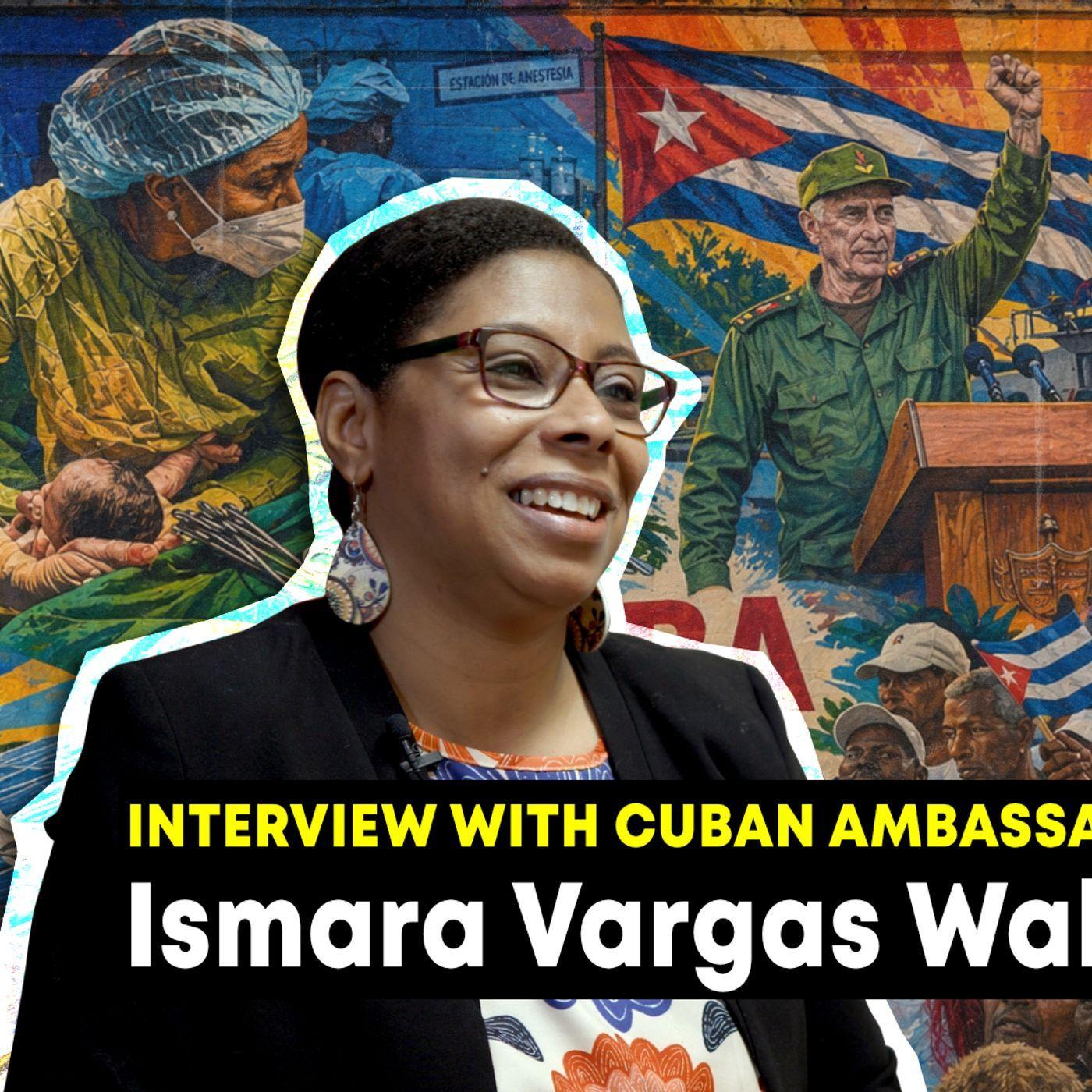
In this episode of Cuba Analysis, Helen Yaffe sits down with Cuban Ambassador Ismara Mercedes Vargas Walter to discuss recent and escalating threats from the US government under President Trump. These include the designation of Cuba as a threat to US national security, the imposition of an oil blockade, and the threat of military aggression to enforce regime change. The conversation explores the human cost of these measures, from energy shortages and blackouts to the damage inflicted on Cuba’s public healthcare and education systems. These coercive measures expose the real strategy behind US policy towards since 1960, as outlined in a secret memo written by US diplomat Lester Mallory advocating economic warfare to provoke “hunger, desperation and overthrow of government”.
The Ambassador explains how the extraterritorial reach of the US blockade obstructs British entities - from individuals to banks - engaging with Cuba. These restrictions disrupt trade, finance, and everyday diplomatic operations; even the daily functioning of the Cuban embassy in London is affected. This is despite more than a century of stable Cuba-UK relations, spanning from diplomacy to co-operation in science and culture. Despite these challenges, Ambassador Vargas Walter emphasises Cuba’s resilience, highlighting a rapid shift towards renewable energies, strong popular unity and an ongoing commitment to sovereignty and self-determination.
The episode closes by highlighting Cuba’s global contributions in healthcare and education and underscoring why international solidarity to defend Cuba is so important right now.
Follow us for updates and new episodes:
YouTube: https://www.youtube.com/watch?v=ZIjujJoi8ck
🌐 Website: https://www.cubanalysis.org
📱 Social: @cubanalysis
Instagram / Facebook / Telegram / YouTube / TikTok
Apple Podcasts: https://podcasts.apple.com/us/podcast/cuba-analysis/id1846065440
#CubanNews #CubaInPerspective #CubanFacts #CubaSolidarity #Cuba #CubaStudies #CubaHistory
English
United States
TRANSCRIPT 🔗
Disclaimer: The podcast and artwork embedded on this page are from Cuba Analysis, which is the property of its owner and not affiliated with or endorsed by Listen Notes, Inc.
EDIT
Thank you for helping to keep the podcast database up to date.
