

WEBVTT
00:00:00.479 --> 00:00:06.080
You know, that enjoyment of the process is what makes painting so great.
00:00:06.320 --> 00:00:11.119
And the, you know, the finished product is just kind of like the icing on the cake.
00:00:11.279 --> 00:00:14.720
And it's one of the reasons why I think painting will never die.
00:00:14.880 --> 00:00:17.039
You know, people always say painting was dying, it's dying.
00:00:17.120 --> 00:00:18.320
You know, AI can do a painting.
00:00:18.480 --> 00:00:24.480
Well, AI might be able to do a painting better than me, but it sure is not going to have my experience of making it.
00:00:24.640 --> 00:00:36.320
And I think as long as we all enjoy making things, you know, with our hands and our minds, you know, and experiencing that joy, it's never going to go away.
00:00:41.359 --> 00:00:44.000
Welcome to Creative Contemplation Podcast.
00:00:44.159 --> 00:00:47.119
I'm your host and the creator, Suzanne Lago Arthur.
00:00:47.280 --> 00:01:00.560
I'm a realist painter working in oils from Loudoun County, Virginia, and I'm fascinated with the subjects of creativity, artistic development, and how these topics can sometimes lead to more profound questions of life, like the nature, perception, and consciousness.
00:01:00.799 --> 00:01:05.840
The season will be going much deeper into our conversations, not just the how, but the why.
00:01:06.000 --> 00:01:08.560
Listen along as we answer these questions and more.
00:01:08.719 --> 00:01:15.439
I'll be interviewing people from all over the creative universe, artists, designers, writers, you name it, and those that understand the creative mind.
00:01:15.519 --> 00:01:18.239
My guests will serve as guides along your own creative path.
00:01:18.400 --> 00:01:20.079
Thanks for joining us today.
00:01:25.280 --> 00:01:29.040
Today on the podcast, I'm speaking with Maryland-based painter Marie Ricchio.
00:01:29.200 --> 00:01:30.400
Welcome to the podcast, Marie.
00:01:30.959 --> 00:01:31.519
Thank you.
00:01:32.079 --> 00:01:34.640
I want to give a little background to our listeners.
00:01:34.799 --> 00:01:36.480
Marie and I actually know each other.
00:01:36.640 --> 00:01:39.120
We met each other in a Zoe Frank class originally.
00:01:39.280 --> 00:01:42.640
Marie, do you remember we were in a in a crit session together?
00:01:42.959 --> 00:01:43.439
Yes.
00:01:43.760 --> 00:01:52.000
And then uh now we're in a gallery together, Tag the Artist Gallery in Frederick, Maryland, um, which I joined after I saw your beautiful solo show just recently.
00:01:52.159 --> 00:01:52.959
So thank you.
00:01:53.439 --> 00:01:54.239
You're welcome.
00:01:54.480 --> 00:01:54.799
All right.
00:01:54.879 --> 00:01:56.560
Well, let's, Marie, let's get started.
00:01:56.719 --> 00:01:58.799
Please share about your artistic development.
00:01:58.959 --> 00:02:00.640
When did that begin for you?
00:02:01.040 --> 00:02:05.519
I have a very distinct memory of when I first discovered art.
00:02:05.680 --> 00:02:10.479
Um, I was in the third grade, and my father had taken me into the city.
00:02:10.560 --> 00:02:14.159
We I grew up on Long Island to the MoMA Museum.
00:02:14.240 --> 00:02:15.919
And I was going up the escalator.
00:02:16.080 --> 00:02:21.599
When I got to the top of the escalator, I saw this wired cow, and it was Calder's wired cow.
00:02:21.680 --> 00:02:30.159
And I was amazed by the way with one single line he was able to create this form that was understood.
00:02:30.319 --> 00:02:32.960
Um, and I spent a long time looking at it.
00:02:33.120 --> 00:02:38.159
I actually bought a postcard from the museum shop, which I still have today.
00:02:38.319 --> 00:02:38.800
Oh wow.
00:02:38.960 --> 00:02:43.280
And on that same day, I saw uh Van Gogh's Starry Night.
00:02:43.520 --> 00:02:46.319
And um, I didn't know what this was.
00:02:46.479 --> 00:02:48.240
I was like, what is going on here?
00:02:48.319 --> 00:02:52.960
I just didn't have a concept that there was this art world or anything like that.
00:02:53.199 --> 00:02:55.120
And that sort of set me on my way.
00:02:55.280 --> 00:02:59.840
And my father used to go to the library all the time, and I would go with him.
00:03:00.000 --> 00:03:06.159
And I discovered the oversized book section, which happened to have lots of books about artists.
00:03:06.319 --> 00:03:08.639
They tend to be oversized books back then.
00:03:09.039 --> 00:03:12.639
And I would just sit on the floor and look through them.
00:03:12.719 --> 00:03:25.039
And by the time you know that year ended, I knew, you know, all the impressionist painters, post-impressionists, contemporary painters, Michelangelo, uh, Leonardo Da Vinci, and all of them.
00:03:25.199 --> 00:03:34.719
Um, and it was it was a really great experience because in, you know, in the schools today now, kids learn about artists very early on.
00:03:34.800 --> 00:03:43.599
There's lots of kids' books written about artists, but back when I was growing up, there was nothing and nobody knew about the art world or or anything about the art world.
00:03:43.680 --> 00:03:54.879
So this was kind of self-educating myself as to, you know, what I would this this thing, whatever this thing was that I was connecting with, but I knew that somehow I wanted to be involved in it.
00:03:55.759 --> 00:03:59.280
Did you uh then have classes going forward from that point?
00:03:59.439 --> 00:04:00.319
From that No.
00:04:00.560 --> 00:04:00.800
No.
00:04:00.960 --> 00:04:05.199
No, no, I you know, I the same story that every artist has, I drew all the time.
00:04:05.599 --> 00:04:07.680
And that's what I drew in my room.
00:04:07.919 --> 00:04:15.599
And um when I used to do these little drawings and I used to sell them to my fellow schoolmates for 20 cents, 25 cents a piece.
00:04:16.399 --> 00:04:16.720
Go get it.
00:04:16.959 --> 00:04:19.360
That is a chocolate bar, you know.
00:04:19.759 --> 00:04:23.120
But um uh no, I I didn't.
00:04:23.199 --> 00:04:24.800
It was artists as entrepreneur.
00:04:24.879 --> 00:04:26.480
I've heard this before, actually.
00:04:27.120 --> 00:04:34.480
Uh well then then what led you to to get your BFA from SUNY Purchase and an MFA in painting uh from the University of Pennsylvania?
00:04:34.639 --> 00:04:36.079
When did that kind of click for you?
00:04:36.480 --> 00:04:40.800
Well, um I just knew I loved art and had to be involved in art.
00:04:41.040 --> 00:04:47.040
And at the time my parents told me I had to go to a state school, you know, that was what they could afford.
00:04:47.120 --> 00:04:50.720
And and luckily this school SUNY Purchase just showed up.
00:04:50.800 --> 00:04:53.120
It was, I was only the 10th graduating class.
00:04:53.199 --> 00:04:54.079
It was a new school.
00:04:54.240 --> 00:04:54.720
Oh, wow.
00:04:54.879 --> 00:04:57.600
And yeah, and I had an arts program there.
00:04:57.839 --> 00:05:03.360
And I thought, okay, I want to go to that one, you know, because I wanted to take art classes.
00:05:03.439 --> 00:05:06.879
And I actually um had to put together a portfolio.
00:05:07.279 --> 00:05:11.120
Um, and I was in the actual visual arts school.
00:05:11.439 --> 00:05:12.319
How were the programs?
00:05:12.480 --> 00:05:18.800
Were they were they kind of observationally based or were they what like uh the process based that was happening a lot back then?
00:05:19.120 --> 00:05:20.480
It was not observational.
00:05:20.639 --> 00:05:28.959
It was still coming out of that abstract world where you know they put you in a room and say, throw your feelings on a canvas, you know, kind of thing.
00:05:29.199 --> 00:05:40.800
Um but I didn't, I did mostly um because I was craving some kind of structure, because it was um there wasn't really that much art instruction that in that way.
00:05:41.040 --> 00:05:46.160
I ended up taking a lot of drawing classes and printmaking classes and design classes.
00:05:46.319 --> 00:05:56.160
Um and I found a lot, uh, I gravitated a lot to the design and printmaking, um, though I ended up being a drawing major just because that's what I had the most credits in.
00:05:56.319 --> 00:06:02.560
Um and I had a a horrible experience in a painting class there that really turned me off to painting.
00:06:02.720 --> 00:06:08.959
So I didn't I didn't paint, I didn't, I didn't paint till I got out of undergrad.
00:06:09.279 --> 00:06:09.839
Oh, wow.
00:06:10.079 --> 00:06:10.639
Do you remember?
00:06:10.800 --> 00:06:12.079
Can you share what that experience was?
00:06:12.240 --> 00:06:14.560
Would you be um Yeah, sure.
00:06:14.639 --> 00:06:24.959
I mean, I I graduated and I started doing these these large abstract paintings that were, I can't even explain them.
00:06:25.120 --> 00:06:34.800
They they they involved like I would go to fabric stores and I'd buy pieces of uh upholstery fabric and I would sew them together and that would be my canvas.
00:06:34.959 --> 00:06:43.199
And then I would paint on top of that, and then I would sew buttons and googly eyes and glitter and and ribbons and stuff on it.
00:06:43.360 --> 00:06:46.560
Um, so it was kind of a little had a texture to it.
00:06:46.639 --> 00:06:53.920
Um, and I would do it on these really big um wood panels um that I would paint black first.
00:06:54.399 --> 00:06:58.319
And, you know, it was just trying to find myself.
00:06:58.399 --> 00:07:04.319
And I think I started gravitating towards that because um, you know, I did a lot of sewing when I was young.
00:07:04.480 --> 00:07:09.920
I made most of my clothes when I was in middle school and I did a lot of, I did quilt making.
00:07:10.000 --> 00:07:15.920
So it all that pattern and fabrics and everything kind of came into my artwork.
00:07:16.079 --> 00:07:22.160
Um, and I did that for three years, and I just felt like I wanted some more instruction.
00:07:22.240 --> 00:07:29.519
Like I felt like I was working on my own and and um I didn't know any other people that were doing what I was doing.
00:07:29.839 --> 00:07:38.240
And so I decided that I wanted to go to grad school because I just wanted because I was working full-time at the same time I was doing this.
00:07:38.399 --> 00:07:40.959
You know, you gotta do something to survive.
00:07:41.199 --> 00:07:51.439
And um, I just wanted a chunk of time to paint and learn how to paint and to be with other people who felt the same way I did.
00:07:52.000 --> 00:07:55.040
And that's why I ended up applying to grad school.
00:07:55.600 --> 00:07:56.240
That's fantastic.
00:07:56.319 --> 00:07:57.120
That's a great story.
00:07:57.680 --> 00:08:02.560
From what you've just told me, I see a connection with some some work going forward.
00:08:03.040 --> 00:08:12.079
So your um interest in design obviously is a connection to to your interest in composition, which is something that we're gonna talk about in your in your paintings.
00:08:12.160 --> 00:08:17.120
And then also, even back then, you were using ribbons, which you're using today.
00:08:17.279 --> 00:08:20.959
So those are two two threads that remain, and I love seeing those things.
00:08:21.120 --> 00:08:22.399
So that's fantastic.
00:08:22.560 --> 00:08:27.759
Who who did you study with in either of those programs of note or somebody that that kind of influenced you?
00:08:27.839 --> 00:08:29.279
Were was there anybody there?
00:08:29.600 --> 00:08:40.000
Um, well, for undergrad, there were there were only two people that um and two classes that I really felt um I got a lot out of them and really has affected me going forward.
00:08:40.159 --> 00:08:44.480
And one was this class called Um Visiting New York Museums and Galleries.
00:08:44.639 --> 00:08:50.720
And it was run by Irving Sandler, who's an art historian who wrote um Triumph of American Painting.
00:08:50.879 --> 00:08:55.840
Um, and I took a bunch of art history classes with him, and I thought it was great.
00:08:56.000 --> 00:09:01.600
And this class every Wednesday, because Purchase is only, you know, 40 minutes from New York.
00:09:01.840 --> 00:09:10.240
So he had a bus and he would put us the 30 of us on the bus and take us around the city and stop off at all these different galleries.
00:09:10.480 --> 00:09:13.120
And he would, he knew the gallery world.
00:09:13.200 --> 00:09:23.039
So he would we'd get out and he would know the the owner of the gallery, and sometimes the artists would be there and they would come out and they would talk to us, and then we'd get in the bus and go to another gallery.
00:09:23.279 --> 00:09:29.200
And a couple of things I learned from that one was not being intimidated about going into galleries.
00:09:29.360 --> 00:09:40.240
I think galleries now are a lot more welcoming, but um I think, you know, back then they were a little bit more intimidating to walk into than they are now.
00:09:40.480 --> 00:09:48.639
And also we had to write a paper on something that we had seen and whether it was something, why we liked it or why we didn't like it.
00:09:48.799 --> 00:09:54.879
So we started, you know, you start asking yourself these questions when you look at this art, you know, what am I getting out of this?
00:09:55.039 --> 00:09:56.320
What does this mean to me?
00:09:56.480 --> 00:09:58.080
What does this mean to the artist?
00:09:58.240 --> 00:09:59.279
Why don't I like it?
00:09:59.440 --> 00:10:05.440
There must be something there that's telling me, ugh, you know, that's giving me a feeling, or why do I really connect with this?
00:10:05.679 --> 00:10:09.759
And that is the way that, you know, I still look at art today.
00:10:09.919 --> 00:10:17.200
You know, when I look at pieces, I, you know, try to understand why I'm getting the feelings that I'm getting from them.
00:10:17.679 --> 00:10:18.240
That's beautiful.
00:10:18.320 --> 00:10:20.399
That's a really lovely connection that you got early on.
00:10:20.480 --> 00:10:22.240
So that's that's fantastic.
00:10:22.480 --> 00:10:22.879
Yeah.
00:10:23.120 --> 00:10:27.120
And then you mentioned and then your MFA program, was there anybody there that yeah.
00:10:27.279 --> 00:10:29.039
Um, well, there was Neil.
00:10:29.200 --> 00:10:31.279
Um, which is one of my questions.
00:10:31.440 --> 00:10:33.759
So we're gonna we can merge them together now.
00:10:33.919 --> 00:10:34.159
Yeah.
00:10:34.240 --> 00:10:38.879
Um I wanted you to share some details of your time studying with landscape painter Neil Williver.
00:10:39.440 --> 00:10:39.840
Yeah.
00:10:40.080 --> 00:10:42.320
Um, well, he was a character.
00:10:44.080 --> 00:10:50.720
He has a big personality, and uh he uh would come in your studio and immediately, you know, sit down.
00:10:50.960 --> 00:11:02.799
And, you know, graduate school a little bit is a blur to me because there was so much going on, but um, I can't remember exactly things that he said to me, but I can tell you the sense that I got from him and a couple things he said.
00:11:03.039 --> 00:11:11.120
Um, the thing I was impressed with, Neil was I always felt like he knew where I was going before I knew where I was going.
00:11:11.440 --> 00:11:12.320
Oh, that's interesting.
00:11:12.639 --> 00:11:12.879
Yeah.
00:11:13.039 --> 00:11:18.960
And I also felt like he knew um that he could do that with with anybody.
00:11:19.039 --> 00:11:24.559
And he also could um see what's going on in your work, even if you weren't a representational painter.
00:11:24.720 --> 00:11:28.320
You know, I came in as an abstract painter and there were abstract painters there.
00:11:28.480 --> 00:11:36.799
There were um realists, there were there were people who did represent representation work, but they were done more from imagination.
00:11:36.960 --> 00:11:38.799
Um, there were some collage artists.
00:11:38.879 --> 00:11:40.879
So it was it was a real mix.
00:11:41.039 --> 00:11:49.360
And, you know, I admired the fact that I he he um could acknowledge other forms of art than than what he did.
00:11:49.840 --> 00:11:52.799
Um he also said, you know, I don't want you to paint like me.
00:11:52.960 --> 00:11:54.480
He used to say that all the time.
00:11:54.720 --> 00:12:05.840
And I remember I I worked in um the uh office at the fine arts, the fine arts office, and um he was sitting there with a pile of slides and he was looking through the slides and everything.
00:12:05.919 --> 00:12:11.440
And and I said to him, you know, how do you pick out who's gonna be get in next year?
00:12:11.519 --> 00:12:12.639
Because it was all the applicants.
00:12:12.720 --> 00:12:14.960
And he says, he said, I just look for the energy.
00:12:15.200 --> 00:12:15.759
Oh, wow.
00:12:15.919 --> 00:12:17.600
And I thought that was a great answer.
00:12:17.840 --> 00:12:18.080
Yeah.
00:12:18.559 --> 00:12:25.440
Not looking at, you know, um, how well uh, you know, how with their technical skills are or anything like that.
00:12:25.600 --> 00:12:27.759
He's just looking to see if they have the energy.
00:12:28.000 --> 00:12:32.480
Well, you know and by energy, do you think he meant uh uh their own artistic vision?
00:12:32.720 --> 00:12:34.320
Is that what he meant by energy?
00:12:34.879 --> 00:12:50.799
Um or just strong composition, like you know I you know, it's I don't know exactly, but you know, sometimes you can see when you look at paintings, you could say, Oh, that was painted very timidly, you know, or somebody really was coming at that painting.
00:12:51.360 --> 00:12:54.720
You know, maybe it's not successful, but they put their all into it.
00:12:55.039 --> 00:12:58.639
Um, and I think maybe that's more of what he was talking about.
00:12:59.360 --> 00:13:06.559
Um so and he was instrumental with me changing from an abstract painter to a representational painter.
00:13:06.879 --> 00:13:08.080
Oh wow, talk about that.
00:13:08.639 --> 00:13:10.639
Well, I met him once before.
00:13:11.120 --> 00:13:13.759
Actually, when I applied to school, I didn't really know who he was.
00:13:14.159 --> 00:13:16.240
It was I was so naive back then.
00:13:16.480 --> 00:13:28.559
And um, he was having a a show at Marble Gallery of his really large paintings, and I guess it was over the summer before I was gonna enter into I'd already been accepted.
00:13:28.799 --> 00:13:34.399
So I went to the gallery to to see the show, and I met him for a few seconds and looked at his paintings.
00:13:34.480 --> 00:13:37.840
And um, so that was the first time I met him, but and he was very nice.
00:13:37.919 --> 00:13:41.039
I mean, I told him I was a new student for next, you know, in the fall.
00:13:41.200 --> 00:13:48.879
Um, and then the first time I met him, he came into my studio and he sat down, he looks around and he says, What is this blank on the wall?
00:13:50.080 --> 00:13:52.240
And I just was like, What?
00:13:52.799 --> 00:13:54.320
Did did the blank start with S?
00:13:54.399 --> 00:13:55.039
Like what it is?
00:13:55.279 --> 00:13:56.320
Yeah, yeah, yeah, it did.
00:13:56.559 --> 00:14:02.000
And uh, and he said, Well, I want you to paint two paintings a day and I'll be back.
00:14:02.159 --> 00:14:04.399
I want you to paint what you see.
00:14:04.639 --> 00:14:07.200
And he said, Paint the cup, paint your bicycle.
00:14:07.279 --> 00:14:13.200
I used to run my bike to campus all the time, you know, paint out your window, you know, paint your brushes, just paint anything.
00:14:13.279 --> 00:14:14.639
Don't worry about finishing it.
00:14:14.799 --> 00:14:17.600
I just want you to do two paintings a day and I'll be back.
00:14:17.840 --> 00:14:22.960
So when he came back, I had about 40 paintings on the wall because I did, because I wanted to learn.
00:14:23.120 --> 00:14:25.200
I didn't know, okay, I want to try this.
00:14:25.360 --> 00:14:28.960
And then he sat down and he said, okay, now we have something to talk about.
00:14:29.120 --> 00:14:30.960
And so interesting.
00:14:31.039 --> 00:14:31.360
Yeah.
00:14:31.600 --> 00:14:32.879
And and he was right.
00:14:33.039 --> 00:14:35.600
And I it was like he didn't have to say anything.
00:14:35.759 --> 00:14:43.600
It was like I understood that having that experience, what what it was about, you know.
00:14:44.000 --> 00:14:55.679
And you know, I always felt very limited when I was doing my abstract paintings because um I was always painting the same colors, making the same shape.
00:14:55.919 --> 00:15:00.960
And um, and you know, color is a really important thing for me, as you'll you'll you'll hear more later.
00:15:01.120 --> 00:15:09.919
But but um and when I started looking out at nature, I was like, I saw colors and color combinations that I couldn't imagine.
00:15:10.159 --> 00:15:14.480
I saw shapes that I couldn't visualize in my head, you know.
00:15:14.639 --> 00:15:20.720
Um, I saw relationships and compositions that were new that I couldn't imagine.
00:15:20.960 --> 00:15:22.240
And that's just for me.
00:15:22.399 --> 00:15:26.159
I mean, there are people who can do that stuff, and I love abstract painting.
00:15:26.240 --> 00:15:27.919
It's nothing against abstract painting.
00:15:28.080 --> 00:15:40.000
Um, it's just for me personally, and also that I think it's that feeling I get when I'm looking at something and trying to understand it.
00:15:40.159 --> 00:15:44.080
There's this pleasure that I get from the problem solving.
00:15:44.159 --> 00:15:46.240
And sometimes it's not easy at all.
00:15:46.399 --> 00:16:09.600
And I'm frustrated and I do bad stuff and I'm mad at myself, but there's underneath it all, there's just this wonderful feeling of that search and trying to understand what I'm seeing and then discovering something like, oh, there's this, you know, gray that's you know, leaning towards orange, isn't that beautiful against the blue, you know, the cobalt blue or something like that?
00:16:10.080 --> 00:16:12.399
And um, I get excited about those things.
00:16:12.480 --> 00:16:14.320
So Yeah, that's beautiful.
00:16:14.639 --> 00:16:18.480
What artists have influenced your work or way of working now?
00:16:20.159 --> 00:16:29.759
Well, I'm an art junkie, so I'm constantly looking at artists, you know, artists that are happening today, artists from way back when.
00:16:30.080 --> 00:16:40.080
And I I get on these kicks where I'll I'll find somebody and I'll watch them for a while and I get really involved in what they're doing and and learn stuff from them.
00:16:40.320 --> 00:16:45.679
And then they kind of go away and someone else comes in and you know, um, and I get pleasure from them.
00:16:45.759 --> 00:17:01.919
And, you know, um, but there's there's some that are been consistent all my life, you know, that they've never walked out the room, you know, they've just always been um and I'll just give you a list of uh let's see, I got about five here.
00:17:02.000 --> 00:17:11.200
There's and I can tell you about one of them though, but let me Fairfield Porter, Mirandi, Antonio Lopez Garcia, Joseph Albers, and you Glo.
00:17:12.000 --> 00:17:13.680
And great list.
00:17:14.079 --> 00:17:25.759
There's different reasons why I like each one, you know, and I've learned something about them, and there's something about my work that I connect with with their work.
00:17:26.079 --> 00:17:33.440
So, you know, I I think Mirandi has probably been the most consistent for me out of all of them.
00:17:33.759 --> 00:17:34.079
Interesting.
00:17:34.319 --> 00:17:40.400
Um and I think it's because he's a hard painter to understand.
00:17:40.559 --> 00:17:40.960
Yeah.
00:17:41.119 --> 00:17:44.559
You know, and there are people who either hate him or they love him, you know.
00:17:44.799 --> 00:17:55.279
And um, and maybe that's why I I still get enjoyment out of him because there's this mystery for me with his work that it's like I don't get him.
00:17:55.359 --> 00:17:58.000
I don't understand why I'm so attracted to him, you know.
00:17:58.319 --> 00:18:04.160
And so over the years I've been thinking about it, and I kind of broke it down into these three different elements.
00:18:04.240 --> 00:18:11.279
Uh there's uh I would say his compositions are very simple, but so strong.
00:18:11.920 --> 00:18:23.119
And how he places those bottles together and how, you know, which ones he chooses to be next to each other or behind, it's all part of that composition and it's so subtle.
00:18:23.359 --> 00:18:26.640
And I think if you took anything out of there, it would fall apart.
00:18:26.799 --> 00:18:27.119
Yeah.
00:18:27.200 --> 00:18:29.279
Um, I I think that's one thing.
00:18:29.519 --> 00:18:48.640
I also think the color, I mean, I people don't think of him as a colorist, but I think he works with such subtlety of warms and cools, and you know, all those browns and everything are are colors next to other colors and they're just extremely subtle.
00:18:48.720 --> 00:18:50.880
Um, and I saw her respond to that.
00:18:51.119 --> 00:19:01.440
And I also think the other thing that I really like about his work is um he kind of teeters between abstract and representation.
00:19:01.599 --> 00:19:08.559
Like he'll put down like a solid square that's the side of a bottle, but the bottle has volume.
00:19:08.720 --> 00:19:13.759
And then in another bottle, he'll just render a little bit to get the bottle to have some volume.
00:19:13.920 --> 00:19:23.039
So it's kind of this at the same time being flat and also having space and volume at the same time, which is feels very contemporary to me.
00:19:23.119 --> 00:19:25.519
And I I just really love that.
00:19:25.680 --> 00:19:26.640
Yeah, definitely.
00:19:26.880 --> 00:19:38.400
Um, so it's not really about rendering, it's about getting the right shapes and color and placement to get the volume that um and this and the solidness of it too, of his office.
00:19:38.480 --> 00:19:38.640
Yeah.
00:19:38.720 --> 00:19:47.519
So for for me, a key strength of his work is definitely like value for me, you know, and the value is what connects what makes those really strong compositions.
00:19:47.599 --> 00:19:52.400
I I hear you completely on the color, but for me, he's more primarily a value-based painter.
00:19:52.559 --> 00:19:58.799
So that's it's an interesting conversation when you kind of break things apart a little bit like that, like how we perceive value and color.
00:19:59.039 --> 00:20:01.119
Um it's really fascinating.
00:20:01.200 --> 00:20:08.319
Uh, is there is there somebody uh of that other list, any anybody else that's really kind of calling to you, maybe currently or?
00:20:08.880 --> 00:20:10.880
Well, Antonio Lopez Garcia.
00:20:11.519 --> 00:20:16.720
And because, you know, I was a landscape painter.
00:20:17.119 --> 00:20:24.079
Well, I did landscape painting and then I went in, I did still live painting towards the end of my grad school, and then I went back to landscape painting.
00:20:24.240 --> 00:20:30.000
And I worked as a, you know, I I did a plain air painting for many, many years.
00:20:30.720 --> 00:20:35.279
And um, and I did kind of quick paintings that were done in three hours.
00:20:35.359 --> 00:20:45.039
And there's this feeling to them, you know, they're they're kind of like um they're just a quick, spontaneous kind of painting.
00:20:45.119 --> 00:20:48.559
And I and I love that, but I wasn't getting satisfaction enough.
00:20:48.640 --> 00:20:50.960
I felt as if I wanted more.
00:20:51.119 --> 00:20:58.000
And when I started looking at a lot of the painters I I really like, especially Antonio Lopez Garcia, they spent a long time on their work.
00:20:58.240 --> 00:21:04.400
Yeah, they're slow painters, they're slow painters, and I thought, you know, I want to slow down.
00:21:04.559 --> 00:21:13.039
I want to know what that experience is like to spend, you know, weeks on a painting and um and have that experience.
00:21:13.200 --> 00:21:17.359
And so I started doing that, and I find that I I just love it.
00:21:17.440 --> 00:21:22.640
I I just really felt like it was where at this point in my life belong.
00:21:22.960 --> 00:21:25.359
So I've done a a a switch.
00:21:26.720 --> 00:21:34.079
One thought I had when you were talking about your education, I think more your your MFA and and your time with your with Neil Wulliver.
00:21:34.400 --> 00:21:41.039
Uh, was there um was it difficult to go from being more abstract based to an observationally based painter?
00:21:41.279 --> 00:21:47.279
Like was there some friction or frustration there in terms of your drawing skill or or anything like that?
00:21:47.759 --> 00:21:50.400
Well, you know, you make a lot of bad paintings when you start.
00:21:52.960 --> 00:21:56.079
You know you were you were learning all by observation, right?
00:21:56.240 --> 00:22:01.440
Like there wasn't any other um class going on as far as like a anatomy or anything to that extent.
00:22:02.000 --> 00:22:05.599
No, but but actually, um actually I didn't think about this.
00:22:05.759 --> 00:22:11.359
The um when I was in grad school I started drawing from the figure because I wanted to be better at drawing.
00:22:11.519 --> 00:22:13.599
And I pretty much have kept up that practice.
00:22:13.680 --> 00:22:17.599
I draw from the figure almost once a week for years and years and years.
00:22:17.759 --> 00:22:18.960
And I'm not a figure painter.
00:22:19.039 --> 00:22:20.079
I don't want to be a figure painter.
00:22:20.240 --> 00:22:23.759
I'm not interested in being a figure painter, but I do it because of the drawing.
00:22:23.920 --> 00:22:24.160
Yeah.
00:22:24.319 --> 00:22:26.079
Um so there was that.
00:22:26.240 --> 00:22:40.160
And then um once again Neil Welver kind of knew where I was headed before I did he got a a scholarship for this um uh program that was up in New Hampshire with Jack Beale and he was trying to bring realist painting back.
00:22:40.319 --> 00:22:46.319
This was kind of um towards the beginning of the the resurgent of realist painting.
00:22:46.559 --> 00:23:00.799
So I went up to New Hampshire for a summer and spent the summer with him and Earl um Martha Earlbacher who is a um talk about anatomy guru I mean yeah it was pretty intense.
00:23:00.960 --> 00:23:04.880
And there was another instructor from whose name I'm forgetting right now.
00:23:04.960 --> 00:23:11.440
I think it starts with a Z, um who taught at the University of uh New Hampshire I can't remember his name.
00:23:11.599 --> 00:23:20.400
He was a printmaker and um so they taught this class for summer and so there was a lot of drawing and a lot of classical stuff that I was so out of my league.
00:23:20.559 --> 00:23:27.279
I mean there were just people there who had been doing it for years and I was like you know what pencil do I use?
00:23:27.440 --> 00:23:33.839
Like what you know totally you know but I was exposed to it which was great.
00:23:34.000 --> 00:23:38.880
And when I came back to Penn I wanted to continue taking the anatomy class.
00:23:38.960 --> 00:23:46.799
So he made arrangements with um the Pennsylvania Academy for me to take a class with Martha Urbacher there.
00:23:47.119 --> 00:24:00.640
Oh wow semester which I did and then you know I got to meet her and then she invited us back to her place and saw all of her paintings and her husband's sculpture and and that was just really a lot of eye opening and and learning through that.
00:24:00.799 --> 00:24:22.480
So yeah because it was that was something that just occurred to me while while you were speaking it sounded like the way you transitioned from abstraction to observational painting was very kind of a natural kind of approach uh because like when I think of representational painting and realism so much of it can can be really heavily weighed down with kind of the canons of proportion and and things like that.
00:24:22.559 --> 00:24:35.519
And it didn't sound at first that you were getting as much of that in your education but uh with Martha you certainly were so yeah and I also you know I places where I felt like I needed it I went back and found it myself.
00:24:36.000 --> 00:24:36.160
Yeah.
00:24:36.319 --> 00:24:40.480
You know I spent um uh two weeks at studio in Kamenati.
00:24:40.960 --> 00:24:41.519
Okay, sure.
00:24:41.680 --> 00:26:50.799
Um uh that was with Nelson Shanks himself Nelson Shanks was still alive yeah he was there um and he uh we actually went to his house saw a studio and had dinner with him but um the uh but it was his students who taught the class and and it was it was great I mean it's not it wasn't the place for me to spend a lot of time there but I I learned a lot about value um because all we did was do value studies of the figure for you know eight hours a day um seven days a week for two you you you do sort of start becoming very sensitive to value so yeah definitely that was a great school I happen to know that you have a story or connection to an influential artist and author of the seminal book Interaction of Color Joseph Albers can you please share that with us yeah um well uh the when I was talking about undergrad there was another class that really affected me which was um the interaction of color which was taught by Cy Sillman who was um Joseph Albers assistant and he he was the one who helped uh Joseph Albers make the original silkscreen um copies of the editions of the original book wow and uh and he taught the class my thought is he taught the class much like um Albers probably taught the class and it was a very tough class he was he was brutal but I learned so much about color because it was taught where you you you're taught by doing and by seeing the same kind of idea when I was teaching myself how to you know paint representationally and so you know you you'd had all the color aid paper and all the swaths of color samples you would steal from the paint store and you would you know work your studies through that and then you would you know put them up on the wall and he would pull them down and put them on the floor and then he would walk over the work and talk about the ones that were on the wall that were successful.
00:26:51.039 --> 00:26:56.480
So oh my God it was like okay my piece got walked on today.
00:26:56.720 --> 00:26:57.200
Right.
00:26:57.440 --> 00:27:01.759
And he was a stickler for you know present presentation.
00:27:02.079 --> 00:27:08.720
And I think that um you know he taught this class it was it was a joint class between the painters and the designers.
00:27:08.880 --> 00:27:17.920
And it was actually a really terrific class for design work because you know presentation is really important in design, especially when you're showing your portfolio.
00:27:18.160 --> 00:27:30.799
So he kind of stressed all that when he was I think that's the reason why he would get upset if there were fingerprints on the cardboard or there's rubber cement showing you know rubber cement stain was a big deal.
00:27:31.039 --> 00:27:43.519
But you know and he and he taught us about how we remember color and how we can't remember color and how color is important in the business world in a lot of ways, um the commercial world.
00:27:43.839 --> 00:27:49.039
And and I just loved it and the assignments were were really fun and very very hard.
00:27:49.279 --> 00:28:04.880
And then when I went to Penn he was it turned out that he had left purchase and he was teaching at Penn when I got there and I was like great so I ended up taking the class again um and then I ended up being his TA which was really wonderful.
00:28:05.279 --> 00:28:21.200
And um and there were days when he couldn't make it down from New York so I would have to take care of the class um and then when he left he gave me a silk screen print of a Joseph Albert amazing wow unfortunately it's not signed.
00:28:21.440 --> 00:28:26.960
Oh it's framed somewhere what was that did you frame it?
00:28:27.200 --> 00:28:48.960
It's not framed yet and my husband and I just said you know we got to get that framed we have a framer now but um yeah you got to get it framed and then put a copy of the book cover or something on the back you know yeah so that yeah or something but it was it meant a lot to me because I really love that class um and I I I use it every day every day.
00:28:49.279 --> 00:29:02.720
I love and appreciate that now I hated it in art school I took that class like a version I'm sure watered down version you know in in the 90s at at the Corcoran School of Art and um I absolutely hated it.
00:29:02.799 --> 00:29:07.039
I I found it the most frustrating exercise possible but I certainly learned a lot.
00:29:07.200 --> 00:29:20.640
I hated all of it the rubber cement you know putting it on the you know that just showed that I wasn't a graphic design candidate at that time I later acquired some of those skills but yeah now I certainly appreciate it.
00:29:20.720 --> 00:29:32.559
And now um especially in light of uh a class that we you and I took recently with Zoe Frank where it just brought up those memories again and and color worlds and and thinking and looking really closely at color relationships.
00:29:32.799 --> 00:29:37.279
I see the genius in it, you know, certainly as a as an older lady.
00:29:37.599 --> 00:29:39.359
But back then oh my God I hated it.
00:29:39.440 --> 00:29:45.279
So I just find that really interesting well you know the the first time I took the t the the class I it I did not do very well.
00:29:46.000 --> 00:29:48.240
You know I did much better the second time.
00:29:48.480 --> 00:29:48.799
Okay.
00:29:49.359 --> 00:29:54.640
Right okay well then maybe it wasn't just me then I needed some maturity there.
00:29:55.920 --> 00:30:20.799
Uh well let's let's talk about your current obsession or current love I should say um your love of still life uh what draws you to the subject matter because it's something that's really occupying I think your your time these days yeah yeah I um with still life I feel like um I can start from the beginning and create it from from nothing.
00:30:21.839 --> 00:30:50.480
You know I've gone back and forth between landscape painting and still life painting and um still life is really giving me more satisfaction over the years and setting it up and deciding on a tabletop, deciding on what objects I'm gonna paint, finding objects I have lots of objects in my uh studio um and pulling pulling objects together so I can figure out you know how I want them to relate to each other.
00:30:50.720 --> 00:31:07.200
I kind of have like a color idea an overall color idea that I want in the still life as I start to put the pieces together um and bring all the elements and I I can light them the way I want to light them and I can work on them for a very long time.
00:31:07.359 --> 00:31:30.400
They don't move and and I also really like um painting objects that have a presence solid objects like I I love painting where the object meets the tabletop that little place that's little line that where it meets and sometimes it's a it's a line and sometimes it's just it just melts into the tabletop.
00:31:30.640 --> 00:31:33.519
And those kind of things I I really love.
00:31:34.079 --> 00:31:35.680
And I love the structure of things.
00:31:35.839 --> 00:31:53.119
I love you know when I'm painting the objects I feel like I'm inside them and figuring out how much space they are taking up and how the ellipses are around me and and how one ellipse is relating to another one and the diagonals and all of that is fun.
00:31:53.279 --> 00:32:13.680
I mean being able to do the composition and the color and also to be able to paint you know these very intense colors that you know you can find little bits of it in nature but um you know if I want to paint an area of red that's two by four inches I'm not gonna find that in nature unless I'm parting painting a barn or something.
00:32:13.839 --> 00:32:17.599
And I I like having the ability to do that.
00:32:17.759 --> 00:32:29.440
I love having color you know kind of like um I'm drawn to Hans Hoffman sometimes with his squares of color and then he has this brush strokes going on and and the colors pushing in and out.
00:32:29.519 --> 00:32:38.880
I I very much turned on by that and I think still life gives me the ability to sort of have those experiences and arrangement is a big a big part of it for you.
00:32:39.119 --> 00:32:43.440
Oh yeah yeah yeah what are you thinking when you're arranging these compositions?
00:32:43.680 --> 00:33:08.400
I'm gonna mash some of my my questions together but uh yeah like what are the themes or yeah what are well I start to see how they relate to each other you know and where where they're touching and where they're not touching and how much space is between the objects and the diagonals that the objects create and how the I like to put something in the background.
00:33:08.480 --> 00:33:11.920
I I've become very um I'm in love with tissue paper.
00:33:12.240 --> 00:33:35.200
Tons of different tissue paper and I've I love taking tissue paper and wrapping it around the objects to to feel like they're being held by the background and I start to paint them and as I paint them they I I move things around you know like I I start out with a viewfinder that that's very helpful for me and I look and see if I feel like the composition is strong.
00:33:35.359 --> 00:33:38.880
And then I start to paint it and as I paint it I realize things are falling apart.
00:33:39.039 --> 00:33:49.519
So I put things in take things out repaint things and I keep moving them around and as I spend time with them I start to feel like a scenario happening.
00:33:49.680 --> 00:34:05.519
I start feeling there's something connecting in the work and I start imagining these stories in my head you know and and they start to become about something and then when I figure out what that is I kind of feel like the painting's done you know that's interesting.
00:34:05.599 --> 00:34:26.079
Yeah everything is where it should be yeah and um and I don't think that people will see that in the work I mean but they might sense that something was going on but that's totally okay because you know if I know that um something happened there I I get the feeling that somebody else will have that feeling.
00:34:26.480 --> 00:34:45.280
For sure do you imply that in the title maybe sometimes I do yeah yeah and and and yeah so the titles are important for my work yeah tell tell me about the current work that that you're doing uh you're gonna have a solo show uh very soon at the First Street Gallery in New York City during the month of March.
00:34:45.360 --> 00:35:00.079
Um what's the theme for that show um well it's called community and my my studio practice usually is when I get in in the morning I listen to music or podcasts a lot of time doors.
00:35:00.320 --> 00:35:16.400
Thank you oh great thank you and um and I paint and then I have a late lunch and in the afternoon I um I listen to NPR which I'm really sad with all the news that's happening because for years and years and years.
00:35:17.199 --> 00:35:25.360
And so the news is kind of in the background or there's there's they're they're interviewing people about stuff that's going on currently or whatever.
00:35:25.599 --> 00:35:31.280
And and I find that it starts to um play into my work.
00:35:31.440 --> 00:35:44.480
It starts to have me you know think about um the world you know and I'm thinking about how we're all getting divided you know and how we need to be a community to survive.
00:35:45.280 --> 00:35:49.840
And I read a book when I was very young that really was impressionable to me.
00:35:49.920 --> 00:36:14.239
And it was about these different groups of people who lived in extreme climates like how do the Eskimos get all their vitamins when they have no vegetation you know how do the Hopi Indians grow corn in the desert you know and I started thinking about these groups of people and how they came together and how their survival um is dependent on each other and figuring these things out.
00:36:14.480 --> 00:36:27.599
And so I started putting these groups of objects together and I'm back in my mind I'm thinking you know if they all need each other in this painting to survive if one of them was taken out they would all fall apart.
00:36:28.000 --> 00:36:28.719
That's beautiful.
00:36:28.880 --> 00:36:31.360
Yeah and and that's important.
00:36:31.599 --> 00:36:39.679
And the other thing is that you know they're they're all different shapes and sizes and colors but they're all united.
00:36:39.920 --> 00:36:58.000
Yeah they're all harmonious within the frame of within the frame right and it's it's I mean it's just a minor thing for me but I I really believe that and um I think that it gives some hope and I think you know in the future we're gonna have to band together for survival.
00:36:58.480 --> 00:36:59.920
Most definitely somehow.
00:37:00.159 --> 00:37:32.480
So it's it's a lot about that and there's um you know I did one there's two very long paintings one is 12 by 48 but they're both 12 by 48 and one is called Community Glacier and the other one's community adobe and it's you know about you know Adobe is very warm and kind of surviving in the red rock you know in the desert and all that and the the uh um the other one is more blue and icy and cold yet they're kind of come together to keep the warmth in this um extreme environment.
00:37:32.880 --> 00:37:34.880
So that's kind of what it's about.
00:37:35.360 --> 00:37:36.159
That's really interesting.
00:37:36.239 --> 00:37:46.960
I'm wondering hearing you say that other things that would come to mind for me would be like like David and Goliath, you know like there's there's other themes that could could come out of uh the current news, you know what's happening in the world.
00:37:47.039 --> 00:37:52.079
And that that would be an really interesting exercise um to kind of take that you know another step forward.
00:37:52.159 --> 00:37:58.480
So I'm what I wonder if that uh if if we'll see more of that in the work, you know, uh as as you continue along this path.
00:37:58.559 --> 00:38:03.039
Like is this kind of a a new theme for you in terms of being inspired by the news?
00:38:03.280 --> 00:39:46.000
Well done I did another one which was years back when they were um separating the children who from their oh yeah oh heartbreaking yeah so anyway I had this these little china pieces that were all splattered oh wow tiny little pieces everywhere and it was it was a to me it was kind of feeling of you know families being pulled apart and um oh Maria I love that I would love to see you explore that further yeah but you know and a lot of the a lot of the works actually in the past have been more about my immediate family about my daughter my son you know our f our family um but also in this upcoming show there's going to be a lot of small paintings that are just like one object and they're kind of the way I look at them they're kind of characters in the whole family of characters you know there's the the papa there's uh the mother there's the the seed jar who's the person who takes care of the seeds for the planting for the next year you know it's all those people you need in your life you know so which which objects um can you tell us what's the the visual language there are there certain objects that we'll see in the exhibit that represent certain things for you uh well they're all they're all just abstract shaped objects I mean some of the things behind me are are going to be in the show and uh you know I have like um I like to mix um what I call no name colors colors that that bend colors that can can go in either direction like people call them browns and grays so I try to take some objects like that and mix them with very intense colored objects and so that the intense color object will kind of come forward.
00:39:46.079 --> 00:40:25.840
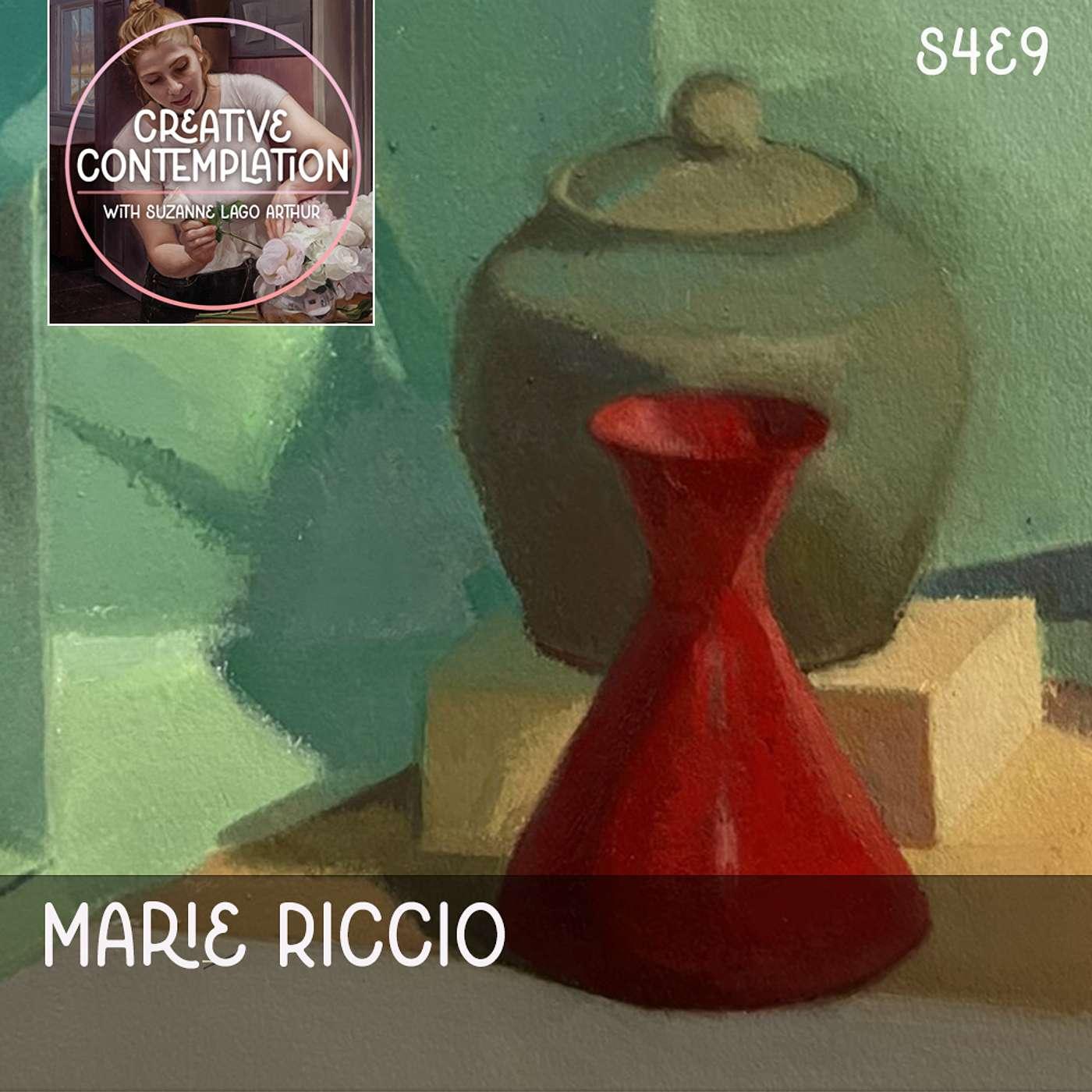
So I have one that's called Papa and there's the Papa is the um is a round uh clay object that actually my father made oh that's uh a lot of the pottery is from my father but oh wow I didn't know that yeah the the browns and the brown pottery not the colorful ones and um they're you know it's kind of um uh browns and greens kind of glaze on it and I have like a little marble in the background that's in the shadow red marble and then there's a red object standing in front of him and it's kind of this idea of you know I was behind him at one time and now he now I'm the caretaker and I'm taking the lead and he's behind me.
00:40:26.000 --> 00:40:37.039
Yeah that kind of idea of oh beautiful switching the roles yeah um but you know people aren't going to see that when they do the painting but it's what I think about, you know, and it's what's important to me.
00:40:37.199 --> 00:40:46.960
Um and you know my father's not doing very well so you know this was my way of dealing with the situation and realizing new role I've taken in his life.
00:40:47.119 --> 00:40:53.360
So well I think these um things that the artist is thinking about when they're painting is definitely uh becomes part of the work.
00:40:53.519 --> 00:41:09.280
It's it's it's that energy that you were talking about earlier uh that Neil Williver when he was looking at the slides, what he's seeing that's that's for me what it is, you know, and that's what resonates is the experiences that the artist is having, you know, when they're painting it, especially like observationally based work.
00:41:09.360 --> 00:41:11.039
Like I always think of it as like a meditation.
00:41:11.119 --> 00:41:20.239
And so when you're looking at what the artist was looking at at that precise angle, you know, um from their vantage point it's it's like you're entering into that studio space with them.
00:41:20.320 --> 00:41:21.679
And I think that's a really beautiful thing.
00:41:21.760 --> 00:41:31.840
And so yeah I think it definitely will convey in the work even if maybe you know it's not um it'll it would be maybe more of an intuitive thing but for sure uh people will get those hits.
00:41:31.920 --> 00:41:32.800
So that's beautiful.
00:41:32.960 --> 00:41:35.679
Um Marie, can you talk about your love of composition?
00:41:36.000 --> 00:41:44.239
We spoke about that just briefly with your background with design um but what is good composition to you and how do you go about achieving it in your work?
00:41:44.480 --> 00:41:44.880
Yeah.
00:41:45.760 --> 00:41:49.519
Well I uh I worked as a magazine designer for a very long time.
00:41:49.679 --> 00:41:59.840
And the thing about magazine I did mostly layouts and spreads and I was the art director of a couple of magazines and and um and you know what I'm doing all day long is just compositions.
00:42:00.000 --> 00:42:01.679
You know so and I loved it.
00:42:01.760 --> 00:42:06.880
You know it's it's interesting how so much composition is played you know plays into design.
00:42:07.679 --> 00:42:15.199
So for me composition has a lot to do with how things line up and also where your eye goes.
00:42:15.440 --> 00:42:25.119
So when I first put something together I kind of look for what's going to be what's going to steal the show where is your eye going to go first and then where does it go second?
00:42:25.280 --> 00:42:26.480
Where does it go third?
00:42:26.559 --> 00:42:28.480
You know, and does it go off the canvas?
00:42:28.639 --> 00:42:32.400
If it goes off the canvas you got to redirect back into the canvas.
00:42:32.719 --> 00:42:34.159
Is it too flat?
00:42:34.320 --> 00:42:40.320
Though my space in my new paintings tend to be more of a shallow space but prior to that I had much more deep space.
00:42:40.480 --> 00:42:56.000
So do I want if it's if you want deep space, you know I got to put more diagonals in it and also play with the size of the objects because as the size as you go back the size gets smaller um and a little bluer and um that's from landscape painting.
00:42:56.400 --> 00:43:11.679
But you know and then I when I arranged the uh cloth or the ribbons or the sticks there aren't as many ribbons and sticks in this particular show but they were used as composition elements.
00:43:11.920 --> 00:43:44.400
So if I saw um like a diagonal happening with how the objects line up then I have some tissue paper in the background and I see a diagonal in the tissue paper and it's almost lining up to the same angle as what the um objects are I'll go in this is why I love tissue paper rather than fabric is I'll go in and I'll change that line a little bit so it is parallel to the other one or or it's going in a little bit when it goes back.
00:43:44.559 --> 00:43:56.320
You know and I'll do the same thing like if I feel like my eye is going off the canvas, I will take a stick or a ribbon and I'll put it on the other side and make it a diagonal to draw your eye in.
00:43:56.719 --> 00:43:57.679
So I do that.
00:43:57.920 --> 00:44:05.760
And also I also look at The color because your eye will jump and try to connect the colors.
00:44:05.840 --> 00:44:19.199
So I have to see where my eye is going with the elements that where the colors are kind of connecting and, you know, kind of group them in a way that it doesn't get too busy and they're all over the place and they have no meaning.
00:44:19.440 --> 00:44:20.960
So I I do that.
00:44:21.199 --> 00:44:26.639
And I also might think about the ellipses and how the ellipses are on the page.
00:44:27.519 --> 00:44:33.840
And I'm I'm definitely uh lean towards verticals and then horizontals.
00:44:33.920 --> 00:44:35.760
And I have a hard time with diagonals.
00:44:35.840 --> 00:44:40.719
So I always have to consciously say, Marie, you got to put a diagonal in here.
00:44:40.880 --> 00:44:43.840
And sometimes I can do it with like the negative space.
00:44:43.920 --> 00:44:51.440
I did this large painting where the diagonal was not where the objects lined up or the ribbon or a piece of paper or something.
00:44:51.519 --> 00:44:57.599
It was actually the negative space between the objects created a diagonal that went into the back.
00:44:57.760 --> 00:44:59.920
So there's different ways of doing it.
00:45:00.079 --> 00:45:04.719
Um and if something lines up, I'll like intentionally line it up, you know.
00:45:04.880 --> 00:45:07.679
But then if you line it up, that that diagonal becomes strong.
00:45:07.760 --> 00:45:09.840
So I need something on the other side to kind of balance it.
00:45:09.920 --> 00:45:12.480
So it's a lot of playing with all of that.
00:45:12.639 --> 00:45:17.280
And um, and I don't get it right on the first time, which is why I end up repainting the painting.
00:45:17.920 --> 00:45:21.760
And how long are you um taking to set up the still life to begin with?
00:45:21.920 --> 00:45:23.119
Like how long does that take?
00:45:23.360 --> 00:45:25.119
I don't actually spend a lot of time.
00:45:25.519 --> 00:45:25.840
Really?
00:45:26.000 --> 00:45:26.159
Yeah.
00:45:26.559 --> 00:45:27.360
Or intuitive.
00:45:27.440 --> 00:45:27.760
Yeah.
00:45:28.000 --> 00:45:28.800
It's very intuitive.
00:45:28.960 --> 00:45:37.679
And what I usually do is when I end a painting and I know I want to start a new one the next day, I'll set it up that night, you know, that evening.
00:45:37.760 --> 00:45:43.679
I'll set up what I think I want, and then I'll sleep on it, and then I'll come back the next morning and I'll tweak it.
00:45:43.840 --> 00:45:45.199
I'll go, no, I love that tip.
00:45:45.280 --> 00:45:45.440
Yeah.
00:45:45.760 --> 00:45:48.400
And then I I'll start painting.
00:45:48.559 --> 00:45:54.880
So and I and the reason why I don't think I'd spend too much time on it is because I know it's going to change while I'm doing so.
00:45:54.960 --> 00:45:57.760
You're bringing objects in and out as you're as you're working the piece.
00:45:57.920 --> 00:45:58.800
Yeah, yeah.
00:45:58.960 --> 00:45:59.199
Yeah.
00:45:59.360 --> 00:45:59.679
Yeah.
00:45:59.840 --> 00:46:03.840
So I mean, it's probably not the most productive way to do.
00:46:05.599 --> 00:46:13.599
But you know, it's I mean, the other thing I really like about paintings are when you can see the search in the painting.
00:46:13.920 --> 00:46:14.800
You know, I love that time.
00:46:15.039 --> 00:46:15.119
Yeah.
00:46:15.360 --> 00:46:26.480
I think when you have when you're painting and repainting and moving things, even though you don't see it on the surface, you kind of can feel it in the paint that you know it was done and moved and changed.
00:46:26.559 --> 00:46:32.079
And and and sometimes people like, you know, Zoe Frank actually leave it there so you can see that it happened.
00:46:32.159 --> 00:46:32.480
Yeah.
00:46:32.639 --> 00:46:35.440
Which is hard for me to do because I'm always trying to think about that.
00:46:35.599 --> 00:46:37.920
But you know, that's exciting.
00:46:38.079 --> 00:46:38.400
Yeah.
00:46:38.639 --> 00:46:41.199
Because you can see the struggle in the search and all that.
00:46:41.280 --> 00:46:41.760
So yeah.
00:46:42.000 --> 00:46:50.480
And these objects that you're painting, you're not paying painting a whole lot of florals that now that I think about it, it's mostly like Yeah, you know, it's they're very static objects.
00:46:50.559 --> 00:46:55.199
They're statics, they're objects that are not dying in front of you or changing dramatically.
00:46:55.519 --> 00:46:57.920
Well, they're not, um, I guess they're not organic.
00:46:58.159 --> 00:46:58.320
Yeah.
00:46:59.039 --> 00:46:59.360
Yeah, yeah.
00:46:59.679 --> 00:47:05.599
Um, it's funny that you said that because there's not many, there's like I think two paintings that have flowers in it in this.
00:47:06.000 --> 00:47:15.199
And when I do flowers, I use artificial flowers, which is but um, you know, it's the journey has been trying to find out what it is that I love.
00:47:15.360 --> 00:47:18.400
And as I get older and older, it's like, I don't want to paint anything.
00:47:18.559 --> 00:47:19.679
I don't want to paint, you know.
00:47:19.920 --> 00:47:20.239
Completely.
00:47:20.320 --> 00:47:20.480
Yeah.
00:47:20.639 --> 00:47:26.880
And so I'm painting Lay, and I and it's like I just realize I I really don't like painting flowers.
00:47:27.039 --> 00:47:27.360
Yeah.
00:47:27.679 --> 00:47:32.079
I'm like, you know, it's like I always want to get the flowers over with so I can get to the vase.
00:47:32.239 --> 00:47:33.039
Oh, that's so interesting.
00:47:33.199 --> 00:47:36.400
And then I was like, well, why am I painting the flowers?
00:47:36.639 --> 00:47:36.800
Right.
00:47:36.880 --> 00:47:37.119
Yeah.
00:47:37.360 --> 00:47:42.639
So um, so this particular series, except for the last one I'm still working on.
00:47:42.719 --> 00:47:45.119
I I just said I'm not painting flowers.
00:47:45.199 --> 00:47:45.360
Yeah.
00:47:45.599 --> 00:47:47.199
So I didn't, there's no flowers in it.
00:47:47.280 --> 00:47:47.920
So I don't know.
00:47:48.079 --> 00:47:50.639
It's flowers gives it a softness, which is nice.
00:47:50.800 --> 00:47:51.119
Yeah.
00:47:51.280 --> 00:47:58.800
So they might be a little bit more um uh not hard edge is not the word, but but uh more design oriented.
00:48:00.079 --> 00:48:05.679
Yeah, because I when I paint flowers, I'm definitely thinking about the ephemeral quality of them and that whole life cycle, you know.
00:48:05.840 --> 00:48:09.119
And sometimes I'll chase it in a painting, like you said, and and show the transition.
00:48:09.199 --> 00:48:10.960
So I I love seeing things like that.
00:48:11.039 --> 00:48:18.480
So it's it's your your work, I guess, is more um architectural, you know, is kind of the thought that kind of comes to mind, you know.
00:48:18.719 --> 00:48:19.519
Yeah, yeah.
00:48:19.599 --> 00:48:20.400
That's that's true.
00:48:20.639 --> 00:48:29.920
So there's a lot of different textures and qualities within that, but there's there's there's an architectural feel to how uh the objects kind of come out of the ground, you know, and how they're connected.
00:48:30.159 --> 00:48:32.159
That's a really good observation.
00:48:32.400 --> 00:48:32.880
Yeah.
00:48:33.039 --> 00:48:43.760
You know, I have I I spend a lot of time with the edges in my paintings because I don't, you know, I don't want it to be like just hard edge objects that feel like they're cut out.
00:48:43.920 --> 00:48:48.480
Like I still want them, I want them to be strong, but I want them to feel like they're in the space.
00:48:48.639 --> 00:48:51.679
So I have to, you know, lose the edges somewhere.
00:48:51.840 --> 00:48:53.039
And that's really fun.
00:48:53.119 --> 00:48:54.719
That kind of happens at the end.
00:48:54.880 --> 00:49:05.679
Um, and it's like I used to like drive around in my car and I look out in nature and I just try to find all of the soft edges in nature, and it's just a game I play with myself and it's a lot of fun.
00:49:05.920 --> 00:49:06.719
Oh, that's great.
00:49:06.880 --> 00:49:07.119
Yeah.
00:49:07.519 --> 00:49:11.119
That's a wonderful tip because that would make you very sensitive to seeing edges.
00:49:11.199 --> 00:49:11.679
That's beautiful.
00:49:12.159 --> 00:49:12.320
Right.
00:49:12.400 --> 00:49:12.639
Yeah.
00:49:12.800 --> 00:49:13.920
So oh, I love that.
00:49:14.159 --> 00:49:23.840
Well, when I was doing a little research, a little further research on you, I I saw something on your website that talked about how your approach to still life differs from your approach to landscape.
00:49:24.079 --> 00:49:26.559
Is that something um that you could share with us?
00:49:26.880 --> 00:49:27.280
Yeah.
00:49:27.519 --> 00:49:29.440
Uh I love landscape painting.
00:49:29.519 --> 00:49:38.000
You know, I still go out during the nice weather about once a week, and um, but I've pretty much limited to doing gouache outside.
00:49:38.239 --> 00:49:41.599
I do these five by seven and eight by ten gouaches.
00:49:42.239 --> 00:50:09.920
And I, you know, I I love the immediate feeling of doing a painting very quickly because when you're in a studio and you're working on something for a really long time, sometimes like you you you can get bored or you get antsy or you get frustrated because you can't figure out what's going on, and you just go outside and you you paint a landscape and you come back and you're fresh because you learn so much from just looking at something that's different than what you've been looking at for, you know, seven days.
00:50:10.159 --> 00:50:16.559
So, and I I the way I view it is that, you know, my still life paintings are additive.
00:50:16.719 --> 00:50:18.239
It's like I start with nothing.
00:50:18.400 --> 00:50:21.119
Now there's different ways that you can do still life painting.
00:50:21.199 --> 00:50:31.840
There are people who, you know, just happen upon something like their still lives are just kind of the painting of a of the corner of their studio or something, and they're really wonderful, but I'm much more of a ranger.
00:50:32.079 --> 00:50:40.159
So um I start with nothing and I add things to it to make what it is that I'm gonna paint.
00:50:40.320 --> 00:50:48.239
And when I go out to the landscape, it's so much is going on, you know, and you can't get it all in.
00:50:48.480 --> 00:51:05.679
And so you have to look at it and you have to like take away your stripping it down to find the, you know, like the five basic shapes that you see out there, which is a great actually um fun thing to do, is just do paintings of five shapes in nature, which I've done before.
00:51:05.920 --> 00:51:06.480
Oh, cool.
00:51:06.800 --> 00:51:14.400
And you just like try to break it down to its simplest form, and then you can go back in and start layering it if you want.
00:51:14.480 --> 00:51:15.840
And that gives it a life.
00:51:16.000 --> 00:51:21.840
I mean, it's not painting every leaf or every branch that will give you a life to your painting.
00:51:21.920 --> 00:51:32.559
It's not the details, it's the underlying structure of what you're looking at and the color and the atmosphere and the edges and the space and the feeling.
00:51:32.639 --> 00:51:34.800
You know, you want to capture that feeling.
00:51:35.119 --> 00:51:40.480
And so I find that I have to do the opposite where I'm just taking things out.
00:51:40.719 --> 00:51:44.159
And uh, so it's more of a reductive kind of process.
00:51:44.400 --> 00:51:46.480
Um, and I like them both, you know.
00:51:46.639 --> 00:51:49.760
I mean, I prefer the still life, but I I I enjoy both.
00:51:50.000 --> 00:51:50.239
Yeah.
00:51:50.480 --> 00:51:53.440
What is your kit like for uh you mentioned gouache.
00:51:53.519 --> 00:51:55.280
So what are you bringing out there with you?
00:51:55.599 --> 00:51:56.000
Yeah.
00:51:56.159 --> 00:52:03.360
Um, well, I went to this whole series of whether I like acrylic gouache or traditional gouache, but I'm I think I'm definitely a traditional gouache person.
00:52:03.519 --> 00:52:11.920
And and part of the reason why I use gouache is that um I'm very indecisive, even though my paintings look like, you know, they're not indecisive.
00:52:12.000 --> 00:52:12.159
Yeah.
00:52:12.800 --> 00:52:16.239
I'm constantly scraping and, you know, don't like that.
00:52:16.400 --> 00:52:17.599
No, put this over here.
00:52:17.760 --> 00:52:26.800
And so gouache gives me that ability to correct things, um, where, you know, um, I think uh watercolor is the hardest medium.
00:52:26.960 --> 00:52:27.199
Oh, yeah.
00:52:27.440 --> 00:52:32.880
If you have to plan ahead, and I'm just not that I don't have the personality for that kind of temperament.
00:52:33.119 --> 00:52:48.400
So um, so I have like a I bought this box that has it's a plastic box that has uh little squares in it, and it has a lid, a tight lid, and I squeeze out my gouache into these little this box.
00:52:48.559 --> 00:52:52.880
You can find it on, I don't know what it's called, but you can find it on um Amazon.
00:52:53.199 --> 00:52:55.440
And it keeps them pretty wet.
00:52:55.679 --> 00:52:56.400
Oh, that's great.
00:52:56.639 --> 00:53:03.840
Yeah, but I've also done dry gouache painting, which is um I don't like as much, but you if they dry out, you can still use them.
00:53:04.000 --> 00:53:07.440
And then I have um I like flat brushes.
00:53:07.519 --> 00:53:13.280
I have a quarter inch flat and a half inch flat, and then just a tiny little round brush.
00:53:13.519 --> 00:53:14.000
Cheap.
00:53:14.159 --> 00:53:16.719
Yeah, it's usually not as good.
00:53:17.199 --> 00:53:21.760
And then I have uh pieces of uh watercolor paper.
00:53:21.840 --> 00:53:25.840
I like working on the uh hot press ones, the smooth.
00:53:26.960 --> 00:53:36.400
And I draw out five by seven, six by eights, and eight by tens, and um, and I have a piece of um uh what is it called?
00:53:36.639 --> 00:53:38.480
The whiteboard with the foam in the middle.
00:53:39.199 --> 00:53:39.679
Foam core.
00:53:40.400 --> 00:53:40.719
Thank you.
00:53:42.559 --> 00:53:45.280
And I have a couple of those and I use the foam core.
00:53:45.360 --> 00:53:54.719
I take two pieces of foam core and I tape them together as the portfolio, but then I use one side of it that I tape the painting on, the paper on, and I paint on that.
00:53:54.960 --> 00:53:55.679
Oh, okay.
00:53:56.079 --> 00:54:00.320
So then I can um, you know, when I'm traveling, it makes it really small.
00:54:00.719 --> 00:54:02.159
With an easel, I imagine, right?
00:54:02.400 --> 00:54:06.400
Yeah, I have a I have an easel that um my husband made for me.
00:54:06.719 --> 00:54:08.800
Oh yet another woodworker.
00:54:08.880 --> 00:54:09.519
I'm jealous.
00:54:09.760 --> 00:54:12.239
Yeah, it's it's like it's my gouache.
00:54:12.639 --> 00:54:16.400
I mean, it will not work for oil paint because it's yeah, it's very, very light.
00:54:16.639 --> 00:54:23.840
And um, he's actually making an adaptive attachment for me right now because I just purchased a oh I'm so jealous.
00:54:24.400 --> 00:54:32.159
A tripod that's the one that fill that closes up to 15 inches high so I can fit it in my suitcase.
00:54:32.719 --> 00:54:38.960
Um, but the but the this thing like fits on the legs is this easel, but the legs are very low.
00:54:39.119 --> 00:54:45.599
It's really made for a clam style uh plain air box, sure, which I don't care for because they hurt my back.
00:54:45.760 --> 00:54:55.760
So yeah, um, so he's making this attachment that he can attach a little higher and uh and it's just made out of um drawing boards, you know, the drawing boards with the clips.
00:54:56.000 --> 00:54:56.480
Oh, wonderful.
00:54:56.639 --> 00:55:01.760
Wow, just cut them down and I painted them with um gray primer paint from Sherman Williams.
00:55:01.920 --> 00:55:04.320
And does he make your frames too?
00:55:04.639 --> 00:55:07.440
Um my framer quit after the first year.
00:55:07.519 --> 00:55:08.960
I was painting too much.
00:55:09.280 --> 00:55:10.480
So that's a yes?
00:55:10.719 --> 00:55:11.920
No, oh no.
00:55:12.079 --> 00:55:14.079
Okay, he was my first cramer.
00:55:14.480 --> 00:55:17.519
He did like one show and he was like, I'm not doing this again.
00:55:17.760 --> 00:55:18.400
Yeah.
00:55:19.519 --> 00:55:23.519
So I have a guy out in Tennessee that I've been buying my frames for from 10 years now.
00:55:23.760 --> 00:55:24.400
Oh wow.
00:55:24.639 --> 00:55:25.599
Oh, that's great.
00:55:25.760 --> 00:55:29.519
Um, well, Marie, this has been absolutely wonderful talking with you.
00:55:29.599 --> 00:55:32.559
Can you share with us uh with our listeners where they can find you?
00:55:32.719 --> 00:55:34.159
Where are you most active online?
00:55:34.880 --> 00:55:41.440
Um, well, I'm uh you can find me at my website, which is marie ricchio.com.
00:55:41.760 --> 00:55:50.639
Um, you can also find me at firststreetgallery uh.org and uh the tag uh the artistgallery.com.
00:55:51.440 --> 00:55:51.840
Uh-huh.
00:55:52.480 --> 00:55:55.599
And um I do have a few things that are on artsy.
00:55:56.000 --> 00:55:57.199
So you can find me there.
00:55:57.280 --> 00:55:59.679
And if a few more stuff is gonna go up soon.
00:55:59.760 --> 00:56:01.679
So and what about social media presence?
00:56:01.760 --> 00:56:02.159
Where are you most?
00:56:02.880 --> 00:56:03.199
Yeah, yeah.
00:56:03.280 --> 00:56:04.719
I'm on Instagram.
00:56:04.960 --> 00:56:09.360
I'm Marie underscore Rickyo, I believe on Instagram.
00:56:09.679 --> 00:56:14.079
And then on Facebook, I'm Marie Riccio, and there's a number after it.
00:56:14.239 --> 00:56:15.840
I'm I should know that.
00:56:16.079 --> 00:56:20.960
I should have I should have thought about that, but um you can you can find me, I'm sure.
00:56:21.199 --> 00:56:23.679
So um if you just Google me.
00:56:24.159 --> 00:56:24.719
Wonderful.
00:56:24.880 --> 00:56:27.039
Is there anything else you'd like to share with our listeners?
00:56:27.679 --> 00:56:53.280
Um well I think that that yeah, I think there's like two things I just want to mention, I guess, because you know, one of the things that that that I think is so wonderful about painting is that, you know, we all start with this uh pigment, you know, and it's either mixed with linseed oil if you're doing oil paint, or it's mixed with gum arabic if you're doing a water-based paint and some other things that you can mix the pigments with.
00:56:53.440 --> 00:57:02.719
And we all start with this, like on our palette, and we all just come up with so many different things, you know, from the same material.
00:57:02.960 --> 00:57:03.199
Yeah.
00:57:03.440 --> 00:57:07.119
And the diversity is just so wonderful.
00:57:07.199 --> 00:57:09.360
And I enjoy all of it, you know.
00:57:09.599 --> 00:57:13.840
I don't want to look at paintings like mine, I want to look at somebody else's paintings, you know.
00:57:14.000 --> 00:57:20.960
And I think that, you know, that enjoyment of the process is what makes painting so great.
00:57:21.199 --> 00:57:26.000
And the, you know, the finished product is just kind of like the icing on the cake.
00:57:26.159 --> 00:57:29.599
And it's one of the reasons why I think painting will never die.
00:57:29.760 --> 00:57:33.199
You know, people always say painting was got dying, it's dying, you know, AI can do a painting.
00:57:33.360 --> 00:57:39.360
Well, AI might be able to do a painting better than me, but it sure is not gonna have my experience of making it.
00:57:39.519 --> 00:57:50.880
And I think as long as we all enjoy making things, you know, with our hands and our minds, you know, and experiencing that joy, it's never gonna go away.
00:57:51.039 --> 00:58:00.639
And and one of the things, I'll leave you with one thing that Neil Oliver told me that I remember so clearly, is that he said to me, you know, if you don't enjoy the process, you'll never be a painter.
00:58:00.960 --> 00:58:13.280
And I never quite understood what he meant by that, but but now I do after all these years that you know it's it's the doing of it and the pleasure of doing of it that um is where the joy really lies, I think.
00:58:13.440 --> 00:58:17.280
Oh, I think someone else experiencing it, that's an added bonus.
00:58:17.360 --> 00:58:19.440
I mean, I hope someone gets joy from it too.
00:58:19.519 --> 00:58:20.159
So there you go.
00:58:20.400 --> 00:58:21.519
Oh, that's beautiful.
00:58:21.840 --> 00:58:23.039
Marie, thank you so much.
00:58:23.119 --> 00:58:25.039
That's the perfect way to end this podcast.
00:58:25.280 --> 00:58:28.000
I really appreciate having you on and speaking with you today.
00:58:28.320 --> 00:58:29.519
Good luck to you on your show.
00:58:29.840 --> 00:58:32.079
All right, and thank you so much for inviting me again.
00:58:32.239 --> 00:58:32.719
Thank you.
00:58:33.039 --> 00:58:33.519
Thank you.
00:58:34.239 --> 00:58:38.159
The following are some of the things that stood out to me from my conversation with Marie Riccio.
00:58:38.880 --> 00:58:42.079
Marie tells us that she always felt a little restricted as an abstract painter.
00:58:42.719 --> 00:58:45.360
She often found herself defaulting to the same colors, for instance.
00:58:45.920 --> 00:58:50.800
But when she began to work from observation, she found colours and relationships that she could not have visualized in her head.
00:58:51.280 --> 00:58:52.239
This was a revelation for her.
00:58:53.440 --> 00:58:56.079
There's a certain pleasure Marie gets from problem solving in a painting.
00:58:56.559 --> 00:59:00.880
Underneath all the layers lies a search and discovery of what she was seeing, which she finds very beautiful.
00:59:02.079 --> 00:59:04.719
Marie suggests a fun game to try when you are outdoors.
00:59:05.360 --> 00:59:08.480
Look for all the soft edges of nature and think about how you would render them.
00:59:09.039 --> 00:59:13.679
She also recommends assigning herself an exercise of defining and painting five different shapes in nature.
00:59:14.239 --> 00:59:15.840
I think this is a great exercise to try.
00:59:17.519 --> 00:59:24.320
Lastly, Marie says that in the places where she recognized that she was lacking instruction or skill, she went and filled those gaps in her knowledge.
00:59:24.800 --> 00:59:25.280
I did the same.
00:59:25.840 --> 00:59:34.880
And I think this is an important point to mention because I think it is easy and possibly a common experience to graduate from an arts program and realize that you're missing some key element in your education.
00:59:35.519 --> 00:59:36.800
And this can leave you feeling bitter.
00:59:37.440 --> 00:59:41.440
The truth of the situation is that no one school can teach you everything you need to know about art making.
00:59:42.079 --> 00:59:42.800
The rest is up to you.
00:59:43.760 --> 00:59:46.079
I want to thank Marie Riccio for speaking with me today.
00:59:46.960 --> 00:59:57.679
Please check the show notes for more information about Marie, including links to her website, social media, and information on her upcoming show, Community, at First Street Gallery in New York City, which opens on March 4th and runs through the 28th.
00:59:58.159 --> 01:00:00.000
With a reception open to the public on March 5th.
01:00:00.880 --> 01:00:04.159
This episode concludes season four of the Creative Contemplation Podcast.
01:00:04.800 --> 01:00:11.280
I will be back in about four months with season five, with all new episodes, including more from the new miniseries in the orbit of you and new glow.
01:00:11.920 --> 01:00:14.400
I would like to thank all my guests for coming on the podcast this season.
01:00:14.719 --> 01:00:21.039
Thank you to Alex Cree, Matt Close, James Lloyd, Jack Rasmussen, Lenny Campello, Morgan Irons, Aaron M.
01:00:21.199 --> 01:00:27.760
Thompson, Susanna Fines, Anne Gardiner, Lisa Mickelwright, Ayako Shimada, Chris Bennett, Laura Smith, and Marie Ricchio.
01:00:27.920 --> 01:00:29.679
And thanks to all you listeners for the support.
01:00:29.840 --> 01:00:34.159
If you're enjoying the podcast, please share, follow, and consider leaving me a five-star review.
01:00:34.239 --> 01:00:35.840
It really helps more people find us.
01:00:36.400 --> 01:00:38.400
Thank you for spending another hour of your day with me.
01:00:38.559 --> 01:00:40.400
Until next time, creatives.
00:00:00.479 --> 00:00:06.080
You know, that enjoyment of the process is what makes painting so great.
00:00:06.320 --> 00:00:11.119
And the, you know, the finished product is just kind of like the icing on the cake.
00:00:11.279 --> 00:00:14.720
And it's one of the reasons why I think painting will never die.
00:00:14.880 --> 00:00:17.039
You know, people always say painting was dying, it's dying.
00:00:17.120 --> 00:00:18.320
You know, AI can do a painting.
00:00:18.480 --> 00:00:24.480
Well, AI might be able to do a painting better than me, but it sure is not going to have my experience of making it.
00:00:24.640 --> 00:00:36.320
And I think as long as we all enjoy making things, you know, with our hands and our minds, you know, and experiencing that joy, it's never going to go away.
00:00:41.359 --> 00:00:44.000
Welcome to Creative Contemplation Podcast.
00:00:44.159 --> 00:00:47.119
I'm your host and the creator, Suzanne Lago Arthur.
00:00:47.280 --> 00:01:00.560
I'm a realist painter working in oils from Loudoun County, Virginia, and I'm fascinated with the subjects of creativity, artistic development, and how these topics can sometimes lead to more profound questions of life, like the nature, perception, and consciousness.
00:01:00.799 --> 00:01:05.840
The season will be going much deeper into our conversations, not just the how, but the why.
00:01:06.000 --> 00:01:08.560
Listen along as we answer these questions and more.
00:01:08.719 --> 00:01:15.439
I'll be interviewing people from all over the creative universe, artists, designers, writers, you name it, and those that understand the creative mind.
00:01:15.519 --> 00:01:18.239
My guests will serve as guides along your own creative path.
00:01:18.400 --> 00:01:20.079
Thanks for joining us today.
00:01:25.280 --> 00:01:29.040
Today on the podcast, I'm speaking with Maryland-based painter Marie Ricchio.
00:01:29.200 --> 00:01:30.400
Welcome to the podcast, Marie.
00:01:30.959 --> 00:01:31.519
Thank you.
00:01:32.079 --> 00:01:34.640
I want to give a little background to our listeners.
00:01:34.799 --> 00:01:36.480
Marie and I actually know each other.
00:01:36.640 --> 00:01:39.120
We met each other in a Zoe Frank class originally.
00:01:39.280 --> 00:01:42.640
Marie, do you remember we were in a in a crit session together?
00:01:42.959 --> 00:01:43.439
Yes.
00:01:43.760 --> 00:01:52.000
And then uh now we're in a gallery together, Tag the Artist Gallery in Frederick, Maryland, um, which I joined after I saw your beautiful solo show just recently.
00:01:52.159 --> 00:01:52.959
So thank you.
00:01:53.439 --> 00:01:54.239
You're welcome.
00:01:54.480 --> 00:01:54.799
All right.
00:01:54.879 --> 00:01:56.560
Well, let's, Marie, let's get started.
00:01:56.719 --> 00:01:58.799
Please share about your artistic development.
00:01:58.959 --> 00:02:00.640
When did that begin for you?
00:02:01.040 --> 00:02:05.519
I have a very distinct memory of when I first discovered art.
00:02:05.680 --> 00:02:10.479
Um, I was in the third grade, and my father had taken me into the city.
00:02:10.560 --> 00:02:14.159
We I grew up on Long Island to the MoMA Museum.
00:02:14.240 --> 00:02:15.919
And I was going up the escalator.
00:02:16.080 --> 00:02:21.599
When I got to the top of the escalator, I saw this wired cow, and it was Calder's wired cow.
00:02:21.680 --> 00:02:30.159
And I was amazed by the way with one single line he was able to create this form that was understood.
00:02:30.319 --> 00:02:32.960
Um, and I spent a long time looking at it.
00:02:33.120 --> 00:02:38.159
I actually bought a postcard from the museum shop, which I still have today.
00:02:38.319 --> 00:02:38.800
Oh wow.
00:02:38.960 --> 00:02:43.280
And on that same day, I saw uh Van Gogh's Starry Night.
00:02:43.520 --> 00:02:46.319
And um, I didn't know what this was.
00:02:46.479 --> 00:02:48.240
I was like, what is going on here?
00:02:48.319 --> 00:02:52.960
I just didn't have a concept that there was this art world or anything like that.
00:02:53.199 --> 00:02:55.120
And that sort of set me on my way.
00:02:55.280 --> 00:02:59.840
And my father used to go to the library all the time, and I would go with him.
00:03:00.000 --> 00:03:06.159
And I discovered the oversized book section, which happened to have lots of books about artists.
00:03:06.319 --> 00:03:08.639
They tend to be oversized books back then.
00:03:09.039 --> 00:03:12.639
And I would just sit on the floor and look through them.
00:03:12.719 --> 00:03:25.039
And by the time you know that year ended, I knew, you know, all the impressionist painters, post-impressionists, contemporary painters, Michelangelo, uh, Leonardo Da Vinci, and all of them.
00:03:25.199 --> 00:03:34.719
Um, and it was it was a really great experience because in, you know, in the schools today now, kids learn about artists very early on.
00:03:34.800 --> 00:03:43.599
There's lots of kids' books written about artists, but back when I was growing up, there was nothing and nobody knew about the art world or or anything about the art world.
00:03:43.680 --> 00:03:54.879
So this was kind of self-educating myself as to, you know, what I would this this thing, whatever this thing was that I was connecting with, but I knew that somehow I wanted to be involved in it.
00:03:55.759 --> 00:03:59.280
Did you uh then have classes going forward from that point?
00:03:59.439 --> 00:04:00.319
From that No.
00:04:00.560 --> 00:04:00.800
No.
00:04:00.960 --> 00:04:05.199
No, no, I you know, I the same story that every artist has, I drew all the time.
00:04:05.599 --> 00:04:07.680
And that's what I drew in my room.
00:04:07.919 --> 00:04:15.599
And um when I used to do these little drawings and I used to sell them to my fellow schoolmates for 20 cents, 25 cents a piece.
00:04:16.399 --> 00:04:16.720
Go get it.
00:04:16.959 --> 00:04:19.360
That is a chocolate bar, you know.
00:04:19.759 --> 00:04:23.120
But um uh no, I I didn't.
00:04:23.199 --> 00:04:24.800
It was artists as entrepreneur.
00:04:24.879 --> 00:04:26.480
I've heard this before, actually.
00:04:27.120 --> 00:04:34.480
Uh well then then what led you to to get your BFA from SUNY Purchase and an MFA in painting uh from the University of Pennsylvania?
00:04:34.639 --> 00:04:36.079
When did that kind of click for you?
00:04:36.480 --> 00:04:40.800
Well, um I just knew I loved art and had to be involved in art.
00:04:41.040 --> 00:04:47.040
And at the time my parents told me I had to go to a state school, you know, that was what they could afford.
00:04:47.120 --> 00:04:50.720
And and luckily this school SUNY Purchase just showed up.
00:04:50.800 --> 00:04:53.120
It was, I was only the 10th graduating class.
00:04:53.199 --> 00:04:54.079
It was a new school.
00:04:54.240 --> 00:04:54.720
Oh, wow.
00:04:54.879 --> 00:04:57.600
And yeah, and I had an arts program there.
00:04:57.839 --> 00:05:03.360
And I thought, okay, I want to go to that one, you know, because I wanted to take art classes.
00:05:03.439 --> 00:05:06.879
And I actually um had to put together a portfolio.
00:05:07.279 --> 00:05:11.120
Um, and I was in the actual visual arts school.
00:05:11.439 --> 00:05:12.319
How were the programs?
00:05:12.480 --> 00:05:18.800
Were they were they kind of observationally based or were they what like uh the process based that was happening a lot back then?
00:05:19.120 --> 00:05:20.480
It was not observational.
00:05:20.639 --> 00:05:28.959
It was still coming out of that abstract world where you know they put you in a room and say, throw your feelings on a canvas, you know, kind of thing.
00:05:29.199 --> 00:05:40.800
Um but I didn't, I did mostly um because I was craving some kind of structure, because it was um there wasn't really that much art instruction that in that way.
00:05:41.040 --> 00:05:46.160
I ended up taking a lot of drawing classes and printmaking classes and design classes.
00:05:46.319 --> 00:05:56.160
Um and I found a lot, uh, I gravitated a lot to the design and printmaking, um, though I ended up being a drawing major just because that's what I had the most credits in.
00:05:56.319 --> 00:06:02.560
Um and I had a a horrible experience in a painting class there that really turned me off to painting.
00:06:02.720 --> 00:06:08.959
So I didn't I didn't paint, I didn't, I didn't paint till I got out of undergrad.
00:06:09.279 --> 00:06:09.839
Oh, wow.
00:06:10.079 --> 00:06:10.639
Do you remember?
00:06:10.800 --> 00:06:12.079
Can you share what that experience was?
00:06:12.240 --> 00:06:14.560
Would you be um Yeah, sure.
00:06:14.639 --> 00:06:24.959
I mean, I I graduated and I started doing these these large abstract paintings that were, I can't even explain them.
00:06:25.120 --> 00:06:34.800
They they they involved like I would go to fabric stores and I'd buy pieces of uh upholstery fabric and I would sew them together and that would be my canvas.
00:06:34.959 --> 00:06:43.199
And then I would paint on top of that, and then I would sew buttons and googly eyes and glitter and and ribbons and stuff on it.
00:06:43.360 --> 00:06:46.560
Um, so it was kind of a little had a texture to it.
00:06:46.639 --> 00:06:53.920
Um, and I would do it on these really big um wood panels um that I would paint black first.
00:06:54.399 --> 00:06:58.319
And, you know, it was just trying to find myself.
00:06:58.399 --> 00:07:04.319
And I think I started gravitating towards that because um, you know, I did a lot of sewing when I was young.
00:07:04.480 --> 00:07:09.920
I made most of my clothes when I was in middle school and I did a lot of, I did quilt making.
00:07:10.000 --> 00:07:15.920
So it all that pattern and fabrics and everything kind of came into my artwork.
00:07:16.079 --> 00:07:22.160
Um, and I did that for three years, and I just felt like I wanted some more instruction.
00:07:22.240 --> 00:07:29.519
Like I felt like I was working on my own and and um I didn't know any other people that were doing what I was doing.
00:07:29.839 --> 00:07:38.240
And so I decided that I wanted to go to grad school because I just wanted because I was working full-time at the same time I was doing this.
00:07:38.399 --> 00:07:40.959
You know, you gotta do something to survive.
00:07:41.199 --> 00:07:51.439
And um, I just wanted a chunk of time to paint and learn how to paint and to be with other people who felt the same way I did.
00:07:52.000 --> 00:07:55.040
And that's why I ended up applying to grad school.
00:07:55.600 --> 00:07:56.240
That's fantastic.
00:07:56.319 --> 00:07:57.120
That's a great story.
00:07:57.680 --> 00:08:02.560
From what you've just told me, I see a connection with some some work going forward.
00:08:03.040 --> 00:08:12.079
So your um interest in design obviously is a connection to to your interest in composition, which is something that we're gonna talk about in your in your paintings.
00:08:12.160 --> 00:08:17.120
And then also, even back then, you were using ribbons, which you're using today.
00:08:17.279 --> 00:08:20.959
So those are two two threads that remain, and I love seeing those things.
00:08:21.120 --> 00:08:22.399
So that's fantastic.
00:08:22.560 --> 00:08:27.759
Who who did you study with in either of those programs of note or somebody that that kind of influenced you?
00:08:27.839 --> 00:08:29.279
Were was there anybody there?
00:08:29.600 --> 00:08:40.000
Um, well, for undergrad, there were there were only two people that um and two classes that I really felt um I got a lot out of them and really has affected me going forward.
00:08:40.159 --> 00:08:44.480
And one was this class called Um Visiting New York Museums and Galleries.
00:08:44.639 --> 00:08:50.720
And it was run by Irving Sandler, who's an art historian who wrote um Triumph of American Painting.
00:08:50.879 --> 00:08:55.840
Um, and I took a bunch of art history classes with him, and I thought it was great.
00:08:56.000 --> 00:09:01.600
And this class every Wednesday, because Purchase is only, you know, 40 minutes from New York.
00:09:01.840 --> 00:09:10.240
So he had a bus and he would put us the 30 of us on the bus and take us around the city and stop off at all these different galleries.
00:09:10.480 --> 00:09:13.120
And he would, he knew the gallery world.
00:09:13.200 --> 00:09:23.039
So he would we'd get out and he would know the the owner of the gallery, and sometimes the artists would be there and they would come out and they would talk to us, and then we'd get in the bus and go to another gallery.
00:09:23.279 --> 00:09:29.200
And a couple of things I learned from that one was not being intimidated about going into galleries.
00:09:29.360 --> 00:09:40.240
I think galleries now are a lot more welcoming, but um I think, you know, back then they were a little bit more intimidating to walk into than they are now.
00:09:40.480 --> 00:09:48.639
And also we had to write a paper on something that we had seen and whether it was something, why we liked it or why we didn't like it.
00:09:48.799 --> 00:09:54.879
So we started, you know, you start asking yourself these questions when you look at this art, you know, what am I getting out of this?
00:09:55.039 --> 00:09:56.320
What does this mean to me?
00:09:56.480 --> 00:09:58.080
What does this mean to the artist?
00:09:58.240 --> 00:09:59.279
Why don't I like it?
00:09:59.440 --> 00:10:05.440
There must be something there that's telling me, ugh, you know, that's giving me a feeling, or why do I really connect with this?
00:10:05.679 --> 00:10:09.759
And that is the way that, you know, I still look at art today.
00:10:09.919 --> 00:10:17.200
You know, when I look at pieces, I, you know, try to understand why I'm getting the feelings that I'm getting from them.
00:10:17.679 --> 00:10:18.240
That's beautiful.
00:10:18.320 --> 00:10:20.399
That's a really lovely connection that you got early on.
00:10:20.480 --> 00:10:22.240
So that's that's fantastic.
00:10:22.480 --> 00:10:22.879
Yeah.
00:10:23.120 --> 00:10:27.120
And then you mentioned and then your MFA program, was there anybody there that yeah.
00:10:27.279 --> 00:10:29.039
Um, well, there was Neil.
00:10:29.200 --> 00:10:31.279
Um, which is one of my questions.
00:10:31.440 --> 00:10:33.759
So we're gonna we can merge them together now.
00:10:33.919 --> 00:10:34.159
Yeah.
00:10:34.240 --> 00:10:38.879
Um I wanted you to share some details of your time studying with landscape painter Neil Williver.
00:10:39.440 --> 00:10:39.840
Yeah.
00:10:40.080 --> 00:10:42.320
Um, well, he was a character.
00:10:44.080 --> 00:10:50.720
He has a big personality, and uh he uh would come in your studio and immediately, you know, sit down.
00:10:50.960 --> 00:11:02.799
And, you know, graduate school a little bit is a blur to me because there was so much going on, but um, I can't remember exactly things that he said to me, but I can tell you the sense that I got from him and a couple things he said.
00:11:03.039 --> 00:11:11.120
Um, the thing I was impressed with, Neil was I always felt like he knew where I was going before I knew where I was going.
00:11:11.440 --> 00:11:12.320
Oh, that's interesting.
00:11:12.639 --> 00:11:12.879
Yeah.
00:11:13.039 --> 00:11:18.960
And I also felt like he knew um that he could do that with with anybody.
00:11:19.039 --> 00:11:24.559
And he also could um see what's going on in your work, even if you weren't a representational painter.
00:11:24.720 --> 00:11:28.320
You know, I came in as an abstract painter and there were abstract painters there.
00:11:28.480 --> 00:11:36.799
There were um realists, there were there were people who did represent representation work, but they were done more from imagination.
00:11:36.960 --> 00:11:38.799
Um, there were some collage artists.
00:11:38.879 --> 00:11:40.879
So it was it was a real mix.
00:11:41.039 --> 00:11:49.360
And, you know, I admired the fact that I he he um could acknowledge other forms of art than than what he did.
00:11:49.840 --> 00:11:52.799
Um he also said, you know, I don't want you to paint like me.
00:11:52.960 --> 00:11:54.480
He used to say that all the time.
00:11:54.720 --> 00:12:05.840
And I remember I I worked in um the uh office at the fine arts, the fine arts office, and um he was sitting there with a pile of slides and he was looking through the slides and everything.
00:12:05.919 --> 00:12:11.440
And and I said to him, you know, how do you pick out who's gonna be get in next year?
00:12:11.519 --> 00:12:12.639
Because it was all the applicants.
00:12:12.720 --> 00:12:14.960
And he says, he said, I just look for the energy.
00:12:15.200 --> 00:12:15.759
Oh, wow.
00:12:15.919 --> 00:12:17.600
And I thought that was a great answer.
00:12:17.840 --> 00:12:18.080
Yeah.
00:12:18.559 --> 00:12:25.440
Not looking at, you know, um, how well uh, you know, how with their technical skills are or anything like that.
00:12:25.600 --> 00:12:27.759
He's just looking to see if they have the energy.
00:12:28.000 --> 00:12:32.480
Well, you know and by energy, do you think he meant uh uh their own artistic vision?
00:12:32.720 --> 00:12:34.320
Is that what he meant by energy?
00:12:34.879 --> 00:12:50.799
Um or just strong composition, like you know I you know, it's I don't know exactly, but you know, sometimes you can see when you look at paintings, you could say, Oh, that was painted very timidly, you know, or somebody really was coming at that painting.
00:12:51.360 --> 00:12:54.720
You know, maybe it's not successful, but they put their all into it.
00:12:55.039 --> 00:12:58.639
Um, and I think maybe that's more of what he was talking about.
00:12:59.360 --> 00:13:06.559
Um so and he was instrumental with me changing from an abstract painter to a representational painter.
00:13:06.879 --> 00:13:08.080
Oh wow, talk about that.
00:13:08.639 --> 00:13:10.639
Well, I met him once before.
00:13:11.120 --> 00:13:13.759
Actually, when I applied to school, I didn't really know who he was.
00:13:14.159 --> 00:13:16.240
It was I was so naive back then.
00:13:16.480 --> 00:13:28.559
And um, he was having a a show at Marble Gallery of his really large paintings, and I guess it was over the summer before I was gonna enter into I'd already been accepted.
00:13:28.799 --> 00:13:34.399
So I went to the gallery to to see the show, and I met him for a few seconds and looked at his paintings.
00:13:34.480 --> 00:13:37.840
And um, so that was the first time I met him, but and he was very nice.
00:13:37.919 --> 00:13:41.039
I mean, I told him I was a new student for next, you know, in the fall.
00:13:41.200 --> 00:13:48.879
Um, and then the first time I met him, he came into my studio and he sat down, he looks around and he says, What is this blank on the wall?
00:13:50.080 --> 00:13:52.240
And I just was like, What?
00:13:52.799 --> 00:13:54.320
Did did the blank start with S?
00:13:54.399 --> 00:13:55.039
Like what it is?
00:13:55.279 --> 00:13:56.320
Yeah, yeah, yeah, it did.
00:13:56.559 --> 00:14:02.000
And uh, and he said, Well, I want you to paint two paintings a day and I'll be back.
00:14:02.159 --> 00:14:04.399
I want you to paint what you see.
00:14:04.639 --> 00:14:07.200
And he said, Paint the cup, paint your bicycle.
00:14:07.279 --> 00:14:13.200
I used to run my bike to campus all the time, you know, paint out your window, you know, paint your brushes, just paint anything.
00:14:13.279 --> 00:14:14.639
Don't worry about finishing it.
00:14:14.799 --> 00:14:17.600
I just want you to do two paintings a day and I'll be back.
00:14:17.840 --> 00:14:22.960
So when he came back, I had about 40 paintings on the wall because I did, because I wanted to learn.
00:14:23.120 --> 00:14:25.200
I didn't know, okay, I want to try this.
00:14:25.360 --> 00:14:28.960
And then he sat down and he said, okay, now we have something to talk about.
00:14:29.120 --> 00:14:30.960
And so interesting.
00:14:31.039 --> 00:14:31.360
Yeah.
00:14:31.600 --> 00:14:32.879
And and he was right.
00:14:33.039 --> 00:14:35.600
And I it was like he didn't have to say anything.
00:14:35.759 --> 00:14:43.600
It was like I understood that having that experience, what what it was about, you know.
00:14:44.000 --> 00:14:55.679
And you know, I always felt very limited when I was doing my abstract paintings because um I was always painting the same colors, making the same shape.
00:14:55.919 --> 00:15:00.960
And um, and you know, color is a really important thing for me, as you'll you'll you'll hear more later.
00:15:01.120 --> 00:15:09.919
But but um and when I started looking out at nature, I was like, I saw colors and color combinations that I couldn't imagine.
00:15:10.159 --> 00:15:14.480
I saw shapes that I couldn't visualize in my head, you know.
00:15:14.639 --> 00:15:20.720
Um, I saw relationships and compositions that were new that I couldn't imagine.
00:15:20.960 --> 00:15:22.240
And that's just for me.
00:15:22.399 --> 00:15:26.159
I mean, there are people who can do that stuff, and I love abstract painting.
00:15:26.240 --> 00:15:27.919
It's nothing against abstract painting.
00:15:28.080 --> 00:15:40.000
Um, it's just for me personally, and also that I think it's that feeling I get when I'm looking at something and trying to understand it.
00:15:40.159 --> 00:15:44.080
There's this pleasure that I get from the problem solving.
00:15:44.159 --> 00:15:46.240
And sometimes it's not easy at all.
00:15:46.399 --> 00:16:09.600
And I'm frustrated and I do bad stuff and I'm mad at myself, but there's underneath it all, there's just this wonderful feeling of that search and trying to understand what I'm seeing and then discovering something like, oh, there's this, you know, gray that's you know, leaning towards orange, isn't that beautiful against the blue, you know, the cobalt blue or something like that?
00:16:10.080 --> 00:16:12.399
And um, I get excited about those things.
00:16:12.480 --> 00:16:14.320
So Yeah, that's beautiful.
00:16:14.639 --> 00:16:18.480
What artists have influenced your work or way of working now?
00:16:20.159 --> 00:16:29.759
Well, I'm an art junkie, so I'm constantly looking at artists, you know, artists that are happening today, artists from way back when.
00:16:30.080 --> 00:16:40.080
And I I get on these kicks where I'll I'll find somebody and I'll watch them for a while and I get really involved in what they're doing and and learn stuff from them.
00:16:40.320 --> 00:16:45.679
And then they kind of go away and someone else comes in and you know, um, and I get pleasure from them.
00:16:45.759 --> 00:17:01.919
And, you know, um, but there's there's some that are been consistent all my life, you know, that they've never walked out the room, you know, they've just always been um and I'll just give you a list of uh let's see, I got about five here.
00:17:02.000 --> 00:17:11.200
There's and I can tell you about one of them though, but let me Fairfield Porter, Mirandi, Antonio Lopez Garcia, Joseph Albers, and you Glo.
00:17:12.000 --> 00:17:13.680
And great list.
00:17:14.079 --> 00:17:25.759
There's different reasons why I like each one, you know, and I've learned something about them, and there's something about my work that I connect with with their work.
00:17:26.079 --> 00:17:33.440
So, you know, I I think Mirandi has probably been the most consistent for me out of all of them.
00:17:33.759 --> 00:17:34.079
Interesting.
00:17:34.319 --> 00:17:40.400
Um and I think it's because he's a hard painter to understand.
00:17:40.559 --> 00:17:40.960
Yeah.
00:17:41.119 --> 00:17:44.559
You know, and there are people who either hate him or they love him, you know.
00:17:44.799 --> 00:17:55.279
And um, and maybe that's why I I still get enjoyment out of him because there's this mystery for me with his work that it's like I don't get him.
00:17:55.359 --> 00:17:58.000
I don't understand why I'm so attracted to him, you know.
00:17:58.319 --> 00:18:04.160
And so over the years I've been thinking about it, and I kind of broke it down into these three different elements.
00:18:04.240 --> 00:18:11.279
Uh there's uh I would say his compositions are very simple, but so strong.
00:18:11.920 --> 00:18:23.119
And how he places those bottles together and how, you know, which ones he chooses to be next to each other or behind, it's all part of that composition and it's so subtle.
00:18:23.359 --> 00:18:26.640
And I think if you took anything out of there, it would fall apart.
00:18:26.799 --> 00:18:27.119
Yeah.
00:18:27.200 --> 00:18:29.279
Um, I I think that's one thing.
00:18:29.519 --> 00:18:48.640
I also think the color, I mean, I people don't think of him as a colorist, but I think he works with such subtlety of warms and cools, and you know, all those browns and everything are are colors next to other colors and they're just extremely subtle.
00:18:48.720 --> 00:18:50.880
Um, and I saw her respond to that.
00:18:51.119 --> 00:19:01.440
And I also think the other thing that I really like about his work is um he kind of teeters between abstract and representation.
00:19:01.599 --> 00:19:08.559
Like he'll put down like a solid square that's the side of a bottle, but the bottle has volume.
00:19:08.720 --> 00:19:13.759
And then in another bottle, he'll just render a little bit to get the bottle to have some volume.
00:19:13.920 --> 00:19:23.039
So it's kind of this at the same time being flat and also having space and volume at the same time, which is feels very contemporary to me.
00:19:23.119 --> 00:19:25.519
And I I just really love that.
00:19:25.680 --> 00:19:26.640
Yeah, definitely.
00:19:26.880 --> 00:19:38.400
Um, so it's not really about rendering, it's about getting the right shapes and color and placement to get the volume that um and this and the solidness of it too, of his office.
00:19:38.480 --> 00:19:38.640
Yeah.
00:19:38.720 --> 00:19:47.519
So for for me, a key strength of his work is definitely like value for me, you know, and the value is what connects what makes those really strong compositions.
00:19:47.599 --> 00:19:52.400
I I hear you completely on the color, but for me, he's more primarily a value-based painter.
00:19:52.559 --> 00:19:58.799
So that's it's an interesting conversation when you kind of break things apart a little bit like that, like how we perceive value and color.
00:19:59.039 --> 00:20:01.119
Um it's really fascinating.
00:20:01.200 --> 00:20:08.319
Uh, is there is there somebody uh of that other list, any anybody else that's really kind of calling to you, maybe currently or?
00:20:08.880 --> 00:20:10.880
Well, Antonio Lopez Garcia.
00:20:11.519 --> 00:20:16.720
And because, you know, I was a landscape painter.
00:20:17.119 --> 00:20:24.079
Well, I did landscape painting and then I went in, I did still live painting towards the end of my grad school, and then I went back to landscape painting.
00:20:24.240 --> 00:20:30.000
And I worked as a, you know, I I did a plain air painting for many, many years.
00:20:30.720 --> 00:20:35.279
And um, and I did kind of quick paintings that were done in three hours.
00:20:35.359 --> 00:20:45.039
And there's this feeling to them, you know, they're they're kind of like um they're just a quick, spontaneous kind of painting.
00:20:45.119 --> 00:20:48.559
And I and I love that, but I wasn't getting satisfaction enough.
00:20:48.640 --> 00:20:50.960
I felt as if I wanted more.
00:20:51.119 --> 00:20:58.000
And when I started looking at a lot of the painters I I really like, especially Antonio Lopez Garcia, they spent a long time on their work.
00:20:58.240 --> 00:21:04.400
Yeah, they're slow painters, they're slow painters, and I thought, you know, I want to slow down.
00:21:04.559 --> 00:21:13.039
I want to know what that experience is like to spend, you know, weeks on a painting and um and have that experience.
00:21:13.200 --> 00:21:17.359
And so I started doing that, and I find that I I just love it.
00:21:17.440 --> 00:21:22.640
I I just really felt like it was where at this point in my life belong.
00:21:22.960 --> 00:21:25.359
So I've done a a a switch.
00:21:26.720 --> 00:21:34.079
One thought I had when you were talking about your education, I think more your your MFA and and your time with your with Neil Wulliver.
00:21:34.400 --> 00:21:41.039
Uh, was there um was it difficult to go from being more abstract based to an observationally based painter?
00:21:41.279 --> 00:21:47.279
Like was there some friction or frustration there in terms of your drawing skill or or anything like that?
00:21:47.759 --> 00:21:50.400
Well, you know, you make a lot of bad paintings when you start.
00:21:52.960 --> 00:21:56.079
You know you were you were learning all by observation, right?
00:21:56.240 --> 00:22:01.440
Like there wasn't any other um class going on as far as like a anatomy or anything to that extent.
00:22:02.000 --> 00:22:05.599
No, but but actually, um actually I didn't think about this.
00:22:05.759 --> 00:22:11.359
The um when I was in grad school I started drawing from the figure because I wanted to be better at drawing.
00:22:11.519 --> 00:22:13.599
And I pretty much have kept up that practice.
00:22:13.680 --> 00:22:17.599
I draw from the figure almost once a week for years and years and years.
00:22:17.759 --> 00:22:18.960
And I'm not a figure painter.
00:22:19.039 --> 00:22:20.079
I don't want to be a figure painter.
00:22:20.240 --> 00:22:23.759
I'm not interested in being a figure painter, but I do it because of the drawing.
00:22:23.920 --> 00:22:24.160
Yeah.
00:22:24.319 --> 00:22:26.079
Um so there was that.
00:22:26.240 --> 00:22:40.160
And then um once again Neil Welver kind of knew where I was headed before I did he got a a scholarship for this um uh program that was up in New Hampshire with Jack Beale and he was trying to bring realist painting back.
00:22:40.319 --> 00:22:46.319
This was kind of um towards the beginning of the the resurgent of realist painting.
00:22:46.559 --> 00:23:00.799
So I went up to New Hampshire for a summer and spent the summer with him and Earl um Martha Earlbacher who is a um talk about anatomy guru I mean yeah it was pretty intense.
00:23:00.960 --> 00:23:04.880
And there was another instructor from whose name I'm forgetting right now.
00:23:04.960 --> 00:23:11.440
I think it starts with a Z, um who taught at the University of uh New Hampshire I can't remember his name.
00:23:11.599 --> 00:23:20.400
He was a printmaker and um so they taught this class for summer and so there was a lot of drawing and a lot of classical stuff that I was so out of my league.
00:23:20.559 --> 00:23:27.279
I mean there were just people there who had been doing it for years and I was like you know what pencil do I use?
00:23:27.440 --> 00:23:33.839
Like what you know totally you know but I was exposed to it which was great.
00:23:34.000 --> 00:23:38.880
And when I came back to Penn I wanted to continue taking the anatomy class.
00:23:38.960 --> 00:23:46.799
So he made arrangements with um the Pennsylvania Academy for me to take a class with Martha Urbacher there.
00:23:47.119 --> 00:24:00.640
Oh wow semester which I did and then you know I got to meet her and then she invited us back to her place and saw all of her paintings and her husband's sculpture and and that was just really a lot of eye opening and and learning through that.
00:24:00.799 --> 00:24:22.480
So yeah because it was that was something that just occurred to me while while you were speaking it sounded like the way you transitioned from abstraction to observational painting was very kind of a natural kind of approach uh because like when I think of representational painting and realism so much of it can can be really heavily weighed down with kind of the canons of proportion and and things like that.
00:24:22.559 --> 00:24:35.519
And it didn't sound at first that you were getting as much of that in your education but uh with Martha you certainly were so yeah and I also you know I places where I felt like I needed it I went back and found it myself.
00:24:36.000 --> 00:24:36.160
Yeah.
00:24:36.319 --> 00:24:40.480
You know I spent um uh two weeks at studio in Kamenati.
00:24:40.960 --> 00:24:41.519
Okay, sure.
00:24:41.680 --> 00:26:50.799
Um uh that was with Nelson Shanks himself Nelson Shanks was still alive yeah he was there um and he uh we actually went to his house saw a studio and had dinner with him but um the uh but it was his students who taught the class and and it was it was great I mean it's not it wasn't the place for me to spend a lot of time there but I I learned a lot about value um because all we did was do value studies of the figure for you know eight hours a day um seven days a week for two you you you do sort of start becoming very sensitive to value so yeah definitely that was a great school I happen to know that you have a story or connection to an influential artist and author of the seminal book Interaction of Color Joseph Albers can you please share that with us yeah um well uh the when I was talking about undergrad there was another class that really affected me which was um the interaction of color which was taught by Cy Sillman who was um Joseph Albers assistant and he he was the one who helped uh Joseph Albers make the original silkscreen um copies of the editions of the original book wow and uh and he taught the class my thought is he taught the class much like um Albers probably taught the class and it was a very tough class he was he was brutal but I learned so much about color because it was taught where you you you're taught by doing and by seeing the same kind of idea when I was teaching myself how to you know paint representationally and so you know you you'd had all the color aid paper and all the swaths of color samples you would steal from the paint store and you would you know work your studies through that and then you would you know put them up on the wall and he would pull them down and put them on the floor and then he would walk over the work and talk about the ones that were on the wall that were successful.
00:26:51.039 --> 00:26:56.480
So oh my God it was like okay my piece got walked on today.
00:26:56.720 --> 00:26:57.200
Right.
00:26:57.440 --> 00:27:01.759
And he was a stickler for you know present presentation.
00:27:02.079 --> 00:27:08.720
And I think that um you know he taught this class it was it was a joint class between the painters and the designers.
00:27:08.880 --> 00:27:17.920
And it was actually a really terrific class for design work because you know presentation is really important in design, especially when you're showing your portfolio.
00:27:18.160 --> 00:27:30.799
So he kind of stressed all that when he was I think that's the reason why he would get upset if there were fingerprints on the cardboard or there's rubber cement showing you know rubber cement stain was a big deal.
00:27:31.039 --> 00:27:43.519
But you know and he and he taught us about how we remember color and how we can't remember color and how color is important in the business world in a lot of ways, um the commercial world.
00:27:43.839 --> 00:27:49.039
And and I just loved it and the assignments were were really fun and very very hard.
00:27:49.279 --> 00:28:04.880
And then when I went to Penn he was it turned out that he had left purchase and he was teaching at Penn when I got there and I was like great so I ended up taking the class again um and then I ended up being his TA which was really wonderful.
00:28:05.279 --> 00:28:21.200
And um and there were days when he couldn't make it down from New York so I would have to take care of the class um and then when he left he gave me a silk screen print of a Joseph Albert amazing wow unfortunately it's not signed.
00:28:21.440 --> 00:28:26.960
Oh it's framed somewhere what was that did you frame it?
00:28:27.200 --> 00:28:48.960
It's not framed yet and my husband and I just said you know we got to get that framed we have a framer now but um yeah you got to get it framed and then put a copy of the book cover or something on the back you know yeah so that yeah or something but it was it meant a lot to me because I really love that class um and I I I use it every day every day.
00:28:49.279 --> 00:29:02.720
I love and appreciate that now I hated it in art school I took that class like a version I'm sure watered down version you know in in the 90s at at the Corcoran School of Art and um I absolutely hated it.
00:29:02.799 --> 00:29:07.039
I I found it the most frustrating exercise possible but I certainly learned a lot.
00:29:07.200 --> 00:29:20.640
I hated all of it the rubber cement you know putting it on the you know that just showed that I wasn't a graphic design candidate at that time I later acquired some of those skills but yeah now I certainly appreciate it.
00:29:20.720 --> 00:29:32.559
And now um especially in light of uh a class that we you and I took recently with Zoe Frank where it just brought up those memories again and and color worlds and and thinking and looking really closely at color relationships.
00:29:32.799 --> 00:29:37.279
I see the genius in it, you know, certainly as a as an older lady.
00:29:37.599 --> 00:29:39.359
But back then oh my God I hated it.
00:29:39.440 --> 00:29:45.279
So I just find that really interesting well you know the the first time I took the t the the class I it I did not do very well.
00:29:46.000 --> 00:29:48.240
You know I did much better the second time.
00:29:48.480 --> 00:29:48.799
Okay.
00:29:49.359 --> 00:29:54.640
Right okay well then maybe it wasn't just me then I needed some maturity there.
00:29:55.920 --> 00:30:20.799
Uh well let's let's talk about your current obsession or current love I should say um your love of still life uh what draws you to the subject matter because it's something that's really occupying I think your your time these days yeah yeah I um with still life I feel like um I can start from the beginning and create it from from nothing.
00:30:21.839 --> 00:30:50.480
You know I've gone back and forth between landscape painting and still life painting and um still life is really giving me more satisfaction over the years and setting it up and deciding on a tabletop, deciding on what objects I'm gonna paint, finding objects I have lots of objects in my uh studio um and pulling pulling objects together so I can figure out you know how I want them to relate to each other.
00:30:50.720 --> 00:31:07.200
I kind of have like a color idea an overall color idea that I want in the still life as I start to put the pieces together um and bring all the elements and I I can light them the way I want to light them and I can work on them for a very long time.
00:31:07.359 --> 00:31:30.400
They don't move and and I also really like um painting objects that have a presence solid objects like I I love painting where the object meets the tabletop that little place that's little line that where it meets and sometimes it's a it's a line and sometimes it's just it just melts into the tabletop.
00:31:30.640 --> 00:31:33.519
And those kind of things I I really love.
00:31:34.079 --> 00:31:35.680
And I love the structure of things.
00:31:35.839 --> 00:31:53.119
I love you know when I'm painting the objects I feel like I'm inside them and figuring out how much space they are taking up and how the ellipses are around me and and how one ellipse is relating to another one and the diagonals and all of that is fun.
00:31:53.279 --> 00:32:13.680
I mean being able to do the composition and the color and also to be able to paint you know these very intense colors that you know you can find little bits of it in nature but um you know if I want to paint an area of red that's two by four inches I'm not gonna find that in nature unless I'm parting painting a barn or something.
00:32:13.839 --> 00:32:17.599
And I I like having the ability to do that.
00:32:17.759 --> 00:32:29.440
I love having color you know kind of like um I'm drawn to Hans Hoffman sometimes with his squares of color and then he has this brush strokes going on and and the colors pushing in and out.
00:32:29.519 --> 00:32:38.880
I I very much turned on by that and I think still life gives me the ability to sort of have those experiences and arrangement is a big a big part of it for you.
00:32:39.119 --> 00:32:43.440
Oh yeah yeah yeah what are you thinking when you're arranging these compositions?
00:32:43.680 --> 00:33:08.400
I'm gonna mash some of my my questions together but uh yeah like what are the themes or yeah what are well I start to see how they relate to each other you know and where where they're touching and where they're not touching and how much space is between the objects and the diagonals that the objects create and how the I like to put something in the background.
00:33:08.480 --> 00:33:11.920
I I've become very um I'm in love with tissue paper.
00:33:12.240 --> 00:33:35.200
Tons of different tissue paper and I've I love taking tissue paper and wrapping it around the objects to to feel like they're being held by the background and I start to paint them and as I paint them they I I move things around you know like I I start out with a viewfinder that that's very helpful for me and I look and see if I feel like the composition is strong.
00:33:35.359 --> 00:33:38.880
And then I start to paint it and as I paint it I realize things are falling apart.
00:33:39.039 --> 00:33:49.519
So I put things in take things out repaint things and I keep moving them around and as I spend time with them I start to feel like a scenario happening.
00:33:49.680 --> 00:34:05.519
I start feeling there's something connecting in the work and I start imagining these stories in my head you know and and they start to become about something and then when I figure out what that is I kind of feel like the painting's done you know that's interesting.
00:34:05.599 --> 00:34:26.079
Yeah everything is where it should be yeah and um and I don't think that people will see that in the work I mean but they might sense that something was going on but that's totally okay because you know if I know that um something happened there I I get the feeling that somebody else will have that feeling.
00:34:26.480 --> 00:34:45.280
For sure do you imply that in the title maybe sometimes I do yeah yeah and and and yeah so the titles are important for my work yeah tell tell me about the current work that that you're doing uh you're gonna have a solo show uh very soon at the First Street Gallery in New York City during the month of March.
00:34:45.360 --> 00:35:00.079
Um what's the theme for that show um well it's called community and my my studio practice usually is when I get in in the morning I listen to music or podcasts a lot of time doors.
00:35:00.320 --> 00:35:16.400
Thank you oh great thank you and um and I paint and then I have a late lunch and in the afternoon I um I listen to NPR which I'm really sad with all the news that's happening because for years and years and years.
00:35:17.199 --> 00:35:25.360
And so the news is kind of in the background or there's there's they're they're interviewing people about stuff that's going on currently or whatever.
00:35:25.599 --> 00:35:31.280
And and I find that it starts to um play into my work.
00:35:31.440 --> 00:35:44.480
It starts to have me you know think about um the world you know and I'm thinking about how we're all getting divided you know and how we need to be a community to survive.
00:35:45.280 --> 00:35:49.840
And I read a book when I was very young that really was impressionable to me.
00:35:49.920 --> 00:36:14.239
And it was about these different groups of people who lived in extreme climates like how do the Eskimos get all their vitamins when they have no vegetation you know how do the Hopi Indians grow corn in the desert you know and I started thinking about these groups of people and how they came together and how their survival um is dependent on each other and figuring these things out.
00:36:14.480 --> 00:36:27.599
And so I started putting these groups of objects together and I'm back in my mind I'm thinking you know if they all need each other in this painting to survive if one of them was taken out they would all fall apart.
00:36:28.000 --> 00:36:28.719
That's beautiful.
00:36:28.880 --> 00:36:31.360
Yeah and and that's important.
00:36:31.599 --> 00:36:39.679
And the other thing is that you know they're they're all different shapes and sizes and colors but they're all united.
00:36:39.920 --> 00:36:58.000
Yeah they're all harmonious within the frame of within the frame right and it's it's I mean it's just a minor thing for me but I I really believe that and um I think that it gives some hope and I think you know in the future we're gonna have to band together for survival.
00:36:58.480 --> 00:36:59.920
Most definitely somehow.
00:37:00.159 --> 00:37:32.480
So it's it's a lot about that and there's um you know I did one there's two very long paintings one is 12 by 48 but they're both 12 by 48 and one is called Community Glacier and the other one's community adobe and it's you know about you know Adobe is very warm and kind of surviving in the red rock you know in the desert and all that and the the uh um the other one is more blue and icy and cold yet they're kind of come together to keep the warmth in this um extreme environment.
00:37:32.880 --> 00:37:34.880
So that's kind of what it's about.
00:37:35.360 --> 00:37:36.159
That's really interesting.
00:37:36.239 --> 00:37:46.960
I'm wondering hearing you say that other things that would come to mind for me would be like like David and Goliath, you know like there's there's other themes that could could come out of uh the current news, you know what's happening in the world.
00:37:47.039 --> 00:37:52.079
And that that would be an really interesting exercise um to kind of take that you know another step forward.
00:37:52.159 --> 00:37:58.480
So I'm what I wonder if that uh if if we'll see more of that in the work, you know, uh as as you continue along this path.
00:37:58.559 --> 00:38:03.039
Like is this kind of a a new theme for you in terms of being inspired by the news?
00:38:03.280 --> 00:39:46.000
Well done I did another one which was years back when they were um separating the children who from their oh yeah oh heartbreaking yeah so anyway I had this these little china pieces that were all splattered oh wow tiny little pieces everywhere and it was it was a to me it was kind of feeling of you know families being pulled apart and um oh Maria I love that I would love to see you explore that further yeah but you know and a lot of the a lot of the works actually in the past have been more about my immediate family about my daughter my son you know our f our family um but also in this upcoming show there's going to be a lot of small paintings that are just like one object and they're kind of the way I look at them they're kind of characters in the whole family of characters you know there's the the papa there's uh the mother there's the the seed jar who's the person who takes care of the seeds for the planting for the next year you know it's all those people you need in your life you know so which which objects um can you tell us what's the the visual language there are there certain objects that we'll see in the exhibit that represent certain things for you uh well they're all they're all just abstract shaped objects I mean some of the things behind me are are going to be in the show and uh you know I have like um I like to mix um what I call no name colors colors that that bend colors that can can go in either direction like people call them browns and grays so I try to take some objects like that and mix them with very intense colored objects and so that the intense color object will kind of come forward.
00:39:46.079 --> 00:40:25.840
So I have one that's called Papa and there's the Papa is the um is a round uh clay object that actually my father made oh that's uh a lot of the pottery is from my father but oh wow I didn't know that yeah the the browns and the brown pottery not the colorful ones and um they're you know it's kind of um uh browns and greens kind of glaze on it and I have like a little marble in the background that's in the shadow red marble and then there's a red object standing in front of him and it's kind of this idea of you know I was behind him at one time and now he now I'm the caretaker and I'm taking the lead and he's behind me.
00:40:26.000 --> 00:40:37.039
Yeah that kind of idea of oh beautiful switching the roles yeah um but you know people aren't going to see that when they do the painting but it's what I think about, you know, and it's what's important to me.
00:40:37.199 --> 00:40:46.960
Um and you know my father's not doing very well so you know this was my way of dealing with the situation and realizing new role I've taken in his life.
00:40:47.119 --> 00:40:53.360
So well I think these um things that the artist is thinking about when they're painting is definitely uh becomes part of the work.
00:40:53.519 --> 00:41:09.280
It's it's it's that energy that you were talking about earlier uh that Neil Williver when he was looking at the slides, what he's seeing that's that's for me what it is, you know, and that's what resonates is the experiences that the artist is having, you know, when they're painting it, especially like observationally based work.
00:41:09.360 --> 00:41:11.039
Like I always think of it as like a meditation.
00:41:11.119 --> 00:41:20.239
And so when you're looking at what the artist was looking at at that precise angle, you know, um from their vantage point it's it's like you're entering into that studio space with them.
00:41:20.320 --> 00:41:21.679
And I think that's a really beautiful thing.
00:41:21.760 --> 00:41:31.840
And so yeah I think it definitely will convey in the work even if maybe you know it's not um it'll it would be maybe more of an intuitive thing but for sure uh people will get those hits.
00:41:31.920 --> 00:41:32.800
So that's beautiful.
00:41:32.960 --> 00:41:35.679
Um Marie, can you talk about your love of composition?
00:41:36.000 --> 00:41:44.239
We spoke about that just briefly with your background with design um but what is good composition to you and how do you go about achieving it in your work?
00:41:44.480 --> 00:41:44.880
Yeah.
00:41:45.760 --> 00:41:49.519
Well I uh I worked as a magazine designer for a very long time.
00:41:49.679 --> 00:41:59.840
And the thing about magazine I did mostly layouts and spreads and I was the art director of a couple of magazines and and um and you know what I'm doing all day long is just compositions.
00:42:00.000 --> 00:42:01.679
You know so and I loved it.
00:42:01.760 --> 00:42:06.880
You know it's it's interesting how so much composition is played you know plays into design.
00:42:07.679 --> 00:42:15.199
So for me composition has a lot to do with how things line up and also where your eye goes.
00:42:15.440 --> 00:42:25.119
So when I first put something together I kind of look for what's going to be what's going to steal the show where is your eye going to go first and then where does it go second?
00:42:25.280 --> 00:42:26.480
Where does it go third?
00:42:26.559 --> 00:42:28.480
You know, and does it go off the canvas?
00:42:28.639 --> 00:42:32.400
If it goes off the canvas you got to redirect back into the canvas.
00:42:32.719 --> 00:42:34.159
Is it too flat?
00:42:34.320 --> 00:42:40.320
Though my space in my new paintings tend to be more of a shallow space but prior to that I had much more deep space.
00:42:40.480 --> 00:42:56.000
So do I want if it's if you want deep space, you know I got to put more diagonals in it and also play with the size of the objects because as the size as you go back the size gets smaller um and a little bluer and um that's from landscape painting.
00:42:56.400 --> 00:43:11.679
But you know and then I when I arranged the uh cloth or the ribbons or the sticks there aren't as many ribbons and sticks in this particular show but they were used as composition elements.
00:43:11.920 --> 00:43:44.400
So if I saw um like a diagonal happening with how the objects line up then I have some tissue paper in the background and I see a diagonal in the tissue paper and it's almost lining up to the same angle as what the um objects are I'll go in this is why I love tissue paper rather than fabric is I'll go in and I'll change that line a little bit so it is parallel to the other one or or it's going in a little bit when it goes back.
00:43:44.559 --> 00:43:56.320
You know and I'll do the same thing like if I feel like my eye is going off the canvas, I will take a stick or a ribbon and I'll put it on the other side and make it a diagonal to draw your eye in.
00:43:56.719 --> 00:43:57.679
So I do that.
00:43:57.920 --> 00:44:05.760
And also I also look at The color because your eye will jump and try to connect the colors.
00:44:05.840 --> 00:44:19.199
So I have to see where my eye is going with the elements that where the colors are kind of connecting and, you know, kind of group them in a way that it doesn't get too busy and they're all over the place and they have no meaning.
00:44:19.440 --> 00:44:20.960
So I I do that.
00:44:21.199 --> 00:44:26.639
And I also might think about the ellipses and how the ellipses are on the page.
00:44:27.519 --> 00:44:33.840
And I'm I'm definitely uh lean towards verticals and then horizontals.
00:44:33.920 --> 00:44:35.760
And I have a hard time with diagonals.
00:44:35.840 --> 00:44:40.719
So I always have to consciously say, Marie, you got to put a diagonal in here.
00:44:40.880 --> 00:44:43.840
And sometimes I can do it with like the negative space.
00:44:43.920 --> 00:44:51.440
I did this large painting where the diagonal was not where the objects lined up or the ribbon or a piece of paper or something.
00:44:51.519 --> 00:44:57.599
It was actually the negative space between the objects created a diagonal that went into the back.
00:44:57.760 --> 00:44:59.920
So there's different ways of doing it.
00:45:00.079 --> 00:45:04.719
Um and if something lines up, I'll like intentionally line it up, you know.
00:45:04.880 --> 00:45:07.679
But then if you line it up, that that diagonal becomes strong.
00:45:07.760 --> 00:45:09.840
So I need something on the other side to kind of balance it.
00:45:09.920 --> 00:45:12.480
So it's a lot of playing with all of that.
00:45:12.639 --> 00:45:17.280
And um, and I don't get it right on the first time, which is why I end up repainting the painting.
00:45:17.920 --> 00:45:21.760
And how long are you um taking to set up the still life to begin with?
00:45:21.920 --> 00:45:23.119
Like how long does that take?
00:45:23.360 --> 00:45:25.119
I don't actually spend a lot of time.
00:45:25.519 --> 00:45:25.840
Really?
00:45:26.000 --> 00:45:26.159
Yeah.
00:45:26.559 --> 00:45:27.360
Or intuitive.
00:45:27.440 --> 00:45:27.760
Yeah.
00:45:28.000 --> 00:45:28.800
It's very intuitive.
00:45:28.960 --> 00:45:37.679
And what I usually do is when I end a painting and I know I want to start a new one the next day, I'll set it up that night, you know, that evening.
00:45:37.760 --> 00:45:43.679
I'll set up what I think I want, and then I'll sleep on it, and then I'll come back the next morning and I'll tweak it.
00:45:43.840 --> 00:45:45.199
I'll go, no, I love that tip.
00:45:45.280 --> 00:45:45.440
Yeah.
00:45:45.760 --> 00:45:48.400
And then I I'll start painting.
00:45:48.559 --> 00:45:54.880
So and I and the reason why I don't think I'd spend too much time on it is because I know it's going to change while I'm doing so.
00:45:54.960 --> 00:45:57.760
You're bringing objects in and out as you're as you're working the piece.
00:45:57.920 --> 00:45:58.800
Yeah, yeah.
00:45:58.960 --> 00:45:59.199
Yeah.
00:45:59.360 --> 00:45:59.679
Yeah.
00:45:59.840 --> 00:46:03.840
So I mean, it's probably not the most productive way to do.
00:46:05.599 --> 00:46:13.599
But you know, it's I mean, the other thing I really like about paintings are when you can see the search in the painting.
00:46:13.920 --> 00:46:14.800
You know, I love that time.
00:46:15.039 --> 00:46:15.119
Yeah.
00:46:15.360 --> 00:46:26.480
I think when you have when you're painting and repainting and moving things, even though you don't see it on the surface, you kind of can feel it in the paint that you know it was done and moved and changed.
00:46:26.559 --> 00:46:32.079
And and and sometimes people like, you know, Zoe Frank actually leave it there so you can see that it happened.
00:46:32.159 --> 00:46:32.480
Yeah.
00:46:32.639 --> 00:46:35.440
Which is hard for me to do because I'm always trying to think about that.
00:46:35.599 --> 00:46:37.920
But you know, that's exciting.
00:46:38.079 --> 00:46:38.400
Yeah.
00:46:38.639 --> 00:46:41.199
Because you can see the struggle in the search and all that.
00:46:41.280 --> 00:46:41.760
So yeah.
00:46:42.000 --> 00:46:50.480
And these objects that you're painting, you're not paying painting a whole lot of florals that now that I think about it, it's mostly like Yeah, you know, it's they're very static objects.
00:46:50.559 --> 00:46:55.199
They're statics, they're objects that are not dying in front of you or changing dramatically.
00:46:55.519 --> 00:46:57.920
Well, they're not, um, I guess they're not organic.
00:46:58.159 --> 00:46:58.320
Yeah.
00:46:59.039 --> 00:46:59.360
Yeah, yeah.
00:46:59.679 --> 00:47:05.599
Um, it's funny that you said that because there's not many, there's like I think two paintings that have flowers in it in this.
00:47:06.000 --> 00:47:15.199
And when I do flowers, I use artificial flowers, which is but um, you know, it's the journey has been trying to find out what it is that I love.
00:47:15.360 --> 00:47:18.400
And as I get older and older, it's like, I don't want to paint anything.
00:47:18.559 --> 00:47:19.679
I don't want to paint, you know.
00:47:19.920 --> 00:47:20.239
Completely.
00:47:20.320 --> 00:47:20.480
Yeah.
00:47:20.639 --> 00:47:26.880
And so I'm painting Lay, and I and it's like I just realize I I really don't like painting flowers.
00:47:27.039 --> 00:47:27.360
Yeah.
00:47:27.679 --> 00:47:32.079
I'm like, you know, it's like I always want to get the flowers over with so I can get to the vase.
00:47:32.239 --> 00:47:33.039
Oh, that's so interesting.
00:47:33.199 --> 00:47:36.400
And then I was like, well, why am I painting the flowers?
00:47:36.639 --> 00:47:36.800
Right.
00:47:36.880 --> 00:47:37.119
Yeah.
00:47:37.360 --> 00:47:42.639
So um, so this particular series, except for the last one I'm still working on.
00:47:42.719 --> 00:47:45.119
I I just said I'm not painting flowers.
00:47:45.199 --> 00:47:45.360
Yeah.
00:47:45.599 --> 00:47:47.199
So I didn't, there's no flowers in it.
00:47:47.280 --> 00:47:47.920
So I don't know.
00:47:48.079 --> 00:47:50.639
It's flowers gives it a softness, which is nice.
00:47:50.800 --> 00:47:51.119
Yeah.
00:47:51.280 --> 00:47:58.800
So they might be a little bit more um uh not hard edge is not the word, but but uh more design oriented.
00:48:00.079 --> 00:48:05.679
Yeah, because I when I paint flowers, I'm definitely thinking about the ephemeral quality of them and that whole life cycle, you know.
00:48:05.840 --> 00:48:09.119
And sometimes I'll chase it in a painting, like you said, and and show the transition.
00:48:09.199 --> 00:48:10.960
So I I love seeing things like that.
00:48:11.039 --> 00:48:18.480
So it's it's your your work, I guess, is more um architectural, you know, is kind of the thought that kind of comes to mind, you know.
00:48:18.719 --> 00:48:19.519
Yeah, yeah.
00:48:19.599 --> 00:48:20.400
That's that's true.
00:48:20.639 --> 00:48:29.920
So there's a lot of different textures and qualities within that, but there's there's there's an architectural feel to how uh the objects kind of come out of the ground, you know, and how they're connected.
00:48:30.159 --> 00:48:32.159
That's a really good observation.
00:48:32.400 --> 00:48:32.880
Yeah.
00:48:33.039 --> 00:48:43.760
You know, I have I I spend a lot of time with the edges in my paintings because I don't, you know, I don't want it to be like just hard edge objects that feel like they're cut out.
00:48:43.920 --> 00:48:48.480
Like I still want them, I want them to be strong, but I want them to feel like they're in the space.
00:48:48.639 --> 00:48:51.679
So I have to, you know, lose the edges somewhere.
00:48:51.840 --> 00:48:53.039
And that's really fun.
00:48:53.119 --> 00:48:54.719
That kind of happens at the end.
00:48:54.880 --> 00:49:05.679
Um, and it's like I used to like drive around in my car and I look out in nature and I just try to find all of the soft edges in nature, and it's just a game I play with myself and it's a lot of fun.
00:49:05.920 --> 00:49:06.719
Oh, that's great.
00:49:06.880 --> 00:49:07.119
Yeah.
00:49:07.519 --> 00:49:11.119
That's a wonderful tip because that would make you very sensitive to seeing edges.
00:49:11.199 --> 00:49:11.679
That's beautiful.
00:49:12.159 --> 00:49:12.320
Right.
00:49:12.400 --> 00:49:12.639
Yeah.
00:49:12.800 --> 00:49:13.920
So oh, I love that.
00:49:14.159 --> 00:49:23.840
Well, when I was doing a little research, a little further research on you, I I saw something on your website that talked about how your approach to still life differs from your approach to landscape.
00:49:24.079 --> 00:49:26.559
Is that something um that you could share with us?
00:49:26.880 --> 00:49:27.280
Yeah.
00:49:27.519 --> 00:49:29.440
Uh I love landscape painting.
00:49:29.519 --> 00:49:38.000
You know, I still go out during the nice weather about once a week, and um, but I've pretty much limited to doing gouache outside.
00:49:38.239 --> 00:49:41.599
I do these five by seven and eight by ten gouaches.
00:49:42.239 --> 00:50:09.920
And I, you know, I I love the immediate feeling of doing a painting very quickly because when you're in a studio and you're working on something for a really long time, sometimes like you you you can get bored or you get antsy or you get frustrated because you can't figure out what's going on, and you just go outside and you you paint a landscape and you come back and you're fresh because you learn so much from just looking at something that's different than what you've been looking at for, you know, seven days.
00:50:10.159 --> 00:50:16.559
So, and I I the way I view it is that, you know, my still life paintings are additive.
00:50:16.719 --> 00:50:18.239
It's like I start with nothing.
00:50:18.400 --> 00:50:21.119
Now there's different ways that you can do still life painting.
00:50:21.199 --> 00:50:31.840
There are people who, you know, just happen upon something like their still lives are just kind of the painting of a of the corner of their studio or something, and they're really wonderful, but I'm much more of a ranger.
00:50:32.079 --> 00:50:40.159
So um I start with nothing and I add things to it to make what it is that I'm gonna paint.
00:50:40.320 --> 00:50:48.239
And when I go out to the landscape, it's so much is going on, you know, and you can't get it all in.
00:50:48.480 --> 00:51:05.679
And so you have to look at it and you have to like take away your stripping it down to find the, you know, like the five basic shapes that you see out there, which is a great actually um fun thing to do, is just do paintings of five shapes in nature, which I've done before.
00:51:05.920 --> 00:51:06.480
Oh, cool.
00:51:06.800 --> 00:51:14.400
And you just like try to break it down to its simplest form, and then you can go back in and start layering it if you want.
00:51:14.480 --> 00:51:15.840
And that gives it a life.
00:51:16.000 --> 00:51:21.840
I mean, it's not painting every leaf or every branch that will give you a life to your painting.
00:51:21.920 --> 00:51:32.559
It's not the details, it's the underlying structure of what you're looking at and the color and the atmosphere and the edges and the space and the feeling.
00:51:32.639 --> 00:51:34.800
You know, you want to capture that feeling.
00:51:35.119 --> 00:51:40.480
And so I find that I have to do the opposite where I'm just taking things out.
00:51:40.719 --> 00:51:44.159
And uh, so it's more of a reductive kind of process.
00:51:44.400 --> 00:51:46.480
Um, and I like them both, you know.
00:51:46.639 --> 00:51:49.760
I mean, I prefer the still life, but I I I enjoy both.
00:51:50.000 --> 00:51:50.239
Yeah.
00:51:50.480 --> 00:51:53.440
What is your kit like for uh you mentioned gouache.
00:51:53.519 --> 00:51:55.280
So what are you bringing out there with you?
00:51:55.599 --> 00:51:56.000
Yeah.
00:51:56.159 --> 00:52:03.360
Um, well, I went to this whole series of whether I like acrylic gouache or traditional gouache, but I'm I think I'm definitely a traditional gouache person.
00:52:03.519 --> 00:52:11.920
And and part of the reason why I use gouache is that um I'm very indecisive, even though my paintings look like, you know, they're not indecisive.
00:52:12.000 --> 00:52:12.159
Yeah.
00:52:12.800 --> 00:52:16.239
I'm constantly scraping and, you know, don't like that.
00:52:16.400 --> 00:52:17.599
No, put this over here.
00:52:17.760 --> 00:52:26.800
And so gouache gives me that ability to correct things, um, where, you know, um, I think uh watercolor is the hardest medium.
00:52:26.960 --> 00:52:27.199
Oh, yeah.
00:52:27.440 --> 00:52:32.880
If you have to plan ahead, and I'm just not that I don't have the personality for that kind of temperament.
00:52:33.119 --> 00:52:48.400
So um, so I have like a I bought this box that has it's a plastic box that has uh little squares in it, and it has a lid, a tight lid, and I squeeze out my gouache into these little this box.
00:52:48.559 --> 00:52:52.880
You can find it on, I don't know what it's called, but you can find it on um Amazon.
00:52:53.199 --> 00:52:55.440
And it keeps them pretty wet.
00:52:55.679 --> 00:52:56.400
Oh, that's great.
00:52:56.639 --> 00:53:03.840
Yeah, but I've also done dry gouache painting, which is um I don't like as much, but you if they dry out, you can still use them.
00:53:04.000 --> 00:53:07.440
And then I have um I like flat brushes.
00:53:07.519 --> 00:53:13.280
I have a quarter inch flat and a half inch flat, and then just a tiny little round brush.
00:53:13.519 --> 00:53:14.000
Cheap.
00:53:14.159 --> 00:53:16.719
Yeah, it's usually not as good.
00:53:17.199 --> 00:53:21.760
And then I have uh pieces of uh watercolor paper.
00:53:21.840 --> 00:53:25.840
I like working on the uh hot press ones, the smooth.
00:53:26.960 --> 00:53:36.400
And I draw out five by seven, six by eights, and eight by tens, and um, and I have a piece of um uh what is it called?
00:53:36.639 --> 00:53:38.480
The whiteboard with the foam in the middle.
00:53:39.199 --> 00:53:39.679
Foam core.
00:53:40.400 --> 00:53:40.719
Thank you.
00:53:42.559 --> 00:53:45.280
And I have a couple of those and I use the foam core.
00:53:45.360 --> 00:53:54.719
I take two pieces of foam core and I tape them together as the portfolio, but then I use one side of it that I tape the painting on, the paper on, and I paint on that.
00:53:54.960 --> 00:53:55.679
Oh, okay.
00:53:56.079 --> 00:54:00.320
So then I can um, you know, when I'm traveling, it makes it really small.
00:54:00.719 --> 00:54:02.159
With an easel, I imagine, right?
00:54:02.400 --> 00:54:06.400
Yeah, I have a I have an easel that um my husband made for me.
00:54:06.719 --> 00:54:08.800
Oh yet another woodworker.
00:54:08.880 --> 00:54:09.519
I'm jealous.
00:54:09.760 --> 00:54:12.239
Yeah, it's it's like it's my gouache.
00:54:12.639 --> 00:54:16.400
I mean, it will not work for oil paint because it's yeah, it's very, very light.
00:54:16.639 --> 00:54:23.840
And um, he's actually making an adaptive attachment for me right now because I just purchased a oh I'm so jealous.
00:54:24.400 --> 00:54:32.159
A tripod that's the one that fill that closes up to 15 inches high so I can fit it in my suitcase.
00:54:32.719 --> 00:54:38.960
Um, but the but the this thing like fits on the legs is this easel, but the legs are very low.
00:54:39.119 --> 00:54:45.599
It's really made for a clam style uh plain air box, sure, which I don't care for because they hurt my back.
00:54:45.760 --> 00:54:55.760
So yeah, um, so he's making this attachment that he can attach a little higher and uh and it's just made out of um drawing boards, you know, the drawing boards with the clips.
00:54:56.000 --> 00:54:56.480
Oh, wonderful.
00:54:56.639 --> 00:55:01.760
Wow, just cut them down and I painted them with um gray primer paint from Sherman Williams.
00:55:01.920 --> 00:55:04.320
And does he make your frames too?
00:55:04.639 --> 00:55:07.440
Um my framer quit after the first year.
00:55:07.519 --> 00:55:08.960
I was painting too much.
00:55:09.280 --> 00:55:10.480
So that's a yes?
00:55:10.719 --> 00:55:11.920
No, oh no.
00:55:12.079 --> 00:55:14.079
Okay, he was my first cramer.
00:55:14.480 --> 00:55:17.519
He did like one show and he was like, I'm not doing this again.
00:55:17.760 --> 00:55:18.400
Yeah.
00:55:19.519 --> 00:55:23.519
So I have a guy out in Tennessee that I've been buying my frames for from 10 years now.
00:55:23.760 --> 00:55:24.400
Oh wow.
00:55:24.639 --> 00:55:25.599
Oh, that's great.
00:55:25.760 --> 00:55:29.519
Um, well, Marie, this has been absolutely wonderful talking with you.
00:55:29.599 --> 00:55:32.559
Can you share with us uh with our listeners where they can find you?
00:55:32.719 --> 00:55:34.159
Where are you most active online?
00:55:34.880 --> 00:55:41.440
Um, well, I'm uh you can find me at my website, which is marie ricchio.com.
00:55:41.760 --> 00:55:50.639
Um, you can also find me at firststreetgallery uh.org and uh the tag uh the artistgallery.com.
00:55:51.440 --> 00:55:51.840
Uh-huh.
00:55:52.480 --> 00:55:55.599
And um I do have a few things that are on artsy.
00:55:56.000 --> 00:55:57.199
So you can find me there.
00:55:57.280 --> 00:55:59.679
And if a few more stuff is gonna go up soon.
00:55:59.760 --> 00:56:01.679
So and what about social media presence?
00:56:01.760 --> 00:56:02.159
Where are you most?
00:56:02.880 --> 00:56:03.199
Yeah, yeah.
00:56:03.280 --> 00:56:04.719
I'm on Instagram.
00:56:04.960 --> 00:56:09.360
I'm Marie underscore Rickyo, I believe on Instagram.
00:56:09.679 --> 00:56:14.079
And then on Facebook, I'm Marie Riccio, and there's a number after it.
00:56:14.239 --> 00:56:15.840
I'm I should know that.
00:56:16.079 --> 00:56:20.960
I should have I should have thought about that, but um you can you can find me, I'm sure.
00:56:21.199 --> 00:56:23.679
So um if you just Google me.
00:56:24.159 --> 00:56:24.719
Wonderful.
00:56:24.880 --> 00:56:27.039
Is there anything else you'd like to share with our listeners?
00:56:27.679 --> 00:56:53.280
Um well I think that that yeah, I think there's like two things I just want to mention, I guess, because you know, one of the things that that that I think is so wonderful about painting is that, you know, we all start with this uh pigment, you know, and it's either mixed with linseed oil if you're doing oil paint, or it's mixed with gum arabic if you're doing a water-based paint and some other things that you can mix the pigments with.
00:56:53.440 --> 00:57:02.719
And we all start with this, like on our palette, and we all just come up with so many different things, you know, from the same material.
00:57:02.960 --> 00:57:03.199
Yeah.
00:57:03.440 --> 00:57:07.119
And the diversity is just so wonderful.
00:57:07.199 --> 00:57:09.360
And I enjoy all of it, you know.
00:57:09.599 --> 00:57:13.840
I don't want to look at paintings like mine, I want to look at somebody else's paintings, you know.
00:57:14.000 --> 00:57:20.960
And I think that, you know, that enjoyment of the process is what makes painting so great.
00:57:21.199 --> 00:57:26.000
And the, you know, the finished product is just kind of like the icing on the cake.
00:57:26.159 --> 00:57:29.599
And it's one of the reasons why I think painting will never die.
00:57:29.760 --> 00:57:33.199
You know, people always say painting was got dying, it's dying, you know, AI can do a painting.
00:57:33.360 --> 00:57:39.360
Well, AI might be able to do a painting better than me, but it sure is not gonna have my experience of making it.
00:57:39.519 --> 00:57:50.880
And I think as long as we all enjoy making things, you know, with our hands and our minds, you know, and experiencing that joy, it's never gonna go away.
00:57:51.039 --> 00:58:00.639
And and one of the things, I'll leave you with one thing that Neil Oliver told me that I remember so clearly, is that he said to me, you know, if you don't enjoy the process, you'll never be a painter.
00:58:00.960 --> 00:58:13.280
And I never quite understood what he meant by that, but but now I do after all these years that you know it's it's the doing of it and the pleasure of doing of it that um is where the joy really lies, I think.
00:58:13.440 --> 00:58:17.280
Oh, I think someone else experiencing it, that's an added bonus.
00:58:17.360 --> 00:58:19.440
I mean, I hope someone gets joy from it too.
00:58:19.519 --> 00:58:20.159
So there you go.
00:58:20.400 --> 00:58:21.519
Oh, that's beautiful.
00:58:21.840 --> 00:58:23.039
Marie, thank you so much.
00:58:23.119 --> 00:58:25.039
That's the perfect way to end this podcast.
00:58:25.280 --> 00:58:28.000
I really appreciate having you on and speaking with you today.
00:58:28.320 --> 00:58:29.519
Good luck to you on your show.
00:58:29.840 --> 00:58:32.079
All right, and thank you so much for inviting me again.
00:58:32.239 --> 00:58:32.719
Thank you.
00:58:33.039 --> 00:58:33.519
Thank you.
00:58:34.239 --> 00:58:38.159
The following are some of the things that stood out to me from my conversation with Marie Riccio.
00:58:38.880 --> 00:58:42.079
Marie tells us that she always felt a little restricted as an abstract painter.
00:58:42.719 --> 00:58:45.360
She often found herself defaulting to the same colors, for instance.
00:58:45.920 --> 00:58:50.800
But when she began to work from observation, she found colours and relationships that she could not have visualized in her head.
00:58:51.280 --> 00:58:52.239
This was a revelation for her.
00:58:53.440 --> 00:58:56.079
There's a certain pleasure Marie gets from problem solving in a painting.
00:58:56.559 --> 00:59:00.880
Underneath all the layers lies a search and discovery of what she was seeing, which she finds very beautiful.
00:59:02.079 --> 00:59:04.719
Marie suggests a fun game to try when you are outdoors.
00:59:05.360 --> 00:59:08.480
Look for all the soft edges of nature and think about how you would render them.
00:59:09.039 --> 00:59:13.679
She also recommends assigning herself an exercise of defining and painting five different shapes in nature.
00:59:14.239 --> 00:59:15.840
I think this is a great exercise to try.
00:59:17.519 --> 00:59:24.320
Lastly, Marie says that in the places where she recognized that she was lacking instruction or skill, she went and filled those gaps in her knowledge.
00:59:24.800 --> 00:59:25.280
I did the same.
00:59:25.840 --> 00:59:34.880
And I think this is an important point to mention because I think it is easy and possibly a common experience to graduate from an arts program and realize that you're missing some key element in your education.
00:59:35.519 --> 00:59:36.800
And this can leave you feeling bitter.
00:59:37.440 --> 00:59:41.440
The truth of the situation is that no one school can teach you everything you need to know about art making.
00:59:42.079 --> 00:59:42.800
The rest is up to you.
00:59:43.760 --> 00:59:46.079
I want to thank Marie Riccio for speaking with me today.
00:59:46.960 --> 00:59:57.679
Please check the show notes for more information about Marie, including links to her website, social media, and information on her upcoming show, Community, at First Street Gallery in New York City, which opens on March 4th and runs through the 28th.
00:59:58.159 --> 01:00:00.000
With a reception open to the public on March 5th.
01:00:00.880 --> 01:00:04.159
This episode concludes season four of the Creative Contemplation Podcast.
01:00:04.800 --> 01:00:11.280
I will be back in about four months with season five, with all new episodes, including more from the new miniseries in the orbit of you and new glow.
01:00:11.920 --> 01:00:14.400
I would like to thank all my guests for coming on the podcast this season.
01:00:14.719 --> 01:00:21.039
Thank you to Alex Cree, Matt Close, James Lloyd, Jack Rasmussen, Lenny Campello, Morgan Irons, Aaron M.
01:00:21.199 --> 01:00:27.760
Thompson, Susanna Fines, Anne Gardiner, Lisa Mickelwright, Ayako Shimada, Chris Bennett, Laura Smith, and Marie Ricchio.
01:00:27.920 --> 01:00:29.679
And thanks to all you listeners for the support.
01:00:29.840 --> 01:00:34.159
If you're enjoying the podcast, please share, follow, and consider leaving me a five-star review.
01:00:34.239 --> 01:00:35.840
It really helps more people find us.
01:00:36.400 --> 01:00:38.400
Thank you for spending another hour of your day with me.
01:00:38.559 --> 01:00:40.400
Until next time, creatives.
