
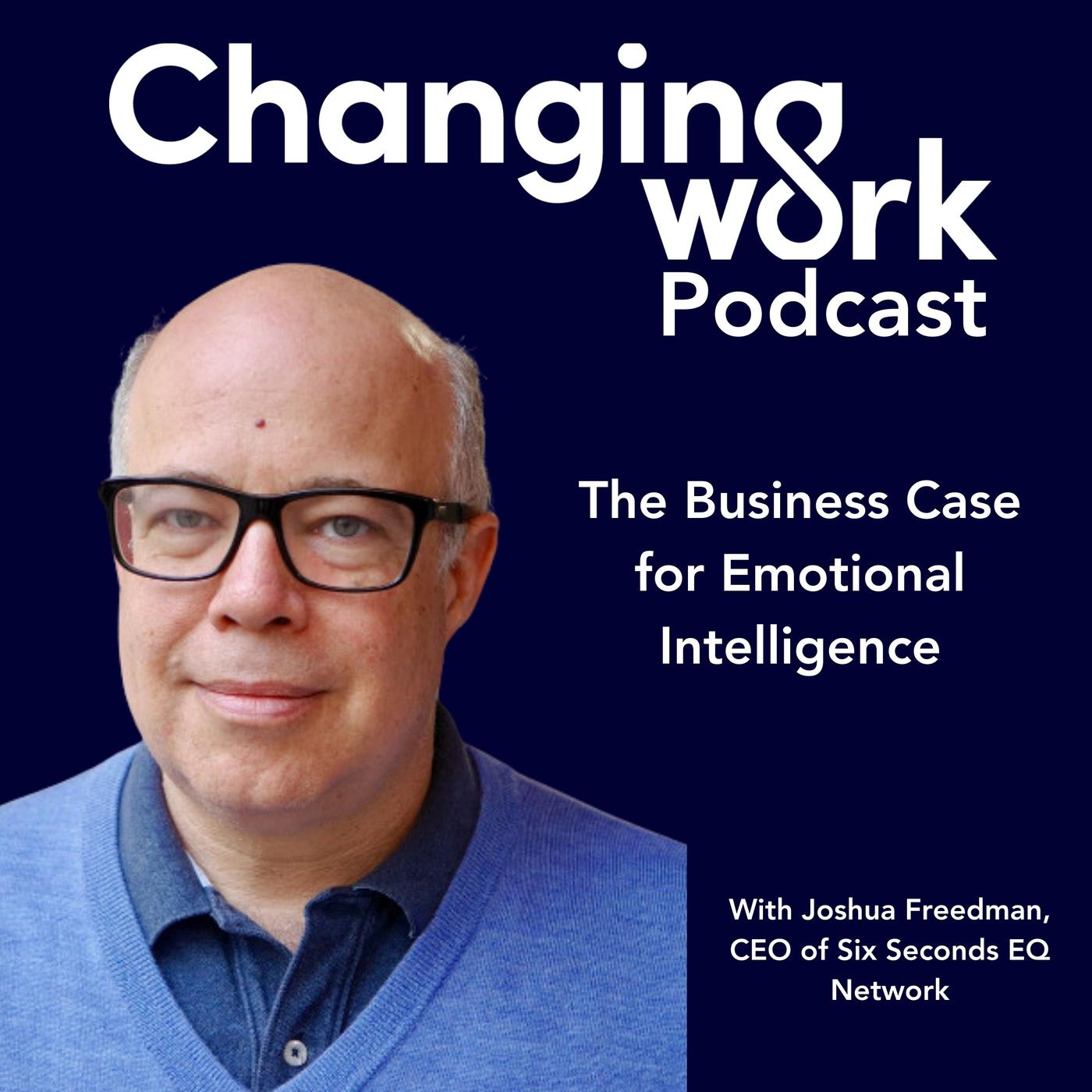
Speaker A
00:00:00
Organizations that prioritize emotional intelligence are 22 times as likely to be high performing.
Speaker A
00:00:06
76% of employee engagement is predicted by managers.
Speaker A
00:00:11
Emotional intelligence.
Speaker A
00:00:14
So basically, if you want people to be engaged, if you want people to be motivated, if you want people to innovate, you want people to solve problems, emotional intelligence is a must have.
Speaker A
00:00:23
And Scott, it's become more predictive over the last five years, so it's becoming more and more important, which makes sense given the kind of mess that we're in in the world.
Speaker B
00:00:34
Hey, friends, welcome to the Changing Work podcast.
Speaker B
00:00:37
We are so glad you're here.
Speaker A
00:00:39
My name is Nick.
Speaker B
00:00:40
And I'm Scott.
Speaker A
00:00:41
And this is the podcast where we talk about changing work from the inside out.
Speaker B
00:00:45
So if you're into making the workplace and the world a better experience via conscious business practices, stick around.
Speaker B
00:00:52
This is for you.
Speaker B
00:00:54
Josh, how are you?
Speaker A
00:00:56
I'm fabulous.
Speaker B
00:00:58
Excellent.
Speaker B
00:00:58
Good to see you.
Speaker B
00:00:59
And where are you dialing in from today?
Speaker A
00:01:02
Santa Cruz, California.
Speaker B
00:01:04
Oh, excellent.
Speaker B
00:01:05
All kinds of neighbors here, holding down the California front.
Speaker B
00:01:09
Well, I'm going to read a little bit about your bio and then you can add any color you like to it and then we will jump into it.
Speaker B
00:01:15
How's that sound?
Speaker B
00:01:16
And do you prefer Josh or Joshua?
Speaker A
00:01:18
I'm happy with either.
Speaker B
00:01:19
Either is good.
Speaker B
00:01:20
Okay.
Speaker B
00:01:21
All right, well, Josh Friedman is one of the world's leading experts on using emotional intelligence to improve performance.
Speaker B
00:01:27
He's the co founder and CEO of Six Seconds, the global non profit dedicated to teaching people how to use emotional intelligence.
Speaker B
00:01:35
He's a master certified coach and instructor for Columbia Teachers College and for Antioch University's doctorate in education and social emotional learning, and teaches professionals all around the world practical tools to measure and create value with emotional intelligence.
Speaker A
00:01:52
Beautiful.
Speaker B
00:01:53
Anything?
Speaker B
00:01:54
What else would you like to add?
Speaker B
00:01:55
It could be fun fact.
Speaker B
00:01:56
It could be, you know, any color you'd like to throw in there.
Speaker A
00:02:00
I'm kind of a neuroscience geek, fascinated by how the brain works.
Speaker A
00:02:04
And I can talk all day about emotions and neuroscience.
Speaker B
00:02:10
So awesome.
Speaker A
00:02:12
Don't get me started.
Speaker B
00:02:15
That's why we're here, my friend.
Speaker B
00:02:16
That's why we're here.
Speaker B
00:02:19
All right, well, before we get into the heady stuff or wherever we're going.
Speaker A
00:02:23
What, like the hardy stuff?
Speaker B
00:02:25
What's that?
Speaker A
00:02:26
The hearty stuff?
Speaker B
00:02:28
The hearty stuff, that's right.
Speaker B
00:02:30
What lights up your heart?
Speaker B
00:02:31
This is where I want to start.
Speaker B
00:02:32
What lights up your heart?
Speaker A
00:02:37
Well, I.
Speaker A
00:02:39
I get to, as a part of my job, I get to work with people as they're learning to develop emotional intelligence.
Speaker A
00:02:47
And there's this moment when people realize my emotions matter and I have choices, and those choices change the future.
Speaker A
00:03:02
And when you can just like, you can just see that little penny dropping.
Speaker A
00:03:08
Sometimes it's as I'm coaching people, sometimes as we're.
Speaker A
00:03:11
I'm leading coach certification programs or working with companies, there's this moment when it's just like, oh, I can change the future for myself, for my business, for my family, for my community, for the world.
Speaker A
00:03:29
And it all starts with emotion.
Speaker A
00:03:31
And that there's something so liberating.
Speaker A
00:03:35
And it just, it lights me up when I see that.
Speaker B
00:03:39
That is beautiful.
Speaker B
00:03:40
I've experienced this.
Speaker B
00:03:41
I'm curious.
Speaker B
00:03:43
So I've experienced Traffic on the 101, which you probably have here as well, in the Bay Area.
Speaker B
00:03:48
And I've experienced.
Speaker B
00:03:49
I.
Speaker B
00:03:49
I discovered a phenomena that is.
Speaker B
00:03:52
I don't know if it's related to electromagnetics, but when you're really, really angry, no one else around you knows how to drive.
Speaker B
00:04:04
I don't know if you've experienced this as well.
Speaker A
00:04:06
Well, I'll tell you, the research on this is part of the way emotions work is we, we do notice things and we interpret things according to our current mood.
Speaker A
00:04:19
And so it's.
Speaker A
00:04:20
It's like a pair of glasses.
Speaker A
00:04:21
Emotions.
Speaker A
00:04:22
Every piece of data that we're bringing in is passing through this filter of our current emotional state.
Speaker A
00:04:30
And again, we could spend a long time talking about this, but basically it's a way for us to use emotions to help us navigate threats and opportunities.
Speaker A
00:04:38
And they don't.
Speaker A
00:04:39
You know, when we're in this emotional state, it's like we're scanning the environment for something.
Speaker A
00:04:45
And it's one of the reasons why emotions have primacy in the brain.
Speaker A
00:04:49
We're not rational people who feel.
Speaker A
00:04:51
We're feeling people who think.
Speaker A
00:04:54
And our brains are primarily driven by emotion and every piece of data.
Speaker A
00:04:59
You know, so even when you have that CFO grant going, let's just be rational.
Speaker A
00:05:03
Like, that's driven by emotion.
Speaker A
00:05:06
And it's probably the CFO being uncomfortable with the emotions that's making them so emotional about it.
Speaker A
00:05:12
But we, we pick up these clues based on our emotional state.
Speaker A
00:05:16
And what you notice, literally, you know, it's Paul Simon song, you're driving down that same very, very same street on that day when you have a different emotional state, you notice different things, you remember different things, and you interpret them differently.
Speaker B
00:05:31
So help me out then.
Speaker B
00:05:33
I'm on the 101.
Speaker B
00:05:34
I'm having a quote bad day one, which probably by your definition is filtered through my Emotion of anger because I'm late for something.
Speaker B
00:05:43
The cars are all stacking up, so I'm in this state.
Speaker B
00:05:48
And then you're talking about.
Speaker B
00:05:49
I have the ability to understand that my emotions are whatever changeable.
Speaker B
00:05:54
I can change my future.
Speaker A
00:05:56
How?
Speaker B
00:05:56
How do I change my future in that moment?
Speaker A
00:05:59
Well, we have a three step process.
Speaker A
00:06:01
The first step is to notice and to collect this data and to say, okay, something's going on here, right?
Speaker A
00:06:10
And that's affecting me.
Speaker A
00:06:13
I'm reacting in a particular way.
Speaker A
00:06:16
And then the second step is to pause.
Speaker A
00:06:19
And I actually have the model right here.
Speaker A
00:06:23
The pause step is red.
Speaker A
00:06:24
So the, the blue step was to notice.
Speaker A
00:06:27
And that's.
Speaker A
00:06:28
We call that know yourself.
Speaker A
00:06:30
And then the red step is to pause and say, okay, wait a minute, is this going where I want to go?
Speaker A
00:06:36
What's the effect of this?
Speaker A
00:06:38
What are the consequences, the practical and emotional consequences?
Speaker A
00:06:42
And if it's not going where I want to go, then maybe I need to try something different.
Speaker A
00:06:47
But it's not enough just to kind of make a behavioral change or work above the waterline on the iceberg.
Speaker A
00:06:53
This is all driven by emotion.
Speaker A
00:06:55
So I need to engage with that emotion.
Speaker A
00:06:57
I need to tune into it.
Speaker A
00:06:58
What is this telling me?
Speaker A
00:06:59
And I don't think anger is bad at all.
Speaker A
00:07:02
Anger is a super useful feeling.
Speaker A
00:07:05
It may be totally the most useful, appropriate feeling in that circumstance.
Speaker A
00:07:10
And it's not inherently any better or worse than happiness or excitement or, or calm.
Speaker A
00:07:16
It's a signal about what you're perceiving.
Speaker A
00:07:20
And it's free data for you, Scott.
Speaker A
00:07:22
Like here, you know, here it is, here's information on your, on your dashboard that you can read, and it tells you something about what you're perceiving and if you can understand that and get the message.
Speaker A
00:07:36
And one of the things that happens as you start naming and understanding, kind of tapping into this feeling, it immediately begins to change and you begin to notice other feelings that you're also having.
Speaker A
00:07:48
We don't just have one feeling at a time.
Speaker A
00:07:51
So if you're angry because you're late, probably there's also some place you want to go.
Speaker A
00:07:57
Anger is connected to motivation.
Speaker A
00:07:59
It's connected to wanting things to change.
Speaker A
00:08:01
I would way rather have frustrated employees than passive employees.
Speaker B
00:08:07
Interesting, right?
Speaker A
00:08:08
Like anger means there's a desire to move, but something's blocking me, in your case, traffic.
Speaker A
00:08:14
Okay, but where you want to move and what's driving that?
Speaker A
00:08:19
So then you kind of come to the end of the red part of the model and you're ready to go.
Speaker A
00:08:22
To the green part.
Speaker A
00:08:24
And by the way, I'm taking a lot longer to explain it than it actually takes in real life.
Speaker A
00:08:28
It actually takes about six seconds to go through these steps.
Speaker A
00:08:32
This, the green step is where do I really want to go?
Speaker A
00:08:35
I'm going to show up at this meeting and I'm.
Speaker A
00:08:37
How I show up is going to have an effect.
Speaker A
00:08:40
In fact, how I'm sitting here in the car right now is having an effect.
Speaker A
00:08:44
Tiny, Tiny.
Speaker A
00:08:47
You know, you're this, this much of the world, but when you change yourself, you change that much of the world.
Speaker A
00:08:52
What is it you want to be putting out there in the world?
Speaker A
00:08:54
How do you want to be showing up?
Speaker A
00:08:56
How do you want to be?
Speaker B
00:08:56
So notice, notice.
Speaker B
00:08:59
Pause.
Speaker B
00:09:00
What's the third one called?
Speaker A
00:09:02
Well, go.
Speaker A
00:09:03
I mean, it's the green one.
Speaker B
00:09:05
Okay, go.
Speaker A
00:09:08
But it's green for go and grow.
Speaker A
00:09:11
But it's about connecting with purpose and also connecting with people.
Speaker B
00:09:15
All right, so you, I think you connected the dots for me.
Speaker B
00:09:19
You said that you're.
Speaker B
00:09:20
Well, I know that you're the CEO of Six Seconds.
Speaker B
00:09:22
This is the name of your company.
Speaker B
00:09:24
And is this why it's Six Seconds?
Speaker B
00:09:26
Because it takes us about six seconds to go through this process.
Speaker A
00:09:29
Yeah.
Speaker A
00:09:30
So Six Seconds is a nonprofit, and we are the largest organization in the world working on developing emotional intelligence.
Speaker A
00:09:38
We were the first international organization in this space.
Speaker A
00:09:40
We work in 150 countries and territories, and a lot of our work is about helping people understand what emotions really are, how they work in the brain.
Speaker A
00:09:49
We do that in every sector.
Speaker A
00:09:52
Emotions are chemicals at a neurobiological level.
Speaker A
00:09:56
And these chemicals affect every living cell in the brain and body.
Speaker A
00:10:00
They affect how we think.
Speaker A
00:10:02
They affect our heart rate, they affect our digestion.
Speaker A
00:10:04
They affect the way we therefore communicate, the way we understand, the way we interact, the way we lead.
Speaker A
00:10:12
These chemicals last in our brains and bodies for about six seconds.
Speaker A
00:10:17
And after about six seconds, the little burst of chemical is broken down, absorbed.
Speaker A
00:10:23
And if you're feeling something for longer than that, it means you're recreating it.
Speaker A
00:10:28
If you believe as I do that there's value in these emotions, it means you have these little six second windows of opportunity to tune in, get the data, get the energy and use it.
Speaker A
00:10:38
Use it on purpose instead of reacting on accident.
Speaker B
00:10:41
Yeah, I've been, I was thinking, as you're saying that there's.
Speaker B
00:10:45
There's definitely.
Speaker B
00:10:45
I'm going to say anger.
Speaker B
00:10:47
There's definitely anger or hurt or other emotions I felt for way longer than six seconds.
Speaker B
00:10:52
Yeah.
Speaker B
00:10:53
Sometimes days or months or Years.
Speaker B
00:10:56
And so you're saying, oh, this is something that I'm continually recreating.
Speaker B
00:10:59
I'm reliving the thing that.
Speaker B
00:11:01
Whatever.
Speaker B
00:11:02
Whatever it was that made me angry in the first place.
Speaker A
00:11:04
Yeah, yeah.
Speaker A
00:11:06
I mean, you might not be doing it consciously, but you are doing that.
Speaker B
00:11:09
Yeah.
Speaker A
00:11:10
And we also.
Speaker A
00:11:13
Emotions are contagious, and the environment that we're in, you know, this, this idea that, you know, all emotions are kind of our own doing is not really true.
Speaker A
00:11:24
We're social animals.
Speaker A
00:11:25
And as social animals, we are wired to be affected by one another.
Speaker A
00:11:31
And so this is one of the problems we're facing in workplaces where we're seeing, you know, massive, unprecedented levels of disconnection, isolation, distress that affects everybody in the environment.
Speaker A
00:11:45
And so I did a little informal survey recently of managers.
Speaker A
00:11:51
How prepared do you feel to deal with the challenges that you're facing today in your workplace?
Speaker A
00:12:03
Only 8% said four or five out of five.
Speaker A
00:12:11
You know, so, like, what we're dealing with.
Speaker A
00:12:13
And I, I mean, I'm a master coach, and I still feel like I don't have the tools that I need as a, as a leader.
Speaker A
00:12:24
The what's coming across my desk, you know, when somebody is, is feeling overwhelmed, facing complexity, feeling burned out, feeling distressed, I'm at the edges of my capacity to support them.
Speaker A
00:12:39
And, you know, I'm not talking about.
Speaker A
00:12:41
I'm not a therapist.
Speaker A
00:12:42
It's not my job to fix anybody or to diagnose anybody.
Speaker A
00:12:46
It's my job to support people, but that what they need support with is a lot harder than it was a few years ago.
Speaker A
00:12:54
And kind of looking at.
Speaker A
00:12:56
We published this amazing research report, the State of the Heart, and the new one is about to come out, and we're seeing 20, 20, 24 data.
Speaker A
00:13:04
It's worse and worse and worse and worse.
Speaker A
00:13:07
The level of dysregulation that we're seeing primarily in our workplaces around the world, it's getting harder.
Speaker B
00:13:16
So what are the things.
Speaker B
00:13:18
I mean, it makes sense, I hear it, that it's worse.
Speaker B
00:13:22
What are the fact, not the factors.
Speaker B
00:13:25
What are the things that let us know it's worse?
Speaker B
00:13:27
Like what's the data say?
Speaker A
00:13:30
Well, I mentioned loneliness and disconnection, you know, is one indicator in the workplace.
Speaker A
00:13:36
You know, we, A lot of organizations measure engagement.
Speaker A
00:13:40
Engagement is stubbornly low.
Speaker A
00:13:44
Absenteeism, turnover, quiet quitting and loud quitting.
Speaker A
00:13:51
They're all of these, all of these signs.
Speaker A
00:13:55
I think that there's a certain amount that, that organizational leaders are just kind of stuck in the.
Speaker A
00:14:03
Well, it, it just, it's just bad.
Speaker A
00:14:05
That's the way it is.
Speaker A
00:14:08
And I think we're tolerating a level of distress in our organizations and kind of settling for a very mediocre status quo.
Speaker A
00:14:20
In a lot of organizations where people are not performing well, people are, are miserable.
Speaker A
00:14:27
The human cost and business cost is very, very high, but it's, it's hard to untangle.
Speaker A
00:14:34
And so a lot of leaders are like, well, we can't fix it.
Speaker A
00:14:38
We just have to endure it.
Speaker A
00:14:39
And that's not true.
Speaker B
00:14:41
No, that's not true.
Speaker B
00:14:43
We talk about people's mental well being, but you started this talking about emotions and how everything gets, you know, essentially filtered through our emotions.
Speaker B
00:14:54
Should we be talking about emotional well being instead?
Speaker B
00:14:57
Or how are they the same or how are they different?
Speaker A
00:15:01
Yeah, I like emotional well being a lot.
Speaker A
00:15:03
We measure well being in our emotional intelligence assessment.
Speaker A
00:15:07
We measure four outcomes.
Speaker A
00:15:09
Effectiveness, relationships, quality of life, and well being.
Speaker A
00:15:13
When we think about well being is essentially the ability to sustain the energy that we need to do the other things.
Speaker A
00:15:21
So that's, that's, that's physical as well as mental and emotional.
Speaker A
00:15:27
I think if you think about a kind of what is the energy you need to do what you're trying to do and do you have enough of it?
Speaker A
00:15:36
And what if in your organization you had more of it?
Speaker A
00:15:41
Whether that's about innovation or problem solving or shipping faster or meeting customers where they are, or understanding people or, you know, transforming your, your industry, whatever it is you're trying to achieve, you know, people coming out of the hospital healthier, or we work with the U.N.
Speaker A
00:16:00
for example, like people actually solving problems together.
Speaker A
00:16:03
Whatever your key outcomes are, what is the energy that it's going to take to do that?
Speaker A
00:16:08
And work is work.
Speaker A
00:16:10
It's, I mean, we.
Speaker A
00:16:11
The word work, right?
Speaker A
00:16:12
It means like energy to get things done.
Speaker A
00:16:18
Some of that comes from our systems and structures, but mostly that comes from people.
Speaker A
00:16:23
And I think this is the great sort of Myth of the 1900s, is that we could just industrialize it all.
Speaker A
00:16:31
We could have widgets, and we became human resources.
Speaker A
00:16:35
And we talk about people as roles and we, you know, we've, we, we sort of dehumanized work.
Speaker A
00:16:41
And I think, as you know, in the People Summit, I think it's time for us to say, you know, our job is, is humans.
Speaker A
00:16:50
It's about humanizing the workplace.
Speaker A
00:16:52
It's about recognizing that people are what drive performance and emotions are what drive people.
Speaker A
00:16:59
So if we want to get, you know, want to get that formula working, and that's the business Case for emotional intelligence in two sentences.
Speaker A
00:17:08
Emotions drive people, people drive performance.
Speaker B
00:17:10
Sure.
Speaker B
00:17:11
So let's say that we have leaders or HR professionals listening like, okay, great, I, I'm in.
Speaker B
00:17:17
I get it.
Speaker B
00:17:18
But what do we actually do?
Speaker B
00:17:21
How do we help our leaders?
Speaker A
00:17:22
Question, Scott.
Speaker A
00:17:24
I love it when, you know, entrepreneurs, sea level leaders ask me that and say, okay, we, we really see that, that, you know, culture, eat strategy for breakfast.
Speaker A
00:17:36
We've got to have a great culture or we're not going to get the results we want.
Speaker A
00:17:41
How do we do it?
Speaker A
00:17:43
And essentially we need to look the same way.
Speaker A
00:17:47
We might do business process, re engineering, look across the stages of the employee life cycle, look across the, the touch points from before people join all the way through to when they leave.
Speaker A
00:17:59
All of the ways that we interact and fuel and shape culture.
Speaker A
00:18:02
Culture will happen automatically if you don't shape it intentionally.
Speaker A
00:18:08
And it tends to kind of regress to the lowest common denominator.
Speaker A
00:18:12
Instead we can say, all right, first of all, what is the business case for us and are we truly aligned?
Speaker A
00:18:19
Do we at the board level, at the C level, do we really believe that, that the, that we as leaders are shaping the culture and conditions in which people work?
Speaker A
00:18:34
As a CEO, are you the chief emotions officer or you know, are you, are you the chief book balancing officer?
Speaker B
00:18:42
Mm.
Speaker A
00:18:46
Can we make that business case for ourselves and is it clear and are we bought in once?
Speaker A
00:18:52
Yes.
Speaker A
00:18:52
The rest is actually quite easy.
Speaker A
00:18:54
Most business leaders are great at optimizing.
Speaker A
00:18:59
They really understand how to like, okay, we're going to measure this and we're going to optimize against that constraint.
Speaker A
00:19:04
So we can measure this and we can optimize against that constraint.
Speaker A
00:19:07
We can measure it at an individual skill level and we can measure it at a team and organizational level.
Speaker A
00:19:12
And we can see, okay, how are we building trust and what are the skills that we need to develop as leaders?
Speaker A
00:19:20
And then we start doing that again across the employee lifecycle.
Speaker A
00:19:24
How are we onboarding people?
Speaker A
00:19:25
How are we hiring?
Speaker A
00:19:26
How are we, you know, attracting people?
Speaker A
00:19:28
How are we onboarding them, how are we developing them, how are we promoting them?
Speaker A
00:19:32
How are we shaping culture in a day to day basis?
Speaker A
00:19:35
And I think that this, this piece of it, of saying it's not a training, training does little, but culture shaping does lots.
Speaker A
00:19:49
And really thinking less about, oh, we're gonna build this skill and learn this thing.
Speaker A
00:19:54
And it's, we got this long laundry list of, of topics we're going to train.
Speaker A
00:19:58
No, let's really look at, in the day to day and in the real world.
Speaker A
00:20:03
That's one reason coaching is so powerful and why every leader needs coaching skills.
Speaker A
00:20:09
Because this isn't an HR responsibility.
Speaker A
00:20:12
This is a leadership responsibility.
Speaker A
00:20:14
Leaders are the culture shapers, and that takes skills.
Speaker B
00:20:20
Beautiful.
Speaker B
00:20:20
So what I hear you say is it starts with, first of all, it starts at the top.
Speaker B
00:20:24
Almost always does.
Speaker B
00:20:26
For the leadership team to say, it's our responsibility to shape the culture.
Speaker B
00:20:32
The culture is going to happen no matter what, but we might as well shape it the way we want and to be responsible for it.
Speaker B
00:20:39
I'd love to.
Speaker B
00:20:40
I'm a really practical guy.
Speaker B
00:20:41
I spent most of my career in the operations world.
Speaker B
00:20:44
So what are, like, a few things I can do as a leader to shape it in that positive way?
Speaker A
00:20:52
Yeah.
Speaker A
00:20:52
So again, I think practicing the skills yourself is going to be really important.
Speaker A
00:20:58
I used to be afraid of emotions, and I would be in a meeting and somebody would be right, and they're sending a very clear emotional message, and I would avoid the heck out of it.
Speaker B
00:21:12
Yeah.
Speaker A
00:21:12
And I had this false belief that if I kind of noticed it and named it, that it would kind of open Pandora's Box.
Speaker A
00:21:21
And I've learned since then, Pandora's Box was already opened.
Speaker B
00:21:26
That's the place we're already living.
Speaker A
00:21:28
It is open, and everyone in the room is noticing it already.
Speaker B
00:21:32
Yeah.
Speaker A
00:21:32
And what's been fascinating to me, Scott, is that if I say, hey, you know, Joe, looks like something's going on over there.
Speaker A
00:21:41
You want to share a little bit what's happening?
Speaker A
00:21:44
Very often that's all I need to do.
Speaker A
00:21:47
Joe's like, yeah, I'm really frustrated about da da da da.
Speaker A
00:21:49
And I don't need to fix it.
Speaker A
00:21:51
I don't need to fade it.
Speaker A
00:21:52
I don't need to smooth it over.
Speaker A
00:21:54
I just go, oh, thank you for sharing that.
Speaker B
00:22:00
And what is.
Speaker B
00:22:03
Yeah.
Speaker B
00:22:03
What occurs to me is that part of it is as simple as our own relationship with emotion.
Speaker B
00:22:10
Like the.
Speaker B
00:22:11
Even what you just said, the before and after.
Speaker B
00:22:13
The before is like, well, I'll put extra words in it like, oh, people are messy and it's kind of scary.
Speaker B
00:22:19
And I don't.
Speaker B
00:22:20
I'm just going to avoid all this emotional stuff.
Speaker B
00:22:23
And I don't really know what to do because it's so complicated versus saying, actually, I know a lot about emotion.
Speaker B
00:22:30
I've lived my whole life tuning into emotions and just having some bravery around it to say, hey, Joe, tell me what's going on.
Speaker A
00:22:39
Yeah, it's huge.
Speaker A
00:22:41
I've also found.
Speaker A
00:22:43
I mean, I'm.
Speaker A
00:22:44
I come from a very quantitative Family culture.
Speaker A
00:22:48
My parents were both statisticians.
Speaker A
00:22:50
And so my approach to emotions has been a really logical approach.
Speaker A
00:22:58
And learning, as I said, learning about the neuroscience, learning what emotions actually are and what they mean and how they work, learning how the brain works.
Speaker A
00:23:06
It's given me a lot of comfort to say, oh, okay, I can do this.
Speaker A
00:23:12
So one of the first skills that we encourage people to develop is emotional literacy.
Speaker A
00:23:17
Just expanding your emotional vocabulary, you know, do you know the difference between, you know, frustration and anger, disappointment and sorrow?
Speaker A
00:23:25
Like, what is disappointment?
Speaker A
00:23:27
You know?
Speaker A
00:23:27
And if Joe says, I'm feeling kind of disappointed, like, do you know what that actually means, by the way?
Speaker A
00:23:33
What it means is I'm a little frustrated and a little sad.
Speaker B
00:23:36
Okay.
Speaker A
00:23:37
And every basic emotion.
Speaker B
00:23:38
Curious about this, what this is.
Speaker B
00:23:42
This is good, right?
Speaker B
00:23:43
So I probably have caveman language to describe my emotions.
Speaker A
00:23:48
Man.
Speaker B
00:23:49
Happy.
Speaker B
00:23:52
So it sounds like you have, you know, more colors of the rainbow of all these emotions.
Speaker B
00:23:57
How exactly do you teach that?
Speaker A
00:24:01
Practicing, you know, practicing with people who are more comfortable and who've learned those feelings.
Speaker A
00:24:08
Studying.
Speaker A
00:24:09
We have a really cool free online tool which is an interactive emotion wheel.
Speaker A
00:24:15
It uses the.
Speaker A
00:24:16
The plutic model of emotional intelligence, which is.
Speaker A
00:24:19
Speaking of rainbows, is this little.
Speaker A
00:24:21
The model is actually this ice cream cone, and it's been unfolded into this flower.
Speaker A
00:24:27
But it's got an interesting logic to it.
Speaker A
00:24:31
And so we built a little free interactive tool.
Speaker A
00:24:35
If you go to 6sec.org wheel you can find it, and you can click around and go, well, what does that mean?
Speaker A
00:24:43
And one of my favorite things is this little button that says, explore the opposite.
Speaker A
00:24:49
And for me, I've been like, okay, so I'm feeling frustrated.
Speaker A
00:24:55
That's kind of in the anger pedal.
Speaker A
00:24:57
I'll say annoyed because it doesn't actually have frustration.
Speaker A
00:25:00
It is annoyance.
Speaker A
00:25:01
What's the opposite?
Speaker A
00:25:02
And I click it and I go, oh, that really helps me understand what this is.
Speaker B
00:25:08
What is the opposite of annoyed?
Speaker A
00:25:12
Apprehension.
Speaker B
00:25:14
Apprehension, yeah.
Speaker A
00:25:17
So the reason these two are up this is.
Speaker A
00:25:20
We're getting.
Speaker A
00:25:21
Getting in the weeds here.
Speaker A
00:25:22
But Pluchic comes from.
Speaker A
00:25:26
He studied animal behavior kind of from the Darwin tradition.
Speaker A
00:25:29
And what he was looking at was the adaptive function of emotion.
Speaker A
00:25:34
So this actually, this model was created originally about animals.
Speaker A
00:25:38
And if you have an angry dog, it's.
Speaker A
00:25:42
And if you have a scared dog, it's Right.
Speaker A
00:25:45
So it has an opposite physiological response.
Speaker A
00:25:50
And so that's why those are opposite.
Speaker A
00:25:53
But anger means I want to move forward, but my way is blocked.
Speaker A
00:26:00
And fear means something that I care about is at risk.
Speaker A
00:26:05
And they're both, they're both connected to this, like something's important.
Speaker A
00:26:12
In fact, basically all emotions are connected to something's important.
Speaker A
00:26:16
We have bigger feelings.
Speaker A
00:26:18
And I really love the term big feelings because it's neutral.
Speaker A
00:26:22
I'm having big feelings about this.
Speaker A
00:26:23
It's because I'm perceiving something big.
Speaker A
00:26:28
You know, coming back to this, this part about, you know, when I said the green part of the model, we're connecting with purpose.
Speaker A
00:26:35
Purpose is part of what's big for us.
Speaker A
00:26:38
So when we, when we connect with emotions, it's because we care about something and emotions become signals to us to help us navigate towards what's really important.
Speaker B
00:26:56
I love this.
Speaker B
00:26:57
We definitely could talk all day about this stuff.
Speaker B
00:27:02
One of the things I know that you're trying to do at six seconds, you have a vision of a billion people practicing emotional intelligence.
Speaker A
00:27:12
Yeah.
Speaker B
00:27:13
First of all, what does that even mean, to practice it?
Speaker A
00:27:16
Well, we went through it, right?
Speaker A
00:27:17
It's this little three step process, noticing I'm turning off the autopilot and I'm, I'm going to respond intentionally and I'm stepping forward on purpose.
Speaker A
00:27:26
That's practicing beautiful.
Speaker B
00:27:27
Okay.
Speaker B
00:27:28
And in this world, what are the stakes?
Speaker A
00:27:33
Right?
Speaker B
00:27:33
I think it's probably obvious, but what are the stakes if a billion or 8 billion people practice this?
Speaker A
00:27:41
Well, first I just want to put it in a business context.
Speaker A
00:27:47
Emotional intelligence is twice as predictive of IQ for performance.
Speaker A
00:27:51
Organizations that prioritize emotional intelligence are 22 times more likely to be high performing.
Speaker B
00:27:58
Whoa, whoa, whoa, say that again.
Speaker A
00:28:01
Organizations that prioritize emotional intelligence are 22 times as likely to be high performing.
Speaker A
00:28:07
And 76% of employee motivation, employee engagement is predicted by managers.
Speaker A
00:28:16
Emotional intelligence.
Speaker A
00:28:19
So basically, if you want people to be engaged, if you want people to be motivated, you want people to innovate, you want people to solve problems, Emotional intelligence is a must have.
Speaker A
00:28:27
And Scott, it's become more predictive over the last five years.
Speaker A
00:28:33
So it's becoming more and more important, which makes sense given the kind of mess that we're in in the world.
Speaker A
00:28:39
So that's the business case.
Speaker A
00:28:41
The human cases is broader.
Speaker A
00:28:45
We know that we are facing a metac crisis as some researchers calling it, this constellation of social, environmental, business, geopolitical factors coming together in this moment.
Speaker A
00:29:05
We have a level of polarization that we haven't seen in the world in a very long time.
Speaker A
00:29:10
All over the world we're seeing, you know, the hottest temperatures on record for five years, breaking the world record for five years in a row.
Speaker A
00:29:21
We have young people who are at a level of despair that's truly alarming.
Speaker A
00:29:28
And we know that there are skills that are measurable, learnable, scientifically grounded skills that make a difference in all of these things.
Speaker A
00:29:41
And we know that people who have developed, develop and practice these skills have more effectiveness, better quality of life, stronger relationships and better well being.
Speaker A
00:29:52
So that's the stakes that's hard to ignore.
Speaker B
00:29:57
So in this world where, at least from this research and from experience, it's really obvious that this is powerful and that it works, why don't we do.
Speaker A
00:30:10
This as a people, I would say we are.
Speaker A
00:30:14
I actually asked that question.
Speaker A
00:30:16
We'd.
Speaker A
00:30:16
One of our research studies is called work, called the Workplace Vitality Study.
Speaker A
00:30:23
And we actually asked that question, why in your organization do, do and don't you prioritize emotional intelligence?
Speaker A
00:30:31
Often the answer is we don't know how.
Speaker A
00:30:35
But the biggest answer is we have a culture that's toxic.
Speaker A
00:30:43
And I think that we, I just did a, a post on this that kind of blew up on LinkedIn, which was what we, you know, what is the a boss do?
Speaker A
00:30:54
And I think we have a particular view of power, we have a particular view of strong, which is rooted in some very old norms.
Speaker A
00:31:06
And I have many, many times I've had senior leaders who I'm coaching say to me, you know, this isn't how I really want to show up, but as a senior leader I'm supposed to blah, blah, blah, blah.
Speaker A
00:31:19
Where did that supposed to come from?
Speaker B
00:31:21
Yeah.
Speaker A
00:31:22
And is that what we actually need right now?
Speaker B
00:31:25
Yeah, yeah, yeah.
Speaker B
00:31:29
Shedding the shackles of should, as my friend Shelley's Paxton says.
Speaker A
00:31:34
Yeah.
Speaker A
00:31:35
Stop shitting all over yourself.
Speaker A
00:31:37
That's right.
Speaker B
00:31:40
Josh, if people want to find you in six seconds, where's the best place?
Speaker A
00:31:45
6Seconds.Org 6seconds.org.
Speaker A
00:31:48
We're also on LinkedIn, other social media and by the way, I mentioned, we work all over the world.
Speaker A
00:31:56
We have tools in 30 languages, we have teams in lots and lots of places and lots of languages in the world.
Speaker A
00:32:02
So where, wherever you are, we will, we'll meet you there.
Speaker B
00:32:06
Cool.
Speaker B
00:32:07
And I know there's lots of people who talk about emotional intelligence.
Speaker B
00:32:10
How is 6 seconds different than the rest?
Speaker A
00:32:15
Well, we were at least one of, if not the first.
Speaker A
00:32:20
We're the largest global organization.
Speaker A
00:32:22
We're a not for profit, we're driven by purpose.
Speaker A
00:32:27
And our approach is it's very practical, it's highly measurable and we have a whole set of tools and systems.
Speaker A
00:32:36
Everything from, we do like almost many times a week, we're doing free introductory sessions all the way up to a doctorate that we run in this topic.
Speaker A
00:32:46
So we're, we're, we've been doing this for over 25 years.
Speaker A
00:32:50
And if you want to really go deep and use this in a transformative way, then we're the people to talk to.
Speaker B
00:32:59
Fantastic.
Speaker B
00:33:01
Last question.
Speaker B
00:33:03
What gives you hope?
Speaker A
00:33:06
Well, one answer to that is in the intro.
Speaker A
00:33:12
You mentioned that I am adjunct at Columbia University.
Speaker A
00:33:15
I'm working in a program where I teach leadership to aspiring school principals.
Speaker A
00:33:21
And it's a program that's particularly was created to engage and support school principals who want to work in areas of deep inequity and mostly in poor communities.
Speaker A
00:33:36
And I've been doing that for seven years now with some amazing colleagues.
Speaker A
00:33:41
And these young leaders are absolutely determined that your, your last name and zip code will not determine your future.
Speaker A
00:33:51
They truly believe that education is the path to a better world.
Speaker A
00:33:56
And just being around that kind of leadership has given me a lot of hope.
Speaker B
00:34:03
Thank you so much for the work that you're doing, Josh, the work that you and your team are doing.
Speaker B
00:34:07
And thank you for sharing your wisdom and your energy with us here today.
Speaker A
00:34:12
Thank you for having me.
Speaker A
00:34:13
And thank you all you people who are putting people at the center.
Speaker B
00:34:18
Awesome.
00:00:00
Organizations that prioritize emotional intelligence are 22 times as likely to be high performing.
Speaker A
00:00:06
76% of employee engagement is predicted by managers.
Speaker A
00:00:11
Emotional intelligence.
Speaker A
00:00:14
So basically, if you want people to be engaged, if you want people to be motivated, if you want people to innovate, you want people to solve problems, emotional intelligence is a must have.
Speaker A
00:00:23
And Scott, it's become more predictive over the last five years, so it's becoming more and more important, which makes sense given the kind of mess that we're in in the world.
Speaker B
00:00:34
Hey, friends, welcome to the Changing Work podcast.
Speaker B
00:00:37
We are so glad you're here.
Speaker A
00:00:39
My name is Nick.
Speaker B
00:00:40
And I'm Scott.
Speaker A
00:00:41
And this is the podcast where we talk about changing work from the inside out.
Speaker B
00:00:45
So if you're into making the workplace and the world a better experience via conscious business practices, stick around.
Speaker B
00:00:52
This is for you.
Speaker B
00:00:54
Josh, how are you?
Speaker A
00:00:56
I'm fabulous.
Speaker B
00:00:58
Excellent.
Speaker B
00:00:58
Good to see you.
Speaker B
00:00:59
And where are you dialing in from today?
Speaker A
00:01:02
Santa Cruz, California.
Speaker B
00:01:04
Oh, excellent.
Speaker B
00:01:05
All kinds of neighbors here, holding down the California front.
Speaker B
00:01:09
Well, I'm going to read a little bit about your bio and then you can add any color you like to it and then we will jump into it.
Speaker B
00:01:15
How's that sound?
Speaker B
00:01:16
And do you prefer Josh or Joshua?
Speaker A
00:01:18
I'm happy with either.
Speaker B
00:01:19
Either is good.
Speaker B
00:01:20
Okay.
Speaker B
00:01:21
All right, well, Josh Friedman is one of the world's leading experts on using emotional intelligence to improve performance.
Speaker B
00:01:27
He's the co founder and CEO of Six Seconds, the global non profit dedicated to teaching people how to use emotional intelligence.
Speaker B
00:01:35
He's a master certified coach and instructor for Columbia Teachers College and for Antioch University's doctorate in education and social emotional learning, and teaches professionals all around the world practical tools to measure and create value with emotional intelligence.
Speaker A
00:01:52
Beautiful.
Speaker B
00:01:53
Anything?
Speaker B
00:01:54
What else would you like to add?
Speaker B
00:01:55
It could be fun fact.
Speaker B
00:01:56
It could be, you know, any color you'd like to throw in there.
Speaker A
00:02:00
I'm kind of a neuroscience geek, fascinated by how the brain works.
Speaker A
00:02:04
And I can talk all day about emotions and neuroscience.
Speaker B
00:02:10
So awesome.
Speaker A
00:02:12
Don't get me started.
Speaker B
00:02:15
That's why we're here, my friend.
Speaker B
00:02:16
That's why we're here.
Speaker B
00:02:19
All right, well, before we get into the heady stuff or wherever we're going.
Speaker A
00:02:23
What, like the hardy stuff?
Speaker B
00:02:25
What's that?
Speaker A
00:02:26
The hearty stuff?
Speaker B
00:02:28
The hearty stuff, that's right.
Speaker B
00:02:30
What lights up your heart?
Speaker B
00:02:31
This is where I want to start.
Speaker B
00:02:32
What lights up your heart?
Speaker A
00:02:37
Well, I.
Speaker A
00:02:39
I get to, as a part of my job, I get to work with people as they're learning to develop emotional intelligence.
Speaker A
00:02:47
And there's this moment when people realize my emotions matter and I have choices, and those choices change the future.
Speaker A
00:03:02
And when you can just like, you can just see that little penny dropping.
Speaker A
00:03:08
Sometimes it's as I'm coaching people, sometimes as we're.
Speaker A
00:03:11
I'm leading coach certification programs or working with companies, there's this moment when it's just like, oh, I can change the future for myself, for my business, for my family, for my community, for the world.
Speaker A
00:03:29
And it all starts with emotion.
Speaker A
00:03:31
And that there's something so liberating.
Speaker A
00:03:35
And it just, it lights me up when I see that.
Speaker B
00:03:39
That is beautiful.
Speaker B
00:03:40
I've experienced this.
Speaker B
00:03:41
I'm curious.
Speaker B
00:03:43
So I've experienced Traffic on the 101, which you probably have here as well, in the Bay Area.
Speaker B
00:03:48
And I've experienced.
Speaker B
00:03:49
I.
Speaker B
00:03:49
I discovered a phenomena that is.
Speaker B
00:03:52
I don't know if it's related to electromagnetics, but when you're really, really angry, no one else around you knows how to drive.
Speaker B
00:04:04
I don't know if you've experienced this as well.
Speaker A
00:04:06
Well, I'll tell you, the research on this is part of the way emotions work is we, we do notice things and we interpret things according to our current mood.
Speaker A
00:04:19
And so it's.
Speaker A
00:04:20
It's like a pair of glasses.
Speaker A
00:04:21
Emotions.
Speaker A
00:04:22
Every piece of data that we're bringing in is passing through this filter of our current emotional state.
Speaker A
00:04:30
And again, we could spend a long time talking about this, but basically it's a way for us to use emotions to help us navigate threats and opportunities.
Speaker A
00:04:38
And they don't.
Speaker A
00:04:39
You know, when we're in this emotional state, it's like we're scanning the environment for something.
Speaker A
00:04:45
And it's one of the reasons why emotions have primacy in the brain.
Speaker A
00:04:49
We're not rational people who feel.
Speaker A
00:04:51
We're feeling people who think.
Speaker A
00:04:54
And our brains are primarily driven by emotion and every piece of data.
Speaker A
00:04:59
You know, so even when you have that CFO grant going, let's just be rational.
Speaker A
00:05:03
Like, that's driven by emotion.
Speaker A
00:05:06
And it's probably the CFO being uncomfortable with the emotions that's making them so emotional about it.
Speaker A
00:05:12
But we, we pick up these clues based on our emotional state.
Speaker A
00:05:16
And what you notice, literally, you know, it's Paul Simon song, you're driving down that same very, very same street on that day when you have a different emotional state, you notice different things, you remember different things, and you interpret them differently.
Speaker B
00:05:31
So help me out then.
Speaker B
00:05:33
I'm on the 101.
Speaker B
00:05:34
I'm having a quote bad day one, which probably by your definition is filtered through my Emotion of anger because I'm late for something.
Speaker B
00:05:43
The cars are all stacking up, so I'm in this state.
Speaker B
00:05:48
And then you're talking about.
Speaker B
00:05:49
I have the ability to understand that my emotions are whatever changeable.
Speaker B
00:05:54
I can change my future.
Speaker A
00:05:56
How?
Speaker B
00:05:56
How do I change my future in that moment?
Speaker A
00:05:59
Well, we have a three step process.
Speaker A
00:06:01
The first step is to notice and to collect this data and to say, okay, something's going on here, right?
Speaker A
00:06:10
And that's affecting me.
Speaker A
00:06:13
I'm reacting in a particular way.
Speaker A
00:06:16
And then the second step is to pause.
Speaker A
00:06:19
And I actually have the model right here.
Speaker A
00:06:23
The pause step is red.
Speaker A
00:06:24
So the, the blue step was to notice.
Speaker A
00:06:27
And that's.
Speaker A
00:06:28
We call that know yourself.
Speaker A
00:06:30
And then the red step is to pause and say, okay, wait a minute, is this going where I want to go?
Speaker A
00:06:36
What's the effect of this?
Speaker A
00:06:38
What are the consequences, the practical and emotional consequences?
Speaker A
00:06:42
And if it's not going where I want to go, then maybe I need to try something different.
Speaker A
00:06:47
But it's not enough just to kind of make a behavioral change or work above the waterline on the iceberg.
Speaker A
00:06:53
This is all driven by emotion.
Speaker A
00:06:55
So I need to engage with that emotion.
Speaker A
00:06:57
I need to tune into it.
Speaker A
00:06:58
What is this telling me?
Speaker A
00:06:59
And I don't think anger is bad at all.
Speaker A
00:07:02
Anger is a super useful feeling.
Speaker A
00:07:05
It may be totally the most useful, appropriate feeling in that circumstance.
Speaker A
00:07:10
And it's not inherently any better or worse than happiness or excitement or, or calm.
Speaker A
00:07:16
It's a signal about what you're perceiving.
Speaker A
00:07:20
And it's free data for you, Scott.
Speaker A
00:07:22
Like here, you know, here it is, here's information on your, on your dashboard that you can read, and it tells you something about what you're perceiving and if you can understand that and get the message.
Speaker A
00:07:36
And one of the things that happens as you start naming and understanding, kind of tapping into this feeling, it immediately begins to change and you begin to notice other feelings that you're also having.
Speaker A
00:07:48
We don't just have one feeling at a time.
Speaker A
00:07:51
So if you're angry because you're late, probably there's also some place you want to go.
Speaker A
00:07:57
Anger is connected to motivation.
Speaker A
00:07:59
It's connected to wanting things to change.
Speaker A
00:08:01
I would way rather have frustrated employees than passive employees.
Speaker B
00:08:07
Interesting, right?
Speaker A
00:08:08
Like anger means there's a desire to move, but something's blocking me, in your case, traffic.
Speaker A
00:08:14
Okay, but where you want to move and what's driving that?
Speaker A
00:08:19
So then you kind of come to the end of the red part of the model and you're ready to go.
Speaker A
00:08:22
To the green part.
Speaker A
00:08:24
And by the way, I'm taking a lot longer to explain it than it actually takes in real life.
Speaker A
00:08:28
It actually takes about six seconds to go through these steps.
Speaker A
00:08:32
This, the green step is where do I really want to go?
Speaker A
00:08:35
I'm going to show up at this meeting and I'm.
Speaker A
00:08:37
How I show up is going to have an effect.
Speaker A
00:08:40
In fact, how I'm sitting here in the car right now is having an effect.
Speaker A
00:08:44
Tiny, Tiny.
Speaker A
00:08:47
You know, you're this, this much of the world, but when you change yourself, you change that much of the world.
Speaker A
00:08:52
What is it you want to be putting out there in the world?
Speaker A
00:08:54
How do you want to be showing up?
Speaker A
00:08:56
How do you want to be?
Speaker B
00:08:56
So notice, notice.
Speaker B
00:08:59
Pause.
Speaker B
00:09:00
What's the third one called?
Speaker A
00:09:02
Well, go.
Speaker A
00:09:03
I mean, it's the green one.
Speaker B
00:09:05
Okay, go.
Speaker A
00:09:08
But it's green for go and grow.
Speaker A
00:09:11
But it's about connecting with purpose and also connecting with people.
Speaker B
00:09:15
All right, so you, I think you connected the dots for me.
Speaker B
00:09:19
You said that you're.
Speaker B
00:09:20
Well, I know that you're the CEO of Six Seconds.
Speaker B
00:09:22
This is the name of your company.
Speaker B
00:09:24
And is this why it's Six Seconds?
Speaker B
00:09:26
Because it takes us about six seconds to go through this process.
Speaker A
00:09:29
Yeah.
Speaker A
00:09:30
So Six Seconds is a nonprofit, and we are the largest organization in the world working on developing emotional intelligence.
Speaker A
00:09:38
We were the first international organization in this space.
Speaker A
00:09:40
We work in 150 countries and territories, and a lot of our work is about helping people understand what emotions really are, how they work in the brain.
Speaker A
00:09:49
We do that in every sector.
Speaker A
00:09:52
Emotions are chemicals at a neurobiological level.
Speaker A
00:09:56
And these chemicals affect every living cell in the brain and body.
Speaker A
00:10:00
They affect how we think.
Speaker A
00:10:02
They affect our heart rate, they affect our digestion.
Speaker A
00:10:04
They affect the way we therefore communicate, the way we understand, the way we interact, the way we lead.
Speaker A
00:10:12
These chemicals last in our brains and bodies for about six seconds.
Speaker A
00:10:17
And after about six seconds, the little burst of chemical is broken down, absorbed.
Speaker A
00:10:23
And if you're feeling something for longer than that, it means you're recreating it.
Speaker A
00:10:28
If you believe as I do that there's value in these emotions, it means you have these little six second windows of opportunity to tune in, get the data, get the energy and use it.
Speaker A
00:10:38
Use it on purpose instead of reacting on accident.
Speaker B
00:10:41
Yeah, I've been, I was thinking, as you're saying that there's.
Speaker B
00:10:45
There's definitely.
Speaker B
00:10:45
I'm going to say anger.
Speaker B
00:10:47
There's definitely anger or hurt or other emotions I felt for way longer than six seconds.
Speaker B
00:10:52
Yeah.
Speaker B
00:10:53
Sometimes days or months or Years.
Speaker B
00:10:56
And so you're saying, oh, this is something that I'm continually recreating.
Speaker B
00:10:59
I'm reliving the thing that.
Speaker B
00:11:01
Whatever.
Speaker B
00:11:02
Whatever it was that made me angry in the first place.
Speaker A
00:11:04
Yeah, yeah.
Speaker A
00:11:06
I mean, you might not be doing it consciously, but you are doing that.
Speaker B
00:11:09
Yeah.
Speaker A
00:11:10
And we also.
Speaker A
00:11:13
Emotions are contagious, and the environment that we're in, you know, this, this idea that, you know, all emotions are kind of our own doing is not really true.
Speaker A
00:11:24
We're social animals.
Speaker A
00:11:25
And as social animals, we are wired to be affected by one another.
Speaker A
00:11:31
And so this is one of the problems we're facing in workplaces where we're seeing, you know, massive, unprecedented levels of disconnection, isolation, distress that affects everybody in the environment.
Speaker A
00:11:45
And so I did a little informal survey recently of managers.
Speaker A
00:11:51
How prepared do you feel to deal with the challenges that you're facing today in your workplace?
Speaker A
00:12:03
Only 8% said four or five out of five.
Speaker A
00:12:11
You know, so, like, what we're dealing with.
Speaker A
00:12:13
And I, I mean, I'm a master coach, and I still feel like I don't have the tools that I need as a, as a leader.
Speaker A
00:12:24
The what's coming across my desk, you know, when somebody is, is feeling overwhelmed, facing complexity, feeling burned out, feeling distressed, I'm at the edges of my capacity to support them.
Speaker A
00:12:39
And, you know, I'm not talking about.
Speaker A
00:12:41
I'm not a therapist.
Speaker A
00:12:42
It's not my job to fix anybody or to diagnose anybody.
Speaker A
00:12:46
It's my job to support people, but that what they need support with is a lot harder than it was a few years ago.
Speaker A
00:12:54
And kind of looking at.
Speaker A
00:12:56
We published this amazing research report, the State of the Heart, and the new one is about to come out, and we're seeing 20, 20, 24 data.
Speaker A
00:13:04
It's worse and worse and worse and worse.
Speaker A
00:13:07
The level of dysregulation that we're seeing primarily in our workplaces around the world, it's getting harder.
Speaker B
00:13:16
So what are the things.
Speaker B
00:13:18
I mean, it makes sense, I hear it, that it's worse.
Speaker B
00:13:22
What are the fact, not the factors.
Speaker B
00:13:25
What are the things that let us know it's worse?
Speaker B
00:13:27
Like what's the data say?
Speaker A
00:13:30
Well, I mentioned loneliness and disconnection, you know, is one indicator in the workplace.
Speaker A
00:13:36
You know, we, A lot of organizations measure engagement.
Speaker A
00:13:40
Engagement is stubbornly low.
Speaker A
00:13:44
Absenteeism, turnover, quiet quitting and loud quitting.
Speaker A
00:13:51
They're all of these, all of these signs.
Speaker A
00:13:55
I think that there's a certain amount that, that organizational leaders are just kind of stuck in the.
Speaker A
00:14:03
Well, it, it just, it's just bad.
Speaker A
00:14:05
That's the way it is.
Speaker A
00:14:08
And I think we're tolerating a level of distress in our organizations and kind of settling for a very mediocre status quo.
Speaker A
00:14:20
In a lot of organizations where people are not performing well, people are, are miserable.
Speaker A
00:14:27
The human cost and business cost is very, very high, but it's, it's hard to untangle.
Speaker A
00:14:34
And so a lot of leaders are like, well, we can't fix it.
Speaker A
00:14:38
We just have to endure it.
Speaker A
00:14:39
And that's not true.
Speaker B
00:14:41
No, that's not true.
Speaker B
00:14:43
We talk about people's mental well being, but you started this talking about emotions and how everything gets, you know, essentially filtered through our emotions.
Speaker B
00:14:54
Should we be talking about emotional well being instead?
Speaker B
00:14:57
Or how are they the same or how are they different?
Speaker A
00:15:01
Yeah, I like emotional well being a lot.
Speaker A
00:15:03
We measure well being in our emotional intelligence assessment.
Speaker A
00:15:07
We measure four outcomes.
Speaker A
00:15:09
Effectiveness, relationships, quality of life, and well being.
Speaker A
00:15:13
When we think about well being is essentially the ability to sustain the energy that we need to do the other things.
Speaker A
00:15:21
So that's, that's, that's physical as well as mental and emotional.
Speaker A
00:15:27
I think if you think about a kind of what is the energy you need to do what you're trying to do and do you have enough of it?
Speaker A
00:15:36
And what if in your organization you had more of it?
Speaker A
00:15:41
Whether that's about innovation or problem solving or shipping faster or meeting customers where they are, or understanding people or, you know, transforming your, your industry, whatever it is you're trying to achieve, you know, people coming out of the hospital healthier, or we work with the U.N.
Speaker A
00:16:00
for example, like people actually solving problems together.
Speaker A
00:16:03
Whatever your key outcomes are, what is the energy that it's going to take to do that?
Speaker A
00:16:08
And work is work.
Speaker A
00:16:10
It's, I mean, we.
Speaker A
00:16:11
The word work, right?
Speaker A
00:16:12
It means like energy to get things done.
Speaker A
00:16:18
Some of that comes from our systems and structures, but mostly that comes from people.
Speaker A
00:16:23
And I think this is the great sort of Myth of the 1900s, is that we could just industrialize it all.
Speaker A
00:16:31
We could have widgets, and we became human resources.
Speaker A
00:16:35
And we talk about people as roles and we, you know, we've, we, we sort of dehumanized work.
Speaker A
00:16:41
And I think, as you know, in the People Summit, I think it's time for us to say, you know, our job is, is humans.
Speaker A
00:16:50
It's about humanizing the workplace.
Speaker A
00:16:52
It's about recognizing that people are what drive performance and emotions are what drive people.
Speaker A
00:16:59
So if we want to get, you know, want to get that formula working, and that's the business Case for emotional intelligence in two sentences.
Speaker A
00:17:08
Emotions drive people, people drive performance.
Speaker B
00:17:10
Sure.
Speaker B
00:17:11
So let's say that we have leaders or HR professionals listening like, okay, great, I, I'm in.
Speaker B
00:17:17
I get it.
Speaker B
00:17:18
But what do we actually do?
Speaker B
00:17:21
How do we help our leaders?
Speaker A
00:17:22
Question, Scott.
Speaker A
00:17:24
I love it when, you know, entrepreneurs, sea level leaders ask me that and say, okay, we, we really see that, that, you know, culture, eat strategy for breakfast.
Speaker A
00:17:36
We've got to have a great culture or we're not going to get the results we want.
Speaker A
00:17:41
How do we do it?
Speaker A
00:17:43
And essentially we need to look the same way.
Speaker A
00:17:47
We might do business process, re engineering, look across the stages of the employee life cycle, look across the, the touch points from before people join all the way through to when they leave.
Speaker A
00:17:59
All of the ways that we interact and fuel and shape culture.
Speaker A
00:18:02
Culture will happen automatically if you don't shape it intentionally.
Speaker A
00:18:08
And it tends to kind of regress to the lowest common denominator.
Speaker A
00:18:12
Instead we can say, all right, first of all, what is the business case for us and are we truly aligned?
Speaker A
00:18:19
Do we at the board level, at the C level, do we really believe that, that the, that we as leaders are shaping the culture and conditions in which people work?
Speaker A
00:18:34
As a CEO, are you the chief emotions officer or you know, are you, are you the chief book balancing officer?
Speaker B
00:18:42
Mm.
Speaker A
00:18:46
Can we make that business case for ourselves and is it clear and are we bought in once?
Speaker A
00:18:52
Yes.
Speaker A
00:18:52
The rest is actually quite easy.
Speaker A
00:18:54
Most business leaders are great at optimizing.
Speaker A
00:18:59
They really understand how to like, okay, we're going to measure this and we're going to optimize against that constraint.
Speaker A
00:19:04
So we can measure this and we can optimize against that constraint.
Speaker A
00:19:07
We can measure it at an individual skill level and we can measure it at a team and organizational level.
Speaker A
00:19:12
And we can see, okay, how are we building trust and what are the skills that we need to develop as leaders?
Speaker A
00:19:20
And then we start doing that again across the employee lifecycle.
Speaker A
00:19:24
How are we onboarding people?
Speaker A
00:19:25
How are we hiring?
Speaker A
00:19:26
How are we, you know, attracting people?
Speaker A
00:19:28
How are we onboarding them, how are we developing them, how are we promoting them?
Speaker A
00:19:32
How are we shaping culture in a day to day basis?
Speaker A
00:19:35
And I think that this, this piece of it, of saying it's not a training, training does little, but culture shaping does lots.
Speaker A
00:19:49
And really thinking less about, oh, we're gonna build this skill and learn this thing.
Speaker A
00:19:54
And it's, we got this long laundry list of, of topics we're going to train.
Speaker A
00:19:58
No, let's really look at, in the day to day and in the real world.
Speaker A
00:20:03
That's one reason coaching is so powerful and why every leader needs coaching skills.
Speaker A
00:20:09
Because this isn't an HR responsibility.
Speaker A
00:20:12
This is a leadership responsibility.
Speaker A
00:20:14
Leaders are the culture shapers, and that takes skills.
Speaker B
00:20:20
Beautiful.
Speaker B
00:20:20
So what I hear you say is it starts with, first of all, it starts at the top.
Speaker B
00:20:24
Almost always does.
Speaker B
00:20:26
For the leadership team to say, it's our responsibility to shape the culture.
Speaker B
00:20:32
The culture is going to happen no matter what, but we might as well shape it the way we want and to be responsible for it.
Speaker B
00:20:39
I'd love to.
Speaker B
00:20:40
I'm a really practical guy.
Speaker B
00:20:41
I spent most of my career in the operations world.
Speaker B
00:20:44
So what are, like, a few things I can do as a leader to shape it in that positive way?
Speaker A
00:20:52
Yeah.
Speaker A
00:20:52
So again, I think practicing the skills yourself is going to be really important.
Speaker A
00:20:58
I used to be afraid of emotions, and I would be in a meeting and somebody would be right, and they're sending a very clear emotional message, and I would avoid the heck out of it.
Speaker B
00:21:12
Yeah.
Speaker A
00:21:12
And I had this false belief that if I kind of noticed it and named it, that it would kind of open Pandora's Box.
Speaker A
00:21:21
And I've learned since then, Pandora's Box was already opened.
Speaker B
00:21:26
That's the place we're already living.
Speaker A
00:21:28
It is open, and everyone in the room is noticing it already.
Speaker B
00:21:32
Yeah.
Speaker A
00:21:32
And what's been fascinating to me, Scott, is that if I say, hey, you know, Joe, looks like something's going on over there.
Speaker A
00:21:41
You want to share a little bit what's happening?
Speaker A
00:21:44
Very often that's all I need to do.
Speaker A
00:21:47
Joe's like, yeah, I'm really frustrated about da da da da.
Speaker A
00:21:49
And I don't need to fix it.
Speaker A
00:21:51
I don't need to fade it.
Speaker A
00:21:52
I don't need to smooth it over.
Speaker A
00:21:54
I just go, oh, thank you for sharing that.
Speaker B
00:22:00
And what is.
Speaker B
00:22:03
Yeah.
Speaker B
00:22:03
What occurs to me is that part of it is as simple as our own relationship with emotion.
Speaker B
00:22:10
Like the.
Speaker B
00:22:11
Even what you just said, the before and after.
Speaker B
00:22:13
The before is like, well, I'll put extra words in it like, oh, people are messy and it's kind of scary.
Speaker B
00:22:19
And I don't.
Speaker B
00:22:20
I'm just going to avoid all this emotional stuff.
Speaker B
00:22:23
And I don't really know what to do because it's so complicated versus saying, actually, I know a lot about emotion.
Speaker B
00:22:30
I've lived my whole life tuning into emotions and just having some bravery around it to say, hey, Joe, tell me what's going on.
Speaker A
00:22:39
Yeah, it's huge.
Speaker A
00:22:41
I've also found.
Speaker A
00:22:43
I mean, I'm.
Speaker A
00:22:44
I come from a very quantitative Family culture.
Speaker A
00:22:48
My parents were both statisticians.
Speaker A
00:22:50
And so my approach to emotions has been a really logical approach.
Speaker A
00:22:58
And learning, as I said, learning about the neuroscience, learning what emotions actually are and what they mean and how they work, learning how the brain works.
Speaker A
00:23:06
It's given me a lot of comfort to say, oh, okay, I can do this.
Speaker A
00:23:12
So one of the first skills that we encourage people to develop is emotional literacy.
Speaker A
00:23:17
Just expanding your emotional vocabulary, you know, do you know the difference between, you know, frustration and anger, disappointment and sorrow?
Speaker A
00:23:25
Like, what is disappointment?
Speaker A
00:23:27
You know?
Speaker A
00:23:27
And if Joe says, I'm feeling kind of disappointed, like, do you know what that actually means, by the way?
Speaker A
00:23:33
What it means is I'm a little frustrated and a little sad.
Speaker B
00:23:36
Okay.
Speaker A
00:23:37
And every basic emotion.
Speaker B
00:23:38
Curious about this, what this is.
Speaker B
00:23:42
This is good, right?
Speaker B
00:23:43
So I probably have caveman language to describe my emotions.
Speaker A
00:23:48
Man.
Speaker B
00:23:49
Happy.
Speaker B
00:23:52
So it sounds like you have, you know, more colors of the rainbow of all these emotions.
Speaker B
00:23:57
How exactly do you teach that?
Speaker A
00:24:01
Practicing, you know, practicing with people who are more comfortable and who've learned those feelings.
Speaker A
00:24:08
Studying.
Speaker A
00:24:09
We have a really cool free online tool which is an interactive emotion wheel.
Speaker A
00:24:15
It uses the.
Speaker A
00:24:16
The plutic model of emotional intelligence, which is.
Speaker A
00:24:19
Speaking of rainbows, is this little.
Speaker A
00:24:21
The model is actually this ice cream cone, and it's been unfolded into this flower.
Speaker A
00:24:27
But it's got an interesting logic to it.
Speaker A
00:24:31
And so we built a little free interactive tool.
Speaker A
00:24:35
If you go to 6sec.org wheel you can find it, and you can click around and go, well, what does that mean?
Speaker A
00:24:43
And one of my favorite things is this little button that says, explore the opposite.
Speaker A
00:24:49
And for me, I've been like, okay, so I'm feeling frustrated.
Speaker A
00:24:55
That's kind of in the anger pedal.
Speaker A
00:24:57
I'll say annoyed because it doesn't actually have frustration.
Speaker A
00:25:00
It is annoyance.
Speaker A
00:25:01
What's the opposite?
Speaker A
00:25:02
And I click it and I go, oh, that really helps me understand what this is.
Speaker B
00:25:08
What is the opposite of annoyed?
Speaker A
00:25:12
Apprehension.
Speaker B
00:25:14
Apprehension, yeah.
Speaker A
00:25:17
So the reason these two are up this is.
Speaker A
00:25:20
We're getting.
Speaker A
00:25:21
Getting in the weeds here.
Speaker A
00:25:22
But Pluchic comes from.
Speaker A
00:25:26
He studied animal behavior kind of from the Darwin tradition.
Speaker A
00:25:29
And what he was looking at was the adaptive function of emotion.
Speaker A
00:25:34
So this actually, this model was created originally about animals.
Speaker A
00:25:38
And if you have an angry dog, it's.
Speaker A
00:25:42
And if you have a scared dog, it's Right.
Speaker A
00:25:45
So it has an opposite physiological response.
Speaker A
00:25:50
And so that's why those are opposite.
Speaker A
00:25:53
But anger means I want to move forward, but my way is blocked.
Speaker A
00:26:00
And fear means something that I care about is at risk.
Speaker A
00:26:05
And they're both, they're both connected to this, like something's important.
Speaker A
00:26:12
In fact, basically all emotions are connected to something's important.
Speaker A
00:26:16
We have bigger feelings.
Speaker A
00:26:18
And I really love the term big feelings because it's neutral.
Speaker A
00:26:22
I'm having big feelings about this.
Speaker A
00:26:23
It's because I'm perceiving something big.
Speaker A
00:26:28
You know, coming back to this, this part about, you know, when I said the green part of the model, we're connecting with purpose.
Speaker A
00:26:35
Purpose is part of what's big for us.
Speaker A
00:26:38
So when we, when we connect with emotions, it's because we care about something and emotions become signals to us to help us navigate towards what's really important.
Speaker B
00:26:56
I love this.
Speaker B
00:26:57
We definitely could talk all day about this stuff.
Speaker B
00:27:02
One of the things I know that you're trying to do at six seconds, you have a vision of a billion people practicing emotional intelligence.
Speaker A
00:27:12
Yeah.
Speaker B
00:27:13
First of all, what does that even mean, to practice it?
Speaker A
00:27:16
Well, we went through it, right?
Speaker A
00:27:17
It's this little three step process, noticing I'm turning off the autopilot and I'm, I'm going to respond intentionally and I'm stepping forward on purpose.
Speaker A
00:27:26
That's practicing beautiful.
Speaker B
00:27:27
Okay.
Speaker B
00:27:28
And in this world, what are the stakes?
Speaker A
00:27:33
Right?
Speaker B
00:27:33
I think it's probably obvious, but what are the stakes if a billion or 8 billion people practice this?
Speaker A
00:27:41
Well, first I just want to put it in a business context.
Speaker A
00:27:47
Emotional intelligence is twice as predictive of IQ for performance.
Speaker A
00:27:51
Organizations that prioritize emotional intelligence are 22 times more likely to be high performing.
Speaker B
00:27:58
Whoa, whoa, whoa, say that again.
Speaker A
00:28:01
Organizations that prioritize emotional intelligence are 22 times as likely to be high performing.
Speaker A
00:28:07
And 76% of employee motivation, employee engagement is predicted by managers.
Speaker A
00:28:16
Emotional intelligence.
Speaker A
00:28:19
So basically, if you want people to be engaged, if you want people to be motivated, you want people to innovate, you want people to solve problems, Emotional intelligence is a must have.
Speaker A
00:28:27
And Scott, it's become more predictive over the last five years.
Speaker A
00:28:33
So it's becoming more and more important, which makes sense given the kind of mess that we're in in the world.
Speaker A
00:28:39
So that's the business case.
Speaker A
00:28:41
The human cases is broader.
Speaker A
00:28:45
We know that we are facing a metac crisis as some researchers calling it, this constellation of social, environmental, business, geopolitical factors coming together in this moment.
Speaker A
00:29:05
We have a level of polarization that we haven't seen in the world in a very long time.
Speaker A
00:29:10
All over the world we're seeing, you know, the hottest temperatures on record for five years, breaking the world record for five years in a row.
Speaker A
00:29:21
We have young people who are at a level of despair that's truly alarming.
Speaker A
00:29:28
And we know that there are skills that are measurable, learnable, scientifically grounded skills that make a difference in all of these things.
Speaker A
00:29:41
And we know that people who have developed, develop and practice these skills have more effectiveness, better quality of life, stronger relationships and better well being.
Speaker A
00:29:52
So that's the stakes that's hard to ignore.
Speaker B
00:29:57
So in this world where, at least from this research and from experience, it's really obvious that this is powerful and that it works, why don't we do.
Speaker A
00:30:10
This as a people, I would say we are.
Speaker A
00:30:14
I actually asked that question.
Speaker A
00:30:16
We'd.
Speaker A
00:30:16
One of our research studies is called work, called the Workplace Vitality Study.
Speaker A
00:30:23
And we actually asked that question, why in your organization do, do and don't you prioritize emotional intelligence?
Speaker A
00:30:31
Often the answer is we don't know how.
Speaker A
00:30:35
But the biggest answer is we have a culture that's toxic.
Speaker A
00:30:43
And I think that we, I just did a, a post on this that kind of blew up on LinkedIn, which was what we, you know, what is the a boss do?
Speaker A
00:30:54
And I think we have a particular view of power, we have a particular view of strong, which is rooted in some very old norms.
Speaker A
00:31:06
And I have many, many times I've had senior leaders who I'm coaching say to me, you know, this isn't how I really want to show up, but as a senior leader I'm supposed to blah, blah, blah, blah.
Speaker A
00:31:19
Where did that supposed to come from?
Speaker B
00:31:21
Yeah.
Speaker A
00:31:22
And is that what we actually need right now?
Speaker B
00:31:25
Yeah, yeah, yeah.
Speaker B
00:31:29
Shedding the shackles of should, as my friend Shelley's Paxton says.
Speaker A
00:31:34
Yeah.
Speaker A
00:31:35
Stop shitting all over yourself.
Speaker A
00:31:37
That's right.
Speaker B
00:31:40
Josh, if people want to find you in six seconds, where's the best place?
Speaker A
00:31:45
6Seconds.Org 6seconds.org.
Speaker A
00:31:48
We're also on LinkedIn, other social media and by the way, I mentioned, we work all over the world.
Speaker A
00:31:56
We have tools in 30 languages, we have teams in lots and lots of places and lots of languages in the world.
Speaker A
00:32:02
So where, wherever you are, we will, we'll meet you there.
Speaker B
00:32:06
Cool.
Speaker B
00:32:07
And I know there's lots of people who talk about emotional intelligence.
Speaker B
00:32:10
How is 6 seconds different than the rest?
Speaker A
00:32:15
Well, we were at least one of, if not the first.
Speaker A
00:32:20
We're the largest global organization.
Speaker A
00:32:22
We're a not for profit, we're driven by purpose.
Speaker A
00:32:27
And our approach is it's very practical, it's highly measurable and we have a whole set of tools and systems.
Speaker A
00:32:36
Everything from, we do like almost many times a week, we're doing free introductory sessions all the way up to a doctorate that we run in this topic.
Speaker A
00:32:46
So we're, we're, we've been doing this for over 25 years.
Speaker A
00:32:50
And if you want to really go deep and use this in a transformative way, then we're the people to talk to.
Speaker B
00:32:59
Fantastic.
Speaker B
00:33:01
Last question.
Speaker B
00:33:03
What gives you hope?
Speaker A
00:33:06
Well, one answer to that is in the intro.
Speaker A
00:33:12
You mentioned that I am adjunct at Columbia University.
Speaker A
00:33:15
I'm working in a program where I teach leadership to aspiring school principals.
Speaker A
00:33:21
And it's a program that's particularly was created to engage and support school principals who want to work in areas of deep inequity and mostly in poor communities.
Speaker A
00:33:36
And I've been doing that for seven years now with some amazing colleagues.
Speaker A
00:33:41
And these young leaders are absolutely determined that your, your last name and zip code will not determine your future.
Speaker A
00:33:51
They truly believe that education is the path to a better world.
Speaker A
00:33:56
And just being around that kind of leadership has given me a lot of hope.
Speaker B
00:34:03
Thank you so much for the work that you're doing, Josh, the work that you and your team are doing.
Speaker B
00:34:07
And thank you for sharing your wisdom and your energy with us here today.
Speaker A
00:34:12
Thank you for having me.
Speaker A
00:34:13
And thank you all you people who are putting people at the center.
Speaker B
00:34:18
Awesome.