

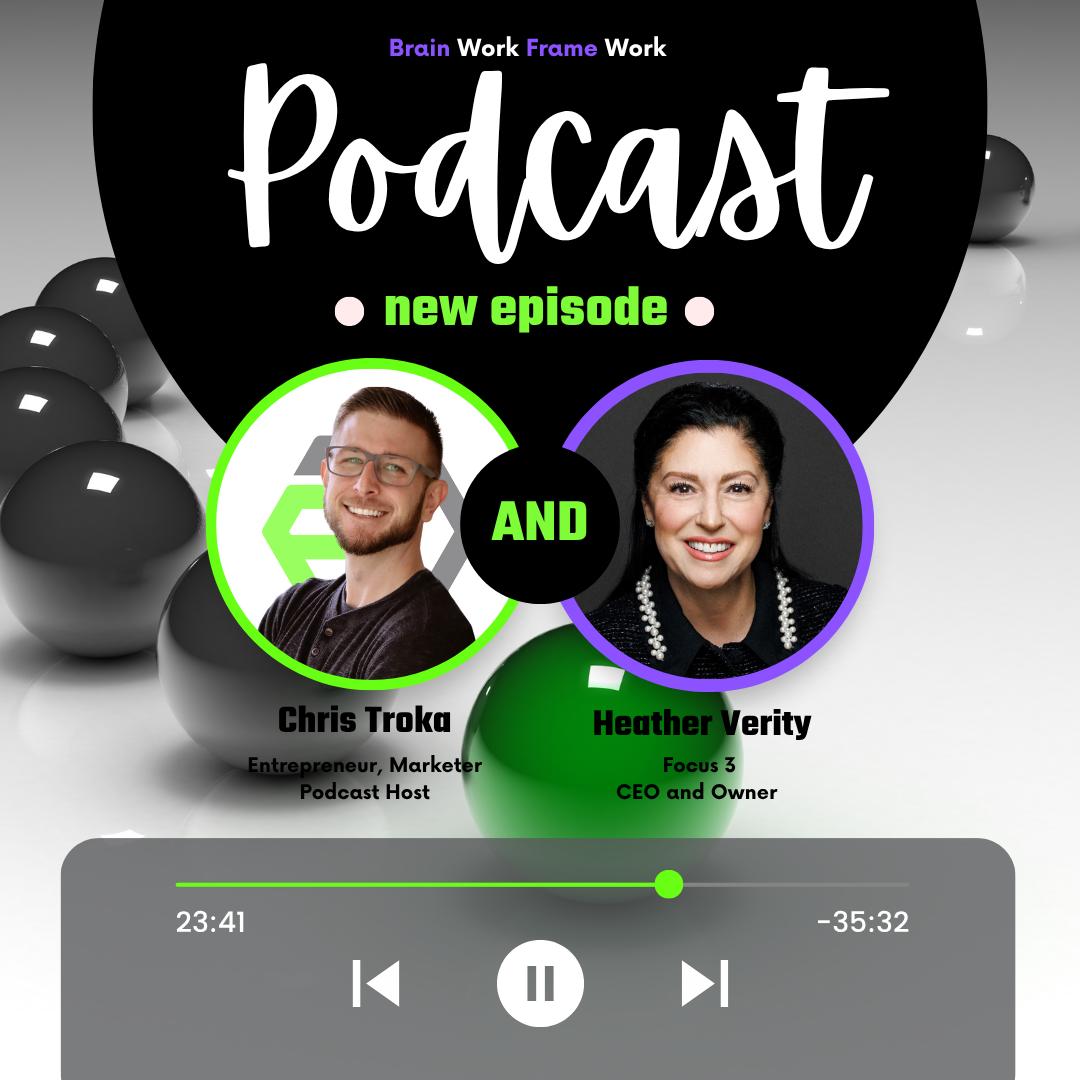
Chris Troka (00:08)
Welcome back to another episode with us today is Heather Verity. Heather is the CEO and owner of Focus 3, a leadership and culture firm behind the R-Factor framework used by Fortune 500 companies, NFL and Division 1 programs and school systems across the country to transform toxic reactive workplaces into discipline, accountable cultures. So excited to have her on. Heather, how you doing today?
Heather Verity (00:30)
I'm so great. Chris, thank you for having me. We were chatting a little bit before we started recording and I'm so thrilled. I love when I find my tribe, my people.
Chris Troka (00:40)
Same here, same here, absolutely. So excited to get into it. But we always like to ask about the journey, because obviously it takes a long time. It's a winding road to get where we are today in entrepreneurship. What were you doing before that kind of led you in this path you're on now?
Heather Verity (00:54)
I have actually been an entrepreneur and in contract as a 1099 contracted person for 36 years. I always jokingly say I've had two jobs in my life that were very short lived. One of them, was Yosemite Sam at Six Flags Magic Mountain in California. And the other I was Chuck E. Cheese. And when I realized how mean those little kids were in the parlor there, I just decided I had to get out.
My dad encouraged me and my mom encouraged me at a very young age to really control my own destiny. I think they knew enough about me at a young age to know that I wouldn't be a very good employee. And I know you and I were joking about if somebody said, you had an hour for lunch, I might have a meltdown. But I just, love and have been self-employed, have had several businesses. The last...
contract that I had was with a major insurance and financial services company for 16 years as a registered principal and a financial security certified planner. I've worked with people my whole life. Everything I've done has been around people. And I had an opportunity in 2017 to hear the founder of Focus 3, Tim Kite, speak about the R factor, which is a portion of our content. And I was really gripped by the
by his keynote and the content. And lo and behold, six years later, I would have the opportunity to purchase the company, which is, probably another episode entirely, but it has been a two and a half year journey so far and just absolutely explosive growth and the team is thriving and I could not be more thrilled.
Chris Troka (02:33)
That is incredibly exciting. Not many entrepreneurs get to experience both entrepreneurship and that struggle, but the opportunity to purchase a business as well. There's a lot of benefits to that because you have clientele ⁓ and existing framework that's kind of already set up, but then you as the entrepreneur get to go in and take ownership of it and kind of make it your own. So what were some of the big improvements after taking over Focus 3?
Did you want to kind of create for this new vision for the company?
Heather Verity (03:04)
I often share with people, we were a 30 year old startup. And what I mean by that is that we had an incredible founder. He was a wonderful speaker, highly engaging, could stand on a stage in front of thousands and deliver this content that he curated very carefully over three and a half decades. And there was a handful of people in the organization. I say it was kind of like this band of merry people that
went around and delivered content, but there was no structural organization whatsoever. And so when I came in, it was truly building from the foundation. And fortunately, I have a lot of experience in that. just didn't, in terms of stumbling blocks, that was really, even through discovery and having an eight month acquisition process, there were so many things that you just don't know until you get in there. And
we have doubled, almost tripled the size of the organization in terms of team. I think that the benefit of that was that I got to create it the way I wanted to. And then the adverse side of that was that there was so much heavy lifting in the beginning. it was very daunting to say the least. And because it's based on content, we had some,
IP intellectual property, there was some massive issues with content not being protected. There were just things that, in hindsight, if we had known a little bit more, I think we might not even have purchased the company, but it was a really smart move. And I'm glad that we did because we've now been able to lay this foundation of something that it is just going to 10X over the next five to 10 years. And to see it.
I know the founder in his heart. I know that's what he would have wanted to do. He just wasn't a business person. And I think that therein lies the challenge for a lot of entrepreneurs. They have a great product. They have an idea, a concept. They just don't know how to scale it. And so fortunately I've been gifted and blessed to have both those sides of the arena. And so it's really helped. And the team is the structure piece to it has added so much more.
trust and confidence in what we're doing.
Chris Troka (05:15)
And that's a big piece in business. A lot of entrepreneurs are great at the skill set that they do, but it's not always marketing or business savvy-ness that they bring to the table. And sometimes we can fall into it with luck. We just make things happen. But other times when you put that structure and framework into place, that can, like you said, two or three X the team and sometimes the revenue, the clientele, the sky's the limit with that. And it's interesting you mention that because a lot of
business owners are focusing on legacy. Like it's not just about me, it's about the team, it's about the people we serve, and it's about creating something for the future. So now with you taking over this legacy, what are you focused on, for the future?
Heather Verity (05:58)
It's such a great question and there's a couple of things I'm really excited about, one of which was an unfinished project from Tim, our founder, which was the R-Factor book. Focus 3, the name of the company comes from three very distinct opportunities and areas that we focus in on, which is leadership, culture, and behavior. we have systems for all of those. The R-Factor is really our flagship product and it teaches people
It's based on a very simple formula of E plus R equals O. Event plus response equals outcome. Unfortunately, in today's society, more people react than respond. And so our curriculum is taught, as you said, worldwide as a global firm. What I'm most excited about was that I promised Tim that I would finish his book. And so we completed the book. When he passed, unfortunately, I had 17 pages.
not a book by any stretch. And so the past year, have finally, we launched the book March 31st. It's on our website and it's through Amazon and you can purchase it. But it was such a passion project because people had asked and had talked about, there a book? Will there be a book? And when you read the book, you'll understand I was the most reluctant author. I kept trying to figure out how I didn't think I really had a book.
And as it turns out, I most certainly did have a book and it's a little bit different than I think most people would expect and I think this is really powerful for entrepreneurs and people that would listen to this content in your podcast because it really talks about my journey from someone who grew up in a very ⁓ diverse and dysfunctional home to someone that can become massively successful and probably the least likely person.
as a child that people would have looked at and said, yeah, she's really gonna be president someday. I probably wasn't that person. So the book was a huge monumental task and it's like birthing a baby. I could not be more proud. And we've always said it's been incredibly successful. And even if it weren't, we're so proud of it as a team and for me personally. And linked to that was a brand new product launch. The company hadn't had a new product launch in decades.
We really stuck to our core content, which is universal and it is as impactful today as it has ever been considering what's happening in the world. But Chris, every room we're in, no matter where we are, if we're with a Fortune 50 company, if we're with a university, if we're with a school, with a second grade class, everybody always asks, this is fantastic. I love this. I can see where it's going to help me on the professional side.
How do I take it home? And I'm so proud. just, April 1st, no joke, no kidding, we launched the R Factor around the dinner table for families. And it's for parents, guardians, coaches, teachers, anybody that's in the charge of a young person. I often say if we're going to create the bright future for tomorrow that we all look forward to, it's gonna start with our kids. But people, don't bring a baby home with a manual that says this is how you do it.
And most parents are relying on the education system. Educators are relying on parents. And there's this gap in between. And what we're seeing in terms of just what's happening with young people today, it's so necessary. If we can teach them how to respond versus react in those predictable events that they're going to face, what a better world, right? I mean, when you think about just teenage pregnancy, violence, bullying, all those things, it's
It has become, it has taken on a life of its own and I could not be more excited.
Chris Troka (09:45)
It really is incredible because we have these moments where we're learning life lessons that we're trying to apply from our personal life into business and vice versa now, because we see the positive impact it can have within our business relationships, bringing it into our personal life. What are some of the symptoms that these businesses or people are going through that they eventually turn to the R factor to look for guidance and clarity?
Heather Verity (10:10)
The biggest challenge, and let's face it, every organization of every size, if you're a startup, if you're a Fortune 100, it's the challenges and changes, you know, just what's happening in, just universally with every business, with the economy, globally. And so a lot of it boils down to trust and confidence in leadership. And everything starts with leadership. And how much we want to place blame on
the employees in the company or the board members or the whatever people want to, point the finger at. I always say, be careful when you point a finger, there's three pointing back at you. And everything starts with leadership. And the biggest challenge that we see that I see personally, and I get to sit in the back of a lot of rooms, it is lack of leadership. And it's not just the lack of leadership, but it is more systemic than that. It's the lack of trust. And when you see
leaders that are so focused on the bottom line and driving revenue and driving profits over people. I've never seen a business in the world that can't operate without people. And regardless of AI and all the technology that's happening, it's still going to be our responsibility as human beings to capture that intelligence and use it appropriately. And that fear and that lack of leadership is really the biggest issue.
that we're facing and the biggest call to action for us. We literally have clients that ask us to come in and teach them our relentless leadership, our leadership system. And part of that is changes and challenges within the organization, but even more so how to have difficult conversations, how to give feedback, how to navigate change. And it's really shocking to see the amount of people that are not equipped.
but are hired into these leadership roles that have no, I know you can relate to this, they have no clue what they're doing, but because someone liked them or they've been around a while, they were promoted up through the chain and they're really ill-equipped to be in those roles. And so as a leader myself, my biggest challenge is how do you help them to navigate what they're going to face in a very uncertain future?
Chris Troka (12:27)
And you know, first off, credit where credit is due, just the fact that these leaders are recognizing that and then realizing, okay, there's something we need to do to fix it. Give them a lot of credit there. But yes, we're often hired into roles and even for ourselves as entrepreneurs, there's many things we don't know that we have to kind of figure out on the fly. And if we don't, our business doesn't succeed. But I think overall, we were kind of joking before about
the opportunity that this presents to us in a world where these big corporations are focused on the profit, they're focused on return to office, and they're just trying to extract as much money as possible. This is an opportunity for a smaller business owners and entrepreneurs to be that business of tomorrow. What do we want to see? What would we want as an employee? And that we can translate into our business and try to build that culture and loyalty. I feel like it's just missed opportunity and
When people are happier, they work harder and they love the mission. It just seems like a win-win.
Heather Verity (13:28)
It absolutely does. We were chatting about that and I shared with the team when I first purchased the company and I say it at every offsite. I intentionally have two to three off sites a year. Our team is entirely remote and we were talking about that. And that takes an incredible amount of trust and loyalty in an organization. And when I shared with them that I wanted to build and grow a company that I wanted to work for.
that was so personal for my husband and I, because we've seen it go wrong for so long. And yet I think there's a lot of people that would say to themselves, you know, if I were in charge, I'd do it this way. And yet they don't ever put themselves in a place to be in charge, but they'd rather complain about what other people are doing. And I get that, there's just, are circumstances in life. I have
always known that if I were to have, several businesses and this one in particular where it was based on the values and my own personal character of leadership and how I could help people with that. I just wanted so desperately and passionately to build a company that I would want to work for. And part of that, I think as entrepreneurs, the challenge we face to your point is
We're really good in silos. We're really good at certain things. And yet people think because maybe we own the business, we're really good at all things. And that is not necessarily the case. It's still a learned skill. people ask me all the time, how would you quantify your success? What would you attribute it to? And I say, for me, it's really, really simple. It boils down to the right people. And when I say the right people, because you
I have people on my team that, Chris, they're so much smarter than I am. They are so good at what they do. And I've heard that, you you heard Henry Ford years, decades and decades ago said, surround yourself with people that are smarter than you. Steve Jobs said the same thing. And I have always taken that to heart because it's, we refer to ego as there's big ego and strong ego.
Big ego is selfish and narcissistic. Strong ego is, understand what my limitations are, but I'm gonna surround myself and hire people that are really good. And for most of my life, I have really followed a very simple track of hire the right people. And I don't mean, they don't have to be the smartest people, they don't have to be the best. I'm looking for character and integrity. You I can teach anybody anything if they're willing to learn.
Character integrity, being polite, being respectful, having confidence, those are things you cannot teach. So I always say if the clay is there and there's a desire to be a part of this organization, I will help you and we'll find the right fit. The right people, give them every tool that they need to be successful. I mean, everything they need, whether it's education, training, support, pats on the back.
whatever that looks like, and then get the heck out of their way. You hired them for a reason, have the confidence, and I would say it's having confidence in your own choices and your own ability to make those choices. Could it go sideways? Of course it can. we're human beings, we're not human doings. We, of course things can go sideways and sometimes...
People interview really well. say interviewing is, it's kind of like dating. it's three months in, you realize the guy you're dating doesn't brush his teeth. You're like, okay, that was a bad choice. And sometimes people are really good at interviewing and they'll get through all the hurdles and then you bring them on. And when the rubber meets the road, it doesn't work out. It's okay. I always say, love people in, love them out, help them find a place where they're going to be successful. I don't think anybody wants to be a part of a team and be the anchor.
that drags the organization down. just having a lot of compassion for people, if you can surround yourself with the right people, you don't have to know everything. You just have to be willing to, help other people to be their best self, which helps the organization in return. And, as a completely remote organization and not the furthest thing from a micromanager, you can imagine, it has been gold for us.
Chris Troka (17:39)
It's a lot of great insight and it's something that, I think entrepreneurs are trying to focus on. we want to be a better person, try to hire in the right skills. Cause again, admittedly, sure we want to be seen as the best, most smartest person ever, but that's not the case. And you can be successful and build the right team and put people in the right positions in order to get to that level. But Heather, where can people find you and connect with you online?
Heather Verity (18:03)
thank you, Chris. One very central location, Focus3, F-O-C-U-S, and the number three dot com has everything about the book. It has our podcast. has our, our factor around the dinner table. Of course, the podcast is relentless and real on Spotify and it's all over the place and I'm very excited. I just was really looking forward to this conversation and if there's one thing I could leave people with.
as an entrepreneur, trust the inner voice. We all have that small spoken voice that comes to us and a lot of times we just push it down and think that's crazy. But in the words of some very famous people, the crazy ones have it dialed in.
Chris Troka (18:45)
Absolutely, and we will have those links available down in the show notes and the description so everyone can get connected and kind of leading into what you were just talking about, kind of the advice for other entrepreneurs. if you were starting over, if you had a piece of advice for other people, what would you share with them? Because we're all kind of going through something different throughout our journey, but I think they'll take that piece of advice and carry it with them.
Heather Verity (19:08)
The biggest thing I've learned over 36 years is to live a life that allows me to take risks. When I think about purchasing this company, a lot of people thought, wow, how were you able to get the capital, to do that? And I, my husband and I have always lived within our means. And we, when we bought a house, we made sure we paid it off as quickly as we could. We've just always put ourselves in a position that
If we got mad, my mom used to call it mad money. You if you get mad, you can leave, you don't have to stay. And I always said, I never want to be beholding to an organization. Cause if I'm there because of the paycheck, because I've overextended myself or I'm living beyond my means, it doesn't allow that freedom and flexibility. When those opportunities come up, you simply don't have the resources or the money to do it. And so I would say first and foremost,
because we're typically as entrepreneurs, we're dreamers. A lot of times we're also the spenders. And so, and I'm saying this as a woman who usually, women are, we do like to spend money and a lot of women like to shop. Fortunately, that's not my advice. I just have always put my family in a situation that when opportunities could arise, I could take advantage of them. So I would say put yourself in a place where you have the affordability because if you have the dream,
The biggest challenge in business is getting the resources and being able to pay yourself and continue to put food on the table and keep a roof over your family's head. Sometimes we get so far out above our skis that we forget there are some things that have to get done.
Chris Troka (20:47)
100%. And I do have one final question. Curious about in your 35 plus years of entrepreneurial experience. What is working in the marketing and client realm? How are you finding, attracting, acquiring clients? It seems like honestly the work that you're doing is probably generating referrals, but I don't know your process. What has been working for you as an entrepreneur over these years?
Heather Verity (21:10)
I have developed a, in fact, I'm doing a first ever, my team has encouraged me to do a sales clinic. It's going to be in August in Columbus, Ohio, because I have all of this knowledge in sales and marketing and how to develop client bases. And it really boils down. I've said it for 30 years. Success is not a secret. It's a system. And I am always challenged when I talk to business owners that say, I'm trying to identify my target market.
And I think there can be such a thing, but I also feel very confident that if you have a business that relates to another human being, there's eight billion people is your market. There is really no limitation to that. What we need to really dial in is what our system is to get in front of people. And there are just things that aren't ever going to change. There's ⁓ cold calling, getting on the phone, meeting with people.
Every single person, I always think of that six degrees of separation. Everyone that you meet knows 60 to 100 people that you don't, and you never know who they're going to introduce you to. So I would challenge people that when it comes to sales and marketing, talk to everybody. let everybody know. But then the key is quantify those results. Track your numbers. I always say, know your numbers. There can be industry standards and industry numbers. And I love when I
get approached by all of these lead companies and they'll say, our data shows it. we can get you a 20 % lift in business. I'm like, really? Are you that confident? So I just know that if I always say the harder I work, the luckier I get. I know that's not an answer that a lot of people want to hear, but I need to know what my numbers are. If I make a hundred calls, how many people am I going to get to talk to? What is my close ratio? What is my, discovery call look like? So
that in and of itself, if you can master what your numbers are in terms of marketing and kind of lift your lid on the thinking of if you have a business that applies to people, you don't have any territories or bandwidth for that. You just need to put one foot in front of the other and start collecting your own data so you see what your numbers are. And then you can really create business plans and strategy around that.
Chris Troka (23:25)
That is very well said and I believe a common phrase is luck is where preparation meets opportunity. So it's kind of putting things together and suddenly that luck it's something that we put out there but it's the universe working together. Heather we appreciate you coming on the show and thank you again for sharing your wisdom your journey and all of your advice with us. You have 30 seconds to take the floor if you'd like anything you'd like to share with our audience all on you.
Heather Verity (23:49)
I'm honored and grateful to be here and I really would love for everyone to challenge themselves. I heard a statistic that 70 % of Americans would leave their job today if they could afford to. Put yourself in a situation to afford to.
Chris Troka (24:05)
love it. Heather, thank you again and appreciate it. Keep up all the great work.
Heather Verity (24:09)
Thanks Chris, you too.
Chris Troka (24:10)
Thank you.
Welcome back to another episode with us today is Heather Verity. Heather is the CEO and owner of Focus 3, a leadership and culture firm behind the R-Factor framework used by Fortune 500 companies, NFL and Division 1 programs and school systems across the country to transform toxic reactive workplaces into discipline, accountable cultures. So excited to have her on. Heather, how you doing today?
Heather Verity (00:30)
I'm so great. Chris, thank you for having me. We were chatting a little bit before we started recording and I'm so thrilled. I love when I find my tribe, my people.
Chris Troka (00:40)
Same here, same here, absolutely. So excited to get into it. But we always like to ask about the journey, because obviously it takes a long time. It's a winding road to get where we are today in entrepreneurship. What were you doing before that kind of led you in this path you're on now?
Heather Verity (00:54)
I have actually been an entrepreneur and in contract as a 1099 contracted person for 36 years. I always jokingly say I've had two jobs in my life that were very short lived. One of them, was Yosemite Sam at Six Flags Magic Mountain in California. And the other I was Chuck E. Cheese. And when I realized how mean those little kids were in the parlor there, I just decided I had to get out.
My dad encouraged me and my mom encouraged me at a very young age to really control my own destiny. I think they knew enough about me at a young age to know that I wouldn't be a very good employee. And I know you and I were joking about if somebody said, you had an hour for lunch, I might have a meltdown. But I just, love and have been self-employed, have had several businesses. The last...
contract that I had was with a major insurance and financial services company for 16 years as a registered principal and a financial security certified planner. I've worked with people my whole life. Everything I've done has been around people. And I had an opportunity in 2017 to hear the founder of Focus 3, Tim Kite, speak about the R factor, which is a portion of our content. And I was really gripped by the
by his keynote and the content. And lo and behold, six years later, I would have the opportunity to purchase the company, which is, probably another episode entirely, but it has been a two and a half year journey so far and just absolutely explosive growth and the team is thriving and I could not be more thrilled.
Chris Troka (02:33)
That is incredibly exciting. Not many entrepreneurs get to experience both entrepreneurship and that struggle, but the opportunity to purchase a business as well. There's a lot of benefits to that because you have clientele ⁓ and existing framework that's kind of already set up, but then you as the entrepreneur get to go in and take ownership of it and kind of make it your own. So what were some of the big improvements after taking over Focus 3?
Did you want to kind of create for this new vision for the company?
Heather Verity (03:04)
I often share with people, we were a 30 year old startup. And what I mean by that is that we had an incredible founder. He was a wonderful speaker, highly engaging, could stand on a stage in front of thousands and deliver this content that he curated very carefully over three and a half decades. And there was a handful of people in the organization. I say it was kind of like this band of merry people that
went around and delivered content, but there was no structural organization whatsoever. And so when I came in, it was truly building from the foundation. And fortunately, I have a lot of experience in that. just didn't, in terms of stumbling blocks, that was really, even through discovery and having an eight month acquisition process, there were so many things that you just don't know until you get in there. And
we have doubled, almost tripled the size of the organization in terms of team. I think that the benefit of that was that I got to create it the way I wanted to. And then the adverse side of that was that there was so much heavy lifting in the beginning. it was very daunting to say the least. And because it's based on content, we had some,
IP intellectual property, there was some massive issues with content not being protected. There were just things that, in hindsight, if we had known a little bit more, I think we might not even have purchased the company, but it was a really smart move. And I'm glad that we did because we've now been able to lay this foundation of something that it is just going to 10X over the next five to 10 years. And to see it.
I know the founder in his heart. I know that's what he would have wanted to do. He just wasn't a business person. And I think that therein lies the challenge for a lot of entrepreneurs. They have a great product. They have an idea, a concept. They just don't know how to scale it. And so fortunately I've been gifted and blessed to have both those sides of the arena. And so it's really helped. And the team is the structure piece to it has added so much more.
trust and confidence in what we're doing.
Chris Troka (05:15)
And that's a big piece in business. A lot of entrepreneurs are great at the skill set that they do, but it's not always marketing or business savvy-ness that they bring to the table. And sometimes we can fall into it with luck. We just make things happen. But other times when you put that structure and framework into place, that can, like you said, two or three X the team and sometimes the revenue, the clientele, the sky's the limit with that. And it's interesting you mention that because a lot of
business owners are focusing on legacy. Like it's not just about me, it's about the team, it's about the people we serve, and it's about creating something for the future. So now with you taking over this legacy, what are you focused on, for the future?
Heather Verity (05:58)
It's such a great question and there's a couple of things I'm really excited about, one of which was an unfinished project from Tim, our founder, which was the R-Factor book. Focus 3, the name of the company comes from three very distinct opportunities and areas that we focus in on, which is leadership, culture, and behavior. we have systems for all of those. The R-Factor is really our flagship product and it teaches people
It's based on a very simple formula of E plus R equals O. Event plus response equals outcome. Unfortunately, in today's society, more people react than respond. And so our curriculum is taught, as you said, worldwide as a global firm. What I'm most excited about was that I promised Tim that I would finish his book. And so we completed the book. When he passed, unfortunately, I had 17 pages.
not a book by any stretch. And so the past year, have finally, we launched the book March 31st. It's on our website and it's through Amazon and you can purchase it. But it was such a passion project because people had asked and had talked about, there a book? Will there be a book? And when you read the book, you'll understand I was the most reluctant author. I kept trying to figure out how I didn't think I really had a book.
And as it turns out, I most certainly did have a book and it's a little bit different than I think most people would expect and I think this is really powerful for entrepreneurs and people that would listen to this content in your podcast because it really talks about my journey from someone who grew up in a very ⁓ diverse and dysfunctional home to someone that can become massively successful and probably the least likely person.
as a child that people would have looked at and said, yeah, she's really gonna be president someday. I probably wasn't that person. So the book was a huge monumental task and it's like birthing a baby. I could not be more proud. And we've always said it's been incredibly successful. And even if it weren't, we're so proud of it as a team and for me personally. And linked to that was a brand new product launch. The company hadn't had a new product launch in decades.
We really stuck to our core content, which is universal and it is as impactful today as it has ever been considering what's happening in the world. But Chris, every room we're in, no matter where we are, if we're with a Fortune 50 company, if we're with a university, if we're with a school, with a second grade class, everybody always asks, this is fantastic. I love this. I can see where it's going to help me on the professional side.
How do I take it home? And I'm so proud. just, April 1st, no joke, no kidding, we launched the R Factor around the dinner table for families. And it's for parents, guardians, coaches, teachers, anybody that's in the charge of a young person. I often say if we're going to create the bright future for tomorrow that we all look forward to, it's gonna start with our kids. But people, don't bring a baby home with a manual that says this is how you do it.
And most parents are relying on the education system. Educators are relying on parents. And there's this gap in between. And what we're seeing in terms of just what's happening with young people today, it's so necessary. If we can teach them how to respond versus react in those predictable events that they're going to face, what a better world, right? I mean, when you think about just teenage pregnancy, violence, bullying, all those things, it's
It has become, it has taken on a life of its own and I could not be more excited.
Chris Troka (09:45)
It really is incredible because we have these moments where we're learning life lessons that we're trying to apply from our personal life into business and vice versa now, because we see the positive impact it can have within our business relationships, bringing it into our personal life. What are some of the symptoms that these businesses or people are going through that they eventually turn to the R factor to look for guidance and clarity?
Heather Verity (10:10)
The biggest challenge, and let's face it, every organization of every size, if you're a startup, if you're a Fortune 100, it's the challenges and changes, you know, just what's happening in, just universally with every business, with the economy, globally. And so a lot of it boils down to trust and confidence in leadership. And everything starts with leadership. And how much we want to place blame on
the employees in the company or the board members or the whatever people want to, point the finger at. I always say, be careful when you point a finger, there's three pointing back at you. And everything starts with leadership. And the biggest challenge that we see that I see personally, and I get to sit in the back of a lot of rooms, it is lack of leadership. And it's not just the lack of leadership, but it is more systemic than that. It's the lack of trust. And when you see
leaders that are so focused on the bottom line and driving revenue and driving profits over people. I've never seen a business in the world that can't operate without people. And regardless of AI and all the technology that's happening, it's still going to be our responsibility as human beings to capture that intelligence and use it appropriately. And that fear and that lack of leadership is really the biggest issue.
that we're facing and the biggest call to action for us. We literally have clients that ask us to come in and teach them our relentless leadership, our leadership system. And part of that is changes and challenges within the organization, but even more so how to have difficult conversations, how to give feedback, how to navigate change. And it's really shocking to see the amount of people that are not equipped.
but are hired into these leadership roles that have no, I know you can relate to this, they have no clue what they're doing, but because someone liked them or they've been around a while, they were promoted up through the chain and they're really ill-equipped to be in those roles. And so as a leader myself, my biggest challenge is how do you help them to navigate what they're going to face in a very uncertain future?
Chris Troka (12:27)
And you know, first off, credit where credit is due, just the fact that these leaders are recognizing that and then realizing, okay, there's something we need to do to fix it. Give them a lot of credit there. But yes, we're often hired into roles and even for ourselves as entrepreneurs, there's many things we don't know that we have to kind of figure out on the fly. And if we don't, our business doesn't succeed. But I think overall, we were kind of joking before about
the opportunity that this presents to us in a world where these big corporations are focused on the profit, they're focused on return to office, and they're just trying to extract as much money as possible. This is an opportunity for a smaller business owners and entrepreneurs to be that business of tomorrow. What do we want to see? What would we want as an employee? And that we can translate into our business and try to build that culture and loyalty. I feel like it's just missed opportunity and
When people are happier, they work harder and they love the mission. It just seems like a win-win.
Heather Verity (13:28)
It absolutely does. We were chatting about that and I shared with the team when I first purchased the company and I say it at every offsite. I intentionally have two to three off sites a year. Our team is entirely remote and we were talking about that. And that takes an incredible amount of trust and loyalty in an organization. And when I shared with them that I wanted to build and grow a company that I wanted to work for.
that was so personal for my husband and I, because we've seen it go wrong for so long. And yet I think there's a lot of people that would say to themselves, you know, if I were in charge, I'd do it this way. And yet they don't ever put themselves in a place to be in charge, but they'd rather complain about what other people are doing. And I get that, there's just, are circumstances in life. I have
always known that if I were to have, several businesses and this one in particular where it was based on the values and my own personal character of leadership and how I could help people with that. I just wanted so desperately and passionately to build a company that I would want to work for. And part of that, I think as entrepreneurs, the challenge we face to your point is
We're really good in silos. We're really good at certain things. And yet people think because maybe we own the business, we're really good at all things. And that is not necessarily the case. It's still a learned skill. people ask me all the time, how would you quantify your success? What would you attribute it to? And I say, for me, it's really, really simple. It boils down to the right people. And when I say the right people, because you
I have people on my team that, Chris, they're so much smarter than I am. They are so good at what they do. And I've heard that, you you heard Henry Ford years, decades and decades ago said, surround yourself with people that are smarter than you. Steve Jobs said the same thing. And I have always taken that to heart because it's, we refer to ego as there's big ego and strong ego.
Big ego is selfish and narcissistic. Strong ego is, understand what my limitations are, but I'm gonna surround myself and hire people that are really good. And for most of my life, I have really followed a very simple track of hire the right people. And I don't mean, they don't have to be the smartest people, they don't have to be the best. I'm looking for character and integrity. You I can teach anybody anything if they're willing to learn.
Character integrity, being polite, being respectful, having confidence, those are things you cannot teach. So I always say if the clay is there and there's a desire to be a part of this organization, I will help you and we'll find the right fit. The right people, give them every tool that they need to be successful. I mean, everything they need, whether it's education, training, support, pats on the back.
whatever that looks like, and then get the heck out of their way. You hired them for a reason, have the confidence, and I would say it's having confidence in your own choices and your own ability to make those choices. Could it go sideways? Of course it can. we're human beings, we're not human doings. We, of course things can go sideways and sometimes...
People interview really well. say interviewing is, it's kind of like dating. it's three months in, you realize the guy you're dating doesn't brush his teeth. You're like, okay, that was a bad choice. And sometimes people are really good at interviewing and they'll get through all the hurdles and then you bring them on. And when the rubber meets the road, it doesn't work out. It's okay. I always say, love people in, love them out, help them find a place where they're going to be successful. I don't think anybody wants to be a part of a team and be the anchor.
that drags the organization down. just having a lot of compassion for people, if you can surround yourself with the right people, you don't have to know everything. You just have to be willing to, help other people to be their best self, which helps the organization in return. And, as a completely remote organization and not the furthest thing from a micromanager, you can imagine, it has been gold for us.
Chris Troka (17:39)
It's a lot of great insight and it's something that, I think entrepreneurs are trying to focus on. we want to be a better person, try to hire in the right skills. Cause again, admittedly, sure we want to be seen as the best, most smartest person ever, but that's not the case. And you can be successful and build the right team and put people in the right positions in order to get to that level. But Heather, where can people find you and connect with you online?
Heather Verity (18:03)
thank you, Chris. One very central location, Focus3, F-O-C-U-S, and the number three dot com has everything about the book. It has our podcast. has our, our factor around the dinner table. Of course, the podcast is relentless and real on Spotify and it's all over the place and I'm very excited. I just was really looking forward to this conversation and if there's one thing I could leave people with.
as an entrepreneur, trust the inner voice. We all have that small spoken voice that comes to us and a lot of times we just push it down and think that's crazy. But in the words of some very famous people, the crazy ones have it dialed in.
Chris Troka (18:45)
Absolutely, and we will have those links available down in the show notes and the description so everyone can get connected and kind of leading into what you were just talking about, kind of the advice for other entrepreneurs. if you were starting over, if you had a piece of advice for other people, what would you share with them? Because we're all kind of going through something different throughout our journey, but I think they'll take that piece of advice and carry it with them.
Heather Verity (19:08)
The biggest thing I've learned over 36 years is to live a life that allows me to take risks. When I think about purchasing this company, a lot of people thought, wow, how were you able to get the capital, to do that? And I, my husband and I have always lived within our means. And we, when we bought a house, we made sure we paid it off as quickly as we could. We've just always put ourselves in a position that
If we got mad, my mom used to call it mad money. You if you get mad, you can leave, you don't have to stay. And I always said, I never want to be beholding to an organization. Cause if I'm there because of the paycheck, because I've overextended myself or I'm living beyond my means, it doesn't allow that freedom and flexibility. When those opportunities come up, you simply don't have the resources or the money to do it. And so I would say first and foremost,
because we're typically as entrepreneurs, we're dreamers. A lot of times we're also the spenders. And so, and I'm saying this as a woman who usually, women are, we do like to spend money and a lot of women like to shop. Fortunately, that's not my advice. I just have always put my family in a situation that when opportunities could arise, I could take advantage of them. So I would say put yourself in a place where you have the affordability because if you have the dream,
The biggest challenge in business is getting the resources and being able to pay yourself and continue to put food on the table and keep a roof over your family's head. Sometimes we get so far out above our skis that we forget there are some things that have to get done.
Chris Troka (20:47)
100%. And I do have one final question. Curious about in your 35 plus years of entrepreneurial experience. What is working in the marketing and client realm? How are you finding, attracting, acquiring clients? It seems like honestly the work that you're doing is probably generating referrals, but I don't know your process. What has been working for you as an entrepreneur over these years?
Heather Verity (21:10)
I have developed a, in fact, I'm doing a first ever, my team has encouraged me to do a sales clinic. It's going to be in August in Columbus, Ohio, because I have all of this knowledge in sales and marketing and how to develop client bases. And it really boils down. I've said it for 30 years. Success is not a secret. It's a system. And I am always challenged when I talk to business owners that say, I'm trying to identify my target market.
And I think there can be such a thing, but I also feel very confident that if you have a business that relates to another human being, there's eight billion people is your market. There is really no limitation to that. What we need to really dial in is what our system is to get in front of people. And there are just things that aren't ever going to change. There's ⁓ cold calling, getting on the phone, meeting with people.
Every single person, I always think of that six degrees of separation. Everyone that you meet knows 60 to 100 people that you don't, and you never know who they're going to introduce you to. So I would challenge people that when it comes to sales and marketing, talk to everybody. let everybody know. But then the key is quantify those results. Track your numbers. I always say, know your numbers. There can be industry standards and industry numbers. And I love when I
get approached by all of these lead companies and they'll say, our data shows it. we can get you a 20 % lift in business. I'm like, really? Are you that confident? So I just know that if I always say the harder I work, the luckier I get. I know that's not an answer that a lot of people want to hear, but I need to know what my numbers are. If I make a hundred calls, how many people am I going to get to talk to? What is my close ratio? What is my, discovery call look like? So
that in and of itself, if you can master what your numbers are in terms of marketing and kind of lift your lid on the thinking of if you have a business that applies to people, you don't have any territories or bandwidth for that. You just need to put one foot in front of the other and start collecting your own data so you see what your numbers are. And then you can really create business plans and strategy around that.
Chris Troka (23:25)
That is very well said and I believe a common phrase is luck is where preparation meets opportunity. So it's kind of putting things together and suddenly that luck it's something that we put out there but it's the universe working together. Heather we appreciate you coming on the show and thank you again for sharing your wisdom your journey and all of your advice with us. You have 30 seconds to take the floor if you'd like anything you'd like to share with our audience all on you.
Heather Verity (23:49)
I'm honored and grateful to be here and I really would love for everyone to challenge themselves. I heard a statistic that 70 % of Americans would leave their job today if they could afford to. Put yourself in a situation to afford to.
Chris Troka (24:05)
love it. Heather, thank you again and appreciate it. Keep up all the great work.
Heather Verity (24:09)
Thanks Chris, you too.
Chris Troka (24:10)
Thank you.
