

1
00:00:02,009 --> 00:00:05,759
Kelly Sheard: Welcome to Beyond
the Razor Wire Fence. I'm Kelly
2
00:00:05,759 --> 00:00:08,579
Sheard, the Director of the
Gender Wealth Institute within
3
00:00:08,579 --> 00:00:12,869
WOMEN'S WAY. Our mission is to
advance gender and racial equity
4
00:00:12,899 --> 00:00:16,649
by building collective power to
disrupt systems of oppression
5
00:00:16,949 --> 00:00:20,369
and strengthen alternative
models centered in inclusion,
6
00:00:20,549 --> 00:00:25,019
love and liberation. Over the
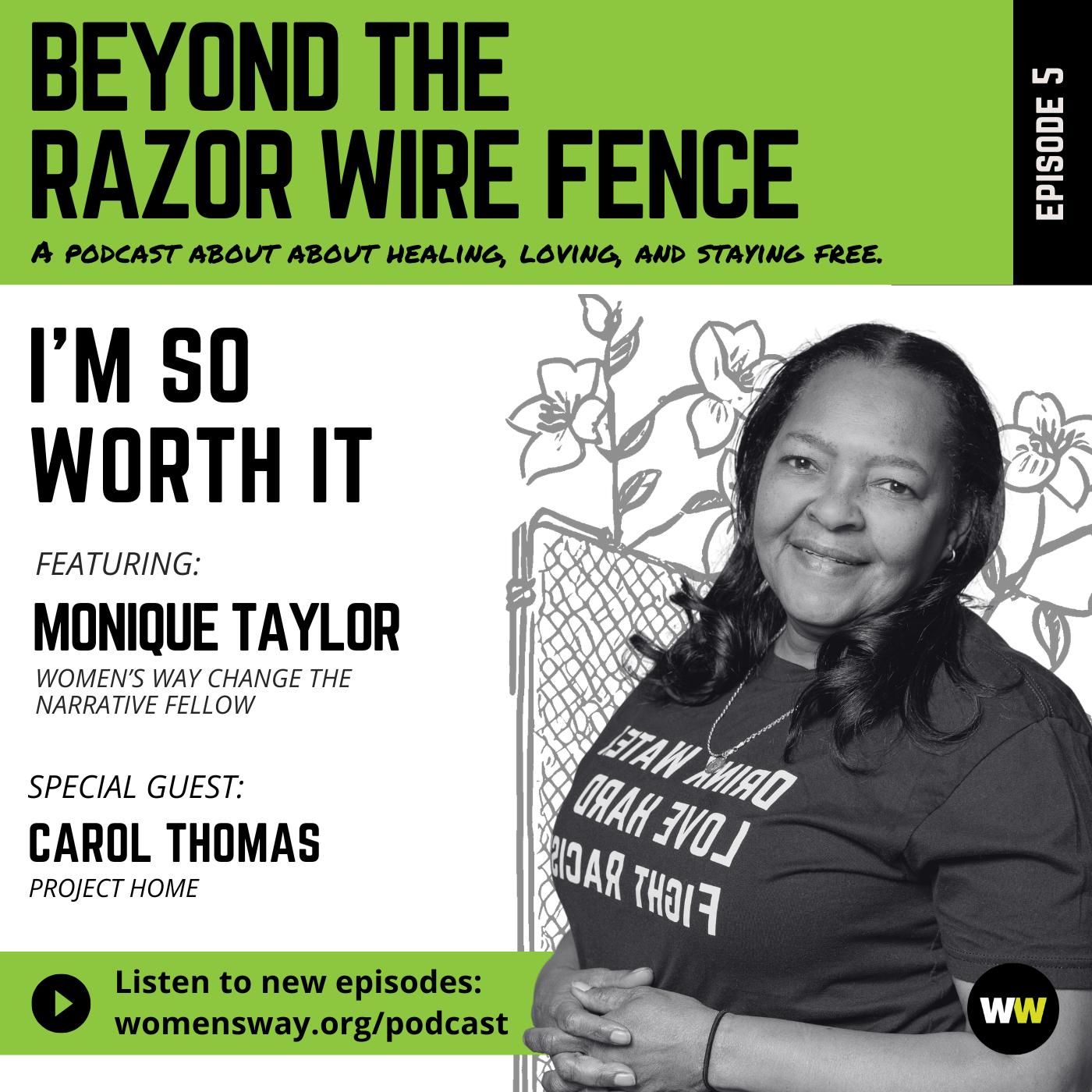
last seven months, WOMEN'S WAY
7
00:00:25,019 --> 00:00:28,679
facilitated a narrative change
fellowship with seven women and
8
00:00:28,679 --> 00:00:31,769
gender expansive individuals
with experiences of
9
00:00:31,769 --> 00:00:36,509
incarceration and reentry. With
help from Love Now Media, our
10
00:00:36,509 --> 00:00:39,839
fellows honed their storytelling
skill set to advocate for
11
00:00:39,839 --> 00:00:43,799
economic equity in Philadelphia.
This podcast centers their
12
00:00:43,799 --> 00:00:48,569
stories. Beyond the Razor Wire
Fence asserts that incarceration
13
00:00:48,599 --> 00:00:53,249
is a form of wealth extraction.
Moreover, through this podcast,
14
00:00:53,489 --> 00:00:56,789
fellows depict the
disproportionately deep impact
15
00:00:56,819 --> 00:01:00,929
for women trans and gender
expansive people. The fellows'
16
00:01:00,929 --> 00:01:04,949
stories dive deep into how the
carceral system perpetuates the
17
00:01:04,949 --> 00:01:07,739
gender wealth gap and calls
attention to the
18
00:01:07,739 --> 00:01:12,449
institutionalized strategies of
extraction before, during and
19
00:01:12,449 --> 00:01:16,469
after incarceration. Through a
combination of interviews,
20
00:01:16,499 --> 00:01:20,489
storytelling and research, the
fellows challenge assumptions
21
00:01:20,489 --> 00:01:24,149
around incarceration and
advocate for a shift in policy
22
00:01:24,149 --> 00:01:27,809
and culture to move us closer to
a liberatory economy.
23
00:01:28,380 --> 00:01:31,710
This episode features Monique
Taylor. We'll hear from her,
24
00:01:31,710 --> 00:01:34,470
listen to her in conversation
with our friends from Love Now
25
00:01:34,470 --> 00:01:37,530
Media. And finally, we'll
welcome Carol Thomas from
26
00:01:37,530 --> 00:01:40,770
Project Home, who will sit down
with me to add context to the
27
00:01:40,770 --> 00:01:44,160
terminology and information
introduced by Monique. Welcome,
28
00:01:44,160 --> 00:01:44,640
Monique.
29
00:01:48,930 --> 00:01:52,770
This episode contains mention of
substance abuse disorder, mental
30
00:01:52,770 --> 00:01:55,110
health struggles, and the opioid
epidemic.
31
00:01:56,320 --> 00:01:59,920
Monique Taylor: Hi. My name is
Monique Taylor. I am a special
32
00:01:59,920 --> 00:02:04,300
initiatives outreach worker for
Project Home in the City of
33
00:02:04,300 --> 00:02:09,430
Philadelphia. I primarily work
in the Kensington community,
34
00:02:09,670 --> 00:02:15,730
which is the opiate epidemic
center. I grew up, I had, you
35
00:02:15,730 --> 00:02:20,680
know, my mom, my dad, we grew up
on, I grew up on a farm, and
36
00:02:20,680 --> 00:02:26,590
when my parents divorced and we
moved away from my dad, I
37
00:02:26,590 --> 00:02:32,260
started to see depression and,
you know, being sad all the
38
00:02:32,260 --> 00:02:41,980
time, and I went into using
drugs to escape the abandonment
39
00:02:42,160 --> 00:02:49,510
that I felt - that my dad had
just abandoned us. And, growing
40
00:02:49,540 --> 00:02:53,800
up was really difficult,
because, you know, I, we went
41
00:02:53,800 --> 00:02:58,630
from one place to another. It
was another environment, new
42
00:02:58,630 --> 00:03:03,700
people to me, and I really
didn't have the experience or
43
00:03:03,880 --> 00:03:07,960
the socialization with other
people, because I grew up on a
44
00:03:07,960 --> 00:03:14,440
farm. And when we moved into the
city and my addiction took off,
45
00:03:16,450 --> 00:03:19,630
I could see my family kind of
struggling like, you know, the
46
00:03:19,630 --> 00:03:27,010
gender wealth gap had already
set in when I was young. My mom,
47
00:03:27,100 --> 00:03:30,700
you know, we didn't have a lot
of the luxuries that we used to
48
00:03:30,700 --> 00:03:34,780
have, and we didn't have a lot
of the necessities. So as my
49
00:03:34,780 --> 00:03:41,740
addiction escalated, I got into
drugs and introduced into the
50
00:03:41,740 --> 00:03:48,250
prison system. When I was in the
prison system, I was away from
51
00:03:48,250 --> 00:03:53,140
home. I was then in Philadelphia
[and] didn't have the access to
52
00:03:53,590 --> 00:03:58,390
the bare necessities like soap
and sanitary products in the
53
00:03:58,390 --> 00:04:04,750
prison, and when I would ask for
help at home, my mom, she really
54
00:04:04,750 --> 00:04:10,750
didn't have it. She had my
children, her grandchildren, and
55
00:04:11,530 --> 00:04:19,240
she was a single parent at the
time. So, you know, I, I hustled
56
00:04:19,240 --> 00:04:23,860
in the jail. You know, I went to
work and for 20 bucks a week.
57
00:04:24,220 --> 00:04:28,780
You know, I used to have to make
my ends meet with just 20 bucks
58
00:04:29,230 --> 00:04:35,740
every two weeks. And while I was
in jail, I started to realize,
59
00:04:35,740 --> 00:04:40,510
like a lot of the women that
were there, were either
60
00:04:41,080 --> 00:04:45,370
returning back into the prison
system for either a parole
61
00:04:45,370 --> 00:04:51,100
violation or probation
violation. So, I could see that
62
00:04:51,130 --> 00:04:57,100
this system was designed to keep
us coming back - coming back in.
63
00:04:57,430 --> 00:05:03,250
You know, you, I never had went
back into the prison system with
64
00:05:03,280 --> 00:05:08,050
just a new case - it was either
a parole violation or dirty
65
00:05:08,050 --> 00:05:14,770
urine or something. So, my call
for action is more support in
66
00:05:14,770 --> 00:05:19,960
the prison system for women that
need support with substance use
67
00:05:19,960 --> 00:05:24,970
disorder. I am a person in long
term recovery. I celebrate nine
68
00:05:24,970 --> 00:05:32,410
years this June. I work in a
community that has been ravaged
69
00:05:32,410 --> 00:05:37,360
from opiates, and I see that
there are support systems there,
70
00:05:37,360 --> 00:05:41,050
but we don't know how to
navigate to get to them. So I
71
00:05:41,050 --> 00:05:45,070
think that we need more people
with the lived experience, like
72
00:05:45,070 --> 00:05:49,150
myself, that know how to
navigate in the system [to]
73
00:05:49,360 --> 00:05:53,860
prevent people from being
incarcerated because we have
74
00:05:53,950 --> 00:06:00,910
substance use disorder or a
mental health concern. It can be
75
00:06:00,910 --> 00:06:04,930
very, very challenging in the
prison system, where they don't
76
00:06:04,930 --> 00:06:14,410
treat your, you know, the trauma
or the support. They just aren't
77
00:06:14,410 --> 00:06:18,130
there. You know, it's you do
your time, you get out, and
78
00:06:18,130 --> 00:06:22,540
you're on your own. And I think
that if we start before we get
79
00:06:22,540 --> 00:06:26,830
into the prison system, then
there wouldn't be a need for the
80
00:06:26,830 --> 00:06:29,170
prison. Thank you.
81
00:06:46,760 --> 00:06:48,950
Nicole Blackson: Hi, I am Nicole
Blackson with Love Now Media,
82
00:06:48,950 --> 00:06:53,300
and today I will be speaking
with fellow Monique Taylor. So
83
00:06:53,300 --> 00:06:55,850
let's chat a little bit. You
talked a lot about the gender
84
00:06:55,850 --> 00:06:58,940
wealth gap, and you took us all
way back to your childhood of
85
00:06:58,940 --> 00:07:02,360
how you saw it kicking then when
you went from a two parent
86
00:07:02,360 --> 00:07:05,450
household with your mom and dad
to a one parent household, which
87
00:07:05,450 --> 00:07:09,740
is living with your mom. Can you
fast forward a little bit and
88
00:07:09,740 --> 00:07:12,380
tell me a little bit of those
details of when you were in a
89
00:07:12,380 --> 00:07:15,800
carceral system and you saw
that, when your mom had to take
90
00:07:15,800 --> 00:07:20,240
care of your children, you
needed more help and you
91
00:07:20,240 --> 00:07:22,430
couldn't afford to get the bare
essentials while you were in the
92
00:07:22,430 --> 00:07:25,160
carceral system. You said you
worked. How much did you get
93
00:07:25,160 --> 00:07:25,460
paid?
94
00:07:26,320 --> 00:07:30,820
Monique Taylor: Yeah, $1.50 a
day. So, it was like $22.50
95
00:07:30,820 --> 00:07:31,930
every two weeks.
96
00:07:31,000 --> 00:07:33,940
Nicole Blackson: Every two
weeks. And what could you get
97
00:07:33,940 --> 00:07:35,140
with the $22.50?
98
00:07:36,170 --> 00:07:38,270
Monique Taylor: Not much
[laughs], you know, like I
99
00:07:38,270 --> 00:07:42,560
could, you know, get my
necessities first. So, like, a
100
00:07:42,560 --> 00:07:46,940
bar of soap would be like,
$1.50/$1.25, and then they would
101
00:07:46,940 --> 00:07:52,100
have caps on, like, how much you
could buy of this product. So,
102
00:07:52,670 --> 00:07:56,000
once I'm finished, like, getting
my necessities. If I could get,
103
00:07:56,510 --> 00:07:59,600
you know, some oodles of
noodles, or, you know, something
104
00:07:59,660 --> 00:08:02,990
pre-packaged, cheap - I would
buy it.
105
00:08:03,510 --> 00:08:06,030
Nicole Blackson: Yeah, I think
that's something to put a cap on
106
00:08:06,030 --> 00:08:10,200
what you can buy with your money
that you earned. Yeah, it's
107
00:08:10,200 --> 00:08:14,910
something. So also thinking
about your story in regards to
108
00:08:15,270 --> 00:08:19,230
just like when you were home and
you said you turned to substance
109
00:08:19,230 --> 00:08:22,470
use, you know, and you struggled
with that for some years, but
110
00:08:22,470 --> 00:08:25,320
you also saw that there were a
lot of other women who were in
111
00:08:25,320 --> 00:08:28,890
the carceral system who
struggled with that. How would
112
00:08:28,890 --> 00:08:31,650
you want the perception of those
people to change?
113
00:08:31,000 --> 00:08:38,860
Monique Taylor: First, you know,
stigma. You know, stigma is
114
00:08:39,880 --> 00:08:45,010
powerful. It really is. Stigma
is something that you could
115
00:08:47,020 --> 00:08:52,210
persuade somebody's, you know,
vision with stigma. You know,
116
00:08:52,210 --> 00:08:56,920
so, like, I would, like... I'm
telling you, when I went into
117
00:08:56,920 --> 00:09:01,420
the prison system, and I seen
most of the women had some form
118
00:09:01,420 --> 00:09:06,190
of addiction like me, I was
like, you know, well, where's
119
00:09:06,190 --> 00:09:11,110
the programs at, right? Like,
where's the meeting at? Where is
120
00:09:11,140 --> 00:09:16,690
the 12 step self help groups at?
And we didn't have any. So I
121
00:09:16,690 --> 00:09:22,510
would want people to look at
this like, people that have a
122
00:09:22,510 --> 00:09:27,970
way out, and there is a way out,
but can't get to the way out.
123
00:09:28,600 --> 00:09:32,290
You know, it's easy to say, 'Oh,
I have this, this and this, but
124
00:09:32,290 --> 00:09:36,460
how do I get this, this, and
this from you, right?' You know,
125
00:09:36,460 --> 00:09:39,280
because we have lots of
organizations with lots of
126
00:09:39,280 --> 00:09:44,620
things in place, but getting to
them, you know, it's like hoops
127
00:09:44,620 --> 00:09:45,190
of fire.
128
00:09:45,240 --> 00:09:46,650
Nicole Blackson: Yeah. So what
I'm hearing is, like, the
129
00:09:46,650 --> 00:09:50,130
accessibility to the supports as
well, and that's why you're
130
00:09:50,130 --> 00:09:52,050
inside, but also why you're
outside?
131
00:09:52,140 --> 00:09:56,280
Monique Taylor: Yes. So while
we're inside, there's really no
132
00:09:56,280 --> 00:10:00,600
supports. You know, you get all
these pamphlets and posters on
133
00:10:00,600 --> 00:10:04,050
the boards in jail as you're
walking down the hallway. They
134
00:10:04,050 --> 00:10:07,680
say, 'Oh, we have this, we have
that.' But then when you get out
135
00:10:08,040 --> 00:10:11,280
and you try to access the things
that they had, it's like, 'Oh,
136
00:10:11,280 --> 00:10:17,220
do you have insurance? You know,
do you have an opiate addiction
137
00:10:17,220 --> 00:10:23,550
as opposed to a crack cocaine
addiction?' So they they try to,
138
00:10:23,580 --> 00:10:28,470
like, start separating the
drugs. And you can't separate
139
00:10:28,470 --> 00:10:33,300
the drug, because the drug does
not have any prejudice. It
140
00:10:33,300 --> 00:10:36,210
doesn't care where you come
from, what you look like...You
141
00:10:36,750 --> 00:10:41,400
know, what color you are, what
gender you are. It doesn't
142
00:10:41,400 --> 00:10:45,270
matter to the drug, so we have
to take that concept on, like,
143
00:10:45,270 --> 00:10:49,260
it shouldn't matter to us. If
you want help, we want to be
144
00:10:49,260 --> 00:10:50,250
here to help you.
145
00:10:51,540 --> 00:10:53,640
Nicole Blackson: So what made
you go into this line of work? I
146
00:10:53,640 --> 00:10:55,740
know you say you work in
Kensington, and you're working
147
00:10:55,740 --> 00:10:59,940
with people who are in recovery
as well. What made you go into
148
00:10:59,940 --> 00:11:00,570
this line of work?
149
00:11:02,310 --> 00:11:07,200
Monique Taylor: Because it takes
one to know one. So, going into
150
00:11:07,200 --> 00:11:13,260
the Kensington community where
people are actively using, it
151
00:11:13,260 --> 00:11:16,350
takes a lot of courage. You
know, especially for someone
152
00:11:16,350 --> 00:11:20,880
like myself; I am in long term
recovery, but like I was
153
00:11:20,880 --> 00:11:24,660
explaining to someone, sobriety
and recovery are two different
154
00:11:24,660 --> 00:11:24,960
things.
155
00:11:24,990 --> 00:11:25,770
Nicole Blackson: Please explain
it.
156
00:11:25,000 --> 00:11:30,130
Monique Taylor: So, sobriety are
people who actively don't use.
157
00:11:31,030 --> 00:11:37,120
Recovery is for people who don't
use and work on their behavior.
158
00:11:37,540 --> 00:11:42,730
So, I had to work on me. You
know, it was easy for me to want
159
00:11:42,730 --> 00:11:47,200
to help other people, but I
needed help. You know, so I had
160
00:11:47,200 --> 00:11:52,000
to help me, to help me, to help
you. You see what I'm saying?
161
00:11:52,000 --> 00:11:57,580
So, in the Kensington community,
I love my community. I love
162
00:11:57,700 --> 00:12:01,720
everything about the community,
even though, yeah, it's ugly.
163
00:12:01,990 --> 00:12:07,600
You know, you see drugs
ravishing... there's nothing
164
00:12:07,630 --> 00:12:08,410
like it.
165
00:12:08,530 --> 00:12:12,820
Nicole Blackson: Yeah, yeah. It
is. Just like it moves you to
166
00:12:12,820 --> 00:12:15,910
tears. It is something that
leaves me speechless at times
167
00:12:15,910 --> 00:12:20,050
when I see it. It almost looks
like a zombie apocalypse of
168
00:12:20,050 --> 00:12:26,170
sorts. Where people are not able
to just kind of be: walk
169
00:12:26,170 --> 00:12:30,730
upright, simple things, talk,
you know, just move with some
170
00:12:30,730 --> 00:12:36,490
fluidity. It is something to
see. It really is. So thinking
171
00:12:36,490 --> 00:12:41,350
about when you said, you know,
you just had to start working on
172
00:12:41,350 --> 00:12:46,120
you. Can you tell us the time
when you realized, 'I gotta get
173
00:12:46,120 --> 00:12:46,660
Mo together?'
174
00:12:49,270 --> 00:12:52,990
Unknown: I'll never forget the
time my mom had been diagnosed
175
00:12:52,990 --> 00:12:58,990
with stage four lung cancer, so
that kind of motivated me to
176
00:12:59,020 --> 00:13:08,650
want to make her last days where
she could be free from not
177
00:13:08,650 --> 00:13:15,160
feeling like she failed with me,
you know, like... It's nothing
178
00:13:15,160 --> 00:13:20,470
like having people who love you
want to help you, but you have
179
00:13:20,470 --> 00:13:23,950
to help yourself first, yeah,
and then you can get all the
180
00:13:23,950 --> 00:13:27,790
support that you want. But this
is not for people who need it.
181
00:13:28,120 --> 00:13:31,990
Recovery isn't for people who
need it. Recovery is for people
182
00:13:31,990 --> 00:13:37,900
who want it. You know, and like,
I needed a lot of things, and I
183
00:13:37,900 --> 00:13:43,660
wanted a lot of things, but I
don't see any greater fight than
184
00:13:43,660 --> 00:13:45,130
to fight for your life.
185
00:13:45,190 --> 00:13:46,600
Nicole Blackson: Yeah,
absolutely.
186
00:13:47,470 --> 00:13:50,800
Unknown: This is the best fight
I've had [laughs], you know,
187
00:13:50,800 --> 00:13:56,620
like, I'm so worth it. And the
people that suffer substance use
188
00:13:56,620 --> 00:14:01,360
disorders, they have to realize
that you're worth it too. You
189
00:14:01,360 --> 00:14:02,380
know, so, yeah.
190
00:14:02,800 --> 00:14:05,770
Nicole Blackson: You mentioned
your mom a lot, and I know a
191
00:14:05,770 --> 00:14:09,730
little bit because we've been in
conversation., What are some of
192
00:14:09,730 --> 00:14:13,480
the... what are some of the
lessons that she taught you? Or
193
00:14:13,480 --> 00:14:15,910
the encouragement that she gave
you that you would want to tell
194
00:14:15,910 --> 00:14:16,810
the people in Kensington.
195
00:14:19,270 --> 00:14:22,150
Monique Taylor: One of the good
things that I can say I learned
196
00:14:22,150 --> 00:14:27,550
from my mom is, you know, people
can walk with you, but they
197
00:14:27,550 --> 00:14:33,250
can't walk for you. You know,
and like, I can, I will be
198
00:14:33,250 --> 00:14:37,330
willing to walk anywhere with
someone as long as they're
199
00:14:37,330 --> 00:14:42,490
walking with me. Like, my job is
not a job if people don't allow
200
00:14:42,490 --> 00:14:47,500
us to help. And like, asking for
help is not an easy thing to do.
201
00:14:47,860 --> 00:14:50,740
Like we always say, 'Well, why
didn't you ask for help?' Well,
202
00:14:50,740 --> 00:14:54,010
if it was that easy, I would've
asked [laughs]. You know, it's
203
00:14:54,010 --> 00:14:59,200
really a skill. It's something
that you have to learn to do,
204
00:14:59,470 --> 00:15:02,620
because we're so self-reliant
and self-willed.
205
00:15:05,870 --> 00:15:07,760
Nicole Blackson: What are some
of the things that you... get
206
00:15:07,760 --> 00:15:10,250
us, that you think get us to
that self-reliance?
207
00:15:13,280 --> 00:15:16,580
Monique Taylor: Just our
humanism, like, you know,
208
00:15:18,440 --> 00:15:19,430
self-willed.
209
00:15:20,180 --> 00:15:22,310
Nicole Blackson: So when you,
let me say this, so when you say
210
00:15:22,310 --> 00:15:27,920
like, we are just conditioned to
be so self-reliant and to be so
211
00:15:27,920 --> 00:15:30,950
self-willing that we have a hard
time asking for help. So, what
212
00:15:30,950 --> 00:15:32,570
gets in the way of us asking for
help?
213
00:15:32,630 --> 00:15:38,270
Monique Taylor: Our ego, our
pride. You know, shame. You
214
00:15:38,270 --> 00:15:42,650
know, the guilt of, like,
usually, when we have to ask for
215
00:15:42,650 --> 00:15:48,080
help, for most of us in the
world that I come from, it is
216
00:15:48,080 --> 00:15:53,690
from a behavior that needs to be
consequences for it. So, like,
217
00:15:53,690 --> 00:15:58,370
you know, begging at the mercy
of the court, you know. And so,
218
00:15:58,370 --> 00:16:01,760
like, I never felt like I should
have to ask for mercy from the
219
00:16:01,760 --> 00:16:06,680
court. I'm suffering from a
disease. Like, I'm sick, you
220
00:16:06,680 --> 00:16:09,110
know what I'm saying? Like, and
in the beginning of my
221
00:16:09,110 --> 00:16:15,530
addiction, it, substance use
disorder, was not a disease, you
222
00:16:15,530 --> 00:16:19,550
know? So, like, you always gonna
go to jail when they didn't look
223
00:16:19,550 --> 00:16:24,860
at it like that. So, like, where
is the support and the help in
224
00:16:24,860 --> 00:16:29,840
that? You know, you locked me
up, but yet you say I'm the one
225
00:16:29,840 --> 00:16:30,620
who's sick [laughs].
226
00:16:30,680 --> 00:16:33,980
Nicole Blackson: Right, right?
So, with the design, with women
227
00:16:33,980 --> 00:16:38,090
in mind, and with those who are
experiencing substance disorder,
228
00:16:39,020 --> 00:16:40,340
what would be your call to
action?
229
00:16:41,390 --> 00:16:43,610
Monique Taylor: Oh, I have so
many of them, but my main -
230
00:16:43,610 --> 00:16:44,420
Nicole Blackson: - give me your
top three.
231
00:16:44,380 --> 00:16:48,318
Monique Taylor: My, my main call
to action is: if there is some
232
00:16:46,250 --> 00:17:37,880
Nicole Blackson: And not just
treat the behaviors.
233
00:16:48,402 --> 00:16:53,178
form of consequence for the
behavior, so like most of the
234
00:16:53,262 --> 00:16:58,121
women that I know that are in
substance use disorder, they
235
00:16:58,205 --> 00:17:03,317
street work. You know what I'm
saying? They go hand in glove.
236
00:17:03,400 --> 00:17:08,679
So, like, how do you remove them
from the street, but you don't
237
00:17:08,763 --> 00:17:14,042
help them with the addiction? So
I get, [it] all boils down to,
238
00:17:14,126 --> 00:17:18,986
something had to happen, just
like for me - my parents got
239
00:17:19,070 --> 00:17:24,432
divorced, my depression set in,
I didn't, couldn't identify with
240
00:17:24,516 --> 00:17:29,963
it, used drugs - so there's some
form of trauma here. And we need
241
00:17:30,046 --> 00:17:34,152
to start opening up the
floodgates so that we can
242
00:17:34,236 --> 00:17:36,080
address these traumas.
243
00:17:38,080 --> 00:17:42,070
Monique Taylor: Yeah, everyone
is different. So like, if we
244
00:17:42,070 --> 00:17:47,320
don't work on addressing traumas
and mental health and having
245
00:17:47,320 --> 00:17:52,300
access to support systems where
they're not weeding us out
246
00:17:52,300 --> 00:17:55,480
because we don't fit this
criteria, we don't fit that
247
00:17:55,480 --> 00:18:01,000
criteria, and making it
inclusive. You know, we see
248
00:18:01,030 --> 00:18:08,620
another concern of mine was, in
the LGBTQ community, how we see
249
00:18:08,620 --> 00:18:14,560
more people in the T category -
the transgender people, Black
250
00:18:14,560 --> 00:18:18,610
and Brown, with the highest rate
of suicide, had the highest rate
251
00:18:18,610 --> 00:18:25,540
of substance use disorder... So
we're starting to see that this
252
00:18:25,540 --> 00:18:30,100
is bigger than what we thought
it was. You know, Kensington is
253
00:18:30,100 --> 00:18:36,520
just a symptom of a bigger
issue. We can't always treat
254
00:18:36,520 --> 00:18:41,050
behaviors, but we can always
help treat the people that are
255
00:18:41,050 --> 00:18:43,570
suffering from their behaviors.
256
00:18:43,640 --> 00:18:45,980
Nicole Blackson: Yeah. Thank you
so much for joining me today.
257
00:18:46,130 --> 00:18:47,360
Thank you. I appreciate you
always.
258
00:18:47,420 --> 00:18:49,220
Monique Taylor: I thank you too.
Have a nice one.
259
00:18:49,520 --> 00:18:50,000
Nicole Blackson: Thank you.
260
00:18:51,740 --> 00:18:55,132
Unknown: A note of context from
WOMEN'S WAY. Medication assisted
261
00:18:55,194 --> 00:18:59,080
treatment is a research backed
gold standard of care for opioid
262
00:18:59,141 --> 00:19:02,842
use disorder. Typically, there
are three medications used to
263
00:19:02,904 --> 00:19:06,112
treat OUD or opioid use
disorder, and they have been
264
00:19:06,173 --> 00:19:09,998
shown to be safe, feasible, and
effective in reducing overdose
265
00:19:10,059 --> 00:19:13,884
deaths as a part of a long term
treatment plan. While Medicaid
266
00:19:13,945 --> 00:19:17,893
can pay for medication assisted
treatment for someone who is not
267
00:19:17,955 --> 00:19:21,409
incarcerated, Federal law
prohibits Medicaid from paying
268
00:19:21,471 --> 00:19:25,357
for this treatment while someone
is incarcerated. This is known
269
00:19:25,418 --> 00:19:28,873
as the inmate exclusion.
Treatment and recovery services
270
00:19:28,934 --> 00:19:32,759
can be the difference between
life or death for those who have
271
00:19:32,820 --> 00:19:36,521
opioid use disorder, and the
time period after incarceration
272
00:19:36,583 --> 00:19:39,914
can be an extremely critical
time frame in the reentry
273
00:19:39,976 --> 00:19:43,553
journey. One report from the
U.S. Department of Health and
274
00:19:43,615 --> 00:19:46,699
Human Services says that
mortality among returning
275
00:19:46,761 --> 00:19:49,845
community members is
significantly elevated in the
276
00:19:49,907 --> 00:19:53,731
post release period, especially
in the week after release when
277
00:19:53,793 --> 00:19:57,740
overdose, suicide, and homicide
are the leading causes of death.
278
00:19:57,802 --> 00:20:01,565
For those incarcerated folks who
are returning home, they may
279
00:20:01,626 --> 00:20:04,957
face challenges such as
inability to access and afford
280
00:20:05,019 --> 00:20:08,843
treatment, bureaucratic hurdles
to reinstate Medicaid or apply
281
00:20:08,905 --> 00:20:12,359
for Medicaid, limited health
record data sharing between
282
00:20:12,421 --> 00:20:16,122
carceral institutions and health
providers, and the pressing
283
00:20:16,184 --> 00:20:19,700
needs to find housing, food, and
employment upon release.
284
00:20:19,000 --> 00:20:39,760
Kelly Sheard: Hello, my name is
Kelly Sheard. I'm the Director
285
00:20:39,760 --> 00:20:43,120
of the Gender Wealth Institute
within WOMEN'S WAY. And I'm very
286
00:20:43,120 --> 00:20:46,300
pleased to be joined here by
Carol Thomas, Director of
287
00:20:46,300 --> 00:20:49,990
Strategic Initiatives and
Supportive Services at Project
288
00:20:49,990 --> 00:20:51,880
Home. Welcome, Carol.
289
00:20:53,140 --> 00:20:54,190
Carol Thomas: Thanks for having
me.
290
00:20:54,220 --> 00:20:57,460
Kelly Sheard: Yes, yes, we are
really appreciative to have your
291
00:20:57,460 --> 00:21:01,180
expertise and your experience to
give us some context into the
292
00:21:01,210 --> 00:21:04,750
stories that we're hearing. So,
I wonder if you can start off by
293
00:21:04,750 --> 00:21:08,530
talking about the connection
between substance abuse and
294
00:21:08,530 --> 00:21:11,260
women who are incarcerated. How
are they related?
295
00:21:12,440 --> 00:21:17,960
Carol Thomas: Well, I'm going to
start with a statistic. So, in
296
00:21:18,740 --> 00:21:26,690
2023, 72% of women were
identified, who are
297
00:21:26,690 --> 00:21:31,580
incarcerated, as having a
diagnosed substance abuse
298
00:21:31,580 --> 00:21:37,910
disorder where they fit the
criteria. And now, the latest
299
00:21:37,940 --> 00:21:45,710
statistics, they have gone up to
about 85% and when you look at
300
00:21:45,740 --> 00:21:53,060
that, the correlation is so
clear. Substance use actually
301
00:21:54,320 --> 00:22:00,680
impacts women in a very
different way, and it's often
302
00:22:00,680 --> 00:22:06,050
survival, it's often
desperation, it's poor judgment,
303
00:22:06,050 --> 00:22:10,100
because they're caught up in the
cycle of addiction. And when you
304
00:22:10,100 --> 00:22:17,210
compare that to the male
statistic, only about 62% of men
305
00:22:17,360 --> 00:22:22,880
have been diagnosed with a
substance use disorder, so it
306
00:22:22,880 --> 00:22:28,400
really is a devastating impact
on women.
307
00:22:29,150 --> 00:22:32,360
Kelly Sheard: Thank you for
that. What are approaches for
308
00:22:32,360 --> 00:22:35,840
treating substance abuse
disorders that do not involve
309
00:22:35,840 --> 00:22:39,290
incarceration, and how do you
think we should treat community
310
00:22:39,290 --> 00:22:42,500
members who harm others as a
result of their addiction. What
311
00:22:42,500 --> 00:22:43,100
should we do?
312
00:22:44,530 --> 00:22:51,790
Carol Thomas: Well, there are
multiple approaches. We have, in
313
00:22:51,790 --> 00:22:57,040
Philadelphia, which has been
part of the restorative justice,
314
00:22:57,310 --> 00:23:03,460
as well as putting participants
first in the behavioral health
315
00:23:03,460 --> 00:23:09,610
system, they have shored up the
system so that there's options
316
00:23:09,760 --> 00:23:17,830
for outpatient, intensive,
probation, inpatient... We have
317
00:23:18,700 --> 00:23:26,560
psychotherapy, as well as a
focus on CBT, which is Cognitive
318
00:23:26,560 --> 00:23:31,720
Behavioral Therapy, along with
Dialectical Behavioral Therapy,
319
00:23:31,900 --> 00:23:37,300
which are evidence based
practices that help women who
320
00:23:37,300 --> 00:23:41,920
are in the throes of their
addiction, and especially help
321
00:23:41,920 --> 00:23:49,060
women who are incarcerated. So,
and those folks can also, before
322
00:23:49,060 --> 00:23:54,280
they even get incarcerated, can
be in pre chop trial status
323
00:23:54,580 --> 00:23:59,950
where they have options to get
into these programs that can
324
00:23:59,950 --> 00:24:05,920
help them maintain family
stability and community support.
325
00:24:06,280 --> 00:24:12,100
So, there are multiple
approaches, but they're not
326
00:24:12,100 --> 00:27:40,960
always easy to access for
people.
327
00:24:23,420 --> 00:24:29,413
We really don't do a great job
on having a clearing house where
328
00:24:29,508 --> 00:24:34,836
people know about all these
services. So, unless you are
329
00:24:34,931 --> 00:24:40,830
working with a social worker or
a social service organization,
330
00:24:40,925 --> 00:24:46,253
or even a peer organization that
knows how to access the
331
00:24:46,348 --> 00:24:51,295
services, know they exist...
there has always been a
332
00:24:51,391 --> 00:24:57,289
disconnect. And we are working
on that with wellness fairs and
333
00:24:57,384 --> 00:25:02,807
various fairs, but you have to
bring the people in. So if
334
00:25:02,903 --> 00:25:08,135
someone's in their active
addiction, they'll walk right
335
00:25:08,230 --> 00:25:14,034
past the fair, unless there's
some motivation to come in. And
336
00:25:14,129 --> 00:25:19,457
the second part you talked
about, what should we do with
337
00:25:19,552 --> 00:25:25,260
community members who hurt? You
have to define hurt. So what
338
00:25:25,356 --> 00:25:30,969
does that mean? Does it mean
that if you went and you broke
339
00:25:31,064 --> 00:25:36,868
in a house and took the pipes
out, or robbed somebody and you
340
00:25:36,963 --> 00:25:42,766
just robbed them and left? Yes,
it's a terrible thing, and we
341
00:25:42,861 --> 00:25:49,045
don't condone it, but that's not
hurt on the level that a violent
342
00:25:49,141 --> 00:25:54,944
crime happened. So you have to
really look at the individual,
343
00:25:55,039 --> 00:26:00,748
and you have to look at the
circumstances, and you don't put
344
00:26:00,843 --> 00:26:05,885
everyone who's under the
influence in the same place.
345
00:26:05,980 --> 00:26:11,689
What you find is, you have to
listen to stories. And, I've I
346
00:26:11,784 --> 00:26:17,397
had that experience for 18
years. I oversaw a licensed drug
347
00:26:17,492 --> 00:26:23,296
and alcohol affairs program for
men coming out of prison. And
348
00:26:23,391 --> 00:26:29,099
they would always say, 'oh, you
can't take anybody who is an
349
00:26:29,194 --> 00:26:34,903
arsonist.' And I said, 'hmm, an
arsonist?', and I said, 'I'd
350
00:26:34,998 --> 00:26:40,897
like to go to prison and listen
to people's stories.' I wanted
351
00:26:40,992 --> 00:26:46,129
to do the interview and not
leave it up to a courtroom
352
00:26:46,224 --> 00:26:51,647
worker who said, 'this is an
egregious crime.' And almost
353
00:26:51,743 --> 00:26:57,736
every arson crime had to do with
the person smoking crack in an
354
00:26:57,832 --> 00:27:02,684
abandoned building and
accidentally set it on fire.
355
00:27:02,779 --> 00:27:08,582
That is not arson. That is not
an intent to harm. So, I asked
356
00:27:08,678 --> 00:27:14,671
the court, could we start taking
them? And I asked my staff, as
357
00:27:14,766 --> 00:27:20,760
well as myself, can we go in and
interview people? We needed to
358
00:27:20,855 --> 00:27:26,564
hear the stories. We need to
hear what the individual has to
359
00:27:26,659 --> 00:27:32,558
say about their life. Because
once you're incarcerated, you're
360
00:27:32,653 --> 00:27:38,361
sitting there, and you can't
help but think about your life.
361
00:27:38,456 --> 00:27:44,450
But, oftentimes, people in the
throes of their addiction, don't
362
00:27:44,545 --> 00:27:50,634
have insight into the harm that
they have caused. So, if it's no
363
00:27:50,729 --> 00:27:56,723
harm hurt, I mean, it has some
harm, but there was no violence.
364
00:27:56,818 --> 00:28:02,336
I think people should be given
the opportunity to have the
365
00:28:02,432 --> 00:28:07,379
opportunity to go out and get
help, to work on their
366
00:28:07,474 --> 00:28:12,802
addiction, to work on their
behavioral health - which is
367
00:28:12,897 --> 00:28:18,034
substance abuse and mental
health. So, we need to give
368
00:28:18,130 --> 00:28:23,933
people choices and options, and
also educate them about those
369
00:28:24,028 --> 00:28:29,927
choices and option. And I can
speak to, if someone has engaged
370
00:28:27,520 --> 00:28:34,030
Why is that? Can you talk a
little bit about that? Why is it
371
00:28:30,022 --> 00:28:35,540
in a violent crime, there should
be consequences for their
372
00:28:35,635 --> 00:28:41,534
actions. And, having worked in
the forensic system, there were
373
00:28:37,090 --> 00:28:46,480
hard to access these multiple
approaches?
374
00:28:41,629 --> 00:28:46,767
people who came out and had to
be sent back because of
375
00:28:46,862 --> 00:28:52,570
behaviors of continued criminal
activity, not continued drug
376
00:28:52,665 --> 00:28:58,850
use, but criminal activity. So,
you have to make the distinction.
377
00:28:58,000 --> 00:29:03,760
Kelly Sheard: It sounds like the
time and space to reflect and
378
00:29:03,760 --> 00:29:07,180
understand nuance is important
when thinking about what's the
379
00:29:07,180 --> 00:29:09,970
right approach for helping
someone with substance abuse
380
00:29:09,970 --> 00:29:13,780
disorder. And, you know, the
carceral system is not always
381
00:29:14,170 --> 00:29:16,930
the right approach, but we need
some space to be able to
382
00:29:16,930 --> 00:29:21,400
consider that, which is
important. One last question for
383
00:29:21,400 --> 00:29:24,490
you, what is the one thing you
think community members should
384
00:29:24,490 --> 00:29:28,450
understand as we think about
creating healing conditions for
385
00:29:28,450 --> 00:29:31,540
folks who are returning home
from incarceration?
386
00:29:31,000 --> 00:29:37,870
Carol Thomas: When I looked at
that question, it's very hard to
387
00:29:37,870 --> 00:29:45,640
pare it down to one thing, but
if I had to, I would say that we
388
00:29:45,640 --> 00:29:52,420
need to have a system that
embraces people for who they
389
00:29:52,420 --> 00:29:57,790
are. They are returning
citizens. They are our mothers,
390
00:29:58,030 --> 00:30:03,820
our sisters, our cousins, our
friends, our lovers. And,
391
00:30:04,300 --> 00:30:10,870
acceptance. There's so much
stigma with having been
392
00:30:11,530 --> 00:30:17,650
incarcerated. I don't use the
word offender, because, okay,
393
00:30:17,710 --> 00:30:22,870
you committed a crime. You also
have been incarcerated. You did
394
00:30:22,870 --> 00:30:27,460
the time. You are now a person
who is returning to the
395
00:30:27,460 --> 00:30:36,220
community. And, if I could do
one thing, I would have peers. I
396
00:30:36,220 --> 00:30:41,320
would have, create a peer
program for every person who is
397
00:30:41,320 --> 00:30:48,370
coming out of our county jails.
Right now, we only have 363
398
00:30:48,490 --> 00:30:55,810
women incarcerated in the county
system in Pennsylvania. We can
399
00:30:55,900 --> 00:31:02,800
absolutely, absolutely create
and put money to good use to
400
00:31:02,800 --> 00:31:09,190
create peers, to create a peer
support network, to help people
401
00:31:09,250 --> 00:31:12,400
make that transition that is so
hard.
402
00:31:13,260 --> 00:31:15,600
Kelly Sheard: It sounds like we
will heal in community, and I
403
00:31:15,600 --> 00:31:19,920
thank you for reminding us of
that. I wish we had more time to
404
00:31:19,980 --> 00:31:22,830
take a deeper dive, but I
appreciate all your expertise.
405
00:31:22,830 --> 00:31:23,610
Thank you, Carol.
406
00:31:23,650 --> 00:31:24,820
Carol Thomas: Thank you for
inviting me.
407
00:31:26,380 --> 00:31:27,940
Kelly Sheard: Thanks for
listening to behind [Beyond] the
408
00:31:27,940 --> 00:31:31,000
Razor Wire Fence. This podcast
is brought to you in
409
00:31:31,000 --> 00:31:34,540
collaboration with WOMEN'S WAY,
Change the Narrative fellows,
410
00:31:34,690 --> 00:31:37,360
Love Now Media and lil'
Drummaboy Recordings.
