

00:00:00:00 - 00:00:39:08
Unknown
Welcome to AZ TechCast, sponsored by the Arizona Technology Council with your hosts, Steve Zylstra and Eric Miller. AZTechCast is dedicated to covering innovation and technology in Arizona and beyond. AZTechCast invites leading experts to have real conversations about what is happening in the tech sector across the state of Arizona, from innovative startups to regional news companies and emerging technologies.
00:00:39:09 - 00:00:53:02
Unknown
AZTechCast covers the critical issues and economic trends propelling the state's growing tech ecosystem.
00:00:53:02 - 00:01:16:14
Unknown
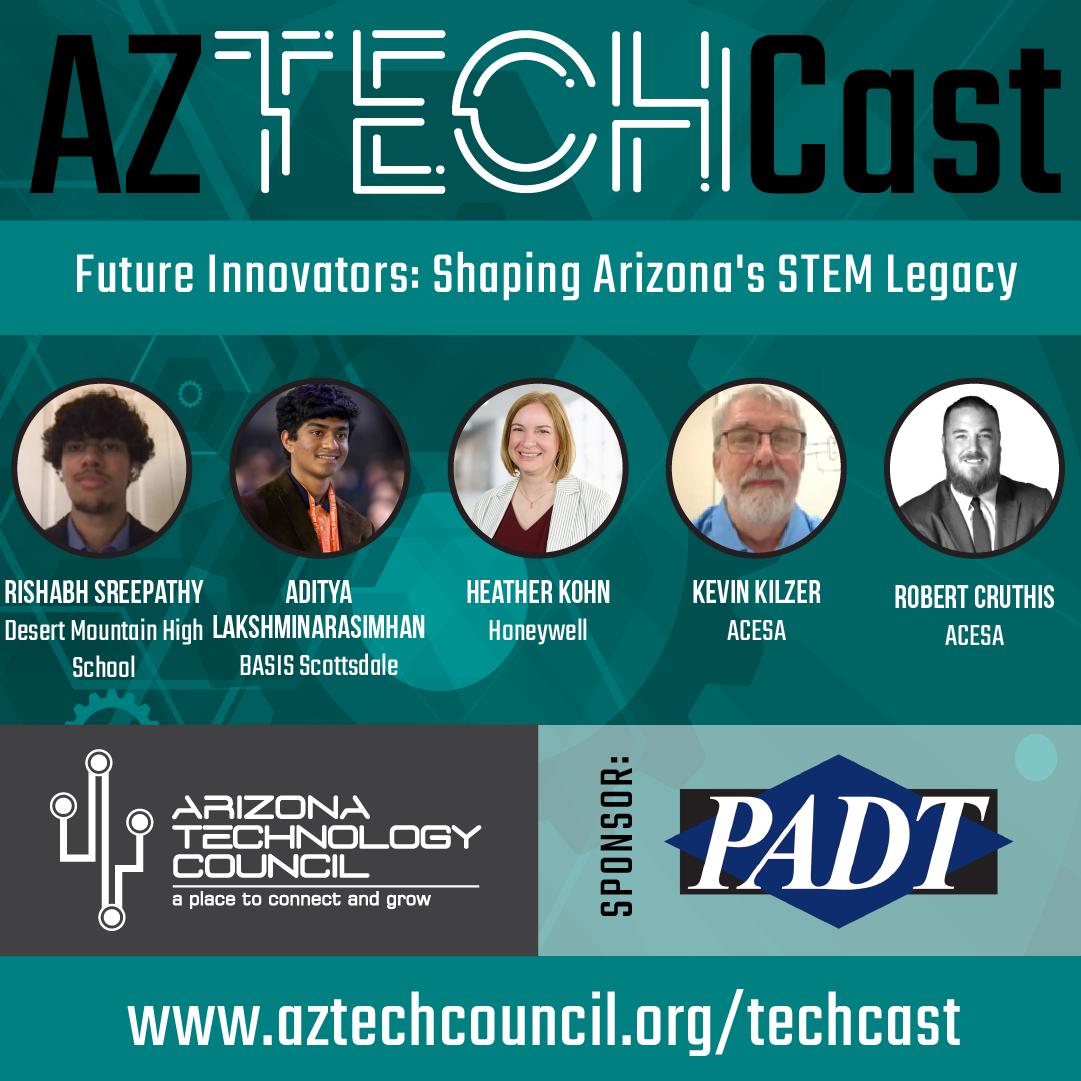
Welcome to this episode of the A-Z Tech Cast. In this episode of A-Z Tech Cast, we're joined, as always, by Arizona Technology Council President and CEO Steve Zylstra. And today, we're excited to spotlight the future of Stem with two exceptional students, Rich Spa Sri Pathy and Aditya Lakshmi Narasimhan. And we had a fourth, our third student that was that had a test.
00:01:16:14 - 00:01:50:12
Unknown
So unfortunately you won't be able to join us today, but they are the winners of the Arizona Technology Council's 2024 Future Innovators of the year award. These students will be recognized at the upcoming Governor's Celebration of Innovation in November. Joining us are Calvin Kilmer and Robert Curtis from the Arizona Council of Engineering and Scientific Associations, a CSA, along with Heather Cohn from Honeywell, to discuss the students groundbreaking projects and share insights on the importance of education, workforce development, and fostering the next generation of Stem leaders in Arizona.
00:01:50:13 - 00:02:12:06
Unknown
Let's dive into their inspiring journeys. I'm Erik Miller, founder and co-owner of ADT, and I'd like to welcome you to the Arizona Technology Council's AZTech Caste, sponsored by ADT. AZTech Cast is dedicated to covering innovation and technology in Arizona and beyond. High tech invites tech and business experts to have real conversations about what's happening across the state of Arizona.
00:02:12:07 - 00:02:18:05
Unknown
AC Tech Cast discusses the critical issues, topics, and trends propelling the state's growing tech ecosystem.
00:02:18:05 - 00:02:23:15
Unknown
So before we get started, Steve, can you tell us our listeners a little bit about the council here?
00:02:24:00 - 00:02:49:06
Unknown
Yes. Thank you Eric. Again, I'm Steve Zylstra, president and CEO, the Tech Council. We're a statewide organization or, trade association for science and technology based enterprises. We do public policy at the state and federal level, sort of the voice and face of the tech industry. We do, around 100 events a year, which is like three a week.
00:02:49:08 - 00:03:18:03
Unknown
This is one of them. And, we also have lots of publications, a magazine and newsletter, two podcasts. And, we negotiate lower cost products and services for our members. We run an association health plan. We run a 401 K program, and we operate 14 standing committees, made up of our, member companies. So full service trade association for science and technology companies.
00:03:18:04 - 00:03:46:10
Unknown
Excellent. Thank you Steve. So we've got a lot of interesting content to cover. So let's dive in. Why don't you start with the questions? Well, before we do that, I'm going to ask everyone to introduce themselves and, say a little bit about their organization and let's talk to, let's ask Kevin to start. Thank you. Steve. My name is Kevin Kilgour, and I work for Microchip Technologies.
00:03:46:11 - 00:04:25:15
Unknown
I am the past president and current, secretary of of a CSA. And, CSA is an organization that's really been around since the late, 50s, early 60s promoting communication between the various organizations like the I Tripoli, the Society of Women Engineers and, other groups and more, more, recently we promote, engineering at, at that the, technical street fairs.
00:04:26:01 - 00:04:57:14
Unknown
Coming up here, this is the, season and, we just try to raise interest in engineering among students. Thank you. Kevin. And I'll just, remind everyone, try not to use acronyms, because our audience is always, not always familiar with the acronyms. So, Robert, I see. Thanks for having me. Yeah. I'm, I work for climate tech Building Technologies, and I am, the current president of a Cesar.
00:04:57:15 - 00:05:44:15
Unknown
We are really focused on helping organizations like, the city council, sorry, the Arizona Technology Council to, link industry and Stem educators together. So we, are really trying to bridge that gap where we can get more industry professionals, engineers and, and, whatnot into classrooms. And I want to thank you both. The city said every year for as long as I can remember, supports the Arizona Tech Council and identifying, the best Stem students, in Arizona from, a variety of computer missions that occur around the state.
00:05:44:15 - 00:06:11:08
Unknown
So thank you for your ongoing support. For the suffer. Heather. Hi. My name is Heather Cohn. I work for Honeywell Aerospace. I'm the workforce development lead. I am a I was an engineer for Honeywell for 15 years, and I'm also an educator, for our public school system, where I developed, Stem program for K through six students and taught that for nine years as well.
00:06:11:09 - 00:06:31:07
Unknown
So thank you for having me today. Thank you. Heather. And okay, now, we're going to go to our students. So we're going to start with a data. If you could tell us a little bit about yourself and, a little bit about your project. Yeah. Hey everyone. I'm a data Lakshman Rossman, and I'm a senior at Scottsdale High School.
00:06:31:08 - 00:07:02:11
Unknown
My project is aimed at visualizing the interactions between respiratory viruses and human proteins using machine learning models. And all of this to help with improving vaccine outcomes. Very cool. Rishabh, could you introduce my name and your project? Yeah. My name is Rishabh Tripathy. I'm a junior at Desert Mountain High School and my project is I created a, blood diagnostic device to detect fungal infection in blood.
00:07:02:14 - 00:07:27:15
Unknown
And basically, it's a device that we can use handheld. And it's it's rapid and accurate. So we can detect these fungal infections in patients as soon as possible. Very cool. So both life sciences, related projects this year. So, I'll start with the first question. Eric, what are, the biggest challenges that you face when developing your project?
00:07:27:15 - 00:07:55:15
Unknown
And how did you overcome them? Let's start with Rishabh. Yeah. So some of the challenges is that we need to achieve all of our results three times to basically achieve reproducible results. And before we can publish them. And so with this we needed to test the the device on three different sets of fungal culture plates. So we needed to see with different serially diluted plates if the same results can be yielded for all of these.
00:07:56:00 - 00:08:22:13
Unknown
So for example, we wanted to see if we can yield less than 10% false positive results. So we needed to have those results achieved by three different times on fungal colony culture plates, and also compare them against different types of, different types of pathogen, such as bacteria. And then once we achieve those results with persistent, usage of the device on the fungal colony culture plates, we're finally able to achieve the results that we wanted to.
00:08:22:15 - 00:08:55:01
Unknown
Very cool. Data? Yeah. I think one of my biggest challenges, personally, was my inexperience to the field at first. Now I've had experience making app developed or developing apps, whether it's mobile apps, and I've also had experience making artificial intelligence models. But for the context of molecular docking, which is the study of these biological properties and how they interact from a mathematical framework, I found it kind of difficult to translate my skills of, like, raw coding into this new biological framework.
00:08:55:02 - 00:09:22:05
Unknown
And in fact, my first prototype was only accurate about 50 or 45% of the time, which is, quite low for something that should be quite high in the field of like viral studies. So I think my inexperience came in as a double edged sword in a way, because I was able to learn kind of curiously about these different topics that I didn't know about, and that kind of interest in learning about different aspects of molecular docking helped me identify two other types of neural networks, which are models of computer science.
00:09:22:06 - 00:10:06:01
Unknown
Very, very cool. Robert, can you talk about, the process that you use for helping the Arizona Technology Council select the students from some of the finance students, across Arizona? Yeah. So we, put together, volunteer panel judges and, they, they really look through all of the material. They get submitted. There's there's a big view review process, and, and that panel will come together and they will select these candidates, and, you draw those from, for instance, the Arizona Science and Engineering Fair and, the International Science and Engineering Fair.
00:10:06:02 - 00:10:41:05
Unknown
What other competitions do you typically draw the students from? Kevin, you know where we pull them from. So, yes, we do pull them in from the, Arizona Science and Leland Fair here in Maricopa County. We also look at the, science fairs in, Tucson and Yuma and also the, Helios. Program that they have a really intense, program during the summer.
00:10:41:05 - 00:11:12:08
Unknown
The summer and, and, and, we've always, found that the students from all of these, different programs really do represent the best in, in, science and, and engineering. By the way, it's always fascinating to me that at the Arizona's governor's celebration of innovation, there's nothing more exciting to the audience than the students presentations.
00:11:12:08 - 00:11:32:12
Unknown
So that's always the highlight, of every event every year. So we're looking forward to it again this year. Eric, looks like you had a question. Yeah. I mean, so this is was a great learning experience. It sounds like. But what do you think the real world impact in the future is of your product, of your of your research.
00:11:32:14 - 00:11:56:09
Unknown
And I'll, I'll start with idea. Yeah. So I think with regards to my project, which is about like the respiratory virus and how it affects infants and children or infants and adults. I think the biggest impact is that I basically identified a sequence, within the domain of the virus that we can target for better vaccine outcomes, and target for future therapeutic approaches.
00:11:56:11 - 00:12:21:02
Unknown
And in the future, I kind of want to leverage my artificial intelligence pipeline that I built with this project to discover novel biomarkers across, so many different macromolecules in the human body and the biological processes are definitely a big area. I, I work with a lot of startups, and there's a lot of people trying to find out what that pipeline needs to look like to get these low quality signals and train them to find these, these markers.
00:12:21:02 - 00:12:43:08
Unknown
That's fantastic. How about you, Reshma? Which about your job, which. I'm sorry. No. You're good. So essentially, as of right now, with the detection of fungal infection, the the usage of the treatment that we have for fungal detection right now, it takes about 24 to 72 hours for this treatment to come through. That's almost three days for these patients to receive their results.
00:12:43:08 - 00:13:03:02
Unknown
And grave cases with where the fungal infection has already progressed by by two weeks before we even get this diagnosis or treatment, it's too late. So this new device that I created can detect the fungal infection in just 5 to 10 minutes. So within that time frame, we can deploy this device in areas such as refugee camps and disaster sites.
00:13:03:04 - 00:13:23:14
Unknown
Specifically in, lesser developed countries. So we can receive these results as quick as possible and give these patients the treatment they need. Pretty cool. Kind of a follow on that just popped in my head. There is. How did you decide to do fungal? I mean, it's not not a common, area of study these days. What what led you down that road?
00:13:24:00 - 00:13:45:10
Unknown
Yeah. So essentially, in the aftermath of Covid 19, there's been an upsurge in fungal infections across the world. Even even in Arizona, we see, valley fever. And then throughout the world, especially in those lesser developed countries that I was mentioning, these fungal infections, a specific one, mucormycosis, is 80 times more prevalent in these, developing countries as they are in developed countries.
00:13:45:12 - 00:14:05:13
Unknown
So it's really something that we need to be looking at right now, because in, during the time of Covid 19, when these fungal infections increased, many of them were misdiagnosed as either Covid or bacterial infections, leading these patients to get, incorrect treatments and therefore leading to their to their death. So essentially, we need like that fungal infection.
00:14:05:15 - 00:14:26:12
Unknown
We need a device to detect it as soon as possible because there's been so much of it occurring and not the correct treatment methods. We've seen throughout the world. You know, I'll ask you the same question, but, I mean, you could have used your pipeline to, I don't know, figure out a way to win a video game or something.
00:14:26:14 - 00:15:08:07
Unknown
Why why viruses. Yeah. So, it's projected that year to year there between 58,000 to 80,000 infant hospitalizations and 100,000 to 160,000 older adult hospitalizations. So seeing as though this potent virus, especially with its new abilities following the 2022 resurgence to basically evade human responses, has basically gained the ability to, affect these two vulnerable demographics. I wanted to kind of research this field to see how I can help leverage these new technologies, whether it's, different types of deep learning neural networks or, generative AI models, to see how we can use them towards weakening the potency of the virus.
00:15:08:08 - 00:15:26:03
Unknown
Furthermore, I believe that because of the Covid 19 pandemic, a lot of researchers and labs who had conducted research on Alzheimer's disease or Parkinson's and even respiratory since video virus, which is the focal point of my study, they had all been forced to basically close down their research and focus all their work on the Covid 19 pandemic.
00:15:26:04 - 00:15:49:01
Unknown
So I felt like that left an opportunity for this virus to then evade human responses and get that much more potent, which is where I thought, using these new artificial intelligence technologies to get in the field. And then study the virus structurally could help weaken its potency. And it always amazes me, Eric, that these, students or high school students, it's just, I have to remind myself.
00:15:49:03 - 00:16:17:01
Unknown
But to me, it blows me away. Heather, you're with Honeywell Aerospace, a very sophisticated organization that, cuts across all aerospace, including space, systems. And, of course, Stem education is a critical part of, you know, what you do as an organization and you have a workforce development title that's very rare in industry.
00:16:17:03 - 00:16:43:06
Unknown
Can you explain that? And then I have another question. Do you follow, these competitions like the until and or the formally until the International Science and Engineering Fair or the Arizona Science and Engineering Fair? And do you try to look for students from these competitions? Maybe you can just discuss your your processes. Sure. Are some of my workforce development title.
00:16:43:10 - 00:17:14:08
Unknown
We've recognized, Honeywell a few years ago the importance of really partnering, education and industry together, to be able to develop us a talent pipeline. And, you know, to meet the increasing needs in Stem fields for, that, that are coming up for, you know, in the future here. So, we, we have a dedicated, role now to be able to work with, go out and form partnerships with our, our different educational institutions.
00:17:14:09 - 00:17:37:00
Unknown
And through that, we're able to provide mentorship, were able to, help educate parents. We're able to provide some extra tips and opportunities for teachers. We can co-create curriculum, with industry, or with education to make it industry relevant. So there's a lot of opportunities where we can get in and really show students from a young age what possibilities are for them.
00:17:37:02 - 00:18:01:04
Unknown
We'd like to start in the elementary school years and kind of show them, you know, give them an introduction to Stem fields and tell them what types of things are available, what types of jobs are available for them in the future. And then they start to spark that interest and grow that love for Stem for them, really keep them engaged in the junior high years, where sometimes they tend to self-select out of the, Stem fields and go to towards other other fields.
00:18:01:05 - 00:18:33:13
Unknown
And, but really help mentor them through that time so that they continue on to high school. And then as they get into high school, provide them with all kinds of real world opportunities. So experiential learning where they're able to come have internships with us, we get into the classrooms with them and mentor, some of the different competitions that you mentioned were able to help, provide mentorship for them as they're going through those processes and, you know, working through engineering design processes as well, that's, extraordinary and and very exciting to me.
00:18:33:14 - 00:19:02:05
Unknown
So, you know, traditionally large corporations like Honeywell would recruit, engineers and so on directly from colleges. But it sounds like you're working directly with K through 12, institutions and, you know, at least historically, though, that was somewhat rare. You know, you might have someone who's an engineer speak in a classroom or something like that about flight, or technology related to flight.
00:19:02:07 - 00:19:31:07
Unknown
Well, when when did you make that decision? And what was the driver? It's been obviously we started partnering with our school districts. It's been 23 years ago now, I guess, and I think it was just the the recognition of needing to, really foster, you know, create those pipelines by fostering, interest in student with, between, you know, students and, in Stem fields.
00:19:31:07 - 00:19:51:08
Unknown
So, you know, we look at the future of workforce and we realize that we're not going to have the talent to meet that, that demand if we don't start students young and really show them what's available for them. Right? So a lot of times, students don't even know what types of jobs they could have in that type of field.
00:19:51:08 - 00:20:12:15
Unknown
So if we can start to expose them to that from a young age and then just really mentor them through, as their, you know, as they continue to grow and their love for this and, you know, start to explore their passions in Stem fields, then we're able to, really build that talent pipeline. And that's going to be great for Arizona's workforce and economy.
00:20:13:00 - 00:20:45:10
Unknown
I'm really hoping many other corporations follow that model. It's it's really interesting to me, and I appreciate what you're doing very much. Let's move, to talk about teachers. First of all, Robert or Kevin, you know, we award, the best teacher Stem teacher, in Arizona, an award every year and, and an honorary, mention, how do you find the best teachers, in Arizona in Stem.
00:20:45:11 - 00:21:13:02
Unknown
And one of you speak to that. So the process there is, a self nomination, the, challenge to us is to get the word out that the, competition is actually open, and, so, so we, try to work through a couple different organizations and trying to, alert, teachers that the opportunity exists.
00:21:13:03 - 00:21:52:05
Unknown
Once we are there, the applicants, we look at the applicants to find the teachers that are are not only, working with their students, but also, working with their, their, their colleagues. So, so, I think that the, the you'll find that the teachers of the year for the last while have been, involved in a number of, different educational programs, that they really do, actually, on their, their own time.
00:21:52:06 - 00:22:11:04
Unknown
So, it's a, an important role that, that the teachers take and they, really do work with everyone. Robert. Anything we want to add or.
00:22:11:05 - 00:22:37:08
Unknown
No, I, I think I think one of the, one of the other challenges is itself nomination. And we have some incredible educators here in the state. They're they're, no one wants to raise their own hand. They're humble. We have some, some incredible people doing incredible things, and they're not bragging about themselves enough. So if anybody's listening, please raise your own hand.
00:22:37:09 - 00:23:01:06
Unknown
So, like I said, for our students, teachers can be critically important to your success. Wrote. What role did your teacher or even other mentors play in helping you achieve your accomplishments? Whoever wants to go first. I guess I can, take the first one. So I think I'd like to begin by thanking, the two mentors.
00:23:01:06 - 00:23:36:12
Unknown
That helped me a lot in my process. My first one is his name is Boris Codec, and he's from the University of Oxford. And he's a good researcher there. And he really helped guide me by answering a lot of the questions about molecular docking or this field that I had practically no experience in at first. And I'd also like to thank my school teacher, Ryan Carey, for, really talking to me and helping me develop a well-rounded approach with this kind of study, because the nature of my work is kind of interdisciplinary, where there's one heavy CS or computer science aspect to it, but there's also like a large biological and natural
00:23:36:12 - 00:24:05:03
Unknown
process to it. And I think I wouldn't have been able to develop the well-rounded perspective for this project if it weren't for, the advice I received from both of these teachers. And I think as a high school student, I'm sure Rishabh can, elaborate more on this for his research as well. I think it's really important to have, a mentor who can, you know, bounce back ideas with you, because as a high schooler, you think of like a lot of ideas, some rudimentary, some that are like so beyond what we can computationally or feasibly do.
00:24:05:06 - 00:24:25:01
Unknown
But to have a mentor that can kind of bounce back ideas with you, whether it be answering questions or, coming up with new ideas. And I remember in the context of my project, my initial model, which I think the 45% accuracy, I ended up actually just talking to my mentor about it seemed like what's going on in this field, how do people normally across that or come across this problem, and how did they solve it?
00:24:25:02 - 00:24:45:12
Unknown
And then we kind of just bounced back ideas and came at the idea of combining three different types of neural network models in artificial intelligence, which was kind of a unique approach in this field. So I think having that mentor who can answer questions and bounce back ideas was extremely instrumental in my journey. And I'm sure Bisharp can speak to the same shot.
00:24:45:13 - 00:25:04:09
Unknown
Yeah, I mean, to to build off that, I totally agree. I mean, we as high schoolers can can create ideas, can bring up ideas, but having having a mentor who's truly interested in the project is, is really crucial. My mentor was, Doctor Nikola Bosch. She's, she's a professor emeritus at, at the Arizona State University.
00:25:04:10 - 00:25:21:09
Unknown
And, with her help, I was able to basically all of the stuff I needed to do. A lot of it was like lab research. A lot of it was, growing those fungal culture plates, like, a lot of the stuff was, hands on approaches. And I really needed an access to a lab for that. And so she gave me that access to a laboratory.
00:25:21:09 - 00:25:45:07
Unknown
And then also along with that, when we have these ideas for projects kind of like combining like mine specifically for my project, like we have the device part of it, and then we also have the color analysis part of it, which analyzes how intense the fungal infection can be. And I think having those ideas as separate is, is can be thought of, thought above, but like kind of bringing them together and really helping, like solidify the process itself.
00:25:45:10 - 00:26:13:00
Unknown
Like my mentor really helped me with that. And so I think without without her, like the like it wouldn't be possible. I think I'll take it to the same thing. But, yeah, they were really like instrumental in our process for for helping us not only, like create the project itself, but kind of like how to like, like telling us how to not only, get the experimental design and the methods across, but also to pitch our project and, like, bring it to the, to the best potential that it could be.
00:26:13:01 - 00:26:39:11
Unknown
How about a shout out for all teachers, right. Yeah. Amazing people that make such an impact on each of our lives. Eric, I don't want to hog all the moderators time. Yeah. One of the questions I wanted to ask of of the, folks here is, especially, Kevin is what trends in Stem education or workforce development do you think are critical for Arizona to really stay competitive in the global market?
00:26:39:11 - 00:27:07:01
Unknown
What do we really need to do? Those of us active in the community to support Stem, where we where do we need to put our efforts? So I think that that the effort there goes to identifying the teachers and, keeping those, those people, that are active not only with their students but, but, but with their, their colleagues.
00:27:07:03 - 00:27:44:11
Unknown
And, and this applies both to the Advanced Placement classes, the AP classes, and also the, career and technical education classes. Because every time get that, that we see, a student excelled the way that the, students with us here have excelled, that, you know, that that they're going to need additional, people to work as a team to truly advance their, their, concepts into the marketplace.
00:27:44:13 - 00:28:17:04
Unknown
So, so, technical training, science training, engineering training at every level is, the key, I think, to actually raising, everybody and, and and and it's a big job keeping track of the, teachers that are excellent and, and but but it really does pay off their.
00:28:17:05 - 00:28:44:08
Unknown
Yeah. Heather or Robert, you have anything you want to add to that about what we need to do as a community? Yeah. So if you look around in Arizona, we are heading towards a very technical workforce being needed. And so, you know, when we when we talk about the, a lack of Stem education or where we need to get that from, it really is going to come from outside organizations assisting in the classroom.
00:28:44:10 - 00:29:13:09
Unknown
So you've got parties like School Connect, which are tying all of these third party companies to classrooms, to school districts that maybe wouldn't have access to Stem programs at all or, or sharing the cost of, in the maintenance of this technology. And instead of being on the burden of one school district now being shared across 15 or or 20 school districts as they participate in those programs.
00:29:13:10 - 00:29:33:14
Unknown
Heather, anything to add to that? Yeah. I think just from an education standpoint, you know, providing experiential learning for students is is key. So be that through, you know, project based learning or inquiry based learning, whatever you want to call it, getting them those real world experience is important. And that's where industry can step in and help.
00:29:33:14 - 00:29:54:03
Unknown
Right. So we can we can come into their classrooms and we can mentor them. As we talked a lot about, both students talk about their mentors and how important that was to them. Right. So having industry members be able to come in and really work with us, with the different students and lend their experience to help, you know, cultivate the next generation of Stem leaders is going to miss critical.
00:29:54:04 - 00:30:17:12
Unknown
So actually, to add on to that, sorry. Yeah. Go ahead please. Sounds good. So to actually add on to that, I think that's like a really amazing thing about Arizona, which is why people like me and wish I were able to do this kind of research. I think Arizona is one of the most open Stem communities, that you can find where there are so many instructors around Phoenix, so many researchers around the entire state of Arizona.
00:30:17:12 - 00:30:37:12
Unknown
We have like world class research labs, facilities and universities within Arizona, all of which have, professors who are really passionate about their projects, but also see the potential for these ideas to kind of develop. So I think, one thing that was definitely helpful for me, and I'm sure Rachelle agrees with this too, was that we've had opportunities to do research as high schoolers.
00:30:37:12 - 00:31:05:10
Unknown
And I think that's mainly thanks to the large like, tech community and the innovation community that Arizona is. And I think, the beauty and I think that's something that, every like middle school student or high school student should aspire to do, which is research, because, whether it's Stem research, like whether it's, you know, studying fungal infections or respiratory viruses, using artificial intelligence or even researching like policies and ways to make things more equitable for, everyone across Arizona.
00:31:05:10 - 00:31:35:04
Unknown
I think there's definitely a lot of room for doing research where you can make these connections, and think outside the box. And I think Arizona's community sets that up very nicely. Just a shout out for the other organization that I lead, the SciTech Institute. We're focused exclusively on K through workforce Stem education. And we, now for 13 years have run the, Arizona Sci Tech Festival, which occurs throughout the state.
00:31:35:05 - 00:32:01:15
Unknown
We run a really cool program called chief Science Officers. And, I think we're in 137 school districts currently have 330 chief science officers. And, they're elected by their peers in grades six through 12. To be the chief science officer for their class, they must create an action plan, Stem action plan for their class. We bring them together in a leadership institute.
00:32:01:15 - 00:32:29:11
Unknown
We bring them together in what we call cabinets. And, these are some of the most remarkable students, you've ever met. And that program has, been so successful. We're now in 15 other states and six other countries with the chief science officer program. So you can see the connection between the tech Council that represents technology based companies and the Sci Tech Institute.
00:32:29:12 - 00:32:52:04
Unknown
Now, I'll just add that this is not new in Arizona. When I was in junior high and Litchfield Park Junior High School, in the 70s, we had these amazing programs that were very new in the country, let alone anywhere in Arizona has been ahead. And it's really I'm really glad to see it and hope to see more of it happening, because it definitely changed my life in a positive way.
00:32:52:05 - 00:33:15:09
Unknown
I mean, it was great stuff. So really cool. Go ahead, go ahead. So I kind of wanted to ask another question of our two students is, so get out my magic wand and say, you can have you can work on anything out there that you want to any project, unlimited resources. You know, what project would you want to go work on?
00:33:15:10 - 00:33:24:04
Unknown
Let's say I ran into Bill Gates at Starbucks and he gave me the money and I give it to guys.
00:33:24:05 - 00:33:51:12
Unknown
Yeah. So I think one this is a nice question, actually. I think I think I have one in mind. So, I think a very interesting global phenomena that, people are researching right now is graceful longevity. So I think as our technology and medicine advancements have improved over the last 100 or so years, we've basically developed the ability to increase the average lifespan from 30 to almost 70 years on average.
00:33:51:12 - 00:34:12:03
Unknown
Granted that some countries are still working on improving the lifespan there, but I think because of this amazing lifespan that is increased, the one side effect of that is that healthspan or how healthily people are living longer, or with this new extra 40 years that people have added to their lives now, could still use a lot of research and improvement because it is still relatively new.
00:34:12:04 - 00:34:39:02
Unknown
So I think with unlimited resources, I think I would probably research how we can improve the average health span of individuals after age 30, that they can live the next 40 years of their life, with this new advent of, longevity, to the best of their ability, where diseases like dementia or Parkinson's, which kind of progress over time, can be kind of weakened because of our new research that we have with, having more healthy, healthy lifestyles.
00:34:39:03 - 00:35:14:05
Unknown
I endorse that quickly. How about rehab? If you got one you'd like to do? Yeah, I think, I think that's a really interesting question, but if if that if that opportunity was presented, I think something that's like really important right now and a lot of research is being done on it. What I would say is neurological disorders, from pediatric neurological disorders all the way to neuro, neurocognitive ones, neurodegenerative ones, like at the younger age span, like a lot like we said, like we were saying in education, like a lot of research is being done on, kids with the autism spectrum disorder or ADHD and year by year, this, this number
00:35:14:05 - 00:35:36:08
Unknown
of, of kids with, with these disorders is increasing. And I think that with that research is also increasing upon that. So on that side of the spectrum and then also on the other side with neuro degenerative disorders like Parkinson's, Alzheimer's and dementia, I think that that type of research would be really cool because not only is the amount of people with those disorders increasing, I think the amount of research is increasing as well.
00:35:36:11 - 00:36:00:00
Unknown
And I think, in, research heavy state like Arizona with so many resources, I think that would be my ideal path to be researching next. Let me do a follow up to that. Eric. So how do each of you see your future unfolded first? Academically and then ultimately professionally?
00:36:00:01 - 00:36:38:00
Unknown
I can take this one first. So essentially, hopefully with with what I've been doing, I think that I've been doing a lot of, like, creating devices that can help, like, patient populations. And I think with that, if I can hopefully continue that research, I would hope to be a physician in the future and use that, the experience that I have in research to create more equitable opportunities for patient populations of all kinds in rural communities, underserved areas, and kind of expand my expand my research on to like populations that aren't being researched at all, and then kind of using that research to improve lifespan, like you was talking about earlier.
00:36:38:00 - 00:37:01:13
Unknown
And, all the all these kind of, disorders throughout the world. But essentially I would like to continue my career as a, as a physician. And did you choose, a school year? Not not yeah. I haven't, I haven't chosen particularly, what undergraduate, institution that I would be, attending yet. But, a great choice is the university of Arizona at the, at the Regeneron.
00:37:01:14 - 00:37:25:09
Unknown
International Science Fair. Both me and, there we both received, a renewable tuition scholarship for $58,000 at the University of Arizona. So it's, it's it's definitely a great, great opportunity there. They have lots of resources and especially, being on that pre-medical track, they have lots of opportunities. And specifically research opportunities dedicated towards, students that want to be on that pre-medical track.
00:37:25:09 - 00:38:08:09
Unknown
So that that would be that would be definitely an option to consider a data. Yeah. So I think, what was the first question I got? Sorry, I was thinking about, well, how do you see your future, unfolding first academically and then ultimately professionally? Yeah. So I think, academically, I want to pursue a degree in computer science where I can study how these different algorithms behave, and basically optimize networks by, learning from nature and how nature can naturally optimize its networks and then use those fundamentals in building new types of AI models, and then kind of going beyond that, one of my, life goals, you could say,
00:38:08:09 - 00:38:38:06
Unknown
or admissions is I want to take these AI models that are like really complex, have the ability to change so many different lifestyles or, applications in the real world and make it so that these models can be run on everyday devices like mobile devices, or computer, phones or tablets. That way, each individual, basically every single person who has access to some kind of mobile device can have the access to train their own models on their own private data, which shouldn't be, group.
00:38:38:06 - 00:39:05:00
Unknown
That's part of this larger model, because I believe that each person is unique and is different. So having their own personalized models that they can run on their phones, which is currently very computationally demanding, could help each individual person, use AI to the best of their ability in a way that complements their existing lifestyle. So there's a tech council is going to do a major conference next year on computer science, information technology and artificial intelligence.
00:39:05:00 - 00:39:31:07
Unknown
And I'm going to ask you now if you're interested in being a speaker, great. For sure I would I would love to do that. Yeah. Excellent. Well, we'll follow up on that. Eric. Yeah. Over to our industry. Experts really would like. So we've we've seen two examples here of, of students and where they've developed these skills. But in your opinion, what are the most critical skills or qualities you think the next generation of Stem professionals need to develop and succeed?
00:39:31:07 - 00:39:53:13
Unknown
I think that's changed since my generation, and I'm curious to think what you think they need to be. I think problem solving is a is a huge skill that they need to be able to have, as well as resilience to, continue along when things don't always go as planned. To. So I think those are definitely some skills that, that, we look for.
00:39:53:14 - 00:40:24:04
Unknown
In addition, that any of the 21st century learning skills like, communication, collaboration, you know, critical thinking, all of that is really important, right? So, teaching students to think critically, I think is, is, so that they're able to problem solve this is essential because I think anytime you, you you can if you've got that skill down and you know how to ask the right questions and do the right types of research and, and can be resilient and, you know, in the in the face of challenges, then I think you're adaptable to any industry.
00:40:24:06 - 00:40:52:12
Unknown
Let me just respond to that real quick. So, we have 750 member companies, science and technology companies across the state. And, that's the thing that I hear most, from our members, they usually, feel comfortable that they're going to know the subject that they went to school for. But it's all these soft skills that are sometimes lacking and so critically important.
00:40:52:13 - 00:41:22:09
Unknown
And and today's, work environment. So thank you for that. Heather. Robert or Kevin. Yeah, I'd love to see passion be on that list. You know, and I think I think that comes from exposure. But you do not get to wear these two fine gentlemen there at without the late nights and the hard work and the determination and that that really comes from being passionate at what you do and, and, that will carry you very far the rest of your life.
00:41:22:09 - 00:41:40:08
Unknown
I think that that one of the characteristics of the entrance that this year is how many of them were really applied science some years we have a lot of petri dishes and microscopes and, and, and, and, and data collection.
00:41:40:10 - 00:42:22:11
Unknown
This year we had a lot of, of, people that, that were working to bring the science to the common man and, and, and, and to really do, technical thing that, that would be easily distributed not, you know, you know, you know, at the level of like the next poster type, kind of of, of a product and, and, and so I think that that's, current trend, I don't know how long it will go, but, but, this year that, that is the, observation.
00:42:22:12 - 00:42:42:12
Unknown
So, some of you again, at the governor's celebration of innovation because you've been selected as, Future Innovators of the year for 2024. Can each of you speak to how that feels and, how that might influence your future?
00:42:42:14 - 00:43:12:10
Unknown
I guess I can, start with this one. So, I first wanted to say, you know, thank you so much to the Arizona Technology Council, the SciTech Institute, and all the partner organizations within the Arizona Tech Council for putting on this event. It's truly, truly an honor to receive this award. And I say that because it's it's a testament to both, like the research that we do, but more importantly, the connections, whether it's the friendships, for example, me and Bishop, we've known each other for a long time, but we got a lot closer together with the research that we did.
00:43:12:11 - 00:43:37:10
Unknown
And even though we research two completely different topics, we found a common interest in, making these technologies more accessible for the common people. So I think that the thing I'm most looking forward to with this award is the community that I am now a part of with the Arizona Technology Technology Council, because, as I've seen, through hundreds of like, LinkedIn posts and through the Arizona Technology Council website, there's so much there's so many conferences.
00:43:37:10 - 00:43:57:15
Unknown
There's basically like one every month that I've seen. And I find that, the rich technological ecosystem within Arizona where, people from individuals like me and resolve all the way to these large companies within Arizona are designing, building and iterating so many different models, with applications in so many different fields. I find it really inspiring.
00:43:57:15 - 00:44:33:01
Unknown
And I really look forward to joining this community. So once again, thank you so much. Absolutely. Thank you. Sure. Yeah, I mean, I I'm just super, super grateful for this award and I'm sure he is too. It's just it's just a great, great opportunity. Not only one to to receive the award, but also to be a part of this community, like you said, to meet to meet professionals in the field is is super, super important to network with these individuals that share the same passions as you, that share the same ideas that you have, and to basically just bounce back ideas, just talk to them about how they think research will affect Arizona's future.
00:44:33:01 - 00:45:07:06
Unknown
I think that's super, super important. And that's why the Arizona Technology Council giving us that opportunity to be there at the at the, event and talk to all these people is just it's just really, really a blessing. And then kind of about the future. I think that like using these technologies that we can we can talk to these people who are already in these fields, since we only have a specific amount that we can do as high schoolers, talking to the people who are already in these fields and pitching those ideas can not only better the science itself and better Arizona's research, it can better like our connections.
00:45:07:08 - 00:45:29:03
Unknown
And even if, like one other person, like one of the kid, like, here's the podcast or here's the event, like we can inspire them and future generations of Arizona to continue that research. So we can see that, like, we can see science as a whole, like building in Arizona. And Arizona as a big, big, has like science having a big, big impact on Arizona's next future generation.
00:45:29:05 - 00:46:02:05
Unknown
You know, our passion for this goes back, quite a long way. You may not know, but, Arizona Tech Council ran the Arizona Science and Engineering Fair for a number of years through our foundation and the SciTech Institute. And, even today, many, many years later, I co-chair the advisory committee, for that. And, one of you mentioned that might have been coven, Southern Arizona CRF program, which is another organization that is a huge collaborate there with us.
00:46:02:05 - 00:46:31:09
Unknown
They run a regional fair, and the science center now runs the Arizona Science and Engineering Fair. And, we're working on we just got $1 million grant from Helios to expand the Arizona Science and Engineering fair and create more regional fairs, around the state. So, we're really committed to the continuation and the enhancement of its excellence, going forward.
00:46:31:10 - 00:46:56:03
Unknown
Eric. Yeah, it I think it's really, really important to to think about the legacy in the state and keep, keep growing it like you've been talking about. So kind of kind of a final question for our industry guests here is, where do you see the Future Innovator program evolving in the next few years? And where do we need to go with it?
00:46:56:04 - 00:47:28:01
Unknown
I'll start with Robert. You go first. Yeah. So I'd love to see more of an industry sponsoring of the innovation challenge. I'd like to see a specific challenge that maybe we have a solution for today, but it isn't. It is an ideal. And can we put fresh minds on that? And what does that look like? And can can we bring in, those candidates that have contributed to that back into the industry and, and lift up the curtain a little bit and let them see what it looks like behind the scenes.
00:47:28:03 - 00:47:53:06
Unknown
Let them participate in the industry space and see what it looks like to looking to work in these companies that they're actively working on from their classrooms. Heather, do you have anything you want to add to that? Yeah. I mean I think increased mentorship is going to be critical. And then also I think just expanding the program to include maybe more diverse Stem fields as well.
00:47:53:08 - 00:48:28:13
Unknown
Yeah, a great direction to go with it. Yeah. Good, good. Kevin. So I think one of the, important things that that could be be, emphasized is, is to, teach the students about the, different roles of, science and engineers, so, so that they will find an interest in, in the, fields there there are so, so many kids that just don't understand what an engineer does.
00:48:28:15 - 00:48:57:12
Unknown
And, and, and so I think that's an industry, pushing to the, the, future innovator work, could, certainly, kind of emphasize the, career opportunities and really the, the, the, the, the, day to day functions of, of an engineer. Cool. By the way, Eric, I want to take a moment to thank Honeywell.
00:48:57:13 - 00:49:25:10
Unknown
Yes, honey? Honeywell. And thank you. Heather is, essentially the sponsor of this year's Future Innovator award at the governor's celebration of innovation. And, the tech council could not bring, the kinds of events, that we do or create the kind of events that we do without the, the support of our sponsors. So really appreciate you, your commitment, Honeywell's commitment to this other.
00:49:25:10 - 00:49:45:09
Unknown
Thank you. You know, it's important to invest, right? And I think that's something that we all have to think about is that this is not a cost. It's an investment. And, it should pay off quite well. Let's go ahead. I, I'm just going to add to it. I think it's something that really great for our employees as well because, you know, they really want to give back to the community.
00:49:45:11 - 00:50:09:06
Unknown
And so we've got our, our, our workforce development team is almost entirely, volunteer run. Right? We've got employees with regular jobs that are taking time out of their schedules because they're passionate and they want to share that passion and their, that passion with, you know, students and, and bring them. And so I think it's, it's something that's really good for our employees, the community, education and industry all combined.
00:50:09:07 - 00:50:34:03
Unknown
It's awesome. Well, I think we got time for one more question here. And I'm going to give it to the students. And it's kind of, you know, I don't know how many younger students are listening to podcasts, or maybe their parents are and will repeat your advice back to them. But what what advice would you give to other students who are interested in pursuing a Stem, project?
00:50:34:05 - 00:50:53:14
Unknown
I think this one first, I'd say that first, like reach out like so many students just think that there isn't like, opportunities and that there isn't a way for them to pursue the the things that they want to do. And I'd say just reach out. There are so many mentors, there are so many people around Arizona, just like everybody here in this meeting today that are so they they're passionate.
00:50:53:14 - 00:51:15:09
Unknown
They want to give back to the community. They want to help these kids like for their their understanding of science and, and technology and engineering. So I'd say first reach out and then second, just do whatever you're passionate about. Like like we mentioned earlier in the meeting that with that passion, like if you are really, really passionate about your subject, you can go to great, great lengths because passion can drive your project like so much.
00:51:15:09 - 00:51:37:01
Unknown
Like, I genuinely enjoyed my project so much and like the experience I had from starting it all the way to the end with with stuff like the the Arizona Science Fair, the International Science Fair, and even now the governor's, Council of Innovation celebration. It's just it's been such an amazing opportunity for me. And I would I would love if other students could get that opportunity as well.
00:51:37:01 - 00:52:00:14
Unknown
So I just say reach out and really just pursue your passions in. DDA what do you think? What advice would you give? Yeah, I'd say yeah. I'd say first and foremost, stay curious. I feel like every, child has a potential where, a potential and more importantly, a curiosity where they ask questions around the world. Mine started when I was my.
00:52:00:14 - 00:52:18:10
Unknown
Started a bit silly, where I would just look at the fan, wonder what that giant thing spinning on the, at the, on the ceiling was. And I feel like, over time, it's quite easy for us to lose this curiosity as we're just learning different things, as we think we know more. And you kind of just stay satisfied with what we know.
00:52:18:11 - 00:52:41:03
Unknown
I'd say go out there and feel unsatisfied. What? You know, so that you feel, more curious and engaged to learn more about what you don't know. And I think the second piece of advice there is, you know, there's a lot of different people out there with so many different, backgrounds, experiences, cultures, ideas. I think there's always one important thing you can learn from each different person.
00:52:41:03 - 00:53:06:10
Unknown
So I'd say an important thing that helped me out is to take notes. Take notes with whoever you talk to. You never know what it's going to be useful for. And then if you find yourself like the job kind of talking on this, on this call here, with all these industry leaders and people running these amazing events, you realize that it all comes together, very nicely when, that one person you talk to, like, ten years ago, is actually one of the main people who actually helped you with doing this project.
00:53:06:10 - 00:53:28:15
Unknown
And I think, you know, just taking notes, learning from different people, having an open mind, and kind of like making sure that you can learn at least one valuable thing from each person is an extremely important trait to have as a young scientist. Eric, I want to ask one more question, but please do. There's a cohort of people out there that we haven't acknowledged today, and that's parents.
00:53:29:01 - 00:53:51:04
Unknown
And, you know, parents are critical to the success, of their students. And, you know, if nothing else, are driving them back and forth, all kinds of things, all the time. So could each of you speak to the role that your parents have played and still play? Today?
00:53:51:05 - 00:54:09:11
Unknown
I guess I could begin. So I'd first like to say thank you to my parents. I think I'm 99%. Actually, I'm 100% sure they're watching this, as we speak. So I think, so, yeah, I think, I'm really, really thankful, to both my dad and my mom. So first, my dad really helped with, pushing me to keep learning and learning.
00:54:09:11 - 00:54:30:02
Unknown
He didn't let me stay satisfied with what I already knew. And, he constantly pushed me to learn more about, different things. And for example, with, my project from, like, a couple of years ago, I was basically making a mobile app for music, which was, a really fun project for me because it helped me with, you know, doing something that I was quite passionate about, which is music, which I've done for about 12 years.
00:54:30:06 - 00:54:57:06
Unknown
But then he kept pushing me and pushing me and pushing me. He was like, try this. Why don't you try this? Why don't you try looking at biological mechanisms? And then he, ultimately pushed me, to think like a problem solver where, you consider the people who are impacted the most as your end goal. So with that kind of mindset he's instilled in me, I think the ideation of products and building things that are specifically tailored for helping the community is something that he instilled in me, and I'm very thankful for.
00:54:57:10 - 00:55:13:08
Unknown
And of course, I'd like to thank my mom as well. She, she's kind of like the one that helps keep me together, keeps me up and running. And and in those late nights when it's like 12 or 1 a.m., she's a lot. It keeps me motivated to work, whether it's through coffee or simply just encouraging me.
00:55:13:09 - 00:55:14:14
Unknown
It's awesome.
00:55:15:10 - 00:55:29:05
Unknown
Yeah. I mean, I totally agree. I don't think I could ever thank my parents enough for what they do for me. And it's just they play such a big role that might not be seen to other people. Like when you really, like, present the project and stuff like that. But it is like one of the biggest roles I like.
00:55:29:05 - 00:55:49:07
Unknown
My parents have helped me so much throughout, throughout my project and throughout life itself. You know, like they stood by my side, like supported me through every step of the way. Let it be like through success or failure, like even even the nights before the science fair where I'm just presenting my project and asking them for for advice or whether they're they're coming and watching me, get an award.
00:55:49:07 - 00:56:09:01
Unknown
It's just I could never, ever thank my parents enough. They've just been like my rock, my everything throughout my entire process. So I, I like I genuinely love my parents and I thank them so much for everything they've done for me throughout throughout my, my life and my project. Yeah, thank you very much. Heartwarming for sure. Yeah. That's great.
00:56:09:02 - 00:56:27:12
Unknown
Well, I think that, I want to thank you all, to all of our speakers and their expertise and time today. Today's AZTech cast was brought to you by PDT. For 30 years, PADT has been providing simulation design and ad and manufacturing products and services to companies who design and make things across Arizona. In the southwest.
00:56:27:12 - 00:56:49:10
Unknown
Many people know us because of our long time activity in 3D printing, but what you may not know is that we have a full product development team at PDG. The team works with everything from startups to hospital systems to large multinational companies to help them develop their products, concepts into Manufacturable product specifications. We can jump in and help with just a part of the product, develop process, or we can do the whole thing.
00:56:49:12 - 00:57:12:15
Unknown
And of course, one thing that makes us unique is our extensive in-house simulation and 3D printing capability. So if you need assistance with your product design and prototyping, or if you know someone that does, please reach out. You can find us at PADT Inc.com. And click on the product development in the main menu and learn more about PDT, where we make innovation work.
00:57:13:00 - 00:57:36:14
Unknown
And again, I want to thank everybody for coming. If you are interested in being a podcast participant or sponsor for the Council's AZTech cast, please contact Marketing at aztechcouncil.org and you can learn more about opportunities, to further position it as a tech expert, influencer or innovator. So until next time, I'm Eric Miller, and thank you for joining us for the AZTech cast.
00:57:36:14 - 00:58:08:11
Unknown
Thank you for joining us for this episode of The AZTechCast. With the Arizona Technology Council, featuring leading tech and business experts who help influence and shape our great state and the industries they serve.. hey Steve
Unknown
Welcome to AZ TechCast, sponsored by the Arizona Technology Council with your hosts, Steve Zylstra and Eric Miller. AZTechCast is dedicated to covering innovation and technology in Arizona and beyond. AZTechCast invites leading experts to have real conversations about what is happening in the tech sector across the state of Arizona, from innovative startups to regional news companies and emerging technologies.
00:00:39:09 - 00:00:53:02
Unknown
AZTechCast covers the critical issues and economic trends propelling the state's growing tech ecosystem.
00:00:53:02 - 00:01:16:14
Unknown
Welcome to this episode of the A-Z Tech Cast. In this episode of A-Z Tech Cast, we're joined, as always, by Arizona Technology Council President and CEO Steve Zylstra. And today, we're excited to spotlight the future of Stem with two exceptional students, Rich Spa Sri Pathy and Aditya Lakshmi Narasimhan. And we had a fourth, our third student that was that had a test.
00:01:16:14 - 00:01:50:12
Unknown
So unfortunately you won't be able to join us today, but they are the winners of the Arizona Technology Council's 2024 Future Innovators of the year award. These students will be recognized at the upcoming Governor's Celebration of Innovation in November. Joining us are Calvin Kilmer and Robert Curtis from the Arizona Council of Engineering and Scientific Associations, a CSA, along with Heather Cohn from Honeywell, to discuss the students groundbreaking projects and share insights on the importance of education, workforce development, and fostering the next generation of Stem leaders in Arizona.
00:01:50:13 - 00:02:12:06
Unknown
Let's dive into their inspiring journeys. I'm Erik Miller, founder and co-owner of ADT, and I'd like to welcome you to the Arizona Technology Council's AZTech Caste, sponsored by ADT. AZTech Cast is dedicated to covering innovation and technology in Arizona and beyond. High tech invites tech and business experts to have real conversations about what's happening across the state of Arizona.
00:02:12:07 - 00:02:18:05
Unknown
AC Tech Cast discusses the critical issues, topics, and trends propelling the state's growing tech ecosystem.
00:02:18:05 - 00:02:23:15
Unknown
So before we get started, Steve, can you tell us our listeners a little bit about the council here?
00:02:24:00 - 00:02:49:06
Unknown
Yes. Thank you Eric. Again, I'm Steve Zylstra, president and CEO, the Tech Council. We're a statewide organization or, trade association for science and technology based enterprises. We do public policy at the state and federal level, sort of the voice and face of the tech industry. We do, around 100 events a year, which is like three a week.
00:02:49:08 - 00:03:18:03
Unknown
This is one of them. And, we also have lots of publications, a magazine and newsletter, two podcasts. And, we negotiate lower cost products and services for our members. We run an association health plan. We run a 401 K program, and we operate 14 standing committees, made up of our, member companies. So full service trade association for science and technology companies.
00:03:18:04 - 00:03:46:10
Unknown
Excellent. Thank you Steve. So we've got a lot of interesting content to cover. So let's dive in. Why don't you start with the questions? Well, before we do that, I'm going to ask everyone to introduce themselves and, say a little bit about their organization and let's talk to, let's ask Kevin to start. Thank you. Steve. My name is Kevin Kilgour, and I work for Microchip Technologies.
00:03:46:11 - 00:04:25:15
Unknown
I am the past president and current, secretary of of a CSA. And, CSA is an organization that's really been around since the late, 50s, early 60s promoting communication between the various organizations like the I Tripoli, the Society of Women Engineers and, other groups and more, more, recently we promote, engineering at, at that the, technical street fairs.
00:04:26:01 - 00:04:57:14
Unknown
Coming up here, this is the, season and, we just try to raise interest in engineering among students. Thank you. Kevin. And I'll just, remind everyone, try not to use acronyms, because our audience is always, not always familiar with the acronyms. So, Robert, I see. Thanks for having me. Yeah. I'm, I work for climate tech Building Technologies, and I am, the current president of a Cesar.
00:04:57:15 - 00:05:44:15
Unknown
We are really focused on helping organizations like, the city council, sorry, the Arizona Technology Council to, link industry and Stem educators together. So we, are really trying to bridge that gap where we can get more industry professionals, engineers and, and, whatnot into classrooms. And I want to thank you both. The city said every year for as long as I can remember, supports the Arizona Tech Council and identifying, the best Stem students, in Arizona from, a variety of computer missions that occur around the state.
00:05:44:15 - 00:06:11:08
Unknown
So thank you for your ongoing support. For the suffer. Heather. Hi. My name is Heather Cohn. I work for Honeywell Aerospace. I'm the workforce development lead. I am a I was an engineer for Honeywell for 15 years, and I'm also an educator, for our public school system, where I developed, Stem program for K through six students and taught that for nine years as well.
00:06:11:09 - 00:06:31:07
Unknown
So thank you for having me today. Thank you. Heather. And okay, now, we're going to go to our students. So we're going to start with a data. If you could tell us a little bit about yourself and, a little bit about your project. Yeah. Hey everyone. I'm a data Lakshman Rossman, and I'm a senior at Scottsdale High School.
00:06:31:08 - 00:07:02:11
Unknown
My project is aimed at visualizing the interactions between respiratory viruses and human proteins using machine learning models. And all of this to help with improving vaccine outcomes. Very cool. Rishabh, could you introduce my name and your project? Yeah. My name is Rishabh Tripathy. I'm a junior at Desert Mountain High School and my project is I created a, blood diagnostic device to detect fungal infection in blood.
00:07:02:14 - 00:07:27:15
Unknown
And basically, it's a device that we can use handheld. And it's it's rapid and accurate. So we can detect these fungal infections in patients as soon as possible. Very cool. So both life sciences, related projects this year. So, I'll start with the first question. Eric, what are, the biggest challenges that you face when developing your project?
00:07:27:15 - 00:07:55:15
Unknown
And how did you overcome them? Let's start with Rishabh. Yeah. So some of the challenges is that we need to achieve all of our results three times to basically achieve reproducible results. And before we can publish them. And so with this we needed to test the the device on three different sets of fungal culture plates. So we needed to see with different serially diluted plates if the same results can be yielded for all of these.
00:07:56:00 - 00:08:22:13
Unknown
So for example, we wanted to see if we can yield less than 10% false positive results. So we needed to have those results achieved by three different times on fungal colony culture plates, and also compare them against different types of, different types of pathogen, such as bacteria. And then once we achieve those results with persistent, usage of the device on the fungal colony culture plates, we're finally able to achieve the results that we wanted to.
00:08:22:15 - 00:08:55:01
Unknown
Very cool. Data? Yeah. I think one of my biggest challenges, personally, was my inexperience to the field at first. Now I've had experience making app developed or developing apps, whether it's mobile apps, and I've also had experience making artificial intelligence models. But for the context of molecular docking, which is the study of these biological properties and how they interact from a mathematical framework, I found it kind of difficult to translate my skills of, like, raw coding into this new biological framework.
00:08:55:02 - 00:09:22:05
Unknown
And in fact, my first prototype was only accurate about 50 or 45% of the time, which is, quite low for something that should be quite high in the field of like viral studies. So I think my inexperience came in as a double edged sword in a way, because I was able to learn kind of curiously about these different topics that I didn't know about, and that kind of interest in learning about different aspects of molecular docking helped me identify two other types of neural networks, which are models of computer science.
00:09:22:06 - 00:10:06:01
Unknown
Very, very cool. Robert, can you talk about, the process that you use for helping the Arizona Technology Council select the students from some of the finance students, across Arizona? Yeah. So we, put together, volunteer panel judges and, they, they really look through all of the material. They get submitted. There's there's a big view review process, and, and that panel will come together and they will select these candidates, and, you draw those from, for instance, the Arizona Science and Engineering Fair and, the International Science and Engineering Fair.
00:10:06:02 - 00:10:41:05
Unknown
What other competitions do you typically draw the students from? Kevin, you know where we pull them from. So, yes, we do pull them in from the, Arizona Science and Leland Fair here in Maricopa County. We also look at the, science fairs in, Tucson and Yuma and also the, Helios. Program that they have a really intense, program during the summer.
00:10:41:05 - 00:11:12:08
Unknown
The summer and, and, and, we've always, found that the students from all of these, different programs really do represent the best in, in, science and, and engineering. By the way, it's always fascinating to me that at the Arizona's governor's celebration of innovation, there's nothing more exciting to the audience than the students presentations.
00:11:12:08 - 00:11:32:12
Unknown
So that's always the highlight, of every event every year. So we're looking forward to it again this year. Eric, looks like you had a question. Yeah. I mean, so this is was a great learning experience. It sounds like. But what do you think the real world impact in the future is of your product, of your of your research.
00:11:32:14 - 00:11:56:09
Unknown
And I'll, I'll start with idea. Yeah. So I think with regards to my project, which is about like the respiratory virus and how it affects infants and children or infants and adults. I think the biggest impact is that I basically identified a sequence, within the domain of the virus that we can target for better vaccine outcomes, and target for future therapeutic approaches.
00:11:56:11 - 00:12:21:02
Unknown
And in the future, I kind of want to leverage my artificial intelligence pipeline that I built with this project to discover novel biomarkers across, so many different macromolecules in the human body and the biological processes are definitely a big area. I, I work with a lot of startups, and there's a lot of people trying to find out what that pipeline needs to look like to get these low quality signals and train them to find these, these markers.
00:12:21:02 - 00:12:43:08
Unknown
That's fantastic. How about you, Reshma? Which about your job, which. I'm sorry. No. You're good. So essentially, as of right now, with the detection of fungal infection, the the usage of the treatment that we have for fungal detection right now, it takes about 24 to 72 hours for this treatment to come through. That's almost three days for these patients to receive their results.
00:12:43:08 - 00:13:03:02
Unknown
And grave cases with where the fungal infection has already progressed by by two weeks before we even get this diagnosis or treatment, it's too late. So this new device that I created can detect the fungal infection in just 5 to 10 minutes. So within that time frame, we can deploy this device in areas such as refugee camps and disaster sites.
00:13:03:04 - 00:13:23:14
Unknown
Specifically in, lesser developed countries. So we can receive these results as quick as possible and give these patients the treatment they need. Pretty cool. Kind of a follow on that just popped in my head. There is. How did you decide to do fungal? I mean, it's not not a common, area of study these days. What what led you down that road?
00:13:24:00 - 00:13:45:10
Unknown
Yeah. So essentially, in the aftermath of Covid 19, there's been an upsurge in fungal infections across the world. Even even in Arizona, we see, valley fever. And then throughout the world, especially in those lesser developed countries that I was mentioning, these fungal infections, a specific one, mucormycosis, is 80 times more prevalent in these, developing countries as they are in developed countries.
00:13:45:12 - 00:14:05:13
Unknown
So it's really something that we need to be looking at right now, because in, during the time of Covid 19, when these fungal infections increased, many of them were misdiagnosed as either Covid or bacterial infections, leading these patients to get, incorrect treatments and therefore leading to their to their death. So essentially, we need like that fungal infection.
00:14:05:15 - 00:14:26:12
Unknown
We need a device to detect it as soon as possible because there's been so much of it occurring and not the correct treatment methods. We've seen throughout the world. You know, I'll ask you the same question, but, I mean, you could have used your pipeline to, I don't know, figure out a way to win a video game or something.
00:14:26:14 - 00:15:08:07
Unknown
Why why viruses. Yeah. So, it's projected that year to year there between 58,000 to 80,000 infant hospitalizations and 100,000 to 160,000 older adult hospitalizations. So seeing as though this potent virus, especially with its new abilities following the 2022 resurgence to basically evade human responses, has basically gained the ability to, affect these two vulnerable demographics. I wanted to kind of research this field to see how I can help leverage these new technologies, whether it's, different types of deep learning neural networks or, generative AI models, to see how we can use them towards weakening the potency of the virus.
00:15:08:08 - 00:15:26:03
Unknown
Furthermore, I believe that because of the Covid 19 pandemic, a lot of researchers and labs who had conducted research on Alzheimer's disease or Parkinson's and even respiratory since video virus, which is the focal point of my study, they had all been forced to basically close down their research and focus all their work on the Covid 19 pandemic.
00:15:26:04 - 00:15:49:01
Unknown
So I felt like that left an opportunity for this virus to then evade human responses and get that much more potent, which is where I thought, using these new artificial intelligence technologies to get in the field. And then study the virus structurally could help weaken its potency. And it always amazes me, Eric, that these, students or high school students, it's just, I have to remind myself.
00:15:49:03 - 00:16:17:01
Unknown
But to me, it blows me away. Heather, you're with Honeywell Aerospace, a very sophisticated organization that, cuts across all aerospace, including space, systems. And, of course, Stem education is a critical part of, you know, what you do as an organization and you have a workforce development title that's very rare in industry.
00:16:17:03 - 00:16:43:06
Unknown
Can you explain that? And then I have another question. Do you follow, these competitions like the until and or the formally until the International Science and Engineering Fair or the Arizona Science and Engineering Fair? And do you try to look for students from these competitions? Maybe you can just discuss your your processes. Sure. Are some of my workforce development title.
00:16:43:10 - 00:17:14:08
Unknown
We've recognized, Honeywell a few years ago the importance of really partnering, education and industry together, to be able to develop us a talent pipeline. And, you know, to meet the increasing needs in Stem fields for, that, that are coming up for, you know, in the future here. So, we, we have a dedicated, role now to be able to work with, go out and form partnerships with our, our different educational institutions.
00:17:14:09 - 00:17:37:00
Unknown
And through that, we're able to provide mentorship, were able to, help educate parents. We're able to provide some extra tips and opportunities for teachers. We can co-create curriculum, with industry, or with education to make it industry relevant. So there's a lot of opportunities where we can get in and really show students from a young age what possibilities are for them.
00:17:37:02 - 00:18:01:04
Unknown
We'd like to start in the elementary school years and kind of show them, you know, give them an introduction to Stem fields and tell them what types of things are available, what types of jobs are available for them in the future. And then they start to spark that interest and grow that love for Stem for them, really keep them engaged in the junior high years, where sometimes they tend to self-select out of the, Stem fields and go to towards other other fields.
00:18:01:05 - 00:18:33:13
Unknown
And, but really help mentor them through that time so that they continue on to high school. And then as they get into high school, provide them with all kinds of real world opportunities. So experiential learning where they're able to come have internships with us, we get into the classrooms with them and mentor, some of the different competitions that you mentioned were able to help, provide mentorship for them as they're going through those processes and, you know, working through engineering design processes as well, that's, extraordinary and and very exciting to me.
00:18:33:14 - 00:19:02:05
Unknown
So, you know, traditionally large corporations like Honeywell would recruit, engineers and so on directly from colleges. But it sounds like you're working directly with K through 12, institutions and, you know, at least historically, though, that was somewhat rare. You know, you might have someone who's an engineer speak in a classroom or something like that about flight, or technology related to flight.
00:19:02:07 - 00:19:31:07
Unknown
Well, when when did you make that decision? And what was the driver? It's been obviously we started partnering with our school districts. It's been 23 years ago now, I guess, and I think it was just the the recognition of needing to, really foster, you know, create those pipelines by fostering, interest in student with, between, you know, students and, in Stem fields.
00:19:31:07 - 00:19:51:08
Unknown
So, you know, we look at the future of workforce and we realize that we're not going to have the talent to meet that, that demand if we don't start students young and really show them what's available for them. Right? So a lot of times, students don't even know what types of jobs they could have in that type of field.
00:19:51:08 - 00:20:12:15
Unknown
So if we can start to expose them to that from a young age and then just really mentor them through, as their, you know, as they continue to grow and their love for this and, you know, start to explore their passions in Stem fields, then we're able to, really build that talent pipeline. And that's going to be great for Arizona's workforce and economy.
00:20:13:00 - 00:20:45:10
Unknown
I'm really hoping many other corporations follow that model. It's it's really interesting to me, and I appreciate what you're doing very much. Let's move, to talk about teachers. First of all, Robert or Kevin, you know, we award, the best teacher Stem teacher, in Arizona, an award every year and, and an honorary, mention, how do you find the best teachers, in Arizona in Stem.
00:20:45:11 - 00:21:13:02
Unknown
And one of you speak to that. So the process there is, a self nomination, the, challenge to us is to get the word out that the, competition is actually open, and, so, so we, try to work through a couple different organizations and trying to, alert, teachers that the opportunity exists.
00:21:13:03 - 00:21:52:05
Unknown
Once we are there, the applicants, we look at the applicants to find the teachers that are are not only, working with their students, but also, working with their, their, their colleagues. So, so, I think that the, the you'll find that the teachers of the year for the last while have been, involved in a number of, different educational programs, that they really do, actually, on their, their own time.
00:21:52:06 - 00:22:11:04
Unknown
So, it's a, an important role that, that the teachers take and they, really do work with everyone. Robert. Anything we want to add or.
00:22:11:05 - 00:22:37:08
Unknown
No, I, I think I think one of the, one of the other challenges is itself nomination. And we have some incredible educators here in the state. They're they're, no one wants to raise their own hand. They're humble. We have some, some incredible people doing incredible things, and they're not bragging about themselves enough. So if anybody's listening, please raise your own hand.
00:22:37:09 - 00:23:01:06
Unknown
So, like I said, for our students, teachers can be critically important to your success. Wrote. What role did your teacher or even other mentors play in helping you achieve your accomplishments? Whoever wants to go first. I guess I can, take the first one. So I think I'd like to begin by thanking, the two mentors.
00:23:01:06 - 00:23:36:12
Unknown
That helped me a lot in my process. My first one is his name is Boris Codec, and he's from the University of Oxford. And he's a good researcher there. And he really helped guide me by answering a lot of the questions about molecular docking or this field that I had practically no experience in at first. And I'd also like to thank my school teacher, Ryan Carey, for, really talking to me and helping me develop a well-rounded approach with this kind of study, because the nature of my work is kind of interdisciplinary, where there's one heavy CS or computer science aspect to it, but there's also like a large biological and natural
00:23:36:12 - 00:24:05:03
Unknown
process to it. And I think I wouldn't have been able to develop the well-rounded perspective for this project if it weren't for, the advice I received from both of these teachers. And I think as a high school student, I'm sure Rishabh can, elaborate more on this for his research as well. I think it's really important to have, a mentor who can, you know, bounce back ideas with you, because as a high schooler, you think of like a lot of ideas, some rudimentary, some that are like so beyond what we can computationally or feasibly do.
00:24:05:06 - 00:24:25:01
Unknown
But to have a mentor that can kind of bounce back ideas with you, whether it be answering questions or, coming up with new ideas. And I remember in the context of my project, my initial model, which I think the 45% accuracy, I ended up actually just talking to my mentor about it seemed like what's going on in this field, how do people normally across that or come across this problem, and how did they solve it?
00:24:25:02 - 00:24:45:12
Unknown
And then we kind of just bounced back ideas and came at the idea of combining three different types of neural network models in artificial intelligence, which was kind of a unique approach in this field. So I think having that mentor who can answer questions and bounce back ideas was extremely instrumental in my journey. And I'm sure Bisharp can speak to the same shot.
00:24:45:13 - 00:25:04:09
Unknown
Yeah, I mean, to to build off that, I totally agree. I mean, we as high schoolers can can create ideas, can bring up ideas, but having having a mentor who's truly interested in the project is, is really crucial. My mentor was, Doctor Nikola Bosch. She's, she's a professor emeritus at, at the Arizona State University.
00:25:04:10 - 00:25:21:09
Unknown
And, with her help, I was able to basically all of the stuff I needed to do. A lot of it was like lab research. A lot of it was, growing those fungal culture plates, like, a lot of the stuff was, hands on approaches. And I really needed an access to a lab for that. And so she gave me that access to a laboratory.
00:25:21:09 - 00:25:45:07
Unknown
And then also along with that, when we have these ideas for projects kind of like combining like mine specifically for my project, like we have the device part of it, and then we also have the color analysis part of it, which analyzes how intense the fungal infection can be. And I think having those ideas as separate is, is can be thought of, thought above, but like kind of bringing them together and really helping, like solidify the process itself.
00:25:45:10 - 00:26:13:00
Unknown
Like my mentor really helped me with that. And so I think without without her, like the like it wouldn't be possible. I think I'll take it to the same thing. But, yeah, they were really like instrumental in our process for for helping us not only, like create the project itself, but kind of like how to like, like telling us how to not only, get the experimental design and the methods across, but also to pitch our project and, like, bring it to the, to the best potential that it could be.
00:26:13:01 - 00:26:39:11
Unknown
How about a shout out for all teachers, right. Yeah. Amazing people that make such an impact on each of our lives. Eric, I don't want to hog all the moderators time. Yeah. One of the questions I wanted to ask of of the, folks here is, especially, Kevin is what trends in Stem education or workforce development do you think are critical for Arizona to really stay competitive in the global market?
00:26:39:11 - 00:27:07:01
Unknown
What do we really need to do? Those of us active in the community to support Stem, where we where do we need to put our efforts? So I think that that the effort there goes to identifying the teachers and, keeping those, those people, that are active not only with their students but, but, but with their, their colleagues.
00:27:07:03 - 00:27:44:11
Unknown
And, and this applies both to the Advanced Placement classes, the AP classes, and also the, career and technical education classes. Because every time get that, that we see, a student excelled the way that the, students with us here have excelled, that, you know, that that they're going to need additional, people to work as a team to truly advance their, their, concepts into the marketplace.
00:27:44:13 - 00:28:17:04
Unknown
So, so, technical training, science training, engineering training at every level is, the key, I think, to actually raising, everybody and, and and and it's a big job keeping track of the, teachers that are excellent and, and but but it really does pay off their.
00:28:17:05 - 00:28:44:08
Unknown
Yeah. Heather or Robert, you have anything you want to add to that about what we need to do as a community? Yeah. So if you look around in Arizona, we are heading towards a very technical workforce being needed. And so, you know, when we when we talk about the, a lack of Stem education or where we need to get that from, it really is going to come from outside organizations assisting in the classroom.
00:28:44:10 - 00:29:13:09
Unknown
So you've got parties like School Connect, which are tying all of these third party companies to classrooms, to school districts that maybe wouldn't have access to Stem programs at all or, or sharing the cost of, in the maintenance of this technology. And instead of being on the burden of one school district now being shared across 15 or or 20 school districts as they participate in those programs.
00:29:13:10 - 00:29:33:14
Unknown
Heather, anything to add to that? Yeah. I think just from an education standpoint, you know, providing experiential learning for students is is key. So be that through, you know, project based learning or inquiry based learning, whatever you want to call it, getting them those real world experience is important. And that's where industry can step in and help.
00:29:33:14 - 00:29:54:03
Unknown
Right. So we can we can come into their classrooms and we can mentor them. As we talked a lot about, both students talk about their mentors and how important that was to them. Right. So having industry members be able to come in and really work with us, with the different students and lend their experience to help, you know, cultivate the next generation of Stem leaders is going to miss critical.
00:29:54:04 - 00:30:17:12
Unknown
So actually, to add on to that, sorry. Yeah. Go ahead please. Sounds good. So to actually add on to that, I think that's like a really amazing thing about Arizona, which is why people like me and wish I were able to do this kind of research. I think Arizona is one of the most open Stem communities, that you can find where there are so many instructors around Phoenix, so many researchers around the entire state of Arizona.
00:30:17:12 - 00:30:37:12
Unknown
We have like world class research labs, facilities and universities within Arizona, all of which have, professors who are really passionate about their projects, but also see the potential for these ideas to kind of develop. So I think, one thing that was definitely helpful for me, and I'm sure Rachelle agrees with this too, was that we've had opportunities to do research as high schoolers.
00:30:37:12 - 00:31:05:10
Unknown
And I think that's mainly thanks to the large like, tech community and the innovation community that Arizona is. And I think, the beauty and I think that's something that, every like middle school student or high school student should aspire to do, which is research, because, whether it's Stem research, like whether it's, you know, studying fungal infections or respiratory viruses, using artificial intelligence or even researching like policies and ways to make things more equitable for, everyone across Arizona.
00:31:05:10 - 00:31:35:04
Unknown
I think there's definitely a lot of room for doing research where you can make these connections, and think outside the box. And I think Arizona's community sets that up very nicely. Just a shout out for the other organization that I lead, the SciTech Institute. We're focused exclusively on K through workforce Stem education. And we, now for 13 years have run the, Arizona Sci Tech Festival, which occurs throughout the state.
00:31:35:05 - 00:32:01:15
Unknown
We run a really cool program called chief Science Officers. And, I think we're in 137 school districts currently have 330 chief science officers. And, they're elected by their peers in grades six through 12. To be the chief science officer for their class, they must create an action plan, Stem action plan for their class. We bring them together in a leadership institute.
00:32:01:15 - 00:32:29:11
Unknown
We bring them together in what we call cabinets. And, these are some of the most remarkable students, you've ever met. And that program has, been so successful. We're now in 15 other states and six other countries with the chief science officer program. So you can see the connection between the tech Council that represents technology based companies and the Sci Tech Institute.
00:32:29:12 - 00:32:52:04
Unknown
Now, I'll just add that this is not new in Arizona. When I was in junior high and Litchfield Park Junior High School, in the 70s, we had these amazing programs that were very new in the country, let alone anywhere in Arizona has been ahead. And it's really I'm really glad to see it and hope to see more of it happening, because it definitely changed my life in a positive way.
00:32:52:05 - 00:33:15:09
Unknown
I mean, it was great stuff. So really cool. Go ahead, go ahead. So I kind of wanted to ask another question of our two students is, so get out my magic wand and say, you can have you can work on anything out there that you want to any project, unlimited resources. You know, what project would you want to go work on?
00:33:15:10 - 00:33:24:04
Unknown
Let's say I ran into Bill Gates at Starbucks and he gave me the money and I give it to guys.
00:33:24:05 - 00:33:51:12
Unknown
Yeah. So I think one this is a nice question, actually. I think I think I have one in mind. So, I think a very interesting global phenomena that, people are researching right now is graceful longevity. So I think as our technology and medicine advancements have improved over the last 100 or so years, we've basically developed the ability to increase the average lifespan from 30 to almost 70 years on average.
00:33:51:12 - 00:34:12:03
Unknown
Granted that some countries are still working on improving the lifespan there, but I think because of this amazing lifespan that is increased, the one side effect of that is that healthspan or how healthily people are living longer, or with this new extra 40 years that people have added to their lives now, could still use a lot of research and improvement because it is still relatively new.
00:34:12:04 - 00:34:39:02
Unknown
So I think with unlimited resources, I think I would probably research how we can improve the average health span of individuals after age 30, that they can live the next 40 years of their life, with this new advent of, longevity, to the best of their ability, where diseases like dementia or Parkinson's, which kind of progress over time, can be kind of weakened because of our new research that we have with, having more healthy, healthy lifestyles.
00:34:39:03 - 00:35:14:05
Unknown
I endorse that quickly. How about rehab? If you got one you'd like to do? Yeah, I think, I think that's a really interesting question, but if if that if that opportunity was presented, I think something that's like really important right now and a lot of research is being done on it. What I would say is neurological disorders, from pediatric neurological disorders all the way to neuro, neurocognitive ones, neurodegenerative ones, like at the younger age span, like a lot like we said, like we were saying in education, like a lot of research is being done on, kids with the autism spectrum disorder or ADHD and year by year, this, this number
00:35:14:05 - 00:35:36:08
Unknown
of, of kids with, with these disorders is increasing. And I think that with that research is also increasing upon that. So on that side of the spectrum and then also on the other side with neuro degenerative disorders like Parkinson's, Alzheimer's and dementia, I think that that type of research would be really cool because not only is the amount of people with those disorders increasing, I think the amount of research is increasing as well.
00:35:36:11 - 00:36:00:00
Unknown
And I think, in, research heavy state like Arizona with so many resources, I think that would be my ideal path to be researching next. Let me do a follow up to that. Eric. So how do each of you see your future unfolded first? Academically and then ultimately professionally?
00:36:00:01 - 00:36:38:00
Unknown
I can take this one first. So essentially, hopefully with with what I've been doing, I think that I've been doing a lot of, like, creating devices that can help, like, patient populations. And I think with that, if I can hopefully continue that research, I would hope to be a physician in the future and use that, the experience that I have in research to create more equitable opportunities for patient populations of all kinds in rural communities, underserved areas, and kind of expand my expand my research on to like populations that aren't being researched at all, and then kind of using that research to improve lifespan, like you was talking about earlier.
00:36:38:00 - 00:37:01:13
Unknown
And, all the all these kind of, disorders throughout the world. But essentially I would like to continue my career as a, as a physician. And did you choose, a school year? Not not yeah. I haven't, I haven't chosen particularly, what undergraduate, institution that I would be, attending yet. But, a great choice is the university of Arizona at the, at the Regeneron.
00:37:01:14 - 00:37:25:09
Unknown
International Science Fair. Both me and, there we both received, a renewable tuition scholarship for $58,000 at the University of Arizona. So it's, it's it's definitely a great, great opportunity there. They have lots of resources and especially, being on that pre-medical track, they have lots of opportunities. And specifically research opportunities dedicated towards, students that want to be on that pre-medical track.
00:37:25:09 - 00:38:08:09
Unknown
So that that would be that would be definitely an option to consider a data. Yeah. So I think, what was the first question I got? Sorry, I was thinking about, well, how do you see your future, unfolding first academically and then ultimately professionally? Yeah. So I think, academically, I want to pursue a degree in computer science where I can study how these different algorithms behave, and basically optimize networks by, learning from nature and how nature can naturally optimize its networks and then use those fundamentals in building new types of AI models, and then kind of going beyond that, one of my, life goals, you could say,
00:38:08:09 - 00:38:38:06
Unknown
or admissions is I want to take these AI models that are like really complex, have the ability to change so many different lifestyles or, applications in the real world and make it so that these models can be run on everyday devices like mobile devices, or computer, phones or tablets. That way, each individual, basically every single person who has access to some kind of mobile device can have the access to train their own models on their own private data, which shouldn't be, group.
00:38:38:06 - 00:39:05:00
Unknown
That's part of this larger model, because I believe that each person is unique and is different. So having their own personalized models that they can run on their phones, which is currently very computationally demanding, could help each individual person, use AI to the best of their ability in a way that complements their existing lifestyle. So there's a tech council is going to do a major conference next year on computer science, information technology and artificial intelligence.
00:39:05:00 - 00:39:31:07
Unknown
And I'm going to ask you now if you're interested in being a speaker, great. For sure I would I would love to do that. Yeah. Excellent. Well, we'll follow up on that. Eric. Yeah. Over to our industry. Experts really would like. So we've we've seen two examples here of, of students and where they've developed these skills. But in your opinion, what are the most critical skills or qualities you think the next generation of Stem professionals need to develop and succeed?
00:39:31:07 - 00:39:53:13
Unknown
I think that's changed since my generation, and I'm curious to think what you think they need to be. I think problem solving is a is a huge skill that they need to be able to have, as well as resilience to, continue along when things don't always go as planned. To. So I think those are definitely some skills that, that, we look for.
00:39:53:14 - 00:40:24:04
Unknown
In addition, that any of the 21st century learning skills like, communication, collaboration, you know, critical thinking, all of that is really important, right? So, teaching students to think critically, I think is, is, so that they're able to problem solve this is essential because I think anytime you, you you can if you've got that skill down and you know how to ask the right questions and do the right types of research and, and can be resilient and, you know, in the in the face of challenges, then I think you're adaptable to any industry.
00:40:24:06 - 00:40:52:12
Unknown
Let me just respond to that real quick. So, we have 750 member companies, science and technology companies across the state. And, that's the thing that I hear most, from our members, they usually, feel comfortable that they're going to know the subject that they went to school for. But it's all these soft skills that are sometimes lacking and so critically important.
00:40:52:13 - 00:41:22:09
Unknown
And and today's, work environment. So thank you for that. Heather. Robert or Kevin. Yeah, I'd love to see passion be on that list. You know, and I think I think that comes from exposure. But you do not get to wear these two fine gentlemen there at without the late nights and the hard work and the determination and that that really comes from being passionate at what you do and, and, that will carry you very far the rest of your life.
00:41:22:09 - 00:41:40:08
Unknown
I think that that one of the characteristics of the entrance that this year is how many of them were really applied science some years we have a lot of petri dishes and microscopes and, and, and, and, and data collection.
00:41:40:10 - 00:42:22:11
Unknown
This year we had a lot of, of, people that, that were working to bring the science to the common man and, and, and, and to really do, technical thing that, that would be easily distributed not, you know, you know, you know, at the level of like the next poster type, kind of of, of a product and, and, and so I think that that's, current trend, I don't know how long it will go, but, but, this year that, that is the, observation.
00:42:22:12 - 00:42:42:12
Unknown
So, some of you again, at the governor's celebration of innovation because you've been selected as, Future Innovators of the year for 2024. Can each of you speak to how that feels and, how that might influence your future?
00:42:42:14 - 00:43:12:10
Unknown
I guess I can, start with this one. So, I first wanted to say, you know, thank you so much to the Arizona Technology Council, the SciTech Institute, and all the partner organizations within the Arizona Tech Council for putting on this event. It's truly, truly an honor to receive this award. And I say that because it's it's a testament to both, like the research that we do, but more importantly, the connections, whether it's the friendships, for example, me and Bishop, we've known each other for a long time, but we got a lot closer together with the research that we did.
00:43:12:11 - 00:43:37:10
Unknown
And even though we research two completely different topics, we found a common interest in, making these technologies more accessible for the common people. So I think that the thing I'm most looking forward to with this award is the community that I am now a part of with the Arizona Technology Technology Council, because, as I've seen, through hundreds of like, LinkedIn posts and through the Arizona Technology Council website, there's so much there's so many conferences.
00:43:37:10 - 00:43:57:15
Unknown
There's basically like one every month that I've seen. And I find that, the rich technological ecosystem within Arizona where, people from individuals like me and resolve all the way to these large companies within Arizona are designing, building and iterating so many different models, with applications in so many different fields. I find it really inspiring.
00:43:57:15 - 00:44:33:01
Unknown
And I really look forward to joining this community. So once again, thank you so much. Absolutely. Thank you. Sure. Yeah, I mean, I I'm just super, super grateful for this award and I'm sure he is too. It's just it's just a great, great opportunity. Not only one to to receive the award, but also to be a part of this community, like you said, to meet to meet professionals in the field is is super, super important to network with these individuals that share the same passions as you, that share the same ideas that you have, and to basically just bounce back ideas, just talk to them about how they think research will affect Arizona's future.
00:44:33:01 - 00:45:07:06
Unknown
I think that's super, super important. And that's why the Arizona Technology Council giving us that opportunity to be there at the at the, event and talk to all these people is just it's just really, really a blessing. And then kind of about the future. I think that like using these technologies that we can we can talk to these people who are already in these fields, since we only have a specific amount that we can do as high schoolers, talking to the people who are already in these fields and pitching those ideas can not only better the science itself and better Arizona's research, it can better like our connections.
00:45:07:08 - 00:45:29:03
Unknown
And even if, like one other person, like one of the kid, like, here's the podcast or here's the event, like we can inspire them and future generations of Arizona to continue that research. So we can see that, like, we can see science as a whole, like building in Arizona. And Arizona as a big, big, has like science having a big, big impact on Arizona's next future generation.
00:45:29:05 - 00:46:02:05
Unknown
You know, our passion for this goes back, quite a long way. You may not know, but, Arizona Tech Council ran the Arizona Science and Engineering Fair for a number of years through our foundation and the SciTech Institute. And, even today, many, many years later, I co-chair the advisory committee, for that. And, one of you mentioned that might have been coven, Southern Arizona CRF program, which is another organization that is a huge collaborate there with us.
00:46:02:05 - 00:46:31:09
Unknown
They run a regional fair, and the science center now runs the Arizona Science and Engineering Fair. And, we're working on we just got $1 million grant from Helios to expand the Arizona Science and Engineering fair and create more regional fairs, around the state. So, we're really committed to the continuation and the enhancement of its excellence, going forward.
00:46:31:10 - 00:46:56:03
Unknown
Eric. Yeah, it I think it's really, really important to to think about the legacy in the state and keep, keep growing it like you've been talking about. So kind of kind of a final question for our industry guests here is, where do you see the Future Innovator program evolving in the next few years? And where do we need to go with it?
00:46:56:04 - 00:47:28:01
Unknown
I'll start with Robert. You go first. Yeah. So I'd love to see more of an industry sponsoring of the innovation challenge. I'd like to see a specific challenge that maybe we have a solution for today, but it isn't. It is an ideal. And can we put fresh minds on that? And what does that look like? And can can we bring in, those candidates that have contributed to that back into the industry and, and lift up the curtain a little bit and let them see what it looks like behind the scenes.
00:47:28:03 - 00:47:53:06
Unknown
Let them participate in the industry space and see what it looks like to looking to work in these companies that they're actively working on from their classrooms. Heather, do you have anything you want to add to that? Yeah. I mean I think increased mentorship is going to be critical. And then also I think just expanding the program to include maybe more diverse Stem fields as well.
00:47:53:08 - 00:48:28:13
Unknown
Yeah, a great direction to go with it. Yeah. Good, good. Kevin. So I think one of the, important things that that could be be, emphasized is, is to, teach the students about the, different roles of, science and engineers, so, so that they will find an interest in, in the, fields there there are so, so many kids that just don't understand what an engineer does.
00:48:28:15 - 00:48:57:12
Unknown
And, and, and so I think that's an industry, pushing to the, the, future innovator work, could, certainly, kind of emphasize the, career opportunities and really the, the, the, the, the, day to day functions of, of an engineer. Cool. By the way, Eric, I want to take a moment to thank Honeywell.
00:48:57:13 - 00:49:25:10
Unknown
Yes, honey? Honeywell. And thank you. Heather is, essentially the sponsor of this year's Future Innovator award at the governor's celebration of innovation. And, the tech council could not bring, the kinds of events, that we do or create the kind of events that we do without the, the support of our sponsors. So really appreciate you, your commitment, Honeywell's commitment to this other.
00:49:25:10 - 00:49:45:09
Unknown
Thank you. You know, it's important to invest, right? And I think that's something that we all have to think about is that this is not a cost. It's an investment. And, it should pay off quite well. Let's go ahead. I, I'm just going to add to it. I think it's something that really great for our employees as well because, you know, they really want to give back to the community.
00:49:45:11 - 00:50:09:06
Unknown
And so we've got our, our, our workforce development team is almost entirely, volunteer run. Right? We've got employees with regular jobs that are taking time out of their schedules because they're passionate and they want to share that passion and their, that passion with, you know, students and, and bring them. And so I think it's, it's something that's really good for our employees, the community, education and industry all combined.
00:50:09:07 - 00:50:34:03
Unknown
It's awesome. Well, I think we got time for one more question here. And I'm going to give it to the students. And it's kind of, you know, I don't know how many younger students are listening to podcasts, or maybe their parents are and will repeat your advice back to them. But what what advice would you give to other students who are interested in pursuing a Stem, project?
00:50:34:05 - 00:50:53:14
Unknown
I think this one first, I'd say that first, like reach out like so many students just think that there isn't like, opportunities and that there isn't a way for them to pursue the the things that they want to do. And I'd say just reach out. There are so many mentors, there are so many people around Arizona, just like everybody here in this meeting today that are so they they're passionate.
00:50:53:14 - 00:51:15:09
Unknown
They want to give back to the community. They want to help these kids like for their their understanding of science and, and technology and engineering. So I'd say first reach out and then second, just do whatever you're passionate about. Like like we mentioned earlier in the meeting that with that passion, like if you are really, really passionate about your subject, you can go to great, great lengths because passion can drive your project like so much.
00:51:15:09 - 00:51:37:01
Unknown
Like, I genuinely enjoyed my project so much and like the experience I had from starting it all the way to the end with with stuff like the the Arizona Science Fair, the International Science Fair, and even now the governor's, Council of Innovation celebration. It's just it's been such an amazing opportunity for me. And I would I would love if other students could get that opportunity as well.
00:51:37:01 - 00:52:00:14
Unknown
So I just say reach out and really just pursue your passions in. DDA what do you think? What advice would you give? Yeah, I'd say yeah. I'd say first and foremost, stay curious. I feel like every, child has a potential where, a potential and more importantly, a curiosity where they ask questions around the world. Mine started when I was my.
00:52:00:14 - 00:52:18:10
Unknown
Started a bit silly, where I would just look at the fan, wonder what that giant thing spinning on the, at the, on the ceiling was. And I feel like, over time, it's quite easy for us to lose this curiosity as we're just learning different things, as we think we know more. And you kind of just stay satisfied with what we know.
00:52:18:11 - 00:52:41:03
Unknown
I'd say go out there and feel unsatisfied. What? You know, so that you feel, more curious and engaged to learn more about what you don't know. And I think the second piece of advice there is, you know, there's a lot of different people out there with so many different, backgrounds, experiences, cultures, ideas. I think there's always one important thing you can learn from each different person.
00:52:41:03 - 00:53:06:10
Unknown
So I'd say an important thing that helped me out is to take notes. Take notes with whoever you talk to. You never know what it's going to be useful for. And then if you find yourself like the job kind of talking on this, on this call here, with all these industry leaders and people running these amazing events, you realize that it all comes together, very nicely when, that one person you talk to, like, ten years ago, is actually one of the main people who actually helped you with doing this project.
00:53:06:10 - 00:53:28:15
Unknown
And I think, you know, just taking notes, learning from different people, having an open mind, and kind of like making sure that you can learn at least one valuable thing from each person is an extremely important trait to have as a young scientist. Eric, I want to ask one more question, but please do. There's a cohort of people out there that we haven't acknowledged today, and that's parents.
00:53:29:01 - 00:53:51:04
Unknown
And, you know, parents are critical to the success, of their students. And, you know, if nothing else, are driving them back and forth, all kinds of things, all the time. So could each of you speak to the role that your parents have played and still play? Today?
00:53:51:05 - 00:54:09:11
Unknown
I guess I could begin. So I'd first like to say thank you to my parents. I think I'm 99%. Actually, I'm 100% sure they're watching this, as we speak. So I think, so, yeah, I think, I'm really, really thankful, to both my dad and my mom. So first, my dad really helped with, pushing me to keep learning and learning.
00:54:09:11 - 00:54:30:02
Unknown
He didn't let me stay satisfied with what I already knew. And, he constantly pushed me to learn more about, different things. And for example, with, my project from, like, a couple of years ago, I was basically making a mobile app for music, which was, a really fun project for me because it helped me with, you know, doing something that I was quite passionate about, which is music, which I've done for about 12 years.
00:54:30:06 - 00:54:57:06
Unknown
But then he kept pushing me and pushing me and pushing me. He was like, try this. Why don't you try this? Why don't you try looking at biological mechanisms? And then he, ultimately pushed me, to think like a problem solver where, you consider the people who are impacted the most as your end goal. So with that kind of mindset he's instilled in me, I think the ideation of products and building things that are specifically tailored for helping the community is something that he instilled in me, and I'm very thankful for.
00:54:57:10 - 00:55:13:08
Unknown
And of course, I'd like to thank my mom as well. She, she's kind of like the one that helps keep me together, keeps me up and running. And and in those late nights when it's like 12 or 1 a.m., she's a lot. It keeps me motivated to work, whether it's through coffee or simply just encouraging me.
00:55:13:09 - 00:55:14:14
Unknown
It's awesome.
00:55:15:10 - 00:55:29:05
Unknown
Yeah. I mean, I totally agree. I don't think I could ever thank my parents enough for what they do for me. And it's just they play such a big role that might not be seen to other people. Like when you really, like, present the project and stuff like that. But it is like one of the biggest roles I like.
00:55:29:05 - 00:55:49:07
Unknown
My parents have helped me so much throughout, throughout my project and throughout life itself. You know, like they stood by my side, like supported me through every step of the way. Let it be like through success or failure, like even even the nights before the science fair where I'm just presenting my project and asking them for for advice or whether they're they're coming and watching me, get an award.
00:55:49:07 - 00:56:09:01
Unknown
It's just I could never, ever thank my parents enough. They've just been like my rock, my everything throughout my entire process. So I, I like I genuinely love my parents and I thank them so much for everything they've done for me throughout throughout my, my life and my project. Yeah, thank you very much. Heartwarming for sure. Yeah. That's great.
00:56:09:02 - 00:56:27:12
Unknown
Well, I think that, I want to thank you all, to all of our speakers and their expertise and time today. Today's AZTech cast was brought to you by PDT. For 30 years, PADT has been providing simulation design and ad and manufacturing products and services to companies who design and make things across Arizona. In the southwest.
00:56:27:12 - 00:56:49:10
Unknown
Many people know us because of our long time activity in 3D printing, but what you may not know is that we have a full product development team at PDG. The team works with everything from startups to hospital systems to large multinational companies to help them develop their products, concepts into Manufacturable product specifications. We can jump in and help with just a part of the product, develop process, or we can do the whole thing.
00:56:49:12 - 00:57:12:15
Unknown
And of course, one thing that makes us unique is our extensive in-house simulation and 3D printing capability. So if you need assistance with your product design and prototyping, or if you know someone that does, please reach out. You can find us at PADT Inc.com. And click on the product development in the main menu and learn more about PDT, where we make innovation work.
00:57:13:00 - 00:57:36:14
Unknown
And again, I want to thank everybody for coming. If you are interested in being a podcast participant or sponsor for the Council's AZTech cast, please contact Marketing at aztechcouncil.org and you can learn more about opportunities, to further position it as a tech expert, influencer or innovator. So until next time, I'm Eric Miller, and thank you for joining us for the AZTech cast.
00:57:36:14 - 00:58:08:11
Unknown
Thank you for joining us for this episode of The AZTechCast. With the Arizona Technology Council, featuring leading tech and business experts who help influence and shape our great state and the industries they serve.. hey Steve
