

ABOUT THIS EPISODE
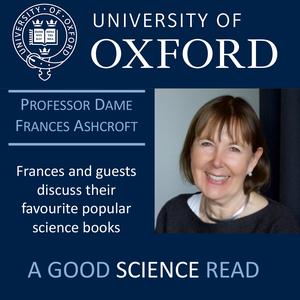
Dr Roger Highfield joins Professor Frances Ashcroft to discuss 'Pain: A Ladybird Expert book' by Irene Tracey and 'A Short History of Nearly Everything' by Bill Bryson. Pain is a very short book but it encompasses everything you want to know about pain in a clear and informative way. What it is, how we measure it, why we need it, and how we can – and often alas, cannot – treat it. A Short History of Nearly Everything is a highly accessible and entertaining account that of the world we live on that ranges from the creation of the solar system, to the structure of the atom, plate tectonics, the rise of life, the development of modern humans and how your cells work. The book won the Royal Society Aventis Science Book Prize in 2004 and the Descartes Prize in 2005, and was the biggest selling non-fiction book of the decade.
Roger is the Science Director of the Science Museum Group, a group of five museums that includes the Science Museum in London. He is also a Visiting Professor of Public engagement at the Universities of Oxford and University College London, a Fellow of the Academy of Medical Sciences and Honorary president of the Association of British Science Writers. Previously, Roger was the science editor of The Daily Telegraph for more than 20 years, and Editor of New Scientist for 4 years. He has written or co-authored nine books, most recently The Dance of Life, Symmetry Cells and How we become Human.
Websites
https://www.rogerhighfield.com/my-sites
https://www.sciencemuseum.org.uk/home
https://en.wikipedia.org/wiki/Bill_Bryson
https://www.ox.ac.uk/about/organisation/university-officers/vice-chancellor
English
United Kingdom
IN THIS EPISODE
TRANSCRIPT 🔗
Are you the producer of this podcast?
Add a podcast transcript
Need Audio-to-Text?
Transcribe with Listen411 in Just 60 Seconds
SEARCH PAST EPISODES
Search past episodes of A Good Science Read.
OTHER EPISODES IN THIS PODCAST
Georgina Ferry and Professor Frances Ashcroft discuss 'The Coming Plague' by Laurie Garrett, and 'Spike: The Virus vs. The People - the Inside Story' by Jeremy Farrar and Anjana Ahuja. 'The Coming Plague' is an extremely well researched book that presents a history of old and new plagues such as TB…
Professor Tim Coulsen and Professor Frances Ashcroft discuss 'Burn: the Misunderstood Science of Metabolism' by Herman Pontzer and 'Transformer: The Deep Chemistry of Life and Death' by Nick Lane. Both these books are concerned with science of metabolism – the process by which food is burnt to prod…
Professor Chris Miller and Professor Frances Ashcroft discuss 'Who We Are and How We Got Here' by the Harvard geneticist David Reich. Series 2 Episode 7: The book 'Who We Are and How We Got Here: Ancient DNA and the new science of the human past' is a compelling account of the origin of modern hum…
Professor Sir Charles Godfray and Professor Frances Ashcroft discuss 'The Fly Trap' by Fredrik Sjöberg and 'As if Human: AI and Artificial Intelligence' by Neil Shadbolt and Roger Hampson. Professor Charles Godfray and Professor Frances Ashcroft discuss The Fly Trap by Fredrik Sjöberg and As if Hum…
Professor Dame Uta Frith and Professor Frances Ashcroft discuss 'Our Brains Our Selves: what a neurologist’s patients taught him about the brain' by Masud Husain Masud Husain is a neurologist and a Professor of Cognitive Neuroscience at the University of Oxford. This book tells the stories of seven…
Disclaimer: The podcast and artwork embedded on this page are from Oxford University, which is the property of its owner and not affiliated with or endorsed by Listen Notes, Inc.
EDIT
Thank you for helping to keep the podcast database up to date.
