

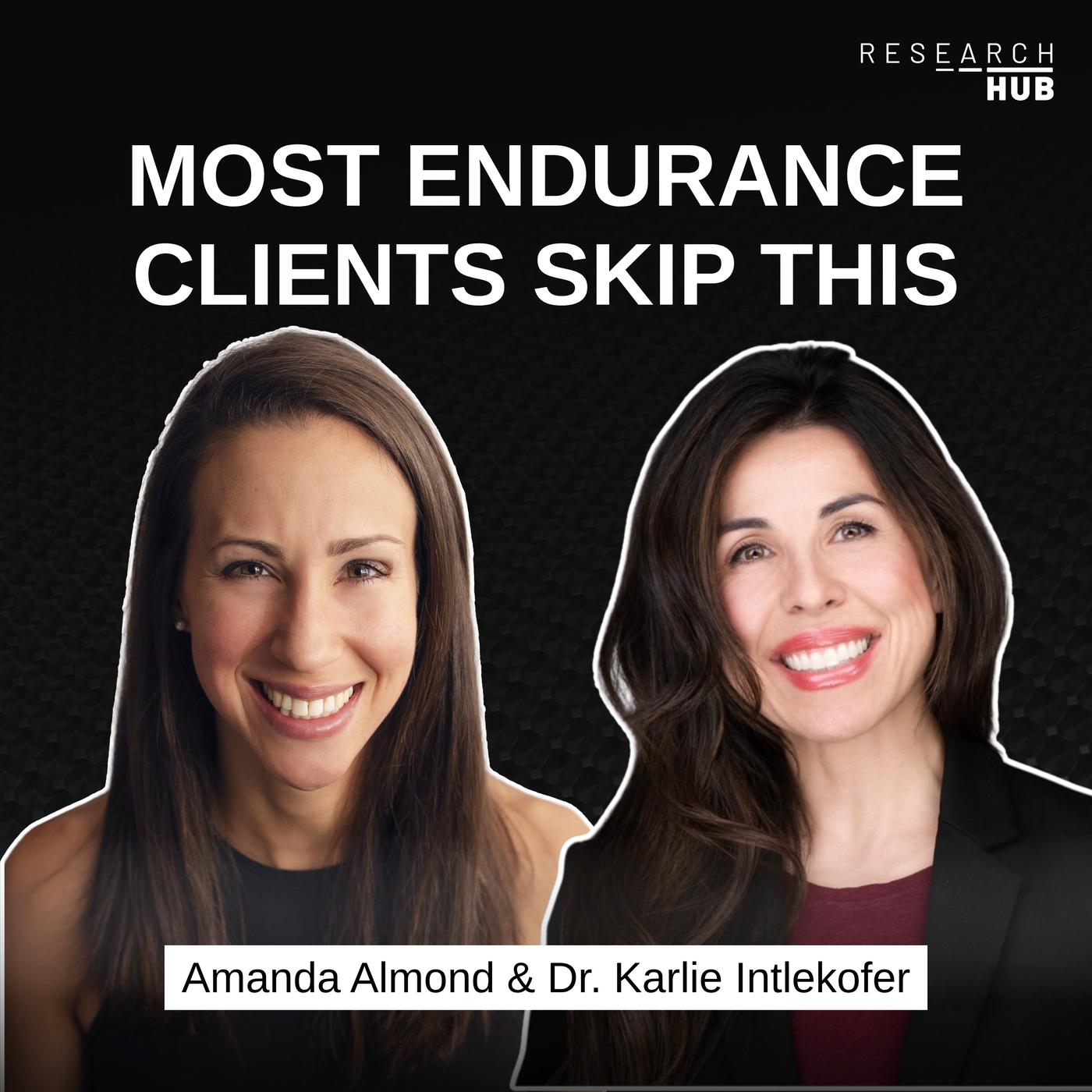
Dr. Karlie Intlekofer: Welcome to the Research Hub podcast where we turn scientific insights into practical strategies for coaches, trainers, and gym operators. I'm Dr. Karlie Intelkofer and today I'm joined by Matrix Fitness Trainer, triathlete and coach Amanda Almond. And one of the many ways that Amanda caught my attention is her performance as a triathlete. And this is in the triathlete where that's someone who started when they're four or five years old, getting into running, et cetera. This is someone who started later in life, which I love a story like that. And even though she may identify as that endurance athlete, she does not hesitate to rely on her expertise in the weight room as a coach, as a personal trainer, and as someone certified in both pre and post postnatal ⁓ care. helping women around pregnancy. to keep their bodies healthy and moving. Now through her experience both in coaching and in training, she knows that strength gains can support endurance performance and also add to long-term resilience, which is something we're all after. And she has that special expertise, like I said, in helping women return to regular workouts after pregnancy. And that's a type of support that's critical for maximizing that member lifetime value. So Amanda, welcome.
Amanda Almond: Thank so much. I'm super excited to be here and chat with you today.
Dr. Karlie Intlekofer: So just to get our bearings, I'm wondering what first got you into physical training and competing in triathlons.
Amanda Almond: So I've been an athlete my entire life, but not ⁓ endurance. So when I was growing up ⁓ high school, I thought running was a punishment for that's so I played sports where ⁓ running for to support the sport you were playing like basketball and volleyball, ⁓ but not of the actual sport per se. And so when I went to college, I ended up playing water polo. ⁓ ⁓ graduated from college realized nobody plays adult water polo and I really, really missed the of competition essentially as an adult. ⁓ And always found that ⁓ sport very important to mental health, the community that comes around it. ⁓ I am a type A person who loves a good challenge. So I was working part-time at a YMCA after college and my coworkers said, can swim with people and you aren't scared, so you should just do a triathlon. And so a little encouragement from them, I signed up ⁓ for first sprint and then a 70.3. which is quite the ordeal. ⁓ somewhere between, ⁓ most people, ⁓ and six and a half hours of working out and ⁓ I'd do one and be done. And then I fell in love with the sport and the process of getting better and what you learn about yourself along the way.
Dr. Karlie Intlekofer: Wonderful. I think that's such a unique perspective that you started in water polo. I don't hear that every day One of the things about water polo is that your training probably looked very different from how it has Evolved in your role both as a coach and as a triathlete yourself But when I speak with a lot of people interested in endurance One the missed opportunities that comes up is that they oftentimes don't do much in any strength training And I know that that's something that you have learned a lot about and you have ⁓ developed as yourself as an athlete and developed other athletes through this lens of understanding that strength is necessary. I'm wondering if you can tell me both from your athletic journey and from your coaching perspective, what made strength training something that was top of mind, something that you knew that you wanted to gain expertise in and develop yourself as well.
Amanda Almond: Yeah, so as a high school athlete, ⁓ I went to a really small school that didn't really put any emphasis on strength training at all. So my only experience was, you know, the three pound weights my mom had in the living room. And that wasn't really enough to build muscle. I didn't know that at the time, but that was my only real experience introduction to strength training until college where ⁓ actually water polo really brought me into heavy lifting and what it meant. It kind of broke this stigma in my mind that heavy lifting meant big and bulky. And even though my degrees in exercise science, I knew that there is still this mentality that you couldn't be fast, you couldn't go far with all this extra muscle or lifting heavy. wasn't important when in reality, being strong and lifting heavy is what kept me more injury free than my teammates and kind of set me up for success. So, and I loved as well the mental advantage of having a strong body and what that did for me in life. That I could show up, I could be in front of a group of people and talk because I knew that I had this physical strength. And so it kind of enabled my confidence a lot more. And so, post college, as I was searching for triathlon or whatever I was going to do next, I kept up the lifting because I loved it. I absolutely fell in love with strength training. And I would say at that time, it still wasn't really prevalent in endurance and there wasn't a lot of research out yet of this is actually beneficial. But what I knew, what I had seen was when I was lifting heavy, when I was strong, that I was a better athlete, I was less likely to get injured, I was less likely to have my form break down. And so I started to put together how this is beneficial. And then through my own certifications, through continuing education, ⁓ to discover other people were talking about this too. And it was becoming a conversation that the old school method of ⁓ run, run, ⁓ to and be really tiny and size is what's important over strength is actually not true. And then it now being, I've been in the competitive endurance field for over 10 years now and watching the shift at the professional level has been really fun to see. Whereas if you looked. Even five years ago, everyone kind of looked a certain way. They were very slight and slender. And now you're seeing athletes show up that have more muscle and you can tell they have more muscle and they're very, very fit, but they don't look ⁓ ⁓ ⁓ eaten vegetables for a couple of months. look like They fuel well and they're really fast. The level of the field is absolutely increasing and it's really exciting to see. And I think a lot of that has to do with the emphasis on strength training and how important that is.
Dr. Karlie Intlekofer: You know, you're bringing up something that's huge right now and we see it in the trends. We see it in consumer reports. We see it in even Google behavior. What are people Googling for? And so, you know, maybe 10 to 20 years ago there was more emphasis on out for fat loss. But right now, of course, the mental component, you know, you brought up that enhanced confidence that you feel as a more powerful, stronger individual ⁓ and presenter. So it can translate into the professional world. But of course we're also shifting from that goal of for the endurance athlete, volume, volume, volume, certainly volume has its place. And we're lightness, being a light, lean runner was like this, like ideal. We're kind of shifting towards an understanding that you have to have strategic strength built into your routine just to keep yourself healthy, just to keep your, you you mentioned form. And that was one of the areas that when I was researching for this episode, that I was so delighted to see that yes, have been many serious coaches of endurance athletes, serious endurance athletes really, who are trying strength training, incorporating a slightly different workout strategy and the results are positive. So, you you mentioned the breakdown in form and just to let you know, you've experienced it, but the studies bear that out that you're running economy or how efficient you are is actually better in a stronger athlete. All things being the same, that athlete who's prioritizing a strength workout, they're going to have a little bit better running form. And then if you have a longer event, certainly that slight percentage increase, even if it's only one or 2 % more economical, six hours later, as you mentioned with your 70.3 event, that adds up to serious time savings. So I want you to know, like the research bears out what you're saying. And I'm also thrilled that there is a more well-rounded Emphasis it we're not just aiming for lightness. We're not just aiming for looking thin We're aiming for endurance athletes that are resilient whose ⁓ running economy their form is all improved One mechanism just to like tease a little bit of mechanism is that we have better We have a better ability to have muscle stiffness. If you think about your muscles kind of like a rubber band It's like growing the rubber band and making it even thicker so that As you're taking, you know, in the case of running, as you're taking different footfalls, your tendons, everything that's involved, you know, you just have a way better efficiency at the end of the day if you're a stronger athlete. And of course this shows up in endurance athletes. shows up in ⁓ athletes of more, you know, shorter races as well. But the research that I looked at, a lot of it was for individuals who were routinely running for two hours for their long, slow distance run. So these are people who are kind of in your... a caliber or category where they are going to have long workouts. They're going to have grueling races, perhaps, you know, races where the mindset advantage of feeling powerful is difficult to sustain for the whole race and is really a huge aspect of success. So if we just switch gears just to the mindset aspect, you told me that you were noticing that gain in confidence. But I'm wondering, do you introduce strength training to maybe some reluctant endurance clients? Do introduce that to them and ⁓ let them know about how it benefits the racing mindset, the competitive mindset that they have to cultivate.
Amanda Almond: Yeah, absolutely. So when I whenever I meet with a new athlete, the first they get a whole list of questions for me. It's like 60 questions on right, hey, tell me your history, tell me all of this, and then let's chat about it. And a good portion of the questions on there are do you strength train? Have you strength train? Do you believe there's value in strength training so we can have that discussion? And thankfully, I've seen a lot of research out now that I can cite them back to some research if they want to argue. the good thing is, is I've seen a shift with a lot of endurance athletes into, yeah, I am willing to try this. And so one of the big topics that I have to talk to people a lot, a lot of the athletes that I coach is, ⁓ you a durable athlete or not? And the definition of durability is widely debated. And research papers have actually been summarized to try and define what durability is. essentially, an athlete, like, hey, or defining if an athlete is durable, I always tell people, you to have enough durability if you want to do the fun workouts, right? So if you want to go do the track reps, if you want to do the sprint, if you want to go do the hill ⁓ repeats, you want to do all of these fun workouts, You have to be durable enough or have this base or your body has to be able to support this extra intensity and extra work. so having that conversation with people and like, the easiest way for you to get more durable if you aren't already is to strength train. and I get to the point with a lot of my athletes and like, look, if it comes down to a 30 minute run or the strength training, ⁓ I'd rather you ditch the 30 minute run and get your strength session in. Cause I'm only programming in very few of those. You can get the running in elsewhere. You will, but you can't skip it. However, if it comes to one or the other, I'd rather you keep that strength training session in twice a week because that is going to be important for your long-term durability and for helping, especially female athletes, especially my female athletes or my older male athletes, especially for you maintaining muscle mass because we know just endurance is going to break down, especially it's almost impossible to keep up a caloric surplus when you're in high volume endurance training. so, and if we don't do any specific strength training, we lose 10 % of our muscle mass per decade after age 30. if we don't do anything for those particular groups of athletes in particular, their muscle mass decreases then also that directly affects their power, their performance output that I see a great injury risk ⁓ with or increase in injury for those athletes who ⁓ just refuse to strength train or start skipping strength training, myself included. I know that if I start to slack, I'm gonna be seeing my physio guy much more often than if ⁓ stay on top of my strength training.
Dr. Karlie Intlekofer: You know, something you mentioned that's again, born out with the research is that we really want to aim for at least two sessions a week when it comes to strength. You know, a lot of clients, a lot of new members to gyms, especially as we're getting close to that New Year's resolution burst, folks will try to ⁓ introduce strength training maybe one day a week and hey, any movement is a good choice. I am pro movement. ⁓ the truth is, ⁓ you're bringing up this important point here, ⁓ once a week and the ACSM guidelines bear this out. Once a week is more helpful for maintaining, but it becomes very difficult to grow muscles if you're only challenging the muscle once a week. And the reason isn't there's nothing special going on here. It's just that between our workouts, we're having Detraining or Deconditioning that can take place. So yes, there's the recovery period where for one to one to a few days, those muscles are building back stronger, but then we start to detrain as that muscle's not getting the challenge that it needs to grow. So there is something special about this aim for at least two times a week. the, like I said, the guidelines, bear that out. The research supports it and, and for the club operators out there, the personal trainers who are at a particular, ⁓ health facility, you should know that there's an adherence advantage to more than twice a week as well. Those members who come in twice a week are highly unlikely to cancel their membership. They're getting that reminder of the value it's bringing them and they're probably noticing some body composition improvements because they are able to progress the strength training, feel stronger, feel more confident with those weights, maybe get more reps or sets in, etc. Whereas the members who come in once a week or less are at a much higher risk of choosing to not re-up their membership in part because perhaps they're at a plateau, right? So like you were mentioning, trying to get to that second workout a week of strength totally makes sense because it's the plateau that oftentimes precedes someone losing interest in making it to the facility or getting that strength movement in. Plateaus can be really demotivating, even though we both know it's part of life, it's part of training. It's actually very normal. So if you're somebody who's at a plateau right now, ⁓ It doesn't mean necessarily that you're doing something wrong. Sometimes it's just as your body's adapting to other challenges, your brain's adapting to other challenges. But I think that that's a really important point about aiming for at least two times a week. Certainly if you have some runners in your clientele, they can maybe get that run done outside, weather permitting. But when it comes to strength training, the fitness facilities are huge because of course that's where all the equipment usually is. When it comes to those facilities, I'm wondering if you have any insights as somebody who goes to a lot of facilities on whether there's something that the owner operator can do to make it more inviting for women. I mean, I know that women right now, they get it, right? We're starting to go for those more powerful workouts, those more challenging strength training workouts, but what can an operator do to make sure it's inviting for those female clientele?
Amanda Almond: Yeah, so and again, I have to think of it as a lot of times when I walk into a facility or if I'm consulting with a facility on what to do, I have to tell them like, I almost need to go take a Zumba class because that puts me out of my comfort zone. And it reminds me what most people feel like when they walk into a weight room, I I'm very comfortable in a weight room. I'll go stand in front of the two big guys on the squat rack and say, hey, can I work in here for some pull ups between you, whatever it happens to be? But ⁓ you put me in a Zumba class, it's very like I want to stand in the back corner, right? So one of the things and I've talked to a lot of women about this, like, hey, what would make weightlifting less scary to you more accessible? And a lot of the comments are like, if you have only one main rack of dumbbells, right, and it's all in one place, and it's right next to the heavy squat racks, and it's in the middle of where all the the bodybuilding guys do all of their lifts, I don't want to go in the busy time and grab my weight in front of all of them and then pretend I know what I'm doing or maybe have to look at my app that I'm following and try and figure out what I'm supposed to be doing. I want to be in a different side. a lot of and we are seeing a trend in this in fitness areas, in gyms and studios of having a functional movement space that has a set of dumbbells that are not just three, four or five pounds that are heavy enough, extra set of kettlebells that are heavy enough that if women, people new on their fitness journey, or even I'll find my endurance athletes who not lifting ⁓ would be bodybuilder type weights, right, but they're getting strength for the size and what they need. And it's their heavy because everybody's version of a heavyweight looks different. And so they are drawn a little bit more to that area off to the side or having that accessible area. And I think that's important. I also love seeing trainers from studios out there working out and just giving people ideas, especially if it's female trainers, like going to the freewayed area, setting up a squat rack, because I think members are watching what they do and that encourages them, like, that's how you use that machine. This is how you do this. ⁓ I'm a huge fan of trainers putting stuff on social media. It doesn't have to be fancy, just, hey, and I try and include a... as often as I can on my social media, like, hey, these are three moves I did during my lift today, so you could do them too. And so just empowering people, ⁓ doesn't have to be crazy complicated. You don't have to spend, ⁓ I don't have time to spend two hours lifting. I spend 30 minutes twice a week and get in, get out, get done. It's very effective. ⁓ been able to maintain or even grow muscle mass when I choose to ⁓ that, in the midst of... endurance sport and a lot of volume of cardiovascular exercise. But what I see is, and I'll even use that functional area too, just because I can kind of circuit around or get things done more quickly without being interrupted. And it's very effective. Especially if you've got a plan, you just go in a couple of lifts and I can get a lot done in a very short period of time.
Dr. Karlie Intlekofer: You know, I speak with a lot of fitness professionals at conferences and events a lot of them ⁓ that they don't want to work out at their facility as much because they have more interruptions and more questions. But something that you're bringing up is really highlighting the business opportunity. If you're motivated personal trainer, if you're a leader in your facility, being able to model kindness, patience, getting after it all in one workout and understanding that yes, you may get some interruptions. Maybe that's a great opportunity to build those stronger relationships that really make the members feel heard, seen, supported. So I'm not saying that it's easy because even when I was a personal trainer part-time, I also struggled staying after my shift to get my own lift in. I know it's ironic because you're already on site. Your stuff is already there. but you're just so tired after your shift or you're just so like, ⁓ I'm done with this place that it can be hard to get yourself to take that next step. But you know what you're mentioning is so true that that connection point, even if they're there to complain about something unrelated, like the locker room, which does happen, right? That connection point is relationship building opportunity. So to the extent that trainers out there who are hearing this leaders out there are hearing this can get them their own butts in the gym, can get their own bodies in the weight rack. I think that it's definitely there's an opportunity here ⁓ long as we can maybe be a little bit more flexible understanding that there might be those interruptions. However, the other point that you mentioned about maybe filming a few movements just so they seem more accessible, more relevant, more top mind, that's also really helpful. Not all facilities have the same goals for people filming, but I think we're starting to realize that It's free advertising most the people who are doing it are focused on their own form. They're focused on their own physical and athletic journey. So I'm hoping that the tide is shifting there because I would love to see more ⁓ people wearing workout clothes who are really getting their sweat on on my Instagram feed than just the fitness models, which of course they're going to look great no matter what, but it's the real everyday ⁓ kind of the grind of it really that I would like to see more of more of that authenticity. So I love that you're leading with that. You know, you also mentioned having that ⁓ duplicate set or an alternative set of dumbbells somewhere else. And that's another thing that leaders are mentioning. They're noticing is a benefit when gyms are crowded. There are oftentimes some lifters who don't maybe know the proper etiquette or they don't realize how disruptive getting out multiple sets of weights are standing right in front of the dumbbell rack is. I know I see a lot of people walk up, grab their weights and immediately start doing their curls right in front of the dumbbell rack. So you bring up a good point that having one other access point at least, it gives someone a little bit of an easier time so that they don't have to walk right in front of someone doing a set, interrupt a set, and they can kind of keep that area lower traffic. So great, great points about making it easy to navigate, making it ⁓ lower intimidation, which again for someone like you or me, I mean, I routinely have worked in with other people, made good friends this way, but I know not everyone wants to do that or feels confident re-racking and then racking weights repeatedly. I mean, that can itself ⁓ kind of like a workout. So great points here. You you're mentioning ⁓ some points too that I think might be extra important in the case of women lifters and ⁓ know, ⁓
Amanda Almond: Absolutely.
Dr. Karlie Intlekofer: Many of the women you coach are balancing busy lives, busy careers, busy home lives, family, you name it. I'm wondering how you help them realize how much it's gonna help them to get stronger. sometimes there's that mindset shift that we're talking about. How do we get, especially mothers, to recognize that this is gonna have a lasting impact on them, a lasting impact mind and body? I'm wondering if you have to have those conversations and really get into the specifics.
Amanda Almond: Yeah, so I can't imagine a mom and not having lifted and being okay. And so ⁓ I just remember, and actually I got my pre and post natal certification ⁓ right before I got with Oliver anticipation of being pregnant and saying, ⁓ if I don't intelligently train for I am going, cause my intent was especially to return ⁓ as an elite And I thought, ⁓ If I don't intentionally train while I am pregnant for this, am really going to suffer and struggle and probably get hurt just because I know ⁓ level ⁓ strength that and I had a toddler who was ⁓ like years old and 35 pounds. So it was like, okay, ⁓ I a huge toddler and I'm going to have this car seat that I'm going to have to carry way off to the side and I'm going to need to ⁓ figure this out while I have no core am to heal ⁓ And I tell so many people and try and relate it back to especially my pregnant moms of like, look, ⁓ as carrying this, I want you to think about this is a car seat, right? As we're doing an unbalanced farmers carry, this is car seat, you have a toddler, you know how heavy it is, but you carry your toddler in front right now because you only have one of them. However, when you're to have to this is how you're going to have to walk. And so this is where you may have to stop and pick up the diaper bag. And so now we're holding the toddler and we're picking up the diaper bag. And that's a lift. That's a deadlift, right? That's a squat, whatever it happens to be. And then you may need to stand on one leg because you're also trying to shut the door while you're doing that. So let's add some instability ⁓ so that we can make this a functional strength movement for motherhood. And I will say, and I'll hold to, I put it out on social media. tell all of my clients, Motherhood is by far the most demanding sport that I have ever done. ⁓ Because it is. Or if you've ever had to go sprint down the driveway after your child who's running into the road while also stopping the dog and picking up stuff as they're going along, it's really, really demanding. And so many times I see women are like, ⁓ I threw my back out. ⁓ I did this. I'm like, yes, because. You can't do all of that. You can't go through pregnancy for nine months and or more and expect that your body is just going to go back and function really well if you do nothing to strengthen it. And so one of the things I loved about the certification I did was it really brought it back to real world. This is going to be a demand for you. You're going to have to carry this or this is and it taught trainers, you know, this movement is important because you're gonna pick your baby up, but you're gonna pick them up not next to your body, because you have to put them over the crib, right? And so you're gonna carry them. So this is why we're doing this movement. And that has helped me so much to relate it back to, especially pre and postnatal clients who I'm training and say to them like, look, again, now you went and did this at home. I go, oh my gosh, I stood up. with no hands with both my kids and my arms. And like that's, that's a getup essentially, right? Like that's, we know this from training, the movements the same. It doesn't look quite so perfect, but it's the same type of movement for you getting up off the ground and, holding your children. And that's why we're going to work on this movement. Cause you need to be able to do that without straining your core or pulling your back or throwing your back out And this is why strength is so important.
Dr. Karlie Intlekofer: I love how you're tying the gain and capacity to the role directly. I love how you're tying that directly. You know, I get to travel. It's a great opportunity to share some of the research. But as I travel, I see so many people who are struggling with their luggage. So I'm always thinking like, wow, real life has real loads that we have to manage. It's not just, man, the stairs are tough. It's You may have a 30 pound piece of luggage you're trying to cram into that overhead space. I can say that sometimes when I'm doing certain lifts like overhead press, I think of that. Now for you as a busy mother, there's so many more meaningful and relevant examples of where you need that capacity. As you mentioned, being able to squat down and pick up, I hadn't even considered. the two kid problem, but as you're mentioning it, yes, there's huge challenges. I mean, the balance, the ⁓ hip mobility, how are your biomechanics? And ⁓ by the way, if you carried your child term, you've got a huge amount of core changes. I mean, we're not even talking about how your ⁓ midsection changes and what that does to ⁓ movement efficiency. So I love how you're tying it together. Now,
Amanda Almond: Ha ha ha!
Dr. Karlie Intlekofer: When the kids are born, when you have a busy family, a young family, I think there's another aspect here from the mental aspect of showing and maybe modeling for your family, how you carve out me time or how you cope with maybe stress or challenges. Is that a component that you also are noticing yourself or that you kind of relate to your clients so that you can ⁓ Show them look at how this is helping you in this way this way, etc
Amanda Almond: Yeah, there's so much mom guilt about everything, right? And so I'm always, it's one of the reasons why I love training moms currently in the phase of life that I'm in as well, because I'm in the thick of it and like, hey, I get it. You feel bad about this. There's always something to talk about when you're a mom training a mom, because we've all got stories and then the quintessential mom guilt that comes with everything. And part of that is training. And I have often thought myself, man, I spend so many hours training. Is this even worth it? it making like, is it taking too much time away from my family? and I will say my, my kids actually training. They like being involved. They ⁓ think fun. We now have a whole matrix squat rack in our garage. ⁓ and so ⁓ I'm out there lifting and they've got their little weights or bands and they're doing it too. Right. ⁓ or they're like, Hey mommy, look, I can do a squat too. ⁓ But ⁓ we've related it back to him for school several times. I'm like, hey, remember, we give up in training. We don't give up at school, too. We try our best. And his teachers have told us ⁓ he'll sit there and he'll say, ⁓ I'm not doing a level 15, I'm only at 10, but I'm trying my best. And I love that because it's a real life experience. And then there are days I tell moms, it's okay to be selfish. don't have to take, there doesn't have to be, I'm teaching my kids healthy habits. It can just be, I'm doing this for my mental health so that I don't lose it later and that's okay. It's okay to use the two hours of free Y care, child care. that comes with my membership and lift for 30 minutes and go sit in silence for the next 90 in a corner. That's okay. Some days that's what I need. And I tell people that all the time and that like you, it's such a position to be in ⁓ you're constantly being touched. You're constantly ⁓ needed. You're constantly having ⁓ watch what you're saying because they're watching you ⁓ and they're
Dr. Karlie Intlekofer: Sure.
Amanda Almond: great moments too, but there's a lot of giving and tired moments. And so if you're yourself not full or if you're not strong enough, you know, or to carry your kids out of the store screaming and crying because they won't listen again and I just pick them up and walk out. But if you're not strong enough to do that, because you haven't taken care of yourself, ⁓ you're not being your best self. And ultimately, that's how you're the best caregiver. And so ⁓ A lot of times for myself, for other trainers, it's just empowering moms, women, people in general that working out isn't selfish. It's important for you to be at your best, to be able to be your best for whatever role you're in in life. Mom, dad, athlete, just ⁓ whatever happens to be, it doesn't matter. ⁓ That's to make you your best.
Dr. Karlie Intlekofer: You know, it reminds me of that quote, and I'll probably butcher it, but it's something like, you can't pour from an empty cup. And it reminds you that you need to do what it takes to prepare yourself to give the best of yourself. it's a great reminder for anyone, like you said, I love that you make it relatable and that you're realistic. think perhaps having your own young family has helped in that way. You're probably more relatable to your ⁓ and then you also have kind of that realistic. Hey, are you exhausted? It's okay to just relax because that is true. There are workouts that need to be lower intensity. It just, it has to happen, you know?
Amanda Almond: Yes. Well, and I'll tell people so many times ⁓ because of some of it's the industry where we've been we've taken strength and it's not heavy enough where we really have to rest or it's the hit but no rest. So it's not even really hit but it's the go go go. I can't stop. I'm ⁓ I used to be the person to ⁓ I'm on a run and I'm running at the stoplight on the corner. Like I can't just stand still because that's not working out. I rest all the time. I'm like stoplight. goodness. Let me just stand here. No, don't wave me on. You go. You have the right away. I wanted to stop. ⁓ I think there's ⁓ aspect as well of educating people as a trainer, like, hey, it's okay to rest between this because it's heavy. It's supposed to be and in fact, ⁓ ⁓ it's if you don't need to rest, we might need to adjust your weight. Like this is another good way to show you you're getting better. However, ⁓ doesn't need to just be go, go go. ⁓ all the time. It's okay to stop for a minute. It's okay to pause. That's not bad. It doesn't mean ⁓ not getting a good workout.
Dr. Karlie Intlekofer: You know, one last thing related to this idea of motherhood is that there's an operation with retaining women during those childbearing years. So for example, we see from like the demographic research, I know Murphy has done a great job of putting some of this together with their state of our health report where they are constantly surveying tens of thousands of fitness consumers in the U S to try to find out what their thoughts are, what their ideas are. And they found that this was a 2023 report found that that age group between like mid thirties to early forties, it's a time where that female member is at a high likelihood to not keep up their membership. And then the reasons why oftentimes that time crunch, that time scarcity, I don't have time for this. I don't have energy for this. It really hits during that, you know, busy with your career, busy with your family moment in your thirties, early forties. So I think that there's some special sauce to having personal trainers on site, on site who understand the demands of motherhood, of going through pregnancy, of how to ⁓ get into exercise. And importantly, something that you exemplify now is that exercise doesn't have to be drudgery. So even as you were describing your son's experience, he is not linking running to punishment. And that's so different for ⁓ older generations, I know for me it was the same thing. We ran because we had a turnover during the game. We ran because we had to do suicides at the end or because someone was late to practice. Running was positioned as, ⁓ you have to do this because you messed up over here. And so I also didn't develop the most like healthy relationship with cardio or endurance training in part because of those formative experiences. Here, you're really bucking the trend. Bravo there. Now, as we turn to the operators in the audience, I'm wondering if you could leave coaches, trainers, facility leaders with one principle regarding how to position strength training for women, how to help women adopt and stick with strength training. What would some of that guidance be? Kind of putting on the consultant hat here.
Amanda Almond: Yes. you know, I think there's multiple ways to approach it. I think some of it is sharing This is, I think that's great, especially with social media. And I think ⁓ that if you can get a member or even a trainer who can talk about this was my this ⁓ is ⁓ why I'm better or... ⁓ There's ⁓ so many activations right now with running of like, run because or running gives me it where and it's at races. It's just a wall and you can Sharpie in what it is. ⁓ love that for strength training and having encouraging people ⁓ write down their why or what it gives them or having trainers, all the trainers share, you know, this is why I left. This is what strength training gives me. I think it's really great. As well as giving them. ⁓ the details and some of the research. I don't like to bog people down in the nitty gritty of all the research, but I will occasionally summarize research studies for athletes who are like, I don't have time for this. Like, well, you don't have time not to do it actually, because it's gonna, you're gonna get injured or this is, you know, actually, you're gonna have to do so much more training if you want to or you could do less training and lift and it might be the same, the same result. So ⁓ talking about, especially for women, think having areas where they know they can work out and maybe some sample exercises or a workout of the week, which used to be very popular, I think a couple of years ago that was like a thing you used to see on Instagram. It's not that anymore. That dates my Instagram experience, but having something over there that gives them, you know, these are three things or.
Dr. Karlie Intlekofer: Ha
Amanda Almond: one of our trainers put out on Instagram, these are three moves that you could do. And it's a female trainer showing females, right? Because I think that is very important. We see that women want to be maybe feel that female camaraderie, but sharing stories, having examples, and then providing them with some of the research. You know, you do lose muscle mass if you don't do anything and lifting ⁓ pound weights or squatting with three pound weights is not enough. you don't have as a female enough testosterone to get big and bulky. It's very hard for women to grow muscles, speaking, unless you're spending hours and hours ⁓ Doing a simple strength workout for 30 minutes twice a week is not going to make you big and bulky. so kind of debunking some of the myths too that are out there that especially for that ⁓ maybe like 45 year old to 65 year old generation that has been fed some lies for a couple of like for years and years that this is why I think it's great education to put that out and tell people it's not the truth. Nor do you have to, you know, be the bodybuilder esque person either like true strength training, you can go still look like you want to and strength train appropriately to gain muscle and it doesn't change too much. some things, but it's not going to make you look so vastly different. Because most of us are genetically programmed to kind of look one way, one of three ways anyway, right? So you're going to fit into that body type. You just may shift it a little bit for the positive with strength training.
Dr. Karlie Intlekofer: Yeah, I love some of these points, especially the one about highlighting personal stories. You know, of course I love the research. If you let me go, I will just get way into the weeds. Like I want to see graphs, charts, tables. I want to see statistics. I want to see effect sizes. But what I know is that almost no one else does. So some of it can support what we're saying. But if we get too bogged down, as you were mentioning, it can really hide the tangible benefits like feeling better, having more confidence. establishing that model of what movement success looks like in your family, carving out me time, carving out me time that might be low intensity just for stress relief. ⁓ Patience, you're bringing up so many points that are probably much more salient than even maybe the bone density points or even the sarcopenia related points. Again, ⁓ consumers will have different interests and ⁓ want them to get all the support they can. ⁓ But bringing in the personal element that really is much more influential when it comes to someone's behavior. I also like how you mentioned women supporting women because there is something special about the empowerment that happens when you have a female trainer with female clients. Of course, you know, any gender we can all be inspired by each other. But when you see someone else who's been through it and that they've shown you how they come out of that challenge, that struggle, that period of the training due to whatever reason, When we see people overcome, it is perhaps the most inspirational, especially when they have something that matches your attribute like gender, right? So I think these are all really important insights and I wanna thank you so much for sharing all of this expertise with us today. Of course, that pre and postnatal ⁓ training cert is something that other personal trainers can get involved with. It will help stem the loss of memberships that are...
Amanda Almond: Yes.
Dr. Karlie Intlekofer: so frequent among women in the mid 30s, mid 40s range that we've been seeing from the demographics. So I think it is important and it's powerful. Now for more research backed insights, more conversations, you can explore additional episodes of the Research Hub podcast on the Matrix Fitness Global YouTube channel. Thanks for joining us and we'll see you next time.
