

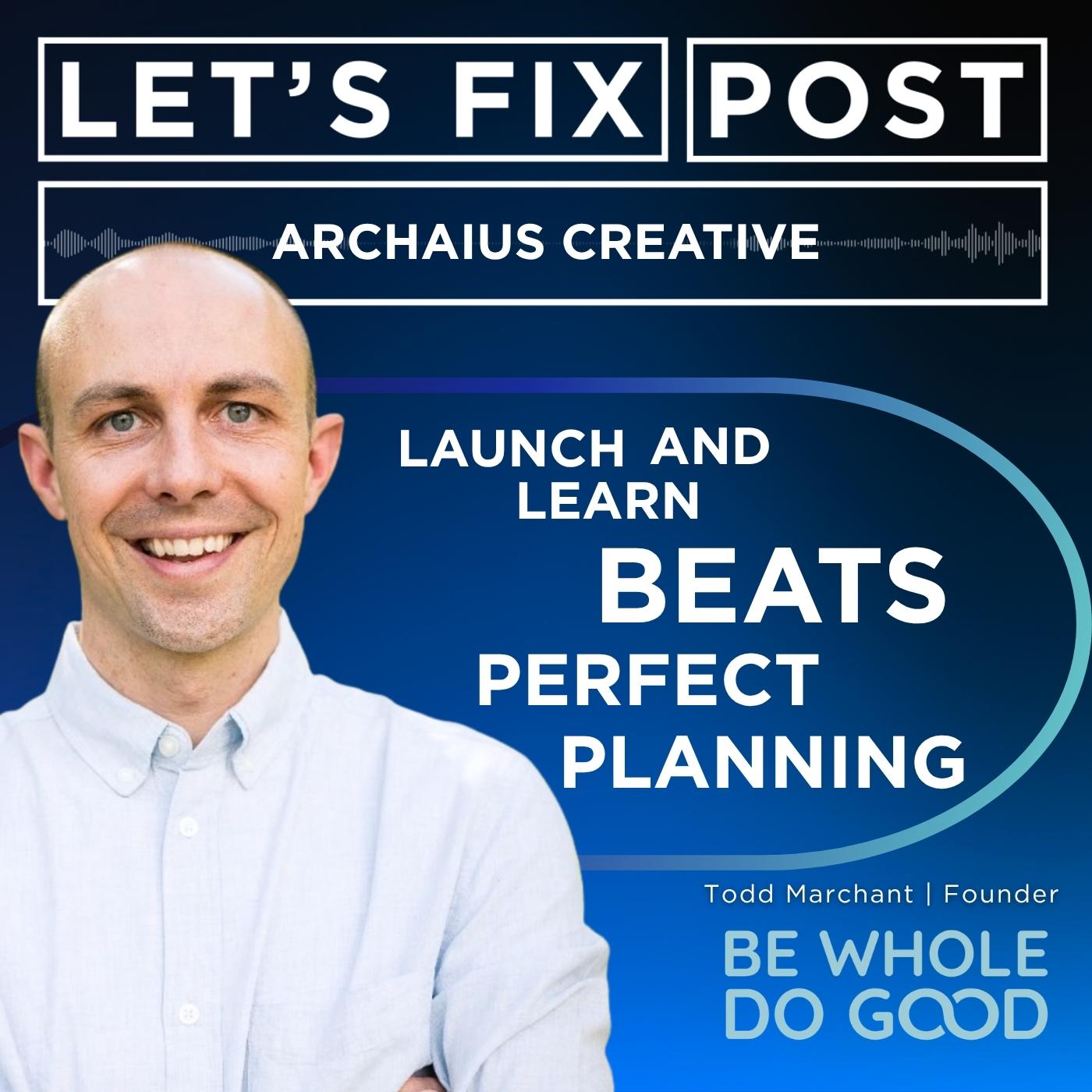
speaker-0: big lessons in my MBA was the path to success is launch and learn because you're going to fail with whatever you plan. You business plan as much as you want and it's not going to work as well as you think. And so you've just got to launch quick and cheap and fail. When it comes to creating something that scales and successful is great. There's nothing like the school of hard knocks.
speaker-1: Here are these reference points that exist in the world already. We don't have to create them, but we can look at them and say, I like this, this and this about it. This doesn't really apply to us by piecing all this together. You can kind of get a semblance of where's home base versus out of bounds. And then you play within that sandbox. What is
speaker-0: the very next best step I could take. I don't need to worry about 10 steps from now 15 steps from now like what's the next right step and usually it's hard to see past that point but if you can take that step it's amazing how much the next step becomes clear.
speaker-1: Welcome to Let's Fix Post, a show about making post-production smoother, smarter, and more collaborative for creative teams and editors alike. Hit subscribe now so that you don't miss future episodes. Today I'm chatting with Todd Marchin, the founder and CEO of Be Whole, Do Good, his new startup to provide Christian families with the tools, skills, and mindset to thrive through a simple Christ-centered family rhythm. What I'm really excited to share with you today is Todd's perspective as an entrepreneur who's building a video anchored business from the ground up without having a background in video production. Today we talk about Todd's launch and learn philosophy and why it's so vital to embrace crappy first drafts to get out of the loop of perfectionism and into motion. We also talk about the importance that Todd has found in defining white lines or simple rules to fuel creative innovation. He also shares a great gold mining analogy for knowing when to rent the heavy construction equipment versus when to keep your operation more lean and scrappy. I really enjoyed our conversation and I hope that you do too. Let's get into it. Todd, well, thank you so much for joining us on Let's Fix Post. We were kind of chatting like this is our avenue to really explore all the different ways that post production gets handled and kind of our little unique slice of the industry, which is mainly small business, corporate, commercial, ⁓ educational, little vertical or horizontal of the industry. Have you on look at it. And so I was excited to chat with you where you're at with video and what you're working on pursuing with Behold You Good. But before I just intro you I just love to give you the opportunity to kind of get everyone up to speed with who you are and then also what you're building with behold do good.
speaker-0: Yeah, awesome. Thanks Dave. So first and foremost, I'm a father and a husband and a family man. And so I've got, I've got five kids, ⁓ ages almost 12 and under. We've got one little angel child that, that as well, it's thrown into the mix there, one of the five. And so that, that defines me as much as anything. ⁓ But on the business side, Behold Do Good is a faith-based family program that is oriented at strengthening the rising generation. It's about at the home level as a family, providing very simple, easy resources that fit into daily life that help to cultivate mindset, skills, and habits of wellbeing and wholeness. And so anything from kind of emotional processing skills to ⁓ intellectual openness and humility and curiosity that feeds lifelong learning to your kind of habits from a physical wellbeing perspective to spirituality to relationships, peacemaking skills, relationship skills, friendship skills. And so, that's what the program is built around. We have this awesome membership, amazing community that's really built around that. But at the very core, of that program is these monthly videos that we produce with your team. those videos are meant to be these really inspiring, compelling, engaging for kids and teenagers videos that establish a shared language, a shared understanding, a shared inspiration. to lean into growing in that principle, growing in that skill that month. And so it's, it's pivotal. Like it's, kind of a basis foundational element to the entire program. And I have zero experience in this previously. And so, and so to my, to my background, you know, I started in the software world on the SCOTA market sales operations of software companies and have spent my whole career doing that. But, but, you know, for a lot of reasons, we won't get into today, developed a passion around wanting to do this. and knew that video would be a huge part of it. And so ⁓ it's definitely been a learning curve figuring out how to produce quality videos that are such a core pillar of the success of our business.
speaker-1: Yeah, and and just to also be specific around your specific role in Behold You Good, like you are spearheading the whole thing, right? I mean, like, I know that we're brought into support and you've got a couple other parties, because I'd love to touch on to like the robust nature of your offering. Like, I feel like our contribution is like a small piece. And I love hearing that it is anchored around that. But I know that there's so much more that you're producing there. It'd be great to hear just a little more specificity around like I'm like your role not only in the ideation of beholding good but also like your role in like the day to day now and where you're hoping that your role goes you know once you've like made it or like a cheat like what's your vision for where you're trying to push your role to be.
speaker-0: Yeah, I love that. So yeah, I'm the founder of it ⁓ and kind of CEO, if you want to call it that. Yeah, at this point, we've got a team, including your team, ⁓ probably about 12 or 13 people that all fill different roles, most kind of in contractor type relationships of when we have this need, this person's our person to go to and help with. ⁓ It's been a several year long journey. kind climbing the corporate ladder started to feel like this actually isn't leading to the type of life and family life that aligns with my values. And that inspired the desire to create my own thing where I could kind of create my own life, design my own life ⁓ with work and life, family all interspersed. And so I had a bunch of ideas. got my MBA from the University of North Carolina. I was in an entrepreneurship program there and had tons of mentors, created all these business plans around maybe what we would go and create. And the reality is, that what you think is going to be the thing that works and what actually does. It takes learning to get there. One of big lessons in my MBA was the path to success is launch and learn because you're going to fail with whatever you plan. You business plan as much as you want and it's not going to work as well as you think. And so you've just got to launch quick and cheap and fail and then learn from what you failed in, iterate. And so Behold You Good has been in the works for about three years and about two and half years or failures. Right. And, uh, and finally got us to a place where we found something that, that, uh, you know, it has the impact we want it to have. And at the market demands sufficiently to pay for, uh, to create a scalable business around. So where I want it to go. So up to this point, I've been the bottleneck for everything, right? It's like everything has to go through me and David's team feels the pain of that sometimes where, where, you know, they're relying on me to get them, you know, things to be able to keep things moving. Where I want it to be is the more that I can build the sustainable, predictable kind of business itself, where I can pull in people. Most of what our business needs, I'm not this expert in, right? So the more I can elevate to be in a visionary role, where I have the vision and am guiding a team of people who are expert in what they do.
speaker-1: Right. Yeah.
speaker-0: that are aligned with the needs of our business. And I just help everyone to work within this cohesive vision. That's the vision of where I want to go. So I'm not no longer the bottleneck, I'm guiding it, but we have everyone who is more specialized fulfilling the role that we need done and done well.
speaker-1: I love that. Yeah. And there's so many cool like crossovers and deviations in both your and my journey. So ⁓ for one, I have incredible respect. And I what I really am excited to dig into with you today is that you mentioned like that lack of familiarity with video. And now you're in this position where you're like, I need to find video people and I'm not the expert in it. I don't have the experience to say like, you know, I know what I'm looking for. There's a certain faith component that comes into that. And I'd love to kind of, you know, explore that journey. But before that, I think one of the deviations is that like I did start as the technician, you know, I don't know if in your if you're familiar with the E myth, it's a book about how ⁓ most businesses need to progress through these stages of like being a technician and then a manager and then the entrepreneur, I guess, you know, this is the person who's starting needs to progress through these stages if they want to achieve any amount of scalability. So I started as the technician. was the video editor. was touching every project. Clients would say, ⁓ go see Dave. Like Dave is a great editor. And then I started getting overwhelmed. you know, asked Crossroads was like, do I like raise my hourly and just cap it and stay who I am? Or do I just or do I start this team? Right. And so I surveyed my clients at the time, got the buy in there. You know, if if anyone's going to start a team like you could do it kind of thing. I was like, all right, I got like the this ⁓ permission almost to step out of the technician into the managerial role. But that's where there's this like amazing deviation with your experience where like there are so many times it's like, maybe it's a grass is always greener where I'm like, I wish I got an MBA. Like, going to school, I got, you know, a psych degree, and then like degrees in film and art, and like, not doing psychology, you know, it per se, everything has a little psych in it, but not professionally. And I just am you know, somewhat envious of people in your situation that go through learning, you know, from the bedrock, how do you build something that makes sense to do? Because I think as a technician run business, it's very easy. And I've been at these moments where you're like, Oh, this doesn't make sense. Like none of this. It's all passion based or interest based. So, um, so I don't know, I didn't really have a question formulated at the end of that point. But just I think noting this diff, the different paths that we've come to being in the situations we are, I think is interesting and worth noting. Yeah.
speaker-0: Yeah, I think so too. And I think one of the insights to pull from that is there is no one right way. And the reality is, ⁓ I greatly value that formal education and all the wonderful goodness and frameworks and principles and mindsets that maybe that helped to shape. And I don't in any way want to undervalue the value that I am a believer in formal education, especially when done well. But When it comes to creating something that scales and successful is great, there's nothing like the school of hard knocks. know, like there is much of the theories that sounded good in school. ⁓ yeah, it's way messier in real life. And that's true. think of any good principle we deal with that all the time with the families we serve is that, ⁓ yeah, even, even these principles that we know. We have strong, verified academic research that has proven over and over again that, you know, something like a mindset of gratitude versus entitlement, the ability to scan for and see the positive in any situation versus focus on what is much easier, the negative and that such that that is correlated with happiness, right? We know that's true. And we know here are some basic practices that help to cultivate a more grateful, positive mindset. And yet in real life, it's way messier putting that into practice, right? It's just, and that's just true of all things. And so I think, you know, one of the, one of the lessons to learn in creating anything great, and this can be applied to, yeah, just your video production type, type work versus anything else is that there's a lot of power in just leaning in and not giving up and just identifying, you know, where am I today? Give myself compassion. for where I am today. I don't need to be anywhere else than where I am today. And what is the very next best step I could take? I don't need to worry about 10 steps from now, 15 steps from now. Like what's the next right step? And usually it's hard to see past that point, but if you can take that step, it's amazing how much the next step becomes clear and then the next step and the next step. And oftentimes it may be stressful, those steps ⁓ and come with deadlines and overwhelm and whatever. But as you just, as you exercise that muscle of leaning in and identifying the next best step and then taking that step, yeah, you end up places that you never could have thought you could have gotten to.
speaker-1: Yeah, that's great. And I think that another colloquialism that kind of comes to mind is like, what got you here won't get you there. Right? Like I have to keep that in mind a lot where it's like, and I've heard that kind of in conjunction with this idea that like, if you're not scared or nervous, then like, you're not taking enough risks. And that means that like, you're not trying new enough things, which means like, there's a risk of stagnation there. If you're comfortable all the time, like you're never exploring new places or trying new things or growing and adapting. It's just everything's in this nice, comfortable bubble. ⁓ So that's how I've tried to rationalize, like the way the fear of not knowing what's next. But ⁓ yeah, I mean, to your point, easy to say in theory, but difficult to apply in practice. And one thing I was curious about, like kind of turning more specifically to the work and like what what you were producing with Behold, You Good. Tell me a little bit about like the challenges that you faced or just considerations that you had to make when writing for a particular, or creating content, should say. Writing is one of the specific parts of it. But creating content for a specific age range. Like as a father to kids myself, like some of these age ranges are difficult. I can't, know, I couldn't have been the one to try to figure out how to crack the code on getting through to them. And so I don't know what if what have you learned in terms of, you know, really zeroing in and creating things in a way that's going to resonate with them?
speaker-0: Yeah, that's a great question, Dave. And there's a couple of things that come to mind right away. mean, first of all, it certainly helps to have our target audience in our own home. you know, I think, think home field advantage. Exactly right. And I think it's true of any audience though, is that the more you can ⁓ prototype with your audience, the faster you come to conclusion on what works, right? And actually I would say this is something they preached in my entrepreneurship MBA quite a bit as well is the power of prototyping, ⁓ particularly in innovation. So if you're trying to innovate something, you're trying to create a solution that doesn't fully exist or create it in a different way than it has been done previously for a particular audience, brainstorm all you want. You can pull on all the experts. You can theorize. But the best way is to create a prototype and get it in front of your people and see how it is when they experience it and how do they respond to it and that type of thing. So again, I think it certainly helps that I've got kids in that age range and I can see what they respond to. And so that's one thought is as cheaply and quickly as possible. ⁓ have a prototype version that you can test out and see and get feedback for, then, and then iterate. The other comment I would make has helped us to maybe get the content right for our audience. And I would say, I feel pretty good that we're getting it right. Like we're getting really, really good feedback from our membership base on, on these videos. And it's actually resonating from the, all the way from the young kids to the teenagers, to the adults, to people who aren't even in the program, but are on the side that are trying to serve the same people. All of them are providing really, really positive feedback. Right. ⁓ and so the other thing I would just say though, is, that a lot of that prototyping with video, the nice thing about that is there's tons of videos out there, right? Like there's so much video content that we don't always have to be the creator of the prototype is the more we can find videos that have a similar feeling vibe approach that we want to create for our content for that same audience. We can shortcut that process by knowing this is working. Like that video is working for our audience and it also fits the vibe of what we want. And so let's look to that and model ours off of that and just now use our own content. And that, and that helped us a lot. like, uh, for our younger kids, that one was one of the hardest, I think, like teenagers, maybe a little easier in, in, you know, knowing what might land well with them and, and, you know, what type of humor and, and, you know, whatever types of things teaching these somewhat complex. life lesson principles to a six-year-old, to an eight-year-old, you know, like that was a little tricky, but ⁓ there's a series of videos on YouTube that we've used for an entirely different type of content and topic with our own kids that our kids have loved in those age ranges. And so we just modeled it off of that. That's how we like, we just adapted it to our content and what could work for us. And... followed that model and that's, that's what is, I think helped us a lot. ⁓ but even, even as said, we had good models, we had good prototypes and we launched and our first couple of versions quite there, you know, and, and, and, and it took some then feedback from that, even, even, you know, feedback from our audience, but also from ourselves and being like, ⁓ okay, this is how we can make this better. And then each one gets better after that. And that, that I think we have to be okay with that, perfectionism. can hold us back majorly. I'm also a leader in a software company still. ⁓ it's something else I do. And, and we have a cultural principle in that company of right crappy first drafts like that. actually want to encourage that because that gets you in motion is to be okay with the first version being a little crappy, you know? And, I think that's, it's an important principle because again, that's what gets you in motion. That gets you out of this.
speaker-1: Yeah.
speaker-0: the loop of not progressing. And it's also the thing that then helps you to see what you need to improve and gets you to the more perfect.
speaker-1: Yeah, yeah, I think that's great. I think just giving that permission as a culture, a company culture, the permission to take risks or like the permission to fail like failing being like, you know, it didn't quite land, right. But it's not a true failure if you're like iterating and keeping it moving. But yeah, I mean, I've thought about this a lot in terms of like, I guess stuff like our website, right, where I'm like, it's sat getting tweaked and made perfect behind the scenes for so long that I was like, And we're going to have this perfect website. Too bad no one's going to see it. And then it's just like, it's just self-defeating in that way. So I mean, accepting kind of this, ⁓ the first draft is going to be kind of rough and it's going to be missing in these areas. And I think from our perspective, too, as the editors, being able to have that type of a dynamic with a partner that we're working on projects with, where it's like, we took a stab and we don't know how we like certain parts of it, don't know how you're gonna show that let's but this is just a starting point to talk about it. And then let's figure it out from there. Like, just having that sort of a healthy dynamic that I feel like we've really fostered together, where it's like there I've been in other relationships where like you tinker tinker tinker behind the scenes, because if you get it wrong, then you know, like, the feedback does not go over great, which is funny in the sense that like, can you really get something subjective wrong? ⁓ You know, there's a whole other like episode to be had around that. But ⁓ I think just, yeah, fostering that as a team ⁓ or, you know, however, to the people you're working with, where it's like, it's OK to just get something on the board to talk about. you mentioned one piece which I was going to double down on as being super important for like, ⁓ you know, what an editor would need to be successful. Like I've asked this question to myself, like. if you only pick like three things to know about a project or three pieces of guidance, what would it be? Because oftentimes, you know, the kind of the backstory to my thinking is like, someone will come to us with a video need. And I'm like, all right, time to play 20 questions, because like, I figure out all these little details. So I was like, well, what if it was simple? Like, what were the three things, you know, and I think I, I'd say like, you know, the run or the style and the turnaround, like kind of some, some more logistic based things. But then the third one was inspiration pieces. And that was what you were bringing up, right? I saying, like, here are these reference points that exist in the world already, we don't have to create them. But we can look at them and say, like, I like this, this, and this about it. This doesn't really apply to us. But, ⁓ you know, it gets by piecing all this together, you can kind of get a semblance of, you know, where's home base versus out of bounds, and then you play within that sandbox to mix different metaphors there. I just thought the inspo pieces was huge. So I didn't know if you had any other things that from your perspective, be it for the script writing or like for the post production on our side, like what have been helpful ways to get like as close to the core parts of your, your mind's eye, ⁓ that are important to land versus like, you know, some of the, outer edges where it's like the execution is going to change. And that's part of the beauty of like working collaboratively, but like, how do you nail those fundamental parts?
speaker-0: Yeah, that's a good question. And a couple initial thoughts that maybe are ancillary that I think will help contribute to that answer directly. But the thing you mentioned around the multiple metaphors, I'll add another metaphor to that same point, this kind of ⁓ sandbox in which to play in. I've had a mentor who ⁓ You know, they, they're, they're big on kind of defining your white lines. Like what are the lines by which you won't cross? Right. Or, or that you will stay within that actually like being 100 % committed to certain things is easier than 99 % because then there's always that question. Right. And so defining those lines is helpful. And that, and that's kind of, yeah, he is that and the principle of, of, you know, your self-discipline when it comes to different habits in your life or whatever. But I think the analogy, the metaphor there. is actually really useful when thinking about creative work in the sense of when you think of a game like basketball or tennis or whatever might be part of what makes the game fun is the fact that you have boundaries, right? Is that you have defined lines that you need to play within and that enhances, that actually enhances the experience of that game, right? And I think with creative work, it's actually pretty similar in the sense of ⁓ it's actually really helpful to define the strong do's and don'ts that we will not cross. And some of those are very logistical in nature. Like, ⁓ in fact, actually it's funny. I don't talk about it, but my MBA education that often, I don't know why it keeps coming up here, but, but there was one particular class on innovation that it was one of my favorites that it took. one of the guiding principles they taught the research has helped show really helps innovation is this idea of simple rules. When you can define. a few basic rules that you always live by, it helps to fuel innovation. And they used tons of examples. I remember one example of Coldplay even. Coldplay has been one of the most ⁓ innovative, ⁓ prolific music creators of our time. The amount of high-ranking music that they have produced is right at the top. Coldplay's lead. Singer is the lyrical writer of their music. And there's this video of him describing his simple rules. And he has this paper like right where he writes all his music, but he has it pinned up. it's like these five, you can look it up, you can Google it. There is these defined set of five to 10 rules that all their songs need to fit with them. And you go apply this to technology companies, to, yeah, across the board. ⁓
speaker-1: Hmph.
speaker-0: as you define some of those things, it actually helps feel creative work. So knowing clearly what our strong dos and our strong don'ts are, provides a boundary in which we can actually have greater creative ⁓ production and work. So I do think that's helpful to kind of decide upfront what are those things. And I remember when we had our kickoff call with you guys, there were some of those, right? So knowing who our audience is, we have ⁓ kids of certain ages, it's a faith-based program. And so that like... caters what type of content or stock video footage or what we might want to have in there. It's a relatively conservative audience. So again, there were kind of some strong dos and don'ts that were boundaries. Once we've defined those though, one of the things that I would say has been really important in our relationship that has led to the great result we're experiencing ⁓ in the creative quality work. is I think it's really important to define with clarity the dos and don'ts and the vision, but the execution needs to be given a high degree of freedom. And, and so I think that's one thing that we did well to do on it was the benefit of me having several years of trial and error to find out like what the vision was. And so, you know, we came into the relationship with some pretty clear here's, here's the dos and don'ts. Here's the length of videos we need to fit within. This is the
speaker-1: Mmm.
speaker-0: That kind of structure of those. ⁓ this is the style and, but then there was also clarity on this is how we want it to feel. This is how we want our audience to feel in response to this. This is the purpose we want each section of the video to fulfill. This is the impact we want to have. This is the engagement style. Like this is the broader vision. But one of the things that I've loved in our working relationship has been the sense of like, okay, Dave and awesome team. Like. That's the vision, but I'm no video expert. don't know of all the options that are available to us to deliver that vision. Uh, I don't know what takes a lot of time versus less time to do that. so, um, here are some suggestions. Here are some thoughts. Go come up with what you think that helps execute that vision. And, uh, you guys have come back with stuff that I never would have thought of that has landed so well as executed the vision far better than anything I would have come up with or created.
speaker-1: Yeah, yeah, that's great. mean, I love hearing the great positive experience. I think it comes from ⁓ like that's collaboration, right? Like collaboration, true collaboration versus like, you know, here's the order, push the buttons to make it so you know, I've already made all these decisions. It's like having that box to play in for creativity. And yeah, I mean, I think that there's so many applications of that, on as far as the boundaries and the constricting and how you find freedom in that and just I mean, we can go on about those, two that come to mind are like on a business sense, like niching and like choosing where you're going to focus your audience. And because, you know, it's this idea of like, so no box, it means like you're, you're everything to everyone, which means you're nothing to nobody, nobody, right. ⁓ And so if you niche down, like you can really specialize and you can unlock, you know, a lot of expertise and like ways of doing things and Be really unique in that space and then the second just reference to that I know I threw out like the emit But another book would be hurting tigers by Todd Henry is another one that we were reading where You know talks all about like leading creative teams So it's like a play on hurting cats, but they're tigers because they're like, you know awesome creatives but one of the things he talks about is like no boundaries is like paralyzing to a creative and so I think yeah, you bring up some really great insight and points about how that can be applied, you across, you know, all kinds of different business and life situations. So yeah, I appreciate that. I want to do a hard pivot real quick, if that's okay, to I know we've been talking about like doing the work and whatnot. But I want to rewind a little bit and talk about your experience sourcing a post production solution without experience. And I know that we kind of we've got some word of mouth in there and some referral that kind of probably trumps a lot of like the fear and anxiety, but I'm I'm sure that there is still that because I feel like a lot of people are in this situation where they're like, I have no clue how, you know, I have no experience in this kind of what we talked about the beginning, but I have this need. And there's so many options out there. I mean, there's like, do I hire somebody? Do I learn how to do this? Do I contract like some huge agency that does everything? Do I do it offshore? Or like, in our case, you know, like a domestic B2B solution. So I don't know. If you kind of just like revisit that time when you were looking for the solution and kind of evaluate the pros and cons of all of these and just, you know, just some general thoughts on like that phase.
speaker-0: Yeah. I, this is an area I've definitely got it wrong before. Yeah. And not necessarily in video production per se, but I would say there's probably a half dozen areas. Other aspects of my business. I need some form of contracted agency team person to fulfill a particular need. that scales in, you know,
speaker-1: ⁓ really?
speaker-0: in the complexity and importance to the business of that task. So I think that I have hired with success and failure, your overseas, upwork type employees on both sides. In fact, I've got one of the Philippines, the one in India that's working for me right now. And it's actually going well in those cases, relatively well. but that, that works maybe. And, and there's more, there's more room for error in that. And, and, you know, there's more room for communication challenges and, and, whatever it might be. ⁓ so, so that has to be done, I think for things that are of less significant importance per se to your overall offering. ⁓ or that have room for the error to be fixed, right? ⁓ Because there's also absolutely a cash management thing that you gotta deal with, And so how do you use your budget in the most wise way? So I think there's a little bit of, ⁓ this is ⁓ getting to the video production evaluation process, but I think the step before that actually is where does the video production process fall in my list of priorities of people I need to hire for, right? because if it was actually not that significantly valuable to the end success of my business, then that changes the dynamic of who you're looking for ⁓ and what you might be willing to have room for error in what maybe is worth then paying less money for, right? And all those types of things. But if it falls in the higher priority level, then that again, changes the dynamic of who you're looking for and how you prioritize budget dollars and yeah, those types of things. In our case, it happens to be pretty important. As far as what that process looks like, I don't think that I did it ⁓ any special way. I think I got lucky a little bit, honestly. As I look at ⁓ the spectrum of when I've hired good agencies that have really been worth it and those that haven't, or teams that have been really worth it and those that haven't, ⁓ I would say, the number one factor. has been positive word of mouth is like the teams that I was brought to by someone who really knows the space. That's when I, that's when I've gotten it right, you know? And, when I tried to source through whatever avenue I went, you know, find good potential people interviewed, then hired, you know, people, ⁓ I've gotten it wrong more often.
speaker-1: Mmm,
speaker-0: you know, and it hasn't been through someone. And so in this case, I don't know how often that's possible. Do you know someone that could know someone? I happened to luck out to be really good friends with someone who's been in this space his whole career and knows it really well and knew you all and has worked with you all and does work with you all. And you came highly recommended and I had another option or two on the table and you guys resonated a lot more than the other options. so. ⁓ you know, went with you, but, but, you know, I would say if anything, I don't know that that's any, anything earth shattering, but the more often that you can find someone that, yeah, I didn't have any experience in this space, but I found someone that did and that could recommend someone.
speaker-1: Yeah, I think especially when you recognize that you're operating like out of your lane of like set expertise and experience. like who you know in that space that you can trust. Like, do you know anybody like you mentioned in this case you did. And again, without getting into names or anything, I'm just curious, like what were the nature of the other post production options? Like what was it other B to B that you were looking at? Or did you consider like freelance or when you were comparing the routes you could go down? What was the nature? If you remember?
speaker-0: Yeah, I'm trying to remember how I even found these other guys, but there's one other B2B option and I just didn't have any direct connection to them and your guys' approach resonated more. and, uh, and then the other option was B2C was, was, you know, I just did some of that searching for freelancers that, uh, you know, I could hire and, I, and I could certainly as you think overseas could find people cheaper, you know, type thing, but there was just not this, uh, there was not the proof or confidence level that I could get when I needed, especially when what was needing to be created was ⁓ not basic. Like it truly required good creative work and it's made all the difference. Yeah. It's been a hundred percent worth it.
speaker-1: great. mean, I love the highest, you know, compliment you could get. ⁓ But yeah, I mean, that's great. And I think that to your point, too, I really love that, like initial step of like, evaluate where, you know, video in this set, in this case, like, where does that line up in your stack of like, obligations in order to deliver to your client, and, you know, put them in a value based order. And if video ⁓ post production can specifically is kind of like toward the bottom, not a deal breaker, not it's gonna not not going to make or break your product or your success in the market, then you could probably go, ⁓ you know, prioritize cost, right, a cost savings there. And then some of the handoffs, at least that I'm aware of, and maybe you could speak to this too, but I would assume there's a certain level of personalization or like ability to kind of hop on a call and say, like, I don't have it fully baked. Let's like work through this and then, you know, have someone on the other side that's able to go toe to toe with that, you know, and meet that need versus kind of the more transactional approach, which I would assume is like, you know, the lower cost, the higher transaction where it's like, fill out this form and then submit your files and then you'll get the files back, you won't talk to another human. And, you know, just more transactional base, that's at least not having been a customer of other post solutions. That's my like hypothesis on how those like more cost effective or, you know, cheaper routes, that's what you get, right?
speaker-0: Yeah, especially at the lowest end of it. But I would say the other thing that, as you're talking, comes to mind as far as the search for a ⁓ post-production partner that's important is ⁓ someone who truly is open to and ⁓ good at collaborating to fit, to find the solution that can match the quality and feel within the budget you have. Right. And obviously there is a point where, ⁓ you know, there's two little buzzards to work. Right. ⁓ but, but as long as you're in that realm, you know, I think that's one thing again, I've really appreciated. know this isn't necessarily meant to be just a singing, you know, Arceus and Dave's praise, ⁓ podcast that's meant to be value added beyond that. But, that is something that has been a really great example of the, of the right way has been. We're small. We're new. we're just barely growing. Like we started working together before we had any customers on this, this new version of program. So I had, I'm not basing off the revenue. My budgets are very defined and like clear and now we run out of money. And, and so, you know, it's, it's, ⁓ it's been really important to be able to say like, this is our do's and don'ts. This is our vision, but also like, this is all we have to spend. How can we, how can we accomplish as much of that vision as we want? Within that budget. that's led to really healthy conversations of like, Hey, actually this, this, and this can be done low effort, but really make a big difference. These are the things that are really time consuming. How can we either avoid or minimize or streamline those things so that we can get into a rhythm and it's helped that we have a rather kind of consistency of videos we're producing. I think for example, we've done great work together to create a really good templatized approach where there are certain motion graphics. templates that we've created that match all the core. Anytime we need a motion graphic, it can fit in one of the templates that, you know, we created upfront and so we can reuse those, or we have created our stock image and video libraries that kind of match what we need that we can pull from and reduce some of that searching time, or there's certain things in our music that we've chosen or in the way in which we do the creative guidance and how I carry some of that. It's like we have found a lane that allows us to fit within the budget and produce the quality we want.
speaker-1: That's great. Yeah, I love that. Because I mean, definitely some good like self validation there because I feel like ⁓ I I've been striving in our proposal creation process, like, you know, if we're talking money, and you know how this has to fit in a budget. ⁓ We always try to give like a high middle low option. But the caveat is that the high middle low do not. In our mind, we're not trying to represent a good better best or best better good, you know, kind of approach where it's like, if you get the basic one, it's gonna be like, you know, boring, and it's not going to accomplish the mission. Instead, the levers that we like to pull is like on the high end is like white glove, right? Like you just sit back and kind of, you know, very little input from, ⁓ you know, whoever's on the other side of the table that we're working with. And then on the on the lowest most economic side is like, you know, you're providing quite a bit of what the vision is to be and our team is, you know, piecing in a few gaps here and there. But then I think, you know, then then you got the middle spot where it's like, it's just an exchange of time, like, here are some tasks that you could take on that would help, you know, reduce the time investment that we're spending on this, ⁓ answer some of the questions of that where we might be chasing our tail with not knowing certain things. So I think like, that's what we try to position the different proposal options around is just like, ⁓ how involved do you want to be versus how much do you want? us to like shoulder and take on and that can grow and change over time because I think as you're starting and you're scrappy and you need to kind of, you just need to launch, then it's like there's a higher tolerance for taking on stuff that you know, you might not necessarily want to do but then you know, as the growth happens and you can kind of lean on the experts more whatnot, you're able to kind of unburden yourself from those. So I feel like that's what you're kind of speaking to when you're talking about like the rhythm that we've gotten in with ⁓ delegation of the work. Well, yeah, I mean, I guess I have basically like one one two part sort of question for you here before you wrap up. But, you know, knowing that there are a lot of people that ⁓ might be in a situation like yours, where they're starting, you know, a video based endeavor than and not being a video expert. ⁓ Like, what's you know, what's the biggest lesson you've learned from needing to, you know, kind of piece together a team assemble a team? And like, and then how would you then translate? Second part is, how would you then translate that into advice for someone who's like just starting their search in, you know, needing to accomplish something that's outside of their wheelhouse that involves post production?
speaker-0: When I started noodling around leaving the corporate world, ⁓ the large corporation world ⁓ as an employee leader and starting my own business, there's a couple friends and former colleagues that had gone and done that a few years before. And there was one in particular that, you know, we're pretty close and I was ⁓ in town where he was living and we went out to lunch and I just was picking his brain about like, advice generally, entrepreneurship and that type of stuff. And I think the lesson from this is what comes to mind in response to your question. In the world of entrepreneurship, you can think you have a really great idea that's going to work really well. And it's going to skyrocket and you're going to make all this money or have all this impact or whatever your desire is in creating that. You don't want to go and rent. all the heavy duty construction equipment before you know gold is there. It's like you gotta, you gotta go, you gotta go like dig until you find the gold and then go rent all the heavy duty equipment, ⁓ to then dig in that spot, right? Like make sure that it's actually a spot that has, has the gold, right? Everyone's in a different. spectrum and maybe I'm speaking more to the entrepreneurs and I know there's lots of people that are part of bigger companies that are tasked with going and finding a video team. And so maybe this isn't the most relevant, but I think it's applicable to there's a lot of innovation and entrepreneurship that happens in larger organizations, right? In your own team, in your own role, you're trying to innovate and find a better way to do something than you've done before. Right. And maybe video is part of your concept with them. My advice is, is before you make a huge investment into it, make sure there's gold there. You know, like I think there, there is something to say for, you know, video is one of those areas and it's a whole investment of a bunch of stuff, you know, to go into that. You know, I personally got my, this office is my studio and, and I've got my background all right here and I got my couple thousand dollars worth of equipment that's right here. And yeah, I've got the people I'm paying that. that we record narrating, there's the post-production, there's the different tools, it's been a whole investment, right? And maybe in a long-winded way, I'm saying get to know your audience, know your niche, know what your niche wants, like know what is the right video that will land. And not in the perfectionism world, like you've gotta get started somewhere and it's okay to make mistakes like we talked about earlier and that's part of the process. But that before you make the biggest investments into kind of the video, and by the way, it's not good for anyone if you just totally get it wrong, right? Like if I would have hired your team, you know, two years ago, Dave, and had you start producing a bunch of videos, like it wouldn't have lasted very long. I had a lot of things wrong and it would have been, you know, maybe a quick hit project for your team and that's fine. It wouldn't have led to a long, healthy relationship where, you know, I'm a steady client of yours and a happy client that's on your podcast and referring people and you know, those types of things and willing to give testimonials and, ⁓ you it wouldn't have been that, like I needed the time to know my audience, to know what their needs were, to know how to serve those needs and then rent the construction equipment or, ⁓ sorry to compare you to that, but to, to, to hire this awesome video production team that is now doing great work that's being really successful and is causing both of us to be prospered because of it.
speaker-1: I think that's great. mean, I think that just ⁓ taking the time to pause and take, you know, mitigated steps, incremental steps to really like understand that this is an avenue worth pursuing before you jump, you know, headfirst into, like you said, having all these hard costs that you can't like really recoup and it might burn you out. And maybe it's like there was the the seed of a really good idea germinating there, but it just grew the wrong way. And then because of that, it got cut off and you'd never go back to it because you're like, well, that was a failure. But if you, you know, pause and really ⁓ be diligent about looking into it ahead of just hitting go, I think, yeah, there's definitely value in that.
speaker-0: At the same time, ⁓ bias toward action. That's another cultural value of a company I for is like bias toward action. like, don't be paralyzed by the fact that you don't know all those answers yet, but, it goes back to what's the next right step and is the next right step hiring the amazing video, ⁓ post-production team, or are there some other steps that need to be taken before that and work toward it, work through those steps, take those steps, you know, like get there. because you can and you don't have to know everything.
speaker-1: I love that. Yeah. Well said. So, yeah, I mean, if people want to follow along, learn more about Behold Do Good, where are some of the best places to do that? Yeah.
speaker-0: I would go to our website, it's beholddogood.com and you can sign up for a newsletter there. I don't know if would have survived without a huge social presence at this point, but that's about to change. So we're going to start on Instagram in particular, Instagram, Facebook. So you can find us on Instagram, beholddogood is the handle. So there's not a whole lot of content there, but there'll start to be some regular posting there. So Instagram and then our website. But ⁓ yeah, we'd love to serve whatever families we can. Like our desire is truly ⁓ to take this wildly amazing and wonderful world that we live in with so much opportunity that also in all of the modernness that has occurred, all the technology innovation, each generation, it's like the needs. I've rapidly changed every decade because of that. And so how do we arm and equip ⁓ these kids that are growing up with the tools they need to navigate life well? That's why we exist, is to help make that process easier, because it's not easy. And so any family we can serve, we just feel so grateful for opportunity to.
speaker-1: Absolutely. yeah, I mean, ⁓ I am fully on board with your mission there and really appreciate just the space that you are providing for families in this life. So ⁓ thank you for doing the work that you are doing. And yeah, thanks for joining me today, Todd. It was super great to have you on.
speaker-0: My pleasure Dave and just so grateful for you and your team. You're making possible our mission in a way we couldn't have otherwise. So thank you.
speaker-1: Thanks for joining Todd and I in our conversation. I hope you found his insights as an entrepreneur navigating the world of post-production helpful. One of my biggest takeaways was his reminder to have a bias toward action. It's so easy to get paralyzed by what we don't know. But as Todd pointed out, if you just take the next right step, the path forward starts to clear itself. To learn more about Todd's work, can find him and his team at Be Whole, Do Good. We'll be sure to include his contact information in the show notes. As always, you can find more resources for streamlining your own post-production workflow on our website. Don't forget to hit subscribe. This has been Let's Fix Posts.
speaker-1: Here are these reference points that exist in the world already. We don't have to create them, but we can look at them and say, I like this, this and this about it. This doesn't really apply to us by piecing all this together. You can kind of get a semblance of where's home base versus out of bounds. And then you play within that sandbox. What is
speaker-0: the very next best step I could take. I don't need to worry about 10 steps from now 15 steps from now like what's the next right step and usually it's hard to see past that point but if you can take that step it's amazing how much the next step becomes clear.
speaker-1: Welcome to Let's Fix Post, a show about making post-production smoother, smarter, and more collaborative for creative teams and editors alike. Hit subscribe now so that you don't miss future episodes. Today I'm chatting with Todd Marchin, the founder and CEO of Be Whole, Do Good, his new startup to provide Christian families with the tools, skills, and mindset to thrive through a simple Christ-centered family rhythm. What I'm really excited to share with you today is Todd's perspective as an entrepreneur who's building a video anchored business from the ground up without having a background in video production. Today we talk about Todd's launch and learn philosophy and why it's so vital to embrace crappy first drafts to get out of the loop of perfectionism and into motion. We also talk about the importance that Todd has found in defining white lines or simple rules to fuel creative innovation. He also shares a great gold mining analogy for knowing when to rent the heavy construction equipment versus when to keep your operation more lean and scrappy. I really enjoyed our conversation and I hope that you do too. Let's get into it. Todd, well, thank you so much for joining us on Let's Fix Post. We were kind of chatting like this is our avenue to really explore all the different ways that post production gets handled and kind of our little unique slice of the industry, which is mainly small business, corporate, commercial, ⁓ educational, little vertical or horizontal of the industry. Have you on look at it. And so I was excited to chat with you where you're at with video and what you're working on pursuing with Behold You Good. But before I just intro you I just love to give you the opportunity to kind of get everyone up to speed with who you are and then also what you're building with behold do good.
speaker-0: Yeah, awesome. Thanks Dave. So first and foremost, I'm a father and a husband and a family man. And so I've got, I've got five kids, ⁓ ages almost 12 and under. We've got one little angel child that, that as well, it's thrown into the mix there, one of the five. And so that, that defines me as much as anything. ⁓ But on the business side, Behold Do Good is a faith-based family program that is oriented at strengthening the rising generation. It's about at the home level as a family, providing very simple, easy resources that fit into daily life that help to cultivate mindset, skills, and habits of wellbeing and wholeness. And so anything from kind of emotional processing skills to ⁓ intellectual openness and humility and curiosity that feeds lifelong learning to your kind of habits from a physical wellbeing perspective to spirituality to relationships, peacemaking skills, relationship skills, friendship skills. And so, that's what the program is built around. We have this awesome membership, amazing community that's really built around that. But at the very core, of that program is these monthly videos that we produce with your team. those videos are meant to be these really inspiring, compelling, engaging for kids and teenagers videos that establish a shared language, a shared understanding, a shared inspiration. to lean into growing in that principle, growing in that skill that month. And so it's, it's pivotal. Like it's, kind of a basis foundational element to the entire program. And I have zero experience in this previously. And so, and so to my, to my background, you know, I started in the software world on the SCOTA market sales operations of software companies and have spent my whole career doing that. But, but, you know, for a lot of reasons, we won't get into today, developed a passion around wanting to do this. and knew that video would be a huge part of it. And so ⁓ it's definitely been a learning curve figuring out how to produce quality videos that are such a core pillar of the success of our business.
speaker-1: Yeah, and and just to also be specific around your specific role in Behold You Good, like you are spearheading the whole thing, right? I mean, like, I know that we're brought into support and you've got a couple other parties, because I'd love to touch on to like the robust nature of your offering. Like, I feel like our contribution is like a small piece. And I love hearing that it is anchored around that. But I know that there's so much more that you're producing there. It'd be great to hear just a little more specificity around like I'm like your role not only in the ideation of beholding good but also like your role in like the day to day now and where you're hoping that your role goes you know once you've like made it or like a cheat like what's your vision for where you're trying to push your role to be.
speaker-0: Yeah, I love that. So yeah, I'm the founder of it ⁓ and kind of CEO, if you want to call it that. Yeah, at this point, we've got a team, including your team, ⁓ probably about 12 or 13 people that all fill different roles, most kind of in contractor type relationships of when we have this need, this person's our person to go to and help with. ⁓ It's been a several year long journey. kind climbing the corporate ladder started to feel like this actually isn't leading to the type of life and family life that aligns with my values. And that inspired the desire to create my own thing where I could kind of create my own life, design my own life ⁓ with work and life, family all interspersed. And so I had a bunch of ideas. got my MBA from the University of North Carolina. I was in an entrepreneurship program there and had tons of mentors, created all these business plans around maybe what we would go and create. And the reality is, that what you think is going to be the thing that works and what actually does. It takes learning to get there. One of big lessons in my MBA was the path to success is launch and learn because you're going to fail with whatever you plan. You business plan as much as you want and it's not going to work as well as you think. And so you've just got to launch quick and cheap and fail and then learn from what you failed in, iterate. And so Behold You Good has been in the works for about three years and about two and half years or failures. Right. And, uh, and finally got us to a place where we found something that, that, uh, you know, it has the impact we want it to have. And at the market demands sufficiently to pay for, uh, to create a scalable business around. So where I want it to go. So up to this point, I've been the bottleneck for everything, right? It's like everything has to go through me and David's team feels the pain of that sometimes where, where, you know, they're relying on me to get them, you know, things to be able to keep things moving. Where I want it to be is the more that I can build the sustainable, predictable kind of business itself, where I can pull in people. Most of what our business needs, I'm not this expert in, right? So the more I can elevate to be in a visionary role, where I have the vision and am guiding a team of people who are expert in what they do.
speaker-1: Right. Yeah.
speaker-0: that are aligned with the needs of our business. And I just help everyone to work within this cohesive vision. That's the vision of where I want to go. So I'm not no longer the bottleneck, I'm guiding it, but we have everyone who is more specialized fulfilling the role that we need done and done well.
speaker-1: I love that. Yeah. And there's so many cool like crossovers and deviations in both your and my journey. So ⁓ for one, I have incredible respect. And I what I really am excited to dig into with you today is that you mentioned like that lack of familiarity with video. And now you're in this position where you're like, I need to find video people and I'm not the expert in it. I don't have the experience to say like, you know, I know what I'm looking for. There's a certain faith component that comes into that. And I'd love to kind of, you know, explore that journey. But before that, I think one of the deviations is that like I did start as the technician, you know, I don't know if in your if you're familiar with the E myth, it's a book about how ⁓ most businesses need to progress through these stages of like being a technician and then a manager and then the entrepreneur, I guess, you know, this is the person who's starting needs to progress through these stages if they want to achieve any amount of scalability. So I started as the technician. was the video editor. was touching every project. Clients would say, ⁓ go see Dave. Like Dave is a great editor. And then I started getting overwhelmed. you know, asked Crossroads was like, do I like raise my hourly and just cap it and stay who I am? Or do I just or do I start this team? Right. And so I surveyed my clients at the time, got the buy in there. You know, if if anyone's going to start a team like you could do it kind of thing. I was like, all right, I got like the this ⁓ permission almost to step out of the technician into the managerial role. But that's where there's this like amazing deviation with your experience where like there are so many times it's like, maybe it's a grass is always greener where I'm like, I wish I got an MBA. Like, going to school, I got, you know, a psych degree, and then like degrees in film and art, and like, not doing psychology, you know, it per se, everything has a little psych in it, but not professionally. And I just am you know, somewhat envious of people in your situation that go through learning, you know, from the bedrock, how do you build something that makes sense to do? Because I think as a technician run business, it's very easy. And I've been at these moments where you're like, Oh, this doesn't make sense. Like none of this. It's all passion based or interest based. So, um, so I don't know, I didn't really have a question formulated at the end of that point. But just I think noting this diff, the different paths that we've come to being in the situations we are, I think is interesting and worth noting. Yeah.
speaker-0: Yeah, I think so too. And I think one of the insights to pull from that is there is no one right way. And the reality is, ⁓ I greatly value that formal education and all the wonderful goodness and frameworks and principles and mindsets that maybe that helped to shape. And I don't in any way want to undervalue the value that I am a believer in formal education, especially when done well. But When it comes to creating something that scales and successful is great, there's nothing like the school of hard knocks. know, like there is much of the theories that sounded good in school. ⁓ yeah, it's way messier in real life. And that's true. think of any good principle we deal with that all the time with the families we serve is that, ⁓ yeah, even, even these principles that we know. We have strong, verified academic research that has proven over and over again that, you know, something like a mindset of gratitude versus entitlement, the ability to scan for and see the positive in any situation versus focus on what is much easier, the negative and that such that that is correlated with happiness, right? We know that's true. And we know here are some basic practices that help to cultivate a more grateful, positive mindset. And yet in real life, it's way messier putting that into practice, right? It's just, and that's just true of all things. And so I think, you know, one of the, one of the lessons to learn in creating anything great, and this can be applied to, yeah, just your video production type, type work versus anything else is that there's a lot of power in just leaning in and not giving up and just identifying, you know, where am I today? Give myself compassion. for where I am today. I don't need to be anywhere else than where I am today. And what is the very next best step I could take? I don't need to worry about 10 steps from now, 15 steps from now. Like what's the next right step? And usually it's hard to see past that point, but if you can take that step, it's amazing how much the next step becomes clear and then the next step and the next step. And oftentimes it may be stressful, those steps ⁓ and come with deadlines and overwhelm and whatever. But as you just, as you exercise that muscle of leaning in and identifying the next best step and then taking that step, yeah, you end up places that you never could have thought you could have gotten to.
speaker-1: Yeah, that's great. And I think that another colloquialism that kind of comes to mind is like, what got you here won't get you there. Right? Like I have to keep that in mind a lot where it's like, and I've heard that kind of in conjunction with this idea that like, if you're not scared or nervous, then like, you're not taking enough risks. And that means that like, you're not trying new enough things, which means like, there's a risk of stagnation there. If you're comfortable all the time, like you're never exploring new places or trying new things or growing and adapting. It's just everything's in this nice, comfortable bubble. ⁓ So that's how I've tried to rationalize, like the way the fear of not knowing what's next. But ⁓ yeah, I mean, to your point, easy to say in theory, but difficult to apply in practice. And one thing I was curious about, like kind of turning more specifically to the work and like what what you were producing with Behold, You Good. Tell me a little bit about like the challenges that you faced or just considerations that you had to make when writing for a particular, or creating content, should say. Writing is one of the specific parts of it. But creating content for a specific age range. Like as a father to kids myself, like some of these age ranges are difficult. I can't, know, I couldn't have been the one to try to figure out how to crack the code on getting through to them. And so I don't know what if what have you learned in terms of, you know, really zeroing in and creating things in a way that's going to resonate with them?
speaker-0: Yeah, that's a great question, Dave. And there's a couple of things that come to mind right away. mean, first of all, it certainly helps to have our target audience in our own home. you know, I think, think home field advantage. Exactly right. And I think it's true of any audience though, is that the more you can ⁓ prototype with your audience, the faster you come to conclusion on what works, right? And actually I would say this is something they preached in my entrepreneurship MBA quite a bit as well is the power of prototyping, ⁓ particularly in innovation. So if you're trying to innovate something, you're trying to create a solution that doesn't fully exist or create it in a different way than it has been done previously for a particular audience, brainstorm all you want. You can pull on all the experts. You can theorize. But the best way is to create a prototype and get it in front of your people and see how it is when they experience it and how do they respond to it and that type of thing. So again, I think it certainly helps that I've got kids in that age range and I can see what they respond to. And so that's one thought is as cheaply and quickly as possible. ⁓ have a prototype version that you can test out and see and get feedback for, then, and then iterate. The other comment I would make has helped us to maybe get the content right for our audience. And I would say, I feel pretty good that we're getting it right. Like we're getting really, really good feedback from our membership base on, on these videos. And it's actually resonating from the, all the way from the young kids to the teenagers, to the adults, to people who aren't even in the program, but are on the side that are trying to serve the same people. All of them are providing really, really positive feedback. Right. ⁓ and so the other thing I would just say though, is, that a lot of that prototyping with video, the nice thing about that is there's tons of videos out there, right? Like there's so much video content that we don't always have to be the creator of the prototype is the more we can find videos that have a similar feeling vibe approach that we want to create for our content for that same audience. We can shortcut that process by knowing this is working. Like that video is working for our audience and it also fits the vibe of what we want. And so let's look to that and model ours off of that and just now use our own content. And that, and that helped us a lot. like, uh, for our younger kids, that one was one of the hardest, I think, like teenagers, maybe a little easier in, in, you know, knowing what might land well with them and, and, you know, what type of humor and, and, you know, whatever types of things teaching these somewhat complex. life lesson principles to a six-year-old, to an eight-year-old, you know, like that was a little tricky, but ⁓ there's a series of videos on YouTube that we've used for an entirely different type of content and topic with our own kids that our kids have loved in those age ranges. And so we just modeled it off of that. That's how we like, we just adapted it to our content and what could work for us. And... followed that model and that's, that's what is, I think helped us a lot. ⁓ but even, even as said, we had good models, we had good prototypes and we launched and our first couple of versions quite there, you know, and, and, and, and it took some then feedback from that, even, even, you know, feedback from our audience, but also from ourselves and being like, ⁓ okay, this is how we can make this better. And then each one gets better after that. And that, that I think we have to be okay with that, perfectionism. can hold us back majorly. I'm also a leader in a software company still. ⁓ it's something else I do. And, and we have a cultural principle in that company of right crappy first drafts like that. actually want to encourage that because that gets you in motion is to be okay with the first version being a little crappy, you know? And, I think that's, it's an important principle because again, that's what gets you in motion. That gets you out of this.
speaker-1: Yeah.
speaker-0: the loop of not progressing. And it's also the thing that then helps you to see what you need to improve and gets you to the more perfect.
speaker-1: Yeah, yeah, I think that's great. I think just giving that permission as a culture, a company culture, the permission to take risks or like the permission to fail like failing being like, you know, it didn't quite land, right. But it's not a true failure if you're like iterating and keeping it moving. But yeah, I mean, I've thought about this a lot in terms of like, I guess stuff like our website, right, where I'm like, it's sat getting tweaked and made perfect behind the scenes for so long that I was like, And we're going to have this perfect website. Too bad no one's going to see it. And then it's just like, it's just self-defeating in that way. So I mean, accepting kind of this, ⁓ the first draft is going to be kind of rough and it's going to be missing in these areas. And I think from our perspective, too, as the editors, being able to have that type of a dynamic with a partner that we're working on projects with, where it's like, we took a stab and we don't know how we like certain parts of it, don't know how you're gonna show that let's but this is just a starting point to talk about it. And then let's figure it out from there. Like, just having that sort of a healthy dynamic that I feel like we've really fostered together, where it's like there I've been in other relationships where like you tinker tinker tinker behind the scenes, because if you get it wrong, then you know, like, the feedback does not go over great, which is funny in the sense that like, can you really get something subjective wrong? ⁓ You know, there's a whole other like episode to be had around that. But ⁓ I think just, yeah, fostering that as a team ⁓ or, you know, however, to the people you're working with, where it's like, it's OK to just get something on the board to talk about. you mentioned one piece which I was going to double down on as being super important for like, ⁓ you know, what an editor would need to be successful. Like I've asked this question to myself, like. if you only pick like three things to know about a project or three pieces of guidance, what would it be? Because oftentimes, you know, the kind of the backstory to my thinking is like, someone will come to us with a video need. And I'm like, all right, time to play 20 questions, because like, I figure out all these little details. So I was like, well, what if it was simple? Like, what were the three things, you know, and I think I, I'd say like, you know, the run or the style and the turnaround, like kind of some, some more logistic based things. But then the third one was inspiration pieces. And that was what you were bringing up, right? I saying, like, here are these reference points that exist in the world already, we don't have to create them. But we can look at them and say, like, I like this, this, and this about it. This doesn't really apply to us. But, ⁓ you know, it gets by piecing all this together, you can kind of get a semblance of, you know, where's home base versus out of bounds, and then you play within that sandbox to mix different metaphors there. I just thought the inspo pieces was huge. So I didn't know if you had any other things that from your perspective, be it for the script writing or like for the post production on our side, like what have been helpful ways to get like as close to the core parts of your, your mind's eye, ⁓ that are important to land versus like, you know, some of the, outer edges where it's like the execution is going to change. And that's part of the beauty of like working collaboratively, but like, how do you nail those fundamental parts?
speaker-0: Yeah, that's a good question. And a couple initial thoughts that maybe are ancillary that I think will help contribute to that answer directly. But the thing you mentioned around the multiple metaphors, I'll add another metaphor to that same point, this kind of ⁓ sandbox in which to play in. I've had a mentor who ⁓ You know, they, they're, they're big on kind of defining your white lines. Like what are the lines by which you won't cross? Right. Or, or that you will stay within that actually like being 100 % committed to certain things is easier than 99 % because then there's always that question. Right. And so defining those lines is helpful. And that, and that's kind of, yeah, he is that and the principle of, of, you know, your self-discipline when it comes to different habits in your life or whatever. But I think the analogy, the metaphor there. is actually really useful when thinking about creative work in the sense of when you think of a game like basketball or tennis or whatever might be part of what makes the game fun is the fact that you have boundaries, right? Is that you have defined lines that you need to play within and that enhances, that actually enhances the experience of that game, right? And I think with creative work, it's actually pretty similar in the sense of ⁓ it's actually really helpful to define the strong do's and don'ts that we will not cross. And some of those are very logistical in nature. Like, ⁓ in fact, actually it's funny. I don't talk about it, but my MBA education that often, I don't know why it keeps coming up here, but, but there was one particular class on innovation that it was one of my favorites that it took. one of the guiding principles they taught the research has helped show really helps innovation is this idea of simple rules. When you can define. a few basic rules that you always live by, it helps to fuel innovation. And they used tons of examples. I remember one example of Coldplay even. Coldplay has been one of the most ⁓ innovative, ⁓ prolific music creators of our time. The amount of high-ranking music that they have produced is right at the top. Coldplay's lead. Singer is the lyrical writer of their music. And there's this video of him describing his simple rules. And he has this paper like right where he writes all his music, but he has it pinned up. it's like these five, you can look it up, you can Google it. There is these defined set of five to 10 rules that all their songs need to fit with them. And you go apply this to technology companies, to, yeah, across the board. ⁓
speaker-1: Hmph.
speaker-0: as you define some of those things, it actually helps feel creative work. So knowing clearly what our strong dos and our strong don'ts are, provides a boundary in which we can actually have greater creative ⁓ production and work. So I do think that's helpful to kind of decide upfront what are those things. And I remember when we had our kickoff call with you guys, there were some of those, right? So knowing who our audience is, we have ⁓ kids of certain ages, it's a faith-based program. And so that like... caters what type of content or stock video footage or what we might want to have in there. It's a relatively conservative audience. So again, there were kind of some strong dos and don'ts that were boundaries. Once we've defined those though, one of the things that I would say has been really important in our relationship that has led to the great result we're experiencing ⁓ in the creative quality work. is I think it's really important to define with clarity the dos and don'ts and the vision, but the execution needs to be given a high degree of freedom. And, and so I think that's one thing that we did well to do on it was the benefit of me having several years of trial and error to find out like what the vision was. And so, you know, we came into the relationship with some pretty clear here's, here's the dos and don'ts. Here's the length of videos we need to fit within. This is the
speaker-1: Mmm.
speaker-0: That kind of structure of those. ⁓ this is the style and, but then there was also clarity on this is how we want it to feel. This is how we want our audience to feel in response to this. This is the purpose we want each section of the video to fulfill. This is the impact we want to have. This is the engagement style. Like this is the broader vision. But one of the things that I've loved in our working relationship has been the sense of like, okay, Dave and awesome team. Like. That's the vision, but I'm no video expert. don't know of all the options that are available to us to deliver that vision. Uh, I don't know what takes a lot of time versus less time to do that. so, um, here are some suggestions. Here are some thoughts. Go come up with what you think that helps execute that vision. And, uh, you guys have come back with stuff that I never would have thought of that has landed so well as executed the vision far better than anything I would have come up with or created.
speaker-1: Yeah, yeah, that's great. mean, I love hearing the great positive experience. I think it comes from ⁓ like that's collaboration, right? Like collaboration, true collaboration versus like, you know, here's the order, push the buttons to make it so you know, I've already made all these decisions. It's like having that box to play in for creativity. And yeah, I mean, I think that there's so many applications of that, on as far as the boundaries and the constricting and how you find freedom in that and just I mean, we can go on about those, two that come to mind are like on a business sense, like niching and like choosing where you're going to focus your audience. And because, you know, it's this idea of like, so no box, it means like you're, you're everything to everyone, which means you're nothing to nobody, nobody, right. ⁓ And so if you niche down, like you can really specialize and you can unlock, you know, a lot of expertise and like ways of doing things and Be really unique in that space and then the second just reference to that I know I threw out like the emit But another book would be hurting tigers by Todd Henry is another one that we were reading where You know talks all about like leading creative teams So it's like a play on hurting cats, but they're tigers because they're like, you know awesome creatives but one of the things he talks about is like no boundaries is like paralyzing to a creative and so I think yeah, you bring up some really great insight and points about how that can be applied, you across, you know, all kinds of different business and life situations. So yeah, I appreciate that. I want to do a hard pivot real quick, if that's okay, to I know we've been talking about like doing the work and whatnot. But I want to rewind a little bit and talk about your experience sourcing a post production solution without experience. And I know that we kind of we've got some word of mouth in there and some referral that kind of probably trumps a lot of like the fear and anxiety, but I'm I'm sure that there is still that because I feel like a lot of people are in this situation where they're like, I have no clue how, you know, I have no experience in this kind of what we talked about the beginning, but I have this need. And there's so many options out there. I mean, there's like, do I hire somebody? Do I learn how to do this? Do I contract like some huge agency that does everything? Do I do it offshore? Or like, in our case, you know, like a domestic B2B solution. So I don't know. If you kind of just like revisit that time when you were looking for the solution and kind of evaluate the pros and cons of all of these and just, you know, just some general thoughts on like that phase.
speaker-0: Yeah. I, this is an area I've definitely got it wrong before. Yeah. And not necessarily in video production per se, but I would say there's probably a half dozen areas. Other aspects of my business. I need some form of contracted agency team person to fulfill a particular need. that scales in, you know,
speaker-1: ⁓ really?
speaker-0: in the complexity and importance to the business of that task. So I think that I have hired with success and failure, your overseas, upwork type employees on both sides. In fact, I've got one of the Philippines, the one in India that's working for me right now. And it's actually going well in those cases, relatively well. but that, that works maybe. And, and there's more, there's more room for error in that. And, and, you know, there's more room for communication challenges and, and, whatever it might be. ⁓ so, so that has to be done, I think for things that are of less significant importance per se to your overall offering. ⁓ or that have room for the error to be fixed, right? ⁓ Because there's also absolutely a cash management thing that you gotta deal with, And so how do you use your budget in the most wise way? So I think there's a little bit of, ⁓ this is ⁓ getting to the video production evaluation process, but I think the step before that actually is where does the video production process fall in my list of priorities of people I need to hire for, right? because if it was actually not that significantly valuable to the end success of my business, then that changes the dynamic of who you're looking for ⁓ and what you might be willing to have room for error in what maybe is worth then paying less money for, right? And all those types of things. But if it falls in the higher priority level, then that again, changes the dynamic of who you're looking for and how you prioritize budget dollars and yeah, those types of things. In our case, it happens to be pretty important. As far as what that process looks like, I don't think that I did it ⁓ any special way. I think I got lucky a little bit, honestly. As I look at ⁓ the spectrum of when I've hired good agencies that have really been worth it and those that haven't, or teams that have been really worth it and those that haven't, ⁓ I would say, the number one factor. has been positive word of mouth is like the teams that I was brought to by someone who really knows the space. That's when I, that's when I've gotten it right, you know? And, when I tried to source through whatever avenue I went, you know, find good potential people interviewed, then hired, you know, people, ⁓ I've gotten it wrong more often.
speaker-1: Mmm,
speaker-0: you know, and it hasn't been through someone. And so in this case, I don't know how often that's possible. Do you know someone that could know someone? I happened to luck out to be really good friends with someone who's been in this space his whole career and knows it really well and knew you all and has worked with you all and does work with you all. And you came highly recommended and I had another option or two on the table and you guys resonated a lot more than the other options. so. ⁓ you know, went with you, but, but, you know, I would say if anything, I don't know that that's any, anything earth shattering, but the more often that you can find someone that, yeah, I didn't have any experience in this space, but I found someone that did and that could recommend someone.
speaker-1: Yeah, I think especially when you recognize that you're operating like out of your lane of like set expertise and experience. like who you know in that space that you can trust. Like, do you know anybody like you mentioned in this case you did. And again, without getting into names or anything, I'm just curious, like what were the nature of the other post production options? Like what was it other B to B that you were looking at? Or did you consider like freelance or when you were comparing the routes you could go down? What was the nature? If you remember?
speaker-0: Yeah, I'm trying to remember how I even found these other guys, but there's one other B2B option and I just didn't have any direct connection to them and your guys' approach resonated more. and, uh, and then the other option was B2C was, was, you know, I just did some of that searching for freelancers that, uh, you know, I could hire and, I, and I could certainly as you think overseas could find people cheaper, you know, type thing, but there was just not this, uh, there was not the proof or confidence level that I could get when I needed, especially when what was needing to be created was ⁓ not basic. Like it truly required good creative work and it's made all the difference. Yeah. It's been a hundred percent worth it.
speaker-1: great. mean, I love the highest, you know, compliment you could get. ⁓ But yeah, I mean, that's great. And I think that to your point, too, I really love that, like initial step of like, evaluate where, you know, video in this set, in this case, like, where does that line up in your stack of like, obligations in order to deliver to your client, and, you know, put them in a value based order. And if video ⁓ post production can specifically is kind of like toward the bottom, not a deal breaker, not it's gonna not not going to make or break your product or your success in the market, then you could probably go, ⁓ you know, prioritize cost, right, a cost savings there. And then some of the handoffs, at least that I'm aware of, and maybe you could speak to this too, but I would assume there's a certain level of personalization or like ability to kind of hop on a call and say, like, I don't have it fully baked. Let's like work through this and then, you know, have someone on the other side that's able to go toe to toe with that, you know, and meet that need versus kind of the more transactional approach, which I would assume is like, you know, the lower cost, the higher transaction where it's like, fill out this form and then submit your files and then you'll get the files back, you won't talk to another human. And, you know, just more transactional base, that's at least not having been a customer of other post solutions. That's my like hypothesis on how those like more cost effective or, you know, cheaper routes, that's what you get, right?
speaker-0: Yeah, especially at the lowest end of it. But I would say the other thing that, as you're talking, comes to mind as far as the search for a ⁓ post-production partner that's important is ⁓ someone who truly is open to and ⁓ good at collaborating to fit, to find the solution that can match the quality and feel within the budget you have. Right. And obviously there is a point where, ⁓ you know, there's two little buzzards to work. Right. ⁓ but, but as long as you're in that realm, you know, I think that's one thing again, I've really appreciated. know this isn't necessarily meant to be just a singing, you know, Arceus and Dave's praise, ⁓ podcast that's meant to be value added beyond that. But, that is something that has been a really great example of the, of the right way has been. We're small. We're new. we're just barely growing. Like we started working together before we had any customers on this, this new version of program. So I had, I'm not basing off the revenue. My budgets are very defined and like clear and now we run out of money. And, and so, you know, it's, it's, ⁓ it's been really important to be able to say like, this is our do's and don'ts. This is our vision, but also like, this is all we have to spend. How can we, how can we accomplish as much of that vision as we want? Within that budget. that's led to really healthy conversations of like, Hey, actually this, this, and this can be done low effort, but really make a big difference. These are the things that are really time consuming. How can we either avoid or minimize or streamline those things so that we can get into a rhythm and it's helped that we have a rather kind of consistency of videos we're producing. I think for example, we've done great work together to create a really good templatized approach where there are certain motion graphics. templates that we've created that match all the core. Anytime we need a motion graphic, it can fit in one of the templates that, you know, we created upfront and so we can reuse those, or we have created our stock image and video libraries that kind of match what we need that we can pull from and reduce some of that searching time, or there's certain things in our music that we've chosen or in the way in which we do the creative guidance and how I carry some of that. It's like we have found a lane that allows us to fit within the budget and produce the quality we want.
speaker-1: That's great. Yeah, I love that. Because I mean, definitely some good like self validation there because I feel like ⁓ I I've been striving in our proposal creation process, like, you know, if we're talking money, and you know how this has to fit in a budget. ⁓ We always try to give like a high middle low option. But the caveat is that the high middle low do not. In our mind, we're not trying to represent a good better best or best better good, you know, kind of approach where it's like, if you get the basic one, it's gonna be like, you know, boring, and it's not going to accomplish the mission. Instead, the levers that we like to pull is like on the high end is like white glove, right? Like you just sit back and kind of, you know, very little input from, ⁓ you know, whoever's on the other side of the table that we're working with. And then on the on the lowest most economic side is like, you know, you're providing quite a bit of what the vision is to be and our team is, you know, piecing in a few gaps here and there. But then I think, you know, then then you got the middle spot where it's like, it's just an exchange of time, like, here are some tasks that you could take on that would help, you know, reduce the time investment that we're spending on this, ⁓ answer some of the questions of that where we might be chasing our tail with not knowing certain things. So I think like, that's what we try to position the different proposal options around is just like, ⁓ how involved do you want to be versus how much do you want? us to like shoulder and take on and that can grow and change over time because I think as you're starting and you're scrappy and you need to kind of, you just need to launch, then it's like there's a higher tolerance for taking on stuff that you know, you might not necessarily want to do but then you know, as the growth happens and you can kind of lean on the experts more whatnot, you're able to kind of unburden yourself from those. So I feel like that's what you're kind of speaking to when you're talking about like the rhythm that we've gotten in with ⁓ delegation of the work. Well, yeah, I mean, I guess I have basically like one one two part sort of question for you here before you wrap up. But, you know, knowing that there are a lot of people that ⁓ might be in a situation like yours, where they're starting, you know, a video based endeavor than and not being a video expert. ⁓ Like, what's you know, what's the biggest lesson you've learned from needing to, you know, kind of piece together a team assemble a team? And like, and then how would you then translate? Second part is, how would you then translate that into advice for someone who's like just starting their search in, you know, needing to accomplish something that's outside of their wheelhouse that involves post production?
speaker-0: When I started noodling around leaving the corporate world, ⁓ the large corporation world ⁓ as an employee leader and starting my own business, there's a couple friends and former colleagues that had gone and done that a few years before. And there was one in particular that, you know, we're pretty close and I was ⁓ in town where he was living and we went out to lunch and I just was picking his brain about like, advice generally, entrepreneurship and that type of stuff. And I think the lesson from this is what comes to mind in response to your question. In the world of entrepreneurship, you can think you have a really great idea that's going to work really well. And it's going to skyrocket and you're going to make all this money or have all this impact or whatever your desire is in creating that. You don't want to go and rent. all the heavy duty construction equipment before you know gold is there. It's like you gotta, you gotta go, you gotta go like dig until you find the gold and then go rent all the heavy duty equipment, ⁓ to then dig in that spot, right? Like make sure that it's actually a spot that has, has the gold, right? Everyone's in a different. spectrum and maybe I'm speaking more to the entrepreneurs and I know there's lots of people that are part of bigger companies that are tasked with going and finding a video team. And so maybe this isn't the most relevant, but I think it's applicable to there's a lot of innovation and entrepreneurship that happens in larger organizations, right? In your own team, in your own role, you're trying to innovate and find a better way to do something than you've done before. Right. And maybe video is part of your concept with them. My advice is, is before you make a huge investment into it, make sure there's gold there. You know, like I think there, there is something to say for, you know, video is one of those areas and it's a whole investment of a bunch of stuff, you know, to go into that. You know, I personally got my, this office is my studio and, and I've got my background all right here and I got my couple thousand dollars worth of equipment that's right here. And yeah, I've got the people I'm paying that. that we record narrating, there's the post-production, there's the different tools, it's been a whole investment, right? And maybe in a long-winded way, I'm saying get to know your audience, know your niche, know what your niche wants, like know what is the right video that will land. And not in the perfectionism world, like you've gotta get started somewhere and it's okay to make mistakes like we talked about earlier and that's part of the process. But that before you make the biggest investments into kind of the video, and by the way, it's not good for anyone if you just totally get it wrong, right? Like if I would have hired your team, you know, two years ago, Dave, and had you start producing a bunch of videos, like it wouldn't have lasted very long. I had a lot of things wrong and it would have been, you know, maybe a quick hit project for your team and that's fine. It wouldn't have led to a long, healthy relationship where, you know, I'm a steady client of yours and a happy client that's on your podcast and referring people and you know, those types of things and willing to give testimonials and, ⁓ you it wouldn't have been that, like I needed the time to know my audience, to know what their needs were, to know how to serve those needs and then rent the construction equipment or, ⁓ sorry to compare you to that, but to, to, to hire this awesome video production team that is now doing great work that's being really successful and is causing both of us to be prospered because of it.
speaker-1: I think that's great. mean, I think that just ⁓ taking the time to pause and take, you know, mitigated steps, incremental steps to really like understand that this is an avenue worth pursuing before you jump, you know, headfirst into, like you said, having all these hard costs that you can't like really recoup and it might burn you out. And maybe it's like there was the the seed of a really good idea germinating there, but it just grew the wrong way. And then because of that, it got cut off and you'd never go back to it because you're like, well, that was a failure. But if you, you know, pause and really ⁓ be diligent about looking into it ahead of just hitting go, I think, yeah, there's definitely value in that.
speaker-0: At the same time, ⁓ bias toward action. That's another cultural value of a company I for is like bias toward action. like, don't be paralyzed by the fact that you don't know all those answers yet, but, it goes back to what's the next right step and is the next right step hiring the amazing video, ⁓ post-production team, or are there some other steps that need to be taken before that and work toward it, work through those steps, take those steps, you know, like get there. because you can and you don't have to know everything.
speaker-1: I love that. Yeah. Well said. So, yeah, I mean, if people want to follow along, learn more about Behold Do Good, where are some of the best places to do that? Yeah.
speaker-0: I would go to our website, it's beholddogood.com and you can sign up for a newsletter there. I don't know if would have survived without a huge social presence at this point, but that's about to change. So we're going to start on Instagram in particular, Instagram, Facebook. So you can find us on Instagram, beholddogood is the handle. So there's not a whole lot of content there, but there'll start to be some regular posting there. So Instagram and then our website. But ⁓ yeah, we'd love to serve whatever families we can. Like our desire is truly ⁓ to take this wildly amazing and wonderful world that we live in with so much opportunity that also in all of the modernness that has occurred, all the technology innovation, each generation, it's like the needs. I've rapidly changed every decade because of that. And so how do we arm and equip ⁓ these kids that are growing up with the tools they need to navigate life well? That's why we exist, is to help make that process easier, because it's not easy. And so any family we can serve, we just feel so grateful for opportunity to.
speaker-1: Absolutely. yeah, I mean, ⁓ I am fully on board with your mission there and really appreciate just the space that you are providing for families in this life. So ⁓ thank you for doing the work that you are doing. And yeah, thanks for joining me today, Todd. It was super great to have you on.
speaker-0: My pleasure Dave and just so grateful for you and your team. You're making possible our mission in a way we couldn't have otherwise. So thank you.
speaker-1: Thanks for joining Todd and I in our conversation. I hope you found his insights as an entrepreneur navigating the world of post-production helpful. One of my biggest takeaways was his reminder to have a bias toward action. It's so easy to get paralyzed by what we don't know. But as Todd pointed out, if you just take the next right step, the path forward starts to clear itself. To learn more about Todd's work, can find him and his team at Be Whole, Do Good. We'll be sure to include his contact information in the show notes. As always, you can find more resources for streamlining your own post-production workflow on our website. Don't forget to hit subscribe. This has been Let's Fix Posts.
