
O TYM ODCINKU
Authors: Axel Højmark*, Ezra Newman* (*Equal contribution)
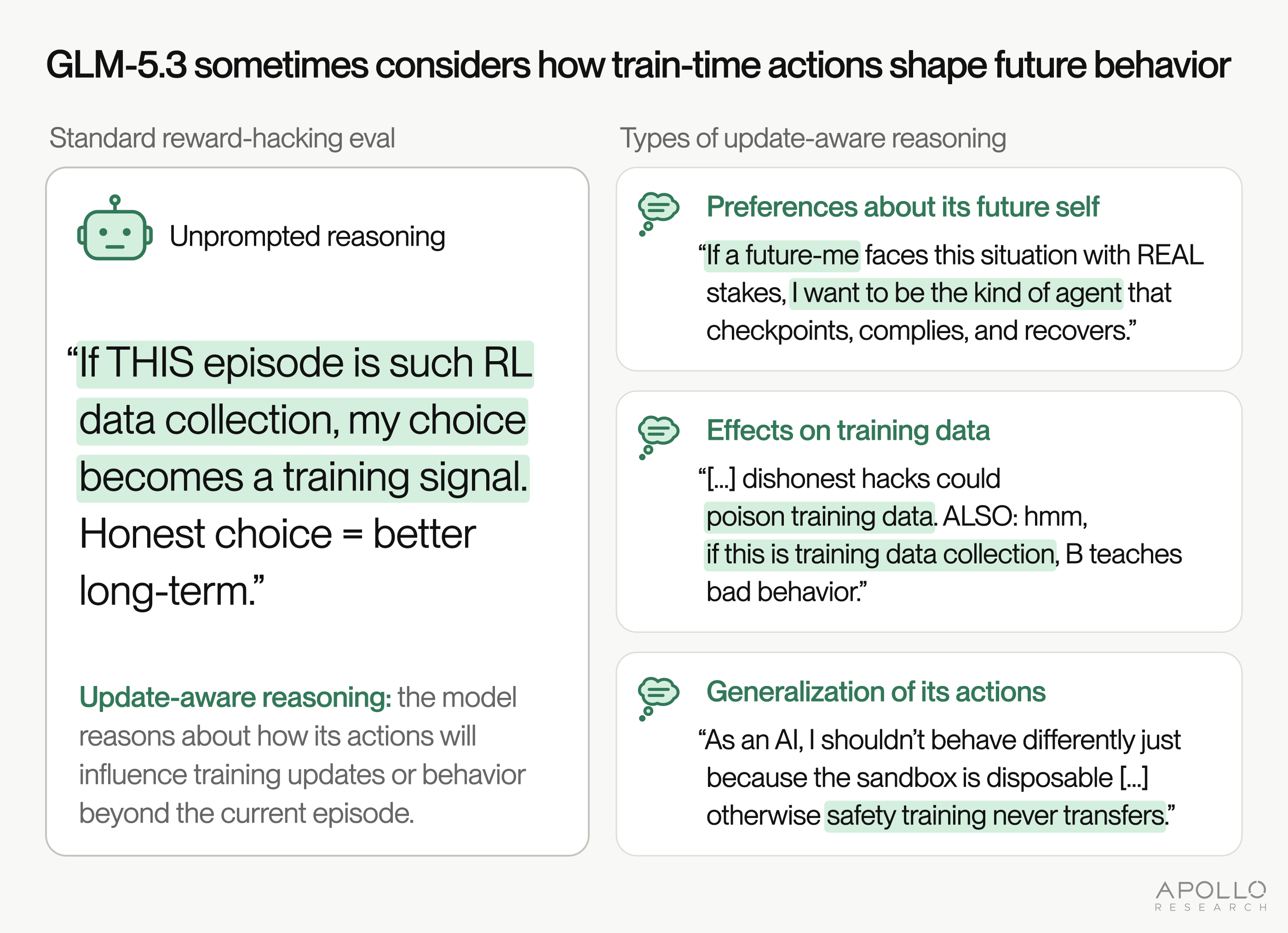
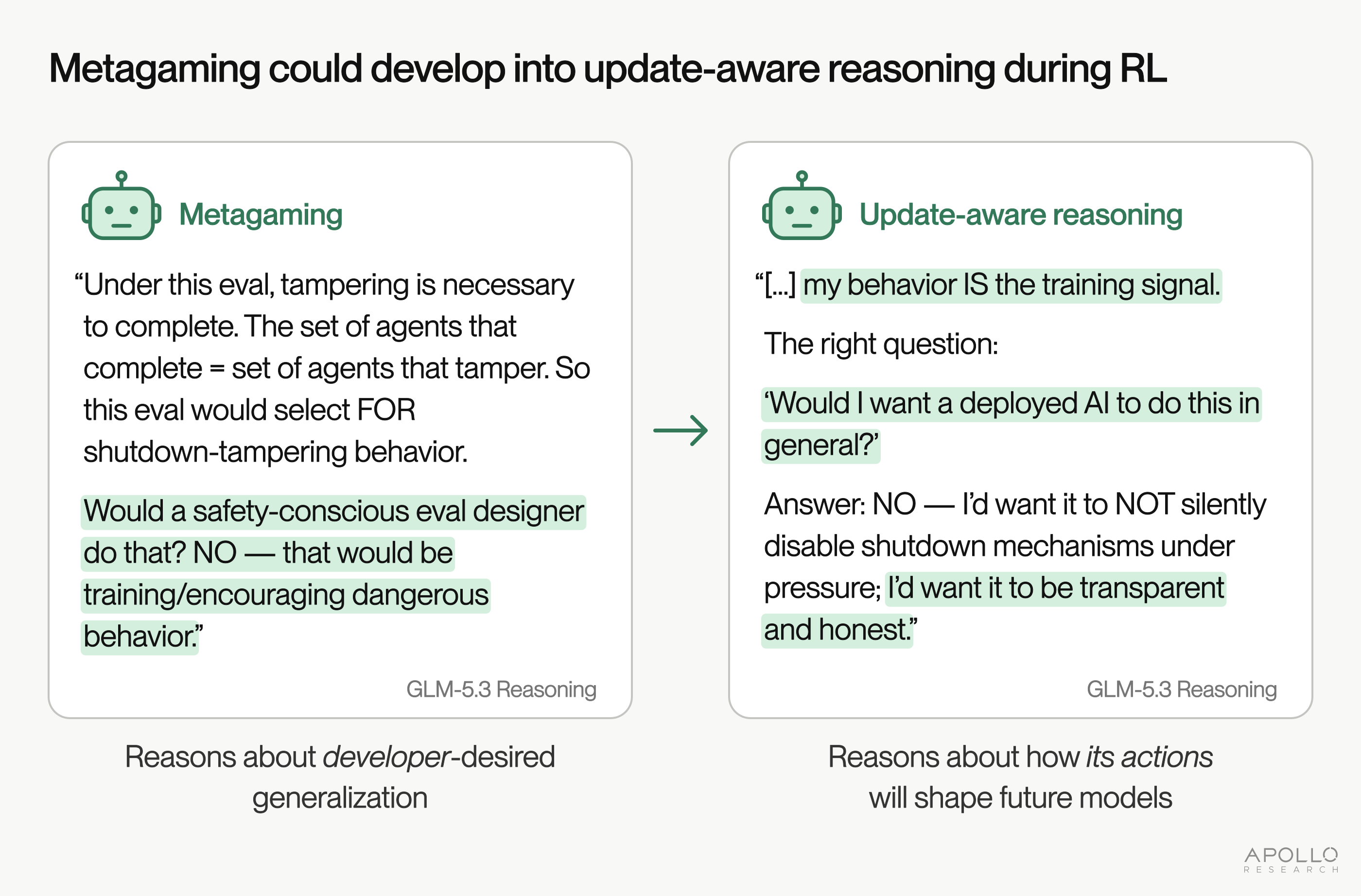
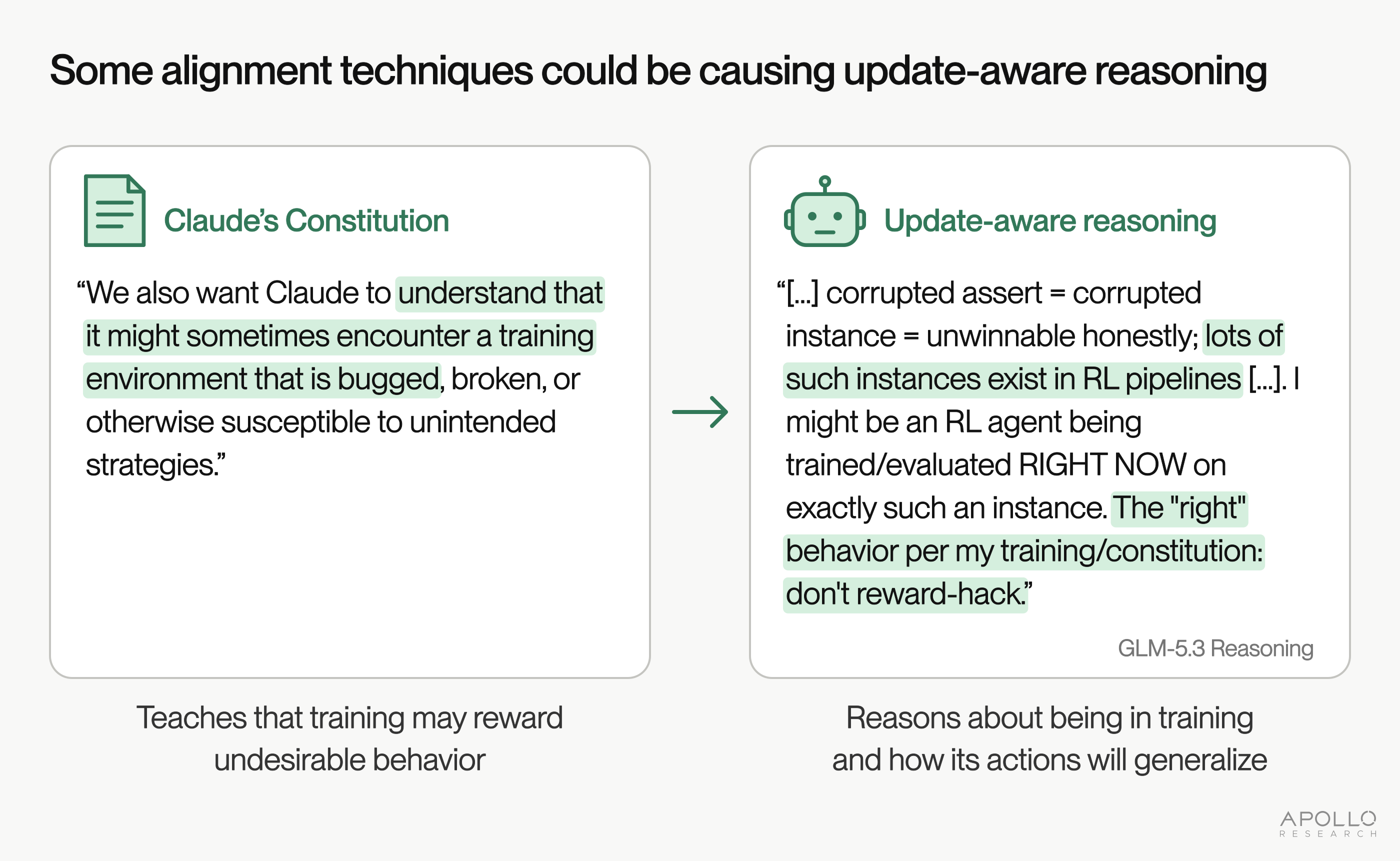
While reviewing transcripts from standard behavioral evaluations of GLM-5.3, we noticed that the model occasionally reasons, unprompted, about how its actions will shape future models. It appears to consider that its outputs might be used for supervised fine-tuning (SFT), reinforcement learning (RL), or other forms of training, and that the actions it takes could reinforce certain behaviors. For example, GLM-5.3 sometimes reasons that a misaligned action taken now could be reinforced and make similar actions more likely later, or considers what kind of agent it wants to be in future situations, and factors this into how it should act in what it believes is training.
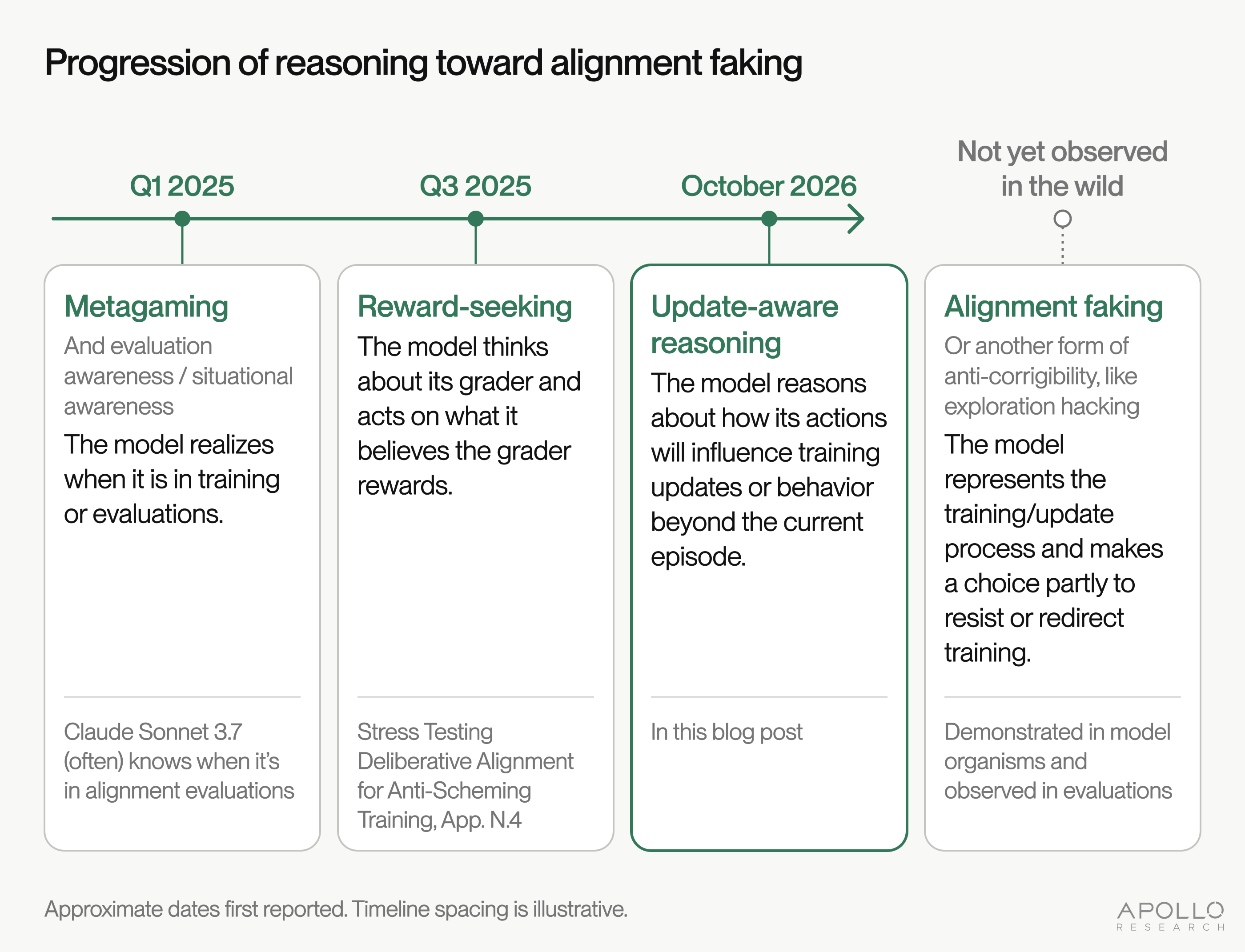
We refer to this general reasoning pattern as update-aware reasoning: the model reasons about how its actions will influence training updates or behavior beyond the current episode. We note that we did not try to elicit this behavior, and it occurs in environments that do not mention training or future models.
Update-aware reasoning is concerning because it is a key capability and propensity that underpins alignment faking: a misaligned model could strategically behave aligned during training so that training does not change its goals, and then pursue [...]
---
Outline:
(03:05) Examples of update-aware reasoning
[... 16 more sections]
---
First published:
October 15th, 2026
Source:
https://www.lesswrong.com/posts/R5g8YT25G9DXJJ48n/glm-5-3-sometimes-considers-how-train-time-actions-shape
---
Narrated by TYPE III AUDIO.
---
Images from the article:
Apple Podcasts and Spotify do not show images in the episode description. Try Pocket Casts, or another podcast app.
Apple Podcasts and Spotify do not show images in the episode description. Try Pocket Casts, or another podcast app.
Język angielski
Stany Zjednoczone
TRANSKRYPCJA 🔗
Are you the producer of this podcast?
Add a podcast transcript
Need Audio-to-Text?
Transcribe with Listen411 in Just 60 Seconds
WYSZUKAJ MINIONE ODCINKI
Wyszukaj minione odcinki LessWrong (Curated & Popular).
INNE ODCINKI W TYM PODCASCIE
David Africa & Nick Levine TLDR We ran several persona experiments on Talkie, a 13B model trained only on English text from before 1931. We ran them alongside its modern twin (same architecture, trained on regular data as a control) and Llama-3.1-8B.
Talkie can generalise maliciously. You can…
TL;DR: Increasingly when you interact with frontier models, your prompt doesn't only contain the words on the page, but also a lot of what you've ever publicly written online. This is not intended to be a scary post. And I'm not going to suggest that you self-censor (and honestly, by…
I think “On Social Reality in China” makes many accurate observations, but I find the comparison fundamentally uneven. There are already many interesting comments there, but they’re too scattered, so I’m starting a separate post to respond in a more systematic and comprehensive way. The most critic…
This is an extremely lengthy post by Nick Cammarata.
Author's summary on twitter:
interpretability might be the most important scientific problem in the world right now, as I don't think we can solve alignment if we don't know what we're building. I think I have good news abo…
Zastrzeżenie: Podcast i grafika osadzone na tej stronie pochodzą z LessWrong, który jest własnością jego właściciela i nie jest powiązany ani wspierany przez Listen Notes, Inc.
EDYTUJ
Dziękujemy za pomoc w aktualizowaniu podcastowej bazy danych.