

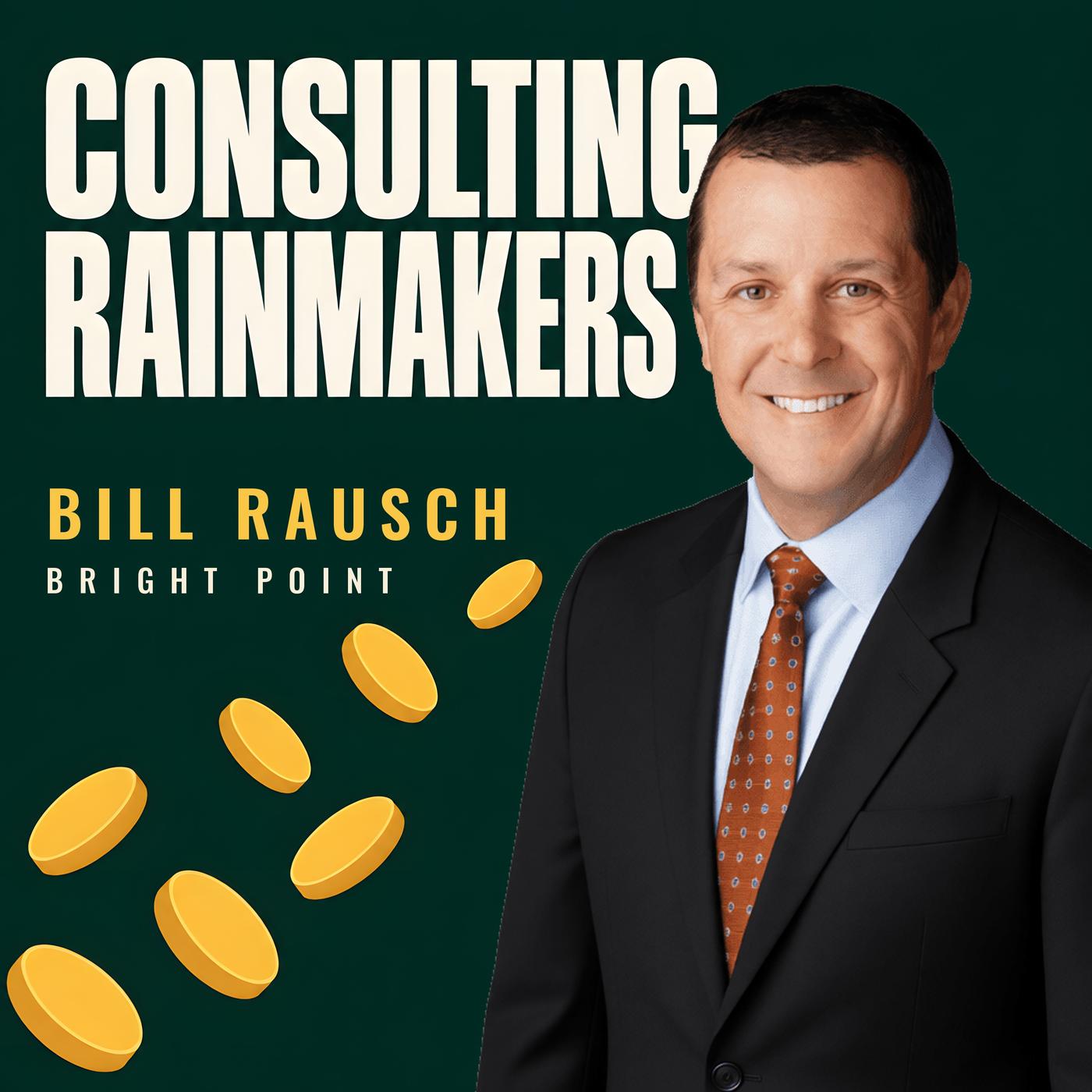
Mikulas: Welcome back to Consulting Rainmakers. today I'm sitting down with Bill Rausch, the managing director at Bright Point. Bill, thank you for coming on today.
Bill Rausch: thanks for inviting me, Mick.
Mikulas: So give me a bit about yourself and kind of your background and what was the path that you know ended with you running Bright Point?
Bill Rausch: that's a long story, Mick. I my early part of my career I was ERP consultant, you know, so we were deploying solutions called JD Edwards, if you're familiar with Net Suite or PeopleSoft or SAP, it was those kinds of solutions and it was a lot of travel, a lot of work and and a lot of pressure. a few years later someone introduced me to Hyperion. I ended up doing consulting for them and Long story short, ended up at another software company running their pre sales team and Left because of travel reasons and then started Bright Point sort of on a fluke. Like my partner at the time, she had lots of travel, and I thought, I'll start Bright Point, I'll work from home. And a few years later, somebody said, Why are you do like you should be helping like you it's you're like three people. Why ar why aren't you bigger? And I'm like, I don't know. I hadn't really thought about it. And someone said, Let's let's figure out how to make you grow faster. faster and grow bigger. And once I got a taste of it, I like, wow, this is great. So
Mikulas: okay. And could you share a bit about Brightpoint and you know what what do you do and who do you help?
Bill Rausch: Excellent. Yeah, our our customers are typically corporate finance, corporate operations teams, and the problem we solve is planning and forecasting and modeling the business. Many businesses have a spreadsheet or dozens of spreadsheets that have these very sophisticated models where you're planning inputs for the business that effectively d drive what revenue looks like, therefore driving expenses. So planning headcount expenses, travel expenses, and then planning revenue. software companies, right, they're planning their annual recurring revenue. And doing this in a spreadsheet is easy to get started, but eventually it doesn't scale. And so our strategic partner Pygment wrote some really interesting, exciting software f to solve that problem and we enable that for corporate finance and operations teams solving your traditional FPNA supply chain revenue operations HR analytics types of challenges.
Mikulas: Right. And so when you kind of step in and start working with such team, what is sort of the first thing that you go through and fix and what are some kind of common mistakes that you see these corporate teams making?
Bill Rausch: one of the I I'll start with the latter. one of the biggest challenges we find with our customers is they don't understand their how their data is structured. you know, we talk about sort of clean data versus messy data. Generally these systems are bringing data in from multiple systems. So you'll have your general ledger system. Net Suite, SAP, Oracle Fusion. You'll have an HR system, ADP, High Bob, applicant tracking systems like Greenhouse, you'll have CRM systems like HubSpot or Salesforce, and then you've got you know operational data coming in from some sort of data warehouse. And invariably we bring all of this data from these disparate systems into this platform. But invariably things don't match up. So I might have 30 departments in Net Suite, but in my HR system I have 35. And in my operational data, I have 20. And they don't always line up one to one. And many times customers don't understand this. Or they've got transactions that don't quite fit into how the business works and they don't necessarily understand why. Invariably it can be things like weird transactions due to an acquisition that they had had in the past. So we tend to clean those things, try to get customers to clean those things up before a project. Most of the time it happens during our projects. The first thing we typically do is try to find pain points for our customers and what are they really trying to solve for? Like what's the What's the val w w why are they talking to us? Like what what caused them to get to the point that they're at today? Sometimes it's you know, we've gotten a big investment, you know, we're a ser you know, we're a venture-backed company, we've got our series B funding, we're moving to Series C, we're gonna double the size of the firm, and we know we can't solve for planning and modeling the business using our spreadsheets or using our old software, we need something new. Or they've just made an acquisition or you know they've been using a different platform, but frankly using it more as a data repository as opposed to truly modeling the business.
Mikulas: Mm.
Bill Rausch: Those are the things that we start with.
Mikulas: understand. And so we were talking a bit of of record. tell me how you use AI specifically because there are a lot of spreadsheets. So how do you enable a organization with AI and what are some sort of use cases where you see that AI brings the most value?
Bill Rausch: that's a spectacular question. we use AI really in sort of two different ways. one question I get, this is mildly related to to your question. I'll start with with this first. Many times we get customers saying, Why do I need to go buy a solution like a pigment or a adaptive planning or one stream, why don't I just use AI with my spreadsheets? And w we've built a a number of spreadsheets using AI and it is incredibly capable. To me, the big challenge is when you want to deploy it outside of a single person. I need data governance, security, auditing, I want people to, you know, spreadsheets, you still have the problem of multiple people inputting at the same time. Now, Google Sheets and Excel 365 sort of solve for that, but they're still not great. we use AI with our strategic partner Pygment. I'm gonna use Pygment going forward. we use Pygment has AI built into its platform. It effectively does three or four different things for our customers. The first is It helps us do analytics. So I can talk to Pygment like I'm talking to you, asking it to give me information about how our business has performed or how we're expecting it to perform. The second thing it can do is help us build models. So because Pygmin is a sort of, we'll just say, multi-dimensional modeling platform, you can't quite model exactly the same way you do Excel. So you've got to work so it's got its own sort of formula language. It's using its modeler agent to Help build models for you. So I can again just talk to the agent and say, I need a model that's going to build a ARR roll forward schedule for me. And I want my churn number to be a some percentage of the previous quarter. And it will just go build this model for you. the third thing is it's planner agent where you can say, I'm building my fourth quarter forecast, and I'd like to adjust the forecast based on our spend to date, as well as we're gonna assume we're gonna spend a bit more money on marketing and spend a bit more money on product management because we've got to spend money on product management to improve our product for next year. So you can talk to it and build your forecasts and plans. Again, just using this modeler agent. literally last week, no, the week before last, they released a feature called frames, which allows us to build boards and charts and graphs in the exact same way that you would do that with. chat or Gemini or Claude, you talk to it and say, I want a chart that looks like this, or I want to build a an interface that looks however you want. A friend of mine, he's a pilot, and he built a he works at Pygment. He built an application using the modeler agent to manage his maintenance on his small aircraft. And then he used frames to build a dashboard that looks like an airplane cockpit related to How how he's doing on maintenance. Like when is it time for an oil change? When's it time to have it inspected? And he's a salesperson, right? He just has no real background in do building these things. Internally at Bright Point, we use AI a couple of different ways. We've built a platform for tracking Or taking every call transcript that we have with our clients and storing them to an AWS knowledge base, which we can then connect via MCP to allow us through any real interface, we use Cloud internally, where I can then ask Claude about a particular problem or challenge with a client, and it will go through every call transcript we've ever had with that client. I can also use it from a performance management perspective. Asking about consultants, like if I had a problem with a consultant, right? He somehow he's got a he or she has a struggling with his his interfaces with handfuls of clients, I can ask Claude to analyze across client transcripts. So that's been incredibly powerful. We use that to do everything from
Mikulas: Mm-hmm.
Bill Rausch: remind me what I had to do from the last call. And it knows enough about our business. It's not like asking Zoom to give us the results of the call because Zoom's calls only know the current call it was on. Whereas our knowledge base is tracking all of our tasks. So we can go backwards and look like, hey, this is the third time your client has asked for this thing, and you just you're not. Delivering it, you need to get on that. That's been incredibly powerful. and it's open to all the consultants in the t in the business, which has been really powerful. I use it to help from a preparing for SOW. development statements of work, right? So that's how we work. We we write up a statement of work and a proposal. We track every prospect call and I use those prospect call transcripts to help me prepare for doing sort of that final interview saying, okay, what do you really need this software to do from a detail perspective? But I know so many things ahead of time. So it really helps from a we call an an implementation scoping call, which typically lasts 60 to 90 minutes. But I'm telling the customer these are all the things I know about you before we have the call. So when we go into the call, we can really deep dive on the ex on the problems that are a bit more sophisticated or complex versus just going over the nitty-gritty that we've already gone through.
Mikulas: Yeah. And I'm I'm all for the note takers. I love them. And I use this for the same use case because you know sometimes you forget things and so being able to kind of recall that information from kind of the last meeting. Yeah, it's it's totally great. And yeah, what you said earlier about kind of how you know the i architecture is important, not only just the AI, I think that's also Because you can basically spin up almost anything in AI with with Claude, but the other thing is, you know, how safe is it? And how do you use it as as you said, across if you have multiple people on the team. So I definitely agree with that. And tell me more about golf and the the life lessons because we were talking before about this and I think you said some great things about kind of how golf relates to real life and lessons. So tell me what are some kind of you know the the best lessons that you've learned from playing golf?
Bill Rausch: yeah, Mick, as we said, I'm a I'm a big golfer, I love it. And I and I've been playing for God, I I think it's twenty-five years, twenty twenty-eight years, something, a long time. And there you know many people when they start to learn, they're like, There's a pond to my left and there's a sand trap to my right, and they're so afraid of putting the ball there because you know, lake you're gonna lose it, or hitting out of the sand is not easy. And in life, we need to keep our eyes focused on where we want to go, not what we want to avoid. And in golf it's the same thing. You don't look at the sand trap or the lake. You you you look at the middle of the fairway like and it's interesting, there's a famous Famous golf teacher, and he said, find the smallest point that you can of where you want the ball to go. Like get as hyper focused on that specific point. Don't worry about everything else. Now, the subsequent lesson is sometimes we make mistakes. Sometimes something goes awry, a big gust of wind happens, someone talks in your backswing, and your ball goes in the lake or it goes in the sand trap. We want to reflect on, okay, what happened? Why did why did that happen? What can I do to avoid that? And then, you know, effectively, sometimes we what we call take your medicine, and you drop your ball and you just try to hit a short shot to somewhere where you can hit the next shot and be really good. So taking your medicine is not trying to be a hero and just put the ball back in play and then proceed to put play. The final little lesson out of that is and we all saw this in that show. I don't know if you get this in in in Europe, but Ted Lasso was a big program on Apple TV. And he I think he even said, You gotta have the mind of a goldfish, you know, or the memory of a goldfish. Forget your mistakes, that they don't matter anymore. Like once you've learned the lesson, forget it and just be positive and think about where you're gonna go going forward. So to me those are sort of three big lessons in golf that I I try to apply to life all the time. And it as most small business owners know, there are lots of things that happen to you and there's many things you do that you happen to yours you know, you put on yourself. But you you gotta like just take it and learn what you can and move forward.
Mikulas: Yeah, well, those were some wise words, Bill.
Bill Rausch: Well, thank you.
Mikulas: you know, it's it's crazy how different things in life relate to kind of lessons, just by how you look at them, if you take something from each thing, what's sort of like one thing that you would like the listeners that are listening to today's podcast with you take from?
Bill Rausch: I think, you know, one thing I've learned is well there's a couple things. One, I I've been doing this a long time and I've got you know the industry with which I work is very small. I I'm I'm working with people that I've worked with over the last twenty plus years. and I think pretty consistently they've said, Bill, one of the things we love about working with you is You do a great job of sort of listening to your clients and and being reactive to what's what they're saying. As they ask more questions, express their their requirements or their pains, you adjust to what they're saying. So, like being flexible from that perspective is important. being I'm gonna say reactive, but being available. Like as a small business owner, one of the things I get I get a lot of kudos for from my strategic partner partners is man, you you you always respond when I send something over. Like you're responsive and you deliver on your commitments. And those things, like that level of reliability is what I like people to know bright point for. Like that's that's who we are. you know, I don't I don't want my customers chasing me or chasing our consultants to go finish something. Like I want to be very proactive. and then from a just a straight business perspective, like I said it's sort of at the beginning of the call, we help corporate finance and accounting teams, or I'd say corporate finance and operations teams, build solutions that help them from their daily process outside of Excel. When it's time to, you know, sort of get away from Excel or get away from the other platforms they've been using because they're somewhat limited. Pigment's the platform to me, that's it's not perfect. It's not for everyone, but boy, it's for an awful lot of people. Like it really does a great job of solving problems and one of the things that's interesting is we were the first partner in North America to sign an agreement with them and you know we've won a couple awards for them for the work that we've done.
Mikulas: Yeah, I I see one behind you. Yeah, yeah. Okay.
Bill Rausch: Yeah, that's it over there.
Mikulas: And so Bill, what is next for Bright Point? Where you want to take it in the next, you know, twelve, twenty four months? What's the goal?
Bill Rausch: the goal, I mean, for us it's really about growth. one of the things that I found, you know, we're sort of in the technology space. And Pygmin is a when I first got started, it was a f I viewed it very much as a fairly technical sort of platform that I needed to hire fairly technical people for. What I've come to the conclusion is consulting is consulting, it doesn't matter. You need consultants that can Listen to clients and respond, and sometimes say no to clients. Like really give good advice and be c confident in who they are and what they know about the domain that we work in as well as the technology, and be able to say to a client, Are you sure that's really what you want? Because here's the cost to doing what you're asking for. So I I'm I'm gonna get to the final answer in a second. If you look at a traditional consulting company, they have ha you know, you typically have a very senior person at the top and you have it's more like a pyramid and you got lots of junior people, like it's a very traditional consulting. And there was a lot of money to be made because the junior people you would charge a lot of r a lot you'd charge the same rate as the senior people, but you had so many of them and you didn't have to pay them as much. It's become very much like a silo where it's almost a one-to-one relationship between senior and junior person. So we've got to find ways to be more productive with the few people that we have. Like I don't need a an organization of a a hundred or a thousand people to do the kind of work that I can typically do with 20 or 30 because of what AI is capable with. So For us, it is really building out the AI frameworks that work in the models that Pygment has. if you you know, Pygment's got their sort of own AI thing, but we're building a whole layer on top of it called the Bright Point Framework, which will allow our consultants to be wildly more productive. And That is really where we're going. So it's building that framework and then building a team of people that can leverage that framework to deploy it for our clients.
Mikulas: Well, this was Bill Raush. Bill, where can people find you?
Bill Rausch: we're pretty easy to find. You can just go to hirebrightpoint dot com on the web and that's one way. You can find me on LinkedIn. I think my profile is just Bill Raush and yeah, that's probably the two good spots to find me. LinkedIn or our website.
Mikulas: Sounds good. Well, I will leave links down below. Bill told me he posts four times a week. So we'll see whether he he is committed to that. And thank you guys for watching.
Bill Rausch: Take care.
