
OVER DEZE AFLEVERING

This Day in Legal History: Earl Warren Takes the Center Chair
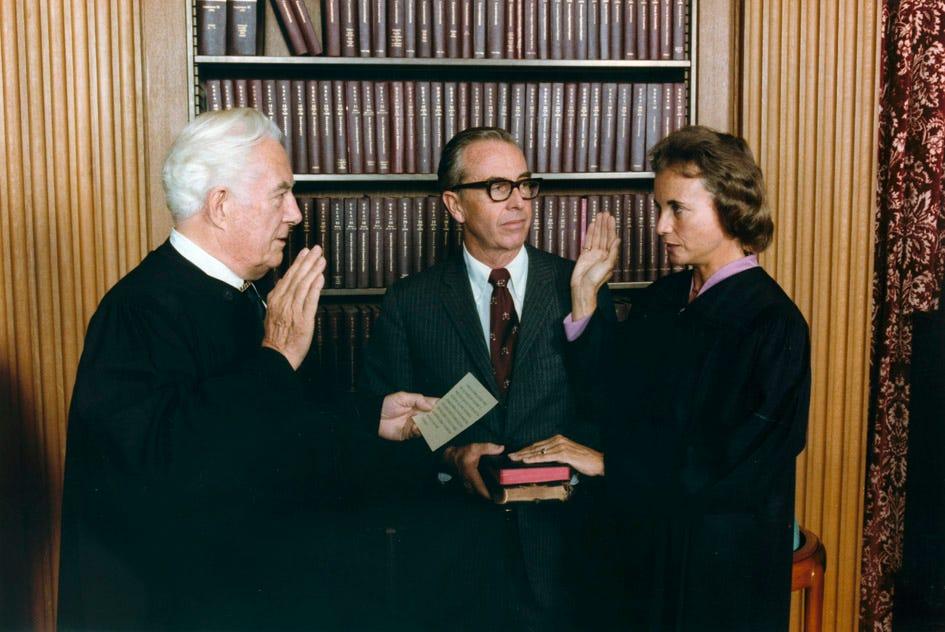
On October 5, 1953, which was the first Monday in October and the opening day of the Supreme Court’s term, Earl Warren was sworn in as the 14th Chief Justice of the United States. Chief Justice Fred Vinson had died of a heart attack less than a month earlier. To make sure the Court opened its term with a full bench, President Eisenhower gave Warren, then governor of California, a recess appointment. Eisenhower and Vice President Nixon attended the ceremony. The Senate confirmed Warren the following March, and he took the oath again.
The timing mattered. Brown v. Board of Education had already been argued once and was set for reargument that term. Warren spent months building a unanimous Court, and in May 1954 he delivered the opinion holding that racially segregated public schools violate the Equal Protection Clause. Over the next sixteen years, the Warren Court reshaped American law: one person, one vote in the reapportionment cases; the right to counsel in Gideon v. Wainwright; the Miranda warnings; and major expansions of free speech and the rights of criminal defendants.
The significance of October 5, 1953 is a reminder of how much depends on who sits on the Court when a term opens. A recess appointment made to fill a seat for opening day put in the center chair the justice who would lead one of the most consequential eras in the Court’s history. And today, exactly 73 years later, is again the first Monday in October, with the Court opening a new term and hearing its first case: our lead story.
The Supreme Court opens its new term today by hearing arguments in one of the most important climate cases it has taken up: Suncor Energy v. County Commissioners of Boulder County. In 2018, the city and county of Boulder sued Suncor and ExxonMobil in Colorado state court under state law, alleging that the companies deceived the public about the role of their products in climate change and seeking compensation for local harms like wildfire, heat, and flooding costs. The Colorado Supreme Court ruled 5 to 2 last year that the case could go forward. The oil companies’ argument is preemption. They say that climate change is caused by greenhouse gas emissions from every country on earth, that the Clean Air Act and the federal structure govern interstate and international air pollution, and that a single state can’t use its own tort law to effectively regulate a global problem or impose liability for emissions far outside its borders. Boulder’s answer is that it isn’t regulating emissions at all. It’s suing over deception, a classic state-law claim, and nothing in federal law clearly displaces that. The Court also asked the parties to address threshold questions about whether it has jurisdiction to hear the case at this stage. Two things raise the stakes. First, nearly 60 similar suits by states and cities around the country turn on how the Court resolves this question. A broad ruling for the companies could end most of them; a ruling for Boulder would send them toward trial. Second, as we covered last week, Justice Alito has recused himself, so only eight justices are sitting. If they split 4 to 4, the Colorado ruling would stand, but without setting any national precedent, and the same fight would return in another case. A decision is expected by mid-2027.
US Supreme Court weighs bid by oil companies to avoid climate lawsuit | Reuters · Earthjustice · Harvard Environmental & Energy Law Program
The administration is asking the First Circuit Court of Appeals in Boston to revive its effort to terminate roughly $2.2 billion in federal research grants to Harvard University. The background: in April 2025, the administration sent Harvard a list of demands, including ending its diversity programs and bringing in outside auditors to monitor academic departments for “viewpoint diversity.” Harvard’s president, Alan Garber, refused, saying no government should dictate what private universities can teach. Within hours, the administration froze Harvard’s grants, citing the university’s alleged failure to address harassment of Jewish students, and it eventually terminated them. A federal district judge ruled for Harvard in an 84-page decision, finding that the administration used antisemitism as “a smokescreen for a targeted, ideologically motivated assault” on the country’s leading universities. That’s a First Amendment retaliation finding: the government can’t cut off a benefit to punish someone for protected speech or for refusing to give up academic independence. On appeal, the Justice Department makes two kinds of arguments. On the merits, it says the government isn’t required to keep funding universities that show “deliberate indifference” to antisemitism. It also argues the case was in the wrong court entirely. Under the Tucker Act, contract claims seeking money from the federal government belong in the Court of Federal Claims, not a district court, and the administration says Harvard’s suit is really a dispute over grant contracts. That jurisdictional argument has worked for the government in other grant-termination cases, so it’s a serious threat to Harvard’s win. The significance goes well beyond one university. This appeal will help decide whether the federal government can use research funding as leverage to force changes in how universities teach, hire, and govern themselves, and whether courts will review that leverage as a speech problem or treat it as an ordinary contract dispute.
US appeals court weighs Trump’s block on Harvard research funding | Reuters · US News · Harvard Magazine
And finally, Poland’s competition regulator, known by its Polish initials as UOKiK, has charged Google with abusing its dominant position in negotiations with Polish news publishers over payment for their content. The backstory is a 2024 amendment to Polish copyright law implementing an EU directive that gives press publishers a right to be paid when online platforms use their content. In Google’s case, that covers articles and snippets shown in Search, Google News, and Discover. The regulator’s theory isn’t that Google refused to pay. It’s that Google controlled the information needed to negotiate. According to UOKiK, Google didn’t give publishers the data they needed to evaluate its offers, such as how much traffic and value their content generated, so publishers had no real way to judge whether the payment was fair. The regulator said that made the negotiations “illusory,” with Google effectively imposing terms. Its president put it bluntly: big tech companies “cannot place themselves above the law.” This is an interesting antitrust theory, because the abuse alleged is an information imbalance rather than a classic refusal to deal or exclusionary practice. A legal right to payment means little if one side can’t see what the content is worth. A few points of perspective: these are charges, not a final decision, and Google will have a chance to respond. If the regulator finds a violation, the maximum fine is 10% of turnover. And this is separate from the European Commission’s investigation, opened last December, into whether Google used publishers’ content in its AI services without adequate payment or the ability to opt out. Together with the U.S. ad-tech remedy we covered last month, it’s another sign that regulators on both sides of the Atlantic are focused on the economic relationship between Google and the publishers whose content it depends on.
Polish regulator suspects Google abused dominant position in publisher payment talks | Reuters · Brandsit · Global Banking & Finance Review
This is a public episode. If you'd like to discuss this with other subscribers or get access to bonus episodes, visit www.minimumcomp.com/subscribe