

0:00
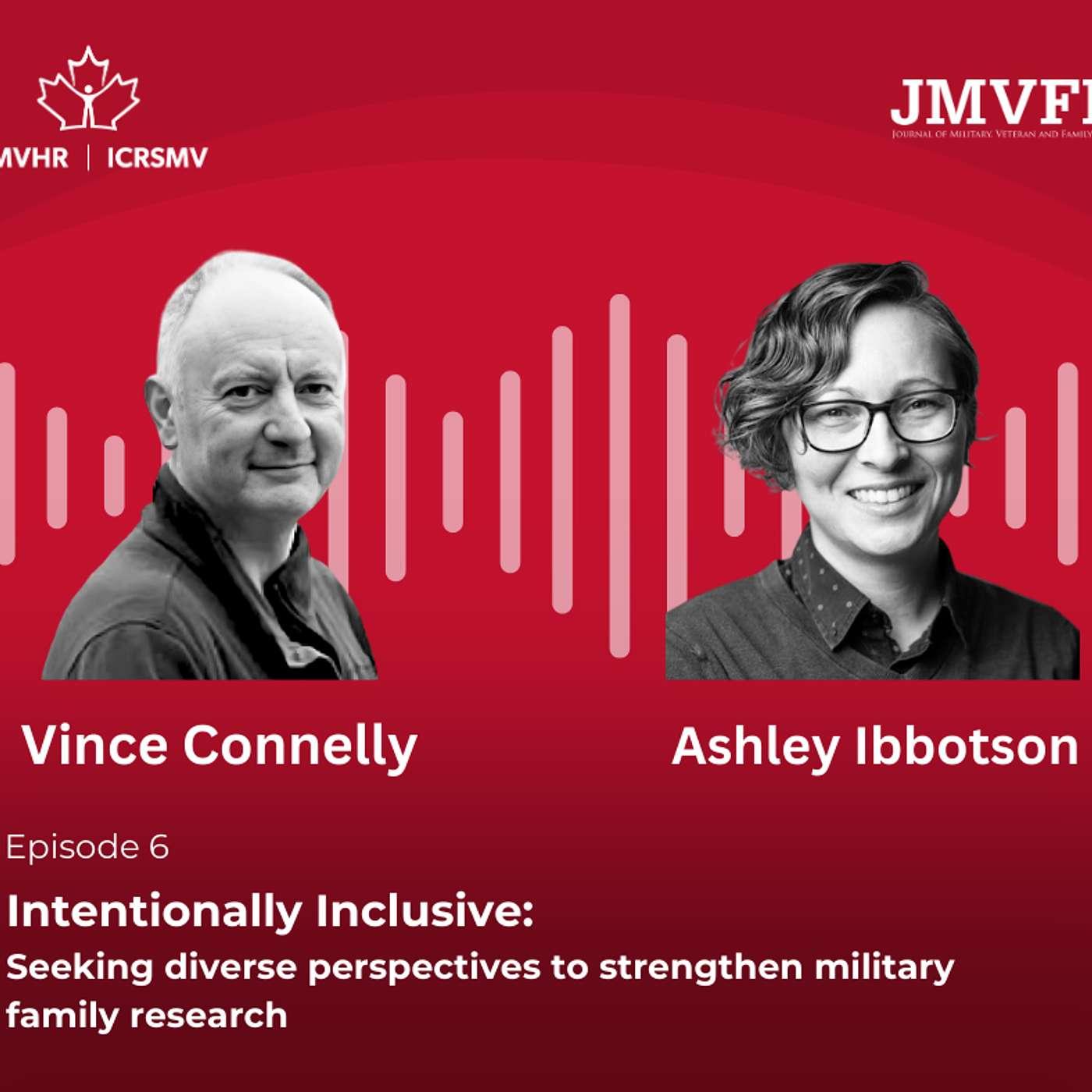
Welcome to Beyond the Battlefield, the exclusive podcast of the Canadian Institute for Military and Veteran Health Research. Each week, we meet with leading researchers and people with lived experience to discuss issues affecting military, Veterans and families. Join us as we unpack the findings to bridge the gap between military Veteran and family health research and real world impact. In today's episode, we sit down with Doctor Vince Connelly and Ash Ibbotson to discuss underrepresented groups in military, Veteran and family research. We'd love to hear your thoughts on today's episode. As you listen to this podcast, feel free to leave feedback in the comment section below. Did you learn something new? Do you have something to share about the topics discussed? At the end of this podcast, we also invite you to complete a short survey by clicking on the survey link in the Podcast Description section. Your input helps us create content that's valuable to you. Vince Connelly is a professor of psychology and leads the psychology team at Oxford Brookes University in Oxford, UK. His research currently focuses on the organizational psychology of the armed forces. He has also published many international works in the field of education and psychology. Professor Connelly's work on the armed forces has an emphasis on the different personnel components of the Total Defense Force, and how they work together. The research impact of his work on reserve forces integration between 2013 and 2020 was rated as world leading by the UK Government Research Excellence Framework in 2022. He has also investigated the civilian perception of Veterans and has explored the crossover of Veteran and reservist identity after compulsory service in Israel. His latest book, Contemporary Military Reserves Between the Civilian and Military Worlds, was published in 2023. Vince is a long serving British Army reservist. Ash Ibbotson is a research coordinator with the Trauma and Recovery Research Unit in the Department of Psychiatry and Behavioral Neuroscience is at McMaster University in Hamilton, Ontario, Canada. Her research work has focused primarily on the experiences of 2SLGBTQIA+ military members and Veterans, and the impacts of military sexual trauma on Canadian military Veterans. Hello, Doctor Connelly and Ash Ibbotson, thank you both so much for joining us today on the Beyond the Battlefield podcast. Today we're going to be discussing groups of military and family members that have typically been left out of the literature. So it's going to be fun to discuss these topics today. As you know, we are doing an entire series dedicated to military families, and we've purposely included diverse perspectives and research backgrounds from all of our guests. My first question to both of you, can you talk a little bit about the work that you're doing and how that fits into the military and family research landscape? Yes, in terms of how our research has been going the last few years on reservists and families, it's been really interesting from my perspective as both a reservist and someone with a family. It's really nice to take a perspective on something that you know or think you know very well, actually. So one of the nice things about the research is being able to reflect on the results back into my own experience and try and improve my own life and relationship with the family as a consequence. But really, we started the work, as you said, because there's not a lot known about reservist families per se. Reservists tend to be a kind of marginalized population in the military. Not a lot of people do research on them. Not a lot of people know that much about them in general society. And the same is very true of their families as well. So we were very interested in understanding what is the offer for the reservist family from the military, but also what's their understanding of the offer and do they see themselves as a military family? And how might that then interact with the reservists themselves and their understanding of reserve service, and how it fits with their obligations to the family themselves? We do know from research that family support is key to allowing reservists to engage with a part time reservist military career, but ironically, we know very little about that engagement and the family's role in it. That's very interesting. We see a lot of work on sense of belonging and identifying as a military family or a military member themselves. I think that's so interesting with reservists. So thanks for laying that out. Something that we have started digging into lately is the lack of representation in 2SLGBTQIA+ families in military family research. And we know that Canadian society is changing, and we know that CAF is meant to be or aiming to be kind of representative of that Canadian society. So really wanting to encourage intentional and specific inclusion of 2SLGBTQIA+ military families in that research to ensure that we are getting the full picture of these families, making sure their needs are met and that kind of thing. Actually, that leads into the first question that I had. So perfect segue. I've heard on this podcast a few times on this series, and we've heard, I think the old adage, too, is that the military family is a husband, who's typically serving, a wife, two and a half kids, and a dog, and we have an international presence. So that dog is a different dog depending on who we chat with. But that's actually not my question. My question is more along the lines of, what is a military family now? Obviously, that old adage is changing. Who are we seeing within military families these days? I think actually, as Ash was saying, you know, it's a question of inclusion. So if you look at modern militaries and who they are composed of, and they're very diverse, you have full timers, regulars as they're called in the UK, part timers, spare timers in terms of reservists. You have contractors, you have civil servants and then you have the diversity of all their families over and above that as well. And it's that diversity and difference that is the heart of the total force and how it works together and how it should work together effectively. And families are a key part of that. And that diversity is represented not just in the military, but also in terms of the huge variety of family members we see out there. So we interviewed and surveyed not just husband and wives, but partners, girlfriends, boyfriends, parents, uncles, aunts, relatives, friends. And we let the family member decide who they were, rather than going out with a definition that excluded people, really. And I think from that we got a very much more diverse and interesting sample actually. And also it then challenges our and also the military's view of things like who's in and out for various benefits, who's in and out for various ways of understanding and accessing support. And I think that one of the weaknesses of that traditional view of the military family is that exclusion of difference and diversity. And we’re also interested in, we don't really talk about it in the paper we publish, but we've also got other results where we talk to people in the armed forces who deal with welfare and support. And we found that while there's a lot of understanding of the diversity of families out there, sometimes there's still that traditional view that can limit people's access and does have an impact on the family members. And we saw some of that mirrored in some of the comments and some of the views we reviewed. There's so much to unpack there, isn't there? There's the reservist themselves that aren't typically represented in the research, and there's the extension to the family. We've talked about the sense of belonging, the sense of identity and who they are. They're trying to figure that out themselves in a sense, and I'm sure that fluctuates and changes. It's not a black and white thing. There's probably feelings of sense of belonging and identity that shift back and forth along these lines, both with the reservist and the 2SLGBTQIA+. What are we noticing as big gaps or areas of under-representation within the military family research? Because I imagine there's not just one. We've chatted about the idea that there's not a lot of research within reservists and the 2SLGBTQIA+ community in general, and there's limited research, even more so extending to the family of those members as well. So highlighting those points, what are some of the areas that we're really seeing gaps these days? To speak to the 2SLGBTQIA+ family angle there, I think that we are kind of seeing a little bit more research on this community more generally in the literature, but it's kind of not intentionally. It sort of comes about, incidentally, some families may be included in a broader study that's looking at family experiences. And then the result of that is that we don't really get to see a kind of in-depth analysis of those families’ experiences. So I feel that is a pretty big gap. We see some work done on partners, but again, that is usually specifically to the partners and not to the fuller family unit. And we see too, that some data gets conflated in these situations. So we may be including some 2SLGBTQIA+ members in the research. But then we tend to conflate this umbrella term and not look at those specific subgroups of that term, which represents really different experiences that need to be further examined. Yeah, we find similar in reservist work as well. There's no specific program looking at these underrepresented families. And I think part of that is because the way reserve forces have changed historically over the last 30 years from being a kind of strategic reserve, one shot, World War Three, could all over in eight days in a nuclear holocaust. And so therefore, we don't really need to think about families because we’ll all be left dealing with the aftermath of that terrible trauma. But there's been a real move over the last 20, 30 years to become much more of an operational reserve where small numbers of reservists are called up, work with their regular colleagues, probably overseas on deployments. And so it's small numbers. So it's kind of a hidden neat. And those small numbers deployed at one time mean they're kind of wrapped up into the regular full force deployments and under the radar that way. And at the same time, there is a belief that reservist families only need to be considered in those deployments. So there's deployments that are obviously long periods of separation. But what really hasn't been looked at are the routine separations. So we might think weekends away or just short periods. But if you're away 2 or 3 weekends, every couple of months, you’re away for a few weeks every year, you're away for one night a week. These absences can mount up over a reservist career of 10, 20 years, so no one has really looked at those absences and the impact on the families. Our families negotiate those absences. And I think over and above that, we have the, as I said, the marginalized population in the military, the reservists, and the way they do their business challenge our traditional military identity, particularly that very masculine, committed to the organization, 24/7 culture. Reservists are not about that. They commit their time in different ways and make different sacrifices, and they have to negotiate time away from their employers, civilian employer and time away from their families. And also we found that they were stealing time, literally stealing time from both in order to get their reservist time in. And what that means sometimes they compartmentalize their life to negotiate absence, which means the family can be marginalized by the reservist in order to negotiate successfully. So it's always useful when you're negotiating to keep secrets from the people you're negotiating with. And sometimes that's, not in all reservists, but a minority of reservists do that. And that can marginalize family even more. And then finally, they are a hard to reach population. If you don't identify as a military family, it's hard to reach out to them, to communicate them. And it's hard to actually understand them through research. We're to really work hard to get our sample smaller as a consequence. Again, such good overview. I had three different questions that I had lined up just to ask on those small pieces. I think one of the keys I'm hearing, too, is there's a difference between being included in the research and being researched themselves to understand their needs. Right. So there's people who who might identify in the 2SLGBTQIA+ community who end up in a sample for whatever reason it might be. There's also reservists. It sounds like Vince, as you were saying, who, we would call them Class C in Canada, where they're pretty much, for a period of time, reg force members. But what about those other subgroups, and what about the experiences of other reservists that have a very differing schedule from the norm? And those are important pieces to really understand. Definitely. And it's interesting. One of the things we found was that there's not a great understanding in the military or in families about the different types of reserve service and what goes with that in terms of welfare and support. So, for example, the welfare and support you should receive on a full time deployment should be in line with their full time colleagues. But it's a lot more ambiguous as to what welfare and support is available for routine training for part time, spare time reservists. But it's also a bit ambiguous when you're a full time but not deployed reservist, we call them full time reserve service, how they qualify and what their relationship of their family is to the service and vice versa. And then there's even more complicated. Another form of reservists we call sponsored reservists, who are actually in a civilian role working with the military but have a reserve obligation on occasion to become part of the military. So there are all these different types of reserve service and how they were enacted that lead to different identities and different ways of negotiating. And we struggle with understanding the reservists, never mind the families of those reservists over and above that. I think too, Vince, because there are these huge differences, we often will see an intentional exclusion as well from research. And, you know, sometimes it's okay. Well, we know this experience is going to be very different. So we want to put it on hold. We'll talk about it in a future study or that kind of thing. But the really important thing is to get back to that. And you're absolutely right. And that exclusion is interesting, isn’t it, in terms of how we make our research choices, how the military funds some research and channel you in particular ways? Absolutely. And I think that's further highlighted. It's not all about sample size as we know, but when they’re a hard to reach group and it's a small sample, it's really hard to pick these pieces of different groups. There's definitely a lot of work to be done. And I know in some of our reservist research, it's also hard because the reservists that we work with, they bounce between classes. And I imagine that's the same in the UK too. So it's really hard to pull from a specific point in time and recall some of these when I was a class A, this is my experience. But now I have a class C for the last five years or I was reg force and now I came back. So it's really hard to understand the different ones because they're moving around so much for the betterment of themselves, their families, career opportunities, whatever it might be. Yeah, absolutely. And I think the other thing is families are also changing as well. So family dynamics are constantly going through change. And this leads also to the other thing that came out of research was over the lifespan of a reservist, their dynamics with their family and with the reserve service will naturally change, and their negotiations with the family will go up and down as a consequence as well, in terms of their success at those negotiations. And sometimes the military don't see that, and they don't understand the different phases of family that individuals are going through, and also how family responsibilities can weigh then on the reservist in different ways at different times in their careers. I see a direct, I don't wanna say comparison because there's not a comparison, but alignment with your work, Ash, in those pieces there, with the recognition of families from the military and the 2SLGBTQIA+ community is probably quite an important piece as well. So we've talked about the limited research, but what do we know about the research? What do we know about the wellbeing and the needs of some of these underrepresented groups, either from the 2SLGBTQIA+ community or from reservists? So both families that aren't really mentioned in the literature much? Honestly, not very much. We don't. There's not much work happening in this area. So again, that's like intentionally inclusive of these families. There's work happening. We know there's work happening in Canada. There's work happening in the UK on 2SLGBTQIA+ members and Veterans. But again, that's usually not family inclusive. It's not looking at that bigger unit. And very similar on reservists in the UK, there's very little UK research in this area. There's been quite a lot in the US actually, looking at deployment because things like the US National Guard, U.S. reserves deployed a lot more in larger numbers than UK forces. So there's some very good work there. And what it does show is families are under strain during these long deployments, as with their regular force. But what's interesting is those families deal with things in a slightly different way. They may have other networks in their civilian lives that aren't accessible, perhaps to some of the regular force families who perhaps isolated on bases. But at the same time, they may be as isolated as some of those families in that way. We found in our research was a mix of family setup and networks. That means some people are able to cope very well with some deployments of absences, but others are not. And the key thing is not to make any assumptions about families. And I think that's sometimes what the military institution does make are those assumptions and stereotypes come to the fore. Sadly. I mean, we know other things, such as 50% of reservists aren't happy in the UK with how their family was looked after on deployment by the military. And there's a slightly higher rate of family breakup after reserve deployment than their full time counterparts. So we know some stuff and we know also that negotiation is a key thing that goes on with families and things like caregiving is an important aspect to that. And from some of our work, we know that caregiving tended to fall on the female in the family, for example, even if they were serving, even if they were a reservist and a dual reservist family, for example. So there are some areas there. And we also know reservists can experience, and again through the life cycle of a family, a mixture of support, ambivalence, indifference and opposition to their reserve service for different reasons and at different degrees of time, really. For example, at one point we asked reservists, in other work, about relationship break up, and we find that the rates and relationship break up is very typical for a sample of their age. So it wasn't higher than normal. But when we asked them, was the reserve service a factor in that break up, 70% of them said it was. So there are impacts on the family, but it may be in ways we don't yet understand. Great point there. And the key thing being the work is now being done on reservists, or it's beginning to. We can understand the impact of a family indirectly in a sense there, but we also don't want to make those assumptions. Just like a lot of work in the US, we don't want to make those assumptions in the UK, Australia, Canada. Obviously, there's different policies and support for families and programs and things along those lines as well. Vince, I was reading through some of your work and it talked about looking at the awareness and the use of available family welfare services for reservist families. Key pieces I saw was not knowing how to access support. And then the other one I really was drawn to was they're not identifying as a military family. I've actually seen this a couple times, do you care to just touch on a couple of those findings and what you saw there? Absolutely. And I think they're really interrelated, actually. So I think the not identifying as a military family means it's difficult to know how to access military support. And I think therefore that drives little awareness and little use of such support, but also it means a lot of the time you assume no support is available, when actually there might be quite a lot of support out there. So it's driving up that awareness and trying to understand what may make them identify more as a military family. But what was also interesting was that we found a number of family members didn't really want to be identified as a military family. They were quite happy to have a member of the military in the family, but really didn't consider themselves as a military family. They saw military service as something their family member did that was theirs, and they were quite happy to be separate from it. Not always. With others, particularly those whose dads served in the regular forces and then moved to part time, come out with the regular force, moved to a part time reservist contract. They were much more, not quite in mourning. I would say that's a strong word, but they missed being a military family, even though they technically were a military family. Their perception was that they had left that identity behind when they went into regular service. Even though, if you think about it in terms of a definitional, they certainly are a military family that way. But essentially the not knowing how to access support, which is very predictive of your ability to cope, particularly on things like deployments. And we knew that ability to cope, if you have a family that goes through a difficult time of deployment, that that impacts when the reservists come home and the reservists who perceive their families haven't been looked after or have had particular difficulties less likely to be retained in service as a consequence. So there's direct consequences both for the family, obviously for the reservist and for the military as well. There's a lot there, isn't there, about families that do not identify as being a military family, those that do but then go through a transition themselves, which is an area that needs to be more researched. We know the military to civilian transition and the impact that has on the member. But what about the impact that has on the family, the access to services, their identity themselves? And I know, extending from different lines of work, but I feel like the sense of belonging is something that's so important in health outcomes and access to services and many different things within the military. Ash, in the 2SLGBTQIA+ community, do we have an understanding of a sense of belonging or of identity as military families in that community? I don't want to speak for military families this way, but I don't want to underestimate either how important military identity is often to these families. And if that lack of integration is there, or if there's a lack of inclusion, then that could have a really negative impact on these families and could be actually a really painful experience for them. So just kind of want to emphasize that too. Yeah. That's good. And one thing I'm always thinking about is the historical context of military service, or explicitly in Canada and specifically at the Purge. And this is something where we could say that, well, these individuals are included in more research or there's more programs and services. And today, possibly some people might say, oh, there's less of an impact because of inclusion. But the reality is, is whether there is or not, these historical contexts still play out and have large impacts on adult children, children, families. Is there anything you can touch on about the historical context? A little bit of an overview for listeners of what the Purge was and the impacts that this community has gone through as part of military service? So the Purge, also known as the LGBT Purge in Canada, was the sanctioned investigation and discrimination of people who were suspected to be LGBT for over 40 years as civil servants. So when you're looking at a policy like that that allowed this sanctioned discrimination, that's going to have an impact, that's going to have a lasting legacy within the institution that could impact if we have family members who were part of the Purge and their children are now joining in the services, that could be really a painful experience for them. Or it could be worrisome for them because they've actually really been harmed by the institution. It could impact recruitment rates for people who are marginalized groups. It breaks that trust of the institution, and that is a legacy that continues on. And I think that's something that needs to be acknowledged, needs to be researched. So it's great to see that there's still research happening on the Purge survivors. There is the ban on service in the UK as well. So this is not just a Canadian issue either. Absolutely. And we're starting to see some of the ramifications of that with some of the recent reviews that will be published about our similar experiences here. I'm really starting to see some of the stories come out about the damage done to individuals and their careers and their families, as you said, where individuals have felt shame and they've hidden things from their family or their friends, as well as all the damage to their personal life. So we're seeing a similar outpouring of the consequences of all those actions over the years, that discrimination. Now, this question might be a little bit loaded because there's so many areas that we can go, but we recognize that military family research has come a long way and no one I've talked to has said it's gotten to the point where we're happy and we're going to stop it. There's a lot of growth, there's still hope and a lot of movement to still progress towards. So what are some areas in both of your lines of research that you hope to see, either in future research or in programs and resources moving forward that can really meet the needs of these underrepresented communities? I think there are many different areas we could go down. Some of them that I think would be useful is really understanding what the needs of the family are. Our project was very much looking at their understanding and awareness, but I think a needs first analysis would be very useful actually. What is it the reservist family needs and expects when their family member is a reservist? And what kinds of support would be most beneficial for those diversity of family members? And I think that's the key really. It's looking in detail at the diversity of family members and a diversity of needs. All those members with the diversity of reserve service that's out there. So it's not necessarily a simple short study, but that would certainly be it. We've got a PhD student here, Matt Albright, looking at some of that at the moment, which will be good. So for example, we found that personalized unit support seemed to be the big differentiator. You know, research between families who are happy with the support they received from the military and those that were not. So some more research, perhaps into what makes a difference at the local level, because often the reserve service is about that localization of the reservists going into their local Army Reserve or RAF or Naval Reserve Center, and those family type interactions between the local unit and the reservist family seem very important. But also, the families were really looking for online information and information they could independently assess and look at. And I think also some research into why that is and what they were after and what they would benefit from in that area would be used mainly to reduce inconsistencies. Because we found that it really became up to the family member to try and understand what was available in terms of support to them, and we want to make it a much more level playing field for all the family members of reservists. Very well said. I'm interested, what we're seeing in Canada is a lot of individuals, reg force, who are not living on base anymore. They're more on the kind of the quote unquote civilian community. Do we have an idea of numbers UK or Canada, of reservists who are living on bases, or was that typically left for more regular force members in the UK? That's much more a regular force pattern in terms of basing. What we do see though is lots of concentration around reserve force centers in towns. We've got about 350 centers across the UK and you tend to find families are concentrated around those centers, whereas with the regular force, because our bases are much more concentrated in a few locations now, and they tend to be in rural locations, their families are actually quite widely spread across the country. And as you said, we're getting a lot more regular force who commute to work. So they'll stay Monday to Friday at these rural bases and then go home at weekends to their families many miles away. So there's quite a different pattern, I would say, in terms of geographic spread, and that obviously it will have an impact on the families themselves, in that case. It'll be interesting. I'm sure some work at some point will be looking at reservists and urban or rural living in proximity to bases and the change within regular force members as well. Ash, so what are some of the areas that you hope to see for upcoming research or programs and resources that could be developed moving forward to support specifically the 2SLGBTQIA+ families? I think just starting out with the research, because we really don't know what these families need right now. So I think with some of the 2SLGBTQIA+ policies that we're seeing put into place into Canada, into the US, I think it's really important that we start prioritizing research on these families, because otherwise we’d risk these families falling through the cracks. I think we need to start with a wellness check for these members and their families. Yeah, I agree, and I know one thing that we've chatted about previously too is that not having exact numbers on the top of mind, but it's easy to say, well, these only make up a small percentage of families, so there's only 20 families. Just as a numerical example, it's a small percentage. But the reality is, if we ever want to support these individuals, whether it's one family, 20 families, 500 families, we should be supporting these individuals and these families. And if we ever want to grow the 20 families into thousands of families to support the Canadian military, we owe it to them to ensure that they're represented in the research. We're understanding their needs, and we're meeting those with programs and resources as well. Absolutely. If we start looking at this is a minority of families, then we're saying that those families don't matter. And that's simply not the case. Yeah. And I think when we talk about historical context, if there's that long standing feelings of they don't belong or they don't matter, there has to be that effort on the other side to show them that they do. Talk is one thing, and action is another thing that I think is quite important. Absolutely. All right. I can't believe we are out of time already for today's episode. I've really enjoyed this conversation. So Ash and Vince, thank you so much for your time. I know the listeners are going to enjoy it as well, and I know there's going to be more conversations, particularly from the two of you moving forward, where we actually are able to talk about some of the research and the growth that we've seen, just like we've seen in family research. So again, thank you so much for your time today. Thank you. Thank you. Thank you again to Doctor Vince Connelly and Ash Ibbotson. Please continue the conversation with us by following the CIMVHR and the JMVFH on Facebook and LinkedIn. Now that you've listened to the Beyond the Battlefield podcast episode six, we invite you to complete a short survey by clicking on the survey link in the Podcast Description section below. Your input helps us create content that's valuable to you. Finally, as the host of Beyond the Battlefield, thank you for listening to the first season of the Beyond the Battlefield podcast, the exclusive podcast of the Canadian Institute for Military and Veteran Health Research. If you would like to hear more in future seasons, please subscribe to the podcast and leave us a review. Until next time, take care and stay well. Goodbye for now.
Welcome to Beyond the Battlefield, the exclusive podcast of the Canadian Institute for Military and Veteran Health Research. Each week, we meet with leading researchers and people with lived experience to discuss issues affecting military, Veterans and families. Join us as we unpack the findings to bridge the gap between military Veteran and family health research and real world impact. In today's episode, we sit down with Doctor Vince Connelly and Ash Ibbotson to discuss underrepresented groups in military, Veteran and family research. We'd love to hear your thoughts on today's episode. As you listen to this podcast, feel free to leave feedback in the comment section below. Did you learn something new? Do you have something to share about the topics discussed? At the end of this podcast, we also invite you to complete a short survey by clicking on the survey link in the Podcast Description section. Your input helps us create content that's valuable to you. Vince Connelly is a professor of psychology and leads the psychology team at Oxford Brookes University in Oxford, UK. His research currently focuses on the organizational psychology of the armed forces. He has also published many international works in the field of education and psychology. Professor Connelly's work on the armed forces has an emphasis on the different personnel components of the Total Defense Force, and how they work together. The research impact of his work on reserve forces integration between 2013 and 2020 was rated as world leading by the UK Government Research Excellence Framework in 2022. He has also investigated the civilian perception of Veterans and has explored the crossover of Veteran and reservist identity after compulsory service in Israel. His latest book, Contemporary Military Reserves Between the Civilian and Military Worlds, was published in 2023. Vince is a long serving British Army reservist. Ash Ibbotson is a research coordinator with the Trauma and Recovery Research Unit in the Department of Psychiatry and Behavioral Neuroscience is at McMaster University in Hamilton, Ontario, Canada. Her research work has focused primarily on the experiences of 2SLGBTQIA+ military members and Veterans, and the impacts of military sexual trauma on Canadian military Veterans. Hello, Doctor Connelly and Ash Ibbotson, thank you both so much for joining us today on the Beyond the Battlefield podcast. Today we're going to be discussing groups of military and family members that have typically been left out of the literature. So it's going to be fun to discuss these topics today. As you know, we are doing an entire series dedicated to military families, and we've purposely included diverse perspectives and research backgrounds from all of our guests. My first question to both of you, can you talk a little bit about the work that you're doing and how that fits into the military and family research landscape? Yes, in terms of how our research has been going the last few years on reservists and families, it's been really interesting from my perspective as both a reservist and someone with a family. It's really nice to take a perspective on something that you know or think you know very well, actually. So one of the nice things about the research is being able to reflect on the results back into my own experience and try and improve my own life and relationship with the family as a consequence. But really, we started the work, as you said, because there's not a lot known about reservist families per se. Reservists tend to be a kind of marginalized population in the military. Not a lot of people do research on them. Not a lot of people know that much about them in general society. And the same is very true of their families as well. So we were very interested in understanding what is the offer for the reservist family from the military, but also what's their understanding of the offer and do they see themselves as a military family? And how might that then interact with the reservists themselves and their understanding of reserve service, and how it fits with their obligations to the family themselves? We do know from research that family support is key to allowing reservists to engage with a part time reservist military career, but ironically, we know very little about that engagement and the family's role in it. That's very interesting. We see a lot of work on sense of belonging and identifying as a military family or a military member themselves. I think that's so interesting with reservists. So thanks for laying that out. Something that we have started digging into lately is the lack of representation in 2SLGBTQIA+ families in military family research. And we know that Canadian society is changing, and we know that CAF is meant to be or aiming to be kind of representative of that Canadian society. So really wanting to encourage intentional and specific inclusion of 2SLGBTQIA+ military families in that research to ensure that we are getting the full picture of these families, making sure their needs are met and that kind of thing. Actually, that leads into the first question that I had. So perfect segue. I've heard on this podcast a few times on this series, and we've heard, I think the old adage, too, is that the military family is a husband, who's typically serving, a wife, two and a half kids, and a dog, and we have an international presence. So that dog is a different dog depending on who we chat with. But that's actually not my question. My question is more along the lines of, what is a military family now? Obviously, that old adage is changing. Who are we seeing within military families these days? I think actually, as Ash was saying, you know, it's a question of inclusion. So if you look at modern militaries and who they are composed of, and they're very diverse, you have full timers, regulars as they're called in the UK, part timers, spare timers in terms of reservists. You have contractors, you have civil servants and then you have the diversity of all their families over and above that as well. And it's that diversity and difference that is the heart of the total force and how it works together and how it should work together effectively. And families are a key part of that. And that diversity is represented not just in the military, but also in terms of the huge variety of family members we see out there. So we interviewed and surveyed not just husband and wives, but partners, girlfriends, boyfriends, parents, uncles, aunts, relatives, friends. And we let the family member decide who they were, rather than going out with a definition that excluded people, really. And I think from that we got a very much more diverse and interesting sample actually. And also it then challenges our and also the military's view of things like who's in and out for various benefits, who's in and out for various ways of understanding and accessing support. And I think that one of the weaknesses of that traditional view of the military family is that exclusion of difference and diversity. And we’re also interested in, we don't really talk about it in the paper we publish, but we've also got other results where we talk to people in the armed forces who deal with welfare and support. And we found that while there's a lot of understanding of the diversity of families out there, sometimes there's still that traditional view that can limit people's access and does have an impact on the family members. And we saw some of that mirrored in some of the comments and some of the views we reviewed. There's so much to unpack there, isn't there? There's the reservist themselves that aren't typically represented in the research, and there's the extension to the family. We've talked about the sense of belonging, the sense of identity and who they are. They're trying to figure that out themselves in a sense, and I'm sure that fluctuates and changes. It's not a black and white thing. There's probably feelings of sense of belonging and identity that shift back and forth along these lines, both with the reservist and the 2SLGBTQIA+. What are we noticing as big gaps or areas of under-representation within the military family research? Because I imagine there's not just one. We've chatted about the idea that there's not a lot of research within reservists and the 2SLGBTQIA+ community in general, and there's limited research, even more so extending to the family of those members as well. So highlighting those points, what are some of the areas that we're really seeing gaps these days? To speak to the 2SLGBTQIA+ family angle there, I think that we are kind of seeing a little bit more research on this community more generally in the literature, but it's kind of not intentionally. It sort of comes about, incidentally, some families may be included in a broader study that's looking at family experiences. And then the result of that is that we don't really get to see a kind of in-depth analysis of those families’ experiences. So I feel that is a pretty big gap. We see some work done on partners, but again, that is usually specifically to the partners and not to the fuller family unit. And we see too, that some data gets conflated in these situations. So we may be including some 2SLGBTQIA+ members in the research. But then we tend to conflate this umbrella term and not look at those specific subgroups of that term, which represents really different experiences that need to be further examined. Yeah, we find similar in reservist work as well. There's no specific program looking at these underrepresented families. And I think part of that is because the way reserve forces have changed historically over the last 30 years from being a kind of strategic reserve, one shot, World War Three, could all over in eight days in a nuclear holocaust. And so therefore, we don't really need to think about families because we’ll all be left dealing with the aftermath of that terrible trauma. But there's been a real move over the last 20, 30 years to become much more of an operational reserve where small numbers of reservists are called up, work with their regular colleagues, probably overseas on deployments. And so it's small numbers. So it's kind of a hidden neat. And those small numbers deployed at one time mean they're kind of wrapped up into the regular full force deployments and under the radar that way. And at the same time, there is a belief that reservist families only need to be considered in those deployments. So there's deployments that are obviously long periods of separation. But what really hasn't been looked at are the routine separations. So we might think weekends away or just short periods. But if you're away 2 or 3 weekends, every couple of months, you’re away for a few weeks every year, you're away for one night a week. These absences can mount up over a reservist career of 10, 20 years, so no one has really looked at those absences and the impact on the families. Our families negotiate those absences. And I think over and above that, we have the, as I said, the marginalized population in the military, the reservists, and the way they do their business challenge our traditional military identity, particularly that very masculine, committed to the organization, 24/7 culture. Reservists are not about that. They commit their time in different ways and make different sacrifices, and they have to negotiate time away from their employers, civilian employer and time away from their families. And also we found that they were stealing time, literally stealing time from both in order to get their reservist time in. And what that means sometimes they compartmentalize their life to negotiate absence, which means the family can be marginalized by the reservist in order to negotiate successfully. So it's always useful when you're negotiating to keep secrets from the people you're negotiating with. And sometimes that's, not in all reservists, but a minority of reservists do that. And that can marginalize family even more. And then finally, they are a hard to reach population. If you don't identify as a military family, it's hard to reach out to them, to communicate them. And it's hard to actually understand them through research. We're to really work hard to get our sample smaller as a consequence. Again, such good overview. I had three different questions that I had lined up just to ask on those small pieces. I think one of the keys I'm hearing, too, is there's a difference between being included in the research and being researched themselves to understand their needs. Right. So there's people who who might identify in the 2SLGBTQIA+ community who end up in a sample for whatever reason it might be. There's also reservists. It sounds like Vince, as you were saying, who, we would call them Class C in Canada, where they're pretty much, for a period of time, reg force members. But what about those other subgroups, and what about the experiences of other reservists that have a very differing schedule from the norm? And those are important pieces to really understand. Definitely. And it's interesting. One of the things we found was that there's not a great understanding in the military or in families about the different types of reserve service and what goes with that in terms of welfare and support. So, for example, the welfare and support you should receive on a full time deployment should be in line with their full time colleagues. But it's a lot more ambiguous as to what welfare and support is available for routine training for part time, spare time reservists. But it's also a bit ambiguous when you're a full time but not deployed reservist, we call them full time reserve service, how they qualify and what their relationship of their family is to the service and vice versa. And then there's even more complicated. Another form of reservists we call sponsored reservists, who are actually in a civilian role working with the military but have a reserve obligation on occasion to become part of the military. So there are all these different types of reserve service and how they were enacted that lead to different identities and different ways of negotiating. And we struggle with understanding the reservists, never mind the families of those reservists over and above that. I think too, Vince, because there are these huge differences, we often will see an intentional exclusion as well from research. And, you know, sometimes it's okay. Well, we know this experience is going to be very different. So we want to put it on hold. We'll talk about it in a future study or that kind of thing. But the really important thing is to get back to that. And you're absolutely right. And that exclusion is interesting, isn’t it, in terms of how we make our research choices, how the military funds some research and channel you in particular ways? Absolutely. And I think that's further highlighted. It's not all about sample size as we know, but when they’re a hard to reach group and it's a small sample, it's really hard to pick these pieces of different groups. There's definitely a lot of work to be done. And I know in some of our reservist research, it's also hard because the reservists that we work with, they bounce between classes. And I imagine that's the same in the UK too. So it's really hard to pull from a specific point in time and recall some of these when I was a class A, this is my experience. But now I have a class C for the last five years or I was reg force and now I came back. So it's really hard to understand the different ones because they're moving around so much for the betterment of themselves, their families, career opportunities, whatever it might be. Yeah, absolutely. And I think the other thing is families are also changing as well. So family dynamics are constantly going through change. And this leads also to the other thing that came out of research was over the lifespan of a reservist, their dynamics with their family and with the reserve service will naturally change, and their negotiations with the family will go up and down as a consequence as well, in terms of their success at those negotiations. And sometimes the military don't see that, and they don't understand the different phases of family that individuals are going through, and also how family responsibilities can weigh then on the reservist in different ways at different times in their careers. I see a direct, I don't wanna say comparison because there's not a comparison, but alignment with your work, Ash, in those pieces there, with the recognition of families from the military and the 2SLGBTQIA+ community is probably quite an important piece as well. So we've talked about the limited research, but what do we know about the research? What do we know about the wellbeing and the needs of some of these underrepresented groups, either from the 2SLGBTQIA+ community or from reservists? So both families that aren't really mentioned in the literature much? Honestly, not very much. We don't. There's not much work happening in this area. So again, that's like intentionally inclusive of these families. There's work happening. We know there's work happening in Canada. There's work happening in the UK on 2SLGBTQIA+ members and Veterans. But again, that's usually not family inclusive. It's not looking at that bigger unit. And very similar on reservists in the UK, there's very little UK research in this area. There's been quite a lot in the US actually, looking at deployment because things like the US National Guard, U.S. reserves deployed a lot more in larger numbers than UK forces. So there's some very good work there. And what it does show is families are under strain during these long deployments, as with their regular force. But what's interesting is those families deal with things in a slightly different way. They may have other networks in their civilian lives that aren't accessible, perhaps to some of the regular force families who perhaps isolated on bases. But at the same time, they may be as isolated as some of those families in that way. We found in our research was a mix of family setup and networks. That means some people are able to cope very well with some deployments of absences, but others are not. And the key thing is not to make any assumptions about families. And I think that's sometimes what the military institution does make are those assumptions and stereotypes come to the fore. Sadly. I mean, we know other things, such as 50% of reservists aren't happy in the UK with how their family was looked after on deployment by the military. And there's a slightly higher rate of family breakup after reserve deployment than their full time counterparts. So we know some stuff and we know also that negotiation is a key thing that goes on with families and things like caregiving is an important aspect to that. And from some of our work, we know that caregiving tended to fall on the female in the family, for example, even if they were serving, even if they were a reservist and a dual reservist family, for example. So there are some areas there. And we also know reservists can experience, and again through the life cycle of a family, a mixture of support, ambivalence, indifference and opposition to their reserve service for different reasons and at different degrees of time, really. For example, at one point we asked reservists, in other work, about relationship break up, and we find that the rates and relationship break up is very typical for a sample of their age. So it wasn't higher than normal. But when we asked them, was the reserve service a factor in that break up, 70% of them said it was. So there are impacts on the family, but it may be in ways we don't yet understand. Great point there. And the key thing being the work is now being done on reservists, or it's beginning to. We can understand the impact of a family indirectly in a sense there, but we also don't want to make those assumptions. Just like a lot of work in the US, we don't want to make those assumptions in the UK, Australia, Canada. Obviously, there's different policies and support for families and programs and things along those lines as well. Vince, I was reading through some of your work and it talked about looking at the awareness and the use of available family welfare services for reservist families. Key pieces I saw was not knowing how to access support. And then the other one I really was drawn to was they're not identifying as a military family. I've actually seen this a couple times, do you care to just touch on a couple of those findings and what you saw there? Absolutely. And I think they're really interrelated, actually. So I think the not identifying as a military family means it's difficult to know how to access military support. And I think therefore that drives little awareness and little use of such support, but also it means a lot of the time you assume no support is available, when actually there might be quite a lot of support out there. So it's driving up that awareness and trying to understand what may make them identify more as a military family. But what was also interesting was that we found a number of family members didn't really want to be identified as a military family. They were quite happy to have a member of the military in the family, but really didn't consider themselves as a military family. They saw military service as something their family member did that was theirs, and they were quite happy to be separate from it. Not always. With others, particularly those whose dads served in the regular forces and then moved to part time, come out with the regular force, moved to a part time reservist contract. They were much more, not quite in mourning. I would say that's a strong word, but they missed being a military family, even though they technically were a military family. Their perception was that they had left that identity behind when they went into regular service. Even though, if you think about it in terms of a definitional, they certainly are a military family that way. But essentially the not knowing how to access support, which is very predictive of your ability to cope, particularly on things like deployments. And we knew that ability to cope, if you have a family that goes through a difficult time of deployment, that that impacts when the reservists come home and the reservists who perceive their families haven't been looked after or have had particular difficulties less likely to be retained in service as a consequence. So there's direct consequences both for the family, obviously for the reservist and for the military as well. There's a lot there, isn't there, about families that do not identify as being a military family, those that do but then go through a transition themselves, which is an area that needs to be more researched. We know the military to civilian transition and the impact that has on the member. But what about the impact that has on the family, the access to services, their identity themselves? And I know, extending from different lines of work, but I feel like the sense of belonging is something that's so important in health outcomes and access to services and many different things within the military. Ash, in the 2SLGBTQIA+ community, do we have an understanding of a sense of belonging or of identity as military families in that community? I don't want to speak for military families this way, but I don't want to underestimate either how important military identity is often to these families. And if that lack of integration is there, or if there's a lack of inclusion, then that could have a really negative impact on these families and could be actually a really painful experience for them. So just kind of want to emphasize that too. Yeah. That's good. And one thing I'm always thinking about is the historical context of military service, or explicitly in Canada and specifically at the Purge. And this is something where we could say that, well, these individuals are included in more research or there's more programs and services. And today, possibly some people might say, oh, there's less of an impact because of inclusion. But the reality is, is whether there is or not, these historical contexts still play out and have large impacts on adult children, children, families. Is there anything you can touch on about the historical context? A little bit of an overview for listeners of what the Purge was and the impacts that this community has gone through as part of military service? So the Purge, also known as the LGBT Purge in Canada, was the sanctioned investigation and discrimination of people who were suspected to be LGBT for over 40 years as civil servants. So when you're looking at a policy like that that allowed this sanctioned discrimination, that's going to have an impact, that's going to have a lasting legacy within the institution that could impact if we have family members who were part of the Purge and their children are now joining in the services, that could be really a painful experience for them. Or it could be worrisome for them because they've actually really been harmed by the institution. It could impact recruitment rates for people who are marginalized groups. It breaks that trust of the institution, and that is a legacy that continues on. And I think that's something that needs to be acknowledged, needs to be researched. So it's great to see that there's still research happening on the Purge survivors. There is the ban on service in the UK as well. So this is not just a Canadian issue either. Absolutely. And we're starting to see some of the ramifications of that with some of the recent reviews that will be published about our similar experiences here. I'm really starting to see some of the stories come out about the damage done to individuals and their careers and their families, as you said, where individuals have felt shame and they've hidden things from their family or their friends, as well as all the damage to their personal life. So we're seeing a similar outpouring of the consequences of all those actions over the years, that discrimination. Now, this question might be a little bit loaded because there's so many areas that we can go, but we recognize that military family research has come a long way and no one I've talked to has said it's gotten to the point where we're happy and we're going to stop it. There's a lot of growth, there's still hope and a lot of movement to still progress towards. So what are some areas in both of your lines of research that you hope to see, either in future research or in programs and resources moving forward that can really meet the needs of these underrepresented communities? I think there are many different areas we could go down. Some of them that I think would be useful is really understanding what the needs of the family are. Our project was very much looking at their understanding and awareness, but I think a needs first analysis would be very useful actually. What is it the reservist family needs and expects when their family member is a reservist? And what kinds of support would be most beneficial for those diversity of family members? And I think that's the key really. It's looking in detail at the diversity of family members and a diversity of needs. All those members with the diversity of reserve service that's out there. So it's not necessarily a simple short study, but that would certainly be it. We've got a PhD student here, Matt Albright, looking at some of that at the moment, which will be good. So for example, we found that personalized unit support seemed to be the big differentiator. You know, research between families who are happy with the support they received from the military and those that were not. So some more research, perhaps into what makes a difference at the local level, because often the reserve service is about that localization of the reservists going into their local Army Reserve or RAF or Naval Reserve Center, and those family type interactions between the local unit and the reservist family seem very important. But also, the families were really looking for online information and information they could independently assess and look at. And I think also some research into why that is and what they were after and what they would benefit from in that area would be used mainly to reduce inconsistencies. Because we found that it really became up to the family member to try and understand what was available in terms of support to them, and we want to make it a much more level playing field for all the family members of reservists. Very well said. I'm interested, what we're seeing in Canada is a lot of individuals, reg force, who are not living on base anymore. They're more on the kind of the quote unquote civilian community. Do we have an idea of numbers UK or Canada, of reservists who are living on bases, or was that typically left for more regular force members in the UK? That's much more a regular force pattern in terms of basing. What we do see though is lots of concentration around reserve force centers in towns. We've got about 350 centers across the UK and you tend to find families are concentrated around those centers, whereas with the regular force, because our bases are much more concentrated in a few locations now, and they tend to be in rural locations, their families are actually quite widely spread across the country. And as you said, we're getting a lot more regular force who commute to work. So they'll stay Monday to Friday at these rural bases and then go home at weekends to their families many miles away. So there's quite a different pattern, I would say, in terms of geographic spread, and that obviously it will have an impact on the families themselves, in that case. It'll be interesting. I'm sure some work at some point will be looking at reservists and urban or rural living in proximity to bases and the change within regular force members as well. Ash, so what are some of the areas that you hope to see for upcoming research or programs and resources that could be developed moving forward to support specifically the 2SLGBTQIA+ families? I think just starting out with the research, because we really don't know what these families need right now. So I think with some of the 2SLGBTQIA+ policies that we're seeing put into place into Canada, into the US, I think it's really important that we start prioritizing research on these families, because otherwise we’d risk these families falling through the cracks. I think we need to start with a wellness check for these members and their families. Yeah, I agree, and I know one thing that we've chatted about previously too is that not having exact numbers on the top of mind, but it's easy to say, well, these only make up a small percentage of families, so there's only 20 families. Just as a numerical example, it's a small percentage. But the reality is, if we ever want to support these individuals, whether it's one family, 20 families, 500 families, we should be supporting these individuals and these families. And if we ever want to grow the 20 families into thousands of families to support the Canadian military, we owe it to them to ensure that they're represented in the research. We're understanding their needs, and we're meeting those with programs and resources as well. Absolutely. If we start looking at this is a minority of families, then we're saying that those families don't matter. And that's simply not the case. Yeah. And I think when we talk about historical context, if there's that long standing feelings of they don't belong or they don't matter, there has to be that effort on the other side to show them that they do. Talk is one thing, and action is another thing that I think is quite important. Absolutely. All right. I can't believe we are out of time already for today's episode. I've really enjoyed this conversation. So Ash and Vince, thank you so much for your time. I know the listeners are going to enjoy it as well, and I know there's going to be more conversations, particularly from the two of you moving forward, where we actually are able to talk about some of the research and the growth that we've seen, just like we've seen in family research. So again, thank you so much for your time today. Thank you. Thank you. Thank you again to Doctor Vince Connelly and Ash Ibbotson. Please continue the conversation with us by following the CIMVHR and the JMVFH on Facebook and LinkedIn. Now that you've listened to the Beyond the Battlefield podcast episode six, we invite you to complete a short survey by clicking on the survey link in the Podcast Description section below. Your input helps us create content that's valuable to you. Finally, as the host of Beyond the Battlefield, thank you for listening to the first season of the Beyond the Battlefield podcast, the exclusive podcast of the Canadian Institute for Military and Veteran Health Research. If you would like to hear more in future seasons, please subscribe to the podcast and leave us a review. Until next time, take care and stay well. Goodbye for now.
