

00:00:14
S1: This is studio One with Sam Rickard and Lizzy Eastham on Vision Australia Radio.
00:00:24
S2: Hello, I'm Sam and I'm Lizzy and this is studio One, your weekly look at life through a different lens here on Vision Australia Radio.
00:00:31
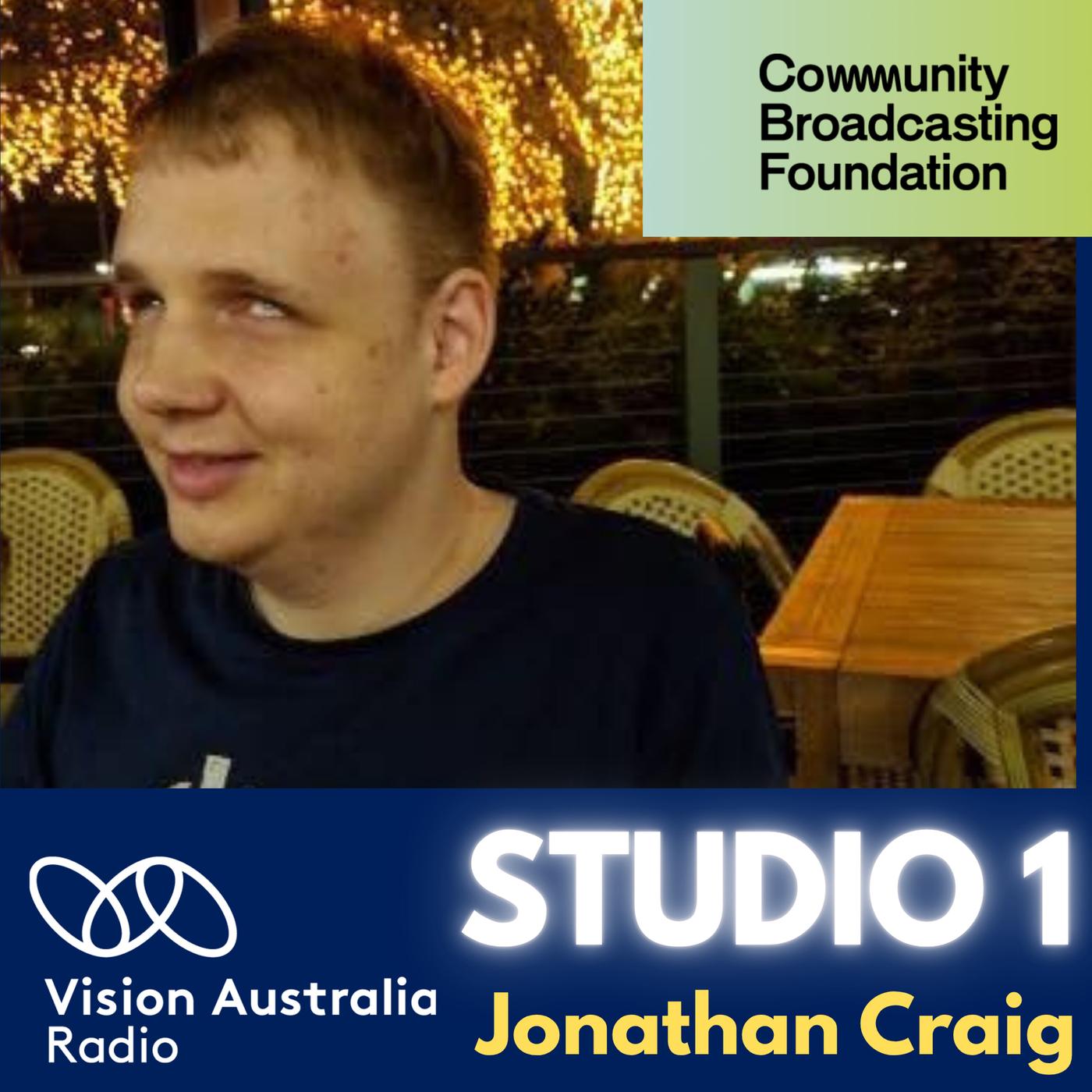
S3: This week, Jonathan Craig from vision 2020 shares his insights into the world of vision loss and the NDIS.
00:00:38
S2: Jonathan also tells us what exactly vision 2020 is.
00:00:42
S3: As we always say at this point, please do get in touch with this show whether you have any experience of the issues covered on this week's episode of Studio One, or if you think there's something we should be talking about. You never know. Your story and insight may help someone who's dealing with something similar.
00:00:58
S2: You can email us Studio One at vision australia.org. That's studio number one at vision australia.org.
00:01:04
S3: Or of course, you can drop us a note on our station's Facebook page by going to facebook.com/radio network.
00:01:13
S2: Well, Lizzie, um, some sad news.
00:01:17
S3: Yes, yes. Uh, it is with a heavy heart that I, uh, regret to inform our dear listeners that one of our beloved choir of angels and, uh, recent contributors to the show, Elise Lonsdale, did pass, uh, away on early Friday morning. And, uh, I know if you're anything like me and you knew Elise, you're probably in utter shock and disbelief at the news.
00:01:45
S4: It was very sudden as well.
00:01:47
S2: Um, you know, it's, uh, she was busily posting away, uh, on, you know, Facebook and all that sort of stuff. And then all of a sudden she's no longer with us.
00:01:56
S3: Yeah, indeed. And, and, uh, I had been texting with her back and forth. Uh, I was on a trip to Lake Creek, and we couldn't wait to share all of our exciting news throughout the week with each other. Of course, many of our listeners would know, at least from the interview that we did with her earlier in the year. Or maybe you knew her through her business Data Australasia or the other roles that she served with in big organizations like Visibility or Vision Australia. But I knew her to be a really good and kind friend that that's how I knew her. And I only knew her for six months, which is very brief compared to the time that a lot of other people knew her. But I am feeling the loss pretty keenly because we did become very close friends. And, um, she was such a bright light in our community indeed.
00:02:43
S2: And she contributed a lot to the show. And she will continue to contribute a lot to the show because we still have some of our, um, vox pops or choir of angels, uh, uh, audio that, um, we haven't got around to showing yet. So, um, yeah, she will live in a live, live on in her own little way. Um, for the next six or so months or so, at least as far as studio one goes.
00:03:06
S3: Indeed. Yes. I think she'll probably be on next week's show as well.
00:03:09
S2: Well, with that said, all that leaves us to do is to say, hello, Jonathan Craig, welcome to Studio One and how the hell are you?
00:03:17
S5: Good, good. How are you?
00:03:18
S2: I'm pretty good. And Lizzie is, of course, sitting there in the background listening to us nattering on. At the moment. It is a cold day in Adelaide. There's bright sunshine and all the heat seems to have escaped out into space. Whereabouts are you at the moment?
00:03:32
S5: Well, I'm in Brisbane at the moment. I actually. I live in Melbourne now, but I was born in Brisbane and have come back home to visit my parents and uh, so it's been beautiful and sunny and lovely in Brisbane the last few days until today when it's been pouring with rain.
00:03:51
S2: All right. So maybe you can tell us a little bit about yourself, because your eye condition or condition in general is a lot different to a lot of what our listeners might have, might have heard of.
00:04:01
S5: Yeah. Um, so I have a, uh, very rare genetic condition called osteoporosis pseudoglioma syndrome. Be thankful that you don't have to spell that. And that causes blindness and brittle bones as part of the same condition. And so, um, I am a, uh, a rare breed in Australia. I think that there's supposedly around 3000 of us in total in the world. Now. I think that, that that's a little bit probably underdiagnosed because there would be some people who are in developing countries, for example, who are not getting caught. But I think even if you even if you account for that, I'd still say it's a very, very rare genetic condition. And I think that, you know, there's maybe four of us in Australia that I know of anyway. And so the result of that, though, in practice that you would see is that I am a blind person and also a wheelchair user. And that's what people are kind of. That's what people visibly kind of encounter.
00:05:12
S2: Are you completely blind or.
00:05:14
S5: Yes, yes. And in fact, rare. You know, I rarely again, you know, don't even have light perception, which yeah, is somewhat unusual. Uh, lots of people can, can still see shadows when they've got the, the, the structure of the eye still in place. They can still see shadows and things.
00:05:32
S2: So the answer to um, what can you see would be um stuff all. Uh, yeah. Really. Yes. And so no worries.
00:05:39
S3: What really fascinates me and I, I got to think about this after we met at round table was being that you are totally blind and in a wheelchair, how do you navigate independently? Yeah. The rest of us use canes or guide dogs, but yeah. How do you do that?
00:05:53
S5: Yeah. Well, look, it's been a bit of a journey. Um, and so I use a cane also. And one of the big challenges has been finding the right cane. So, uh, you know, what I use is an ambush tech cane. If anyone knows what that is, some of your listeners will. Um, with a very thin handle and I can kind of hold the handle of the cane between my thumb and index finger, but also have part of my hand on the rim of the wheel of my wheelchair. And if you know what a wheelchair wheel looks like, there's the tire itself and there's like an outer rim on, on lot of wheelchair wheels, which is like a metal rim. And so I can have some fingers around the rim and help to steer. And I also like, I have use of my feet. So I often want to, if I, if I need to use one hand to get a wider arc on my cane, I can kind of, I can wheel with one hand and correct the natural veer that would result from that with my feet. But I like using my feet as like steering correction mechanisms so that, you know, that works in a lot of situations. And that would have been how people might have seen me Operate a lot in Adelaide at the Round Table conference, but um, in over long distance outdoor journeys, for example, I will still have somebody, uh, pilot me, as I like to say, and it's sort of similar to where, you know, somebody in on a long journey, you know, not some blind people will choose to have a sighted guide because it's just, it's easier and it's actually less stressful for the sighted person with them to just go into that sighted guide configuration. And so pushing a wheelchair then becomes sort of comparable to a sighted guide type situation.
00:07:43
S2: So tell us what is vision 2020? I know you work for them, but maybe you can give us a potted.
00:07:50
S5: Yeah. My employer, that's what they they are the people who pay me and keep me alive. And I'm really grateful to them because, uh, you know, uh, I, I've eaten a lot of tins of tuna in my life and, um, you know, it's good to have a bit of an upgrade. So but probably that's not what you care about. Um, and, and it's, you know, it's very important to me, but, uh, vision 2020 is the, uh, national peak body for the vision and eye health sector. And so our responsibility, I guess, is to advise government on issues to do with both preventative eye health. So that is making sure that people, uh, who need glasses, get glasses, people who need surgery or other ophthalmic treatment get it, but also independence and participation for people with permanent vision loss. So those are our two kind of parallel worlds that we play in. And vision 2020 is a member organization, but our members are not just random guys. Our members are organizations. So for example, one of our members is an organization you may have heard of called Vision Australia. And, uh, you know, all of the guide dogs, uh, organizations are members of us blind Citizens Australia is a member of US. So all of these, these organizations that, that, whose names should be familiar to vision impaired people listening to this program. Also members of us, however, are organizations whose names might be less familiar to you, like the Ophthalmology College, um, and the Australian Society of Ophthalmologists and, uh, some names that you might know of like Specsavers, for example, you know, as a member of us. And the benefit of that is we are a broad church and we can bring everybody together to discuss issues from every aspect of the patient journey. And so, as I said, we talk about a, you know, a couple of different things, the prevention, making sure that people don't lose their vision unnecessarily, but then also making sure that if somebody does lose their vision, or if somebody like myself is congenitally blind or visually impaired, then they get all of the support that they need.
00:10:15
S2: Has there been anything that sort of crossed your desk that you've, um, been rather surprised by? Um, I think anyone that has worked in the disability sector will always come across one of those cases.
00:10:25
S5: I think that, uh, probably the things that surprised me most are the cases where. And some of. Sometimes it's an unpleasant surprise where the cases where we find out about people getting lost in the system, you know, people being unable to get access to services. I spoke to a lovely elderly Polish lady a couple of months ago, and she was talking about this situation where, you know, she had been looking for access to a very simple talking clock. And, you know, she just had so much trouble with that whole process. And, you know, those are the unpleasant surprises that we get when the system doesn't always work for everyone perfectly. And, um, you know, that's what keeps me doing what I'm doing because there are lots of people out there and, you know, particularly older people who've lost their vision and have not had an easy, as easy a time as I have where I grew up with all of this, you know, they've come into this different world that is so unfamiliar to them and they're really having to adapt and learn. And that's probably been one of the biggest lessons that I've had, is to understand that everybody comes to this with a different perspective. Like, you know, I'm very, very happy, you know, in my blindness and very, very comfortable with it. And, and, you know, if somebody came to me and said, oh, I'm going to restore your eyesight, I'd say, please go away. But, you know, it's been really important for me to discover, you know, how many different, uh, points of view people have about it and to really accept and be comfortable with all of those different points of view and, and acknowledge the grief that people feel when they go through a change that they didn't, you know, volunteer for. But then also to say, well, you know, I acknowledge that grief, but you're, um, you know, your life is not going to be empty. Now, there is so much that remains ahead of you that you'll be able to, once you work through this grief, you'll be able to continue to do many of the things that you love doing.
00:12:43
S2: It's amazing how a lot of things that we as um, disabled people with a congenital disability take for granted is things that are just completely new for other people who have suggested only entered that. How would you describe your role with vision 2020?
00:12:58
S5: So I'm policy and advocacy manager And so, um, I, I guess, uh, head up our policy team. And that means that I have to kind of cross over all of the different, like areas that we work in and have a broad knowledge of them though, you know, are the, the, my awesome team are more expert in specific areas. You know, it's been, again, a kind of humbling thing where I started in a world that I was a little bit more familiar with, uh, working around advocacy to improve the NDIS to improve aged care. And, uh, you know, now I've moved into a world that I'm really not that familiar with, which is like, how well does an optometry appointment go and what could make it better? Why do people not go to an optometrist when they need to? You know, all of these questions that are in a different world to what I've been used to, you know, and, uh, it's been, yeah, it's, it's, it's again, been a learning experience to get across all of that because you have to understand it to some extent to, to lead the team.
00:14:10
S3: Well, I just found it interesting, uh, when you were doing your presentation, you said that as far as the NDIS population goes or people receiving NDIS support, vision impaired people were I mean, can you just remind us of the percentage? Again, it was very small.
00:14:25
S5: Around there around. So so they're around, uh, 2% of NDIS participants of the 750 000 NDIS participants have vision impairment as their primary disability. So that is a total of around 11,089. I think people have vision impairment as a primary disability on the NDIS. Now that, uh, I would caution you, doesn't include every I would say it doesn't include everyone with a vision impairment on the NDIS for lots of different reasons. So, for example, some people would know that when you get on the NDIS, you have to choose a primary disability. That is what is the disability that that affects you or harms you more. And this goes back to this question of multiple disabilities, because I refuse to play this game. They said, oh, well, does it is it more difficult to be in a wheelchair or more difficult to be blind? I said no to that. Um, and I said, you know, I, my condition is the specific name of my condition, osteoporosis pseudoglioma syndrome. Now, because there's no one on there, there's no data point for that. I'm listed in the box. That's other on the NDIS. But the point, the thing that's interesting about that, and the thing I was really trying to highlight in my presentation, is the way the assumptions that we make about the, the, what we look like as a cohort are not quite right. And that's been a surprise for me at vision 2020. For example, the number of people who are young like us and vision impaired and blind is quite a small number. The vast majority of people with a serious vision impairment in Australia are over the age of 65 and acquired their vision condition over the age of 65. So that means that they are not eligible for the NDIS. Really important because those people are getting support from the aged care system, which is not as widely reported on as the NDIS, but there's a whole bunch of people who, you know, who really need help, who are not actually eligible for the system. We sort of assume is going to help them. But the other important thing is, you know, in the context of all of these budgetary discussions around the NDIS, 2% 11,089 people. We are a drop in a drop in the ocean. We are the plankton inside. The drop in the drop in the ocean. The total amount, I think that is spent on people with vision loss as a primary disability in the NDIS. I think it would be like 300 million or under, I would say in a budget of, you know, reportedly 50 billion. Right. So I think that that's an important thing as well in this narrative and this conversation that we're having about, oh, disabled people are doing this and that, and the NDIS is so expensive. Well, uh, you know, setting all of that aside, blind or visually impaired people in the NDIS are not that expensive.
00:17:46
S2: Well, this is the, the, and one of the other things that I found interesting about what you had to say there really is why this is why we do have um fights with the Ndia is because no one really knows how to quite handle us. There's no specific specialist in vision impairment who processes our claims or anything like that. So every time we come across somebody new, we're completely new to them as well.
00:18:10
S5: Correct. Because they were most people at the Ndia who we encounter are never going to have encountered a blind or visually impaired person before. So you can see if you've experienced the repeated phenomena of, of, uh, you know, of having someone not understand you that well, you know, this is why and the agency is hesitant to hire specialists in such a rare disability because they would, you know, spend just an absolutely huge amount of money in flights to move them around constantly to people to do, you know, conversations with them. And it's just a, it's a very expensive way to do things in their view, when they know how few of us there are. So you need to be really creative when you're thinking about mechanisms to make sure that the agency does have the knowledge they need to deal with us in the right, in that in that moment when they meet us.
00:19:09
S2: And indeed, the Ndia is is doubling down on a lot of this. I mean, they, uh, the new eligibility criteria that they're proposing now does specify a single disability, for example. So I mean, where's that going to leave people? Other people.
00:19:22
S5: Well, yeah. So, so it's, that's a little bit complicated. So, um, they're changing things in, in multiple ways and, and multiple ways at the same time. Uh, so for example, what you will, um, you will now be able to, um, be eligible for access to the NDIS with multiple disabilities that meet the eligibility criteria. So what is going to happen over time is that as people are reassessed, They will get what's called an impairment notice. And that impairment notice will have information about what disabilities they met the criteria for. So for example, my, uh, if I got a reassessed and got a new impairment notice, it might say that I had, uh, blindness and brittle bones and it would list both of those disabilities. Whereas previously you would only ever allowed to be have one disability listed. Now what the, the other thing that they're changing at the same time, which is, I know this is really confusing and will be confusing for some people, but what they're changing is that you won't be able to get support for a disability that you have that doesn't meet the eligibility criteria for the NDIS. So say, for example, that I was diagnosed with ADHD. I would get the. I could meet the disability criteria for blindness and for brittle bones, but not for ADHD. And then as a result, I would not be able to get whatever. I don't know what it is, but an ADHD specific NDIS support, like a million fidget spinners of all different colors and sounds and things like that, which would be awesome. Um, and maybe I actually, I don't know, maybe I do have ADHD. Um, it's just made me really think about that. Um, but, um, you know, so, so what, what ultimately, ultimately they are tightening up what you can get supports for because there has been cases made previously where they've said, oh, my ADHD intersects with my blindness. And so, you know, I need my million fidget spinners, please. And that has, you know, that has been a successfully made case, you know, and there and I'm not saying whether this is right or wrong, by the way. I think it's really complicated, but yeah, they are. Um, you will in the future, you will only be able to get supports based on a disability which met the eligibility criteria. So I'll be able to get a cane because I'm blind, I'll be able to get a wheelchair because I have brittle bones and I won't be able to get an ADHD specific support, which might be a fidget spinner or might be something more relevant than an actual ADHD diagnosed person would be able to tell me. Does that make sense or is that helpful?
00:22:24
S3: Do you know if they're increasing the list of disabilities that won't be eligible anymore? Because that's the one thing I'm wondering is if they're going to start going well that no longer makes you eligible.
00:22:34
S5: Increasing the lists of disabilities that won't be eligible. Well, the answer to that question is interesting. In the current world, there are what's called access lists that include a big list of Of disabilities that allow you access to the NDIS. Those lists have a lot of different conditions on them, and one of them is if you are legally blind, you just automatically and someone can prove that and that you're going to be a life long, legally blind. An ophthalmology letter will get you automatic access to the NDIS. So that's cool. And then there's a bunch of other conditions which which even if you're not like legally blind yet, they assume that they're going to, uh, lead to serious visual impairment. And so even if you're not that visually impaired yet, you go on the NDIS to prep you for that time. And so there's a bunch of those conditions. Now, the reason I explain all of this is because those lists are actually being, uh, going to be abolished in the reforms. The argument for why that is, is because there has been an assumption that if a condition is on the list, then you get on, and if a condition is not on the list, then you don't get on. So, for example, there's lots of vision conditions that were not on the list, and that has led to people being rejected from the NDIS because their condition wasn't on the list. But that was kind of random because the impact of their condition was just as much as another condition that was. So they're saying the government that is that if we remove the access lists, it might be a good thing because it will stop people from thinking about a condition and the name of the condition, and whether that name of that condition is on the list. And start people thinking about how impacted are you by whatever condition that you have. And that's the basis on which you get onto the NDIS. Now, the other way that this might cut is that it now means that somebody who is legally blind is not automatically eligible for the NDIS. So it is possible that if you could somehow, uh, make an argument that someone's legal blindness was not having a great impact on their life, then they might be cut out of the NDIS. Now, I would say that's very unlikely to happen, but it's an interesting thought experiment. Does that help? Lizzie, I feel like the questions are all just really long and like, have a lot of detail, but I don't really know how to explain it in any shorter period of time.
00:25:26
S2: I think the problem is, is that there's a lot of, uh, news coming out at the moment and we're sort of all being bombarded by it. So yeah, that's really been been the problem there. And, uh, I think we're conditioned also not to necessarily listen to the government when they say, oh, but it'll be all, be all be fine because it very rarely is.
00:25:45
S5: Well, it's our job at vision 2020 to think about the ways in which it may or may not be fine, and to try and get ahead of those. And so this is the the kind of thing that that me and my team are doing is to trying to, to try to be on top of the potential risks and, and unintended consequences of a new policy that, that they try to introduce. And, you know, we, we do that sometimes well and sometimes not well, but it's, it's, um, you know, I guess I just acknowledge as well, like the yeah, bombarded is a good word. And I really acknowledge the mental health impact of this on people with disability, you know, and so, uh, sometimes these discussions about details and stuff are, can get a bit prolonged, but I think it can be important to say what is and isn't happening as well.
00:26:35
S2: Indeed. Um, so we've talked about some of the more, um, surprising and negative things, for example, so people falling through the, through the system. Is there anything ever popped up, um, that you've in your time at, uh, vision 2020 that you've gone, oh my God, how terrific.
00:26:52
S5: Oh, yeah. There's been been heaps of things. I'll tell you one big story about a big victory that I was peripherally involved in. But that I think was, you know, something that I'm proud of. And I'll tell you a very small story. Um, the big story is probably, you know, one of the biggest wins that, that I've seen in my time at vision 2020. And, and, uh, I was kind of a witness to this and was kind of on the edges of it, but it was, it was a great example of collaboration. Basically, vision 2020, along with a coalition of our member organizations, were able to secure $12 million for assistive technology in the Indo-Pacific. So that's going to a few countries in the Indo-Pacific. And what that will include is things like glasses and white canes for children. Basically, it will be delivered through schools. People will be screened for hearing and vision problems and things like that. And also, you know, will be tested if they if they benefit from a wheelchair or something like that. And, um, then they will get access to the assistive technology and to be involved in it was a whole group of us who were all working together to get this done and to really take advantage of a particular moment where we felt felt that the government was going to be keen and eager and to jump on it. And then, uh, you know, a bit of a smaller story, which doesn't have a, you know, a big dollar figure attached to it, but I think is really important as well. There was been a transition to a new aged care program called the new Support at Home program recently for people who are older. And they they may need some help, but they don't want to go into a nursing home or a retirement accommodation or anything like that. They still want to remain in their own home. So in the transition to that new program, they developed a new kind of list of assistive technology that people would be able to access with government subsidies in that program. And they initially accidentally didn't include most of the vision assistive technology like canes and magnifiers and Braille devices and all of those kinds of things that are most commonly used by vision impaired people. Um, and so this was, you know, this was something that I was much more significantly involved in. And it mostly happened behind the scenes. You know, there was not a public, you know, media story or anything about it. But but we went to the department and we said, like, we and by we, I mean, uh, many vision 2020 members, you know, it wasn't just wasn't just us. It was us and a coordinated group of, of vision 2020 members, which included, of course, Vision Australia played a big part in this. And we went to the department and we said, look, this is an accidental omission. We we think we know what's happened. You know, here's what we think does need to be included. And this is why, because there's no other way for people to access these devices. And the department listened to us and they said, yes, we're sorry. This was a this was a very random accident and we're going to fix it. And the minister is going to sign off on that change. And then that's what happened. So, you know, as a result of that, people can now older people who need it, which is, as I said before, the majority of people with a vision impairment, they can now access these devices in the new support at home program. And that's really something that I was quite involved in and I do feel very proud of. And both of those examples are kind of show the importance of like vision 2020 as an organization to, to be a coordinator, to get everybody together and on the same page and in the same room often. And it also shows the importance of like teamwork generally, like it's never just one person who's standing up and being the hero of some thing, you know, it's always everything that I do and that everyone in this who's successful in politics and policy ever does is, is about teamwork and is about working together to get something done.
00:31:13
S2: Jonathan Craig, thank you for joining us. It has been a pleasure.
00:31:17
S5: Thank you so much for having me. It's been great to to talk and I'm sorry for my very long answers.
00:31:22
S2: That's a wrap for this week. Big thank you to Jonathan and a special thank you to Vision Australia Radio Adelaide manager Pam Green.
00:31:29
S3: And of course, a big thanks to you for listening. That includes our listeners on the Reading Radio Network. Or have you maybe listening? You can find a podcast of this program, plus some extra content from time to time on Apple, Spotify, Google, or your favorite podcast platform.
00:31:45
S2: Next week, once more, we're packing our bags and traveling the world.
00:31:49
S3: Our choir of angels unloads on travelling with a disability.
00:31:53
S2: But between now and then, please do get in touch with the program. Whether you have experience of any of the issues covered on this week's episode of Studio One, or if you think there's something we should be talking about. You never know. Your story and insight may help somebody else who is dealing with something similar.
00:32:07
S3: You can contact us via email at studio 1@australia.org. That's studio number one at vision australia.org. Or of course, you can find us on Facebook or Instagram by searching for VA Radio Network. We want to hear from you.
00:32:23
S2: Bye for now.
00:32:24
S1: Studio one was produced in the Adelaide Studios of Vision Australia Radio. This show was made possible with the help of the Community Broadcasting Foundation. Find out more@kbf.org.au.
