
ဤအပိုင်းအကြောင်း
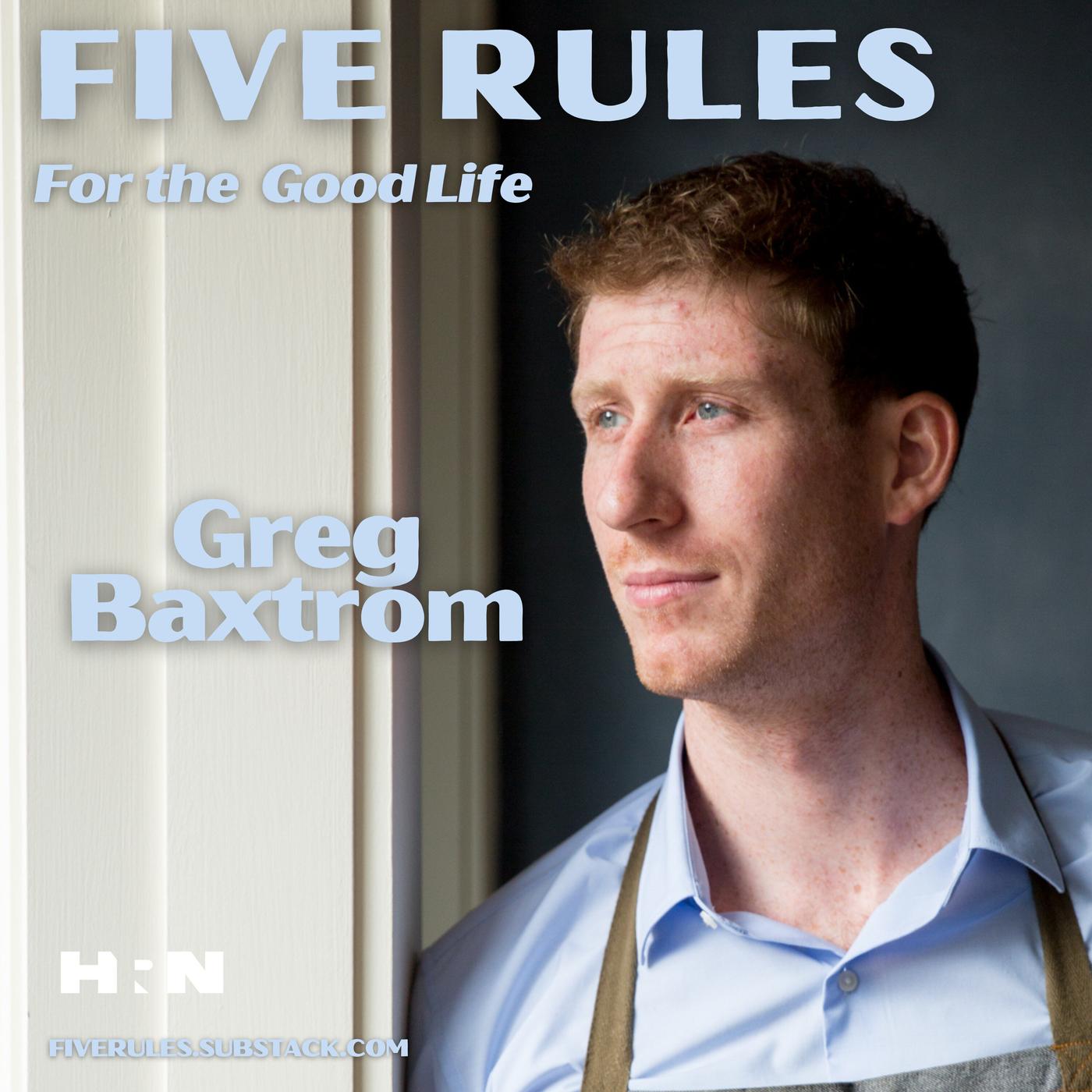
Greg's Five Rules for Getting Your Life Back on Track
Greg Baxtrom is the chef and owner of 5 Acres in Rockefeller Center and the author of Nothing Matters but Delicious: A Radically Honest Cookbook about food, alcoholism, recovery, and rebuilding a life. In this deeply personal conversation, Greg shares his Five Rules for Getting Your Life Back on Track. Together, we talk about the long road to sobriety, the daily work of becoming reliable again, and how cooking helped him begin accumulating the days that eventually became a new life.
These conversations are important because no one should have to struggle alone. Hearing Greg speak so openly about his lowest moments, the people who helped him, and the work he continues to do offers more than hope—it reveals a path forward. Recovery does not happen all at once, and it does not always move in a straight line. Sometimes it begins with telling the truth, asking for help, or simply doing the one thing you said you would do that day. Wherever you are in that process, be patient and kind to yourself. You are not alone, and change is possible.
Introduction
Hello and welcome to Five Rules for the Good Life. I’m your host, Darin Bresnitz. Today, I’m chatting with Greg Baxtrom, the chef and owner at Five Acres in Rockefeller Center, and the author of Nothing Matters but Delicious, a radically honest cookbook, out now on 10 Speed Press. He’s here to share his five rules for getting your life back on track. He talks about the importance of telling the truth, the necessity of building a routine you can actually keep, and that by being patient and kind to yourself is the key to real change. This conversation, along with his cookbook, are deep explorations of Greg’s struggle with alcoholism, his journey through recovery, and how he’s put his life back together. It is a great conversation for anyone who is going through similar struggles or for anyone looking for a insight to understand those who are. So let’s get into the rules here on HRN. Greg, so good to see you.
Opening
Congratulations on the book and Five Acres. Thanks for making time for the show. Yeah, thanks for having me. I appreciate it. I love the book and it starts off with a very powerful introduction where you talk about living your life in two unequal parts. How much has the concept of balance played a part in your life? I mean, there was none until recently. Sure. Even now, I’m not that great at it. I mean, I’m pretty great at being sober. I don’t have near misses and stuff, but I’m probably on day 55 straight of no days off. Right. Still a work in progress. I take things like going to bed at a specific time. I try to be in bed by 10 o’clock every day. It’s pretty good. I try to wake up and have a coffee. I still have some non-negotiables, but there are ones that get tossed out the window still. I’ll go through a phase of like, now I’m vegan and I’m starting off with a five-day fast and I’m signing up for my trainer.
Yeah. So that lasts like four days. And right now I haven’t really been going to the gym because I’ve been coming here every day to just kind of make this new thing land well and represent what we try to do. Yeah. You know, I prioritize my family more. I also just go to Chicago more. I wouldn’t even consider going for a holiday in the past. And now I try to go home for birthdays. I prioritize that a little bit more. A cookbook like yours, nothing matters but delicious, usually comes out as a celebratory, usually four or five-year mark of a restaurant, which was Olmstead. You closed the restaurant last year. The book just came out and a lot of what delayed the book was life happening around it. How do you feel about its release now? It was hard for me to even write the book in the first place. I eventually became acquainted and friendly with Joshua David Stein. And I had other avenues to go down.
There were big publishers that wanted a great big Olmstead book. They would make it as beautiful as I wanted and as cheffy as I wanted. Yeah. I was basically told it wouldn’t sell but it would look pretty. Sure. As vain and egotistical as I am to have a nice pretty book, I really didn’t want to do something that from the get-go wouldn’t be even attempt to be successful. I’m dyslexic and I have ADHD. It took Josh to literally lay on my couch while I just talked and cooked and would just type as I was doing stuff. Yeah. I wanted it to be accessible. Yes, there’s some Olmstead stuff in there. A lot of the recipes are when I went to rehab the second time because the first time it didn’t really take. There was no getting another shot. I woke up at eight. I walked my dog, got my juice.
Right. I made my coffee and I went to the farmer’s market as often as I could to make just enough food for myself that night. I was just accumulating days. So a lot of the recipes in the book are just what I cooked to get to 90 days. Many people would not open a cookbook so honestly with tales of their own addictions and their lows battling alcoholism, let alone shape the recipes and stories within these pages. Why did you want this to be a fundamental of the book which you call a radically honest cookbook? I don’t want bipolar sober chef on my tombstone. I don’t want to be remembered for that. I dedicated 20-25 years to doing this thing. I still love it, but I unraveled.
I wanted to be on solid ground again through instructions from my doctors, psychiatrists and psychologists. I had been documenting my time in rehab the first time and then the second time. I have a first-hand 20-30 page document of basically what it was like getting sober that I’ve never really done anything with and I just took a chunk of it out and I decided to put that into the book. I wanted to move on. I’m not afraid of doing the work of getting sober, becoming reliable again. I’m all for that. I just want to set the tone again. Hopefully, I can get back to, okay, Greg’s back to being reliable and talented. The fact that you are willing to put in the work, the fact that you have the opportunity to do so, the fact that you’ve been so honest about it makes me so excited for you to share your five rules for getting your life back on track.
Rule One: Tell the Truth
In the introduction, you lean into what it was like to go home into Chicago, to having to start lying about what you were doing with your life and how you’re spending your time. Yeah. Your first rule talks about the importance of moving in the other direction. What’s your rule number one? You gotta just tell the truth. At that point, I knew I was a mess and I knew I was a drunk and I was miserable and lonely and sad and suicidal, but no one really knew that. People just saw that I was drinking more. Yeah. I would hide in the employee bathroom and drink. I felt like I was still involved in there and around the people that I liked and admired and so when I went to Chicago, I think my parents just sort of and my family assumed I was stressed and drinking. Eventually, I got a DUI and my father came and picked me up. I jumped out of the moving car. Wow.
I’m named after my dad’s brother who got hit by a drunk driver. Yeah. I was so uncomfortable and miserable. Sure. The next day, my sister finds me and she’s like, look, I don’t think this is just run-of-the-mill hereditary alcoholism. I think there’s something else there. I think you should go to the hospital, not just straight to rehab again. That was the first time that I felt hope. I was miserable. I didn’t want to be this way. I knew there was a problem from the get-go and I didn’t want it. That doctor and a team of people were like, you’re on all the wrong medication. Basically, we believe you’re bipolar and we need to put you on all new medication. Yeah. From there, once I was on all the new medication, then I was transferred to a different type of rehab.
The property was so big, they didn’t even care if you left to go camping for a couple of days because you weren’t going to go anywhere. There was just thousands of acres. I got to be out in nature while accumulating those first couple of days being sober. With that opening up, there was a woman in my life who really took care of me, who happened to be a nurse. Then, there was also my sister who’s a doctor. Without them, for sure, I would not be here right now.
Rule Two: Accept That You Don’t Have All the Answers
Going through all of that, having to look inwards sometimes can be a very hard awakening, but it does lead you to accept that you don’t have this, which is your rule number two. My rule number two is to accept that you don’t have all the answers. I am a reliable person when I’m not a drunk. My intentions are good. In the very beginning, you’re like, you just need to be 30 days sober, and then you’ll be able to recalibrate and go back to a beer a day. Eventually, you break down. You go, okay, it’s three months, and then it’s six months, and then it’s a year. It’s a long time before you go, okay, fine. I get it. I won’t be able to drink again. I went to Smart Recovery, Wellbriety, NA, AA. I just wanted to be fixed, and I was willing to do it.
Rule Three: Get Professional Help
The more you can be honest and open up, some people, how they’re communicating to you is going to click. Once you’ve accepted that you don’t have all the answers and you start listening to other people in your life and build a support system, that’s really important on a personal level. At the end of the day, your rule number three talks about looking to these other types of people for guidance. What’s your third rule? Getting professional help. The people in my life tried their best. Everybody was for me going to AA meetings, for me getting a psychiatrist, but the sadness in me was not going away, though. I didn’t want to exist anymore. It required consistent medical observation. Even when you’re opening up about having a drinking problem or being a little depressed, I don’t want my parents to know that. Sure. But once there was a medical team, many doctors and psychiatrists and therapy, those feelings go away. What sucks is that even after being sober for three years and medicated, I don’t really keep track of that.
I think it’s going on six years now. Not that long ago, I had to go back to the hospital for having some pretty dark thoughts, and I was in the hospital for two weeks. I’m sorry.
Rule Four: Build a Routine
There’s a little bit of rolling with the punches even when you get the professional help. A lot of the times when you’re staring down big life changes, knowing that everything is going to be different, it can be overwhelming, but your rule number four talks about how gradual steps make the biggest changes. What’s your fourth rule? Building a routine. One is just waking up around the same time, having good hygiene, brushing your teeth, taking a shower, making a coffee. For me, I would go to the farmer’s market or go to the grocery store, and I would buy enough just for the day so that way I had something to do the next day. I signed back up for guitar lessons. I could still only play like two songs. Really tried to invest in myself. After I had accumulated 90 days of sobriety, then it was about building a routine so that way the people in my life saw that I wasn’t fragile because everybody is thinking you’re very fragile.
Sure. Half the people in my life are like, you’re going to need to change careers. How will you go into a restaurant that you own or that you work at that has liquor on a shelf? New approaches, new routines. You’re just talking to the wrong person if you’re saying just change professions. It is a non-negotiable. I remember I did a commercial with Gordon Ramsay, and it was nine o’clock in the morning, and I was drinking cooking brandy in the basement to take the edge off. The routine part of it at the restaurant was that if I was in the basement, in that area where the brandy was, that people didn’t need to start looking at the cameras or send somebody over there. Of course. I just needed to be present.
Maybe I didn’t need to do 14-hour days right away, just being reliable for four hours or five hours. I do have the benefit of I own the restaurant. Plus, we were in COVID, so we were selling barbecue in the backyard while running a soup kitchen on one side, while running a high-end bakery on the other side, while doing a pop-up for black chefs across the street. When I was a drunk, I liked duck, and I would butcher the duck. I started to become the guy where I would tell the team, I got the duck today, and I would take it out. Then I would just vanish, or I’d be in the bathroom, and then they would have to butcher it, or they would go put it away or something.
The routine was just if I said I was going to do something, I did it. Even if it was one thing, if it was mop the floor or clean up the garden or something, if I said I was going to do something, I had to do it. You’ve been so honest about your journey, the time it’s taken, 30 days, 90 days, years.
Rule Five: Be Patient With Yourself
Your fifth and final rule really does talk about being kind to yourself and allowing for this. What’s your rule number five? You got to be patient with yourself, with how people act around you. Fortunately, people gave me a lot of grace. Beautiful. My staff didn’t really leave. I had one guy that worked for me for six years. He had to help carry me out of the office and sneak me out the back door. He didn’t move on until everything was set, and I was good. Wow. I owe that guy everything, and he just helped consult with some drinks we were doing here. There are definitely some bridges burned, and I’ve tried to make attempts at rectifying the ones that I’m aware about, or the ones I have access to. Some people are there for it, and some people could care less. Yeah. I remember I was over a year sober, and I was on Channel 9 News for the Super Bowl. I posted that I was on it.
You know, the first comment is like, oh, this guy’s still slurring his words. He must still be a drunk. Huh. That sucked. I can only imagine. Maybe that guy moved to New York to work for me, and when I got there, I was a drunk. He didn’t like his experience. I was a disappointment. Right. What’s important to me is that I’m dependable and reliable. I try to be a nice guy. I’m not always. In my position, I would rather be dependable for everybody that they can rely on me, and that’s what I work on. Greg, deeply appreciate you sharing so much about your life. The book, Nothing Matters But Delicious, is out now.
Closing
If people want to get it, if people want to check out Five Acres, if people want to see what you have going on, where can they go? If you come to Five Acres, and you buy the book, it comes with a little spice jar, so that’s fancy. You can order it through Kitchen Arts and Letters or Amazon or a bunch of publishers. I know Barnes and Nobles is carrying it. It’s on our website. There’s links there if that helps. Thanks so much for taking the time. Thanks so much for sharing so much. I can’t wait to swing back into New York and pop up to Rockefeller Center. Let me know. Give me a heads up.
See Privacy Policy at https://art19.com/privacy and California Privacy Notice at https://art19.com/privacy#do-not-sell-my-info.