
MENGENAI EPISOD INI

REUTERS/Evan Vucci
The Loyalty Machine Is Eating Its Own
A Rally Without the Usual Reward
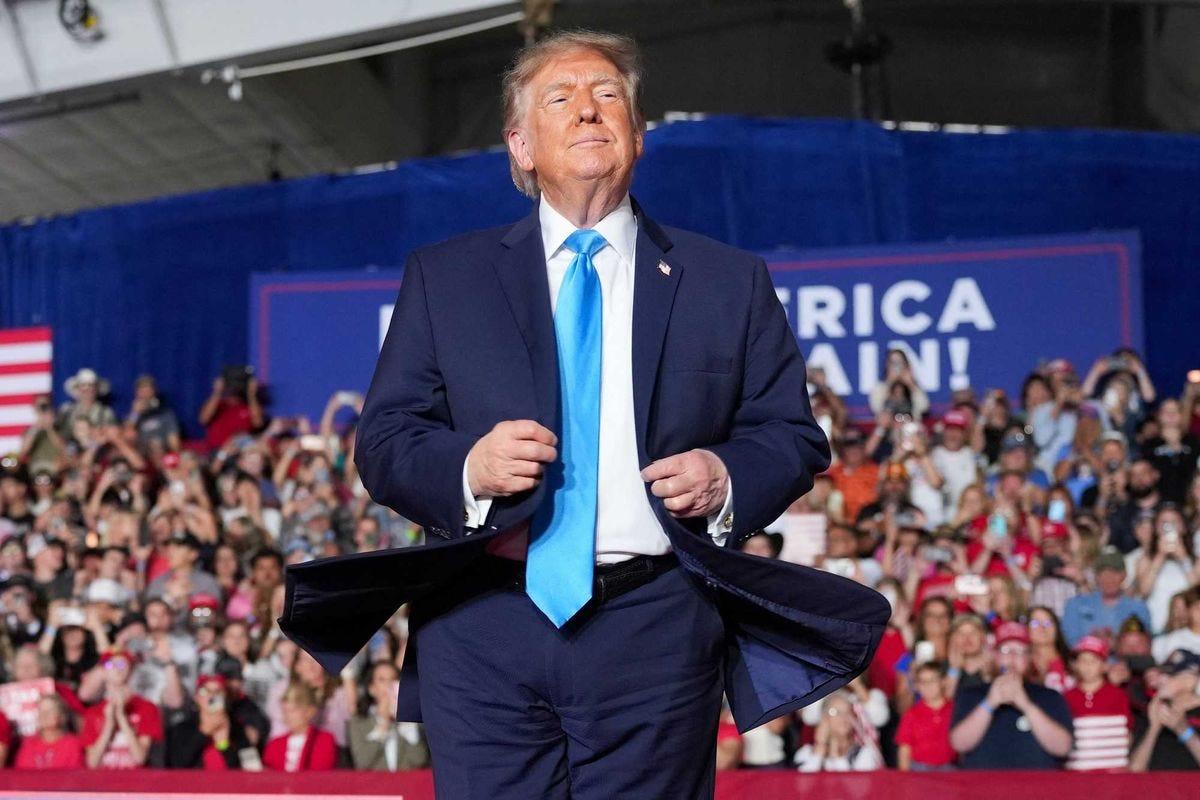
Donald Trump spoke for 105 minutes at a Dallas convention designed to energize Republicans before the midterms. Fox News carried the address in full, yet its average audience between 9 and 11 p.m. was roughly 2.5 million—about normal for the network’s prime-time programming. Empty seats and muted crowd reactions supplied the more visible evidence that Trump’s promised surge of enthusiasm had not materialized.
That is the context. The political story is not simply that a rally “flopped.” It is that a movement built around permanent spectacle is discovering that compulsory attention cannot manufacture momentum indefinitely.
Help fuel the work. Independent analysis doesn’t fund itself:☕ Buy us a coffee
The White House Wants Obedience, Not Coverage
The clearest statement of power came from Trump trade adviser Peter Navarro. After Fox News fired Maria Bartiromo, Navarro argued that CEO Suzanne Scott should have apologized when contacted by the White House. The alleged offense was not merely unfavorable coverage: Bartiromo had shared a corporate memo concerning the network’s refusal to perpetuate Trump’s false claim that the 2020 election was stolen.
Navarro’s complaint exposes the governing expectation. A television network identified with the Republican coalition is supposed to behave as an auxiliary of presidential power. Editorial limits become “disrespectful to the president.” A corporate decision becomes something the White House expects to review, challenge and reverse through pressure.
That is not confusion about media relations. It is an assertion that proximity to the administration creates a duty of submission.
Fox Helped Build the Trap
Fox News is not a powerless target caught between politics and journalism. It possesses a national platform, a loyal audience and immense influence over Republican political identity. Navarro’s attack matters precisely because Fox helped create an audience for whom loyalty to Trump can supersede loyalty to the network.
He even described the bargain openly: Fox will amplify inflammatory stories about transgender people and immigrants, but it maintains certain “guardrails,” including around election claims. The revealing point is not that Fox has standards. It is how selective those standards appear within Navarro’s own account. A network may feed its viewers scapegoats and grievance, then discover that the same political machinery rejects any boundary placed around its preferred leader.
Fox retains institutional power. But it spent years strengthening a faction that now treats editorial independence—even narrowly exercised—as betrayal.
A Ratings Story Conceals a Power Struggle
The source frames much of the episode through embarrassment: average ratings, empty seats, weak applause and foreign political setbacks. Those details show diminished command of attention, but celebrity metrics can obscure the more consequential struggle.
The question is not whether Trump remains a “marquee draw.” It is whether Republican institutions, aligned media companies and administration officials still organize themselves around his personal authority. Navarro’s comments suggest that the answer remains yes: when Fox declines to repeat an election falsehood, the administration’s response is pressure, denunciation and an attempt to turn the network’s own audience against it.
A disappointing audience does not erase that machinery. It may make the machinery more punitive as spectacle becomes less reliable.
Scapegoating as Programming Strategy
Navarro’s remarks also reveal the hierarchy of acceptable deception. He praised Fox for coverage portraying transgender people and undocumented immigrants as sources of menace, then faulted the network for drawing a line around “election integrity.” We cannot infer the network’s entire editorial strategy from one adviser’s characterization. But his approval makes the political incentive plain: weaker groups remain useful targets because attacking them reinforces the coalition without challenging the leader.
This is how misdirection operates. The people with actual authority—the president, his administration and the media executives who decide what millions see—fight over control of the narrative while immigrants and transgender people are offered as recurring objects of fear. Their relative lack of power is not incidental. It is what makes them convenient.
When Propaganda Stops Producing Enthusiasm
The larger pattern is a governing coalition trying to convert media attention into personal obedience while redirecting public frustration toward vulnerable groups. Fox supplied much of the infrastructure. Trump supplied the grievance politics. Administration officials now police the boundary between useful amplification and intolerable dissent.
The thin crowd response and ordinary ratings may indicate fatigue, but fatigue is not accountability. A political spectacle can lose novelty while the institutions shaped around it continue enforcing loyalty, rewarding scapegoating and treating factual limits as insubordination. The system’s error is not that the show has become boring. It is that so much power was reorganized around the performer in the first place.
Thanks to Alter Net
Source: Awkward silence: Trump-a-Palooza a ratings flop for Fox News
Systemic Error is a reader-supported publication. To receive new posts and support my work, consider becoming a free or paid subscriber.
We warned them.We told them.We shouted from the rooftops.We plead.We begged.They didn’t listen.Now, we all will suffer.Y’all know what to do, right?VOTE BLUE! 💙Vote as if your life — nay, our country — depend on it.Because, this time, and every time, it does.
This is a public episode. If you'd like to discuss this with other subscribers or get access to bonus episodes, visit paulstsmith.substack.com/subscribe