

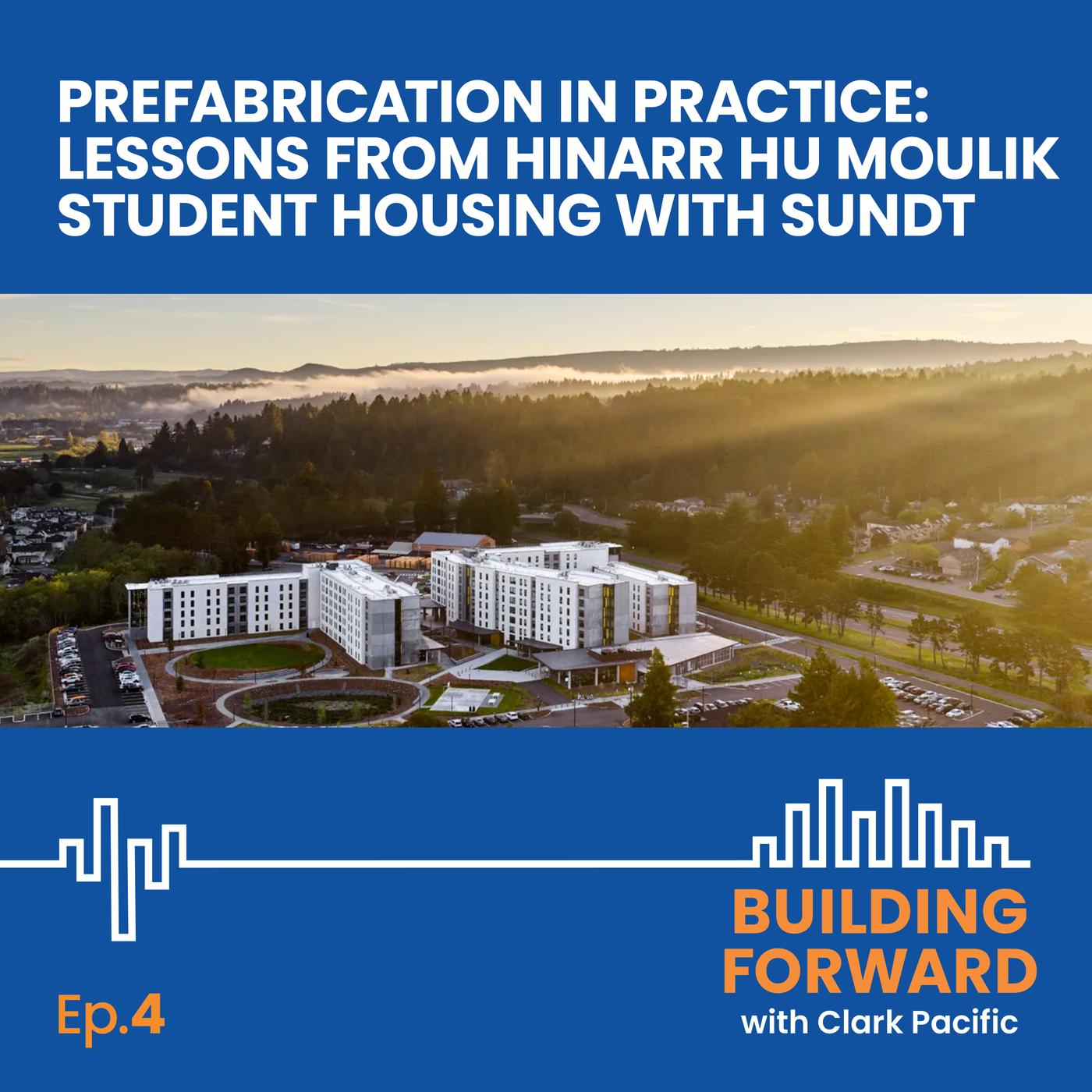
Doug Bevier: to another episode of Building Forward with Clark Pacific, the podcast where we explore what's next in construction and how we get there. Today, I'm excited have my friend Dylan Rogers, project director at Sundt, joining us. Dylan, you to give a little bit of a background before we get started?
Dylan Rogers: ⁓ Dylan Rogers with Sundt Construction, as Doug already said, project director, focus on higher education in Northern California, progressive design, build type projects. And and I had a great experience up at Cal Poly Humboldt and that's what we're here to talk about.
Doug Bevier: Yeah, with mean, the student housing demand has has continued to be pretty high in California, which is great. But I to just with maybe a high level question, Dylan, of why do you think is becoming more of a strategy with these student housing projects?
Dylan Rogers: I think what makes student housing, especially. What's the word I'm looking for makes sense with with prefabrication is there's a lot of repetitiveness. Especially on the facades, if you plan it right. And, you know, a of projects, there's a shortage of resources, labor resources, especially some remote areas. And being able to offsite potentially 50,000 man hours or whatever really can help reduce overall project costs and risks.
Doug Bevier: Yeah, I think that was one of the main strategies for the specifically for the Cal Poly, Cal Poly Humboldt student housing. And I believe that was your first time using a precast on a student housing project or am I mistaken?
Dylan Rogers: That's that's correct. mean, we we have used other like products higher education products, specifically the Sac State science building. We had a Clark product on there, but the infinite facade with student housing, that was a first for us for sure. And really met lot of the objectives that we were trying to accomplish when it came to the facade system, specifically up at Cal Poly Humble. being that it was almost six hours away from the metropolitan area, know, workers had to travel a long way to get there. And of our very early strategies was to offsite as much work as possible, labor as possible. And we successful with that with your product.
Doug Bevier: The design build delivery on that, think really allowed you guys a little bit of flexibility of when you brought key trade subcontractors onto the project. One thing I appreciated about the Cal Poly Humble was working with you and SCB, the designers on the project, I mean, at the schematic level. I assume there's obviously there's risk associated with bringing in key subs before a lot of the design has been influenced, so to say. what ⁓ kind of what was your strategy on doing that? And you have recommendations or trade-offs because what happened on the job?
Dylan Rogers: Yeah, I don't know how much I want to divulge of our secrets sauce Essentially, as soon as we had the building massing pretty much locked in, mean, we knew bringing on a basically right around 70 % schematic design, we developed a just panelized exterior facade system. And we left it wide open for the market to come back to us. we basically said, look, there's probably going to be around when all is said and is one hundred and sixty thousand square feet of skin. Here's basically a section of, you know, the skin intent that we want, which was like the window, the vent, the this, the that, you know, a little bit of call it design stuff in there. And so we just went out to the market and we got four turnkey design build proposals back. Three of them were more on the framing side, you know, like using a metal stud system. They all had different types of finishes on them. And then Clark was the only one where we got a precast system. There were lot of to going. to Clark's system, especially this being an OSFM reviewed project where you've got to have your ULs in line. You've got to make sure they're easy to inspect. And so you say there's taken on risk. I looked at this process as reducing risk and really making sure we understood all of the intricacies that went play. And we evaluated all four proposals I think, you know, teaming up with Clark Pacific really was about trust and moving forward ⁓ working that opinion of cost down throughout design. And we can talk about that if you want. ⁓ So.
Doug Bevier: Yeah, I mean, I was going to point out like one of the things that I'll never forget is the, you know, the conversations we were having early on about how this is going to be built on trust. ⁓ I I go into offices all the time and I preach how important it is to bring us in early to unleash the real value. Because no matter the product, every manufacturer has these key parameters that affect their price. And it can be completely different even from one precaster to another precaster, needless to say, one panalized system provider to another panalized system provider.
Dylan Rogers: you
Doug Bevier: once a designer and architect gets excited about their vision, it's really hard to work backwards. So having that upfront seat the table is key. So you can iterate kind of congruently with the, with the design team. And we, ⁓ know, I talk about it as a target value price, right? Hey, this is what do we think we're going to be? As long as we hit that, we know we'll continue to move forward, but also knowing that there's consequences if we don't hit that it's like, you You can't really go backwards in the design schedule. So there is a lot of trust that needs to get built up. So maybe could you talk about that process and experience that you had there?
Dylan Rogers: sure. I remember where I was. I was like, Doug, there's a lot on the line here and there's a lot of unknowns. you know, we have an opportunity to really start, you know, the beginning of not be we've worked with Clark Pacific in the past, but, you know, there was an opportunity to continue to do this on a lot of future student housing projects.
Doug Bevier: Yeah.
Dylan Rogers: And that trust works both ways. You're like, look, I know I can work this number down, but you got to work with me. And so that's where I came into play with SCB, who is a fantastic who's who's understands like, if we make a few minor changes to the footprint, and one of them was like the returns, you know, we had these bump outs, you know, we're like, ⁓ even bedrooms or the the living room, something popped out. We wanted them like three feet, but you're like, Hey, if there's a way to get this down to eight, whatever it was, we ended up finding a very cost effective solution. Treat the building footprint. We were early enough in design, which contributed to a lot of savings there. And then some of the other things that we were able to massage over the course of the design iterations is the parapets and, really listening to your team say, Hey, if you go this approach, whether it was some type of structure and post or whatever it was that we needed to, if we were under four feet or something, we could save more costs. So it's just that back and forth transparency, meeting every week and working together to try to, you know, try to beat the budget.
Doug Bevier: Yeah, I mean, think it worked really well, too. I mean, mentioned SCB. What was great is I had worked with SCB on or four residential projects leading up to that. Although it was a different team at that office, they had a good understanding of our system, which definitely helped build their trust a little bit, think, in the beginning. you know, little story here. I was in project management and then I helped develop our product, Infinite Facade, before I came over into pre-construction. And this was first project. And so I remember.
Dylan Rogers: Hmm
Doug Bevier: still remember getting the call from you. It was like a Friday before I ⁓ for a family party and you were saying, you're going to be awarded the job. And hand was shaking because I so much adrenaline. And I vividly remember calling boss when I got off the line. was like, I am never going back to operations. This is the best Yeah, ⁓ so that, ⁓ I now. ⁓
Dylan Rogers: Yeah, you're a deal junkie. Ha
Doug Bevier: So that was awesome. But I do remember, you know, the, think really works well too is how you do have to have a lot of trust both, both ways, right? Saying, Hey, I know Dylan and son, you're not going to take advantage of me if I expose, you know, everything and vice versa. so I think what we we tried to do is this pricing spreadsheets where every kind of milestone or half milestone we were looking at, what's making the cost go up? What's making the cost go down and have good active conversation, but be transparent with those real costs. And I know there was times where our costs got a little high and the friction was there and then we got it a little bit low. And I think at the end of the day, we pretty much nailed the target value price. I mean, within a point or two of where we needed to be from the original onset before it really developed, was, for me, was proud of that, but it also took a lot of give and take, I think for everybody at the table, but at the end of the day, it was the best solution for the project.
Dylan Rogers: mean, I at the end of design and ⁓ as heading into construction and we finally had a contract, you know, a construction with you guys, we had a pre-con contract. We hit that ⁓ and it took you know, ⁓ it took the client decisions, the architect and everybody, but we got there a team without reducing the, the visual impact of the building. I still think we got a fantastic product out there that looks amazing. And a lot of those decisions don't always impact what you see. And so there can be a lot of, I don't even like to say ⁓ value engineering, but you know, ⁓ there's a of things within the Clark system that you can find some of these efficiencies as long as the team's willing to
Doug Bevier: Yeah, that's what saying.
Dylan Rogers: you know, and engineer the maintenance of the
Doug Bevier: What, you know, after going through this whole experience with, a job of this scale with this type of a system, what advice would you give contractors, if you can share that, or architects thinking about using prefabrication for the first
Dylan Rogers: Yeah, will tell you what went really well for this. One, brought you on board middle and a schematic design. We then held either one or two meetings a week. think one was more like a PM kind of budget cost meeting. And then the other one was like full blown coordination with our BIM team, our structural engineer and the architect to just coordinate. the design. mean, I want to say by the end of DVDs that we were fully coordinated. mean, hit it hard and early and you're just going to be keyed up for success. I think one of the craziest things about that whole project, you are Pacific provided a schedule with their proposal that would have been like Mayish. Now, maybe it was like summer of 2023 where you're like, oh, we're going to have panels out there. It was like 20 months later, May of 2024, 2020, whatever, whatever it was. We hit the date within like a week and the plan just came together. It was awesome. So and then we showed up and slammed it out in the field and away we went.
Doug Bevier: Yeah, what was the feedback from your guys' field team? Because you guys self-performed the cast and play structure, is that correct?
Dylan Rogers: Yeah, and I guess going back to those coordination meetings, we also had our concrete, ⁓ you know, project manager in there and understanding where embeds needed to be and tolerances and all that stuff. So there was just a lot of pre-planning, a lot of pre-work that was done early. But once once you're out in the field, especially up in Humboldt, it rains 70 inches a year across 120 days, keeping that job site clean.
Doug Bevier: Yeah.
Dylan Rogers: It is the utmost like the and with with these with your panelized approach, the truck shows up. We got the tower crane right there, picks them up off the truck and sets them in the place. We've got some great photos of like here's an elevation of a building. Nothing's in the morning of by the end of the day. The whole elevations done. I mean, it's like clap your hands and you know, you're pretty much done. And then just the follow-up makeup work is off a boom list. I we're saving on all that scaffolding. We're able to get back to the site work that's underneath the building exterior and really just great schedule enhancement.
Doug Bevier: I think that pre-playing and having your team doing the cast in place and in all those meetings so such early on, if I remember right, we had like less than 10 Asbelts on that whole job. And it was like, I've never seen something like it for that big. mean, we had, you know, was 14, 140,000 square feet. So I can't remember how many panels, how many panels that is. But for to have that little amount of Asbelts was pretty awesome.
Dylan Rogers: Yeah. I'll be honest with you. So we have online software and we have photos every day of the job site that are uploaded. Like I was waiting to see what the one panel has got to go back or something or be cut. I mean, everything fit. Everything just fell into place and was awesome. It was great.
Doug Bevier: Yeah. So I know, I think there's a lot of understanding of the high level value props of prefabricated, and we'll just specifically talk about facade systems today, but prefabricated facade systems like this, whether it's precast or one of these other, you know. like Gauge Metal Frame Systems about a lower site impact, you get your panels up faster. What else about the specific, ⁓ think the Humble site was very unique, but were there advantages you didn't think, or you didn't even have in your evaluation upfront that now you look back and you're like, wow, that even to the value?
Dylan Rogers: would say going back, I mentioned inspections before. ⁓ I think we all know this story of OSFM fire month hold type inspections ⁓ I ⁓ a close tab on those. With our construction and I want to say we had over 2000 inspections. That's not necessarily just on your system. like, less 10 needed to be re-inspected.
Doug Bevier: ⁓ yeah. Yeah.
Dylan Rogers: And so that whole fire safety around, you know, all the floor, these are important details. These are things that can get you hung up on these projects. It was flawless. mean, it just, it went great.
Doug Bevier: I remember having a lot of conversations we sold the project about your concerns around the ULs and fire-safing, and I kept saying, it's not a problem. It's not a problem. I don't know if fully believed me until we got out to the site. ⁓ But it worked. ⁓ Yeah, doubt.
Dylan Rogers: Well, you know, is a... there was a turnkey package fire-suit thingy. Facade panels for a reason.
Doug Bevier: Looking at student housing projects in the future, ⁓ key aspects, like when you're getting into pre-construction or a pursuit for know, for sign, what are things that jump out on the page that says, yep, this is a project that'd be perfect for prefabrication?
Dylan Rogers: I think a lot of it depends on the site type, you know, like what type of site is it really tight? Then we're definitely going to go with a panelized system. I mean, if it's a student housing project out in a field and you've got great weather unless there's some other value add, I'm not necessarily thinking about the moment. Maybe that's not the justification, but ⁓ where there's a bit of a remoteness or a tight site. Inclinant weather, we're going to really push the panelized system harder.
Doug Bevier: And I know you guys have used a lot of other systems and other panelized systems throughout your markets here in California. Are some key benefits to the Infinite Facade that maybe from the owner's perspective or the university's perspective that was a good value add for the longevity of the building?
Dylan Rogers: Yeah, for cross-mingling student housing, we, up at Cal Poly, like our, do have conditions of success at the kickoff of the project. And one of the conditions was a plus building. They wanted, this was an asset to that campus. And they wanted that asset sauce for generations. And when you just say the word, let's go precast, you or just
Doug Bevier: Six, 12, 18. ⁓
Dylan Rogers: precast, instantly think it's like a fortified structure in there and they're buying longevity. And so that particular client really valued that.
Doug Bevier: Excellent. Here's my little plug. Precast is designed for 75 years. So, if anybody doesn't know that. There you go.
Dylan Rogers: Oh, okay, 75 years. So, I guess from Sundt's position, what do you think that did really well in managing the Craftsman project? And what is that kind of lets us stand out amongst our peers of other GCs?
Doug Bevier: Well, I'll start with saying that based on the experience we had with Sunt on... couple a humble, we would work with you guys anytime, anywhere. I number one, I think our cultures aligned really well from like, hey, we just we want to build things and we want to build things right. And I think that I mean, I think that kicked it off. But I also just think that the relationship we built up front, ⁓ not you and me, but just our kind of our upfront teams really, you know, as we handed it off, those types of relationship translates. But what appreciated was when we gave advice or recommendations on our system. The feedback was taken, was reflected. And then if something wasn't taken, it was, wasn't just like, no, it was, Hey, these are the, these are the reasons we're not going to do it because there's other value other way. Right. So it felt like such a collaboration throughout the process. And I think when you have that type of buy-in, it creates a culture, not just a culture at Sundt or culture at Clark Pacific, but a culture for the project that then everybody just feeds into. once you feel truly like a, like a team, you really want
Dylan Rogers: Thank
Doug Bevier: to do what's right for the job. And then, I mean, I that speaks volumes. think that the most important thing. And I know that's a little bit of an intangible. answer, but we've had the similar experiences when working with different SET teams regardless of location. But from this specific project, I think you had mentioned it earlier, but the amount ⁓ of charrettes and coordination was key. So having a couple of those check-ins every single week so people weren't working in ⁓ silos, that key.
Dylan Rogers: Thank
Doug Bevier: But really it was doing that from that 75 % schematic design level. I can't tell you how many times people reach out. You know, we're of course going to give advice. My job is to increase the market, is increase precast market share. Not just make sales for Clark Pacific, but I'm trying to make precast, you know, market larger. And so we're going to give that advice no matter when or how somebody asks it. But too often do I give advice, they listen to it. I don't hear anything for three or four months and then a bid comes out you're like, wow, didn't see the value here. And it's kind of this relationship of, you are going to provide exactly what's on this paper and no no buts about it. And you're like, OK, we can do that way. But you're not getting that value of this of this relationship. And of it's yeah, ⁓ it can affect costs, some of it's just like a risk and a construct ability of to do some things. Nobody likes to even if you're hitting your budgets, nobody likes to slug through a project and make things harder if it doesn't add value. So there was things that we wanted to do that weren't accepted, we were told why, and it made a lot of sense to us. So at least you have that as you're going through and saying, okay, why are we doing these little things here and So that was way different working with Sunt than...
Dylan Rogers: It's great to hear.
Doug Bevier: a vast majority of other projects. I do think the design build model and bidding out early, I do think that's catching on a little bit. I think I'm seeing that more and more throughout the years, still not enough. And time I get on a job at 50 % or later, DDSETs or later, I just see this value that's lost and you're not going backwards. sometimes it kills you inside because you're like, man, there's such a better way to build this and it's too late. to have that foresight was
Dylan Rogers: I will say you mentioned to bid it out earlier and we really went more of like a best value proposal approach. And we saw the value in Clark Pacific system. And this is what I'll say. Maybe on that moment, it wasn't the lowest cost product, but by the end of the project, it by far was the best, you know, best value product that we could have selected. There were so many other efficiencies. that went into the project as a result of using your system that really keyed us up for success. If you think about it, like I said, six hours away from any metropolitan area and we brought it in under budget and I had a schedule. I mean, that's pretty remarkable. a big contributor to that was the panelized facade system.
Doug Bevier: you Yeah, you know, at Clark Pacific, we're never going to be just the lowest cost provider on a spreadsheet. We're going to be competitive, but what we always are trying to show is the total value of a prefabricated system in all the other efficiencies you get. So I get very frustrated.
Dylan Rogers: Thank
Doug Bevier: maybe that's a bad choice of words, but you know, of getting in too late and then some numbers in and let's just say a young estimator level these different systems ⁓ and look it and say, hey, this doesn't make sense. you're like, did you account for this, this, that, you know? And so having those, you know, that was important.
Dylan Rogers: Bye.
Doug Bevier: thought of how influential you and Sean were in the beginning of that project. People didn't know what they're doing, they're building, and able to do that value evaluation. yeah.
Dylan Rogers: we are talking about how well this project ended up for both Clark sons. Is there anything sounds could have done throughout that process?
Doug Bevier: sure there's you probably come up with little things here and there but nothing that ever jumps out at me like we you know, I think What I loved about this project is we we got competitive as we could on the price You guys also listened to when we said hey this adds not sometimes it wasn't cost dollars It was just a construct ability issue and I think at end of the day You know, we made our margin, is great. I know ⁓
Dylan Rogers: Left turn now.
Doug Bevier: Yeah, we you know, we we and we're very proud of what we produced and I think when you have those types of jobs, it's not I'm internal did great but they can only affect ⁓ so much a job ⁓ and You we reliant, know on our partners like son having our backs and being able to listen to us not just having a sole focus on Get the job done. It was Doug. We want you to get the job done But we also want you to have a great
Dylan Rogers: Mm-hmm.
Doug Bevier: experience and want to work with us again. And I think that was a mindset. I mean, we've done work in the past with Sundt, but it did definitely kick off a effort on our end to say, how can we work with Sundt more in more sectors? And there's jobs I can't talk about right now, but that's happening. And it's because of the experience we had on Cal Poly Humboldt. I'll never forget it.
Dylan Rogers: Thank agree. I think infusing fun throughout the process, it was very visible from both It really was a fun process to be part of an experience.
Doug Bevier: I will tell you, the one concern I had is I knew the distance and I had to get trucking rate, right? I did not drive from plant to Humboldt until I think after I got that phone call from you. And I was just like going over everything one last time thinking, okay, did I miss anything? Did I screw anything up? And then I looked at the route and all these little sharp turns and I was like, huh. ⁓
Dylan Rogers: Peace. Who's freaking... I wonder if we can make it.
Doug Bevier: Yeah, I hopped in the car the next day and drove it. And I was like, I'm just going to get in there. And I drove all the way out to Humboldt and back. And I was there was a few turns. I was like, this could be a little this would be all right. But we jumped all over it immediately and made sure we didn't have any issues. But I will I've never I won't forget like that feeling in my pit of my stomach right after I sold it, which was the greatest feeling I'd ever had to what did I screw up? But now it was awesome.
Dylan Rogers: Yes. Yeah. Similarly, could say I obviously make a lot of trips up there and to be driving down the freeway and see your panels on the Five North, go to your job site, you're like, ⁓ that's kind of cool. I know where those are going.
Doug Bevier: Yeah. But the best compliment I would get would be Bob Clark would mention, I don't know, multiple times a month, like when in the halls, he was just like, go get me another Humble. go get me another Humble, like through the whole process, right? So it was, yeah, it made me feel like a rock star. So thanks Dylan. ⁓ And I appreciate you joining today and coming on the podcast, talk a little bit about our experience. It truly was a pleasure on my end look forward to all the work we're going to have in the future.
Dylan Rogers: I love hearing that. Yeah, let's do it. you I know there's going to be a lot. know it. So appreciated everything Clark Pacific did and the teamwork and chemistry was awesome. And let's go. Let's get another Humboldt
