WEBVTT
00:00:00.058 -->
00:00:15.762something like 90 to 95% of a rocket's mass is just the fuel carbon nanotubes, and they would have to be perfectly manufactured to have the highest rating of tensile strength whole load of other issues, like needing a neutron star to exist which is usually a pretty big issue for a material.
00:00:15.805 -->
00:00:17.056let's say this cable snaps.
00:00:17.056 -->
00:00:24.516Yes, it'll still have the centrifugal force on it, but hello, and welcome to Entropy Rising, a podcast all about science and futurism.
00:00:24.836 -->
00:00:29.407I'm your host, Jacob, and joining me is, of course, the ever-so-wonderful co-host, Lucas.
00:00:29.836 -->
00:00:31.027Lucas, how are you doing today?
00:00:31.137 -->
00:00:32.307doing great today, Jake.
00:00:32.377 -->
00:00:33.436You know why I'm doing great?
00:00:33.567 -->
00:00:34.067Why is that?
00:00:34.216 -->
00:00:36.156Because we get to talk about space elevators.
00:00:36.351 -->
00:00:37.692The tethers to the heavens.
00:00:37.692 -->
00:00:45.951very exciting topic that has been, visualized in many science fiction books and games and, I think it would be really cool to dive in and see how they would actually function.
00:00:46.112 -->
00:00:47.012Yeah, absolutely.
00:00:47.012 -->
00:00:58.472This is a topic that has been on my radar for a really long time, that I haven't really wanted to dive into yet because, as with so many of these topics, I just kind of intuitively thought not possible.
00:00:58.841 -->
00:01:04.201Uh, but they're, they're more interesting than I give them credit for, and there's more possibility behind them than I think I first realized.
00:01:04.552 -->
00:01:11.072So I'm excited to dive into it, share what all we've learned about them, and hopefully have an interesting discussion about tethers to the heaven.
00:01:11.081 -->
00:01:12.802Did you get that from somewhere, or did you come up with that?
00:01:13.102 -->
00:01:14.191I came up with that.
00:01:14.391 -->
00:01:15.001On the spot?
00:01:15.111 -->
00:01:15.871On the spot.
00:01:15.941 -->
00:01:17.031All right, that's impressive.
00:01:17.121 -->
00:01:17.731Thank you.
00:01:17.909 -->
00:01:23.978orbital elevators are a key component of a lot of science fiction, and the reason isn't hard to see.
00:01:24.009 -->
00:01:28.668This would be probably one of the cheapest ways you could possibly get cargo into orbit.
00:01:28.998 -->
00:01:40.899and when we talk about a future of humanity where you have more people living in orbit than on the planet, then having an easy way to get people and cargo from the surface and into orbit is civilization-changing.
00:01:40.909 -->
00:01:57.066This would absolutely fundamentally change our relationship with And a lot of the assumptions that we've made in so many earlier episodes about how you would or wouldn't do things because it's just too impractical or expensive to bring cargo onto Earth or get cargo off of Earth, this completely changes that equation.
00:01:57.426 -->
00:02:05.465So this is a huge idea, and the benefits are immediate and clear, but they're also presented with humongous challenges.
00:02:05.465 -->
00:02:20.186I mean, of all of the mega structures we have talked about, this one to me just seems like the hardest to build for so many different reasons, and the failure modes are so catastrophic that there's humongous pros to this and humongous reasons why we want this.
00:02:20.665 -->
00:02:29.366But it's hard to say if the cons outweigh that, and that's gonna be, I think, one of the most interesting potential projects humanity could probably ever embark on.
00:02:29.758 -->
00:02:35.870it would be civilization-changing and also incredibly devastating if it went wrong.
00:02:36.129 -->
00:03:00.731but I feel like jumping into first, like those benefits that we can get from it, for people that don't quite understand is we are essentially giving ourselves an elevator into space, allowing us to have a, depending on the size of it, an entire launch point for the production of whatever we could see feasible out there while being able to maintain supplies and everything for the people doing that without cost.
00:03:01.051 -->
00:03:09.899Once the structure is built, then from there, we've opened up a doorway into readily expanding into our entire solar system.
00:03:10.079 -->
00:03:10.579Absolutely.
00:03:10.579 -->
00:03:17.628And one thing I do really wanna point out with these elevators, and this is a key importance, is you don't build an elevator and then go into space.
00:03:17.929 -->
00:03:25.558You would already have a humongous space infrastructure surrounding your planet before you ever started building one of these projects, right?
00:03:25.679 -->
00:03:27.329It's kinda the same thing with O'Neill cylinders.
00:03:27.329 -->
00:03:29.408An O'Neill cylinder is not the first thing you build in space.
00:03:29.639 -->
00:03:31.848An orbital elevator is not the first thing you build in space.
00:03:32.068 -->
00:03:35.551You don't settle a new spot of land and immediately put up a skyscraper.
00:03:35.741 -->
00:03:40.592So this is a late-stage project, and something you already do when you probably have a colony on the Moon.
00:03:40.602 -->
00:03:50.762You probably already have hundreds of thousands, if not millions, of people living into orbit, and you've already got enough demand into Earth's orbit to justify building such a massive project.
00:03:50.762 -->
00:03:54.361So that is, I think, something really important to point out, and something that I think gets overlooked.
00:03:54.361 -->
00:04:01.241I think a lot of people imagine that you wanna build an orbital elevator first to justify getting into space, but absolutely not.
00:04:01.451 -->
00:04:06.391You wanna have the justification for the orbital elevator well before you ever actually start trying to build the thing.
00:04:06.592 -->
00:04:06.991Yes.
00:04:07.032 -->
00:04:10.931And also, without the infrastructure in space, it just wouldn't be possible to build.
00:04:11.002 -->
00:04:12.919Yeah, that's another key important thing, too, right?
00:04:12.919 -->
00:04:18.103This is a massive thing to build, and it does need to be constructed in orbit and then lowered down to the planet.
00:04:18.103 -->
00:04:20.463So you need so much stuff already there.
00:04:20.463 -->
00:04:21.843You need to have material in space.
00:04:21.843 -->
00:04:28.274And trying to build all of this on Earth and transporting it up into space is ironically something you can't really do without an orbital elevator in the first place.
00:04:28.553 -->
00:04:35.004So realistically, you need to have a lot of manufacturing already set up into space before this thing could ever get off the ground, really.
00:04:35.334 -->
00:04:35.704Yeah.
00:04:35.764 -->
00:04:40.120you don't build the Golden Gate Bridge if there wasn't a city there for you to build it.
00:04:40.170 -->
00:04:44.451You don't build a highway between two spots with the anticipation someone might move there one day.
00:04:44.451 -->
00:04:46.262You've gotta have the two towns to justify it.
00:04:46.541 -->
00:04:54.341Something else with orbital elevators that I think gets overlooked a lot, and isn't discussed enough, is what we actually use them for.
00:04:54.610 -->
00:05:02.161Because if you ask someone, "Okay, we have an orbital elevator. What do you think the point of it is?" A lot of people are gonna say,"Well, to get into Earth's orbit." And that's not an unfair assumption.
00:05:02.161 -->
00:05:03.821We would 100% use it for that.
00:05:04.201 -->
00:05:08.511But another thing the orbital elevator would be really important for is actually leaving Earth's orbit.
00:05:08.821 -->
00:05:18.440Because of the way these are constructed, they actually go past geosynchronous orbit, and this means if you let go of an orbital elevator, it'll launch you into an even higher orbit than geosynchronous.
00:05:18.721 -->
00:05:30.560Which means you could bring material cargo and ships up and give them a kick into the solar system, and all of that with zero fuel, zero delta V would be a pretty big advantage, especially if we were trying to leave Earth's orbit.
00:05:30.810 -->
00:05:41.291Even going to the moon, going to Mars, going to the outer solar system, that's a really big advantage that doesn't get talked about enough, And of course, having a cheaper way to move goods in and out of orbit.
00:05:41.456 -->
00:05:42.807the benefits are immense.
00:05:42.877 -->
00:05:55.456Being able to, redistribute large amounts of stuff without any kind of fuel is, honestly something that if it is possible to do, which it does face a lot of challenges, it probably will have to be done.
00:05:55.646 -->
00:05:59.317Yeah, I mean, this is probably the most efficient way to get things into space.
00:05:59.317 -->
00:06:12.706When we think about rockets, something like 90 to 95% of a rocket's mass is just the fuel needed to get the material into space, and if we wanna build out our orbital infrastructure, that's gonna be a devastating thing to have to deal with forever.
00:06:13.076 -->
00:06:16.526And unfortunately, that's just gonna be what we have to deal with in the beginning.
00:06:16.826 -->
00:06:25.336But being able to get around that through something like an orbital elevator, or there's some alternative technologies we'll make other episodes on as well, like skyhooks, and launching platforms.
00:06:25.747 -->
00:06:28.987But the orbital elevator is definitely one of the most popular ways to do that.
00:06:29.357 -->
00:06:29.706Yeah.
00:06:29.887 -->
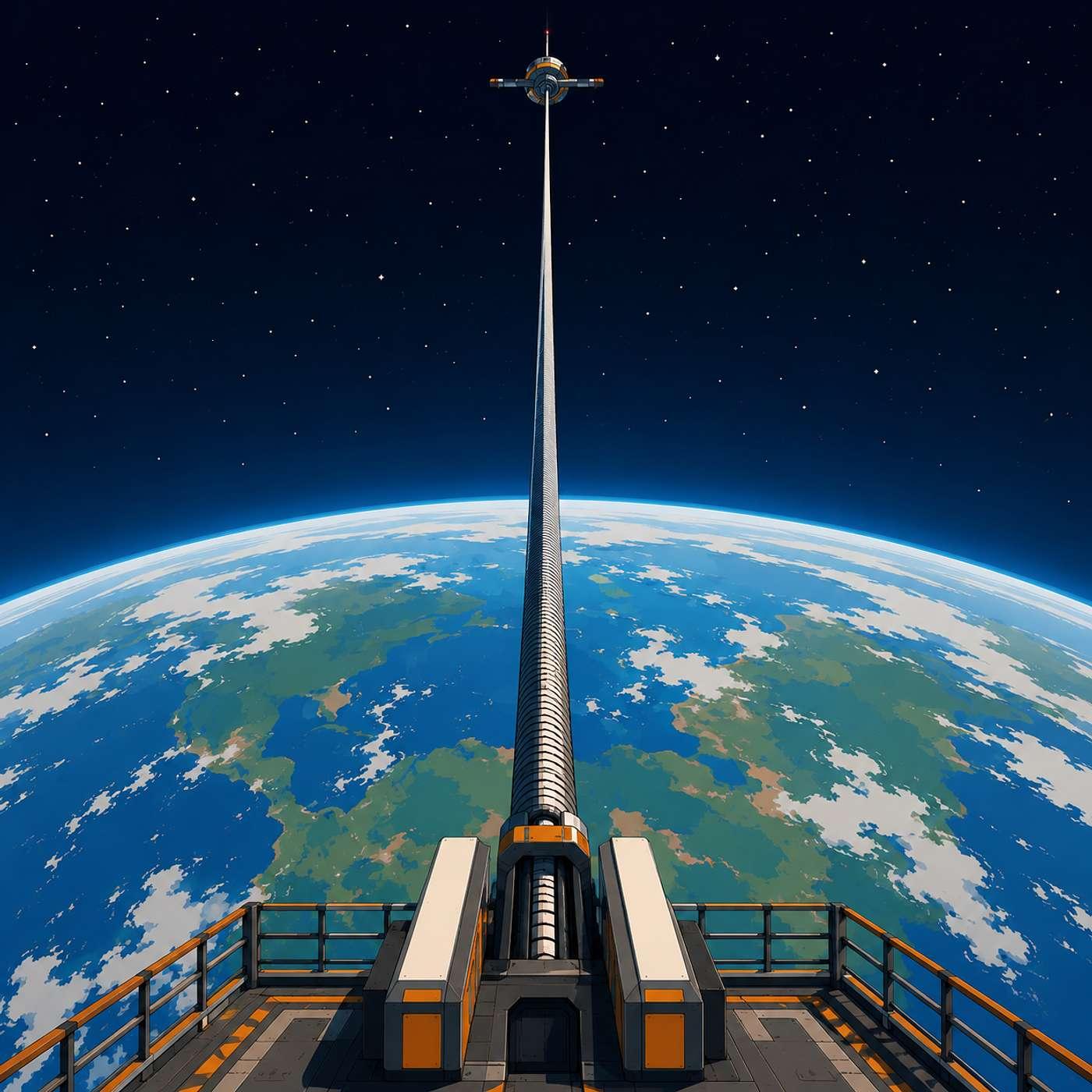
00:06:36.992let's actually take a moment and talk about what this is gonna be like, because there's some design characteristics of these that I'm not sure how much get explored.
00:06:37.382 -->
00:06:43.762I mentioned it already there, you need a huge counterweight, and this needs to be well beyond geostationary orbit.
00:06:44.072 -->
00:06:45.322And I think that's something people miss.
00:06:45.322 -->
00:06:50.242A lot of people seem to think that it's gonna stop at geostationary orbit, but that's not the case.
00:06:50.273 -->
00:06:54.392Because for an orbital elevator to work, the cable needs to be in tension.
00:06:54.702 -->
00:07:00.182And the only way you can do that is if your center of mass of the entire thing is beyond geosynchronary orbit.
00:07:00.463 -->
00:07:12.413So you need a massive counterweight pretty significantly far out from geosynchronary orbit, but you will, of course, have a station in between the counterweight and the planet right at the most stable orbit, which for an orbital elevator is, of course, geostationary.
00:07:12.642 -->
00:07:21.362That's really important, too, Because along this entire pathway, that point, the geostationary point, is the only place where you could step off the platform and be in a stable orbit.
00:07:21.656 -->
00:07:26.716If you're below that, you'll actually fall back to Earth, and if you're above that, you'll be kicked off into a higher orbit.
00:07:27.057 -->
00:07:28.346Now, the higher orbit's really helpful.
00:07:28.387 -->
00:07:29.877You can use that to kick into another planet.
00:07:30.016 -->
00:07:31.536But falling back to Earth is not helpful.
00:07:31.607 -->
00:07:31.857No.
00:07:32.002 -->
00:07:35.901so it is really important to imagine this thing, just how far out it's really going to extend.
00:07:35.901 -->
00:07:36.851I think I was looking at it.
00:07:36.862 -->
00:07:43.091A lot of them are about 100,000 kilometers in length is the design, which is about a third of the way to the moon.
00:07:43.262 -->
00:07:43.391Yes.
00:07:43.391 -->
00:07:45.281So these are very large structures.
00:07:45.319 -->
00:07:53.562they are absolutely massive structures and, they need to be designed that way to have the benefits that they do, and to be able to maintain their ability to transport products back and forth.
00:07:53.680 -->
00:08:11.745but with that in mind, this large cable that is pretty much holding an entire station on the other end, another detriment that comes to mind is the tensile strength, how much strength we would need to have to hold an object that's spinning with the Earth's rotation while holding a station that's millions of tons.
00:08:12.139 -->
00:08:20.060We have very few things that we could make that cable out of on Earth right now that would be able to withstand that pressure.
00:08:20.610 -->
00:08:39.253right now the only thing that really comes to mind is carbon nanotubes, and they would have to be perfectly manufactured to have the highest rating of tensile strength that they possibly could, and that's not factoring in, the, things moving back and forth across that cable, the, how maintenance would have to be applied to it as well.
00:08:39.682 -->
00:08:41.413It all becomes very complicated.
00:08:41.530 -->
00:08:44.410That is an issue, and not one that we should overlook.
00:08:44.451 -->
00:08:48.181The material engineering going into an orbital elevator is huge.
00:08:48.280 -->
00:08:56.541This cable is going to be under an immense load, and you need a very strong material to be capable of handling that.
00:08:56.860 -->
00:09:04.370And really, orbital elevators were 100% in the realm of science fiction until we discovered how to manufacture carbon nanotubes.
00:09:05.020 -->
00:09:12.143And even with carbon nanotubes, which I believe is one of the strongest materials we can currently make, it is really pushing that material limit.
00:09:12.322 -->
00:09:25.115I believe, they have a tensile strength in the 70 to 100 kilopascal range, And while that does then put you in the realm of possibility for an orbital elevator, you hit on it earlier, they need to be perfectly manufactured.
00:09:25.365 -->
00:09:33.946You can't have any defects because that could quickly drop that tensile strength, and you really do need every last bit of that strength to make the structure work.
00:09:34.096 -->
00:09:41.255And then another concern too is if you do use carbon nanotubes and you do make them perfectly, you don't have a large safety margin.
00:09:41.255 -->
00:09:47.025You really are maxing out that material, which means it doesn't take much extra force to break the structure.
00:09:47.046 -->
00:09:50.885And that's a concern because in engineering, we really wanna have a safety margin.
00:09:50.885 -->
00:09:52.936A safety margin is of critical importance.
00:09:53.186 -->
00:10:01.355You can't just use 100% of your material strength to build a structure because then the smallest change in load or smallest miscalculation will collapse that structure.
00:10:01.666 -->
00:10:06.916And all of that has to happen while this structure goes through an entire planetary atmosphere.
00:10:07.206 -->
00:10:15.673There's hurricanes, there's storms, random winds, there's all kinds of different structural forces that are gonna be enacted on this cable, all while you're maxing out the tensile strength.
00:10:15.682 -->
00:10:17.482So that's all a huge concern.
00:10:17.962 -->
00:10:30.582With that being said, though, I do think it's at least somewhat interesting that we have a material that is at least theoretically capable of supporting this structure, which is more than we can say for a lot of different mega structures, and that does give me a little bit of hope.
00:10:30.687 -->
00:10:35.817I don't think we're gonna have some miracle material that's 100 times stronger than carbon nanotubes, at least not in the near term.
00:10:35.817 -->
00:10:48.561there are some theoretical materials like magmatter, and nuclear pasta that only exist in the core of neutron stars that comes with a whole, whole load of other issues, like needing a neutron star to exist which is usually a pretty big issue for a material.
00:10:49.270 -->
00:10:58.304But I do think it's interesting there is at least a material, and if we are able to improve its strength by a little bit, even by two or three X, then you might gain that safety margin.
00:10:58.325 -->
00:11:00.701So that's interesting to me at least it's definitely possible.
00:11:00.780 -->
00:11:06.740Humanity over the years has done very good at taking one material, mixing it with another, and making it even stronger.
00:11:06.870 -->
00:11:09.490I have no reason to think that we would stop now.
00:11:09.740 -->
00:11:10.811No, absolutely not.
00:11:10.821 -->
00:11:21.097if we can make that margin a little bit better then that Makes our project more and more feasible for sure, and it does it… get us closer to this could probably be one of the first mega structures that we build.
00:11:21.197 -->
00:11:26.395Yeah, I could definitely see that, except for maybe a Dyson swarm, because I think that's something that would slowly be built up over time.
00:11:26.532 -->
00:11:31.841once you put your first satellite that uses solar power in orbit of the sun, you've technically started your Dyson swarm.
00:11:31.912 -->
00:11:34.032I don't know at what point you wanna call that a Dyson swarm.
00:11:34.381 -->
00:11:37.861Another thing I did wanna touch on was the actual material strengths involved here.
00:11:38.142 -->
00:11:43.652and really when we're talking about tensile strength of a material, we are talking about the bonds of its molecules or atoms.
00:11:43.721 -->
00:11:44.062Yes.
00:11:44.172 -->
00:11:51.652And the carbon-carbon bond is one of the strongest bonds, and that's why pure carbon, like a carbon nanotube, is so strong, and that's what we're using.
00:11:51.979 -->
00:12:01.379and that's why even if you can make them perfect, you do eventually reach a point where that carbon-carbon bond just fundamentally is not strong enough, and that's, the material limit we're into.
00:12:01.448 -->
00:12:18.688So we would need to discover or use potentially stronger chemical bonds or find some new form of matter or take advantage of different forms of physics that aren't the electromagnetic force, and that's kind of the idea of some of these other forces that use either the strong or weak nuclear force instead of using the electromagnetic force, which is what holds atoms together.
00:12:19.067 -->
00:12:23.067With that in mind, though, is there anything stronger than a carbon-carbon bond that we know of today?
00:12:23.280 -->
00:12:30.451Yeah, there are bonds that are stronger, but when it comes down to tensile strength, it's not just the bond strength we have to worry about, it's the actual weight of the molecule.
00:12:30.461 -->
00:12:40.671So there are some metals that technically have stronger bonds, but they're pretty heavy, so you don't get a stronger tensile strength because it comes down to the strength of the bond divided by the actual weight of the atoms.
00:12:40.681 -->
00:12:46.201So that's why the carbon-carbon bond is so good, because carbon's a pretty small atom in the grand scheme of things.
00:12:46.291 -->
00:12:47.780I think it's, what, six on the periodic table?
00:12:48.211 -->
00:12:49.010I hope I got that right.
00:12:49.010 -->
00:12:49.471I'm a chemist.
00:12:49.471 -->
00:12:50.750If not, I'll have to cut that out.
00:12:50.890 -->
00:12:53.610And it provides you with a lot of tensile strength.
00:12:53.620 -->
00:12:57.421So that's the advantage of the carbon-carbon bond over some potentially stronger ones.
00:12:57.721 -->
00:13:00.921But off the top of my head, I know carbon-oxygen bonds are stronger than carbon-carbon bonds.
00:13:01.120 -->
00:13:01.620I see.
00:13:01.630 -->
00:13:01.660Yes.
00:13:01.671 -->
00:13:02.971But it's hard to make a chain out of.
00:13:02.980 -->
00:13:05.000That's why pure carbon nanotubes are much better.
00:13:05.158 -->
00:13:10.698But there is still hope that we could still make a, atomic bond that could be stronger than the carbon-carbon bond in the future.
00:13:11.005 -->
00:13:13.355but if not, I'm sure that we could find a way to work with it.
00:13:13.535 -->
00:13:14.566Yeah, absolutely.
00:13:14.605 -->
00:13:17.556And there are some other design considerations going on here too.
00:13:17.885 -->
00:13:23.125For one, when we think about the climbers going up and down the elevator- I think that's something people kinda overlook.
00:13:23.245 -->
00:13:25.485These can't be traditional elevator cars, right?
00:13:25.495 -->
00:13:25.666No.
00:13:25.765 -->
00:13:30.145They need to be powered in some way, shape, or form, and they're going over a very long distance.
00:13:30.155 -->
00:13:34.546They're going 100,000 kilometers, much further than any two points of Earth are connected by quite a lot.
00:13:34.956 -->
00:13:39.775So you need some way to power these, and if that adds weight, that reduces your cargo you can carry.
00:13:39.985 -->
00:13:46.405So that is another consideration to happen, and it's very possible you might have these climbers be nuclear powered, via fusion.
00:13:46.405 -->
00:13:55.916That could be a good way to do it, although the issue with fusion is I think that's a technology that'll get more efficient with size, so a larger reactor will probably perform better than a smaller one.
00:13:56.105 -->
00:13:59.556So having a small, compact one on one of these elevator cars could be an issue.
00:14:00.005 -->
00:14:09.655so maybe even you'll use fission, or maybe you'll actually have reactors built into the elevator itself and a conductive material supplying power to the car, kinda like how electric trains work now.
00:14:09.807 -->
00:14:15.427I think would probably be the most efficient because then you remove the need to have the power source on the actual vehicle.
00:14:15.557 -->
00:14:15.826Yeah.
00:14:15.866 -->
00:14:18.417No, that's a fair point, and you could potentially have redundancies too.
00:14:18.417 -->
00:14:24.476If one fails, maybe some of the ones can take up the slack, and you're not stuck in a cart, 25,000 kilometers out of the Earth's atmosphere.
00:14:24.476 -->
00:14:25.216So that could be helpful.
00:14:25.256 -->
00:14:26.636That definitely could be helpful.
00:14:26.886 -->
00:14:30.756Now, I'm wondering about, the space elevator and it's spinning.
00:14:30.836 -->
00:14:36.027Is there centripetal force being applied to these cars as well as they're moving up and down this cable?
00:14:36.116 -->
00:14:37.157Yeah, there will be.
00:14:37.157 -->
00:14:47.187So interestingly, there is centripetal force, but Earth's gravity in this case is gonna be much, much stronger for a lot of the journey up, unlike when you're on the ISS, for example, right?
00:14:47.261 -->
00:14:50.642the only reason you feel weightlessness isn't because gravity isn't there.
00:14:50.642 -->
00:14:52.711It's that you're in this constant free fall.
00:14:53.121 -->
00:14:55.451But on an orbital elevator, you're not in orbit.
00:14:55.711 -->
00:15:01.211You are very much standing on the platform, and Earth's gravity only drops off by a small percentage once you reach low-Earth orbit.
00:15:01.331 -->
00:15:04.861But as you start moving further and further away, gravity will get weaker and weaker as you go up.
00:15:05.111 -->
00:15:12.231And eventually, once you reach the point of geosynchronous orbit, you will experience weightlessness because you are now actually in a stable orbit.
00:15:12.552 -->
00:15:16.692And then as you go beyond geosynchronous orbit, you would start feeling the opposite.
00:15:16.692 -->
00:15:19.721You would start feeling the centripetal force pushing you into the ceiling.
00:15:19.731 -->
00:15:22.562It would be very minor, to be clear, unless you went really far out.
00:15:22.662 -->
00:15:30.528But you would start having a force pushing you into what would be your ceiling on the way up, Because now you're actually moving faster than the orbit you're in, so you do start to get that centripetal force.
00:15:30.879 -->
00:15:37.274But that's why if you go beyond geosynchronous orbit, if you step off the platform, you will be shot up into a higher orbit.
00:15:37.294 -->
00:15:39.195So you would have a bit of a force there Yeah.
00:15:39.339 -->
00:15:48.014and, you know, It helps just a little bit It would move the capsular, the crawler, faster towards it without needing as much power the closer it got to its end destination.
00:15:48.115 -->
00:15:48.414Yeah.
00:15:48.414 -->
00:15:53.424So basically the whole way up until you reach the geosynchronary spot, you're fighting gravity.
00:15:53.475 -->
00:15:53.745Right.
00:15:53.804 -->
00:16:02.075Once you hit that spot, you're now in weightlessness, And once you go past that point, the elevator will actually be pulled toward the counterweight because of the actual rotational force.
00:16:02.414 -->
00:16:05.725So yeah, it would help, and as you went up, you would need less and less and less power.
00:16:05.804 -->
00:16:08.225now how long do you think a journey like that would really take?
00:16:08.384 -->
00:16:09.205It wouldn't be quick.
00:16:09.235 -->
00:16:11.144you're moving 100,000 kilometers.
00:16:11.365 -->
00:16:18.125Even if you can go at a really respectable speed, and once you get into space, you don't have an atmosphere, you might be able to move at several hundred kilometers an hour.
00:16:18.144 -->
00:16:25.384But this is gonna be a multi-day trip, And so realistically, these elevator cars are probably gonna be like mini hotels that you're gonna be staying in for multiple days.
00:16:25.384 -->
00:16:27.054You'll get a room with a bed.
00:16:27.065 -->
00:16:34.835There might be bars, entertainment, restaurants, and people who live and work full time in each one of these cars just because of how long it's going to take.
00:16:34.894 -->
00:16:37.325And it will, like I said, depend on how fast you're able to go.
00:16:37.664 -->
00:16:40.134And there will probably be an economical point there too, right?
00:16:40.134 -->
00:16:50.065Like, you can go faster, but if it, that costs more energy, at a certain point, that might not be worth it, and I'm sure there'll be some kind of equilibrium point of speed versus economic profitability, where you end up at.
00:16:50.105 -->
00:16:51.514But yeah, no, great question.
00:16:51.544 -->
00:16:52.875The answer is it's gonna take a minute.
00:16:53.044 -->
00:16:53.414Yeah.
00:16:53.534 -->
00:16:56.004also how big do you think this cable will be?
00:16:56.014 -->
00:17:03.581like, like these massive things housing people to go up and down, that could be the size of small hotels Like how many shuttles do you think would be running on a track at once?
00:17:03.581 -->
00:17:07.520'Cause it could only be one if it goes up one track and returns on one track.
00:17:07.681 -->
00:17:08.520Not necessarily.
00:17:08.580 -->
00:17:13.280There's already elevators in buildings that can move sideways to get out of the way of pods coming down.
00:17:13.520 -->
00:17:19.560So you could imagine that you had abilities for these to move around the track, to dodge each other as they're going up and down.
00:17:19.596 -->
00:17:24.105But I think you would probably have thousands of these running on the elevator at any given time.
00:17:24.155 -->
00:17:29.266I mean, for this to be economically valuable, you need a great justification for the cost that you put into building this.
00:17:29.536 -->
00:17:35.885This will be by several orders of magnitude the singular most expensive structure humanity has ever made.
00:17:36.115 -->
00:17:41.605Several times more expensive than the entire GDP of the world today, by probably an order of magnitude.
00:17:41.976 -->
00:17:47.635So you really need to move a lot of people and a lot of cargo to have this elevator justify its expense.
00:17:47.855 -->
00:17:51.786And that's why I said in the beginning, you're not building this to start your orbital infrastructure.
00:17:51.786 -->
00:17:59.516You're only building this when you already have a sprawling economy in space, and you can justify moving that much cargo, and you actually have a need for that.
00:17:59.577 -->
00:18:03.407so with that in mind, how large do you think the cable would actually have to be for this elevator?
00:18:03.634 -->
00:18:04.994fairly massive, honestly.
00:18:05.005 -->
00:18:06.974So the cable would likely be tapered.
00:18:06.984 -->
00:18:08.384It wouldn't just be a straight cable.
00:18:08.638 -->
00:18:17.229It would be thinnest on the planet where it experiences the weakest amount of forces, but as you move up the elevator, it would need to get thicker and thicker and thicker to handle the increasing forces that it's experiencing.
00:18:17.598 -->
00:18:23.608As for how thick it would be on the planet, I would assume several hundred meters at the minimum, maybe a kilometer or more.
00:18:23.838 -->
00:18:30.689Really just depends on what material you use, how much safety margin you need, and what strengths we're capable of working with.
00:18:30.778 -->
00:18:37.909You need to finely balance, though,'cause every little bit of thickness you add to the cable adds more weight, and then that weight means you need more cable to support it.
00:18:37.909 -->
00:18:44.558So you get into this diminishing returns- where as you make it thicker, it has more strength, but now it has more weight, and so there's gonna be some point at that.
00:18:44.729 -->
00:18:48.679I've seen some models say as low as 400 meters, and some say up to a kilometer.
00:18:48.939 -->
00:18:57.409So it just fully depends on what material you're working with, what your safety margins are, and how many cables and how many cars you need to support going up and down at any given time.
00:18:57.628 -->
00:18:59.259that is quite a massive structure.
00:18:59.308 -->
00:19:09.838But it would have to be that big regardless to be able to, like you said, take full advantage of it and build all this infrastructure around using that cable to move product and people up and down.
00:19:09.888 -->
00:19:10.138Yeah.
00:19:10.199 -->
00:19:14.808Actually, another key point too is this cable does not need to connect to the planet at just one point.
00:19:15.038 -->
00:19:18.528So the actual structure itself needs to go over the equator of the Earth.
00:19:18.538 -->
00:19:20.648There's not really any negotiation on that.
00:19:20.679 -->
00:19:24.648That's the only way you can actually have a fixed spot in orbit over the planet.
00:19:24.979 -->
00:19:27.469But that doesn't mean that the cables have to go to the equator.
00:19:27.719 -->
00:19:29.528You could actually have cables branching off, right?
00:19:29.528 -->
00:19:37.419you could have one in North America, one in South America, that meet somewhere in the middle and still have the whole structure be over geostationary orbit.
00:19:37.719 -->
00:19:48.999And you could imagine you could potentially have hundreds if not thousands of cables branching all around the world going to one spot, that way you have multiple access points on the ground, and that could give you an excuse for countries working together, right?
00:19:48.999 -->
00:19:51.836Like, the United States wanted their own orbital elevator.
00:19:51.836 -->
00:20:00.175The only way we're getting that in our country would be to find a partner in South America who also wants one and then connect them together because we're not on the equator.
00:20:00.175 -->
00:20:02.955The whole center of mass of this thing has to be in the equator.
00:20:03.296 -->
00:20:06.076So it's worth pointing out that it may not just be one point.
00:20:06.076 -->
00:20:11.645You may have the cable split and go into several different connecting points on the Earth, and that could also provide redundancy.
00:20:11.790 -->
00:20:13.780that definitely would be beneficial.
00:20:13.866 -->
00:20:23.757And the reason why I think that it would be is when I think about the Earth spinning with now this massive object just on one side, it makes me think of, like, the centrifuges that we used to work with.
00:20:23.817 -->
00:20:27.406you, can't just throw something in without a counterweight and just have it spin.
00:20:27.916 -->
00:20:35.027let's say we build a space elevator on the equator, and we have it branch out into the countries that it can reach from that point in the equator.
00:20:35.547 -->
00:20:44.636Would it make sense that we would have to build a second space elevator to match on the other side to be able to match that force and not throw the Earth off of its gravitational rotation?
00:20:44.757 -->
00:20:45.747That's a fair question.
00:20:45.757 -->
00:20:46.416not really.
00:20:46.426 -->
00:20:52.106You are right about the centrifuge, and technically building this thing will slightly change… I think it's called the barycenter.
00:20:52.106 -->
00:20:59.336It's the point at which two bodies rotate, and so you are adding a lopsided bit of mass to the Earth, and very minutely that would change how it rotates.
00:20:59.376 -->
00:21:04.567But it's worth pointing out the mass of this elevator versus the mass of the planet, there's a huge discrepancy there.
00:21:04.567 -->
00:21:07.656This will be nowhere near the mass of Earth.
00:21:07.666 -->
00:21:12.916So yes, it's out of balance like a centrifuge, but it's almost like having a speck of dust in one part of your centrifuge.
00:21:13.076 -->
00:21:14.596That's not enough to throw things off.
00:21:14.626 -->
00:21:21.426You would need a absolutely insane amount of mass connected to the planet to change its rotation like that.
00:21:21.777 -->
00:21:27.477So it's not really something we'd have to worry about, and you wouldn't need to then go build one on the other side of the planet to balance it.
00:21:27.477 -->
00:21:30.047You could build them all on one side if you really wanted to.
00:21:30.287 -->
00:21:32.777You're not gonna change the rotation of the planet by any significant amount.
00:21:32.826 -->
00:21:35.146You will change it, but not by enough that matters.
00:21:35.247 -->
00:21:41.931The Three Gorges Dam in China also changed how the Earth rotates because it just stopped so much mass in the form of water on one part of the planet.
00:21:42.250 -->
00:21:47.891So there will be an effect, but it's not gonna be a measurable one or one that matters practically here on Earth.
00:21:47.901 -->
00:21:57.369I But with the thought of this, how long the space elevator will be, and how there's just these exposed, you know, not, not super exposed, but there's these crawlers going up and down this cable.
00:21:57.433 -->
00:22:01.324Our orbit is already littered with, uh, satellites everywhere.
00:22:01.423 -->
00:22:09.008we would have to clear a path and make sure that path is clear, and then how do we just avoid space debris cutting our space elevator in half?
00:22:09.018 -->
00:22:14.178I feel like just the smallest piece, if it destroyed the structural integrity of one, it would be just like with rope.
00:22:14.298 -->
00:22:16.248Like it splits a little bit, it splits all.
00:22:16.343 -->
00:22:24.790and that is a huge concern with these elevators as well because, like you said, you are clearing a whole orbit, and also if all the orbits you're clearing, this is the equatorial orbit.
00:22:25.010 -->
00:22:28.711So you need to make sure that nothing is going to intersect with your cable during that orbit.
00:22:28.881 -->
00:22:36.060It's not really possible to fully clear that orbit 'cause anything else orbiting the planet will have to intersect with the space elevator's orbit at some point, right?
00:22:36.060 -->
00:22:45.990There's no way to avoid that, so it's all gonna come down to timing, and you'll have to very carefully monitor all of your satellites and ensure that they're not gonna hit this really long cable, which is doable.
00:22:46.171 -->
00:22:49.661we already now have to monitor our satellites to avoid them colliding with other things.
00:22:49.911 -->
00:22:56.576But this is obviously a much larger section gonna of something that's going to intercept every single possible orbit, so that will be a challenge.
00:22:56.616 -->
00:22:59.356And for powered satellites, that's not a crazy thing to avoid.
00:22:59.356 -->
00:23:05.731They can just adjust their orbits as needed to make sure that when they're crossing through the equator, they're not going to intersect when the cable's there.
00:23:05.731 -->
00:23:08.537But like you said, with space debris, that's a whole other challenge.
00:23:08.777 -->
00:23:17.686I imagine that by this point in time, what we'll have to do is, for one, you will just have to go and clear out the orbit before you build this orbital elevator.
00:23:17.957 -->
00:23:30.666You would send ships, you would find all the debris and try to eliminate it, and then once you actually got the elevator built, it would have to have some type of defensive system on it to shoot down any larger chunks that could propose damage to it.
00:23:30.957 -->
00:23:35.277And you may even have other orbital platforms that are in kind of a similar orbit to it.
00:23:35.432 -->
00:23:49.126you can't actually put something in orbit near the cable 'cause it's not in a stable orbit, but they would maybe go around and constantly be clearing up the orbit, just orbiting the equator and taking care of anything they see as they see it would really be the only thing you could do.
00:23:49.326 -->
00:23:50.277So it does get tricky.
00:23:50.477 -->
00:23:57.592You could potentially maybe put some shielding on it to protect the cable, but that again adds mass, and that means you need an even stronger cable.
00:23:57.916 -->
00:24:00.106So I do think orbital platforms might work better.
00:24:00.267 -->
00:24:06.396But they're, like I said, they're a challenge because other than geostationary orbit, no other orbit below that station is stable.
00:24:06.606 -->
00:24:09.797So you can't park anything next to this elevator without attaching it to it.
00:24:10.386 -->
00:24:15.240So if you do wanna put a defensive platform It's only gonna intersect that cable on a small amount of time.
00:24:15.570 -->
00:24:18.191And that's okay 'cause it's just going through this orbit and cleaning it up.
00:24:18.421 -->
00:24:20.810Not like it has to be parked next to the platform.
00:24:21.240 -->
00:24:24.095But for anything you miss, you just gotta build a way to handle it.
00:24:24.154 -->
00:24:25.085There's not much you can do.
00:24:25.401 -->
00:24:25.711Yeah.
00:24:25.921 -->
00:24:27.611that is definitely a scary part of it.
00:24:27.711 -->
00:24:42.310but I'm sure with other technologies, we would be able to limit the amount of random debris that is in that orbit, and then with better computer systems, we could make sure that satellites never interact with the elevator as it's moving along its orbit.
00:24:42.411 -->
00:24:46.330Yeah, and by this point, you're really established in space, so it's not- hard to imagine.
00:24:46.330 -->
00:24:56.901You might have a bunch of small satellites, hundreds, thousands of these things constantly scanning for small debris that could intersect with the orbital elevator, and then grabbing it and de-orbiting it and moving it.
00:24:57.075 -->
00:25:17.045And I imagine that in this point in time, Earth's orbit is a very valuable space, so you likely already have very strict controls on putting clutter and trash into Earth's orbit, and you're constantly monitoring and cleaning it up, and there's probably a good chunk of money always happening to keep this orbit clear, Not just for your space elevator, but for all the other infrastructure that exists in Earth's orbit by this time.
00:25:17.255 -->
00:25:17.555Mm-hmm.
00:25:17.846 -->
00:25:30.365And I mentioned earlier that you can use this platform as a launching point to go to other planets because the counterweight actually extends beyond the geosynchronary orbit, and it has more energy than you need for that orbit.
00:25:30.566 -->
00:25:36.846So if you're attached to the counterweight and you let go, it'll actually fling you into a higher orbit, which is very helpful for traveling to other planets.
00:25:37.056 -->
00:25:40.800And you could also build orbital elevators on other planets.
00:25:41.246 -->
00:25:43.655They don't need to be in just Earth's orbit.
00:25:43.955 -->
00:25:46.596Now, not all planets can have an orbital elevator.
00:25:46.855 -->
00:25:48.046There are certain limitations.
00:25:48.145 -->
00:25:57.946Venus, for example, can't have an orbital elevator 'cause it rotates too slow, so you don't have that intersection point of the planet's rotation able to keep the counterweight, without it being way too far.
00:25:58.205 -->
00:26:01.726And also at that point, you're in the gravity well of the sun, so it wouldn't be stable.
00:26:01.967 -->
00:26:05.826But Mars can have an orbital elevator, and actually you can do a smaller orbital elevator there.
00:26:05.826 -->
00:26:09.497So what's barely feasible on Earth is actually quite possible on Mars.
00:26:09.796 -->
00:26:12.047And so potentially that's another thing we could explore too.
00:26:12.365 -->
00:26:23.066You could leave Earth, travel to Mars, and then ride down the orbital elevator at Mars, all with very little fuel, which would make doing a Mars colony so much more economical than any other model really.
00:26:23.353 -->
00:26:23.742Yeah.
00:26:23.853 -->
00:26:34.509it definitely reduces the amount of tensile strength that you would need to support it, and being able to have that interaction of getting off Earth, leaving on a ship that just flies right over to Mars, landing there.
00:26:34.569 -->
00:26:38.829No landing, no taking off, which is also the most dangerous parts of these ships.
00:26:39.279 -->
00:26:42.009it, it saves lives, and it makes everything just easier.
00:26:42.099 -->
00:26:44.829Yeah, and it just makes Mars so much more economically valuable.
00:26:44.920 -->
00:26:46.819So that's 100% something we could do.
00:26:47.016 -->
00:26:51.289The Moon unfortunately can't have an orbital elevator because, again, it just rotates too slow.
00:26:51.539 -->
00:26:57.809But the Moon's not that hard to get off of, and you could potentially just do like a rail gun system to launch cargo off of the Moon, so that's not a huge concern.
00:26:57.829 -->
00:26:59.259You could do orbital towers on the Moon.
00:26:59.519 -->
00:27:00.619These aren't in tensile strength.
00:27:00.619 -->
00:27:05.339They're actually in compressive strength, and they're basically giant skyscrapers that reach up into the heavens.
00:27:05.464 -->
00:27:07.335but you still need to get that horizontal velocity.
00:27:07.335 -->
00:27:11.095If you step off of one of these, you'll fall on the ground, so you still need to get that lateral velocity.
00:27:11.095 -->
00:27:13.345But thankfully Moon has a very low escape velocity.
00:27:13.605 -->
00:27:13.755Yeah.
00:27:13.755 -->
00:27:14.795So that is something you could do.
00:27:14.865 -->
00:27:15.744Just do a big jump.
00:27:15.880 -->
00:27:17.089You're good basically a run, yeah.
00:27:17.569 -->
00:27:18.329Just take off running.
00:27:18.339 -->
00:27:19.799that is something also you could do.
00:27:19.869 -->
00:27:25.240And having them on these other planets could really make our solar system so accessible, and that could be a huge benefit.
00:27:25.480 -->
00:27:35.209But even for Mars, it's an issue'cause you need to have the planet colonized and have the infrastructure there for it to be worth building this structure, which I think at some point we might reach, but not anytime soon Yeah.
00:27:35.659 -->
00:27:40.338I do wanna talk about what happens when one of these things fail, because that's the huge concern, right?
00:27:40.338 -->
00:27:45.612You have this giant cable reaching up 100,000 kilometers what happens if that snaps?
00:27:45.817 -->
00:27:51.207well, in my mind, it wouldn't be good, especially if we had it connected across multiple different countries.
00:27:51.457 -->
00:27:52.707let's say this cable snaps.
00:27:52.707 -->
00:27:58.929Yes, it'll still have the centrifugal force on it, but that's not going to be enough to keep it, away from Earth.
00:27:58.939 -->
00:28:08.434It will, I imagine, fall back down into our planet's orbit destroying things on its way down, and then landing on Earth with the, Earth's gravity pulling it in.
00:28:08.625 -->
00:28:10.634That fully depends on where it snaps at.
00:28:11.115 -->
00:28:11.615I see.
00:28:11.704 -->
00:28:13.863In my thoughts, it would snap in the middle.
00:28:14.262 -->
00:28:21.863So if it snapped in the middle, what would happen is the portion of the cable that's still connected to the counterweight would fall away from Earth.
00:28:22.222 -->
00:28:22.383Right.
00:28:22.383 -->
00:28:23.792'Cause remember, this is in tensile strength.
00:28:24.053 -->
00:28:25.413It's like spinning a bucket on a string.
00:28:25.573 -->
00:28:28.343So the, the part that's farther away from Earth would actually fly away.
00:28:28.673 -->
00:28:36.979The part that's closer to Earth, like you said, would effectively wrap itself around the planet, and this would be a pretty devastating, consequence.
00:28:37.269 -->
00:28:38.679It would whip itself around.
00:28:38.689 -->
00:28:39.969It would gain speed, too.
00:28:39.969 -->
00:28:40.759It's like a whip.
00:28:41.128 -->
00:28:52.378if you've ever seen the videos of a horse whip, that loud snap they make at the end- Mm-hmm is because you introduce that flick, that wave basically propagates down the whip into the end, and by the time you reach the end of a whip, it's going faster than the speed of sound, and that's that crack.
00:28:52.659 -->
00:28:53.729Cool videos of it online.
00:28:54.159 -->
00:28:55.838Fascinating concept when it's on a whip.
00:28:56.328 -->
00:29:04.798A little bit terrifying when it's on the cable of your orbital elevator falling around your planet, and as it falls, it's accelerating the end of it faster and faster.
00:29:05.108 -->
00:29:09.969So it would basically whip around your planet, and it would cause a lot of devastation.
00:29:09.979 -->
00:29:13.999I don't wanna undersell just how devastating that would be for a planet.
00:29:14.519 -->
00:29:29.394Yeah, just thinking about, first of all, it falling back and wrapping around the planet is crazy, but then like Jake said, the way that it's working is it's concentrating all of that energy and mass into a single point, and hitting it would be like us getting hit with a large asteroid.
00:29:29.535 -->
00:29:29.865Yes.
00:29:29.884 -->
00:29:41.325It would potentially be quite devastating, and the worst, absolute worst-case scenario would be the cable breaking at the top, near geosynchronous orbit, that's just even more mass falling down to hit the planet.
00:29:41.565 -->
00:29:48.505The best-case scenario would be cable breaking at the surface, 'cause if you just let go at the surface, the whole thing would fall away from Earth, and you would be safe.
00:29:48.700 -->
00:29:52.592the reason why I was thinking it would break at the middle is that would probably be… I don't know.
00:29:52.602 -->
00:29:56.142Would that be where it has the most tension, or would it be at the very top?
00:29:56.211 -->
00:30:07.555It'd be at the top, but near Earth, it's in the atmosphere, so it's dealing with a lot more dynamic forces, There's also gonna be more things in low Earth orbit, so there's, I think, more of a potential for collisions and dynamic loading there.
00:30:07.934 -->
00:30:08.654But yeah, you are right.
00:30:08.654 -->
00:30:10.555The top is where the most of the force is concentrated at.
00:30:10.664 -->
00:30:11.015Yeah.
00:30:11.065 -->
00:30:15.900realistically, what probably would have to be done is there would have to be, like, an emergency release.
00:30:16.192 -->
00:30:20.972Well, the issue with that, though, is once you lose that counterweight, you don't have tensile strength anymore.
00:30:21.163 -->
00:30:24.942So you could put an emergency release, but that wouldn't stop anything.
00:30:25.008 -->
00:30:31.548Because once the cable's snapped, it's no longer in tension, so you could let go of it at the Earth, but that wouldn't change anything.
00:30:31.758 -->
00:30:33.907The cable's still falling down due to gravity.
00:30:34.188 -->
00:30:41.738The only way the emergency release would work is if it still had the counterweight going beyond geostationary orbit to pull the cable away.
00:30:41.738 -->
00:30:45.907But once you lose that counterweight, the cable will fall, whether it's connected to the planet or not.
00:30:46.117 -->
00:30:49.184Well, what if we could predict a collision that was unstoppable?
00:30:49.634 -->
00:30:51.548Then at that point, yeah, you could do an emergency release.
00:30:51.587 -->
00:30:55.465Or I… You know, I'm just trying to think about- No, no, yeah … what would actually break this cable.
00:30:55.560 -->
00:30:59.080If it is purely based on tension, you'd think that we would have the sensors for it.
00:30:59.361 -->
00:31:12.851And if we were to, let's say, see tension is getting, to a critical amount, if we were to release it from the planet at its base, wouldn't that relieve some of the tension, and the counterweight would just pull the entire thing into space?
00:31:12.861 -->
00:31:15.050Yeah, the counterweight would pull the whole thing into space.
00:31:15.060 -->
00:31:16.921So that is something you could potentially do.
00:31:16.980 -->
00:31:28.990It's hard to imagine a situation where you know that's going to happen- Yeah… fast enough to react, ' cause presumably event that just loads the cable really fast, and you can't predict it.
00:31:29.111 -->
00:31:30.431And once it snaps, it's too late.
00:31:30.480 -->
00:31:32.101But that is potentially something you could do.
00:31:32.111 -->
00:31:51.131You could also potentially maybe have countermeasures ready in space, really massive ships that just have a ton of thrust-to-mass ratio and there's a bunch of them always in orbit of the planet so that they're pretty close to the cable in the event of emergency, that if it snaps, they can quickly grab onto the cable and start pulling it away or trying to stabilize its orbit.
00:31:51.381 -->
00:31:52.580you would have to pull it away, really.
00:31:52.580 -->
00:31:55.030There's no way to stabilize the orbit if it's connected to the planet.
00:31:55.151 -->
00:31:57.830I could imagine you could have a fail-safe point, right?
00:31:57.840 -->
00:32:00.980So it's going to twist in the direction of Earth's orbit.
00:32:01.270 -->
00:32:06.530And so if it's gonna fall over the ocean, that will probably cause some issues but maybe not be as devastating.
00:32:06.871 -->
00:32:25.611So maybe you have somewhere on it massive thrusters that are ready to pull the cable away and a breakaway point somewhere where it can break and allow some of the cable to fall back to Earth to relieve some stress and to reduce the weight and then allow these thrusters to pull the severed section away and prevent it from whipping around the planet.
00:32:25.760 -->
00:32:26.230I see.
00:32:26.250 -->
00:32:33.980And you may actually have several of these breakaway sections all the way through, so it can break into a bunch of different pieces and be easier to manage, and they could all launch away from the planet.
00:32:34.401 -->
00:32:40.830That does add mass, and that does add material constraints, and that also means you have to have these breakaway points, which are hard to imagine.
00:32:40.830 -->
00:32:46.330But that is probably realistically the only way you could design this system in a fail-safe way.
00:32:46.560 -->
00:32:50.631And even then, it will do damage, but you are at least mitigating it.
00:32:50.701 -->
00:32:51.101Yeah.
00:32:51.143 -->
00:33:02.089definitely is hard to imagine Like, yes, we built this giant, tether and, every, you know, 100 kilometers there's a little spot where if you push a button the entire thing breaks away.
00:33:02.160 -->
00:33:04.359Yeah, and a thruster ready to carry you away.
00:33:04.369 -->
00:33:04.390Yeah.
00:33:04.400 -->
00:33:07.230we would like for you guys to ride this into space now, please.
00:33:07.250 -->
00:33:11.923the nice thing is the pods they have to be designed to leave an atmosphere, so they're basically tiny spaceships.
00:33:12.191 -->
00:33:17.681failsafe for them would be having some type of thruster that's able to gain the orbital speed they need before they fall back.
00:33:17.711 -->
00:33:21.861But that would be a challenge, and also you have to carry that weight up and down.
00:33:21.951 -->
00:33:30.557And the issue is, like I said, if these fall, they don't have the speed they need to stay in orbit, and that becomes a bigger issue the lower you are down closer to Earth.
00:33:30.837 -->
00:33:46.147And so there would just be, I think no matter what you did, unless you were basically carrying rocket ships up to you, which defeats the whole point of the orbital elevator, there would be a point where it's probably no longer safe or there's no longer enough energy in these rocket motors to get you into a stable orbit.
00:33:46.157 -->
00:33:50.268And if it fails at that point and you're in the pod, there's nothing anyone can do.
00:33:50.490 -->
00:33:53.190so then you're just relying on parachutes, which you could use parachutes too.
00:33:53.190 -->
00:33:59.079You're not reentering at orbital speed, so burning up is less of an issue than if you were trying to reenter the orbit.
00:33:59.079 -->
00:34:00.720So there are less forces in that way.
00:34:00.920 -->
00:34:04.170So maybe a combination of parachutes for lower Earth orbit.
00:34:04.430 -->
00:34:08.400These can detach, thrust away like a veto tower on a rocket and parachute down.
00:34:08.400 -->
00:34:14.519And then for the higher orbits where there's lower energy required, they have a rocket motor that can enter into a stable orbit.
00:34:14.925 -->
00:34:17.494definitely is nice to think about, there could be options.
00:34:17.572 -->
00:34:19.885I'm just thinking about riding on it when it would break.
00:34:19.896 -->
00:34:23.255I just feel like the initial vibration from it would just instantly kill you.
00:34:23.306 -->
00:34:28.423don't know if you've ever seen like metal snap and just like that like initial snap is incredibly violent.
00:34:28.503 -->
00:34:34.744That is true, but that would propagate through the cable at the speed of sound for that material, which is gonna be slower than the speed of light.
00:34:34.753 -->
00:34:38.244So you could- release from the cable and get away from it.
00:34:38.523 -->
00:34:39.603Physics is so cool.
00:34:39.954 -->
00:34:40.134Yeah.
00:34:40.134 -->
00:34:46.193So- … so there is a potential there you can actually separate from the cable and move away from it- before that energy reached down to you.
00:34:46.353 -->
00:34:47.344Absolutely, yeah.
00:34:47.353 -->
00:34:48.157Dude, so cool.
00:34:48.221 -->
00:34:52.150And if you have breakaway points, you could break the cable hopefully before that energy transfer happened.
00:34:52.268 -->
00:34:54.688But it would be a very violent thing to happen no matter how you slice it.
00:34:54.918 -->
00:34:55.827Yeah, but still.
00:34:55.867 -->
00:34:57.398definitely a lot of fail-safes in place.
00:34:57.438 -->
00:35:05.400Hope that they would be implemented or we would just have created a, object that has tensile strength that gives us a, chance of failure close to zero.
00:35:05.490 -->
00:35:08.490Yeah, but there's no such thing as zero, and even then you're gonna want safety measures.
00:35:08.490 -->
00:35:10.610So it is fascinating to think about.
00:35:10.989 -->
00:35:12.438Well, thank you all for joining.
00:35:12.509 -->
00:35:23.248I hope you enjoyed the episode, and next week we're gonna be talking about how interstellar spaceships could actually handle running into debris at near the speed of light, the engineering that go behind that, and the type of fail-safes you would have to look at.
00:35:23.358 -->
00:35:28.509So if that sounds like a fascinating topic, join us next week, which is actually next week, 'cause we're doing weekly episodes now.
00:35:28.559 -->
00:35:29.048That's right.
00:35:29.168 -->
00:35:34.199And if you like the show, consider supporting us on Patreon or subscribing on your podcast platform of choice.
00:35:34.559 -->
00:35:35.628Anything is appreciated.
00:35:35.858 -->
00:35:36.278Take care.
00:35:36.458 -->
00:35:36.938Thank you, guys.
00:35:36.949 -->
00:35:37.619See you next week.