


WEBVTT
00:01:11.280 --> 00:01:19.519
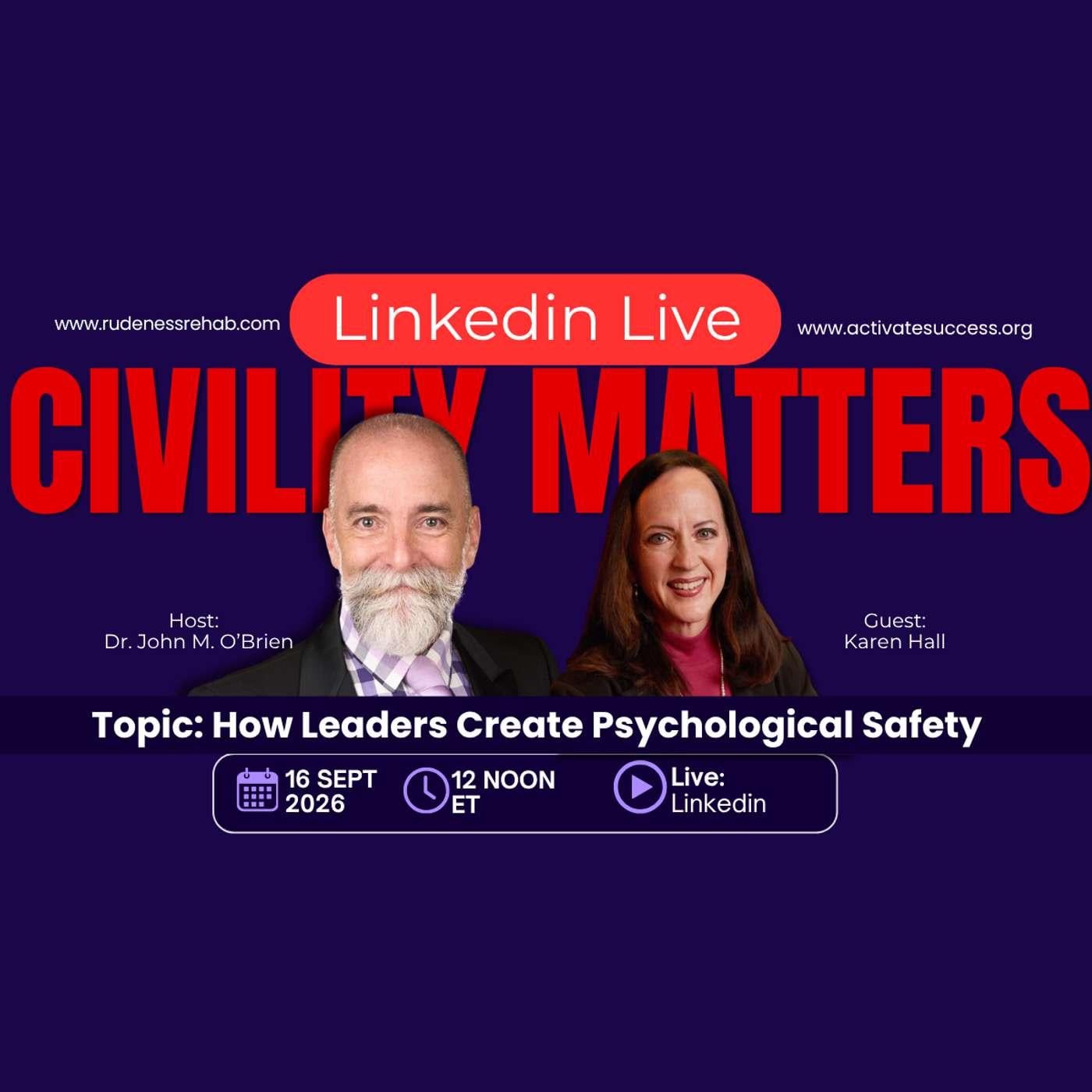
Welcome to Civility Matters, the podcast that seeks to answer the important question why you gotta be so rude?
00:01:19.920 --> 00:01:21.359
I'm John O'Brien.
00:01:21.519 --> 00:01:27.200
I'm the host of uh of uh the Civility Matters podcast and author of Rudeness Rehab.
00:01:27.280 --> 00:01:31.200
And I'm joined today by um my friend Karen Hall, who is there.
00:01:31.280 --> 00:01:35.439
She will be returning in just oh, there she is! Okay, so welcome, Karen.
00:01:35.680 --> 00:01:39.680
Um, you we will be um having her expertise in just a moment.
00:01:39.920 --> 00:01:47.280
But first, I always like to share a few what I like to call startling statistics around the topic that we will be tackling today.
00:01:47.359 --> 00:01:53.840
And today's topic, how leaders create psychological safety, the missing link in civil discourse.
00:01:54.079 --> 00:01:56.640
So just a few statistics to get us rolling.
00:01:56.879 --> 00:02:01.439
From Business Solvers Workplace Empathy, they do that every year.
00:02:01.519 --> 00:02:16.560
And from their 2025 data, they estimated that$180 billion, that's a lot of money, is at risk annually in the US due to attrition in organizations that are perceived as unempathetic to their employees.
00:02:16.960 --> 00:02:30.560
Now, despite that business risk, many CEOs still think 60% of CEOs, according to the same research, think that empathy is kind of nice as a work perk, but not something that's really necessary for effective business.
00:02:31.919 --> 00:02:35.919
Now that stands in contrast to some of the things that we hear from employees.
00:02:36.159 --> 00:02:50.479
From the same research, um, we hear that psychological safety ranks among the top three workplace priorities for 84% of employees, just behind pay raises and flexible work.
00:02:50.800 --> 00:02:57.439
Psychological safety is a core feature of retention for employers.
00:02:58.159 --> 00:03:08.000
And yet, 40% of employees say that their workplace is toxic, and 33% report experiencing coworker intimidation.
00:03:08.719 --> 00:03:16.000
Now, finally, nine out of 10 CEOs say empathy does improve financial performance.
00:03:16.240 --> 00:03:32.240
So on the one hand, they're saying it improves financial performance, but on the other hand, they're not necessarily seeing it as an essential to the workplace or perhaps doing things to create an organization where employees actually feel that sense of psychological safety and empathy.
00:03:32.400 --> 00:03:36.639
And that's why we have today's guest who will be solving all these problems.
00:03:36.719 --> 00:03:40.080
So let me tell you about my guest, Karen Hall.
00:03:40.400 --> 00:03:47.599
So Karen is an international psychological safety keynote speaker, best-selling author, and founder of Momentum Media.
00:03:47.759 --> 00:04:00.639
She equips leaders to create psychological safety by regulating their nervous systems and using emotional intelligence to build trust, increasing engagement, innovation, resilience, and performance.
00:04:00.960 --> 00:04:06.080
Karen is also editor-in-chief and executive producer with the Los Angeles Tribune.
00:04:06.240 --> 00:04:18.319
She's produced international broadcasts and hosted conversations on NTV and Sky TV, with reaching audiences with a combined reach of approximately 25 million.
00:04:18.800 --> 00:04:21.680
Wow, that's almost as many as listening to the podcast.
00:04:21.920 --> 00:04:37.199
She's also the host of the Hero Within podcast, ranked in the top 2.5% globally, where she showcases unsung heroes who share how they navigated adversity and overcome challenges to find hope and healing to return to love.
00:04:37.600 --> 00:04:54.079
Karen has served as a chief leadership officer and chief relationship officer to corporate leaders and brings practical strategies that leaders can immediately use to build trust, which is increasing courageous contribution, innovation, and creativity.
00:04:54.560 --> 00:04:57.600
And perhaps most importantly, she's been married 41 years.
00:04:57.680 --> 00:05:03.199
Oh, excuse me, over 41 years, and has four children and seven grandchildren.
00:05:03.360 --> 00:05:09.600
So please join me in giving the warmest Civility Matters podcast welcome to Karen Hall.
00:05:11.519 --> 00:05:15.439
Wow, that was so, so kind, John.
00:05:16.160 --> 00:05:17.279
Oh, you know what?
00:05:17.519 --> 00:05:21.120
When I just see your face, I just feel so happy.
00:05:21.279 --> 00:05:24.480
Even when I see the picture, I feel so happy.
00:05:24.879 --> 00:05:25.360
Oh, good.
00:05:25.519 --> 00:05:26.000
Oh, good.
00:05:26.079 --> 00:05:28.000
Um, well, listen, we're so so glad to have you.
00:05:28.079 --> 00:05:33.920
And I know my audience is very curious to have this conversation about psychological safety.
00:05:34.000 --> 00:05:41.920
Um, but before we do that, I always like to start off with my guests um sharing one fun fact about yourself.
00:05:42.079 --> 00:05:51.920
So, what would be the one fun fact about myself is that I have always wanted to um be able to sing by myself.
00:05:52.079 --> 00:05:57.839
I am a shower singer and I sing in the shower and I sing in the car when I'm by myself.
00:05:58.000 --> 00:06:02.399
And so when my husband and I got married, he wanted me to sing, you know, to him.
00:06:02.560 --> 00:06:04.000
And he said, Well, sing for me.
00:06:04.160 --> 00:06:05.759
And I said, No, sing with me.
00:06:05.920 --> 00:06:08.879
And he said, No, I want to hear you, just sing to me.
00:06:08.959 --> 00:06:12.639
And so, anyway, I he I said, I'm afraid to sing by myself.
00:06:12.959 --> 00:06:23.680
So he got me voice lessons and I would take voice lessons and then sing in the I would go practice in the car by myself until I felt confident enough to sing to him.
00:06:24.399 --> 00:06:24.879
Wow.
00:06:25.279 --> 00:06:26.240
Good for you.
00:06:26.480 --> 00:06:27.279
Good for you.
00:06:27.600 --> 00:06:30.639
The funny thing is that people could hear me in the in the car.
00:06:32.079 --> 00:06:33.759
They could hear you anyway, right?
00:06:34.079 --> 00:06:35.519
They can hear me anyway.
00:06:36.079 --> 00:06:41.680
Well, at some point we will have you back on the podcast and you will just simply sing your responses.
00:06:41.839 --> 00:06:45.040
But we won't do that today because that would be ambushing you, okay?
00:06:45.439 --> 00:06:46.560
Okay, okay.
00:06:47.040 --> 00:06:49.759
So let's get into um some of the material for today.
00:06:50.079 --> 00:06:57.600
So, first, what would you say is one experience that most changed how you think about your work and about people that work?
00:06:58.720 --> 00:07:08.399
You know, I my it's been a personal journey to learn how to regulate my nervous system and to create psychological safety for myself.
00:07:08.639 --> 00:07:14.240
A lot of people, we talk about creating psychological safety for others, and a leader needs to do that.
00:07:14.319 --> 00:07:17.279
But first, a leader needs to start with themself.
00:07:17.439 --> 00:07:22.240
And I remember um well trying to work on this ever since I've been a child.
00:07:22.480 --> 00:07:26.639
But the thing that I didn't understand was how important it was to have empathy for myself.
00:07:26.720 --> 00:07:33.040
And I remember a very important moment where I was escalated and I was trying to figure out what to do, and I was stuck.
00:07:33.199 --> 00:07:36.319
I just was stuck and I had this belief and I was stuck.
00:07:36.639 --> 00:07:41.439
And um, and my daughter said to me, I was she's she said, What's going on?
00:07:41.519 --> 00:07:42.319
And what are you thinking?
00:07:42.399 --> 00:07:46.720
And I told her my thoughts, and she said, Would you ever say that to a client that was stuck?
00:07:46.879 --> 00:07:48.160
And I said, No.
00:07:49.680 --> 00:07:58.000
But as a coach, you know, and as a leadership strategist, I was judging myself because I knew what to do, but I couldn't regulate my nervous system to do it.
00:07:58.160 --> 00:08:02.480
And when she said, you know, why do you feel like that about yourself?
00:08:02.639 --> 00:08:04.319
You're judging yourself so harshly.
00:08:04.480 --> 00:08:09.759
So anyway, I stopped judging myself when she said, You have permission.
00:08:10.399 --> 00:08:13.040
And I was like, Oh, I have permission.
00:08:13.279 --> 00:08:15.360
And I just started to de-escalate.
00:08:15.439 --> 00:08:20.240
And then I realized I need to love myself the same way that I love my clients.
00:08:20.879 --> 00:08:22.079
Yes, absolutely.
00:08:22.240 --> 00:08:31.519
That's such an important message that we, you know, there's this uh saying in the therapy world that the client can only go as far as the therapist has been.
00:08:31.680 --> 00:08:39.200
And I think it's similarly true in the coaching world, in the leadership world, that you have to be working on yourself.
00:08:39.360 --> 00:08:47.440
And you it's gonna be hard to offer uh empathy or non-judgment to others if you're not really offering it to yourself.
00:08:47.840 --> 00:08:48.799
Right, right.
00:08:48.960 --> 00:08:49.519
So true.
00:08:49.679 --> 00:08:56.159
And so that's when I really recognized because I was it was easy for me to be empathetic if someone was hurting.
00:08:56.480 --> 00:08:59.919
So easy, you know, to care about someone else that was struggling.
00:09:00.159 --> 00:09:04.320
But I didn't realize that I wasn't offering myself that same level of empathy.
00:09:04.399 --> 00:09:18.159
I did to a to a certain degree, I do a lot of self-love, but there were there was a certain point at which I defaulted to an earlier judgment of myself that I recognized that part I was not giving myself empathy in.
00:09:18.960 --> 00:09:19.759
Right, right.
00:09:19.919 --> 00:09:20.879
That's great, that's great.
00:09:21.039 --> 00:09:25.279
So, our primary topic today is we're gonna talk about psychological safety.
00:09:25.360 --> 00:09:42.159
But I'm sure when I have introduced you to my listeners as known as the queen of empathy, that um people will want to know just a little bit about that, but also like how empathy helps create psychological safety and why that matters for civility.
00:09:42.720 --> 00:09:47.840
Well, the way that I that I got that title was um I didn't think of it.
00:09:48.720 --> 00:09:57.600
But I was trying to figure out my branding and I was trying to rebrand myself, and and so I had this huge focus group with all of my clients.
00:09:57.840 --> 00:10:00.240
They're so kind to come and do this anyway.
00:10:00.399 --> 00:10:04.480
And so they started, I had them all answer questions about me.
00:10:04.639 --> 00:10:11.759
And one of the things that every single person said was my level of empathy was something they had never experienced before.
00:10:11.919 --> 00:10:16.159
And so one of the clients said, You should call yourself the queen of empathy.
00:10:16.240 --> 00:10:17.919
And I said, Oh no, I couldn't say that.
00:10:18.080 --> 00:10:24.240
That's just I'm working on empathy myself, you know, so I'm not the queen.
00:10:24.399 --> 00:10:29.919
And they said, No, you have to use that title because you have more empathy than anyone we've ever met.
00:10:30.000 --> 00:10:34.080
And just because you're still working on it doesn't mean that you don't excel in that area.
00:10:34.240 --> 00:10:46.240
So I was like, Okay, I guess I'm empathy is extremely important in creating psychological safety because, as you mentioned, we can't take someone where we haven't been.
00:10:46.399 --> 00:10:51.200
And and if we're going to lead a team and we're in a crisis, they're gonna look to who?
00:10:51.279 --> 00:10:52.399
They're gonna look to the leader.
00:10:52.480 --> 00:10:54.799
They need a point person to guide them.
00:10:54.960 --> 00:11:04.799
If I come to that situation and I'm dysregulated and I do not have empathy for myself to uh help myself be regulated, I cannot lead authentically.
00:11:04.960 --> 00:11:17.759
I could get up there and fake it, and I can't, but other people could get up there and fake it and say, oh yeah, you know, numbers are down, but but we've got this perfect plan, don't even worry about it, and maybe give, you know, some kind of a message.
00:11:17.919 --> 00:11:27.840
Well, first of all, people that are in tune, that have you know the ability to recognize this awareness energetically, they will sense that something is off.
00:11:28.000 --> 00:11:34.399
They may not know what it is, and they may doubt that message that comes across to them and say, oh no, that can't possibly be true.
00:11:34.559 --> 00:11:38.320
But we will feel and sense when there's a lack of authenticity.
00:11:38.559 --> 00:11:49.120
And so a leader needs to be able to regulate their nervous system first and create that environment of trust, and they have to have empathy for themselves to be able to regulate themselves.
00:11:49.440 --> 00:11:50.720
Absolutely, absolutely.
00:11:50.799 --> 00:12:08.879
And you know, sometimes I would just add to that that people may think verbally they're saying one thing, but their non-verbals may be something saying something else, and people pick up on that mismatch, and that's what can sometimes be the thing that's creating anxiety and a recognition that this is not actually an authentic message.
00:12:09.120 --> 00:12:31.519
Right, and that destroys trust little by little, layer by layer, because like I said, we may not be able to articulate it, we may not be able to even believe it, but there is something that we recognize that it can even just be the eyes, you know, it's like the body language may just be so perfect, but there's something that comes through and and we sense it.
00:12:31.679 --> 00:12:36.000
So I think that's fascinating how it's almost like our soul senses it.
00:12:36.080 --> 00:12:41.279
There's there's something there that the truth we recognize there's not a total truth.
00:12:41.600 --> 00:12:43.440
Right, right, absolutely.
00:12:44.000 --> 00:12:52.559
So tell um now that we've tackled the Queen of Empathy, um expertise, um, talk about your expertise in psychological safety.
00:12:52.639 --> 00:12:58.159
And if you would just how I mean, there's lots of definitions that fly around out there about that, but how you would define it?
00:12:58.960 --> 00:13:05.919
I define it as creating an environment where people feel safe so that they can express themselves.
00:13:06.080 --> 00:13:14.240
Because every time we have an interaction with somebody, we're scanning, we're looking, you know, we're looking for all those signs, that neurosception.
00:13:14.480 --> 00:13:17.360
Is this person safe to tell what I really think?
00:13:17.600 --> 00:13:23.120
Is this person safe that they are going to receive this in a way that will not harm me?
00:13:23.360 --> 00:13:25.840
Because our brain is wired to look for danger.
00:13:26.000 --> 00:13:36.240
So we're always looking for that, even in someone that we know, you know, like like for example, say that we say that we don't hear from them and there's silence on the other end.
00:13:36.480 --> 00:13:39.120
We don't know for sure what that means.
00:13:39.200 --> 00:13:49.759
It does that mean that something has changed in the relationship, so that's very important because when we have to realize that people are scanning us to know if we are safe.
00:13:49.919 --> 00:13:54.159
And every interaction that we have with someone gives them data.
00:13:54.320 --> 00:13:58.000
And if they have a positive experience, that builds trust.
00:13:58.159 --> 00:13:59.120
So Stephen R.
00:13:59.279 --> 00:14:05.600
Covey called this putting in bank account, putting emotional deposits in an emotional bank account.
00:14:05.679 --> 00:14:18.000
So every time I speak, every time you see me, every time you interact with me, read something, every interaction is either a deposit in the emotional bank account or a withdrawal in the emotional bank account.
00:14:18.159 --> 00:14:24.080
So that's that's how I define psychological safety is do I feel safe with you?
00:14:24.720 --> 00:14:25.200
Uh-huh.
00:14:25.759 --> 00:14:29.360
Hopefully you feel safe here with me as long as I don't get you singing.
00:14:30.480 --> 00:14:32.399
I feel totally safe with you, John.
00:14:32.639 --> 00:14:33.919
That's when I see your picture.
00:14:34.000 --> 00:14:35.519
I feel so happy.
00:14:36.639 --> 00:14:40.480
And that's a that is that's a gift, John, that you have.
00:14:40.639 --> 00:14:42.879
And that's why you're so successful.
00:14:43.120 --> 00:14:44.240
Oh, thank you.
00:14:44.480 --> 00:14:48.399
Um, just a follow-up on that psychological safety question.
00:14:48.639 --> 00:14:54.639
How do you think people know it may be embedded in your answer, but how do you think people know if it's missing in a conversation?
00:14:54.799 --> 00:14:57.440
How do you know if it's missing like as a listener?
00:14:57.679 --> 00:15:01.600
But also how do you know if it's missing as a speaker?
00:15:02.720 --> 00:15:07.600
So if I'm if I'm the speaker, how do I know if I'm creating psychological safety for my audience?
00:15:07.759 --> 00:15:07.919
Yes.
00:15:08.080 --> 00:15:08.799
Is that what you mean?
00:15:08.879 --> 00:15:09.519
Yeah, yeah.
00:15:09.759 --> 00:15:19.600
So so as a speaker, even as the leader, you know, I have to have emotional intelligence to be self-aware and to realize what's going on within me.
00:15:19.679 --> 00:15:23.840
But I also have to have the emotional intelligence to know what's going on with you.
00:15:24.000 --> 00:15:30.799
So I will scan your face to see do you feel safe when you hear what I say?
00:15:31.039 --> 00:15:34.639
And that is very important because sometimes people miss those cues.
00:15:34.720 --> 00:15:42.720
So if I feel something's off, I will pause and I will say, tell me what's coming up for you, John, when you hear that from me.
00:15:42.879 --> 00:15:44.879
You know, what has your experience been?
00:15:45.039 --> 00:15:49.600
Or, John, is there something that you would like to share in response to what I just said?
00:15:49.759 --> 00:15:56.639
And so we create the environment where it's safe to be able to share and encourage that inner dialogue.
00:15:56.799 --> 00:16:09.120
And if you said, I think what you're saying is a bunch of crap, you know, then I then I am going to risk if I want to create psychological safety, I'm going to be receptive and I'm going to be curious and not judgmental.
00:16:09.200 --> 00:16:10.559
I'm going to say, tell me more.
00:16:10.720 --> 00:16:12.480
You know, why do you think that?
00:16:12.639 --> 00:16:24.399
So that's that's what I can do as the speaker and the leader is first be aware of if I sense or even energetically, do I just sense that something is off for you when you hear that?
00:16:24.559 --> 00:16:25.200
And why?
00:16:25.360 --> 00:16:30.639
Because maybe you have more information about the situation that I need to know.
00:16:31.360 --> 00:16:32.240
Yes, absolutely.
00:16:32.399 --> 00:16:44.240
And sometimes as we talk about the difference between the intent of a behavior and the effect of a behavior, like we may think that we are doing something and creating psychological safety or supporting people, but they may not feel that.
00:16:44.399 --> 00:16:48.399
And as you're saying, a good leader is open to that feedback, right?
00:16:48.639 --> 00:16:48.960
Right.
00:16:49.200 --> 00:16:57.519
And and personalizes it because, for example, um, you know, I'm kind of a touchy person and I like to pat people on the arm or whatever I can't help myself.
00:16:57.759 --> 00:17:11.920
But if in your culture, for example, that is something that is going to create a lack of safety for you, I have to be aware of that because it might be just fine to do that with one person, but it might not be fine to do it with another person.
00:17:12.079 --> 00:17:19.279
So being aware of each of those, the the intent might be just fine, but but the effect might not.
00:17:19.759 --> 00:17:21.200
Right, right, right.
00:17:21.759 --> 00:17:29.920
So, can someone create psychological safety for a person whose views they find genuinely harmful or offensive?
00:17:30.079 --> 00:17:31.200
And if so, how?
00:17:31.519 --> 00:17:33.279
Yes, I'm tricky.
00:17:33.680 --> 00:17:34.880
Tricky, very, very tricky.
00:17:34.960 --> 00:17:39.359
And I have been in these situations, and for a long time I didn't know how to handle them.
00:17:39.519 --> 00:17:45.839
Sometimes I would be quiet and I would just listen because I I just felt like that was all I could do.
00:17:45.920 --> 00:17:49.119
I didn't, I didn't feel safe saying what I thought.
00:17:49.279 --> 00:17:53.039
And then in other situations, I thought, oh well, I'll just tell them.
00:17:53.200 --> 00:17:53.920
Maybe I should.
00:17:54.079 --> 00:17:56.160
Everybody says, you know, stand in your truth.
00:17:56.240 --> 00:17:58.480
And so I thought, well, I guess I need to say it.
00:17:58.720 --> 00:18:00.240
That sometimes didn't work out.
00:18:00.319 --> 00:18:11.039
And then I realized that what I could do, like I have been in situations where I have been polar opposites and what I felt that what they thought was harmful.
00:18:11.200 --> 00:18:17.200
And I thought, I absolutely disagree with that opinion, and I can see harm in that.
00:18:17.359 --> 00:18:19.440
So what I did was I combined the two.
00:18:19.599 --> 00:18:22.000
I listened first and I was curious.
00:18:22.079 --> 00:18:22.799
Well, tell me more.
00:18:22.880 --> 00:18:23.519
Why do you think that?
00:18:23.599 --> 00:18:24.640
Tell me more, tell me more.
00:18:24.799 --> 00:18:32.799
And I would listen, and then I would say, I appreciate your passion in that subject.
00:18:32.960 --> 00:18:39.680
I appreciate how passionately you feel about that point, that opinion, that issue.
00:18:40.000 --> 00:18:47.039
And then they realized that I wasn't being becoming an adversary in that situation.
00:18:47.279 --> 00:18:52.319
And so many times when that has happened, they realize, oh, she's not my enemy.
00:18:52.480 --> 00:18:57.440
And so we can then work together and find a compromise or a way to work together.
00:18:57.519 --> 00:19:08.480
It's absolutely fascinated me how when I find some measure of common ground and I build upon that, that then we can move forward so that there is not that harm.
00:19:08.880 --> 00:19:18.319
That's such an important point, I think, because when you oftentimes there is this, I mean I find it's always this always true, there's some underpinning of commonality.
00:19:18.480 --> 00:19:18.640
Yeah.
00:19:18.960 --> 00:19:34.640
Even when people have, and sometimes people's opinions can be initially framed in a very emotional way, which it sounds very harmful, but when you actually get curious and ask questions and help them unpack it, they're able to uncover the fact that perhaps it isn't as extreme as they initially said.
00:19:35.039 --> 00:19:35.680
Exactly.
00:19:35.920 --> 00:19:36.079
Right.
00:19:36.319 --> 00:19:54.000
Sometimes, and and the other thing that's I that I find very interesting is that most of the time, I mean, I'm sure you've heard this, John, but you know, it's either a um it's a cry for help in in those times when they are acting in an unloving or harmful way.
00:19:54.240 --> 00:20:09.279
And when you can recognize what is the unspoken need behind that, then it changes how you look at the situation and it doesn't feel as personal, especially if it's directed at you, which as a leader it often is, you know, I'm mad that you did this thing.
00:20:09.440 --> 00:20:15.359
But when you can recognize what's the unmet need behind there, then then you treat that differently.
00:20:15.519 --> 00:20:21.839
And if you recognize that there's a cry for help, then then you can see that totally differently.
00:20:22.079 --> 00:20:24.480
Right, right, absolutely, absolutely.
00:20:24.960 --> 00:20:31.440
Uh so uh what's the difference between between disagreeing with someone and dehumanizing them?
00:20:31.519 --> 00:20:34.720
And how does psychological safety help keep that line intact?
00:20:34.880 --> 00:20:36.400
It's kind of what you were just talking about.
00:20:37.039 --> 00:20:42.559
It is, it's exactly what I was saying, because if I villainize you, then we become enemies.
00:20:43.039 --> 00:20:55.680
I may I may sense myself as the victim and you're the villain, and so then I can think you're the enemy, you're bad, I can attach words about your character and your person and dehumanize you.
00:20:55.920 --> 00:21:05.599
But if I recognize, you know, that there is a cry for help in that behavior, then I'm touching your humanity, then it's human to human.
00:21:05.759 --> 00:21:10.640
I make cries for help, I act in unloving ways because I have an unmet need.
00:21:10.880 --> 00:21:20.720
And when I recognize, oh, I do that too, then then I see us as human to human and I respond instead of react.
00:21:21.519 --> 00:21:22.160
Absolutely.
00:21:22.319 --> 00:21:22.960
Yeah.
00:21:23.519 --> 00:21:33.200
So if a listener does just one thing differently to build psychological safety for themselves or others, what would you suggest that is?
00:21:34.319 --> 00:21:37.119
I think being curious is one of the most powerful things.
00:21:37.359 --> 00:21:46.240
And the unfortunate thing is that curiosity is a higher function of the brain, and we have to regulate our nervous system to be able to be curious.
00:21:46.400 --> 00:21:51.119
And again, as I mentioned, the way that that starts is with empathy for ourselves.
00:21:51.279 --> 00:21:59.759
And the the thing that I absolutely am amazed at is if you and I are having a conflict and I am really struggling to have empathy for you.
00:22:00.640 --> 00:22:04.000
And for myself, and maybe I just think I'm right, you're wrong.
00:22:04.240 --> 00:22:13.039
And that can cause that that uncivility in the in the interaction between us and in the environment, you know, with the whole culture of the environment.
00:22:13.279 --> 00:22:16.400
Then I have to start and say, What can I control?
00:22:16.480 --> 00:22:18.240
The only thing I can control is me.
00:22:18.400 --> 00:22:19.440
I can't change you.
00:22:19.599 --> 00:22:22.480
I often can't even get you to see my point of view.
00:22:22.640 --> 00:22:23.519
And so Stephen R.
00:22:23.680 --> 00:22:25.839
Kevy also said, I'm just a fan of Stephen R.
00:22:26.000 --> 00:22:29.440
Kevy, but he changed my life, you know, 40 years ago.
00:22:29.599 --> 00:22:36.160
And one of the things that he said was, seek first to understand and then to be understood.
00:22:36.319 --> 00:22:37.599
We put it the other way around.
00:22:37.680 --> 00:22:40.720
We're like, let me tell you what I think and let me tell you why you're wrong.
00:22:40.880 --> 00:22:42.799
And we want to just convince everybody.
00:22:42.880 --> 00:22:48.640
And we even have training on how to, you know, overcome objections and close the sale and all the thing.
00:22:48.799 --> 00:22:50.960
But it's about understanding.
00:22:51.119 --> 00:23:00.559
And if you feel safe enough to tell me how you really feel, and you've and it's psychologically safe for you, then I can gain that understanding and then we can move forward.
00:23:00.720 --> 00:23:05.759
But it starts with having the ability to be regulated myself.
00:23:06.000 --> 00:23:28.880
The other thing that happens that's so fascinating to me is that when I do seek to understand you first and I'm calm and I'm regulated, I'm I'm genuinely curious about you, and I think loving thoughts about you, that I love you as a human, that you're my brother, you know, and my sister, and I think of you that way, then I change in the way that I interact with you.
00:23:29.039 --> 00:23:40.160
And and then what happens is when I am feeling empathy for me and for you, because I feel empathy that you are so frustrated with the situation or you're so frustrated with me.
00:23:40.240 --> 00:23:54.400
If I feel empathy for you, then what happens is that my mirror neurons activate your mirror neurons and we co-regulate and you start to de-escalate as I am de-escalated.
00:23:54.559 --> 00:24:02.880
All of us have gone into a room and somebody comes in and everything's fine, and then somebody comes in that's oh agitated, and it just changes the dynamic.
00:24:03.039 --> 00:24:08.880
And that's something you know about you know, your your rehab, rehab, what's the title?
00:24:09.039 --> 00:24:16.000
Rehab rudeness rehab, rudeness rehab, and that's one of the things that you know you talk about, and we all sense it.
00:24:16.160 --> 00:24:34.640
And even if the person doesn't say anything, but likewise, if a person comes into a room where everybody's agitated and they're calm, they can help co-regulate the others and create that calmness in others, and that can even create psychological safety just by that in and of itself.
00:24:34.799 --> 00:24:40.799
So being able to regulate our nervous system is the pillar of psychological safety and one of the first steps.
00:24:41.119 --> 00:24:41.599
Absolutely.
00:24:41.680 --> 00:24:52.319
And I always talk to leaders about the fact that leading is kind of like parenting, that parents have to be regulated to co-regulate their kids, leaders have to be regulated to co-regulate their employees, right?
00:24:52.559 --> 00:24:53.839
Absolutely, absolutely.
00:24:53.920 --> 00:25:00.720
And then it goes back and forth, and then the psychological safety is in place and the people can share.
00:25:00.880 --> 00:25:02.960
And that's when we have creativity.
00:25:03.119 --> 00:25:08.480
If I I can't see everything, I'm not in everybody's mind, I'm not everywhere all at once.
00:25:08.640 --> 00:25:17.119
So I rely on my team to give me that information to increase productivity, to increase performance so that I get a missing piece of the puzzle.
00:25:17.279 --> 00:25:20.880
Hey, Karen, did you know that this thing is flawed over here and it's not working?
00:25:21.119 --> 00:25:23.359
Guess what our clients just said about this?
00:25:23.599 --> 00:25:25.039
We could improve in this way.
00:25:25.200 --> 00:25:29.039
Well, I might not have heard the client, I might not have even thought of the solution.
00:25:29.200 --> 00:25:42.000
And if my team feels safe enough to share, we innovate, we create, and we increase our productivity and our performance because we increased engagement.
00:25:42.319 --> 00:25:43.680
Yes, yes.
00:25:44.240 --> 00:25:45.839
So we have just a few minutes left.
00:25:45.920 --> 00:26:00.559
So this is the lightning round for a few things, but I can't let I can't let our audience down without talking about, for example, if someone's out there who's listening right now that's in a workplace where they don't feel psychologically safe, what advice would you have for them?
00:26:00.799 --> 00:26:04.960
And kind of in terms of navigating difficult work environments.
00:26:05.279 --> 00:26:08.720
Well, I've been in those situations myself where I didn't feel safe.
00:26:08.880 --> 00:26:24.240
I had, I could tell you lots of stories about that, but the thing that I think is most important is to regulate yourself and remind yourself that you are safe within your body, you know, unless unless they're physically attacking you, which has that has also happened.
00:26:24.400 --> 00:26:29.680
But then you can say, I am supporting myself and I will take care of myself.
00:26:29.839 --> 00:26:39.200
And so reminding yourself, and then if it's not that severe, you can you can think, I love myself, I'm supporting myself, and I will figure this out.
00:26:39.359 --> 00:26:43.440
And in the meantime, I'm going to send loving thoughts to that person.
00:26:43.759 --> 00:26:48.160
Like, say you feel like you can't talk to them, you could just send, I am sending you love.
00:26:48.240 --> 00:26:51.359
I don't know what your unmet need is, but I am sending you love.
00:26:51.519 --> 00:26:59.279
And I have seen that even work, that just changing that feeling safe enough to send you love can change the dynamic.
00:26:59.599 --> 00:27:01.039
Absolutely, absolutely.
00:27:01.279 --> 00:27:03.119
Sounds woo, but it's true.
00:27:03.359 --> 00:27:05.440
No, it's absolutely, absolutely.
00:27:05.519 --> 00:27:06.319
No, it does.
00:27:06.400 --> 00:27:12.400
Um, and I think there is a forgetting the um, I think it's a the meta meditation from Buddhism that does just that.
00:27:12.480 --> 00:27:18.319
It's about sending love to, and even the highest level of that is to send love to an enemy, which I think is hard to do.
00:27:18.559 --> 00:27:18.880
Exactly.
00:27:18.960 --> 00:27:19.519
Yes, right.
00:27:20.240 --> 00:27:31.440
Yeah, it is hard to do, but if you can see the humanity in that person and see that they're coming from a place of fear, well, you would have compassion and you would have empathy, and that's how you can send that love to them.
00:27:31.680 --> 00:27:32.559
Indeed.
00:27:32.960 --> 00:27:34.960
So, our time grows short.
00:27:35.200 --> 00:27:36.160
I'm sorry to say.
00:27:36.480 --> 00:27:40.720
There's so much more to ask, but what final piece of advice would you have for our viewers?
00:27:42.160 --> 00:27:52.160
I would I would remind you that you are a being of love, and that all those that you interact with are also a being of love.
00:27:52.400 --> 00:27:58.559
And as a being of love, that we can come to a point where we can be civil with each other.
00:27:58.799 --> 00:28:08.720
We may totally disagree, but we can still love the person and disagree with the thing, and I think that's the most important thing that we can remember.
00:28:09.279 --> 00:28:12.480
Wow, such great advice and such a great sentiment.
00:28:12.559 --> 00:28:14.960
Um, we can wish that now for um the world.
00:28:15.039 --> 00:28:16.000
So we're on a mission.
00:28:16.079 --> 00:28:21.920
Um, I'm on a mission to make the world more civil, and it sounds like you're on the mission to make the world more psychologically safe.
00:28:22.000 --> 00:28:25.039
So we can combine our power for good, Karen.
00:28:25.440 --> 00:28:27.440
Yes, yes, yes, yes, John.
00:28:27.759 --> 00:28:29.839
So thank you so much for um coming on the show.
00:28:29.920 --> 00:28:32.960
I know our audience really appreciated having you here.
00:28:33.119 --> 00:28:40.400
Um, and I hope you'll consider coming back down the road because there's so much more to talk about related to empathy and psychological safety in the workplace.
00:28:40.640 --> 00:28:44.720
It would be my honor and my privilege to be with you every time.
00:28:45.279 --> 00:28:47.039
You can hear the crowd going wild.
00:28:47.119 --> 00:28:48.960
So um, so thank you for that.
00:28:49.119 --> 00:28:56.880
So um I want to say thank you to all of you who are watching live and also people who will be um watching or listening to this as a recording.
00:28:57.039 --> 00:29:05.440
And in closing, I want to invite you to recall the old adage how many psychologists does it take to change a light bulb?
00:29:05.759 --> 00:29:09.680
The answer is just one, that the light bulb has to want to change.
00:29:09.839 --> 00:29:17.519
So when it comes to the tidal wave of rudeness and incivility in our society, what kind of light bulb are you gonna be?
00:29:18.240 --> 00:29:20.799
Until next time, I'm Don O'Brien.
00:29:20.960 --> 00:29:23.839
And remember, civility matters.
00:01:11.280 --> 00:01:19.519
Welcome to Civility Matters, the podcast that seeks to answer the important question why you gotta be so rude?
00:01:19.920 --> 00:01:21.359
I'm John O'Brien.
00:01:21.519 --> 00:01:27.200
I'm the host of uh of uh the Civility Matters podcast and author of Rudeness Rehab.
00:01:27.280 --> 00:01:31.200
And I'm joined today by um my friend Karen Hall, who is there.
00:01:31.280 --> 00:01:35.439
She will be returning in just oh, there she is! Okay, so welcome, Karen.
00:01:35.680 --> 00:01:39.680
Um, you we will be um having her expertise in just a moment.
00:01:39.920 --> 00:01:47.280
But first, I always like to share a few what I like to call startling statistics around the topic that we will be tackling today.
00:01:47.359 --> 00:01:53.840
And today's topic, how leaders create psychological safety, the missing link in civil discourse.
00:01:54.079 --> 00:01:56.640
So just a few statistics to get us rolling.
00:01:56.879 --> 00:02:01.439
From Business Solvers Workplace Empathy, they do that every year.
00:02:01.519 --> 00:02:16.560
And from their 2025 data, they estimated that$180 billion, that's a lot of money, is at risk annually in the US due to attrition in organizations that are perceived as unempathetic to their employees.
00:02:16.960 --> 00:02:30.560
Now, despite that business risk, many CEOs still think 60% of CEOs, according to the same research, think that empathy is kind of nice as a work perk, but not something that's really necessary for effective business.
00:02:31.919 --> 00:02:35.919
Now that stands in contrast to some of the things that we hear from employees.
00:02:36.159 --> 00:02:50.479
From the same research, um, we hear that psychological safety ranks among the top three workplace priorities for 84% of employees, just behind pay raises and flexible work.
00:02:50.800 --> 00:02:57.439
Psychological safety is a core feature of retention for employers.
00:02:58.159 --> 00:03:08.000
And yet, 40% of employees say that their workplace is toxic, and 33% report experiencing coworker intimidation.
00:03:08.719 --> 00:03:16.000
Now, finally, nine out of 10 CEOs say empathy does improve financial performance.
00:03:16.240 --> 00:03:32.240
So on the one hand, they're saying it improves financial performance, but on the other hand, they're not necessarily seeing it as an essential to the workplace or perhaps doing things to create an organization where employees actually feel that sense of psychological safety and empathy.
00:03:32.400 --> 00:03:36.639
And that's why we have today's guest who will be solving all these problems.
00:03:36.719 --> 00:03:40.080
So let me tell you about my guest, Karen Hall.
00:03:40.400 --> 00:03:47.599
So Karen is an international psychological safety keynote speaker, best-selling author, and founder of Momentum Media.
00:03:47.759 --> 00:04:00.639
She equips leaders to create psychological safety by regulating their nervous systems and using emotional intelligence to build trust, increasing engagement, innovation, resilience, and performance.
00:04:00.960 --> 00:04:06.080
Karen is also editor-in-chief and executive producer with the Los Angeles Tribune.
00:04:06.240 --> 00:04:18.319
She's produced international broadcasts and hosted conversations on NTV and Sky TV, with reaching audiences with a combined reach of approximately 25 million.
00:04:18.800 --> 00:04:21.680
Wow, that's almost as many as listening to the podcast.
00:04:21.920 --> 00:04:37.199
She's also the host of the Hero Within podcast, ranked in the top 2.5% globally, where she showcases unsung heroes who share how they navigated adversity and overcome challenges to find hope and healing to return to love.
00:04:37.600 --> 00:04:54.079
Karen has served as a chief leadership officer and chief relationship officer to corporate leaders and brings practical strategies that leaders can immediately use to build trust, which is increasing courageous contribution, innovation, and creativity.
00:04:54.560 --> 00:04:57.600
And perhaps most importantly, she's been married 41 years.
00:04:57.680 --> 00:05:03.199
Oh, excuse me, over 41 years, and has four children and seven grandchildren.
00:05:03.360 --> 00:05:09.600
So please join me in giving the warmest Civility Matters podcast welcome to Karen Hall.
00:05:11.519 --> 00:05:15.439
Wow, that was so, so kind, John.
00:05:16.160 --> 00:05:17.279
Oh, you know what?
00:05:17.519 --> 00:05:21.120
When I just see your face, I just feel so happy.
00:05:21.279 --> 00:05:24.480
Even when I see the picture, I feel so happy.
00:05:24.879 --> 00:05:25.360
Oh, good.
00:05:25.519 --> 00:05:26.000
Oh, good.
00:05:26.079 --> 00:05:28.000
Um, well, listen, we're so so glad to have you.
00:05:28.079 --> 00:05:33.920
And I know my audience is very curious to have this conversation about psychological safety.
00:05:34.000 --> 00:05:41.920
Um, but before we do that, I always like to start off with my guests um sharing one fun fact about yourself.
00:05:42.079 --> 00:05:51.920
So, what would be the one fun fact about myself is that I have always wanted to um be able to sing by myself.
00:05:52.079 --> 00:05:57.839
I am a shower singer and I sing in the shower and I sing in the car when I'm by myself.
00:05:58.000 --> 00:06:02.399
And so when my husband and I got married, he wanted me to sing, you know, to him.
00:06:02.560 --> 00:06:04.000
And he said, Well, sing for me.
00:06:04.160 --> 00:06:05.759
And I said, No, sing with me.
00:06:05.920 --> 00:06:08.879
And he said, No, I want to hear you, just sing to me.
00:06:08.959 --> 00:06:12.639
And so, anyway, I he I said, I'm afraid to sing by myself.
00:06:12.959 --> 00:06:23.680
So he got me voice lessons and I would take voice lessons and then sing in the I would go practice in the car by myself until I felt confident enough to sing to him.
00:06:24.399 --> 00:06:24.879
Wow.
00:06:25.279 --> 00:06:26.240
Good for you.
00:06:26.480 --> 00:06:27.279
Good for you.
00:06:27.600 --> 00:06:30.639
The funny thing is that people could hear me in the in the car.
00:06:32.079 --> 00:06:33.759
They could hear you anyway, right?
00:06:34.079 --> 00:06:35.519
They can hear me anyway.
00:06:36.079 --> 00:06:41.680
Well, at some point we will have you back on the podcast and you will just simply sing your responses.
00:06:41.839 --> 00:06:45.040
But we won't do that today because that would be ambushing you, okay?
00:06:45.439 --> 00:06:46.560
Okay, okay.
00:06:47.040 --> 00:06:49.759
So let's get into um some of the material for today.
00:06:50.079 --> 00:06:57.600
So, first, what would you say is one experience that most changed how you think about your work and about people that work?
00:06:58.720 --> 00:07:08.399
You know, I my it's been a personal journey to learn how to regulate my nervous system and to create psychological safety for myself.
00:07:08.639 --> 00:07:14.240
A lot of people, we talk about creating psychological safety for others, and a leader needs to do that.
00:07:14.319 --> 00:07:17.279
But first, a leader needs to start with themself.
00:07:17.439 --> 00:07:22.240
And I remember um well trying to work on this ever since I've been a child.
00:07:22.480 --> 00:07:26.639
But the thing that I didn't understand was how important it was to have empathy for myself.
00:07:26.720 --> 00:07:33.040
And I remember a very important moment where I was escalated and I was trying to figure out what to do, and I was stuck.
00:07:33.199 --> 00:07:36.319
I just was stuck and I had this belief and I was stuck.
00:07:36.639 --> 00:07:41.439
And um, and my daughter said to me, I was she's she said, What's going on?
00:07:41.519 --> 00:07:42.319
And what are you thinking?
00:07:42.399 --> 00:07:46.720
And I told her my thoughts, and she said, Would you ever say that to a client that was stuck?
00:07:46.879 --> 00:07:48.160
And I said, No.
00:07:49.680 --> 00:07:58.000
But as a coach, you know, and as a leadership strategist, I was judging myself because I knew what to do, but I couldn't regulate my nervous system to do it.
00:07:58.160 --> 00:08:02.480
And when she said, you know, why do you feel like that about yourself?
00:08:02.639 --> 00:08:04.319
You're judging yourself so harshly.
00:08:04.480 --> 00:08:09.759
So anyway, I stopped judging myself when she said, You have permission.
00:08:10.399 --> 00:08:13.040
And I was like, Oh, I have permission.
00:08:13.279 --> 00:08:15.360
And I just started to de-escalate.
00:08:15.439 --> 00:08:20.240
And then I realized I need to love myself the same way that I love my clients.
00:08:20.879 --> 00:08:22.079
Yes, absolutely.
00:08:22.240 --> 00:08:31.519
That's such an important message that we, you know, there's this uh saying in the therapy world that the client can only go as far as the therapist has been.
00:08:31.680 --> 00:08:39.200
And I think it's similarly true in the coaching world, in the leadership world, that you have to be working on yourself.
00:08:39.360 --> 00:08:47.440
And you it's gonna be hard to offer uh empathy or non-judgment to others if you're not really offering it to yourself.
00:08:47.840 --> 00:08:48.799
Right, right.
00:08:48.960 --> 00:08:49.519
So true.
00:08:49.679 --> 00:08:56.159
And so that's when I really recognized because I was it was easy for me to be empathetic if someone was hurting.
00:08:56.480 --> 00:08:59.919
So easy, you know, to care about someone else that was struggling.
00:09:00.159 --> 00:09:04.320
But I didn't realize that I wasn't offering myself that same level of empathy.
00:09:04.399 --> 00:09:18.159
I did to a to a certain degree, I do a lot of self-love, but there were there was a certain point at which I defaulted to an earlier judgment of myself that I recognized that part I was not giving myself empathy in.
00:09:18.960 --> 00:09:19.759
Right, right.
00:09:19.919 --> 00:09:20.879
That's great, that's great.
00:09:21.039 --> 00:09:25.279
So, our primary topic today is we're gonna talk about psychological safety.
00:09:25.360 --> 00:09:42.159
But I'm sure when I have introduced you to my listeners as known as the queen of empathy, that um people will want to know just a little bit about that, but also like how empathy helps create psychological safety and why that matters for civility.
00:09:42.720 --> 00:09:47.840
Well, the way that I that I got that title was um I didn't think of it.
00:09:48.720 --> 00:09:57.600
But I was trying to figure out my branding and I was trying to rebrand myself, and and so I had this huge focus group with all of my clients.
00:09:57.840 --> 00:10:00.240
They're so kind to come and do this anyway.
00:10:00.399 --> 00:10:04.480
And so they started, I had them all answer questions about me.
00:10:04.639 --> 00:10:11.759
And one of the things that every single person said was my level of empathy was something they had never experienced before.
00:10:11.919 --> 00:10:16.159
And so one of the clients said, You should call yourself the queen of empathy.
00:10:16.240 --> 00:10:17.919
And I said, Oh no, I couldn't say that.
00:10:18.080 --> 00:10:24.240
That's just I'm working on empathy myself, you know, so I'm not the queen.
00:10:24.399 --> 00:10:29.919
And they said, No, you have to use that title because you have more empathy than anyone we've ever met.
00:10:30.000 --> 00:10:34.080
And just because you're still working on it doesn't mean that you don't excel in that area.
00:10:34.240 --> 00:10:46.240
So I was like, Okay, I guess I'm empathy is extremely important in creating psychological safety because, as you mentioned, we can't take someone where we haven't been.
00:10:46.399 --> 00:10:51.200
And and if we're going to lead a team and we're in a crisis, they're gonna look to who?
00:10:51.279 --> 00:10:52.399
They're gonna look to the leader.
00:10:52.480 --> 00:10:54.799
They need a point person to guide them.
00:10:54.960 --> 00:11:04.799
If I come to that situation and I'm dysregulated and I do not have empathy for myself to uh help myself be regulated, I cannot lead authentically.
00:11:04.960 --> 00:11:17.759
I could get up there and fake it, and I can't, but other people could get up there and fake it and say, oh yeah, you know, numbers are down, but but we've got this perfect plan, don't even worry about it, and maybe give, you know, some kind of a message.
00:11:17.919 --> 00:11:27.840
Well, first of all, people that are in tune, that have you know the ability to recognize this awareness energetically, they will sense that something is off.
00:11:28.000 --> 00:11:34.399
They may not know what it is, and they may doubt that message that comes across to them and say, oh no, that can't possibly be true.
00:11:34.559 --> 00:11:38.320
But we will feel and sense when there's a lack of authenticity.
00:11:38.559 --> 00:11:49.120
And so a leader needs to be able to regulate their nervous system first and create that environment of trust, and they have to have empathy for themselves to be able to regulate themselves.
00:11:49.440 --> 00:11:50.720
Absolutely, absolutely.
00:11:50.799 --> 00:12:08.879
And you know, sometimes I would just add to that that people may think verbally they're saying one thing, but their non-verbals may be something saying something else, and people pick up on that mismatch, and that's what can sometimes be the thing that's creating anxiety and a recognition that this is not actually an authentic message.
00:12:09.120 --> 00:12:31.519
Right, and that destroys trust little by little, layer by layer, because like I said, we may not be able to articulate it, we may not be able to even believe it, but there is something that we recognize that it can even just be the eyes, you know, it's like the body language may just be so perfect, but there's something that comes through and and we sense it.
00:12:31.679 --> 00:12:36.000
So I think that's fascinating how it's almost like our soul senses it.
00:12:36.080 --> 00:12:41.279
There's there's something there that the truth we recognize there's not a total truth.
00:12:41.600 --> 00:12:43.440
Right, right, absolutely.
00:12:44.000 --> 00:12:52.559
So tell um now that we've tackled the Queen of Empathy, um expertise, um, talk about your expertise in psychological safety.
00:12:52.639 --> 00:12:58.159
And if you would just how I mean, there's lots of definitions that fly around out there about that, but how you would define it?
00:12:58.960 --> 00:13:05.919
I define it as creating an environment where people feel safe so that they can express themselves.
00:13:06.080 --> 00:13:14.240
Because every time we have an interaction with somebody, we're scanning, we're looking, you know, we're looking for all those signs, that neurosception.
00:13:14.480 --> 00:13:17.360
Is this person safe to tell what I really think?
00:13:17.600 --> 00:13:23.120
Is this person safe that they are going to receive this in a way that will not harm me?
00:13:23.360 --> 00:13:25.840
Because our brain is wired to look for danger.
00:13:26.000 --> 00:13:36.240
So we're always looking for that, even in someone that we know, you know, like like for example, say that we say that we don't hear from them and there's silence on the other end.
00:13:36.480 --> 00:13:39.120
We don't know for sure what that means.
00:13:39.200 --> 00:13:49.759
It does that mean that something has changed in the relationship, so that's very important because when we have to realize that people are scanning us to know if we are safe.
00:13:49.919 --> 00:13:54.159
And every interaction that we have with someone gives them data.
00:13:54.320 --> 00:13:58.000
And if they have a positive experience, that builds trust.
00:13:58.159 --> 00:13:59.120
So Stephen R.
00:13:59.279 --> 00:14:05.600
Covey called this putting in bank account, putting emotional deposits in an emotional bank account.
00:14:05.679 --> 00:14:18.000
So every time I speak, every time you see me, every time you interact with me, read something, every interaction is either a deposit in the emotional bank account or a withdrawal in the emotional bank account.
00:14:18.159 --> 00:14:24.080
So that's that's how I define psychological safety is do I feel safe with you?
00:14:24.720 --> 00:14:25.200
Uh-huh.
00:14:25.759 --> 00:14:29.360
Hopefully you feel safe here with me as long as I don't get you singing.
00:14:30.480 --> 00:14:32.399
I feel totally safe with you, John.
00:14:32.639 --> 00:14:33.919
That's when I see your picture.
00:14:34.000 --> 00:14:35.519
I feel so happy.
00:14:36.639 --> 00:14:40.480
And that's a that is that's a gift, John, that you have.
00:14:40.639 --> 00:14:42.879
And that's why you're so successful.
00:14:43.120 --> 00:14:44.240
Oh, thank you.
00:14:44.480 --> 00:14:48.399
Um, just a follow-up on that psychological safety question.
00:14:48.639 --> 00:14:54.639
How do you think people know it may be embedded in your answer, but how do you think people know if it's missing in a conversation?
00:14:54.799 --> 00:14:57.440
How do you know if it's missing like as a listener?
00:14:57.679 --> 00:15:01.600
But also how do you know if it's missing as a speaker?
00:15:02.720 --> 00:15:07.600
So if I'm if I'm the speaker, how do I know if I'm creating psychological safety for my audience?
00:15:07.759 --> 00:15:07.919
Yes.
00:15:08.080 --> 00:15:08.799
Is that what you mean?
00:15:08.879 --> 00:15:09.519
Yeah, yeah.
00:15:09.759 --> 00:15:19.600
So so as a speaker, even as the leader, you know, I have to have emotional intelligence to be self-aware and to realize what's going on within me.
00:15:19.679 --> 00:15:23.840
But I also have to have the emotional intelligence to know what's going on with you.
00:15:24.000 --> 00:15:30.799
So I will scan your face to see do you feel safe when you hear what I say?
00:15:31.039 --> 00:15:34.639
And that is very important because sometimes people miss those cues.
00:15:34.720 --> 00:15:42.720
So if I feel something's off, I will pause and I will say, tell me what's coming up for you, John, when you hear that from me.
00:15:42.879 --> 00:15:44.879
You know, what has your experience been?
00:15:45.039 --> 00:15:49.600
Or, John, is there something that you would like to share in response to what I just said?
00:15:49.759 --> 00:15:56.639
And so we create the environment where it's safe to be able to share and encourage that inner dialogue.
00:15:56.799 --> 00:16:09.120
And if you said, I think what you're saying is a bunch of crap, you know, then I then I am going to risk if I want to create psychological safety, I'm going to be receptive and I'm going to be curious and not judgmental.
00:16:09.200 --> 00:16:10.559
I'm going to say, tell me more.
00:16:10.720 --> 00:16:12.480
You know, why do you think that?
00:16:12.639 --> 00:16:24.399
So that's that's what I can do as the speaker and the leader is first be aware of if I sense or even energetically, do I just sense that something is off for you when you hear that?
00:16:24.559 --> 00:16:25.200
And why?
00:16:25.360 --> 00:16:30.639
Because maybe you have more information about the situation that I need to know.
00:16:31.360 --> 00:16:32.240
Yes, absolutely.
00:16:32.399 --> 00:16:44.240
And sometimes as we talk about the difference between the intent of a behavior and the effect of a behavior, like we may think that we are doing something and creating psychological safety or supporting people, but they may not feel that.
00:16:44.399 --> 00:16:48.399
And as you're saying, a good leader is open to that feedback, right?
00:16:48.639 --> 00:16:48.960
Right.
00:16:49.200 --> 00:16:57.519
And and personalizes it because, for example, um, you know, I'm kind of a touchy person and I like to pat people on the arm or whatever I can't help myself.
00:16:57.759 --> 00:17:11.920
But if in your culture, for example, that is something that is going to create a lack of safety for you, I have to be aware of that because it might be just fine to do that with one person, but it might not be fine to do it with another person.
00:17:12.079 --> 00:17:19.279
So being aware of each of those, the the intent might be just fine, but but the effect might not.
00:17:19.759 --> 00:17:21.200
Right, right, right.
00:17:21.759 --> 00:17:29.920
So, can someone create psychological safety for a person whose views they find genuinely harmful or offensive?
00:17:30.079 --> 00:17:31.200
And if so, how?
00:17:31.519 --> 00:17:33.279
Yes, I'm tricky.
00:17:33.680 --> 00:17:34.880
Tricky, very, very tricky.
00:17:34.960 --> 00:17:39.359
And I have been in these situations, and for a long time I didn't know how to handle them.
00:17:39.519 --> 00:17:45.839
Sometimes I would be quiet and I would just listen because I I just felt like that was all I could do.
00:17:45.920 --> 00:17:49.119
I didn't, I didn't feel safe saying what I thought.
00:17:49.279 --> 00:17:53.039
And then in other situations, I thought, oh well, I'll just tell them.
00:17:53.200 --> 00:17:53.920
Maybe I should.
00:17:54.079 --> 00:17:56.160
Everybody says, you know, stand in your truth.
00:17:56.240 --> 00:17:58.480
And so I thought, well, I guess I need to say it.
00:17:58.720 --> 00:18:00.240
That sometimes didn't work out.
00:18:00.319 --> 00:18:11.039
And then I realized that what I could do, like I have been in situations where I have been polar opposites and what I felt that what they thought was harmful.
00:18:11.200 --> 00:18:17.200
And I thought, I absolutely disagree with that opinion, and I can see harm in that.
00:18:17.359 --> 00:18:19.440
So what I did was I combined the two.
00:18:19.599 --> 00:18:22.000
I listened first and I was curious.
00:18:22.079 --> 00:18:22.799
Well, tell me more.
00:18:22.880 --> 00:18:23.519
Why do you think that?
00:18:23.599 --> 00:18:24.640
Tell me more, tell me more.
00:18:24.799 --> 00:18:32.799
And I would listen, and then I would say, I appreciate your passion in that subject.
00:18:32.960 --> 00:18:39.680
I appreciate how passionately you feel about that point, that opinion, that issue.
00:18:40.000 --> 00:18:47.039
And then they realized that I wasn't being becoming an adversary in that situation.
00:18:47.279 --> 00:18:52.319
And so many times when that has happened, they realize, oh, she's not my enemy.
00:18:52.480 --> 00:18:57.440
And so we can then work together and find a compromise or a way to work together.
00:18:57.519 --> 00:19:08.480
It's absolutely fascinated me how when I find some measure of common ground and I build upon that, that then we can move forward so that there is not that harm.
00:19:08.880 --> 00:19:18.319
That's such an important point, I think, because when you oftentimes there is this, I mean I find it's always this always true, there's some underpinning of commonality.
00:19:18.480 --> 00:19:18.640
Yeah.
00:19:18.960 --> 00:19:34.640
Even when people have, and sometimes people's opinions can be initially framed in a very emotional way, which it sounds very harmful, but when you actually get curious and ask questions and help them unpack it, they're able to uncover the fact that perhaps it isn't as extreme as they initially said.
00:19:35.039 --> 00:19:35.680
Exactly.
00:19:35.920 --> 00:19:36.079
Right.
00:19:36.319 --> 00:19:54.000
Sometimes, and and the other thing that's I that I find very interesting is that most of the time, I mean, I'm sure you've heard this, John, but you know, it's either a um it's a cry for help in in those times when they are acting in an unloving or harmful way.
00:19:54.240 --> 00:20:09.279
And when you can recognize what is the unspoken need behind that, then it changes how you look at the situation and it doesn't feel as personal, especially if it's directed at you, which as a leader it often is, you know, I'm mad that you did this thing.
00:20:09.440 --> 00:20:15.359
But when you can recognize what's the unmet need behind there, then then you treat that differently.
00:20:15.519 --> 00:20:21.839
And if you recognize that there's a cry for help, then then you can see that totally differently.
00:20:22.079 --> 00:20:24.480
Right, right, absolutely, absolutely.
00:20:24.960 --> 00:20:31.440
Uh so uh what's the difference between between disagreeing with someone and dehumanizing them?
00:20:31.519 --> 00:20:34.720
And how does psychological safety help keep that line intact?
00:20:34.880 --> 00:20:36.400
It's kind of what you were just talking about.
00:20:37.039 --> 00:20:42.559
It is, it's exactly what I was saying, because if I villainize you, then we become enemies.
00:20:43.039 --> 00:20:55.680
I may I may sense myself as the victim and you're the villain, and so then I can think you're the enemy, you're bad, I can attach words about your character and your person and dehumanize you.
00:20:55.920 --> 00:21:05.599
But if I recognize, you know, that there is a cry for help in that behavior, then I'm touching your humanity, then it's human to human.
00:21:05.759 --> 00:21:10.640
I make cries for help, I act in unloving ways because I have an unmet need.
00:21:10.880 --> 00:21:20.720
And when I recognize, oh, I do that too, then then I see us as human to human and I respond instead of react.
00:21:21.519 --> 00:21:22.160
Absolutely.
00:21:22.319 --> 00:21:22.960
Yeah.
00:21:23.519 --> 00:21:33.200
So if a listener does just one thing differently to build psychological safety for themselves or others, what would you suggest that is?
00:21:34.319 --> 00:21:37.119
I think being curious is one of the most powerful things.
00:21:37.359 --> 00:21:46.240
And the unfortunate thing is that curiosity is a higher function of the brain, and we have to regulate our nervous system to be able to be curious.
00:21:46.400 --> 00:21:51.119
And again, as I mentioned, the way that that starts is with empathy for ourselves.
00:21:51.279 --> 00:21:59.759
And the the thing that I absolutely am amazed at is if you and I are having a conflict and I am really struggling to have empathy for you.
00:22:00.640 --> 00:22:04.000
And for myself, and maybe I just think I'm right, you're wrong.
00:22:04.240 --> 00:22:13.039
And that can cause that that uncivility in the in the interaction between us and in the environment, you know, with the whole culture of the environment.
00:22:13.279 --> 00:22:16.400
Then I have to start and say, What can I control?
00:22:16.480 --> 00:22:18.240
The only thing I can control is me.
00:22:18.400 --> 00:22:19.440
I can't change you.
00:22:19.599 --> 00:22:22.480
I often can't even get you to see my point of view.
00:22:22.640 --> 00:22:23.519
And so Stephen R.
00:22:23.680 --> 00:22:25.839
Kevy also said, I'm just a fan of Stephen R.
00:22:26.000 --> 00:22:29.440
Kevy, but he changed my life, you know, 40 years ago.
00:22:29.599 --> 00:22:36.160
And one of the things that he said was, seek first to understand and then to be understood.
00:22:36.319 --> 00:22:37.599
We put it the other way around.
00:22:37.680 --> 00:22:40.720
We're like, let me tell you what I think and let me tell you why you're wrong.
00:22:40.880 --> 00:22:42.799
And we want to just convince everybody.
00:22:42.880 --> 00:22:48.640
And we even have training on how to, you know, overcome objections and close the sale and all the thing.
00:22:48.799 --> 00:22:50.960
But it's about understanding.
00:22:51.119 --> 00:23:00.559
And if you feel safe enough to tell me how you really feel, and you've and it's psychologically safe for you, then I can gain that understanding and then we can move forward.
00:23:00.720 --> 00:23:05.759
But it starts with having the ability to be regulated myself.
00:23:06.000 --> 00:23:28.880
The other thing that happens that's so fascinating to me is that when I do seek to understand you first and I'm calm and I'm regulated, I'm I'm genuinely curious about you, and I think loving thoughts about you, that I love you as a human, that you're my brother, you know, and my sister, and I think of you that way, then I change in the way that I interact with you.
00:23:29.039 --> 00:23:40.160
And and then what happens is when I am feeling empathy for me and for you, because I feel empathy that you are so frustrated with the situation or you're so frustrated with me.
00:23:40.240 --> 00:23:54.400
If I feel empathy for you, then what happens is that my mirror neurons activate your mirror neurons and we co-regulate and you start to de-escalate as I am de-escalated.
00:23:54.559 --> 00:24:02.880
All of us have gone into a room and somebody comes in and everything's fine, and then somebody comes in that's oh agitated, and it just changes the dynamic.
00:24:03.039 --> 00:24:08.880
And that's something you know about you know, your your rehab, rehab, what's the title?
00:24:09.039 --> 00:24:16.000
Rehab rudeness rehab, rudeness rehab, and that's one of the things that you know you talk about, and we all sense it.
00:24:16.160 --> 00:24:34.640
And even if the person doesn't say anything, but likewise, if a person comes into a room where everybody's agitated and they're calm, they can help co-regulate the others and create that calmness in others, and that can even create psychological safety just by that in and of itself.
00:24:34.799 --> 00:24:40.799
So being able to regulate our nervous system is the pillar of psychological safety and one of the first steps.
00:24:41.119 --> 00:24:41.599
Absolutely.
00:24:41.680 --> 00:24:52.319
And I always talk to leaders about the fact that leading is kind of like parenting, that parents have to be regulated to co-regulate their kids, leaders have to be regulated to co-regulate their employees, right?
00:24:52.559 --> 00:24:53.839
Absolutely, absolutely.
00:24:53.920 --> 00:25:00.720
And then it goes back and forth, and then the psychological safety is in place and the people can share.
00:25:00.880 --> 00:25:02.960
And that's when we have creativity.
00:25:03.119 --> 00:25:08.480
If I I can't see everything, I'm not in everybody's mind, I'm not everywhere all at once.
00:25:08.640 --> 00:25:17.119
So I rely on my team to give me that information to increase productivity, to increase performance so that I get a missing piece of the puzzle.
00:25:17.279 --> 00:25:20.880
Hey, Karen, did you know that this thing is flawed over here and it's not working?
00:25:21.119 --> 00:25:23.359
Guess what our clients just said about this?
00:25:23.599 --> 00:25:25.039
We could improve in this way.
00:25:25.200 --> 00:25:29.039
Well, I might not have heard the client, I might not have even thought of the solution.
00:25:29.200 --> 00:25:42.000
And if my team feels safe enough to share, we innovate, we create, and we increase our productivity and our performance because we increased engagement.
00:25:42.319 --> 00:25:43.680
Yes, yes.
00:25:44.240 --> 00:25:45.839
So we have just a few minutes left.
00:25:45.920 --> 00:26:00.559
So this is the lightning round for a few things, but I can't let I can't let our audience down without talking about, for example, if someone's out there who's listening right now that's in a workplace where they don't feel psychologically safe, what advice would you have for them?
00:26:00.799 --> 00:26:04.960
And kind of in terms of navigating difficult work environments.
00:26:05.279 --> 00:26:08.720
Well, I've been in those situations myself where I didn't feel safe.
00:26:08.880 --> 00:26:24.240
I had, I could tell you lots of stories about that, but the thing that I think is most important is to regulate yourself and remind yourself that you are safe within your body, you know, unless unless they're physically attacking you, which has that has also happened.
00:26:24.400 --> 00:26:29.680
But then you can say, I am supporting myself and I will take care of myself.
00:26:29.839 --> 00:26:39.200
And so reminding yourself, and then if it's not that severe, you can you can think, I love myself, I'm supporting myself, and I will figure this out.
00:26:39.359 --> 00:26:43.440
And in the meantime, I'm going to send loving thoughts to that person.
00:26:43.759 --> 00:26:48.160
Like, say you feel like you can't talk to them, you could just send, I am sending you love.
00:26:48.240 --> 00:26:51.359
I don't know what your unmet need is, but I am sending you love.
00:26:51.519 --> 00:26:59.279
And I have seen that even work, that just changing that feeling safe enough to send you love can change the dynamic.
00:26:59.599 --> 00:27:01.039
Absolutely, absolutely.
00:27:01.279 --> 00:27:03.119
Sounds woo, but it's true.
00:27:03.359 --> 00:27:05.440
No, it's absolutely, absolutely.
00:27:05.519 --> 00:27:06.319
No, it does.
00:27:06.400 --> 00:27:12.400
Um, and I think there is a forgetting the um, I think it's a the meta meditation from Buddhism that does just that.
00:27:12.480 --> 00:27:18.319
It's about sending love to, and even the highest level of that is to send love to an enemy, which I think is hard to do.
00:27:18.559 --> 00:27:18.880
Exactly.
00:27:18.960 --> 00:27:19.519
Yes, right.
00:27:20.240 --> 00:27:31.440
Yeah, it is hard to do, but if you can see the humanity in that person and see that they're coming from a place of fear, well, you would have compassion and you would have empathy, and that's how you can send that love to them.
00:27:31.680 --> 00:27:32.559
Indeed.
00:27:32.960 --> 00:27:34.960
So, our time grows short.
00:27:35.200 --> 00:27:36.160
I'm sorry to say.
00:27:36.480 --> 00:27:40.720
There's so much more to ask, but what final piece of advice would you have for our viewers?
00:27:42.160 --> 00:27:52.160
I would I would remind you that you are a being of love, and that all those that you interact with are also a being of love.
00:27:52.400 --> 00:27:58.559
And as a being of love, that we can come to a point where we can be civil with each other.
00:27:58.799 --> 00:28:08.720
We may totally disagree, but we can still love the person and disagree with the thing, and I think that's the most important thing that we can remember.
00:28:09.279 --> 00:28:12.480
Wow, such great advice and such a great sentiment.
00:28:12.559 --> 00:28:14.960
Um, we can wish that now for um the world.
00:28:15.039 --> 00:28:16.000
So we're on a mission.
00:28:16.079 --> 00:28:21.920
Um, I'm on a mission to make the world more civil, and it sounds like you're on the mission to make the world more psychologically safe.
00:28:22.000 --> 00:28:25.039
So we can combine our power for good, Karen.
00:28:25.440 --> 00:28:27.440
Yes, yes, yes, yes, John.
00:28:27.759 --> 00:28:29.839
So thank you so much for um coming on the show.
00:28:29.920 --> 00:28:32.960
I know our audience really appreciated having you here.
00:28:33.119 --> 00:28:40.400
Um, and I hope you'll consider coming back down the road because there's so much more to talk about related to empathy and psychological safety in the workplace.
00:28:40.640 --> 00:28:44.720
It would be my honor and my privilege to be with you every time.
00:28:45.279 --> 00:28:47.039
You can hear the crowd going wild.
00:28:47.119 --> 00:28:48.960
So um, so thank you for that.
00:28:49.119 --> 00:28:56.880
So um I want to say thank you to all of you who are watching live and also people who will be um watching or listening to this as a recording.
00:28:57.039 --> 00:29:05.440
And in closing, I want to invite you to recall the old adage how many psychologists does it take to change a light bulb?
00:29:05.759 --> 00:29:09.680
The answer is just one, that the light bulb has to want to change.
00:29:09.839 --> 00:29:17.519
So when it comes to the tidal wave of rudeness and incivility in our society, what kind of light bulb are you gonna be?
00:29:18.240 --> 00:29:20.799
Until next time, I'm Don O'Brien.
00:29:20.960 --> 00:29:23.839
And remember, civility matters.
