

이 에피소드에 관해

Breaking the Silence with Dr. Gregory Williams
Surviving the Hagee Name: A Memoir of Childhood Abuse and Recovery with Nat Hagee
Author and survivor Nat Hagee, niece of megachurch pastor John Hagee, joins Dr. Gregory Williams on Breaking the Silence to discuss her debut memoir, Surviving Hagee, and the years of childhood sexual abuse by her father that it confronts.
A Houston Evening and a Busy Week Ahead
Dr. Gregory Williams opens the broadcast from his home near the Texas Medical Center in Houston, mentioning the Texans' win and the Longhorns' disappointing season before describing the week ahead. He is preparing to train probation officers and security staff in Angleton on vicarious trauma, following an earlier session there with convicted perpetrators themselves. Williams reminds listeners they can call 888-627-6008 or text him directly, and that the show streams live on the Shattered by the Darkness Facebook page before reaching more than one hundred fifty podcast platforms. He calls the program the network's top-rated show and thanks the audience. Rather than work through his usual prepared opening, Williams sets his notes aside, offering to email listeners a free PDF covering steps for handling depression and darkness of mind if they text him their address. He says he wants to move straight into tonight's conversation, calling the upcoming guest connection one of the more meaningful author relationships the show has had.
Introducing Nat Hagee and Surviving Hagee
Williams introduces Nat Hagee, a San Antonio-based author, survivor, and speaker whose debut memoir, Surviving Hagee, is releasing on Amazon Kindle immediately and in print on October 31st. He explains that her last name carries weight because her uncle is Pastor John Hagee, the nationally known megachurch leader whose books Williams has read since college. Hagee confirms she has Houston-area roots, having grown up in Baytown, Texas. Williams notes that the book opens by naming the Hagee connection rather than burying it, and Hagee explains that she spent years burdened by the name and controlled by its weight, and no longer wants to hide it. She agrees to answer any question Williams asks. Williams praises the memoir's raw, direct, dark-humored tone, free of the sanitized self-presentation he associates with social media, and says he read it cover to cover before inviting her on the show.
A Father's Abuse Begins in Childhood
Hagee describes the abuse by her father beginning around age four or five as a game that gradually escalated over years into repeated sexual abuse by the time she was about ten, continuing several times a week into her teenage years. She explains that her father, then a police officer who rose to captain and was heavily involved as a music minister at their Baytown church, groomed her slowly and deliberately, telling her the relationship was special and must stay secret. As the youngest child, she assumed for years that this was simply how fathers behaved with their children. She recalls wanting to please him, receiving money and treats afterward, and only gradually recognizing as she grew older that something was wrong, even as conflicting feelings complicated her understanding of what had happened to her. The abuse slowed only after her mother died of cancer.
Other Abusers and the Cost of Trust
Hagee tells Williams that her father was not the only person who abused her as a child; a corner-store clerk, visiting family friends, and, later, several older church acquaintances also victimized her, including an incident she says was filmed by older children connected to a church deacon's family when she was twelve or thirteen. She says she assumed at the time that such treatment from men was simply normal. Williams asks how the abuse affects her now, and Hagee says she trusts almost no one, constantly studying people's mannerisms even in friendly conversation, and that it took her years to distinguish consensual relationships from abuse and use. After her father's crimes became public, she learned some older cousins had also been abused by him decades earlier, which leads her to suspect her mother may have known more than she ever revealed.
Church Silence, Public Exposure, and a Family Divided
Hagee says church leaders in Baytown learned of the abuse at the time and suppressed it rather than intervening, and that when her father was eventually arrested, members of that congregation accused her of lying about a man they considered a pillar of the community. She recalls her uncle, Pastor John Hagee, learning of the abuse, confronting her father, and telling him he was no longer welcome in the family; Pastor Hagee and his wife subsequently paid for years of her mental health treatment, including therapy and ketamine sessions, support she says she never expected given her reputation within the family as its troubled member. That support ended abruptly, without warning, shortly after she married her wife, and she and her uncle's side of the family no longer speak. Hagee says the experience of institutional judgment damaged her relationship with Christianity more than the abuse itself did.
Addiction, Survival, and a Message of Hope
Hagee describes turning to alcohol, cocaine, and other drugs from around age twelve to numb her pain, and recounts three attempts to end her life as a teenager and young adult before beginning sustained therapy. She says she no longer identifies with organized religion, instead describing accountability to something larger than herself, though she credits years of therapy and psychiatric care with helping her reach a stable place. She is already writing a follow-up book, tentatively called Life After Survival, and hopes to build a career as a speaker under the banner of moving from surviving to thriving. Asked what she would tell someone in their darkest moment, Hagee urges people to believe in and love themselves first, to keep basic routines, and to seek therapy when ready. Williams closes the hour thanking her for her openness and reminding listeners that, in his view, there is always hope through faith.
영어
미국
전사 🔗
Are you the producer of this podcast?
Add a podcast transcript
Need Audio-to-Text?
Transcribe with Listen411 in Just 60 Seconds
이 팟캐스트의 다른 에피소드
Breaking The Silence with Dr Gregory Williams
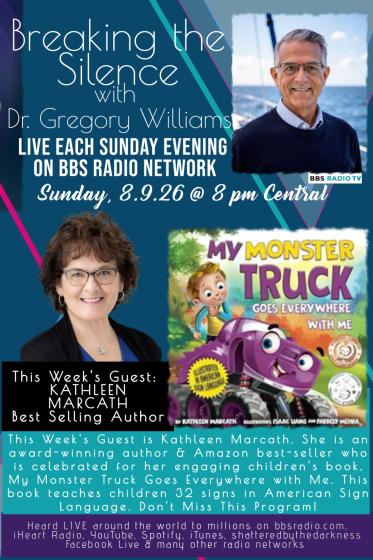
ASL Picture Books and the Power of Accessible Communication
Dr. Gregory Williams hosts Breaking the Silence with guest Kathleen Marcath for a heartfelt conversation about American Sign Language, deaf and hard-of-hearing children, inclusive picture book…

Breaking The Silence with Dr Gregory Williams
Outcry, Healing, and the Courage to Face What Fear Has Hidden
Guest, JoDee Neil, Owner of Neil Now Legal, Prosecutor, Attorney and Author of "Outcry Witness: A Former Prosecutor's Guide to Healing and Justice After Sexual Violence"
This week's guest i…
Breaking The Silence with Dr Gregory Williams
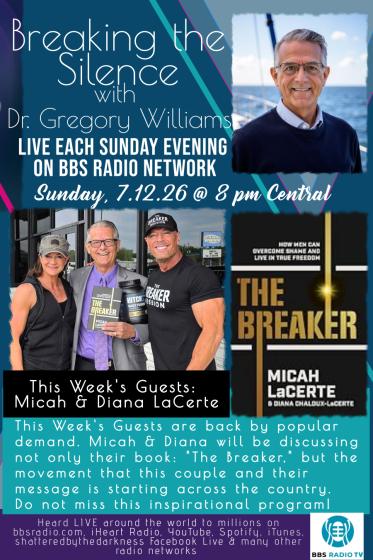
Breaking Shame and Building a Mission of Healing
Guests, Diana and Micah LaCerte, Owners of HitchFit and Co-Authors of The Breaker
This week's guests are back by popular demand. Micah and Diana will be discussing not only their book: "The Breaker." bu…
Breaking The Silence with Dr Gregory Williams
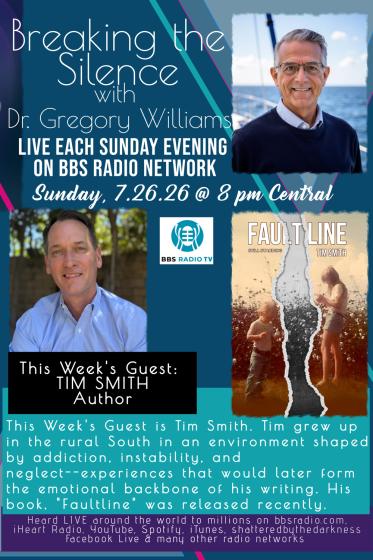
Fault Lines, Family Trauma, and the Courage to Still Stand
Dr. Gregory Williams speaks with author Tim Smith about childhood kidnapping, neglect, shame, therapy, memory, identity, and how telling the truth can turn trauma into hope, healing, and person…
Breaking The Silence with Dr Gregory Williams
Unconquerable: One Trusted Adult Can Change Everything
Dr. Gregory Williams welcomes Chief Matt Antkowiak for a powerful conversation about child-abuse prevention, grooming awareness, survivor shame, institutional accountability, school safety, and the…
면책 조항: 이 페이지에 포함된 팟캐스트와 작품은 Dr Gregory Williams에서 가져온 것입니다. 이 팟캐스트는 소유자의 재산이며 Listen Notes, Inc.와 제휴하거나 보증하지 않습니다.
