


이 에피소드에 관해
The cheapest AI model is often the most expensive. That is the trap this episode is built to help you avoid: sending routine work to a frontier model, or cheap work to a model that fails and hands the mess to a person, and paying for both mistakes on every run.
In this episode, Chris Bradley makes sense of a landscape that shifted fast in June and July. A new most-capable model. A family that ships in three deliberate sizes. And a wave of open-weight models from the US and China that companies can run inside their own walls. His frame for all of it is rightsizing: matching the model to the work the way a manager matches a person to a task. He sorts the work into three tiers, the Clerk for high-volume routine work, the Operator for the reliable execution that runs the business, and the Expert for the hard, high-stakes reasoning.
The heart of the episode is a single idea: stop comparing sticker prices. The number that matters is cost per success, total cost divided by the jobs actually completed. Chris explains how the Lab measures exactly that with VeritivBench, an internal framework that scores models against real recorded workflows rather than public leaderboards. Then he walks the two levers that make rightsizing real at scale, routing work to the right tier automatically and caching the context you reuse, and closes on tokenization, the hidden reason two models at the same price can leave you very different bills.
Part of the Enterprise Transformation arc.
영어
미국
전사 🔗
Are you the producer of this podcast?
Add a podcast transcript
Need Audio-to-Text?
Transcribe with Listen411 in Just 60 Seconds
이 팟캐스트의 다른 에피소드

In Episode 1, I mentioned a competitive analysis I ran in thirty minutes that would have taken two weeks. A global network analysis — fifty-plus competitor locations, fifteen manufacturing hubs, proximity calculations, coverage gaps, and a full action plan for leadership.
I never finished that stor…
Four years of ChatGPT history. Two years of Claude projects. Custom instructions, saved memories, accumulated context built up across thousands of conversations. And then a new harness ships — Cowork, Claude Code, Codex — and suddenly the question isn't which AI do I use. It's how do I move what I'…
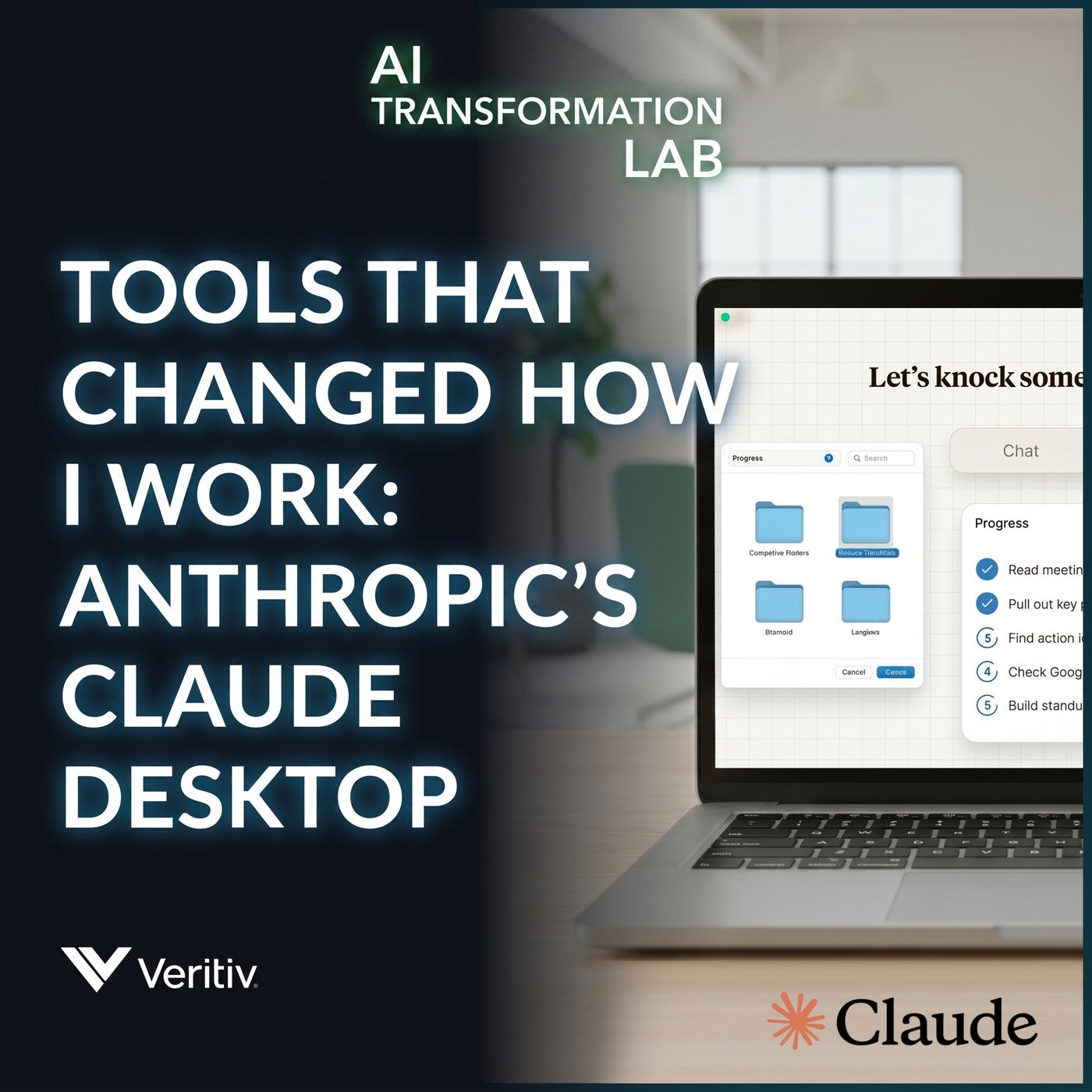
The big three AI labs are all building superapps — but each is packaging them differently. Google blurs everything together inside Antigravity. OpenAI is consolidating into Codex. Anthropic took a third path: three distinct surfaces inside one Claude desktop app — Chat, Cowork, and Code.
In this ep…

On April 16th, OpenAI shipped a capability expansion that turned Codex from a coding tool into a true agentic super app. Computer use, in-app browser, GPT Image 2.0, persistent memory, and a plugin ecosystem of ninety-plus integrations — layered on top of the desktop release from February.
The prac…
AI won't fix a broken process — it just helps you run it faster. That's the trap most organizations are walking into: pointing powerful agents at workflows that were never worth doing in the first place, and cementing the waste in place.
In this episode, Chris Bradley makes the case that Continuous…
면책 조항: 이 페이지에 포함된 팟캐스트와 작품은 Veritiv에서 가져온 것입니다. 이 팟캐스트는 소유자의 재산이며 Listen Notes, Inc.와 제휴하거나 보증하지 않습니다.
