


このエピソードについて
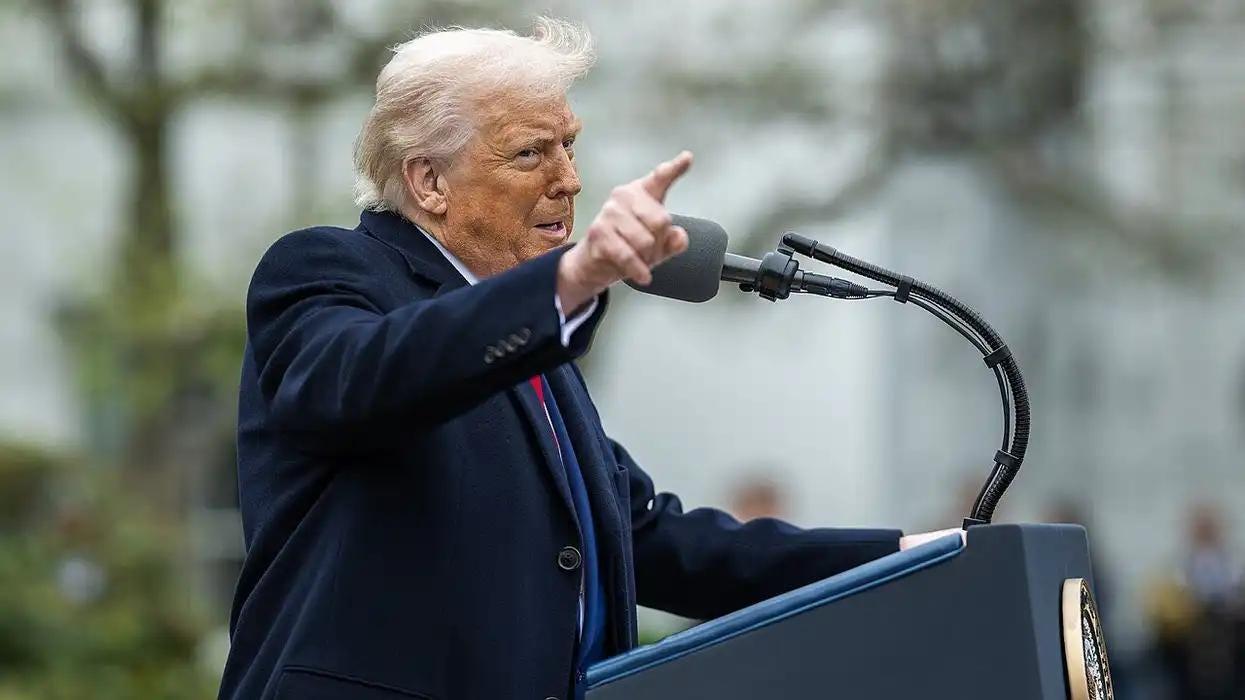
President Donald Trump in the White House Rose Garden on April 2, 2025 (Official White House Photo by Daniel Torok/Flickr)
The Ballot-Blocking Scheme Failed. The Intimidation Campaign Did Not.
This Was State Power, Not “Election Security”
The Supreme Court rejected the Trump administration’s attempt to impose new Postal Service restrictions on mail voting shortly before the 2026 midterms. The proposed system would have required the Justice Department to cross-reference mail-ballot recipients against a federal database and prevent ballots from being sent to people absent from that list. Seven justices refused emergency relief; Clarence Thomas and Samuel Alito dissented.
That is the necessary context. The political substance is simpler: the executive branch tried to place a federal filter between eligible voters and their ballots.
Help fuel the work. Independent analysis doesn’t fund itself:☕ Buy us a coffee
The Administration Chose the Crisis
The government’s defeat was not an unfortunate collision with the electoral calendar. The administration pursued a major procedural change so late that Brett Kavanaugh concluded election officials lacked sufficient time to implement it reasonably and that doing so would be “arbitrary and capricious.”
Responsibility therefore belongs to the officials who designed, defended, and attempted to force through the rule. The administration controlled the timing. It selected the machinery. It sought emergency judicial permission to disrupt an election already approaching.
The White House’s legal analogy was revealing. It compared mail ballots to cremated remains and replica explosives—items the Postal Service subjects to special handling. That argument reduces voting from a protected exercise of citizenship to a suspicious object requiring federal containment. It also evades the decisive distinction: mishandling a package is an operational problem; withholding a ballot changes who can participate in government.
MAGA’s Definition of a Legitimate Judge
The reaction from Trump-aligned influencers exposed the movement’s actual standard for judicial legitimacy. Justices were praised as “patriots” when they supported the administration and denounced as “rogue,” “compromised,” or corrupt when they did not.
This is not a coherent objection to judicial power. It is a demand for judicial obedience.
Several of the justices now accused of helping Democrats were appointed by Republican presidents, including Trump. That fact matters because it strips away the pretense that the outrage concerns partisan composition. The complaint is that judges with conservative credentials failed to deliver the required political result in this particular case.
Institutions are legitimate in this framework only while functioning as instruments of the leader. Independence becomes betrayal the moment it produces a constraint.
The Convenient Scapegoats
The article’s quoted activists repeatedly blame judges for acting too late, helping Democrats, or deliberately delaying the policy. That story reverses agency. Judges did not invent the last-minute rule. State and local election officials did not create the implementation problem. Voters requesting mail ballots did not manufacture administrative chaos.
The administration initiated the change and then asked the Court to transfer the cost of its timing onto election administrators and voters. When that failed, its supporters redirected blame toward the institution that refused permission.
Calling the proposal “election security” performs the same laundering operation. The phrase assumes that restricting ballot distribution is protective without establishing that the targeted voters are ineligible or that the existing system is inadequate. A policy with obvious potential to suppress participation is presented as neutral maintenance; opposition is then recast as assistance to Democrats.
Defeat Can Still Produce the Intended Effect
The Court blocked the formal mechanism, but government power does not operate only through rules that survive litigation. It also works through uncertainty, delay, and fear.
Election attorney Pooja Chaudhuri identified the remaining consequence: voters hearing about abrupt mail-rule changes, possible immigration enforcement at polling places, and federal monitoring may simply withdraw. Citizens in mixed-status families can be legally entitled to vote and still reasonably fear attracting government attention.
That chilling effect should not be mistaken for accidental confusion. The reported actions consistently attach risk and suspicion to ordinary participation. Even without proof that deterrence was every official’s private motive, discouraging vulnerable voters is a foreseeable political consequence. The administration does not need to invalidate every unwanted ballot if enough people can be persuaded that casting one is dangerous or futile.
Suppression as Administrative Theater
This episode reveals a broader method: introduce a disruptive restriction, wrap it in the language of security, seek emergency approval, and blame institutional saboteurs when the attempt fails. The resulting spectacle still spreads the message that ballots are suspect, election systems are compromised, and participation may expose voters to scrutiny.
The Court prevented one exercise of executive power. It did not erase the propaganda generated around it. That is the durable political pattern: administrative coercion and public intimidation working as complements. When the rule is blocked, the fear remains—and the officials who created it move on to blaming everyone with less power than themselves.
Thanks to Alter Net
Source: MAGA influencers turn on Kavanaugh: ‘The death of America is on him’
Systemic Error is a reader-supported publication. To receive new posts and support my work, consider becoming a free or paid subscriber.
We warned them.We told them.We shouted from the rooftops.We plead.We begged.They didn’t listen.Now, we all will suffer.Y’all know what to do, right?VOTE BLUE! 💙Vote as if your life — nay, our country — depend on it.Because, this time, and every time, it does.
This is a public episode. If you'd like to discuss this with other subscribers or get access to bonus episodes, visit paulstsmith.substack.com/subscribe


