

00:00:07
Welcome back to Regenerative Champions, the podcast that highlights the narratives of everyday heroes who are transforming our first systems. I am Sherifat Alabi, a graduate student at the Ohio State University. Also with me is Omope.
00:00:24
Hi there. I'm Omope Carter Daboiku also known as Mama O agriculturalist, author, mentor, storyteller and proud practitioner of indigenous regenerative farming techniques. I grew up in Appalachian Ohio in the small river town of Ironton.
00:00:42
Thank you for joining me on this episode, Omope. On every episode of Regenerative Champions, we talk with someone who is not just growing Food. But growing up for the future, our guests are regenerative farmers who work with nature in ways that nourish both people and the planet. So if you ever wondered what it means to farm for the future, or how a single farm can inspire communities, then it is then this conversation is for you.
00:01:18
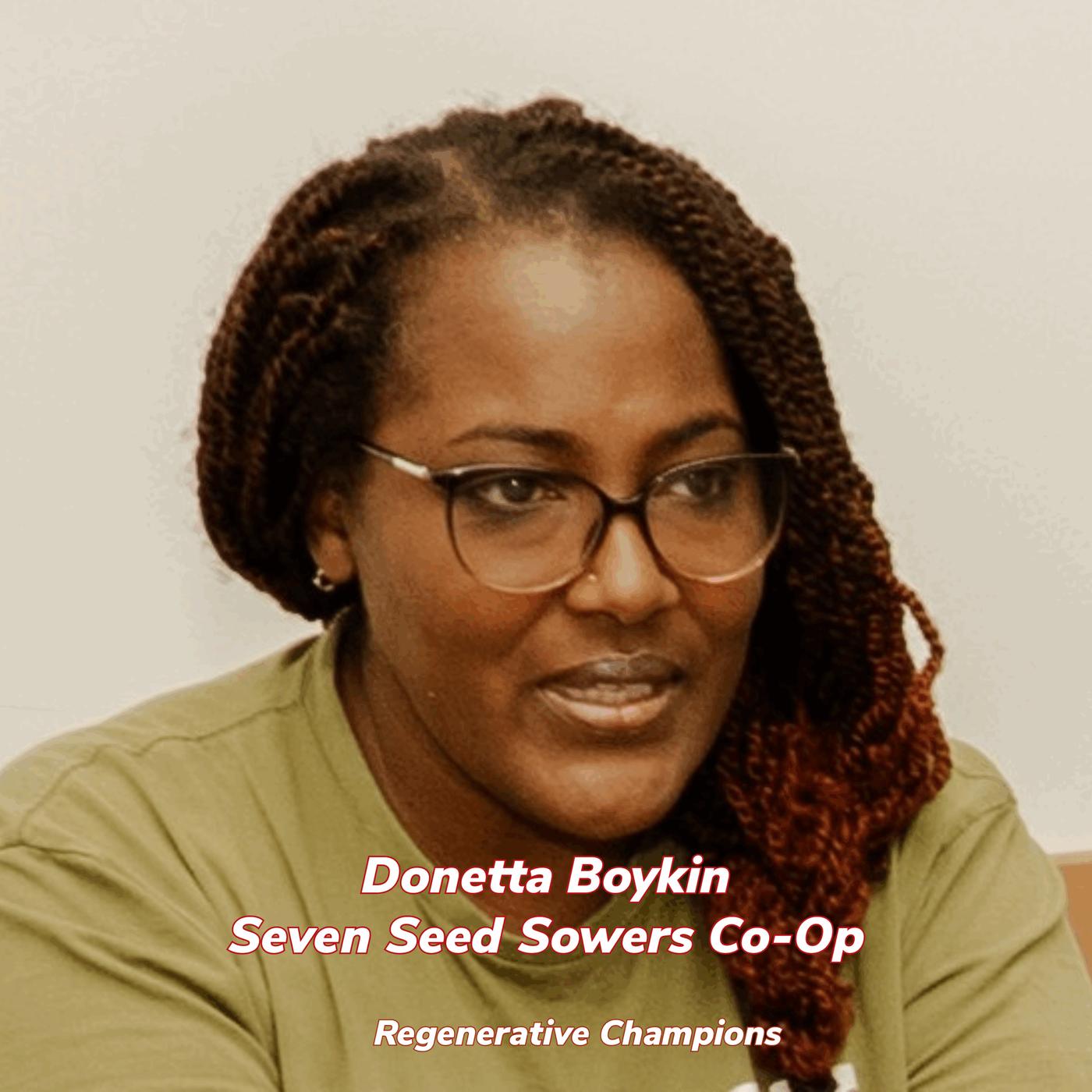
On today's episode, our team set out to Dayton, Ohio. It was a great day to meet our regenerative champion, the president and founder of Seven Seeds Sower Co-Op, I am talking about the nature boy King. The nature founded the seven seats over cook up in 2022 to support beginning Farmers established their regenerative farming operation and gain entry into the market. For Donnetta, farming is therapeutic and has benefited from various skill shares. Now sit back and stay tuned for an enriching conversation between Donnetta and Omope
00:02:03
Would you please introduce yourself?
00:02:05
I am Donnetta Boykin. I am owner of Indigos, herbals and organics. That is my farm and then also founder, President of Seven Seed Sowers Co-op designed to support beginning and BIPOC farmers and providing them with technical assistance, most of our participants are graduates from the incubator farming program that Central State did with the city of Tremont and the actual concept of the Co-op was birth at that time because I wanted to really get participants that were coming out of that out of the incubator program, some additional support after the program kind of ended. Help them make those connections within the community and the USDA so that their farm actually does grow and become and and actually has a voice of its own, so to speak. I didn't want it to be the case Where you know they join the Co-op and so now it 7 seas so is Co-op and they're everything coop related. So each individual farmer does have the opportunity to build their own farm and kind of like grow their farm practices their organization create SOP's and you know the whole 9. So that in the event that they want to transition, you know, like they want to pack up and go somewhere else or, you know, do something on their own. Their farm has been established. They have a farm number. They have records. The whole 9 for them to be able to do that. So each individual kind of does their own thing. Some people are growing just for the purpose of, like, work For instance, he just does starts, plant starts, you know, and then miss Cheryl. She actually does grow like actual produce. And then we have a few other people that are coming in They're still young yet, so they're growing produce and doing farmers markets, but they haven't actually established their farm identity yet. So currently right now, 7 seeds sower is managing 3 different farm spaces.
00:03:56
What year did you start your business?
00:03:58
I started indigos herbals and organics in 2017. Co-op that’s in 2022.
00:04:06
Why do you farm?
00:04:07
I realize that there's a huge difference between what our children are getting inner city and what children and more of affluent areas are receiving. I then notice that there's so many children are not even just children. These are adults now that have never experienced Food that is normal to my world and I feel that everybody should try them out. Then there's the portion of it that it's just therapeutic. My grandmother passed away. I went through a divorce. I lost my brother, I've lost my mom. I lost my other brother like we've had. I've had a lot of losses over the course of the last roughly 8 to 10 years, and one of the things that has helped me keep my sanity is the farm. And so any kind of hard time that I've been through, giving me a safe space to process my emotions and my feelings and gives me an opportunity to pour all that out. But then it gives me something back in return. So it's that place that I go to get nourished. You know, we live on the planet that pays us, provides for us consistently and continually. And it's just necessary to love it back.
00:05:20
So describe your farming operations.
00:05:24
We use regenerative practices. Essentially, there are no chemicals whatsoever. I tend to stick with mostly heirloom plants and seeds, grow a little bit of everything. I'm kind of like I was telling someone jokingly that I am like a a seed hoarder. And then she was like, no, you're a seed Librarian. I was like I like That Better to create like a balanced farm where I'm growing not only produce but also medicinal herbs.
00:05:48
What does regenerative agriculture mean to you?
00:05:53
For me, regenerative agriculture is more about reestablishing that connection with the land and working with it as opposed to kind of taking a domineering, causing the link to submit to what we want. But actually Coming in and being a actual good steward of the space and really working with it as opposed to forcing it to Be what we want it to be.
00:06:23
So what's Motivated you to start regenerative farming?
00:06:28
I didn't know for a long time that there was anything Else meaning before you got in the incubator, you already understood that you had to feed the earth the Earth feed you? Yes. And so it wasn't until I got. And so the now the flight. Wait, what you you just till every year. Jesus. OK, that's the thing. Uh, you don't compost. You don't put the ohk. OK, that was more of a wake up call for me because I was actually doing a lot of that in my own. I just didn't know what was called I Was just doing it.
00:06:59
So what were just the practices? Are you using on you?
00:07:03
Currently right now we are. I've done my first real cover crop this year. I'm so excited. It is a mixture of don't make me lie. Sereal, rye, barley. It's got some radishes in there. I believe some Gyptian cabbage. I might be wrong And oh, crop rotation, that's a must. Definitely. Oh, no-till. That's also something I've implemented within the last year. So using mulch to actually increase our water retention within the soil is a wonderful Thing, one of the things I didn't think that I would need to do at our farm size is companion planting. Like I think we get very kind of hard lined in agriculture and we're like, oh, we need rolls of corn and rolls of spinach. And when I grew at the house, I didn't have the pest problems that I've, I've seen bugs that I didn't know Existed since I've been in the incubator program, but I think half of that is because we don't interrogate and I don't think I said that word right. But you know what I meant? Herbs and flowers and things of that nature into our actual spaces, appropriately, to kind of create a balance. So we end up having all these bugs that are tearing up stuff. And it's like, oh, if you.
00:08:21
So you wanna focus on effective use of biodiversity. What are some of the challenges you faced as a farmer?
00:08:31
Access to resources. I would say money and light infrastructure a lot that would help make farming easier that we would love to have access to. But when it comes to like applying for grants and things of that nature, you know, trying to navigate those waters can be very difficult when you're a first time farmer And then even the daunting idea of even approaching a USDA grant blows my mind like the first time I saw one, I was just like, why? Why does it? Why? I mean, do you really need all these pages? You know, it's just a lot to take on. And so then to know that there are different Types of equipment and you know, again water. You know, you would think that that wouldn't be that hard of a thing to come by, but it is for your sight these types of things that we should readily or could you know you would think you would readily have accessible aren't necessarily accessible. And so then as a farmer, if you're farming, even if you're farming full time, I can't imagine farming full time and then trying to find time to do grants. There's a lot of compartmentalizing. Yeah, that's the word I want to use. That has to happen in order for you to be balanced and successful and and or you have to have a really good team around you Where you can delegate certain responsibilities, so if you are a farmer of or you know if you're organization of one that's a lot. Here's another thing that I've noticed. Recently you have urban farmers, Most of us are working 9:00 to 5:00 jobs and then we are doing this in our spare time or, you know, available time. But then there's a lot of opportunities such as programs, classes, meetings, tours, things of that nature that are taking place That we miss out on because they're on a Wednesday at 10:00 in the morning or in and don't get me wrong, I get it. Because if I'm the person that's actually facilitating this tour, I'm gonna do it during my normal working business hours. But it's kind of like, you know, trying to go to the dentist, you gotta take time off to go to the dentist because the dentist works the same time that you're. Working but when you have multiple people sharing a space and you have to come together collectively to agree upon different practices. So I may be, no-till. But the person next to me, maybe they love the till and so they till and every time they till we get a new weed that was not there last year this year the weed was everywhere. It's crazy and we didn't have this one before and so I keep noticing, you know, like and I I'm, I'm like urging people like, please don't till it.
00:11:09
Am I understanding you to say that the Co-op doesn't necessarily have mandatory Land Management practices?
00:11:18
The Co-op does, but the incubator site technically isn't under the coop yet. And so as it is still ohk, I guess you did ask me specifically. I apologize, that's alright. I got the answer. OK, but that was. That's really the only the main challenge I would say is the issue is when you do have you know we've had multiple people Growing at the incubator site and it isn't like specifically that you have to do This.
00:11:46
Government support. So how has the relationship with the government officials handed out?
00:11:52
If we're talking specifically about the two sites that are in the program right now, the city's been amazing, city of Dayton, amazing. You know, they've been very hands on. There's a young lady there, Jasmine Young With citywide development, she just came on into their department and she has been she's very much a great help to us, so I could not have asked for, you know, better help at all when we're talking city of Dayton citywide Development.
00:12:21
So what opportunities have you enjoyed in being a farmer?
00:12:25
I love the conferences. I love the farm tours. I love seeing what other farmers are doing, just the land, the land, how their mind works, and how they actually implement ideas. Because a lot of times it, you know, I think everything is about perspective and we can all show up And witness same picture if you will. But we're all going to have different interpretations of it. So just seeing what their interpretations are and how they implement those on their site is amazing.
00:12:53
Why should regenerative practices be supported by the Community?
00:12:57
Regenerative practices should be supported by the community because the the reach is further than just your community. It really is about taking care of the planet in a way that maybe they don't have to be as hands on. You know what I mean? Like if they support what we do then it makes it able for us to have a greater reach with what we do which impacts More than just Our local community but supports surrounding area.
00:13:22
What do you think people fail to understand about regenerative agriculture?
00:13:28
I feel like they understand that it one it is a necessity, but two it's not as hard as you think it is. I think it can be a bit overwhelming to people to implement some of the practices and I feel like that is what deters A lot of people from doing them But you know, it's not that hard. It really is just kind of relearning what you probably already knew anyway.
00:13:52
Do you think there is adequate understanding and depth about plant science and agriculture as a science for the general population to understand The benefit of the regenerative practices.
00:14:05
No. And I think it's not detailed enough in a lot of ways. Like, OK. For example, here's here and this is like a random example that kinda is tied, but not so people recycle, right? Ohh yeah, we recycle, they just throw a bunch of stuff and recycle bin and they ship it off. OK, but you don't know that. You gotta peel the label off of the thing before you send it. You don't know. You gotta clean the can out before you put it in the. So then half of what you're. Actually sending to be recycled isn't even being recycled because it's dirty. So you felt like you was doing something because somebody told you this much of it, or you only understood this much of it. But you're really not having the impact that you thought you were having. Did I answer that good?
00:14:48
What types of motivating feedback you get from your buyers and the motivating feedback could be about the quality of food, the color, the price, whatever.
00:14:57
That yes, They are very happy about, you know, just flavor wise the quality of the food, the variety that we offer. And I I would say Variety, simply because with us being able to be a lot more economically accessible All the people you know, it also opens up the door for us to have a better, more diverse product line, I would say because we're able to use that money to purchase a variety of different seeds and things of that nature. So yeah, people are always very excited about All of that.
00:15:30
So what do you hope your farm looks like in the future that I seek?
00:15:33
So there are a couple of organization that I've had the wonderful opportunity to contact. They were come in connection with like Rafi USA down in South Carolina And they do a lot of amazing work. And then like Midwest farmers of color, they're doing like a lot of amazing work. And I would just love for Seven Seed Sower Co-op to have that type of positive impact in our community. I really hope that it is able to provide not only, you know, avenues and resources for urban AG for urban farmers, but then also like community members and kind of support, you know them across the boards Library we have that here at the Chop Wood library locations to watch that expand and grow would be a wonderful blessing to have an opportunity to do sub awards for grants to local farmers also would be a huge blessing. Internships to provide a lot of some of those young people That are coming up and opportunity to get their hands in the dirt, but then also provide land space for new farmers. We have like people, I went into a grill at a farmers market. She had just gotten her degree from central agriculture. She's like, but I don't know what to do now. I wanna be able to give her the avenue of what to do now.
00:16:51
What's an inspiring discussion? Thank you, Donnetta and Omope. And that is it on today's episode.
00:17:06
I hope this conversation left you as inspired as I am that farming is not just about growing food, but about growing connection, resilience and care for the future. If you enjoy this episode. Please take a moment to subscribe, comment and share it with someone who cares about where their food comes from, or someone who needs to hear that change is already happening. This work is supported by the Hall Hunger Initiative, the USDA RCPP Project 2794, and it lead partner, the one.two.five Benefit Corporation. Many thanks also to Joy Rumble at the Ohio State University. Until next time I am Sherifat Alabi, and you can be the next Regenerative Champion.
