

このエピソードについて

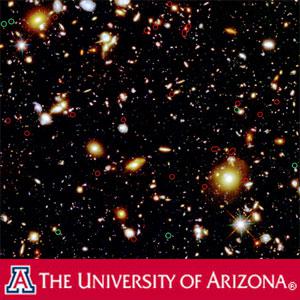
Transcript: In cosmology galaxies are used as markers of expanding space. In addition to the overall cosmic expansion gravity has caused matter to clump or cluster on many different scales. In addition to the gravitational attraction that caused galaxies to collapse and form in the first place gravity has also caused galaxies to aggregate together or congregate in regions of space. The distribution of galaxies in three dimensions in the universe overall is called large scale structure.
英語
アメリカ合衆国
文字起こし 🔗
Are you the producer of this podcast?
Add a podcast transcript
Need Audio-to-Text?
Transcribe with Listen411 in Just 60 Seconds
このポッドキャストの他のエピソード
Transcript: A clever technique for measuring the distance of galaxies that applies to galaxies with smooth light distributions like ellipticals is called surface brightness fluctuations. The idea of surface brightness is that it is the flux per unit area in a galaxy. The important thing to realiz…
Transcript: When a massive star dies the supernova that results can rival an entire galaxy in brightness, so it can be seen to a very large distance, a billion lightyears or more. When a single massive star dies it does not do so in a well regulated way, but the supernovae that result from a binar…
Transcript: Most of the techniques for measuring distance in astronomy depend on well understood properties of stars or entire galaxies. However, if astronomers believe they’ve measured the current expansion rate of the universe then redshift itself can be used to indicate distance. Redshift is d…
Transcript: One of the best distance indicators for elliptical galaxies is the Faber-Jackson relation, named after the two astronomers who discovered it. The Faber-Jackson relation relates the range of stellar velocities or their velocity dispersion in the nucleus in an elliptical galaxy with the …
免責: このページに埋め込まれているポッドキャストとアートワークは Dr. Christopher D. Impey, Professor, Astronomy からのものであり、その所有者の所有物であり、Listen Notes, Inc. と提携または承認されていません。
