


INFORMAZIONI SU QUESTO EPISODIO
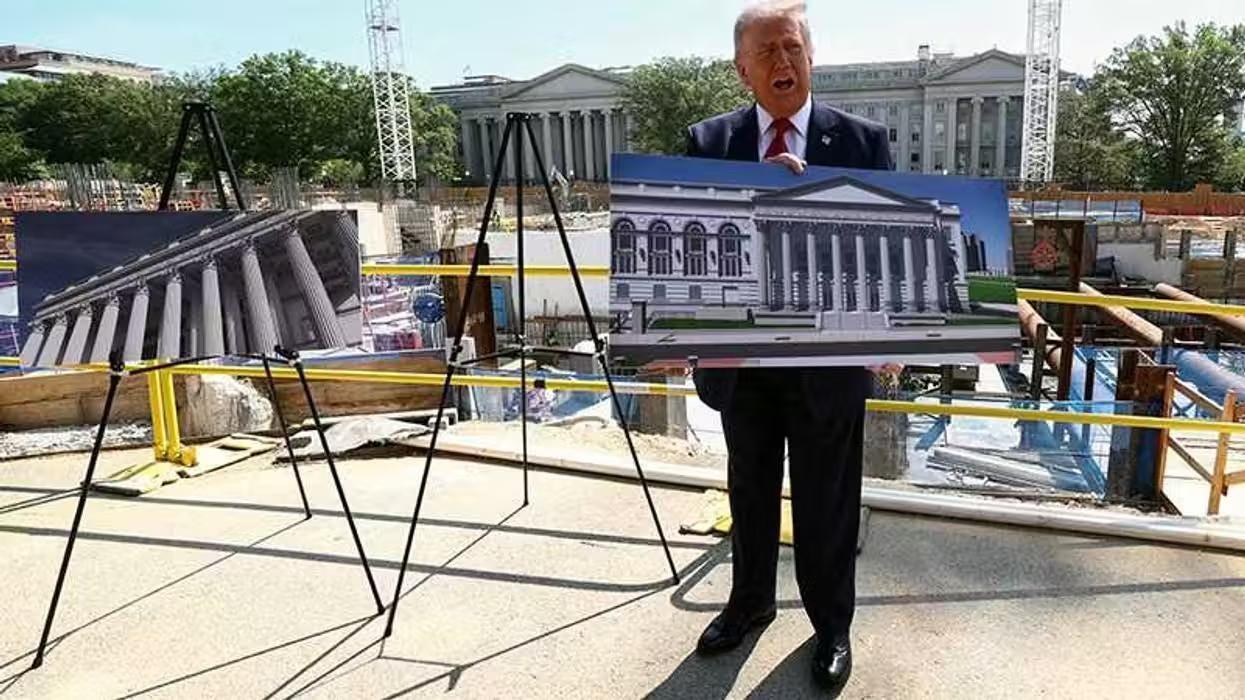
FILE PHOTO: U..S. President Donald Trump speaks at the site of ongoing construction of the planned White House ballroom in Washington, D.C., U.S., May 19, 2026. REUTERS/Kevin Lamarque/File Photo
A Presidential Ballroom Built on an Unanswered Transfer of Power
The Money Moved
The reporting describes a White House construction project expected to cost roughly $927 million, encompassing a ballroom and bunker-related security upgrades after President Donald Trump demolished the East Wing in late 2025. After a proposed $1 billion congressional allocation was removed, the administration reportedly redirected Secret Service funding instead. The article gives conflicting figures—approximately $351.6 million, $415 million, and “at least $396 million” redirected in June 2026 from a $1.17 billion appropriation—making a full accounting essential rather than optional.
The President Had the Power; Congress Did Not Make This Choice
Congress did not approve the ballroom appropriation described here. According to the reporting, the House added $1 billion to a budget bill, but that money was ultimately removed. The decisive action came afterward: Trump reclassified the project as a “military center” connected to White House national security, and Secret Service money was shifted into White House security upgrades.
Help fuel the work. Independent analysis doesn’t fund itself:☕ Buy us a coffee
That sequence matters. Calling a desired building a security facility does not answer who authorized the transfer, what legal authority supported it, or why an agency already reporting resource concerns could afford to lose the money. The label supplies a justification. It does not supply accountability.
The Office of Management and Budget may also hold critical answers. Sen. Maggie Hassan’s letter asks whether OMB gave the Secret Service advance notice or a rationale and seeks its correspondence with the agency and other White House offices. Until those records are produced, the reporting does not establish exactly who approved each transfer or whether Secret Service officials objected.
“Donations” Became an Agency’s Problem
Trump said donations would fully fund the project. According to the article, fundraising fell short, and the administration then pursued public money. When Congress did not provide the proposed amount, funds appropriated to the Secret Service were reportedly redirected.
That is not a story about a construction budget unexpectedly becoming complicated. It is a story about executive power converting a presidential priority into an agency expense after the promised financing proved insufficient. The political trick is familiar: describe an elective project as indispensable, attach it to “national security,” and force the public to debate implementation while the foundational decision escapes scrutiny.
The relevant question is not whether a secure White House needs renovations. It is why this particular structure, at this particular scale, acquired priority over money assigned to an agency with existing protective and financial-crime responsibilities.
The Real Costs May Be Elsewhere
The Secret Service does more than guard presidents. Hassan’s questions identify the potential institutional tradeoffs: terminated or disrupted investigations, reduced personnel or hours in financial-crimes work, and effects on state, local, federal, and foreign partners.
The article does not establish that those harms occurred. Hassan is asking whether they did. But that uncertainty indicts the opacity surrounding the transfer, not the legitimacy of the inquiry. If hundreds of millions of dollars can leave an agency without a public account of which operations will shrink, the administration has concealed the policy choice inside bookkeeping.
Every redirected dollar has an opportunity cost. A ballroom described as security infrastructure does not erase that cost; it merely makes the Secret Service absorb it.
Oversight Reduced to Asking for Receipts
Hassan is demanding a budget accounting, operational-impact assessment, advance-notice history, rationale, and internal correspondence. These are basic records needed to determine what the administration did. Yet Congress appears here not as the institution controlling the purse, but as an investigator trying to reconstruct an executive decision after the money moved.
That imbalance is the larger scandal. The administration reportedly failed to obtain the requested appropriation through legislation, then achieved part of its objective through an agency transfer. Congressional dysfunction did not authorize that maneuver, but it weakened the institution most capable of stopping or exposing it.
The article’s own inconsistent totals reinforce the problem. Whether the amount was $351.6 million, $396 million, or $415 million is not a trivial discrepancy when the money came from an agency appropriation. Without itemized records, even the scale of the diversion remains contested.
The Architecture of Executive Impunity
This is larger than a ballroom. It shows how presidential preferences can be laundered through the language of security, financed through obscure transfers, and presented to Congress as a completed administrative fact.
The power lies with the officials who ordered and approved the redirection. The consequences may fall on Secret Service personnel, financial-crime investigations, partner agencies, and taxpayers who were initially told private donations would cover the project. Focusing only on whether the building is extravagant misses the institutional offense: an executive priority reportedly bypassed a failed funding route and reached into another public function instead.
The structure rising at the White House is therefore also a monument to weakened control of public money. Its most revealing feature is not the ballroom’s size. It is how little those exercising the power have yet been required to explain.
Thanks to Alter Net
Source: Republican demands answers after Trump taps Secret Service funds for ballroom
Systemic Error is a reader-supported publication. To receive new posts and support my work, consider becoming a free or paid subscriber.
We warned them.We told them.We shouted from the rooftops.We plead.We begged.They didn’t listen.Now, we all will suffer.Y’all know what to do, right?VOTE BLUE! 💙Vote as if your life — nay, our country — depend on it.Because, this time, and every time, it does.
This is a public episode. If you'd like to discuss this with other subscribers or get access to bonus episodes, visit paulstsmith.substack.com/subscribe


