


INFORMAZIONI SU QUESTO EPISODIO
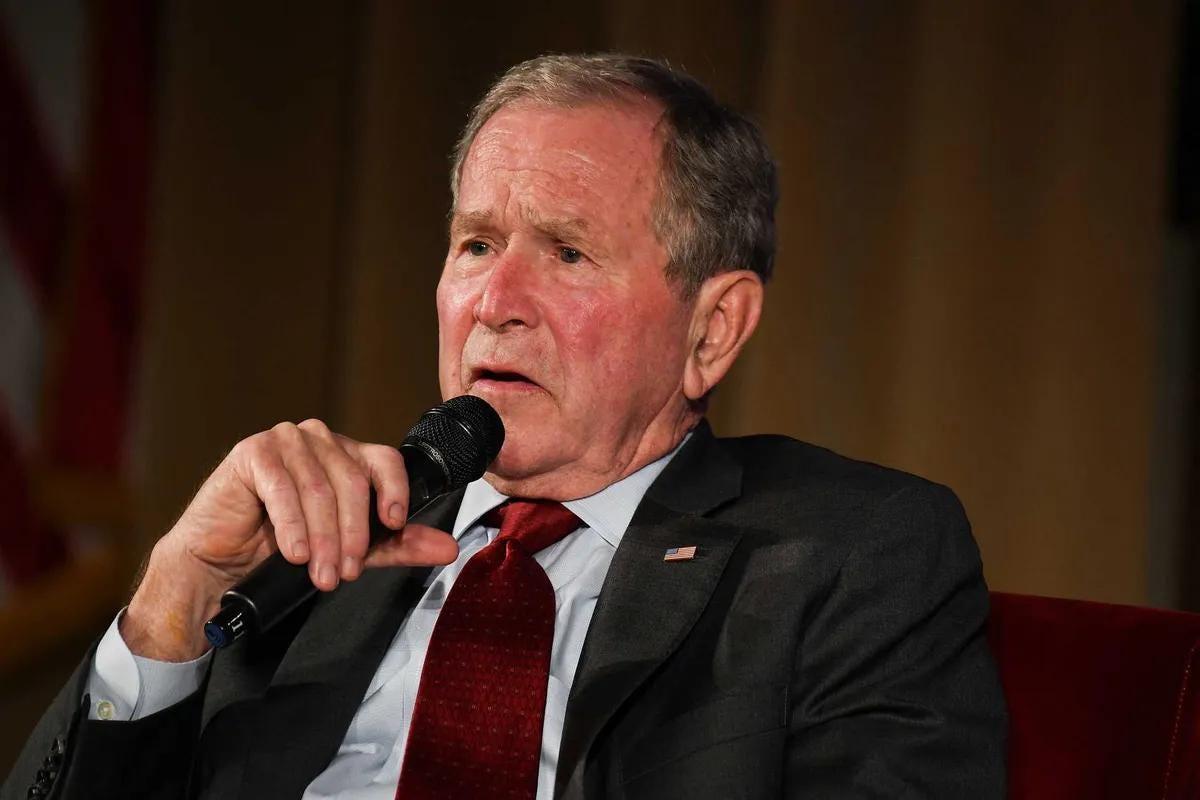
Former U.S. President George W. Bush and former U.S. Secretary of State Condoleezza Rice (not pictured) have a conversation as the George W. Bush Presidential Center commemorates the 25th anniversary of the September 11, 2001 attacks in Dallas, Texas, U.S., September 9, 2026. REUTERS/Jeremy Lock
George W. Bush Paints Himself Into the Frame
A Presidency Reduced to a Reaction Shot
George W. Bush marked the 25th anniversary of September 11 by exhibiting paintings at his presidential center, including his rendering of Andy Card telling him that a second plane had struck the World Trade Center. The coverage responded largely as spectacle: surprise, jokes about Bush’s expression, and admiration for the audacity of painting “that moment.”
The Man in the Chair Had the Power
The classroom image is not merely an awkward portrait of a stunned man. It depicts the president of the United States receiving information about an attack on the country. Andy Card delivered the news; Bush held the institutional power.
Help fuel the work. Independent analysis doesn’t fund itself:☕ Buy us a coffee
Yet the coverage turns that fact into an aesthetic curiosity. Bush becomes a face to inspect rather than an officeholder whose authority defined what came next. The fixation on whether he “nailed” his own expression substitutes reaction-reading for political analysis.
Bush Controls the Frame
Bush selected the images, painted them, presented them as his “reflections,” and displayed them through the George W. Bush Presidential Center. That is an exercise in historical authorship.
His chosen sequence is revealing: private shock, smoke over Manhattan, a badge, a flag over the Pentagon. It centers victimhood, service, and national unity while leaving presidential agency outside the canvas. The collection, as described, commemorates what happened to America without confronting what power did with the event.
That omission may be artistic choice rather than a declared political argument. But it still produces a politically useful frame: Bush appears as witness, mourner, and patriot—not as the person who occupied the presidency.
Irony Does the Reputational Work
The social-media reaction treats the paintings as astonishing content. A former president converts a defining catastrophe into self-authored imagery, and journalists marvel at the weirdness of it.
This is not scrutiny. It is reputational softening through irony. Once power becomes quirky, it becomes easier to consume and harder to interrogate. The article’s framing is weak because it records astonishment without examining who benefits when a former president’s historical role is recast as an eccentric art story.
Memory Is an Institution
The paintings are not hanging in a neutral room. They are being displayed at a center bearing Bush’s name, accompanied by Bush’s account of what the anniversary means. He supplies the images, the venue, and the moral language.
“An enemy” revealed “the spirit of the American people,” he wrote. That formulation assigns agency to the attacker and virtue to the nation while saying nothing about presidential choice. The dead are honored; the flag is raised; the officeholder becomes contemplative. Institutional power disappears behind solemnity.
The Politics of the Blank Canvas
Political memory is often shaped less by outright falsehood than by controlled omission. Powerful officials do not need to erase an event when they can narrow its meaning—selecting the moment before responsibility begins and inviting the audience to remain there.
Bush’s paintings may be sincere reflections. They are also artifacts of self-curation by a former president with his own institution and platform. The systemic error is not that he painted himself looking stunned. It is that political coverage looked at a portrait of power and saw only the expression.
Thanks to Raw Story
Source: ‘Absolute madman’: George W. Bush’s wild 9/11 paintings spark firestorm
Systemic Error is a reader-supported publication. To receive new posts and support my work, consider becoming a free or paid subscriber.
This is a public episode. If you'd like to discuss this with other subscribers or get access to bonus episodes, visit paulstsmith.substack.com/subscribe


