
INFORMAZIONI SU QUESTO EPISODIO
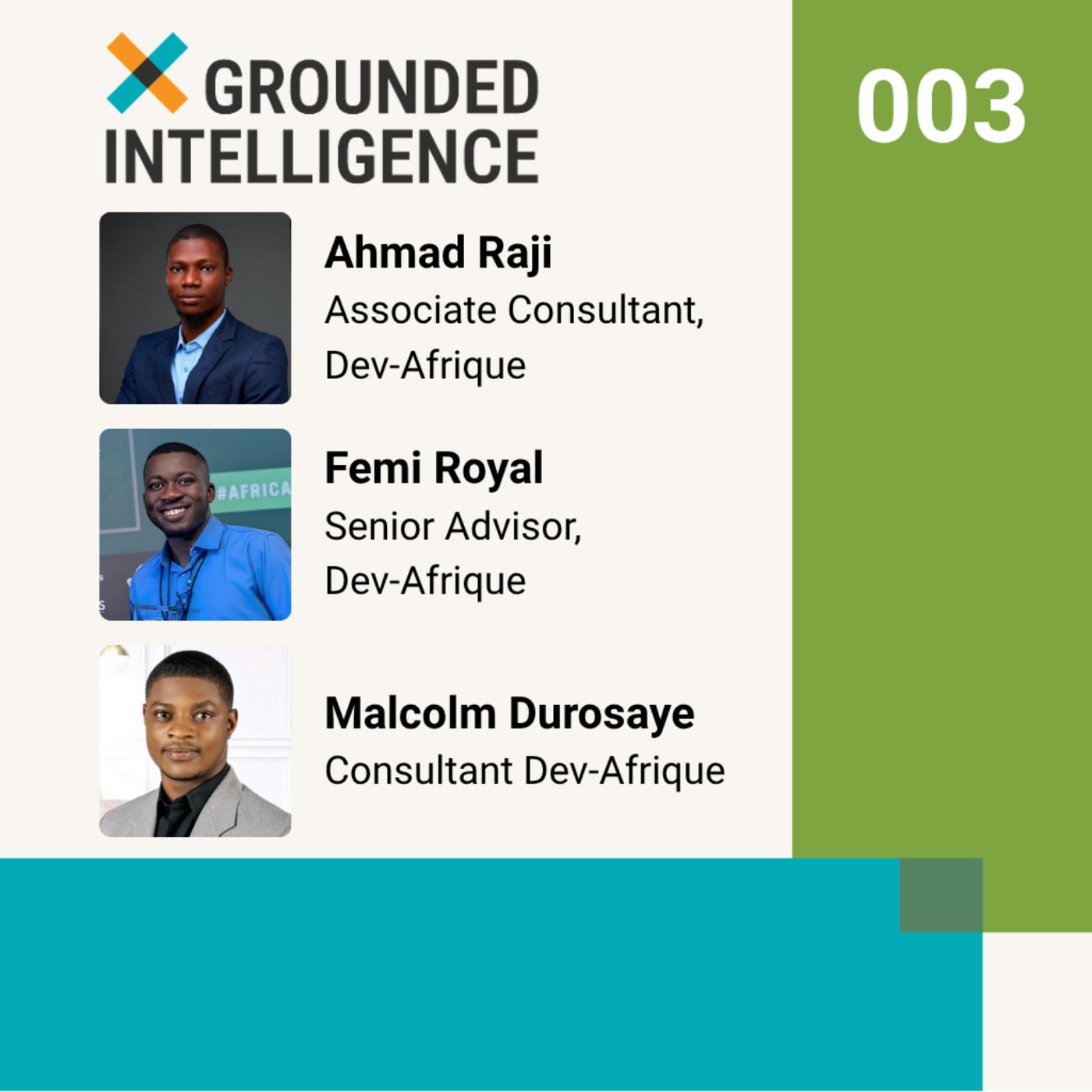
Femi Royal, Senior Advisor (governance and systems), Malcolm Durosaye, Consultant, and Ahmad Raji, Associate Consultant, are co-authors of the AGX AI discussion paper on localized Agri-LLMs for small-scale producers in Africa and India. The panel unpacks how frontier AI models fail without local crop, soil, and market data; how India's AgriStack and Bhashini contrast with Africa's fragmented data systems; how tools like PlantVillage Nuru and FarmerChat are reaching farmers through voice and SMS in low-connectivity environments; and why donor-funded agricultural AI collapses without blended public-private business models.
Femi Royal is a Senior Advisor at Dev Afrique Development Advisors, a partner organization in the AGX AI initiative focused on responsible AI for smallholder farmers. He co-authored the AGX AI discussion paper "Localized Agri LLM: Exploring Low Power, Low Cost Models for Small-Scale Producers in Africa and India," which examines why frontier AI models trained on North American and European data fail to serve African and Asian agricultural contexts. Royal's work centers on governance and systems-level questions—how multi-stakeholder frameworks, digital public infrastructure, and policy alignment shape whether AI tools reach small-scale producers or remain donor-dependent prototypes.
Malcolm Durosaye is a Consultant at Dev Afrique Development Advisors and co-author of the AGX AI discussion paper on localized Agri-LLMs for small-scale producers in Africa and India. His research for the paper examined the gap between language translation and true contextual localization, mapping how local crop, soil, weather, and market data determine whether AI-generated agricultural advice is relevant or misleading. Durosaye approaches localization as a data and context problem rather than a language problem, drawing contrasts between India's digital public infrastructure investments and Africa's fragmented agricultural data systems.
Ahmad Raji is an Associate Consultant at Dev Afrique Development Advisors and co-author of the AGX AI discussion paper exploring low-power, low-cost AI models for small-scale producers in Africa and India. His contributions to the paper addressed how accessibility barriers—unreliable internet, lack of smartphones, and low literacy—determine whether even well-built AI models can reach the farmers they are designed to serve. Raji's work focuses on the infrastructure and delivery side of agricultural AI, examining how voice-based and SMS systems, telco partnerships, and blended public-private business models can sustain AI advisory tools beyond initial grant funding.
Femi, Malcolm, and Ahmad explain:
◼️ Why translating a frontier model into local languages still fails smallholder farmers
◼️ What India's AgriStack reveals about Africa's missing digital infrastructure
◼️ How lead farmers and extension agents become the real AI delivery channel
◼️ Why promising agricultural AI tools collapse when donor funding ends
◼️ What hallucination and liability risks look like in farm advisory contexts
◼️ How African innovators already deploy voice and SMS tools in low-connectivity areas
◼️ Why telcos may shape agricultural AI the way M-PESA shaped mobile money
◼️ What putting farmers in control of their own data actually requires
To read the discussion papers, click the link below.
TRASCRIZIONE 🔗
CERCA TRA GLI EPISODI PASSATI
ALTRI EPISODI IN QUESTO PODCAST