

Billie Tienda: Hi, everyone. Welcome to Stratabus and to being on our podcast. And we are so, so grateful to have each one of you. Thank you all for taking the time to be here. We know how valuable your time is, and we are grateful that you have chosen to spend this hour with us. So, as you all know, we work with founders who are as amazing as you all. And we created this series to hopefully bring like minds together and just be very like open and vulnerable. Share anything that makes you feel comfortable. Ideally, the more, you know, you have to drink, perhaps the more you'll be open. But if you don't, that's okay too. We just want you as you are. And before we kick things off, I think it would be great for each one of you to just go around to introduce yourself, like thirty to sixty seconds, or if you want to make it ten seconds, just to for each of you to know who you are. And then after that, I'm going to introduce a special guest to also get things started. So with that, I am gonna go to my Brady Bunch, the person on the left to start. Hey everybody, great to be here. I'm Miles Harrison. I am a data scientist and now ⁓ entrepreneur and founder of my company Practici, which is a data and analytics consulting practice. It's also the Greek word for practicality because there is a lot of hype and nonsense flying around the business world these days when it comes to AI. do a lot of work here where I'm sitting in the city of Toronto with the tech community and partnering with startups and helping them build and things like that. But there's also a more traditional side to the work we do a bit northy here in a county called Simcoe, where we are working with a lot of manufacturers and helping them with operations and and trade and logistics and things like that. Awesome. Thank you. Page. Hi, I'm Paige Arnoffin and I'm the founder and CEO of Mavens and Moguls. We're a global branding and digital marketing firm that I started almost twenty five years ago. And I'm based in the Boston, Massachusetts area, and I'm excited to chat with y'all today. Thank you, Dan. Yeah. I grew up in Boston, Paige, and I think Brandon's close by, so we'll have to talk about that at some point. But ⁓ My name's Dan Sincavage. ⁓ I founded a company called Tenfold, ⁓ scaled it for seven years and sold it to a company called Live Persons in the conversational AI space. Served as the chief strategy officer there as a public company. ⁓ more recently helped a friend sell a company called Pros in Houston, which is another public company to Toma Bravo. ⁓ been a learning period of ⁓ launching a consulting business and navigating a portfolio work model versus historically kind of being all in on one thing which has its whole host of new challenges. And I think a lot of you are familiar with and working through too. So excited about the the conversation today. Dan, do you and Joan know each other? I feel like you've had to be at Twisted X before together. I think we You look really familiar, either there or like one of these like startup bashes in Austin. Yeah. My my sense my sense is we've crossed paths. Yeah. Yes. Okay. Well, I'll go to Joe since I introduced you. I'm Joe Silva. I'm the co-founder, CEO of Spection. We're a cybersecurity software company. So we work with like large enterprise cybersecurity teams helping them understand like how their systems are susceptible to attacks and how they can Fix them. Kind of interestingly enough. Jenna's husband. And I worked ⁓ with Amy when I ran cybersecurity at TransUnion, America's favorite credit bureau. That's right. And now we're gonna go to the other Brandon, non Jenna's husband. Brandon. I was gonna say ⁓ denodjan as husband. So ⁓ so I'm Brandon Metcalf. I'm the CEO and founder of a company called Assemble. ⁓ Assemble, we classify ourselves as a workforce orchestration company. So essentially what we do is provide talent recruitment technology to hire people, and then we have digital workers to ⁓ supply the digital part of ⁓ a hybrid workforce, and then we have consulting practice that blends it all together. So we help companies build human digital ⁓ workforces. Very cool, very, very cool. I talk to them. Someone that they'll call me if I like say something to them, they'll just be like, Hey Jenna. We have Stanley, we have Bradley, we have Rosa, we have Ben, ⁓ we have Pam. Like there's quite a few. They all have different jobs and functions and motivations for success and different managers and coaching and all the whole thing. These are agents, not people, right? So I understand. Correct. Yeah. Okay. Yes. People first. Yeah. That's me. Yeah. And not least. Without further ado, Amy. Hi everybody. Amy Crook. I am the founder of Strativist and I ⁓ have the pleasure of working very closely with Jenna on a day-to-day basis and Erin who's gone backstage. And I have been in talent for a couple decades, decided to set up a fractional firm a year ago. And now we're dabbling with a little bit of software building to help support kind of the work that we're doing with our clients. So super excited to be here as Jenna's guest. Thank you, Amy. So now I'm sure you're all wondering who is the man in the corner that I'm not picking on, but now he is our special guest and we are going to have some fun. So with that, it's my pleasure to introduce Kevin, who will lead us through some fun and fun conversation starters. Thank you, Kevin. Well, thanks for the intro, Jenna, and good to meet everybody. Technical difficulties, but the show must always go on. ⁓ so my name is Kevin Railsback. ⁓ I'm an employee health and benefits consultant. and I've been working in healthcare ⁓ and healthcare technology for the last decade. That's like the technical reason why I work with Jenna, but ⁓ actually the reason she asked me here is ⁓ my wife and she were sorority sisters. We've known each other for a very long time. Prior to this decade in healthcare, I spent a little over a decade as an actor. So I think she brought me here because like, you know, talking, ⁓ being fun, funny, whatever on cue. But when you're an actor, also you're a bartender. So I spent about a decade being a bartender as well. And I know that a bunch of you guys got sent a bottle of wine that might have that wine close by. So I thought we'd like start with just a little game. ⁓ and even if you don't have wine that you can play along. This is gonna be like a wait, wait, don't tell me style. Little games. You're all leaders, CEOs, founders. And I would assume that you guys are all good communicators. You know how to speak with confidence, get people on your side so we can move in a direction. But do you know anything about wine? ⁓ and don't answer. If you're like a a total wine snob, if you're a Somalia yourself, don't tell us because that's gonna be part of the game. So don't tell me if you know anything about wine, but if you've got your wine nearby, I want you to give yourself a little tasting pour because you are going to Try your wine, you are going to give us a Somolier level description of your wine. If you are a wine snob and a Somolier, fantastic, convince me. If you know nothing about wine, fantastic, convince me. And just so that it's fair, I'm gonna, without knowing what you actually know about wine, after we're done, I'm gonna give you guys a score on a range of novice to bartender BS to classic wine snob or sommelier level explanation. Just to get the ball rolling, I'll start ⁓ with mine. As you can see, I have a the scoring is on your description. Accuracy or or performance. Performance only. Performance only. Tell me the truth, but it's about your performance, ⁓ not about your accuracy. Because again, I will ⁓ I'll show you right now. As you can see, my vintage is ⁓ DA Pepeer. This is ⁓ This is not wine. I actually ⁓ I I had to pull myself out of the game. I hit my quota. I hit my quota early. So I'm on the Diet Doctor Pepper. So if you don't drink, you can also just fake it completely like me. But I'm gonna give you I'm gonna give you my real this is me going. So I'm gonna give you a an explanation of how to BS. So Okay, so it's a very fruit forward cherry. Well, little caramel. The effervescence is really lifting the aromatics. Yeah, definitely cherry. A little blackberry, like a touch of licorice. There's something ⁓ medicinal, so like a slight bitterness. It's almost like a burnt marshmallow. The body, white, effervescent, crisp, the ⁓ the aspartame is really kicking the finish into this dry dryness, which is quite enjoyable. So as you can tell, I would I would rate me like a that's a bartender BS. That's a bartender BS. It is not based on real wine knowledge, clearly. But Dan, you you volunteered yourself since I saw you got wine in your hand. So so why don't you give us a go? Yeah, you did. I don't know. I'm so sorry. You gotta go first. And then everybody else can start getting ready with your BS if you're BSing. But if you really know about wine, show us show us what you know. So Dan, give us a shot. I d well Yeah. So I'm gonna miss on knowing a lot about wine, but I do enjoy it. ⁓ The pinky. Yeah, the pinky up. That was actually not planned, so if it was that I apologize for that just being a natural state. But that was great. Definitely big and bold. Like ⁓ feels like a confident wine, if ⁓ you know what that means. I'm tasting some like black currant and dark cherry notes. Maybe a little bit of of ⁓ wet stone on on the finish. Definitely worth pairing with like ⁓ some kind of ⁓ you know, some kind of nice steak. I think that's what I that's about what I got. Yeah, Dan, that's that's fantastic. I'm gonna give Dan I'm gonna give you a classic wine snob that is second to only Somalier. That's a classic wine snob. Dan gets a classic wine snob. Really? I heard whetstone. I was like I I was brought in. Wet stone. Maybe, maybe Amy's gonna downgrade. Why are you eating whetstones? That doesn't seem like the right thing to do. Okay. Joe. All right. Do I ⁓ have a Like a faint hint of bourbon. Like definitely cognac flavor forward, like it was like it aged in a cast. Yeah. Probably also on the nose, I get like bad decisions and fights. Take a full sip. It's really good your insecurity. Yeah, it it I feel like it pairs well with like angry emails and family alienation. Okay. Kevin, how would you score it? Fantastic. You know what? You would have been at the bar right alongside me serving the drinks. That's a classic bartender BS. Because not only did he give us a good description, but there was some fun in it. He brought me in. I was leaning in and I learned more about him. So that's a bartender BS. That's a good score. I dig it. Okay, cool. Who's next? Okay. I'm going to do Paige. All right. I'm loving the color. I think it's just a really rich, kind of deep blackberry that The nose is awesome, kind of earthy undertones. And I love the legs. Like when you look and you're swooshing it, the legs are really kind of real you know, this is a hearty wine. And yeah, it would just go with pretty much anything. I mean, I'm a big red wine drinker anyway. So like just, you know, bring it on. I think the appetizer, the entree, I'd even drink it with dessert. So great choice, really fun, fun selection, and it kind of hits on all notes for me. Fantastic. Not only did she give a food pairing all the way through dessert, but she also brought up the legs, which I it felt so real. So I'm gonna I'm gonna I you know, it could have been barked under B.S. But because of the legs and the dessert pairing, I'm gonna give that a classic wine snob, not a novice, classic wine snob. I think the only person left is Brandon. Do we have do we have Brandon left? We have we have three more left. Yeah. So Brandon, your turn. Okay. Yeah, for mine, you know, it's it's very ⁓ it's nice, it's refreshing. It's very crisp. I like it chilled. ⁓ but it's significantly lacking in fun and alcohol and texture. I wouldn't want to pair it with anything. I'm just not a fan. I think it's a disaster. They actually have water somaliers now. So water somaliers is a real thing. They have them. Look it up. This is the real thing. You can have a water sawm your restaurant. But I would say that water description lacked the minerality quality that I was really hoping for in my water sawm. I didn't get to hear about the origin. So I'm gonna drop that down to a a water bartender BS. That's a water bartender BS from brand. But he gets the effort. Okay. I'm going to go to Miles. Okay. I have this ⁓ I think it's Italian Sprite wine in a in a can. It's it's pretty good. It has a soft kind of starts soft. It's very citrus forward lemon and lime. And then it has a finish with the delicious taste of sodium benzoate and aluminum and NBA promotion. Yeah. I think it pairs well with like diabetes and food. As a type one diabetic myself, I love that you're calling out ⁓ the health implications of said wine. ⁓ but then that's gonna make me not want to drink it. So I don't know. That's ⁓ it's a little a little worrying. Calling out the can, though, was the was a nice move. So I'm gonna I'm gonna give that a bartender BS. Not a novice, but a bartender BS. You brought me in. It's awesome. Okay. Amy. Smells like 4 p.m. And it's giving me images of regret and bad decisions. And I heard that it's got legs. And so I'm gonna say that because that got somebody else extra points. And I think it's really tasty. You wish you could have more. Is that you wanna end? Okay. Okay. Kevin, how are you ready? Gotta give some extra points on bringing in the emotional experience. That's such an important quality. One of the best Somaliers that worked at this bar that I was at was always describing things in emotions. Like one time he described red wine as like a hairy chested lover who kisses you on the beach at night. And I was like, That is an experience you're describing. So I loved I love the experiential nature of how you did it. The name of that wine. I don't know. I think it was Harold. The wine was called Harold. No, I cannot I can't remember for the life of me. So I'm gonna I'm gonna you know what? I'm gonna give that ⁓ on the emotional description, that was some level emotional description. ⁓ but ⁓ I'm gonna drop you down to classic wine snub ⁓ because you asked for it. You asked for the extra points with the legs. So I'm gonna drop you down to wine snub. If you don't ask, you don't get. That's true. There you go. Now I know. Great round. So who was the top who was the top mark? Was it Joe? Yeah, you know, this is tough. I gotta say, I think Joe's gonna be my winner for for the humor and bringing me in with the description. But ⁓ as far as actual wine description goes, I'm gonna have to give it to Dan. I think Dan was was our Somalier for the day, but Joe was our bartender. I want Joe giving me the pork. Right. Congratulations, guys. Congratulations, Joe, yes. Yes. Okay. Thank you so much, Kevin. That was fun. You guys are welcome. Okay, we appreciate you. Okay. So now that everyone's a little bit more, you know, comfortable and knows each other and their ability to Is it bullshit maybe? We all have, so that's good. So What is gonna happen is there's about 10 questions that I have and you don't have to answer each one, right? If there's one that really stands out to you, or if there's someone that I really think would be good at answering this, I might do that. But that's ⁓ the the show of what's gonna be like. So with that, I'm gonna start ⁓ with a question that I think would be it's a little bit more fun too, but what do, you know, for each of you, what is something that Your employees think that you know, but you actually always look it up on Google. Honestly, probably how to spell something. Yeah. That's again what's my only Googling these days. Is like, wait, did I spell that right? Everything else I go straight to an LLM, unfortunately. I was gonna say, I don't know when the last time I Googled something is compared to the last time I've asked a lot or Yeah. Or chat GPT or any of the other things that I use ⁓ like any math equation is it's easier for me to go there than have to think, which is I'm actually good at math and good at finance, but ⁓ that's my shortcut. I think for me it's more technical stuff like how to do a print screen. Like I always forget what are the three buttons you have to push at the same time? Is it command, is it shift? And you know, it's like I'd look like a tech genius, but really I'm just using a cheat sheet so that I don't screw it up. That's me too, and I'm not a founder, but I tech is not my thing. But you can make it look like it is. Yes. I'd say like a pet pet peeve for me, and I don't have employees right now. I'm like a sole employee, so like ⁓ I annoy myself at times. But ⁓ like previously, like whatever the employees asked, if I didn't know the answer, like it would be a lookup in Google and then if the answer was very evident, that was always a petty for me of like, did you take the the like quick second to Google it before like spamming the entire company with the question? So like, you know, my yeah, my answer would be like whatever they asked would be like if I didn't know the answer, it's like, let me see if I can find that very quickly and if I could, like, here's the answer, but maybe next time like try Google. Yeah. Which would be Claude or something else to brand his point today. Yes. Is Google the new dictionary? I don't No, anybody that Googles anything except maybe my parents. It's been a while. You know it's funny, I built my first software company by teaching myself how to program in Salesforce via Google. Really? I Googled all the questions that I've ever had and there was so much knowledge built out out there that it was easy to figure out how to do it. Occasionally when I've hit the cloud usage like threshold, I'll divert to Google. And yeah. Well Now we're gonna move into more vision and innovation. So what is one company you wish you'd invest in? Facebook. Yeah, that's a good one. Did say Facebook game? Yeah. It just blew up. Like that would have been awesome to get some of that stock. Databricks for my end. For me, it would probably be Anthropic. Yeah. That's a good one. I wasn't given the opportunity to invest in Anthropic, but same. ⁓ Small detail. ⁓ It's been revealed. Okay. As long as we're imagining. Okay. Well, we'll move on to another question that perhaps you two could answer, but what problem in the world do you hope that someone solves in your lifetime? I hope, but I know they won't. And that is that if there's someone out there that can figure out how to get people to quickly and efficiently get off an airplane after it lands, I would be the happiest person in the world. Because my favorite person is in the world is the person that somehow is capable enough to have enough money to fly first class but then is not capable enough to figure out how to get their bag out of the overhead bin while a hundred and fifty people are waiting for them. Or maybe they just don't care. It drives just remember this files. This is how they do it when there's no emergency. Imagine if there was an emergency how they'd do it. That's that's ⁓ true. That's so true. Okay. The obvious ones for me, and I don't know, you're probably not thinking this, but like cure cancer, autoimmune disease, world peace. Like yeah, that would be awesome. But realistic, not so much. Yeah. Okay. I'm gonna I hope I hope somebody could ⁓ eventually somebody might be able to work out a more effective way to spend the tax dollars that they collect from me on a regular basis. ⁓ I'd like them to figure out something that's gonna work a little bit better than then. Well I love that one. I'd like them to figure out how I don't have to pay them tax dollars. That's that's that's that's the real unlock there. Gotta get those deductions in. I'm always jealous of how people figure out how their taxes are so small. I just don't we're doing something wrong. I don't know. I agree with you on that. Okay. So now moving on to how, you know, you've all evolved as leaders and as founders. So ⁓ what habit has had the biggest impact on your effectiveness? Motional modulation. Like you have to like understand, like when you're like leading, especially a small company with people who are typically like really committed. Like they read you way more than you think they do. And and you have to really modulate emotionally because they're gonna even if they're not experts, they're gonna read like micro expressions, which means if you get really up with something, it's great. But then they're also going to expect the inverse. So like being steady and emotionally modulating because you have to understand that what for you may not seem like a big thing. People may 10x that in terms of what it signifies. Yeah, it's so true. Yeah, I think that's so true. Like and to extend it further, like one of the things I've learned is, you know, I need to be six to nine months where I want everyone else to be. So if the d business is doing really well right now, I need to be foreshadowing like the business is going to be struggling six to nine months from now. So what are we going to be doing? Or if the business is struggling right now, you know, in six to nine months as we get through it, here's the happy path. This is where we're going to be to to get them focused in in dialed into where we want to go versus what they're stuck in today. Like keep them on track towards the goal versus like being stuck in just I think sometimes like the everyday, right? Versus like that this is the end goal and like it's not going to be linear, right? I think that's sometimes hard. Yeah. And to to somewhat to Joe's points the emotional, like realizing that people hang off of every word and every spatial reaction that that I make. But to my point, it's Not just the focus of how do we get there, but it's like what are they going through right now? If the business is tough, everyone's super frustrated. But when the business is popping, everyone's super happy and forgets what it's like to be frustrated. So how do you balance that out and 'cause no one else in the room or in the company's gonna do it. Yeah. That's a really good point. Yeah. It's like your responsibility to stay around those corners and come up with a contingency plan for either way. Good or bad, you have to be ready to take the necessary steps to make it work. For me it's more like not trying to do everything myself, leveraging my network and my contacts and delegating so that I'm not always the best person to solve all the problems, even though I may feel like I have the weight of the world on my shoulders. I have to know where I can add value and know where I can count on others. So just relying on my team. I was gonna say the same thing, Cage. I was worried that I'm earlier in the journey than everyone else because for me it's been delegating and learning to delegate effectively has been something that I've gotten better at. But also at the same time, sometimes the expression, if you want something done right, you've got to do it yourself can be true. But then that's still not good as a leader because even if there's something that maybe you could do better, maybe that's not true, your time, it's not your job to do that. And your time is better served doing it doing something else or just reviewing what someone else does and saying, Yes, this is good or no or guiding them, right? So it's still a bit difficult for me, but that's something that I've slowly gotten better. Yeah, I would I would agree. Also difficult for me, Miles, like an area I'd struggle with and probably like area of growth on my side. But in terms of like where I've like grown the most or learned the most, the ⁓ like leaning into uncomfortable. conversations side of things. Like I think early on, like I was a manager of like people when I was very young that were much older than me. And I like tended to like dance around difficult issues and wanted to be like a friend more than a leader. And like then you have to let people go. And like you realize the downstream like impact of like, ⁓ like I I could have been more direct with people about like their performance or expectations or things. And I I left some of those things unsaid and implicit and I did it 'Cause I thought it was in their best interest like not to like hurt their feelings, but ⁓ like recognizing that feedback delivered in the right way is a gift and avoiding it's like a a really shitty thing to do as a leader. So like leaning hard into the conversations that are uncomfortable as early as you can and recognizing that even if it's tough, like it's usually in the best interest of the person to hear that versus like letting it play forward and having some like other, you know, negative impact on them downstream. I totally agree. I had to learn that too, the hard way. Yeah. Right. Not really it hurts them in the long run and you're not doing them any favors actually. So yes, I agree. It's such an interesting transition for those of you that have been, you know, corporate, which might be all of us actually. Corporate then moved into running your own business. Is that all of those good habits that you built I think are really good foundationally, but when it becomes your baby, it's so difficult to have that same objective perspective. And to Miles' point, like I almost wish that I could unlearn the like, well if you want something doing, like, 'cause I get I get crazy and I'm glad Erin's not on here because she's been dealing with me for a while and she's not able to call me out. But like This the little things that could easily be passed on that I like collect because I just I'm so conscious that at this stage of growth that I it needs to be authentic, correct and reliable. I don't work with anyone who couldn't do this easily, but it's hard when it's your thing to separate decision from emotion sometimes. But you have to you have to force yourself because otherwise you'll kill your own company. I was definitely thinking about you and Erin when we were talking about delegation. So that was spot on. You got better, I think. ⁓ You're welcome. So with all of you being founders, what is something that you wish someone had told you before becoming a founder? Perhaps that you didn't know or didn't realize would be a thing. If there was a chance, what do you wish someone could have told you? Don't do it. Just kidding. Just kidding. Don't. Do you want to stay married? No, just kidding. Just kidding. For me, it was more like the people that you start with are not always the ones that are gonna grow with you. And so it's a lesson I learned, but I wish I had learned it sooner. My bias is, you know, we have a saying in the South, you know, you want to dance with the date that brung you. And so the people that started with me, I I kept them around longer than a few of them ⁓ longer than I probably should have. When the signs were there that we were growing beyond their comfort zone and they didn't have the growth mindset that we needed to scale, I should have shook hands and parted ways sooner because, you know, if you're working with the A team, they want everyone to be on the A team. And if they're people dragging you down it you know, culturally it's just not gonna be a good fit for growth and scaling. So I just wish I had learned that a little faster, but once I learned it, I got really good at it and I spotted the signs early and wasn't scared to to get going. But they say you hire slowly and fire fast. And I think that's really true. I agree. For me, I I think this is my fourth company but a scale the the Probably two things. But the biggest thing is managing yourself and managing your own headspace is the the key to all of it. No one else is gonna be there to to help you do that. And the emotions and the mindset that you're dealing with, regardless of if it's positive or negative, will directly impact everyone else in your your ecosystem. A ⁓ every employee will latch onto it and you don't have to say anything, you don't have to give any look, but they can just feel the energy and that energy is what's gonna ⁓ distract them or help them. So Realizing that and realizing that, you know, finding finding ways to to clarify that mental space is probably one of the biggest benefits you could do for yourself and for your company. I've heard people say before, well yeah, like being an entrepreneur is not for the faint of heart. I'm not sure that that one sentence really articulates and emphasizes that point enough based on my experience. And the other thing that I wish I well that I would tell myself if I did this again, you know, is that For the type of business I'm doing, it's not it's not field of dreams, right? It's it's not if you build it, they will come. And it seems kind of backwards, but the way that cash flow works and that you need money to operate a business and build it, you kind of have to like buy the plane ticket and then pack your luggage after. Like so I feel like I spent a lot of time and I mean it was good too, because like the team also we we spent a lot of time building a lot. And learning together. I think if I did it again, if somebody had put it a slightly different way to me, or if I could explain it to myself and say, look, this isn't about sales and this isn't about culture, this is about sheer operational economics, then it would be like, ⁓ okay, I would have done something that was different. ⁓ because a very common founder mistake, whether they are building a product. and have venture capital and and funding dollars behind them or whether they're bootstrapping is to, you know, suffer in silence, spend two years building a product, a service that nobody wants. So you need to get out and sell and you need and even if you're not in the business of sales and if you're a founder you are, you need to get out and talk to people and say like, what do my customers want? And and get feedback. A good point. Yes. Or something I understood but didn't have like I have a better appreciation for now, at least, is that the trajectory of your company is less about all the things you do and more about the story you can tell, which depending on the company is sometimes loosely tethered to the things that you're doing. Right? It's like based on it, but it's really more like work backwards from the narrative you want to tell at each stage in the company. Mm-hmm. It's a lie. what you're saying? No, no, it's not a lie, but these are these are data points created by what you do and this is the story you want to tell. Those those data points can be put together in different ways. I mean you have to do that all the time. Look at look at what's in front of you and and make it make sense. Like that's just like every single day. People want to read narratives, not fact sheets. So true. Yeah. Or make narratives. Sure, yeah, you're right. No, people will make their own narrative if you don't give them the narrative. You don't give it to them, then they're gonna make their own. People are quick, right? Okay. So now moving on to decisions and defining moments, which I'm sure all of you probably can ⁓ attribute to. But tell us about a moment that perhaps, perhaps you questioned whether your company would make it. And it doesn't have to be, you know, the one that Right now it could be a different one that you were operating in, but was there just a challenge that a challenging time that you could speak of that you're like, ugh, I just don't think it's gonna work? You know the weird thing, I mean, Glassdoor didn't make it, but that was not my responsibility. The one thing that the one the one thing that I'm actually consistently shocked by is that despite the first six months that Erin and I experienced Not one time did we think like God, this is not gonna work. It's not gonna work. Like the entire time we were psychotically delusional that like it was only a matter of time that things were gonna land the way that we needed them to land. And then I look at this fiscal year and I'm like, good. Like we stuck it out, you know? Because there were so many moments, and you know, you see. Especially when you have co-founders because it's like a different a different bond. Like I think I often think I spend I spend more time with Erin and Jenna than I do with like probably anyone anyone else. But we just have this like relentless belief. There's like not there's not anything in us that we don't that we think ⁓ we we might not be able to do that or this might not be possible. And I actually think you need that. Otherwise you will give up and your company will fail because it's easy to give up. It feels right. Everything everything is telling you like just go back to corporate. It's easy, it's safe, but that's not what you want to do. You want to build. Every quitter I know thinks about failure. So like I really you know, Jed, I'm a relentlessly positive person. Like I'm serious. I spent a lot of time in like my career and other jobs assessing people and I've seen a lot of people quit hard things and every quitter I know thinks about failure. Same. Delusional. Just ignored like delusional. That's not a that's not an option. So we'll just keep going. Yeah. But I like that. I don't even believe in failure. I think you either succeed or you learn something. And you don't make that mistake again. If you learn, you're better for it and you move forward. And you know, you've heard the saying if one door shuts Go find the window. Go find the back door. Like I think that's just for me, it's kind of part of the entrepreneurial DNA. Like I you know, I was never scared to fail. It never dawned on me that it wouldn't work. I'm like, it might not be a Fortune five hundred company one day. I doubt it will, but you know, we're we're going places. Like we're solving real problems and people seem to appreciate the help and let's do it, you know. I think the first few years it's like putting a car in, you know, fifth gear. I didn't even realize you could downshift. Like I was just going, going, going. And it took me years to figure out. Like, you know, sometimes you're in second gear, sometimes you're in neutral. I didn't even know there were other gears on the ⁓ you know, in the car for years, literally. And I just attributed it to I guess that's what it means to be an entrepreneur. I don't know. It's nice to do it for yourself though, rather than do it for some big corporation that you don't even care about. But it you did make me think of something, Paige, just another question, is, you know, ha was there on all of your journeys, was there, you know, a piece of advice that perhaps you ignored, right? Thinking like, ⁓ I don't need to worry about that or right now, but it actually turned out to be right and you wish you had listened to it? I don't have that capacity for introspection, so although somebody says Yeah, kind of I was gonna say What that would Similar to Joe. We get so much advice and so many opinions and you know, everyone has one. ⁓ and there's there's just so much context that people from the outside who are we trying to help you and trying to give you opinions just don't have the full perspective all the time. So I think one of the the biggest lessons to learn is how do you process the why behind what someone's actually trying to tell you so you can get to the what they're actually trying to tell you. To figure out can you apply it or not? Cause I do think, you know, listening is a is a secret weapon, listening to your employees, certainly listening to your customers, but even listening to friends. And you know, most of the founders I know are are friends with a lot of other founders. We just kind of flock together. ⁓ and all the businesses are very different. ⁓ but there's similarity in all the challenges that we all face. And I'm certainly big fan of getting into like CEO groups and things like that, especially when When you're in the earlier stages of the business to to try to hear perspectives and opinions. But at the end of the day, it's like how do you process that information to to figure out what the right decision is at the time? And similar to Joe, I'm like, I don't I can't be that retrospective of all the different pieces. But as much as like advice and opinions, everyone has them, like there is a lot of knowledge out there that you can gain if you apply it the right way. Mm-hmm. And one person's definition of stalking can be someone else's definition of being pleasantly persistent. So, you know, you know, I I feel like what what works or didn't work for you might work for me because my style's a little bit different. Like I remember I had ⁓ met a CEO, ⁓ this woman CEO of a very interesting industrial products company. And ⁓ we'd met at a networking event. She said, You know, I want you to come to the office. I want to show you what's going on. Maybe you could help me with marketing. We sent in a proposal after the meeting. And for weeks I was following up, you know, by email, by voicemail. The woman was like completely non-communicative. And I thought, well, ⁓ well, I tried. I guess she hired somebody else. I don't know. And then this networking group that we both belonged to had a big event and she was the keynote speaker at the event. And I almost didn't go because I thought she's gonna think I'm stalking her. Like, you know, I'm f followed up, she never responded. I saw her across the room before her big keynote and kind of waved, but I didn't make it over to her before. She went up on stage and she gives this big speech about it's a women business owners ⁓ group. She gave this big speech about how critical it is. As women business leaders, we need to support each other, put our money where our mouth is. We should be hiring each other and really thinking of each other first before we go to the greater community. That's what these groups are supposed to do for each other. And as part of her talk, her speech, she said, you know, and that's why I've hired Page's firm to handle all of my marketing and PR for the next year. And I'm like, Wait, did she just say she's no questions, didn't even acknowledge receipt of the proposal, nothing. And there were this is a group of like three hundred members, and it was a big meeting. A lot of people were there. And I got so much business as a result of this event, because this woman is known as being just tough as nails, very astute and just tough. And I felt like a rock star. Like after she finished. People were like coming up to me. ⁓ my God, you must be so good. If she hired you, ⁓ my God, like, you know, if I need help, you're gonna get the phone call. Like I'm gonna let you know as soon as I have the budget, I wanna hire you too. And I thought I almost didn't show up at this event because she hadn't responded to my messages. And, you know, thank God I did, because I got more business as a result of that meeting the next month. was like the busiest period of my company. And I was only a few years old at that point. And so you just don't know. I mean, I you think you know because you're the founder, you're the CEO, you started the business, you know the ins and outs, but you don't know everything. And you I think it's very we can't get out of our own way sometimes. So trust your intuition. And if it's something you believe in and you're excited about Bring it and when the timing's right, the stars will align. I like that. Trusting your gut. So like the original question on existential crisis, like we were growing like super, super quickly, like no idea what we were doing. We raised like a million three and we were at three million and like run raid and ⁓ went out, raised a bunch of money in San Francisco over Christmas and we came back to like scale the company and ⁓ Like we had raised at a seventy million dollar valuation, like things were going great. And like maybe six months down the line, my co founder, like at the time I'll use careful words here, ⁓ like was running like a secretive ICO in the background to like do an initial coin offering and had allocated shares differently than than what were, you know, apportioned amongst investors for ownership and had spent millions of dollars on said ICO effort in like we went from like a seventy million dollar valuation, like scaling super quickly, like we're hiring like incredible talent to like, okay, we're recapping the company. It was an eight million dollar valuation and like no one trusted the business. And so it was like a super existential moment of like, fuck, like I spent three years, like we had this this opportunity and like I trusted the wrong person or whatever. Like now this is this is kind of you know. in a tough situation. But I'd say like customers were still using the product, getting a ton of value. And like we we hunkered down to a core group of people, hired some folks that some of you know, like you know, Mike came in as CFO and like brought in a new CEO and like like started to rally the team. So for me, like that was an existential moment. I was in like a dark place. I think we hired people that were like positive Joe type people that were like, no, we can do this. And ⁓ Like they came in and lifted, you know, the company out of that. Along with myself, like I started to rally around that too. But ⁓ that was a kind of defining moment for me. I'm not a hundred percent sure of all of the lessons packed in that, but I've carried them forward and like I do think like one of the key lessons was just, you know, people want to be at a place that's winning. They like they wanna understand like how they're contributing to what it is that the mission and vision is. And like I think Jeff, who came in as our CEO at the time, like did an incredible job of re-enlisting everybody of if you're here, you're part of building this and you have a defined role and your contribution to that is clear. And like every day you should understand how what you're doing is attaching to this kind of higher level company objective. And like it it massively took the culture from this like deep dark hole to like, okay, like we're all now rallying around building this new thing and we sold the company for a great exit in like less than two years after that. And I attribute a lot of it to that like new energy coming in and shifting the culture and ⁓ a whole lot of work that was done by Mike on the CFO side as well. But yeah. Like definitely maybe to Joe's original point of like understanding the narrative, like what are you building towards getting people aligned around that and then just Like running hard at it, it makes a big difference. I agree with you. Having a CEO, I mean, I'm a firm believer of what the company is and the culture is like starts the top, right? And then you're able to, you know, continue the the efforts from the CEO or the founder, right? Of what they're looking for. But it does take a certain person, I think, and energy to to get folks to do that. So I agree with you. I'm gonna switch it up a little bit because I feel like I have a different group perhaps the retrospective just isn't, you know, flavor. So how about what is perhaps a really wild moment that you've had that you needed to keep yourself like in it, in the game? Was there like, did you have to like drive to Mexico or something in a night? Did you have to, you know, go and, you know, sell something crazy? Like what was something where you're like, okay, I have to, I gotta do this. So I just gotta do it. I gotta keep going. Was there ever any time like that? I mean, I was trying to win my biggest client. This was this is my first company. The buyer was based in Singapore. I was living in San Francisco at the time and we didn't have any money and we're scrappy and this was a multi billion dollar largest staffing firm in the world that we're trying to win a region for that we really had no business winning. So every meeting that he wanted to have with his team, I would fly an economy from San Francisco to Singapore to take the meeting in person. And we got through the whole deal cycle and it was down to me and a legacy provider that corporate was saying, you need to take the legacy provider, and he said, No, I'm gonna choose Brandon because I know him, I trust him, and he showed up every single time. So it was suffering through those flights and building the in person relationship that led to not only winning that division, but ultimately winning the global relationship of with them, ⁓ which then had me sell my company for a lot of ⁓ multiples because of it. It was terrible. The crab was a great job, but it was a lot of fun. But I'm sure you have so many points now because of it, right? You were able to rack that up. Like this isn't exciting, but it was excruciating and miserable. Like, hey, hey, we're gonna make a decision tomorrow. ⁓ here's some criteria we need you to answer by tomorrow morning in like, you know, a hundred and like eleven page Word document and just going through it all. It's like not a thing you can claw your way through. I just know like I crushed like two things of like nicotine pouches, I Like a small like myocardial infarction like during it. Didn't like I was just ripping expresses and nicotine the whole time. Like I mean, that's kind of the job, but it's just ⁓ it's fucking miserable. Right. Like I'm just being honest. It's not exciting. Like nobody's shooting at me. In that space no one's shooting at you. That's a good thing. But yeah, like it's just it's just brutal. Yeah, you just really gotta like, you know, lock in, like I did not have like the right psychotropic drugs to like make it through. So it was just like nicotine and espresso and I just power through. Just ⁓ just just miserable. Like I spent like 30 minutes before I did it like just thinking about how much I don't fucking want to do this. You have to do what you have to do, right? You just gotta do it. Yeah. Yeah. You have no choice. That's right. Yeah. Yes. Paige, were you gonna say something or Miles? I didn't know if you were purple. Sorry. I was just gonna say, you know, I did not fly to Singapore. I I on a much, much ⁓ smaller scale, but you know, we pitched some business against some much more established, bigger firms. And, you know, I grew up in the deep south and manners are really important, you know. I return phone calls, you know, I write thank you notes, you know, just kinda like the basic etiquette. Courtesy. And I ne when we don't win business, I never ask people why didn't you hire us or, you know, what did we do wrong? I you know, I just figure it didn't work, whatever. But we we won this piece of business and it was a huge project. And I said, I know the firms you're talking to, and a lot of great competition out there. I'm just curious, what made you choose us? We're obviously thrilled. And he said, y'all had the best manners. He said, like every time you said you'd get back to us on Friday, you always did. You know, after meetings, you you wrote thank you notes. Like nobody does that. And I think sometimes it's like just the basics that you end up standing out because yeah, you press the flesh, you show up in person, you make the extra effort. Another client that had an RFP and we usually don't do RFPs to win business. The you know, I'm not really into beauty contests. It's like usually they're just shopping around to get a better price or to make the incumbent agency ⁓ more competitive. But this company insisted that we fill it out. And I looked at the RFP and I said, we're not a traditional agency. We don't ⁓ like they wanted all the spec work. And I'm like, that's not the way we roll. you know, I can fill out the RFP, but there are like four questions I'm just gonna ignore. And they said, all right, you know, fine, you can ignore And we had the meeting and it ended up we raised questions v challenging a lot of their basic assumptions that they thought were so critical to the RFP. And we challenged them in a way that I thought for sure we would lose the business. Because depending on how you interpret the questions, it could be like a response would be like you need to invest twice as much money as you think you do to answer these questions, depending on the assumptions you're making. And they said, How do you mean? And we explained it and they said, ⁓ my God, no other firm raised this. You're absolutely right. And they ended up hiring us for twice as much money as they wanted to spend because they hadn't they didn't understand the difference of what they were asking for. So sometimes just being honest and being I don't know, just human, especially these days with AI, the more human you can be, the more direct you can be, you know, showing your creativity. I think that's what's gonna help people stand out and win more business. And you know, I I just think that that comes down to the killer application of the new millennium, maybe. I don't know. Yes, I agree. I think being, you know, true to yourself is the best way to be, no matter what that is. Well, we are at time and it went by fast. I think it did. I hope it did. But I just want to thank all of you so much for your time, for your stories, for your honesty, for all of your, you know, lessons learned and how what you have gone through has definitely shaped where you are today. even if we don't want to talk retrospectively. I still appreciate hearing about it and hearing what your thoughts are. But all of you are amazing people and loved hearing from each of you. So cheers and cheers to taking risks, lifting each other up. Joe, you have to cheers and lift others up and continuing to build companies. So thank you guys so much for today's conversation.
INFORMAZIONI SU QUESTO EPISODIO
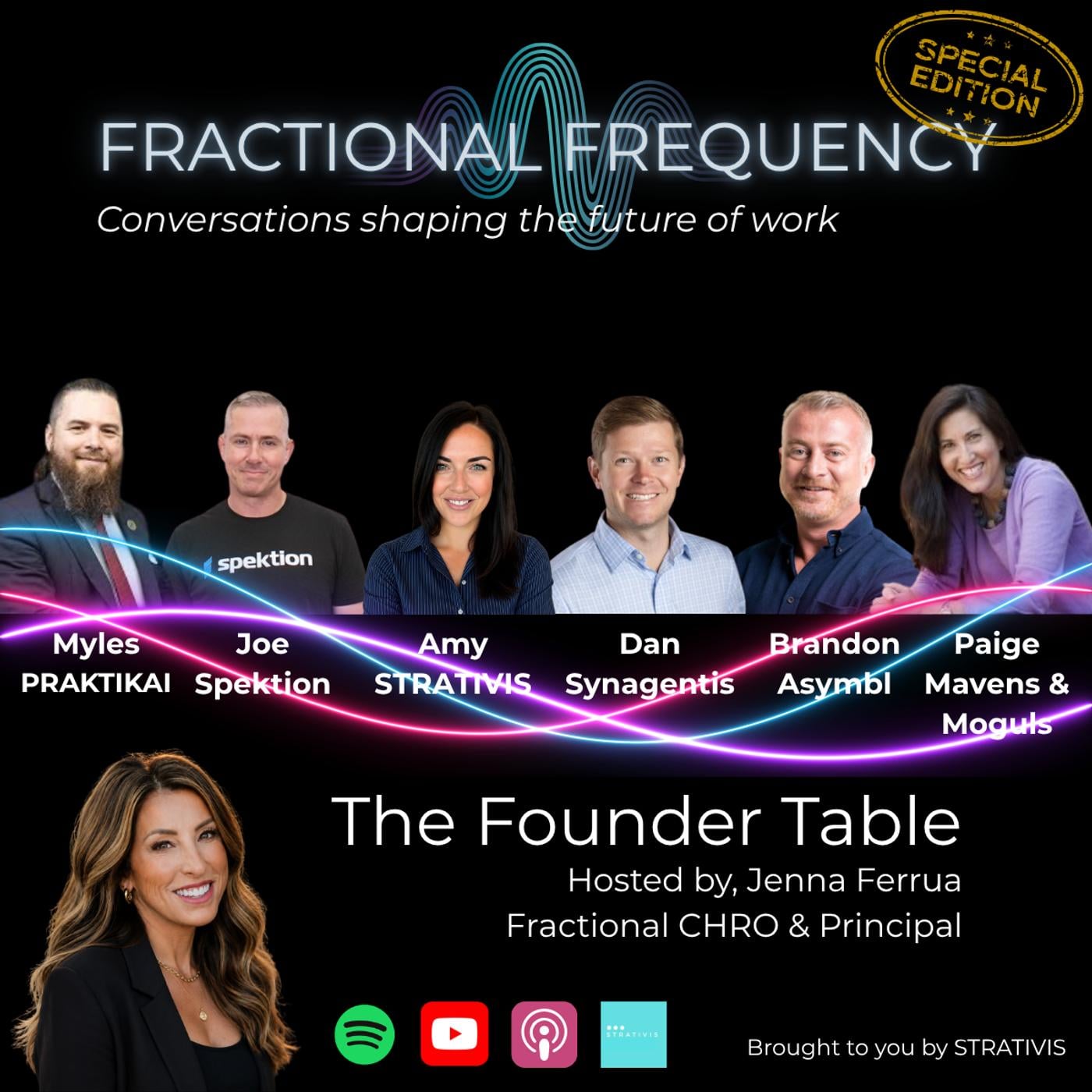
Special Edition: The Founder Table
What does it really take to build and scale a company?
In this special edition of Fractional Frequency, Jenna Ferrua brings together six founders for an honest conversation about the realities of entrepreneurship, leadership, and innovation in the age of AI.
Featuring:
- Joe Silva - Founder of Spektion
- Brandon Metcalf - Founder of Asymbl
- Linkedin: https://www.linkedin.com/in/metcalf/
- Dan Sincavage - Founder of Synagentis
- Paige Arnoff, Fractional CMO, Founder of Mavens & Moguls
- Myles Harrison, Founder of PRAKTIKAI
- Amy Crook, Founder of STRATIVIS
Whether you're a founder, executive, investor, or simply curious about the future of work and business, this roundtable offers practical insights, candid stories, and diverse perspectives from leaders building what's next - and some bonus giggles.
Tune in for one of our most dynamic conversations yet, where experience meets innovation, and the future of work takes center stage.
Inglese
Stati Uniti
IN QUESTO EPISODIO
TRASCRIZIONE 🔗
CERCA TRA GLI EPISODI PASSATI
Cerca gli episodi passati di Fractional Frequency.
Dichiarazione di non responsabilità: Il podcast e la grafica incorporati in questa pagina provengono da STRATIVIS Operators: Amy Crook | Erin Todus | Jenna Ferrua, che è di proprietà del suo proprietario e non è affiliato o approvato da Listen Notes, Inc.
MODIFICA
Grazie, ci hai aiutato a mantenere aggiornato il database dei podcast.
