

Meaghan Hipkin: Hey Sammy. Hey Meg. Hey everyone, welcome to Split, the podcast where my sister Meg and I, Sam, explore what it means to grow from the same roots while evolving into entirely different people. As identical twins, our origin story was quite literally as one being split into identical bodies and beginning our lives growing up in the same home and moving through life with strongly mirrored identities. But recently, Our paths have diverged in profound ways, carrying us not only to different ends of the planet, but different experiences, beliefs, relationships, and versions of ourselves. This podcast is really a love note to that evolution and a space where we'll explore not just twinhood, but identity, spirituality, philosophy, relationships, personal growth, attachment, womanhood, and the strange and wonderful experience of staying deeply connected to each other while continuously becoming new. And always improving people. Okay, so how do we want to start? well, I thought we'd start by kind of exploring what we feel our perceived differences were as kids and then see where we're at now if things have changed, if we've moved further apart in terms of personality, or maybe we've started to ⁓ become more alike. So I think this an interesting topic because yeah, in some sense, I feel that we have become more alike over time, but we can explore that a little bit. So I think as kids, we really diverged in terms of how we wanted to be perceived by our schoolmates or our parents or friends, whatever it may be. I think that In some ways I really embodied a more masculine presence and then you really did the opposite, right? Like you started to emb embody a lot more f of a feminine a feminine center. ⁓ yeah, so I feel like I agree with this. Well, I think you know that I agree with this because we've sort of had this conversation before, but it almost feels like it was a way of we both we both had different ways of coping with Some of the ⁓ isolation or negativity or like kind of nasty things that were being directed towards us as preteens and and young teenagers. And I feel like I really wanted to lean into acceptance or acceptance from other people and find ways to do that, whereas you navigated it b with a little bit more of a rebellious spirit and decided that if people weren't going to accept you or us as you were, as we were, then you would just sort of ⁓ increase the width of that canyon, so to speak, I guess. I don't r I'm not really sure. A hundred percent. Yes. I did. And you know it's funny because Because you say that the you know, I w I wanted them to accept us as we were or nothing at all, right? But at the same time I I developed this personality around like, you know, looking cool or coming off like like nobody could touch me, nobody could hurt me. You couldn't say anything that would that would make me upset. But Really, I was just high like that was just the curtain I was hiding behind. Yeah, you really put on like a a suit of armor. Yeah. And so it's funny that I thought that and yet I wasn't really truly being myself. I was the the armor became my personality. Yeah. In a lot of ways. But I also think if we go further back than that, even when we were really young and before we'd started to experience some of the negative stuff that we experienced when we were in junior high or even a little bit in high school, ⁓ you know, I feel like you still leaned a little bit more into that feminine feminine energy and I leaned a little bit less that way. Not to the extent that I did when I was I th I think so as well because I remember being very young and looking in the mirror and like admiring sort of like the femininity of my features. And so like from a very young age for me I had a very strong value for beauty, but also a little bit of shame around being seen in it. I don't really know how to explain that. But do you remember when Uncle Pat like brought those portraits over for Christmas of us? And like ⁓ and I started crying because people were gonna look at them. Like I was uncomfortable about being looked at in that way. But at the same time, like from a very young age I remember one of the things I wanted most was to was to be beautiful. And I don't know if you had that same experience. I don't know if we've ever had a conversation about this specific dynamic I don't think we have. From from our li at this point of our life. ⁓ usually our conversations kind of revolve around the ages from like nine or ten onward. I feel like. So for me, that's something that like was a very natural desire and And something that I wanted to identify with from as as long as I can remember, really. Right. And so that's why when we hit that stage, instead of leaning into I don't care what anybody thinks about me or I'm not gonna wear makeup, I'm not gonna do all this stuff, I leaned into more like what I always wanted to become, even though even though sort of the people around us when we went through that awkward stage were saying something very Different. Yes. Yes. And so for me, that was never something I ever really thought about as a kid. Right. For me, I was a a little bit more focused on the competitive aspect of life. Like I wanted to be cool. I wanted to be like good at stuff, right? And so that was really where my focus lied and where I derived my my worth and my value. It wasn't from It wasn't ever from wanting to look, you know, beautiful or pretty or whatever. Mm-hmm. So yes, that was that I I don't recall ever having ever having thoughts like that when I was a kid. Even up until high school. I don't know if I just didn't let myself think or if it just wasn't how I was wired at the time. Yeah, it's just it's very interesting because I don't really know like where this came from. within me and why it was so important to me. But it it was, it always was. And then and then I think I think that that point of our lives where like we did have an awkward stage and like people were mean about our appearances, like it was really devastating for me. And I think it was for you two, but maybe for a different reason. Yeah. Yeah. I think I remember crying. I know. Looking in the mirror, just feeling ugly. I remember you saying that. Yeah. Yeah. And I think for me for me it was the devastation was that I felt like I wouldn't be or couldn't be accepted or valued or seen as someone people wanted to befriend unless I strove to you know, meet those standards that were expected of us by the other kids in high school. Or and junior high, not so much high school. Yeah. What? But I think but ⁓ sorry, go for it. No, go ahead. Go ahead. No, you go. No, I was just gonna say I I'm I'm thinking, I'm like, did I want this so bad because I felt like the only way to be accepted? I don't know why I thought this was because of this, or was it like a desire in me for a different reason, but I also saw how it did increase in some ways, like how accepted you were. I don't really know like where it begins and where it ends. I was just sort of analyzing that in myself and I'm still not sure about the answer. Yeah, I don't need I don't really think that we necessarily need to know all of those answers in ourselves, but I just think it's interesting that we really decided to take you know, opposite perspectives or kind of just a divergent ways of of pr of perceiving the world and how people were perceiving us and why they were perceiving us a specific way or how we wanted to be perceived. A hundred percent. Yeah. So ⁓ Yes. Okay. Was it you say you you sort of framed it as we decided to sort of take those two different perspectives, but was it really a decision or was it yeah like just just our own individual natural inclinations? Yeah. And I think in a lot of ways it was that. And who knows why that happened, just in case it wasn't stated before we are identical twins. So you would think that, you know, evolving from the same genetic material. we might decide and not even decide. We might think the same way and we might choose to be perceived the same way. So what is it that makes it different? Was it was it ⁓ experiences that we had when we were really young or was it something else? Is it is it inherent? This has always been a fascinating question for me, especially as twins, and we've kind of seen the evolution of ourselves as people. ⁓ Yeah, for sure. And and it's always sort of struck me that even though so much of who we are is mirrored, like we do have a lot of similarities. The way we look at things in a lot of ways is very similar, but then but then at the root, there are these very foundational differences that I think might be quite subtle to people if they If they don't know us. And so for me, that's maybe speaks to for those who are listening, Meg and I are both quite spiritual people. I would say we're we're also very grounded, but we're also ⁓ we do we do ponder spirituality quite a bit and and practice it in our own lives. But for me, this becomes the question of a soul and the imprint there, or maybe it is nature and nurture and our own. specific individual experiences that we had when we were young that we have no memory of right now. Yeah. But then but then you look at pictures of us from when we're three or four years old and you're like given the pretty smiles and like totally like Nan Princess for the camera and I'm doing all the weird faces. I know exactly. Like it's always been it's always been what feels like an inherent quality to us in that we kind our energies kind of drifted in different directions from a very young age. Yeah. Yeah. I would totally agree. Yeah. What yeah. When you look back at those little baby pictures, you can totally see the personality in the photos. You ⁓ you you with your little edgy like your little edgy facial expressions coming out and then me just like there like smiling sweetly at the camera, like batting my eyelashes essentially. Yes. And it's it's funny because because I think with a lot of twins, ⁓ identical twins, you will get the the twins that that want to be exactly the same or sometimes you'll get the violent opposite end of that where they want nothing to do with each other and they're extreme opposites. But we sort of landed we sort of landed, I feel like in a little bit more of a moderate space. Yeah, definitely. We we are more moderate, but I would say we land kind of on the codependent side of moderate or up until recently. Well I never said we weren't codependent. Yeah. ⁓ I just meant in terms of in ⁓ in terms of personality ⁓ in terms of personality differences or the desire to be exactly the same or Yes. For sure. For sure. Yeah, we are definitely more moderate. But I would say if people were to look at us and were to examine us for a date, they would say that we are very similar in a lot of ways. And even back then they would say we're similar. A lot of people could tell us apart by our voices. When we were teenagers, a lot of people could tell us apart very easily by our personality because I definitely played a specific character as a kid. I thought that was who I was, but really I was playing a part that that made me feel like even if I was never accepted. Yeah. I s I still felt like I was I was a cool kid regardless. Right. Yeah. And the reason why you weren't accepted was because you were too cool for school. Right. Right, exactly. It was like me, I don't know if I would ever consider what I was doing kind of as a character, but I mean I I feel like I definitely adopted certain behaviors and ⁓ maybe maybe certain ways of performing for the world because I thought it would make me more digestible. Right. And, you know, I think we all have our masks, but I honestly also believe that you have always been a very open honest person with how you put yourself out into the world. Yeah. And in some ways I was, but in a lot of ways my masks were layered and deep. Yeah. I mean we you you always say that I wear my heart on my sleeve. And sometimes it happened in a way that could be a little embarrassing or that would make you cringe. A little cringe. I have cringed a lot in my life. Second from a second hand. Yeah from me. Because yeah, I was so this is so this is another big difference between the two of us, I would say. And I feel like that is sort of becoming the gap between us in this area is shrinking as well. But ⁓ so I was always quite open and vulnerable. I would say I wasn't afraid to embarrass myself if I felt a certain way, even though I felt like really embarrassed sometimes after the fact. And I would say you, Meg, were you were much more self protective than I was. A hundred percent. There is no way ⁓ for and you know, in some ways I was willing to put myself myself out there in ways you weren't. Like I was ⁓ a little bit more of a performer. I would go a hundred and like I I would try I would try I tried my best to beat people and and what not like beat people up, but like when it came to Yeah We kind of endeavor. Yeah, and you had more class clown energy than me. Yes, I did. I I made weird jokes. But when it came to anything that truly required vulnerability, there was no way I was going to ⁓ put myself out there and risk embarrassment. Yeah, I guess I should I guess I should make that distinction because it's true, like in terms of when it when it comes to performing Or showing people that you weren't afraid to like take a risk or do something, but it was it always was in sort of more of a performative way. Whereas my risks were always based on my my feelings. And they were very earnest and honest and like self driven. I wasn't necessarily doing it for anybody else. I was doing it for me because I can't just keep my feelings inside my body. Whereas I feel like for you there was something that you wanted to prove. Yeah, I wanted to prove I don't what did I want to prove? I wanted to prove that you couldn't you can't beat me down, you can't kill my spirit. I think that's what it was. You you could not affect me is what I wanted people to know. You you could not even if you tried kill my spirit, even if you actually did do it. Even if you actually did do it. I wasn't gonna let you know. Yeah. Whereas I was very much the opposite on that. I was very affected and very obviously affected by what other people would say about me or people's actions or how I perceived people's actions and what it meant about what they thought of me or how they felt about me or whatever it was. So so so as we were growing up, I was somebody who also required from you a lot of validation. And that wasn't necessarily something that you asked of me. as much maybe because you felt like because you had to take on that role, it wasn't something I could do for you at the same time, or maybe you just didn't feel like you wanted to need that kind of validation from me or another person. It's also I I would I would argue that maybe like to some extent, like there was a period of time when we were younger and teenagers where maybe you didn't take me that seriously, but maybe I'm just overthinking that. I don't know. I did take you seriously. I've always taken you seriously. Did yeah. Did I have specific views, black and white views on how you put yourself out there? Yes. But it was because the armor I had put up made me so uncomfortable when people, especially you who in a lot of ways people perceived us as the same person. And to have you go out and be vulnerable and be then schmushed together into one individual with you made me very uncomfortable. Yeah, because when a when when something happened, like if one of us did something, then that the judgment or the outcome or or the aftermath of that fell on both of us because people had a hard time separating us. So like as context for people who are listening who may not have had the experience of of having a twin, that's a really real piece that comes with being a twin. And and you see this within families to some extent too. Like oftentimes families will be will be judged on a single member of a family. But that amplifies in a twin dynamic because people often assume That we are the same person existing in two different bodies. Yes. Yes. And we have never felt that we are anywhere near the same person. Even though we are, you know, crafted from the same bones. And I don't just think I mean spiritually, we believe a lot of the same things. Our lifestyles are very similar, but w our person that our personalities have always been different. Yeah. ⁓ but I and I mean a lot but a lot of those things too we've influenced each other. You know what I mean? So those those beliefs that we hold similarly, yeah. I mean that's a back and forth influence also happening in between us as well. Yeah, definitely. And I think we were I think we came into this world with a very similar view of of right and wrong or, you know, emotional capacity. So in s in those ways we're we're similar inherently. Yeah. Yeah. For sure. But I find now as we get older and as we've really started to explore life without the other person glued to our side that in some ways those sharp differences have softened. Yeah. I do you do you feel the same way or is that just me? No, I do. I do feel that. I feel like I feel like from my end I've become more self, what's the word I'm looking for? Self I no, self serving isn't the word I'm looking for because that that's not the connotation I'm looking for. But I'm able to fulfill and validate myself more and I feel like ⁓ well, much more. Like I've had to do a lot of work on that over the last couple of years since we've been apart from each other. And and so in that way I feel like I've moved more into your territory because I feel like you've built that skill from a young age because you never wanted to ask. You d you did internalize a lot of shit too that you shouldn't have internalized. I did. I did. But at the same time. But at the same time, you were like relying on yourself. Self-reliant. That's the word I'm looking for. I've become more self-reliant. And I feel like you were always a little bit more that way to begin with. And I feel like with you, like your edges have been softening. Yes. Yes. I and a lot of this has to do with like ⁓ the work we've done together, you know, facing some of the uncomfortable moments in my past and really just Integrating. Yeah. Some of the stuff that you know, we had good lives, but everybody deals with a little bit of trauma. And so integrating that, coming to terms with some of the experiences I had, you know, I had as a kid really allowed me to one, shed my armor, two, be more open to ask for validation, right? to be validated, to accept and and open myself up for it. and also to be more vulnerable. Right. Like it was never easy for me. And still in some moments it's not. It takes work. But to Talk about The things that I need, you know, affirmations of or or validation from, acceptance for, just to be vulnerable. Yeah. Yeah. For sure. I've also I've also really like embraced my femininity a lot more. Once that armor came down, I could start to lean out of my masculine my masculine edges and ⁓ and yeah, my masculine mask and embrace and embrace my femininity. And that's always been in me. It's just I never let myself express it. Not in any big way. Anyway. Well yeah. So I mean I wouldn't say that you ever presented as as masculine. So I so but I say that because because I'm saying because well of course that's always been in you or like there for you to access when you were ready to access it. But so when I say that's one of the things that I am thinking about when I say that your edges have softened, is that is that a step into femininity at sort of a deeper level for you? And I feel like For me, like I was are always a little bit more naturally in that space to begin with, maybe a little bit too much. I probably need a little bit more yang balance. But ⁓ yeah. So I think with all of the work that you've been doing to become more self-reliant, you know, I think a lot of that is creating more of that balance within you. And I think that's what both of us are really working towards at this point in our lives is just really trying to create balance within ourselves. Right. Yeah. And isn't it interesting? I I like to see patterns and I like to look at things from different perspectives, but for whatever reason I've never seen it from this perspective before is that when you're looking at it from sort of a a Eastern spiritual perspective, like you your work was to cultivate more Yin and my work was to cultivate more yang. So Yeah, it's almost as if we that's so that's kind of cool to think that it is cool as V and A B Yang. And now we've ⁓ kind of shifted into our own yin yang yin yang our own individual duality within ourselves. Yeah. As opposed to instead of expressing as the individual elements and then needing each other there to to balance the other out. Right. Huh. That's so interesting. That's a cool So for those of you so so just for context, for the listeners, ⁓ for the last two years I have been living in South America and Meg is ⁓ continuing to live in our home country of Canada. So we've been s apart for over two years now and I think I'll be going home to visit in August now. So ⁓ about a month. I'm really excited. Yeah. Me too. I smile every time I think about the fact that I get to see you next month. Really? Me too. Yeah. Me too. I'm like, I'm gonna see Sam. I can't believe it's been two years since we saw each other. Over. Yeah. That's wild. So yeah, the the longest time we were ever apart before that was probably like two weeks. Three. Three. For the first time I was in Ecuador on my own. Is that the That was like 19 days or something. Okay. Uh-huh. So cool. Yeah. Wild. Okay. ⁓ that was a really interesting conversation, Sammy. We actually learned a few new things about each other today, which is honestly hard to do when we've been well, as twins and we know everything about one another. So it's very cool. Yeah. I I know. And we're it's not like we're a stranger to these deep conversations, but somehow we We explore it a little further than we have before in some areas. So yeah, that was really interesting. We didn't really cover the subject of our codependency. I feel like that would be sort of maybe a good starting point for our talk next week. Maybe what do you think? Yeah, I think that's a great idea. And if anybody has any questions about what it's like to be a twin or about us as individuals, feel free to reach out. We can maybe cover that on the next episode as well. And We hope that you enjoyed listening to these twins talk about their twin experience. And we hope that everybody, all of you wonderful, beautiful listeners, have a wonderful week. And hopefully we'll see you back here at Split next week. Thanks for listening, everybody. Take care. Bye. Bye. Talk soon.
TENTANG EPISODE INI
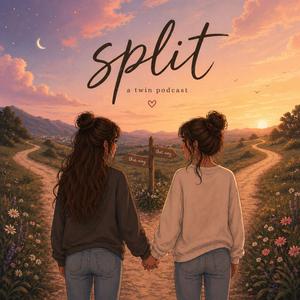
Ever wondered how identical twins perceive their identities differently as they grow older? Join Sam and Meg as they reflect on their journeys from childhood to now, exploring their perceived differences, shared similarities, and evolving self-awareness. This episode dives into the nuances of twin dynamics, personal growth, and the ongoing process of balancing individuality with connection.
In this episode:- The contrasting ways twins coped with negativity and societal perceptions during childhood
- The evolution of their personalities and emotional resilience over time
- The impact of external validation versus self-reliance
- Reflections on having lived apart for over two years and the significance of reunion
- The twin codependency and efforts to balance independence and connection
- Spiritual perspectives on inherent differences and soul imprinting
- How shared influences shape their mutual beliefs and values
- Exploring the concepts of yin and yang within their individual journeys and collective balance
- Yin and Yang Philosophy Explanation
- Twin Dynamics and Relationship Studies
- [Book: "The Twin Guide: A Journey into the Heart of Twin Relationships" by David and Barbara C:** (Unavailable link—search on Amazon)
Sam's Instagram: samara_del_sol
Meg's Instagram: meg_hipkin
Notes:This episode offers a candid, heartfelt glimpse into the nuanced experience of being twins navigating individuality, shared history, and personal evolution. The dialogue emphasizes the importance of authenticity, vulnerability, and continuous self-discovery in twin relationships and beyond.
Inggris
Amerika Serikat
konten eksplisit
TRANSKRIP 🔗
CARI EPISODE TERDAHULU
Cari episode sebelumnya dari Split.
Sanggahan: Podcast dan karya seni yang disematkan pada halaman ini berasal dari Meaghan Hipkin, yang merupakan milik pemiliknya dan tidak berafiliasi atau didukung oleh Listen Notes, Inc.
Sunting
Terima kasih telah membantu agar basis data podcast tetap terbaru
