
इस एपिसोड के बारे में
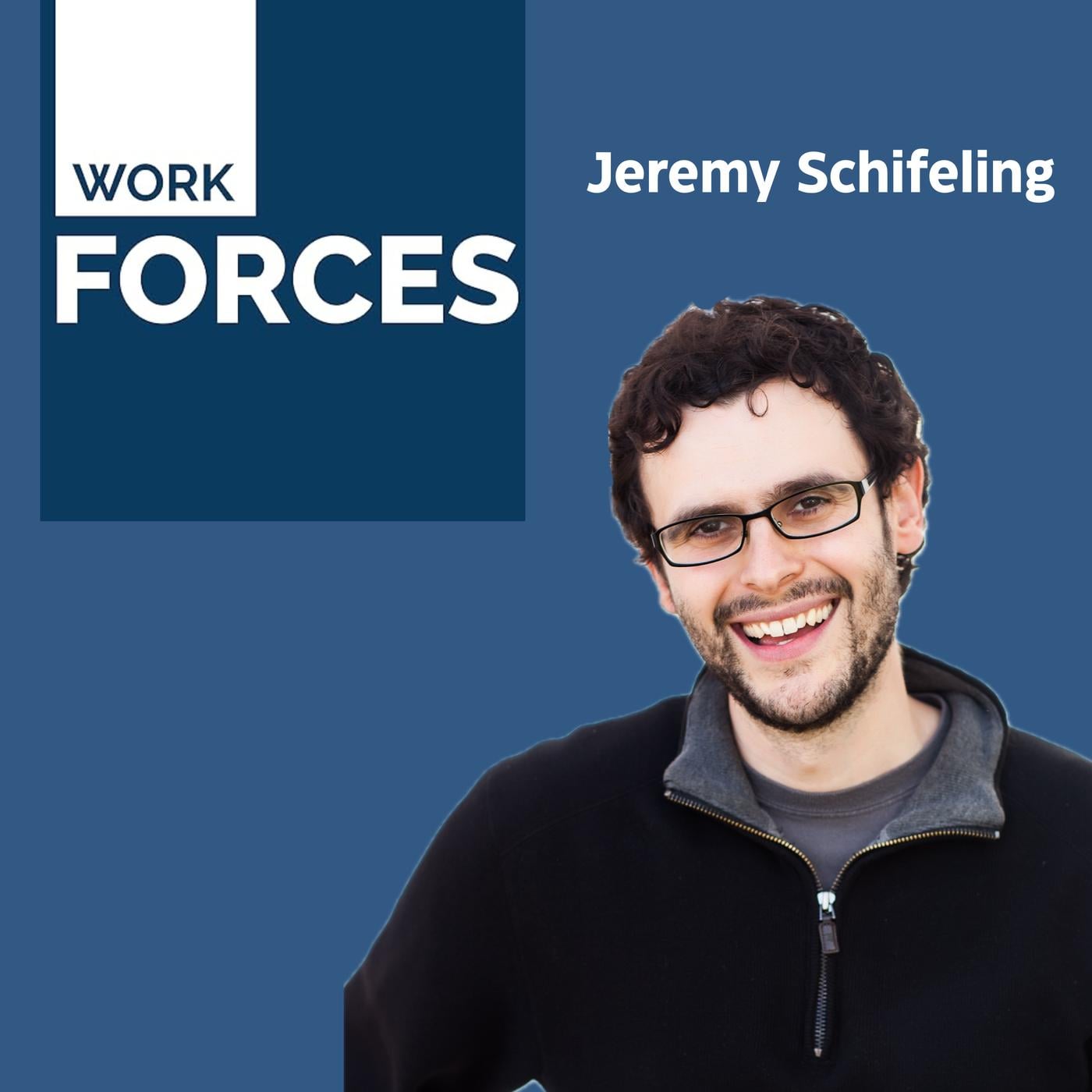
Jeremy Schifeling, author and career coach, has devoted his career to helping others succeed in theirs, from teaching kindergarten in Brooklyn, NY to training career professionals at more than 350 organizations and universities worldwide. In this conversation, Jeremy traces the arc from AI's early promise as a career coaching tool to the arms race it has created in hiring, where students are applying to hundreds of jobs with AI-generated materials and recruiters are struggling to identify real talent. He shares data about the enduring power of human connection and referrals over algorithmic job searching, making the case that career centers are uniquely positioned to lead on AI fluency rather than wait for someone else to go first. He also challenges educators and workforce practitioners to stop using complexity as a permission slip for inaction.
Transcript
Julian Alssid: Welcome to the Work Forces Podcast. I'm Julian Alssid.
Kaitlin LeMoine: And I'm Kaitlin LeMoine, and we speak with innovators who are shaping the future of work and learning.
Julian Alssid: Together, we unpack the complex elements of workforce and career preparation, and offer practical solutions that can be scaled and sustained.
Kaitlin LeMoine: This podcast is an outgrowth of our Work Forces consulting practice through weekly discussions, we seek to share the trends and themes we see in our work and amplify impactful efforts happening in higher education, industry, and workforce development all across the country. We are grateful to Lumina Foundation for its past support during the initial development and launch of this podcast, and invite future sponsors of this effort, please check out our Work Forces podcast website to learn more. And so, with that, let's dive in.
The New York Times recently published a thought-provoking story about a new MIT report that is warning that AI is causing what they call cognitive surrender on college campuses, with students reaching for chatbots when struggling with a new concept, and university leaders offering a range of guidance about how to respond. Some are embracing AI enthusiastically, others are banning it, and many are somewhere in between, trying to figure out the right answer in real time.
Julian Alssid: And that tension lands right at the heart of what we think about in workforce development, if students are outsourcing their thinking to AI before they ever even enter the labor market, you know what does that mean for the skills they bring with them, and who is responsible for helping them develop the judgment to know when to use AI and when not to? Those aren't just questions for universities; they're questions for employers, career coaches, and really anyone who works at this intersection of learning and careers.
Kaitlin LeMoine: Which brings us to our guest today, Jeremy Schifeling, has devoted his career to helping others succeed in theirs. From teaching kindergarten in Brooklyn to leading education marketing at LinkedIn. He's gone on to publish best-selling LinkedIn and AI job-seeking books on Amazon and train career professionals at more than 350 organizations and universities worldwide. Jeremy's newest book, Unbreakable, makes the case that the workers who will thrive in the age of AI are not the ones chasing every new tool, but the ones developing the scarce human skills that technology cannot replace. Jeremy, welcome to Work Forces. We're so glad to have you with us today.
Jeremy Schifeling: Thanks for having me on. Thrilled to be here.
Julian Alssid: Great, Jeremy. Yes, so glad to have you here. And if you will, in your own words, tell us a bit about your background.
Jeremy Schifeling: Yeah, absolutely. So as mentioned, you know, I got my start teaching kindergarten in Bed Stuy, and one of the things that I realized early on was technology was going to be part of these kids' lives forever. And here I was in the early 2000s teaching them how to make PowerPoint, how to make mp3s. It seems quaint by today's standards, but then over the course of my journey working at LinkedIn, working as a career coach at the University of Michigan, working with all these schools today, I realize that technological drumbeat has only gotten faster and faster with each passing year. And so, one of the things I've always been very passionate about is how do we prepare that next generation, not just to survive these technological changes, but actually to thrive. And so, that's what we're all trying to figure out right now in this age of AI.
Kaitlin LeMoine: Absolutely. So, I mean, you've you've written a few books, right? That in some ways trace that arc of how careers and job searching have changed. And of course, this is going from learners in kindergarten to you know people going into the workforce. But those books have covered mastering LinkedIn, using AI as a career coach to your newest book, would love to have you walk us through your evolution and your thinking, and and what what do you feel are some of the common threads that cut across and and new learnings that emerged for you as you wrote each of those books.
Jeremy Schifeling: So I'll just sort of pick up with AI because I think that's what's on everyone's minds these day these days. So I had really sort of this interesting opportunity, which is I was leading the marketing team at Khan Academy back in 2022, and my boss Sal Khan came to me that summer and said, Jeremy, I just got this amazing new tool from my buddy Sam Altman over at OpenAI. This was before anyone knew who Sam Altman really was, and I said, Ah, we always hear about these new things in Silicon Valley, you know, crypto and all this stuff. And then I used ChatGPT when it was still in beta before it had been released to the public for the first time, and I was like, Wow, this is going to be big. I could even tell back then, but I was so naive because, as someone who had been a career coach, I thought it was going to be a panacea. I had worked with all these international students, all these introverts who had trouble telling their story, and that was holding them back when it came to the job search. I said, now everyone's going to have a career coach in their pocket. Everything's going to be solved. Fast forward two years, and I'm working with all these students around the country and around the world. None of them are using it the way that I envisioned, you know, to figure out their perfect path in life and to do all this deep reflection, instead they're using it like the Staples Easy button: build me a resume, write me a cover letter, and now I'm talking to all the recruiters of the world who are throwing up their hands, saying, Jeremy, this is a disaster. I can't tell who's good. Everything just seems fake. And so, really, this AI journey in just a couple of years went from what I thought was going to be utopia to a little bit of a nightmare, and now we're trying to find our way out of it.
Julian Alssid: Well, so yeah, so kind of diving a little bit, a little bit deeper there. So you've described AI as creating an arms race in in hiring and career preparation, you know, for everyone involved with you know students racing ahead as we've discussed, and employers trying to get a handle on this, and you know, and some employers kind of you know a little frozen as to what to do around hiring, and so can you unpack that dynamic and what what does it mean for all the people and institutions who are trying to navigate their way?
Jeremy Schifeling: So imagine you know fall 2022, ChatGPT comes out. All of a sudden, students who once might have applied to 10 or 20 jobs realize that the incremental cost of applying to a marginal job has essentially gone to zero. Right? Say ChatGPT, build me resumes for every one of these 100 job applications. Done. And so now all of a sudden, if you're a recruiter, you were facing about 100 applications per job in the fall of 2022. Here in the fall of 2026, you're facing about 250 applications per job, more than a doubling in just a few short years. At the same time, because there were these huge layoffs going through the industry, guess who was being laid off every time you saw a headline at Amazon or Meta or any of these places? It was the recruiters because if these firms were consolidating, they just needed fewer recruiters to do the job. So all of a sudden, you have more applications from students, fewer recruiters to process them. It's a disaster for the recruiting profession. So what do they do? They erect higher barriers. They either have entry-level jobs that require five years of experience, or they have even more high-powered applicant tracking systems that basically say, Hey, we've got to screen out 95% of these candidates because we don't have time to deal with them. Now, come back to the student. This is sort of the cycle part. They say, Hey, it just got way harder to get a job, there are fewer entry-level jobs all of a sudden, and my acceptance rate is way lower. I better apply to even more jobs using even more AI, and the cycle spins and spins in classic arms race fashion.
Kaitlin LeMoine: And so, what I mean, as you're having these conversations with with job seekers, with students, with career coaches, I mean, what are some of the what's some of the guidance you're offering, right? Because this is, as you're saying, this is a really complex time and and sort of unprecedented in many ways. Would love to hear the guidance you're offering to these different, you know, key players in the space.
Jeremy Schifeling: Yeah. So to build on a sort of arms race metaphor, how do you stop an arms race? You have to have a peace treaty, right? You have to step outside of that vicious cycle dynamic and find a better way. And so, what I'm recommending on both sides of the house is getting back to the more humanistic things. What I tell coaches and students is: Look, you might think that your chance of getting any job is something like 0.1 percent. So if you just apply to 1000 jobs, you're on average likely to get one offer. In reality, when you apply with AI and everything is all the same, your chance is essentially zero. So you can multiply zero times anything, you're still getting zero offers. So if you want to play a way better game, the data is super clear. A referral back in 2016 was about a 10x advantage over applying online in terms of your chances of being hired. In the age of AI, when we can no longer trust anything we see on our screens, it is now a 20x advantage. So I'm telling all those students: get out there, talk to real people, get that real advantage. And the same thing for employers. Instead of just reviewing resumes and screening cover letters that are all sort of homogenous, what if you actually met with students and had a chance to sort of get to know them face to face? Maybe you can use your own human algorithm to detect who feels really like a good fit in a way that the ATS never can, and so basically stepping away from this AI precipice, coming back to some of those human fundamentals.
Julian Alssid: Those make so much sense, and I spend a lot of time talking to my 20-something kids about about this. And I guess one, you know, one challenge they face is so much of their their lives have been around using technology and social media. Can you, you know, like how do you, how do you even build that skill to get the referrals? And how do you, how do you, you know, like, what, like, what's your advice to someone who's just coming out of or recently out of college about kind of building the kinds of relationships that lead to referrals. Because my hunch is that it's hard to do that strictly online. You can't do it just online.
Jeremy Schifeling: I'm so glad you mentioned this, Julian. Because here's the deal: we expect our students, our Gen Z kids, or the students that we teach, to go out there and do all this stuff, and yet they've never been taught how to do it. Right? It's crazy our priorities in our society, where we want every kid to memorize the periodic table, but not know how to take someone out to coffee and meet a new person. And so I think whether you're in workforce development, whether you're a career coach, whether you're just on faculty in an organization, it's incumbent upon us as the older generation to actually empower the younger generation with the skills to do these things, and then I think the biggest thing we can also do, and this is almost like a mind mindset shift, is I know it is so hard to imagine when you're 18 or 21 or 25, but when you're 38 and 45 and 65, you do really want to help the next generation. You know, there's this whole psychological field of generativity that Erik Erikson coined, which basically says the further along in your career you get, the more you want to leave your legacy, the more you want to pay it forward. And so we got to tell students, hey, when you reach out to these older folks, you're not bothering them, you're not annoying them, you're actually giving them the greatest gift, which is the chance to be generative and share what they've learned. And if we can sort of bridge that divide where the students have the skills and they also understand where we're coming from, now I feel like they're going to be better able to to meet the moment where it's at.
Kaitlin LeMoine: When you mentioned the notion of you know we need to we need to prepare learners with these skill sets, I think more and more the types of skills you're mentioning around networking and you know, setting up coffee dates, or I think more and more of those types of skills are being woven into career services type practices, right? I'd be curious to hear you talk more about you know the gap between where career services in organizations and in higher education institutions where the gap where the gaps are for them, because I think this is a really complicated moment for for those departments as well. Just around navigating, you know. There's of course AI is still relatively new, but also needing to prepare this next generation. Would love to hear you to talk a little bit about that.
Jeremy Schifeling: Yeah, I feel really bad for the career coaches of the world right now because more and more, the responsibility for the number one outcome of education, which is prepare people for the workforce, prepare them for a career and a great life, is falling on their shoulders, and yet at the same time, they're doing it with less resourcing, with less headcount, and so it's just asking a lot of these folks. And then on top of that, they also now have to be AI fluent. We only have 40% of career coaches in America trained on AI. So how can we expect them to lead on AI? And so my sort of call is: career centers should advocate for themselves. You know, they should be able to demonstrate the ROI of what they're driving. But then higher education leaders or workforce development leaders should respond to that clarion call and say, "Hey, if we're going to ask you to work minor miracles in our students' lives, we got to empower you to do that with AI training, with resourcing, with headcount. That's commensurate to the task that's on their shoulders.
Julian Alssid: So, so you think it's just about allocating resources to this? I mean, is that is it is it that simple?
Jeremy Schifeling: This is a great question. So, yeah, if you were just going to go to a career services team today that's operating in the way that was operating in 1985, say, and say, "Hey, do more resume workshops, do more cover letter workshops, obviously that's not going to get the job done. The world has changed so much since then, and it's changing even faster as we speak. However, if you allocate that money towards saying, "Hey, we know that a lot of members of academia are not so pleased with what AI has done to their syllabi and their assessments and everything that they've relied upon for years, but because you are the one concrete bridge to the world of work, we want you to actually lead on this to teach students that yes, you should be using AI, but there's a right way to use AI and a wrong way, and we're going to make sure that you feel so confident with these tools that you can represent that to the next generation, because we can't guarantee, you know, given tenure that that's going to happen in every classroom on our august university, but we can absolutely make sure that the career center is representing what employers want and giving the students the skills to be absolutely fluent in what matters.
Julian Alssid: But that's a pretty tall order. I mean, educators and workforce professionals didn't necessarily sign on to do this, and they don't necessarily have the skills themselves. So how how should they think about building this into their programs?
Jeremy Schifeling: So I'm going to give you an example of a change that was made in the business school career coaching world over the last couple decades, and then I'm going to show you why I think this is possible in all career coaching. So when I went to University of Michigan as an MBA student 15 years ago, every single coach, even at the business school, was a lifetime coach. You know, master's degrees in counseling, therapy, all that kind of stuff, and again, they were really good at understanding us as humans, not so great at understanding industry. That wasn't their background. However, by the time I came to coach at the University of Michigan's business school, seven years later, every single coach came from industry. There was a finance coach from J.P. Morgan, a consulting coach from Deloitte. I was the tech coach from Google and Apple and LinkedIn, and they basically said we need this skill set, so we're going to go out and hire for it. And again, that takes resources, that takes headcount. But I think the same is true. It's either we're going to train up the folks who are already there, or if we need to layer in additional skills, let's bring in people who actually are using AI out in the real world because that's what our students are about to have to do in a few short months or years.
Kaitlin LeMoine: Yeah, I also wonder how the you know there's been such a push and a momentum toward work-based learning opportunities, internships, making sure that learners obtain these professional work experiences, right? Like before leaving a college or university, I do wonder too how that factors into some of what you're saying around, you know, giving people not not only the coaching but just the real world experience of being in environments where they're using these tools and developing some of the other skills, like the more human skills we're talking about as well.
Jeremy Schifeling: Yeah, you nailed it, Kaitlin. Like, here's the real deal. I'm a hiring manager myself. I hire for my own company. I never say, Hey, what AI certificate do you have? How did you do it in your AI course in college? I say, What have you built with AI? Because the really big upside of AI, because I know we're usually focused on the dark sides, is the fact is that every single person on this planet today is a computer scientist and a data scientist and a designer because they have those tools at their disposal in a way that didn't exist four years ago, and so if you're going through college not actually building awesome stuff, creating a portfolio of what's possible, then I start to wonder as a hiring manager, what can you actually do for me when I give you those same tools and those same resources?
Julian Alssid: So, Jeremy, given that our our podcast is called Work Forces, what would you recommend to educators and employers and and policymakers as well? We really haven't gone there so much, but I think this has all sorts of implications for for policy. What what what would you recommend to those who want to become forces in preparing workers and learners for careers in in the age of AI?
Jeremy Schifeling: Yeah, I am so glad you asked this, Julian, because this is my biggest thought. Is I know people see this as a threat. They say, "Hey, things were pretty good up until AI came out. You know, we had a grasp on what we were doing. It, we were in rinse, wash, and repeat mode. Now AI has shaken everything up. But I see AI as a real leadership opportunity. If you're a workforce development leader who's always advocating for more funding, now you say, hey! If you're going to invest in us, we're going to absolutely magnify the return because our clients can do so much more. If you're a career center leader who said, "Hey, we have the worst office on campus. We're in some dank basement in the hinterlands of the campus. Well, guess what? This is your chance to step up and say, we're not just going to coach our students getting a job. We're going to equip them with the skills they need to build a career, build a great life. And I feel like if folks want to seize the mantle for this, there's a couple things they can do. Number one, if you've been on the sidelines, it is not too late. I think we've all been shamed by our IT teams over the years. Don't touch that new technology-it's too scary. You might break it. AI is the one technology that breaks all the rules for IT because you can't break it. It is a digital sandbox for you to play with. So, for anyone listening to this who needs that permission to come into the party, I say go for it. Try to plan a vacation with it. Try to come up with a witty joke to tell your kids at dinner. Just start to see that jagged edge of what actually works in AI, what it's not so good at, and then once you start to understand it, say, "Hey, this is not so complicated. We don't need to get caught up in you know all the AI hysteria and this model versus that model. Let's just show our students, let's just show our clients how they can use it to get things done in their lives that are important to them, and I think if we can claim that leadership mantle, the resources, the headcount, everything else is going to follow along.
Kaitlin LeMoine: So, I guess I'm just I'm I'm wondering when you say like you know continue to use these tools. I think there's also been you know as we kind of kicked off this conversation today, questions around like should we use it, should we not use it? Right, like navigating the the complexities of the decision making around those tools. Would love to hear your thoughts on on navigating that complexity.
Jeremy Schifeling: Yeah, so I really tip my cap to Ethan Mollick here because I know he coined this term a couple years ago over at Wharton. This idea of the jagged frontier is that AI is really superhuman at some things, completely idiotic at others, and because there's no manual that comes with AI, there's no guidebook to every possible scenario. The only way to discover these things is by doing it yourself. As an example, if you went to ChatGPT in November of 2022 when it came out and said write a cover letter, you would have thought it was a minor miracle. Oh my goodness! It's grammatical. It's got the three paragraphs. But then, only once you realize it does the same thing over and over again with the same template, do you start to see the dark side. And you would not have uncovered that just reading blogs about AI or reading headlines about AI. The way you uncover it is by getting your hands dirty with AI. And again, I know no one has enough time in the day to do these things, but just starting to bake it into your workflow, make it a part of your toolkit, is the most natural way. As I told my kindergartners back in the day, to learn by doing, and then once you've put in the time, when you've put in the couple hours to really start to understand these things, you say, "Hey, I'm no longer going to send my students out to the wolves to figure this out on their own. I'm going to actually lead them out there because I have strong feelings about what's good and what's less effective.
Kaitlin LeMoine: Yeah, I think it's a complex moment, right? To to figure to navigate that and figure that out, and what is good and what's less effective, and and where are the use cases where using these tools makes really good sense, and where does it become much more complicated? Feels like we're at that moment.
Jeremy Schifeling: Yeah, I'm going to say something spicy for your audience, which is: do not allow the complexity to be your permission slip for inaction. I work with hundreds of universities around the world, and Kaitlin and Julian, what do you think is their number one question about AI. What are our peer schools doing? Again, this kind of let me not be the leader here. The leader gets arrows in the back. I'm just going to be that follower. I'm going to learn from someone else who goes out in front. And because I'm still getting that question four years into this journey, what I see a lot of folks doing is saying, "Hey, let's use complaints about legal, IT, all these different things as reasons not to take actions. Reasons not even to use it myself personally. And unfortunately, even though you might say, "Well, I'm senior in my career. I'm set. I don't have to worry about this. I'm going to retire in a few years. Your job is to ensure that the next generation is ready, no matter how you personally feel about it, and so if we have that responsibility to truly pay it forward, like Erik Erikson said, then I think we owe it to that next generation to put in the time and the work ourselves, not just wait for someone else to do it.
Julian Alssid: So, where is the leadership coming from, then? I mean, that's you know, I think what you're describing is not atypical in terms of pushing the frontiers of institutions like academia.
Jeremy Schifeling: Yeah. So here, here's where I see it. It's bubbling up in all these little pockets inside each career center. Usually not at the director level because again, they're managing the bureaucracy, they're managing all the politics. But it's usually like an associate director or an assistant director, even someone a little bit younger, who's like, I'm using all this stuff. I don't want to tell anyone because I don't want to get in trouble. I don't want the IT team to rap my knuckles, but I'm doing incredible stuff, and I'm starting to talk to my students about it. And I think if you're a smart director or dean or president, you say, I want to hear those voices. Don't do this in the shadows. Teach us, teach the whole team, and then let us teach the students.
Kaitlin LeMoine: So I think as we wind down the conversation today, we would love to learn more about how we can continue to follow your work, along with how our listeners can continue to follow what you're up to.
Jeremy Schifeling: As a LinkedIn alum, I know it's not the fashionable site, but please connect with me on LinkedIn because I love to share and discuss there. I feel like it's one of the few safe spaces on the internet these days where you can actually talk about these things without getting into a flame war. So if you want to debate any of these finer points, would love to see you on LinkedIn.
Kaitlin LeMoine: Great. Well, thank you so much for taking the time to join us today, Jeremy.
Jeremy Schifeling: Thank you for the opportunity and good luck to everyone out there. I know it is a heavy burden that is on your shoulders right now, but I'm also confident that just like past generations prepared us, we can do the same for the next.
Julian Alssid: Hear, hear. Thank you, Jeremy.
Kaitlin LeMoine: We hope you enjoyed today's conversation and appreciate you tuning in to Work Forces. Thank you to our listeners and guests for their ongoing support, and a special thanks to our producer Dustin Ramsdell. If you're interested in sponsoring the podcast or want to check out more episodes, please visit workforces.info/podcast. You can also find Work Forces wherever you regularly listen to your favorite podcasts. If you enjoyed this episode, please subscribe, like, and share it with your colleagues and friends. And if you're interested in learning more about Work Forces Consulting, please visit workforces.info/consulting for more details about our multi-service practice.