
इस एपिसोड के बारे में
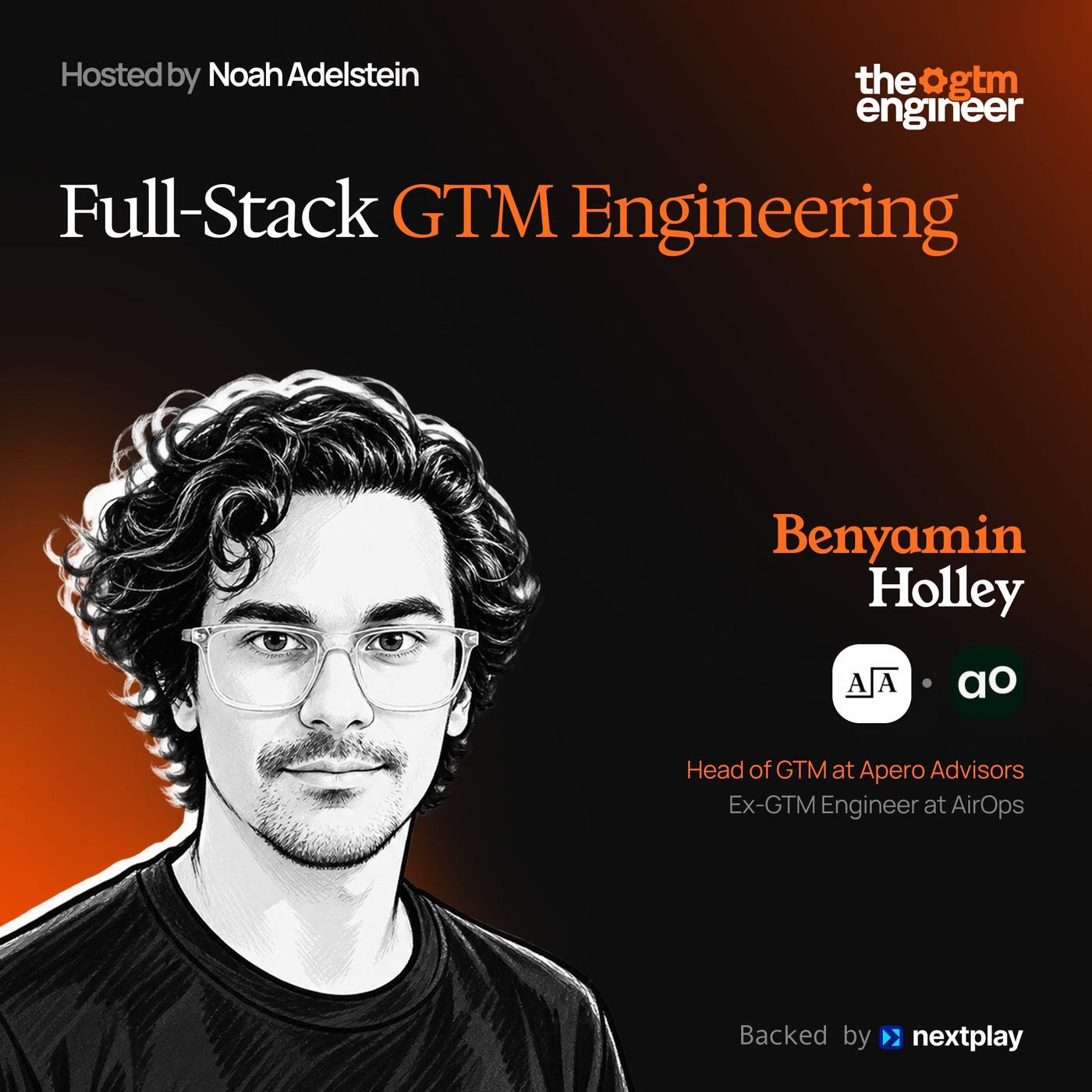
Benyamin Holley is the Head of GTM at Apero Advisors, a GTM engineering firm that builds the data, systems and workflows teams need to drive repeatable growth. Benyamin started his career working in recording studios, then ran a small home recording studio business, where he ran Instagram ads for the first time. Afterwards, he went into sales, selling motorcycles before becoming an SDR at PandaDoc. After PandaDoc, Benyamin transitioned into growth and GTM engineering. He worked as the Head of Growth at Cyft, an AI IT startup, then joined AirOps as a GTM engineer. During his time at AirOps, Benyamin helped run the cold email program, built lead magnets, and did CRM enrichment work. He now works at Apero Advisors a GTM Engineering agency, leading GTM.
In this podcast, we discuss:
* One of Benyamin’s AirOps lead magnet builds
* How the Salesforce CLI gives AI far more access than HubSpot
* Why you should build in guardrails before giving AI access to systems like the CRM
* What it takes to build an effective Claude Code instance for GTM Engineers
* Why it’s important for a GTM engineer to win trust with their stakeholders
* Why Benyamin thinks most GTM agencies fall short
* Where GTM Engineering should sit in the org
Episode highlights:
* Benyamin walks through a lead magnet tool he took over building at AirOps. Since AirOps is an AEO platform, they wanted to be able to show potential buyers how their company was performing in AI search. The tool scraped a company’s website to find its positioning, ran many prompts designed to impersonate all of their potential buyers, then generated a scorecard that showed how well the company did. AirOps then effectively promoted the scorecard through cold email, ads, newsletters and influencer partnerships.
* Benyamin explains why he prefers Salesforce over HubSpot when he is using tools like Claude Code and Cursor. Salesforce’s CLI lets an agent control nearly every part of the platform, allowing Benyamin to use Claude to handle previously manual tasks. He points out that it can access practically the entire platform, and he’s used it to do things like reset a user’s password, and change security profile settings. HubSpot however, does not give agents the same level of access, which makes working with it far more manual and high friction.
* Benyamin shares that he made sure to build guardrails before letting Claude Code touch the CRM. He knew that having agents work across the CRM would ultimately save him tons of time, but was only worth doing once the agents could operate safely with little to no risk of being destructive. Benyamin set up a rollback script that saves the state of every contact they get enriched, so any bad run can be undone. He was also sure to put his API key with write access in a separate environment file from his read-only key, and configured his setup so that Claude has to ask twice before using it. These guardrails gave him the confidence needed to use AI for CRM work.
* Benyamin explains that a GTM engineer has to earn trust with stakeholders before they’ll use anything they build. At an established company, a GTM engineer is often building for other teams, and if they don’t trust the GTM engineer to build things that will be helpful, it makes trying to be impactful far more difficult. Benyamin earned trust with the SDRs at AirOps by first delivering impactful builds they were asking for. So when he built campaigns for the team to execute and new processes for them down the line, he had their buy-in and quickly gained alignment on the work.
* Benyamin argues that most GTM agencies fall short. They rarely have enough context on the businesses they work for, and generally do not carry the responsibility a full time employee does. A full time employee has time to get to know a business intimately, and feels responsible for making sure their work lasts. Many agencies however, launch into work with little context, and add and lose customers constantly. As a result, they don’t treat a failed engagement as a big deal. Apero Advisors runs differently by taking on only a few clients at a time. This gives them room to learn their clients’ businesses intimately, and makes it so they feel the pain of any failed engagement.
Where to find Benyamin:
Transcript details:
(00:00) Intro
(05:11) AI search readiness scorecard
(09:48) Promoting the lead magnet
(11:45) What to look for in a GTM Engineering manager
(13:13) Ben’s takeaways working with marketing
(17:37) Salesforce vs. HubSpot
(19:39) Building enrichment pipelines
(27:13) Allowing for CRM rollbacks and the context to give Claude
(31:56) The most useful GTM Engineering backgrounds and different types of profiles to hire
(38:51) Where GTM Engineering should sit in the org
(42:17) Marketing skills and the importance of AI fluency across different types of marketing roles
(49:02) Why agencies often fall short
(56:54) How Ben thinks about LinkedIn content
(1:00:00) Favorite underrated software tool, and wrap-up
This podcast is brought to you by Tapistro
I’ve seen many CRMs full of records and third party data nobody trusts, without any signals that can be used to prioritize who to target. While the finished system feels simple and obvious, few tools make building it easy.
It’s hard to know where to start when you want to rebuild your company and people data, then enrich, score, and prioritize each record. That’s not to mention building a scalable solution that smoothly connects into your existing systems.
Tapistro is an agentic GTM platform designed for people with all degrees of technical skills - whether they want to be in the CLI or inside of a web app.
Tapistro has everything you need to build your GTM infrastructure in one place: a data marketplace, the ability to scan for signals like job changes, hiring, and web intent, they have agents that can do research and draft outreach, and they are able to sync everything to and from your CRM. They have a single unified view for every prospect + account, and they help you continue to improve how you define your ICP over time.
You can check out Tapistro here, and mention The GTM Engineer for 30 days of free access.
For inquiries about sponsoring the podcast and to recommend any guests, email noah@thegtmengineer.ai
This is a public episode. If you would like to discuss this with other subscribers or get access to bonus episodes, visit thegtmengineer.substack.com