


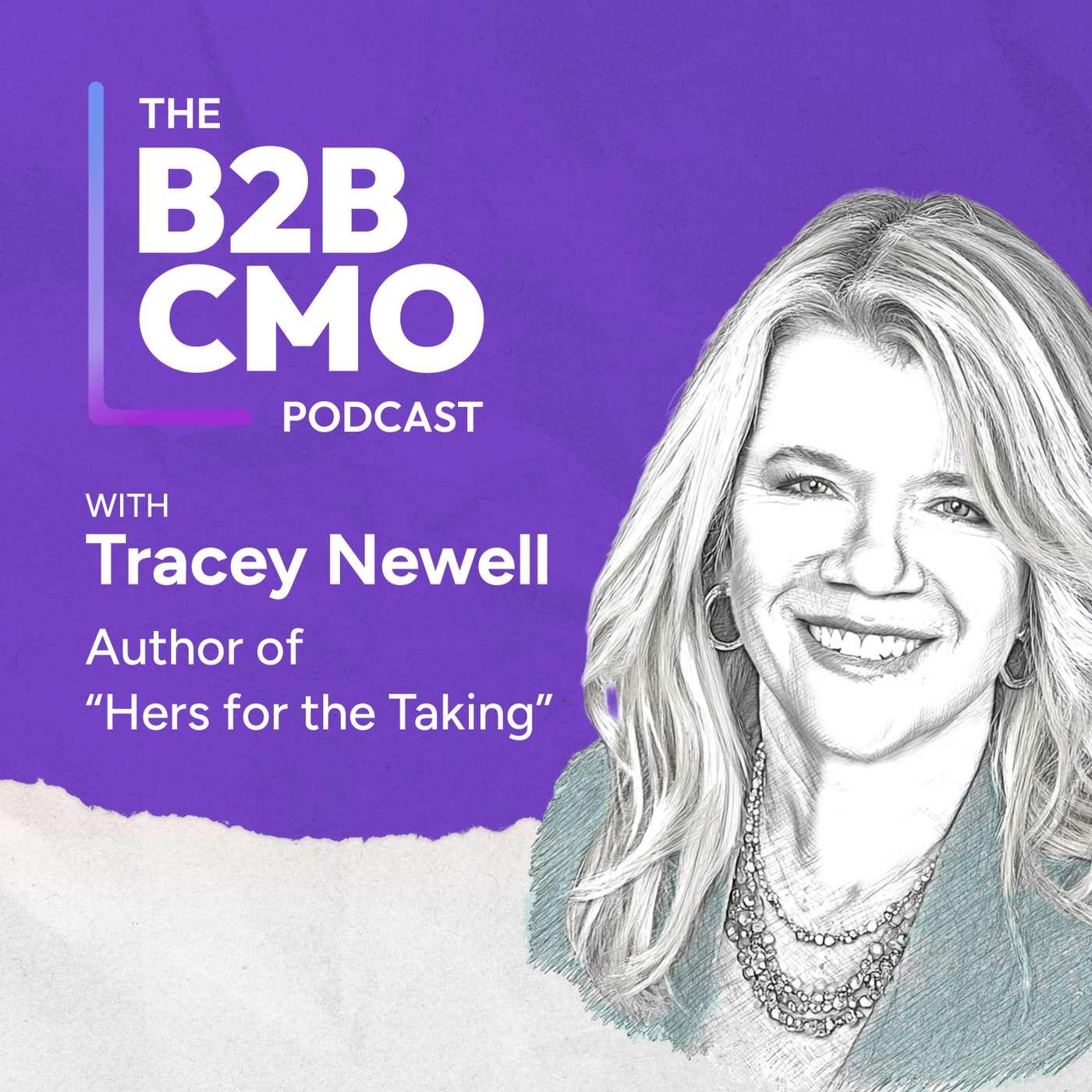
B2B CMO - 002 - Tracey Newell
===
[00:00:00]
Sydney Sloan: [00:00:05] [00:00:10] [00:00:15] [00:00:20] Hello and welcome [00:00:25] back everybody to the B2B CMO podcast. Today we [00:00:30] have with us Tracy Newell. She is the author of Hers for the Taking [00:00:35] fantastic book. Highly recommend you get it. And, um, she's based this story on [00:00:40] leading global revenue teams. She was the president at Informatica. Now she sits on [00:00:45] many boards and she's very active board member.
Sydney Sloan: I've, I've heard many stories in some of the [00:00:50] fastest growing software companies in the world. Tracy has held leadership positions at [00:00:55] Proofpoint, Polycom, Cisco, where we have shared stories, and now she's [00:01:00] on a mission to help more women step into leadership. With confidence and [00:01:05] clarity. I couldn't think of a better person to add to our podcast that can bring a [00:01:10] different perspective.
Sydney Sloan: That's not directly from the CMO. It's surrounding the cmo. She's managed [00:01:15] CMOs, she's been president, she's been on boards, and so we're gonna get into some details [00:01:20] on what she's seen and what she's recommending to keep us more strategic. But before we dive [00:01:25] into the questions, Tracy, uh, we're gonna get to know you a little bit.
Sydney Sloan: So we always love to start with like. [00:01:30] Who is Tracy Newell? What is your origin story? Where'd you come from
Tracey Newell: Where did I
Sydney Sloan: and [00:01:35] welcome? Where did you come from
Tracey Newell: Uh, well, I guess, you [00:01:40] know, I was born and raised in California and I grew up in the Silicon Valley and fell in love [00:01:45] with tech at a very early age, straight outta college, and started in really big giant [00:01:50] companies like at and t and Cisco, and started going into smaller companies. And the smaller they [00:01:55] got, the more fun they became.
Tracey Newell: And so, uh, that's, that's a little bit about me and now I'm doing board [00:02:00] work and when I'm not doing that, I'm spending time with my family.
Jon Miller: Hmm.
Sydney Sloan: Awesome. And, [00:02:05] um, if, if there was, um, a biopic of your life [00:02:10] and you look back. Into your experiences, what would be the two to [00:02:15] three scenes that you definitely would wanna make sure made it into the movie and who would play [00:02:20] you?
Tracey Newell: Oh gosh, we clearly didn't [00:02:25] rehearse these questions, but, uh, the. Two to three [00:02:30] scenes. I, I would say one, one scene for all of your listeners, your [00:02:35] viewers is, uh, would be the reality in my [00:02:40] probably thirties, that we can do so much more. Then we know, you know, and I, [00:02:45] I was challenged, I was lucky about a number of times and I talked a lot about it in my book, [00:02:50] uh, that, you know, people said, Hey, you can do this.
Tracey Newell: You can run a company. And I remember looking around going, [00:02:55] who are you talking to? You know? 'cause I'd never met anyone who'd run a company, let alone. Thought that I could do it. So, [00:03:00] you know, I, I would say that was one of the, the big lessons learned. And I would say [00:03:05] the second one of my favorite movies I just watched it is, uh, I don't know how she does it with Sarah Jessica [00:03:10] Parker.
Tracey Newell: Um, the book was really, really good. Um, but this idea of balancing family and [00:03:15] life was really hard for me. In my thirties and, and, and I [00:03:20] almost shut down my career because of it. And, uh, that's another big lesson and message [00:03:25] I have for men and women that are, you know, in the messiness of life with little tiny [00:03:30] people at home.
Tracey Newell: Or maybe it's aging parents or just, you know, really heavy burdens that you're carrying. [00:03:35] Uh, you can't have an amazing career and have an amazing [00:03:40] personal life too. Would be my second scene that would be most important.
Sydney Sloan: And do you [00:03:45] have a favorite actress who you think would play you?
Tracey Newell: Oh, [00:03:50] maybe Tia Leone. I'd have to be really lucky,
Sydney Sloan: [00:03:55] that's a good one. I love that.
Tracey Newell: I do like her. Madam Secretary was a pretty [00:04:00] great show.
Sydney Sloan: Love that. Love that. Well, um, I do remember [00:04:05] reading that chapter in the book where you were in, you were in the office and somebody said [00:04:10] that to you and you wrote you, I think you said like an emphatic note, like, there's no way I can do that. I have. You know, [00:04:15] I'm struggling as it is. How could I ever do it?
Sydney Sloan: And then you went into, in a complete [00:04:20] diatribe of like, wait a minute, men can do it. Why can't I do it? Um, so, uh, those, [00:04:25] the, I vividly remember that story. So I think it would make a good scene in, uh, in a, [00:04:30] maybe you have a six part mini series,
Tracey Newell: Yeah, there's
Sydney Sloan: the Life of a Silicon Valley's [00:04:35] Lady
Tracey Newell: Uh, a hundred percent yeah. Men and women both feel the pain, but [00:04:40] I have met so many women that have turned down promotions and I turned down a ton of them, uh, just because of [00:04:45] all these amazing stories I was making up in my head. None of 'em were true.
Sydney Sloan: Yeah. Well, let's [00:04:50] get into, um, some of the, the themes as well of the book. [00:04:55] And so you talk about confidence as something that you can [00:05:00] build, not something you're born with. So I'm curious if there's a moment in your [00:05:05] career where you didn't feel ready, so we can dive into one of those stories, but you said yes [00:05:10] anyway.
Sydney Sloan: The moment where you actually went over this, the voice in your head and [00:05:15] did it, and what was the outcome, what did that decision cost you or what unlocked [00:05:20] for you in that moment where you finally said yes.
Tracey Newell: Yeah, so kind of going back to that [00:05:25] first scene that we were just talking about, I, I knew I wanted to, [00:05:30] you know, again, I was early thirties, wanted to make a change. Working at big company is working at Cisco. [00:05:35] And I knew I didn't like my current job and I wanted a new one. I didn't know what that was. And someone [00:05:40] said, well, what do you want to do long term?
Tracey Newell: You know, five, 10 years from now, do you wanna run a company? [00:05:45] And the thought of running Cisco at 30 years old seemed a little overwhelming to [00:05:50] me. And, uh, she pushed back and said, well, why not? And I said, well, I have two little kids. [00:05:55] And, uh, I just can't imagine doing that right now. I'd never see him again.
Tracey Newell: She said, gimme another reason. I said, I don't have the [00:06:00] skills. And, and this mentor said, you know, what, about 15 [00:06:05] years from now, would you do it then when your kids are maybe in high school or college? And I, [00:06:10] it, it really caused me to hit the pause button and I kind of gulped out, maybe stammered out a [00:06:15] maybe, you know, because she seemed to think it was possible and.
Tracey Newell: And her advice [00:06:20] is what changed my life. Her her advice said, well then get the experiences in the next 10 to [00:06:25] 15 years that will allow you to have that option when you know you're a bit [00:06:30] farther down the road and, and so that was life changing advice. You know, I've been talking a lot on LinkedIn [00:06:35] about how your career is not a ladder, it's more of a jungle gym.
Tracey Newell: And I took a lot [00:06:40] of sideways steps. I went backwards several times, you know? [00:06:45] And people would look at me and go, what are you doing? You know why? Like I, my first management job was [00:06:50] managing accounts receivable when I was 26 years old, and my friends were all in sales and they said, you're [00:06:55] crazy. And yet, you know, maybe I was, I, I didn't really understand what, [00:07:00] what I was doing, I think at the time, but.
Tracey Newell: These were union employees that have been with the [00:07:05] company called at t more, you know, longer than I'd been alive. You know, they're all 25, 30 year vets. [00:07:10] And I learned more from managing that team than I did in my next two or [00:07:15] three jobs. So, you know, taking lots of laterals and sidestep so that you learn how to run a [00:07:20] business, run a company, versus being, you know, what I call a mile high and an inch deep, where you [00:07:25] only know your function.
Tracey Newell: Uh, that, that really changed my career [00:07:30] trajectory.
Sydney Sloan: That's so interesting. And then when you're running those functions, I always wondered that when I [00:07:35] was that age is like I was afraid that I couldn't lead [00:07:40] people if I hadn't done the job first, and that was actually a [00:07:45] limiter. Um, but having context of like how the company runs is different than [00:07:50] that. Um, and, and so maybe that was, you know, I understand finance.
Sydney Sloan: [00:07:55] I've worked in finance. I know there's always like. If you're in marketing and you'd [00:08:00] been in sales before, that appreciation for, hey, you held a [00:08:05] bag, like, is like a badge of honor. I, I recommend to marketers, like, if you can, [00:08:10] you know, go do that as part of your journey because it just makes that bond [00:08:15] stronger.
Sydney Sloan: Um, and you, you were in sales for a long time too, right? Like that
Tracey Newell: Yeah, I [00:08:20] was in sales, but I did all kinds of different roles that were operational. So, you know, market [00:08:25] analysts, accounts receivable, strategy operations, those kinds of jobs. [00:08:30] Um, and I always ended up going back to sales and customer success 'cause that that was my passion. But when I went [00:08:35] back, I, I was a much better leader and I was more empathetic to my functional leads as [00:08:40] well, but also able to understand how to find a joint mission or a joint goal [00:08:45] that cross sales.
Tracey Newell: You know, I always think of marketing, marketing isn't really a function. It's, you [00:08:50] know, it's lots of functions. You know, if you could find an initiative that crosses over product marketing and brand and demand, [00:08:55] gen and sales and customer success and engineering, well, gosh, now the whole company is [00:09:00] rowing together.
Tracey Newell: Uh, and I think those cross-functional roles really helped me to understand how [00:09:05] to work with my other teammates to get the best result.
Sydney Sloan: That's a perfect [00:09:10] leeway into our shared connection. Doug Deline, we're definitely going to give him a shout out. [00:09:15] Um, 'cause he was one of the best bosses I ever had as well. Um, [00:09:20] and he shows up in your book. So when you think about Doug, what did you learn [00:09:25] from him about leadership that most people would miss if they were just watching from the [00:09:30] outside?
Sydney Sloan: So you and I both know him very well. I worked for him for four years. I think you even worked for him longer than that. [00:09:35] Like what? What were some of those insights? Do you
Tracey Newell: Yeah, so it, [00:09:40] it, Doug's funny. He's one of the few people I mentioned by name in the book. And the reason why that [00:09:45] happened is I wrote the book and I had an anonymized everyone except for the, [00:09:50] the women rock stars that I, I called out and uh, after [00:09:55] writing the book, I called Doug and I said, you know, I have to tell you, you are all over this book.
Tracey Newell: [00:10:00] Do you want me to use your name? And he said. Tracy, if you actually think I helped [00:10:05] you, please yes. Use my name. And so I got that cleared on the, on [00:10:10] the, uh, before we published. But, but, um, he was an amazing mentor and a [00:10:15] very funny story. So I was in his office and I was planning to quit Cisco. I was just [00:10:20] frustrated.
Tracey Newell: I felt like the company wasn't going in the right direction. So he was my boss's boss [00:10:25] and running North America, and I showed up in his office for a skip level. [00:10:30] And I was ranting and I was pretty inappropriate. Honestly. I, you know, this is broken and this [00:10:35] is wrong. And they don't get this and not, you know, sales isn't working with marketing and marketing's not working with sales ops and, [00:10:40] you know, and I was ranting and he said, uh, he stopped me and he goes, do you wanna come work for me?[00:10:45]
Tracey Newell: And I said, doing what? And he goes, well, I don't know. The job doesn't really [00:10:50] exist, but you could help me with strategy and, you know, follow me around for six months and then you could, you know, it just helps [00:10:55] me scale in meetings I can't get to. And I, I kind of stopped and paused and [00:11:00] thought, well, I'm gonna quit anyway, so I might as well give this a try.
Tracey Newell: And he followed [00:11:05] through. And, uh, 18 months later, I learned more from him in those [00:11:10] 18 months than I would've in 10 years. Uh, absolutely trained, [00:11:15] changed the trajectory of my career and my family's life. And, um, why? [00:11:20] Because I had access to rooms I would never have had access to. You know, I, I was [00:11:25] only, I don't know, my mid thirties by then, and he truly did empower me, but I worked really [00:11:30] hard to be fair, you know, I worked really hard to get in his head, understand what he was trying to do, and [00:11:35] then to bring the whole company around us together to, you know, [00:11:40] help the company accelerate.
Sydney Sloan: I pulled a quote out of your book, um, that like I underlined [00:11:45] when I was reading it. And, it was after you had worked with him and, [00:11:50] um, you said, I can't believe what we've achieved in the last years and no one [00:11:55] reported to me. And he said, my advice for you is to spend the rest of your [00:12:00] career pretending that no one reports to you.
Sydney Sloan: At the end of the day, they know you're [00:12:05] the boss, but people do things for their reason, not for yours. You, if you can win their [00:12:10] hearts and minds and bring people together in a cohesive strategy, you'll be unstoppable. I, I was [00:12:15] like. Like that is such an empowering piece [00:12:20] of advice because I talk to so many people and I go back to that comment of like, [00:12:25] I had to do the job before I had to be able to know and like [00:12:30] micromanage even.
Sydney Sloan: Right? But if they don't, if you act like they don't work for you and you empower them [00:12:35] and get them aligned, so is there a story that you can remember? Where [00:12:40] that happened, you had a big strategic idea. 'cause I think this is a challenge for CMOs. You know, [00:12:45] we, we've grown up generally in the function, probably not across the business like you had [00:12:50] experienced.
Sydney Sloan: And even now with ai, we're being pulled down into the weeds. We're [00:12:55] being expected to do more to, you know, do the agents and have [00:13:00] hands on. And, and a lot of my friends are like, you know, aren't afraid to do it, [00:13:05] but it's. It's different, uh, than leading from the [00:13:10] front. Um, so what, what would your advice be to them, or what's that story that you could [00:13:15] share with us that aligns with Doug's advice?
Tracey Newell: Yeah. So [00:13:20] again, I took that advice to heart. That became my, my leadership style. You know, I, I'm a [00:13:25] big believer in servant leadership. Talking recently to a president of a very large company, and [00:13:30] he said, I don't believe in servant leadership because everyone thinks you have to be nice all the time and you don't get results.
Tracey Newell: And I [00:13:35] said, well, I've never met an executive that can stay in the job for any long period of time. [00:13:40] That doesn't execute well, especially on the Go-To-Market side. Uh, so [00:13:45] I, I have a different perspective. I think you can lead from the front and you can. You [00:13:50] can help serve and make people's jobs easier and more effective while still [00:13:55] expecting, uh, people to do their job and to be outstanding at doing their job.
Tracey Newell: Um, an [00:14:00] example, you know, I called it out in the book back in those times, the number one initiative that. [00:14:05] That, uh, we had was to go build the channel for Cisco. Cisco had a big fulfillment [00:14:10] channel, but there wasn't a ton of value add and everybody in the company was working so [00:14:15] hard to build the channel.
Tracey Newell: The channels team certainly, uh, was losing sleep, but so were the [00:14:20] sales teams. So it was the marketing teams. So it was the channel marketing teams, uh, you know, everybody was working [00:14:25] hard, but we really weren't working collectively together. And so, you know. [00:14:30] Really brought the smartest people in each function that I could find together to say, okay, this is [00:14:35] our charter.
Tracey Newell: We will do this and let's figure out. You know, how can we [00:14:40] work together to go do this, um, as one united team with the [00:14:45] proper metrics in place. Uh, and when we did that, it took us a couple years, but I, I [00:14:50] still think today, I'll hear some of the boards that I'm on. People say, well, our channel's not like Cisco's.
Tracey Newell: And [00:14:55] I always laugh 'cause Cisco didn't, it wasn't always like that, you know, 10 years ago. [00:15:00] But, you know, how does that imply to today's world, Sydnee? I, I think, you know, if you. [00:15:05] Uh, think about, you know, what is every company trying to achieve? You know, for the CMO, the, [00:15:10] it's, everyone's trying to drive top line revenue.
Tracey Newell: Everyone's trying to drive net retention. [00:15:15] Uh, everyone's trying to reduce churn. So picking even one of those [00:15:20] ideas and then getting product marketing demand gen along with a couple of the best sales [00:15:25] VPs, along with a couple of the best cheap customer. Executives, uh, couple the [00:15:30] best scs. I think that, that, especially in tech, scs get left out and they [00:15:35] are the backbone of every company.
Tracey Newell: And they can tell you why people are, are leaving or [00:15:40] joining. And, uh, and, and then say, you know, this is the one thing that I really wanna thread the [00:15:45] needle on. Um, I used to work with the CMO, uh, who I thought. She was [00:15:50] one of the best CMOs I ever worked with. She's super strategic and she, she made the [00:15:55] comment that, um, 'cause I was new and I said, we don't have any, you know, sales and marketing aren't working [00:16:00] together.
Tracey Newell: She got mad. She said, what are you talking about? You know, we have 20 campaigns. And I said, yeah, but I don't know about any of 'em. [00:16:05] So how can I align sales and channels and the scs? Let's just pick [00:16:10] one or two. I don't care which one, and let's get everybody on your team, and everybody on my team and everybody on [00:16:15] customer success, all doing one or two things brilliantly.
Tracey Newell: Around that [00:16:20] campaign. And, and she smiled and she goes, oh yeah, you're talking about the, the sym, you [00:16:25] know how the CMO is really the conductor oftentimes for a company? And I, I kind [00:16:30] of looked at her and she goes, well, no, think about it. Think about a symphony. You've got the, you know, you've got the winds, you've got [00:16:35] the brass sections, you've got the string section.
Tracey Newell: And the conductor isn't playing [00:16:40] music in each of those sections, but he or she is trying to get each of those groups to [00:16:45] work together to play their part. To make beautiful music. And I, I think that's a [00:16:50] great analogy as to what a CMO can do in, [00:16:55] in the right situation because it's hard to be [00:17:00] outstanding.
Tracey Newell: My view in marketing, if you aren't, if you don't have engineering on [00:17:05] board and product management on board, 'cause how do you create brand presence? How do you create [00:17:10] differentiation? How do you create a winning story that sets the company apart? Without those people, [00:17:15] but you also need sales. You need channels, you need the, the, the technical [00:17:20] teams, uh, all aligned as well, um, to get the company's [00:17:25] voice as loud as it can possibly be.
Sydney Sloan: I a hundred percent agree with that. I think [00:17:30] my, like I would say the, the highlight of that was when I was at [00:17:35] SalesLoft and we really did get, get into how do [00:17:40] does marketing champion the customer experience through the entirety and pull that all [00:17:45] together. And that's where you can get marketing and sales and product in [00:17:50] product experiences that drive adoption, the community and, and, [00:17:55] and all of us.
Sydney Sloan: Telling one story consistently, showing up to the [00:18:00] customer consistently is the same company. We're all brand ambassadors, is what we called [00:18:05] ourselves. And like when that happened, that was magic. Um, and [00:18:10] I, I'm encouraging CMOs all size companies right now. It's a time [00:18:15] where we can go back and do that because AI is changing everything in the way that.
Sydney Sloan: [00:18:20] Buyers are doing their research and learning the products. I mean, like you just look at today's products, people will go to ChatGPT [00:18:25] PT, ask it to do something, take that code, dump it into another technology, like [00:18:30] it's just not the same. And so we have to reimagine what that is and [00:18:35] then say, now how do we.
Sydney Sloan: You know, build a relationship with our user in a [00:18:40] way that's meaningful for them when the way they work has completely changed. So [00:18:45] definitely a fan of the champ championing the customer experience at right now as, as it's being a [00:18:50] hundred percent reimagined. Um, I have one more question. I know that John has one too.[00:18:55]
Sydney Sloan: Um, so I will, um, switch hats a little bit from, from leadership and, [00:19:00] uh, like I think you're what, on four or five boards right now? Is that right?
Tracey Newell: Yeah, I'm seeing on five boards. Yeah.
Sydney Sloan: [00:19:05] Five boards. Okay. Um, and active, I remember your story. She's an active board [00:19:10] member. Um, if they want you to be, I remember you saying that too.
Sydney Sloan: Um, so what are the, um, [00:19:15] what would be the signals from the board's perspective in thinking in these like [00:19:20] large, more public companies that the company is creating the [00:19:25] market? Like either like. Already leading or disrupting new [00:19:30] markets. What advice would you have for the CMO on the artifacts or [00:19:35] decisions or how they can own that story in the boardroom around [00:19:40] market leadership or if they're trying to like take over a market, like have you seen that done?
Sydney Sloan: Well, [00:19:45] I think that of as a strategic thing, which is why I'm asking.
Tracey Newell: for for [00:19:50] sure. I, I've seen it as an operator and I've seen it as a board member and, you know, I, [00:19:55] I think what. It's always funny when you're in it, you know, when you're in the, [00:20:00] the middle of a market transformation, a category change because you don't always [00:20:05] recognize the signs when you're in it.
Tracey Newell: But in hindsight, looking back, um, [00:20:10] you know, I, I always say, you know, you can tell when things are changing because the [00:20:15] company's almost built a better mousetrap. They've changed the way things are done, and so a [00:20:20] problem existed. And people were so used to the problem, they didn't think there was a [00:20:25] better solution until a new company comes along that out innovates and creates [00:20:30] market change.
Tracey Newell: And, and you know, one of the ways you know that [00:20:35] you're out in front and you've got a bit of a lead is at first you don't have a [00:20:40] lot of competition. I mean, there's always competition. And I, I am a big believer as leaders, we should [00:20:45] always be humble and we should always be paranoid. But when you're winning more than your fair [00:20:50] share and your competitors are coming up behind you, but you've got 99 [00:20:55] reasons as to why you're superior and they really can't touch that other than to behalf of your [00:21:00] price.
Tracey Newell: Um, to me that's a sign that you are leading in a brand new [00:21:05] category. Uh, and also cha changing buying centers is also a common sign. I can remember [00:21:10] when we were at Proofpoint, um, it was an email security company. We were a hundred million at the time. [00:21:15] Uh, it was pretty commoditized. And our buying center was the, uh, the IT team in charge [00:21:20] of exchange, 'cause it was email security.
Tracey Newell: So security came second and we wanted to get [00:21:25] to the ciso. And the CISO was saying, the chief security officer was saying, you know, sorry, I can't help you. That's not my [00:21:30] budget. It's not my problem. And, you know, we redefined the product. Uh, uh, [00:21:35] we redefined our brand and, uh, started calling ourself a security company first.[00:21:40]
Tracey Newell: Uh, ransomware became a really big problem at the time when we had a product. We were the only ones [00:21:45] in email security that had a ransomware solution. And we also were, we [00:21:50] persevered in really going after the chief security officer. And so we made our way into that [00:21:55] office. And what changed? Is who owned the budget.
Tracey Newell: So it didn't happen overnight, [00:22:00] but suddenly that budget switched to security and it became much larger. And that's [00:22:05] another sign that the category is changing. And so, um, how can [00:22:10] CMOs think about, what are a couple of artifacts that you might think about is, um, [00:22:15] I would be asking in the boardroom or on the op operating team, you [00:22:20] know, what is, what is the.
Tracey Newell: The story. What is your why? Like I [00:22:25] wanna have such good clarity on why we are different [00:22:30] and why we're unique and that narrative. I love Simon Sin Sinek's book of start with why. [00:22:35] Um. I think that's really important and, and a, a very simple [00:22:40] thing to do is when you get your story right, and to me, the whole company has to come together to get the story [00:22:45] right.
Tracey Newell: You know, the best individual contributors along with the ELT, need to all agree. Like, this is why we're [00:22:50] amazing. Um, a fun thing to do. Uh, we did pitch Perfect at Proofpoint when we [00:22:55] were, I don't know, 150 million and we, we did a, made a contest. Everybody in the company had to do two [00:23:00] to three minutes on why.
Tracey Newell: Why we're amazing, you know, and the CEO and I and all [00:23:05] the ELT members, you know, did our videos, but it was so fun. Like people started [00:23:10] bringing their Girl Scout troops talking about Proofpoint and the water polo team is talking about Proofpoint, like [00:23:15] the amount of energy we got from getting the story right, uh, was really important.[00:23:20]
Tracey Newell: Um. You know, just having clarity around the ICPI, I see a lot of companies that, [00:23:25] you know, they, they say, Hey, I can sell the 20 buying centers. It's so awesome. And I, I am like, okay, yeah, [00:23:30] that's, that's great, but it's bad because how in the world can the Go-To-Market team. [00:23:35] Focus, they can't. And so just getting real clarity, uh, when [00:23:40] I, again, I'll use Proofpoint, Informatica was the same too.
Tracey Newell: We, we chose a persona that we were gonna go [00:23:45] after and everything that we did around Go-To-Market strategy, around mergers, [00:23:50] acquisitions, everything was, can we stay in that office? You know, when you're 20 [00:23:55] billion, 30 billion, you can have lots of specialists and overlays and all this. Yeah, that's a different conversation.
Tracey Newell: But in [00:24:00] the, in the early days of the company, the more you can get intentional on, we wanna [00:24:05] own the office of X, the office of the ciso, the CFO, the CDO, [00:24:10] um, I think that really helps the whole company to win. Um, and then on metrics, [00:24:15] keeping it simple, I, I think, you know, you get the company aligned around a handful of [00:24:20] metrics.
Tracey Newell: Uh, that will scale with the company. I think that's really important too, so that we can see that [00:24:25] we're making progress.
Jon Miller: Tracy, thank you for, for joining us so much, and I, I [00:24:30] completely agree with your point about getting the company aligned around this, the core message and differentiation in [00:24:35] ICP. Um, I wanna dive into the metrics a little bit more if I can. Um, I think a lot. [00:24:40] The CMOs today struggle with credibility, struggle [00:24:45] with, you know, being perceived as too tactical.
Jon Miller: And I, I think part of the problem is because [00:24:50] oftentimes the, the metrics that they've been using are kind of too, too much [00:24:55] based on activity, you know, kind of too tactical. What, you know, what, what do you recommend for A [00:25:00] CMO who maybe is in a company where, you know, where they don't necessarily see the [00:25:05] value that marketing can bring on the strategic level, how, how do they change the [00:25:10] narrative? What, you know, how do they prove their value? Where have you seen that work? Well.
Tracey Newell: [00:25:15] Yeah, sure. I, I, a pet peeve of mine, if I may, [00:25:20] is, you know, we've all seen it, it, you know, the, especially if the company isn't [00:25:25] hitting their growth goals, as you walk into an executive, you know, QBR [00:25:30] and, you know, sales is missing and professional services is missing, and [00:25:35] engineering doesn't have the money to do what they need to do, and, and the.[00:25:40]
Tracey Newell: The CMO will start high fiving 'cause they're hitting the top of the funnel metrics and, [00:25:45] and everyone gets frustrated 'cause it's not converting. And to me that's a classic error. [00:25:50] I, I would love to see the CMO really start thinking about what are the [00:25:55] strategic objectives of the company. And those are super obvious.
Tracey Newell: You know, it's top line revenue, [00:26:00] it's net retention, um, it's innovation, uh, and how do [00:26:05] you align to that. And so I think today, in today's world. You know, just really [00:26:10] making sure that there's quality metrics around things like. Win rate, you know, [00:26:15] what's going on, uh, for the loss rate, you know, and getting real clarity on why we lose and [00:26:20] when we lose, uh, can we track for, you know, our campaigns, what's most effective and what's [00:26:25] actually tracking to close rates and follow it all the way through the funnel.
Tracey Newell: Uh, [00:26:30] what's going on with pricing, I think is a, pricing is a really strategic discussion that most [00:26:35] companies don't spend a lot of time talking about. And, and, um. Yet, it's such a good lever [00:26:40] for driving top line revenue, uh, and win rates. Uh, and then [00:26:45] expansion. I, I think so often we get really caught up in chasing new logos.
Tracey Newell: 'cause that's an [00:26:50] obvious thing to go chase and we should do that. But in most worlds that I've lived [00:26:55] in, you know, most companies are trying to get. You know, net new revenue 50% through [00:27:00] net new, uh, customers. But 50% through expansion is so much easier to sell to the [00:27:05] installed base. And it's complicated. I'm not in any way saying it's easy to sell the installed base.
Tracey Newell: 'cause most [00:27:10] companies have a data problem, you know, and they have a hard time understanding who are their [00:27:15] customers and what do their customers have. But I would say for A CMO, that's critical [00:27:20] because that's one of the easiest levers. To really get clarity on and [00:27:25] um, and have programs around how to drive expansion and net retention
Jon Miller: I mean, one of the [00:27:30] challenges is not everything in marketing is measurable. So, you know, you [00:27:35] especially, you know, is, you know, brand and how's it landing in the marketplace and [00:27:40] some of these like softer things. What have you seen CMOs do to, you know, well [00:27:45] around that kind of problem?
Tracey Newell: Yeah, so I, I, I, I feel like the world has [00:27:50] moved away and should move away from justifying why marketing's important. I, I, you [00:27:55] know, I, I can remember where we measured how many touch points we had on a deal. You know, Hey, I [00:28:00] touched this one deal 32 times. And in a, in a world where sales and marketing [00:28:05] and customer success are tied at the hip, to me that.
Tracey Newell: That's just [00:28:10] obvious. You know, I don't feel like that's what we need to measure, but it, it, it is helpful, [00:28:15] uh, to measure what, you know, I ran these 20 [00:28:20] campaigns and here's what actually happened throughout the process and what converted and what was the [00:28:25] time to value. Uh, and when you can start doing that, it's so much easier for marketing to [00:28:30] ask for more budget.
Tracey Newell: I, I always have a lot of empathy for the cmmo 'cause it's the, because they are [00:28:35] the only ones with. You know, the highest variable variability in their budget. You know, it's easy to come [00:28:40] asking for that money at, you know, when a new quarter starts. Uh, and yet I don't think [00:28:45] that's the right answer for a company.
Tracey Newell: But the, the better and tighter you can get on a clarity of [00:28:50] metrics. If, if you give me a dollar if's, how many dollars I can get in return for [00:28:55] that, uh, the easier it is for sales and marketing to come together and, and demand that, you know, you, you [00:29:00] get those budgets right.
Sydney Sloan: One of the trends that's happening right now is that, you [00:29:05] know, everybody's web traffic is down because people are going to the LLMs, but the, [00:29:10] uh, the actual people who are coming to you are much more highly qualified. [00:29:15] And so a lot of the. The adv, the, the [00:29:20] opportunity now is to actually think about how do we convert more of that?
Sydney Sloan: How do we [00:29:25] speed up processes? 'cause that's what customers are looking for in that process with [00:29:30] sales. And so from that partnership perspective, there's the campaigns itself, but [00:29:35] there's the partnership of marketing and sales on accelerating or, you know, [00:29:40] increasing the conversion rates between stage two and stage three or stage four and [00:29:45] stage five.
Sydney Sloan: I know you were on boards now, but maybe you hear stories or back in the days when [00:29:50] you were, you know, running the sales teams, like did you see certain [00:29:55] strategies in place where that was the focus? Um, and what kinds [00:30:00] of things did they do, uh, to help that in that partnership of like [00:30:05] all the deals in motion now, how can marketing help sales? too
Tracey Newell: Yeah, so I, [00:30:10] I've always believed in quality over quantity. I think. The quantity game is a, a long [00:30:15] road to a small house, right? It's, it's so much easier to
Sydney Sloan: That's a Doug stay that says.
Tracey Newell: [00:30:20] Yeah, it probably is a Doug statement, but, but you know, especially if you're selling the [00:30:25] enterprise in the mid-market and SMB, it's different where quantity matters a lot and predictability [00:30:30] matters a lot.
Tracey Newell: But what matters more to me, to your point, is the conversion rates. And, [00:30:35] and that's where, you know, all elements of the go-to market team can come together to really work [00:30:40] on what is working. So if we have a campaign to grow through [00:30:45] one of the hyperscalers on their marketplace. Well, what can we do to get that [00:30:50] hyperscaler intimately engaged in working with our sales and marketing team?
Tracey Newell: And I, I would add Sydnee, that's an [00:30:55] area that I see, I would love to see the marketing team spend more time on. You know, in the, in the [00:31:00] world when we were selling hardware, at the risk of aging myself, you know, [00:31:05] there was VARs and VADs for a lot of, a lot of industries. Um, and they still [00:31:10] are. But what is I think changing a lot in the [00:31:15] last decade is the ecosystem play, right?
Tracey Newell: So they may not be [00:31:20] actually selling my product, but gosh, can they influence who is going to buy my product? It [00:31:25] could be through the sis, it could be the hyperscalers it, you know, and it varies by industry, what [00:31:30] your ecosystem looks like. But um marketers can have such huge impact [00:31:35] in working with those entities to do co-branded campaigns, co-branded [00:31:40] workshop, co-branded events, and especially if you are an up and coming [00:31:45] company, your ability to leverage the bigger companies that are working alongside [00:31:50] you. Um, I think that's a huge opportunity and it's missed. So a lot of the demand gen [00:31:55] teams these days are only trying to do demand gen for their current company. And to [00:32:00] partner up with some of these big ecosystem plays to me is so much easier. You can [00:32:05] compound your win rate and compound the number of people you're talking to.
Sydney Sloan: Yeah, I'm smiling and, [00:32:10] and nodding my head because, um, that is one of my plays because I truly [00:32:15] believe that as we think about, and, and I even talk about being a. Chief market officer, not [00:32:20] marketing. Like if you really understand the market, the technologies and partners in that [00:32:25] ecosystem that serve that, that customer and go partner with them.
Sydney Sloan: Like [00:32:30] understand, you know, be very clear where your swim lane is. So there's not like gray areas of [00:32:35] competition, but it's a one plus one equals five equation when you can [00:32:40] go together. When you have multiple people telling that story, not just your own [00:32:45] teams and, and you can create differentiation through [00:32:50] specific integrations or specific, you know, services packs or whatever it [00:32:55] is, that then gets you not only on the short list, but gets you the reason why they have to [00:33:00] go with you and they can't go with somebody else.
Sydney Sloan: So I'm a huge, huge fan of that. And I've [00:33:05] actually run alliances a couple of times. I think that's a natural way to extend [00:33:10] our strategic input, is actually can marketing own, uh, the partnership and [00:33:15] ecosystem. It's part of the Go-To-Market, um, that is nicely aligned if you do it [00:33:20] well. Um, so that definitely something for the CMOs out there to think about,
Tracey Newell: I just wanna underscore that 'cause I have [00:33:25] worked with a number of CMOs where the, you know, the CEO's leading from the front and he or [00:33:30] she has a relationship with the CEO of a Fortune 500 that they're [00:33:35] whining and dining and there's synergy. And so we go and we create products. [00:33:40] Synergies, which is expensive.
Tracey Newell: You know, that's a lot of man hours that we could be doing something [00:33:45] else, you know, spending our time on something else. And we go create product strategies and then [00:33:50] hopefully the sales guy or gal gets to know somebody in the sales org of that team. And I'll ask the CMO, [00:33:55] what are you doing around this partnership?
Tracey Newell: You know, your partnership with Microsoft or with [00:34:00] Google, or with SAP or with Oracle, you know, whatever that partnership is. And the CMO will say, well, I [00:34:05] don't know. I'm not really engaged. And it's like, what? So, you know, we all need to go meet [00:34:10] our peers and, and if sales doesn't have sales, then shame on them.
Tracey Newell: 'cause that's, [00:34:15] nothing's gonna happen if the salespeople don't start to get to know each other. But, uh, marketing's the same and we can ride the [00:34:20] coattails of these partners, uh, that we have. And our brand message can be much, much [00:34:25] louder by leveraging these other companies.
Sydney Sloan: I, um, yes, [00:34:30] yes, yes, yes. Please go out and do that. If they don't, if you don't yet know your top partners, it's also like as [00:34:35] you're sitting in the C-suite, you wanna have strategic partners That is. Part of the exit [00:34:40] strategy. Like, you know, going public is really hard these days. If you can build a [00:34:45] cohesive strategic alliance with two or three potential acquirers, that's another path to [00:34:50] outcome.
Sydney Sloan: Uh, you know, which, which is why we work too. So, um, okay. [00:34:55] My last, my last question and then John's gonna have some fun questions for you, Tracy. Um, you know, going [00:35:00] back, uh, to the concept of a seat at the table and, um. And [00:35:05] now that you look back after everything that you achieved, when you [00:35:10] think back to that 30-year-old who was getting the advice, you know, in 15 years, where do you wanna be?
Sydney Sloan: You [00:35:15] set your goals. Do you, do you feel like the definition of success [00:35:20] has changed now than it was back then? When you, like, look back at it [00:35:25] for a a, a C-suite leader, or for you personally?
Tracey Newell: I don't know if [00:35:30] the definition for the leader has changed. I, I feel as though more. [00:35:35] People earlier in their career are wondering, you know, it's funny, even the title of the book, when I [00:35:40] was trying to come up with the title, I wrote the book and I wrote it through Forbes. And Forbes didn't [00:35:45] like my title, so I wrote the book without the title.
Tracey Newell: And so now I'm trying to come up with the title 'cause the book [00:35:50] is written and I'm kind of in a bit of a panic and I'm looking at all these things around ceilings and [00:35:55] you know, all this. These, you're shattered and those kinds of words. [00:36:00] And I created a focus group of, of women [00:36:05] in their thirties and uh, they all came back very nicely and very politely and said, you know, [00:36:10] that's your issue.
Tracey Newell: It's not my issue. and I said, what do you mean? And they said, well, we don't feel [00:36:15] like anyone's keeping us from getting to the C-suite. Like that was kind of your thing in the eighties. [00:36:20] We are trying to decide should we do it right? Is it worth it? And how much will I have to [00:36:25] give up if I do, you know, can I have a personal life?
Tracey Newell: Have a giant career and [00:36:30] you know, that was a big reason as to why I wrote the book. 'cause I, my answer is an emphatic yes, you can have a ama, [00:36:35] an amazing personal life and you can have an amazing career. And, uh, I just wanna encourage [00:36:40] more men and women to think bigger and broader and, and going for it, reaching your [00:36:45] potential.
Sydney Sloan: My, my lesson being on the other side now, like now I'm an [00:36:50] advisor. Um, and but don't forget yourself in the process. [00:36:55] Is what I tell people now. I used to, I used to say that and like, you know, it takes a village and all those [00:37:00] different pieces, but I, I sacrificed a lot for me [00:37:05] personally in order to have that.
Sydney Sloan: And I think, I think it's still worth it. Like I had a fantastic career, [00:37:10] but now that I actually do have time to do things, have deeper friendships. [00:37:15] Like, I look back and I'm like, huh, you know, could I have taken one less trip and gone to that thing? You [00:37:20] know, like, so I do wonder, uh, in reflection,
Tracey Newell: That's an important part of the message. You [00:37:25] can. You can be an executive and still have a life. You know, you, you [00:37:30] just, you say, Hey, I have a hard stop at four and your hard stop at four, maybe going to a [00:37:35] recital or maybe going to a baseball game. But you can do that. In fact, you have more [00:37:40] control, more power to do that the higher you go.
Tracey Newell: So, you know, put yourself on the map for [00:37:45] sure.
Jon Miller: The example I always use is the airlines. They tell you an event of an emergency. Put your own [00:37:50] mask on first. So you know, some, some, sometimes you gotta take care of yourself to take [00:37:55] care of everybody else.
Tracey Newell: I love that. I might steal that.
Jon Miller: as we're wrapping up here, Tracy, just, what's [00:38:00] something fun about you that, that we should all know?
Tracey Newell: Oh gosh. Something fun about me. [00:38:05] Um. This is why we didn't go into marketing, John. 'cause I, my, my creativity side's [00:38:10] not as good. Um, but no, what's fun about me? Uh, I always [00:38:15] thought that I would be an author when I was a little kid. Um, I was a voracious reader and [00:38:20] I, you couldn't get me outta the library. I don't know if that's cool to say that out loud, but it's true.
Tracey Newell: And, uh, [00:38:25] I thought I'd be an author and then I grew out of that. And, and thought that just doesn't seem [00:38:30] practical and ended up doing what I did with sales and the rest of it. And so the fact that I actually did [00:38:35] get this book written was, was a big milestone for me. And you know, it's, it's kind of a fun [00:38:40] thing for anybody that is getting close to your second chapter.
Tracey Newell: You know, it's not somebody told me it's [00:38:45] not retirement, it's called performant. It's you, you're doing what you prefer to do. [00:38:50] Um, it's kind of fun to think about those things you grew out of, you know, because. [00:38:55] Why did you do that? Let's go back to what you know, makes us happy and doing the things we love.
Jon Miller: [00:39:00] I love that and I love that you got to write your book. That's one of a dream of mine, you know, as well. [00:39:05] Uh, I also thought I was gonna be an astronaut as a kid, so I don't know if that's gonna, you know, pan out, but, but definitely the [00:39:10] book writing. Um, the other fun question I wanna ask you is, we call it What, what's your, your not [00:39:15] your nine to five, but your five to nine Kinda what, what's that kind of core passion that's [00:39:20] outside of work?
Tracey Newell: Yeah, well, I'm still a huge reader. Uh, [00:39:25] I, you know, it's all over my book. I, I was able to raise two daughters [00:39:30] with my husband, uh, who's a saint, and uh, and they keep me [00:39:35] busy still, so I worried a lot when they were young, like, am I ruining them? Are they still gonna talk to me? [00:39:40] Now if I don't talk to him every day, it's kind of a funny day.
Tracey Newell: And, uh, and then I'm [00:39:45] recently become a grandmother, so that makes me feel really old to say out loud, but that's amazing. So, um, but [00:39:50] I have all kinds of passions, passion projects, and I, I would also add, um, [00:39:55] doing work to give back has become a huge passion of mine. So, you know, I'm involved with a couple of [00:40:00] nonprofits and that gives me so much joy
Jon Miller: Those are all great examples of a [00:40:05] preferment, I think you called it. Um, yeah. so you, you already gave a [00:40:10] shout out to Doug. Um, anybody else you want to shout out that kind of helped you get to where you are [00:40:15] today? Uh, mentors along the way.
Tracey Newell: Yeah, no. So lucky. I mean, I, I just think [00:40:20] hopefully everybody's got that one or two people, whether it was a coach in sports or [00:40:25] uh. You know, family member, gosh, my dad was certainly my role [00:40:30] model, um, when he was with us. But, uh, I would say the other big shout out, um, my first [00:40:35] sales manager was Sally Shreve, and I was 26 years old.
Tracey Newell: And I talk, tell this story in the book, but [00:40:40] I was failing miserably. And, uh, and I got transferred to her and she was the number one [00:40:45] sales manager in the country at the time for at and t. So there's about 400 of them. And, [00:40:50] and she had been the number one sales manager three or four years in a row. So that's kind of a big deal.
Tracey Newell: And she looked at me [00:40:55] and she said, we're gonna put you on a little plan. Like this is our first meeting. And my, I as [00:41:00] well, I'm like, I'm gonna get fired. You know, it was like the end of the world. And, uh, she, she [00:41:05] saw that, and so she felt bad and so she said, go outside my office and tell me what you see. [00:41:10] And I saw that everybody on our team was on the stack rank, and they were all over [00:41:15] 150%, like literally eight out of 10 people.
Tracey Newell: And so I went back in the office and I repeated that and, [00:41:20] and she says, so what's your goal? And I, I go, well, I, I wanna get to a hundred percent. And she, [00:41:25] she looks at me and she goes, yeah, that's great, but you can't be on my team if you wanna be at a hundred [00:41:30] percent. So go home, think on it, come back tomorrow, tell me what you, what you wanna do.
Tracey Newell: And, uh, so [00:41:35] I, I'm, I may be slow, but I'm not stupid, so I, I. Oh, I slept, came back next [00:41:40] day. I said I'd like to be at 150%. And in my mind, there was no way I was gonna get to a hundred. I was at like [00:41:45] 60% a quota. I would like, I would hear competition and go, oh, I lost again. Like I, it was just [00:41:50] terrible. And, um, she smiled and said, okay, great.
Tracey Newell: Let's do the work. And we, I finished [00:41:55] that year at 180% and she changed my life for sure [00:42:00] because I, that was a lesson that we can achieve anything we want to achieve. If. But it's all about where [00:42:05] we set our sights and if we're willing to do the work and surround ourself with smart people to get things done.
Tracey Newell: So, [00:42:10] you know, huge shout out to Sally Schrem.
Jon Miller: That's a great story to wrap things on. [00:42:15] Thank you so much.
Tracey Newell: Well, thank
Sydney Sloan: set. Set the, set the sites high [00:42:20] for sure. Okay. Um, so folks, this is, uh, the [00:42:25] B2B CMO podcast. You've just heard from Tracy Newell, um, what it's [00:42:30] like to work around the CMO and how to be strategic and how to show up for board. Some [00:42:35] excellent advice in there. Picking strategic [00:42:40] projects and making sure that you care about, uh, the [00:42:45] metrics at a high level.
Sydney Sloan: Don't get into the minutiae. We've said that before, uh, many [00:42:50] times. You know, and, and metrics that you can track over a long period of time. Um, and to [00:42:55] really think about, um, being a true leader and that you can set [00:43:00] audacious goals and go after them and inspire others to achieve those with you. So, [00:43:05] uh, some, some of the lessons that I took away from our conversation, Tracy. Okay. So
Tracey Newell: [00:43:10] you So much for having me.
Thanks for listening to the B2B CMO [00:43:15] podcast. Head on over to b2b CMO project.com for more episodes, [00:43:20] plus the latest research and framework CMOs need, not just to survive but [00:43:25] actually thrive as AI in the new playbook reshape how we Go-To-Market. And if this [00:43:30] episode sparks something for you, please follow the show.
Leave a rating and share it with a marketing [00:43:35] leader who could use a little inspiration. Special thanks to our wonderful partners. G [00:43:40] two LinkedIn Webflow Gold cast, Demandbase two x in check [00:43:45] for making this podcast possible. Until next time, be safe out [00:43:50] there.
