


אודות פרק זה
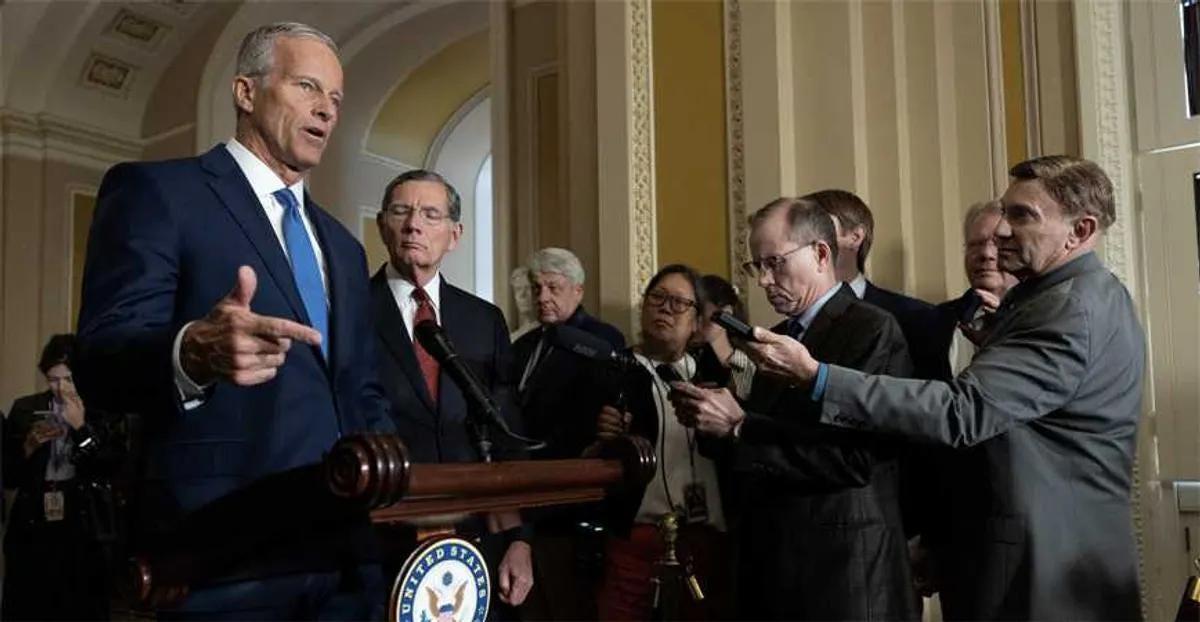
U.S. Senate Majority Leader John Thune (R-SD) and Senate Republican leaders speak with reporters following the Republican weekly policy lunch on Capitol Hill in Washington, D.C., U.S., September 15, 2026. REUTERS/Evan Vucci
Nebraska Republicans Found a Race They Cannot Buy Quietly
A Safe Seat Starts Looking Expensive
The reporting describes a Republican-aligned super PAC reserving more airtime than any other advertiser in Nebraska’s Senate race, while Republican Sen. John Kennedy traveled to campaign alongside incumbent Sen. Pete Ricketts. Their target is Dan Osborn, an industrial mechanic running as an independent with the Democratic Party’s endorsement. The money and reinforcements do not establish that Osborn will win. They establish that Republicans no longer consider ignoring him a safe strategy.
Power Is Not Evenly Distributed
Ricketts is not merely one candidate trading arguments with another. He is an incumbent senator and former governor whose family fortune came from TD Ameritrade and whose family controls the Chicago Cubs. He has the support of national Republican political machinery and a super PAC capable of dominating the race’s advertising.
Help fuel the work. Independent analysis doesn’t fund itself:☕ Buy us a coffee
Osborn has a different asset: evidence that Nebraska’s usual partisan arithmetic is not absolute. In 2024, with no Democrat in the race, he finished within seven percentage points of the winner. In the previous Senate contest, the Democratic nominee had lost by nearly 40 points. Democrats have again stepped aside, allowing Osborn to compete without splitting the opposition vote.
That contrast explains the spending more clearly than campaign rhetoric does. A candidate outside the customary party structure came close enough to make entrenched power purchase insurance.
The Outsider Has Given Them Ammunition
Republicans did not invent Osborn’s recorded remarks. According to reporting cited in the article, he said some Trump supporters in a small Nebraska town backed the president because they wanted to feel like winners “because their lives probably suck.” Other recordings captured him describing the border wall as “a symbol of racism” and discussing the share of Republican voters he believes he needs.
Osborn has not disputed the recordings. He told CNN he “would apologize to those people that might be offended” and said he had been trying to explain the appeal of outsider candidates.
The contemptuous phrasing was his decision, and it handed opponents a useful weapon. Criticizing the attack campaign does not require pretending its raw material was fabricated. A candidate asking working-class Republicans to cross party lines cannot casually reduce some of them to damaged people seeking emotional compensation and expect the remark to remain politically weightless.
The Disguise Argument Protects the Duopoly
Republicans are using the tapes to portray Osborn as a Democrat concealed beneath an independent label. The state Democratic Party’s endorsement and decision not to field its own candidate give that argument factual material, as do Osborn’s reported comments about the border wall.
But the accusation also serves a larger purpose: it denies voters the possibility that political identity might exist outside party ownership. Under this logic, an independent who receives Democratic support is not an independent making a coalition; he is a fraud. The major parties may absorb donors, activists and interest groups by the thousands, but a candidate who assembles support across existing lines is treated as counterfeit.
That framing is convenient for institutions built to make every viable candidacy pass through one of two gates.
Class Is the Contest Republicans Cannot Avoid
Osborn’s campaign is presenting the race as an industrial mechanic against a wealthy former governor from a nationally prominent family. That contrast does not prove which candidate would govern better, and biography is not a substitute for policy. It does, however, expose why the race has become troublesome for Republicans.
The party’s normal advantage in Nebraska may be vulnerable when partisan loyalty collides with resentment of concentrated wealth and professional political power. The article attributes the more favorable climate partly to voter unease with President Donald Trump and the GOP. The scale of Republican intervention suggests party actors take that possibility seriously, even if it does not tell us how widespread the unease is or determine the election’s outcome.
When Dominance Requires Reinforcements
The larger pattern is not that money guarantees victory or that an independent label guarantees independence. It is that entrenched parties reveal their anxieties through resource allocation. Republicans hold the incumbent, the state’s usual partisan advantage and access to major outside spending. Yet they are treating Osborn as a threat worth saturating the airwaves against.
The misdirection is to make the story primarily about whether Osborn is secretly a Democrat. The more consequential fact is that Nebraska’s political establishment is mobilizing institutional and financial power against a candidate who demonstrated that the state’s voters cannot be treated as permanently assigned property. Osborn’s own words may help that establishment contain him. The expensive containment effort shows why it believes containment is necessary.
Thanks to Raw Story
Source: Republicans are sweating a Senate seat they didn’t expect was at risk: WSJ
Systemic Error is a reader-supported publication. To receive new posts and support my work, consider becoming a free or paid subscriber.
We warned them.We told them.We shouted from the rooftops.We plead.We begged.They didn’t listen.Now, we all will suffer.Y’all know what to do, right?VOTE BLUE! 💙Vote as if your life — nay, our country — depend on it.Because, this time, and every time, it does.
This is a public episode. If you'd like to discuss this with other subscribers or get access to bonus episodes, visit paulstsmith.substack.com/subscribe


