


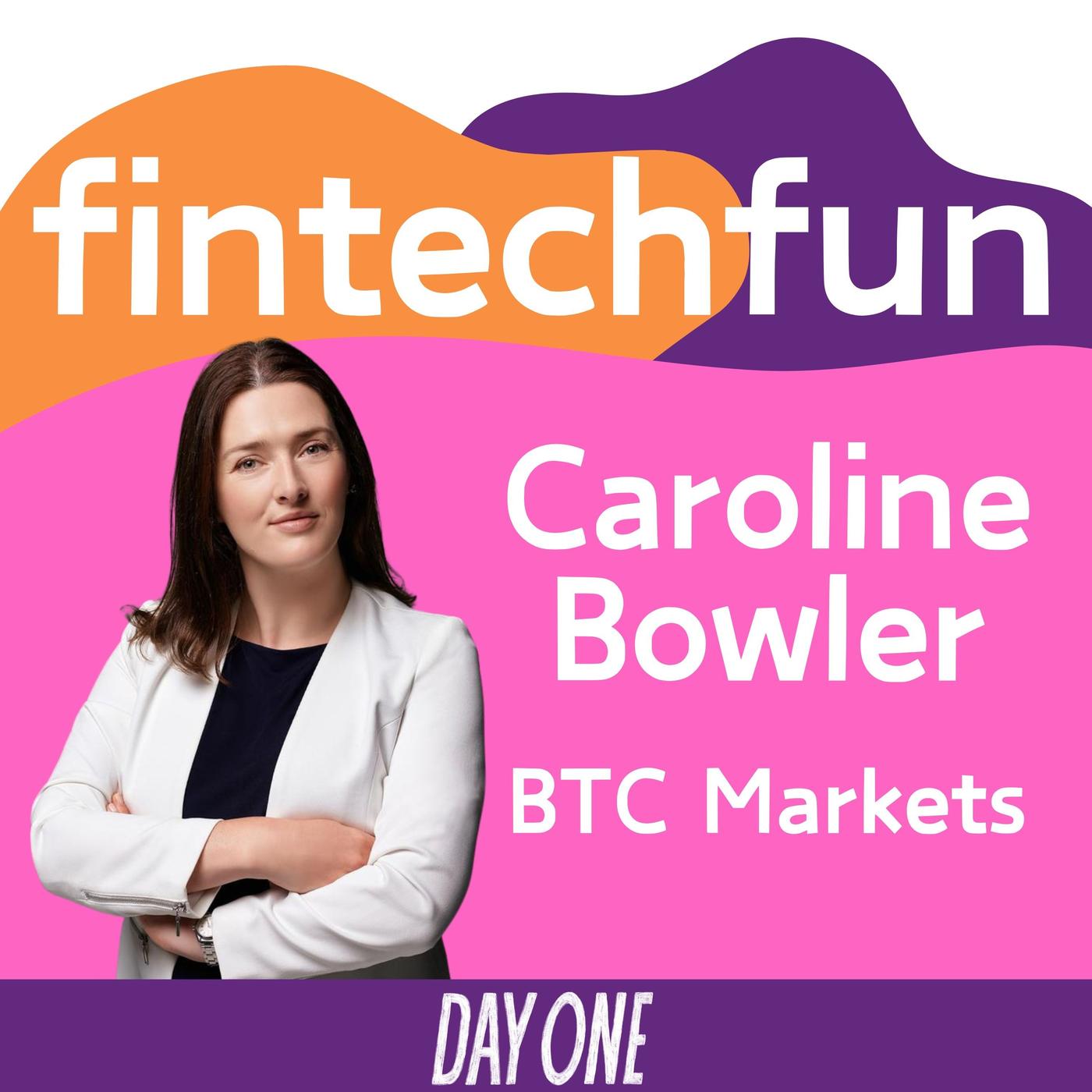
TRANSCRIPT_FTF - Caroline Bowler
[00:00:00] Chris Titley: Hi, it's Chris Titley here as part of the Fintech Fun podcast series. I'm joined by Caroline Bower from BTC Markets. Caroline, thank you so much for being part of this series.
[00:00:09] Caroline Bowler: Thank you so much for having me.
[00:00:10] Chris Titley: Caroline, let's talk about BTC and a little bit about your background and how the two intertwine and what BTC is.
[00:00:17] Caroline Bowler: Yeah, brilliant. So, uh, it's now 11 years in existence, which in crypto terms means it's an OG, which is quite something, uh, in, in any market. So I'm very proud of that based here, predominantly in Melbourne that we have got. Casting crew members scattered across across Australia, but it's predominantly Australian and our clients are Australian to my background is institutional finance used to work for private client stockbroker in Dublin, and then moved to a US investment bank in Dublin.
And then in Singapore spent about 10 years in Singapore, which I loved, but when I was there, I set up my own business. Um, doing strategy and PR comms for fintech and blockchain businesses, which back in 2013, 2014, something like that, it was all incredibly new. Fintech itself was very new, let alone blockchain, which was just this kind of like subset within it.
Um, but I cut my teeth there, um, BTC markets for one of my, um, Australian clients. And, uh, once I sold the business, I was Permanently in Melbourne, I got a call one day and asking, would I be interested in having a conversation about the CEO role? So that's now, yeah, five years ago, it'd be five years into January that I started, which also I think kind of puts me near an OG status.
I'm still here and I've got all the gray hairs to prove it, but my hairdresser will never tell. But yeah, so we've been around that long. And what we often get told by so many people is, Oh, you're, you're like, the first exchange I used to get into crypto. Uh, which we're very pleased about that, that kind of the early adopters trusted us, um, with, with their, as far as coming on ramp into this whole new ecosystem of finance and what it means.
And we're very grateful for those as well. Um, because what, what we find, and it's how I refer to us as like the designated driver of a sterling crypto, we're sober behind the wheel, but we're going in the same direction. And what we find is that in times of market upheaval, or certainly some of the, uh, very.
How to find the words
[00:02:17] Chris Titley: volatile or
[00:02:19] Caroline Bowler: say, for example, when FTX, uh,
[00:02:23] Chris Titley: major news,
[00:02:24] Caroline Bowler: yeah, that you made the news. That's a better way of putting it when that happened. What we found is that people flooded back to BTC markets. Cause I want to say that designated driver, we are kind of viewed as being. This oasis of security.
Um, and I think we think we're considered helpful. I think our clients like that. We're helpful, um, and stable and omnipresent in the Australian ecosystem. So we're very pleased with that. And we take that very seriously, our role within the Australian crypto ecosystem.
[00:02:54] Chris Titley: And Caroline, there's been a lot of offshore players, and you've seen some, some naming rights and sponsors of stadiums around the world with crypto exchanges.
How important is it for you to say that we're, you know, Australian owned and Australian operated?
[00:03:06] Caroline Bowler: I think it's probably more important to Australian crypto users or people who are looking at Digital assets more broadly, and certainly we can see the convergence. The trend is traditional finances merging with, uh, with crypto.
And I know there are many who kind of rebuff that, but that is absolutely the trend. And that trend is coming from traditional finance. It's not necessarily coming from crypto. But to your question, the importance of those big names coming into Australian market is great because it tells us that there's something, uh, vibrant and, and, uh, worthwhile within the Aussie market.
And certainly giving Australians choice is really, really important. And that's the same in, in, in any marketplace. But particularly if you look at that, that, that flattening between traditional and crypto, it's really good to see, uh, those, the technology and the insights from international. Moving in here, because it's going to be increasingly global.
Um, and that's probably an issue more for the regulations than it is for those practitioners within the business. But, as I say, when we've seen a lot of the internationals come and go, and we know about the challenges kind of, uh, in some of those international firms. And as I say, our clients have, have stayed with us and stayed loyal.
So to that point, I think for the Australians, great to have choice. It's great to have a range of, um, different products and services, but we haven't seen an exodus by any stretch of the imagination, um, to the international partners, which I think is probably surprising for some of those international partners.
I certainly suspect that they thought that that, um, the Aussie market would be one that they could just ride into and scoop it all up and make off with all the goodies. But I don't think they understand. Necessarily the full psyche of an Australian marketplace and what it is that Australians really value.
And I think that there is probably a greater sense of, um, supporting the local team, um, and backing yourselves in that sense, then perhaps it was fully understood by some of the internationals coming into this market. This isn't somewhere like, oh, these are smart and they can read through, pardon the expression, but they can read through the bullshit and, um, and they know, you know, kind of.
Where's the reliable place to invest? And we know we're not the only Australian option out there. Just want to make that point. But, um, but certainly that's what we've seen from the behavior.
[00:05:17] Chris Titley: Carolyn, you talked about some similarities to traditional finance and coming from a stockbroking background and investment bank background.
What, what parallels do you see in terms of timing in the future? Or do you see a lot of sort of similarities to where, you know, the digital assets can go?
[00:05:32] Caroline Bowler: Yeah, absolutely. If I may, on that point, I was at a, I've done a lot of travel this year. I've been in Europe, the U S across Southeast Asia, and I've got more travel to come.
Oh, and, and the UAE, as I say, more travel to come. And 1 of the trends that came through, as I said, was about how this move toward digital assets is coming from traditional finance. I was in Zurich at a. Banking conference effectively, uh, with the bank regulators from around the world, we're all descending into Zurich as they do on an annual basis.
Now to talk about these new technologies, digital assets, AI, et cetera, et cetera. And I sat in the room and listened to, um, institutions like JP Morgan, uh, Goldman Sachs, UBS. Citibank, um, got the list goes on, talk about not just proof of concept, but talking about the live products they have in market using blockchain technology.
They are absolutely driving this push forward into digital assets into what's known as real world assets, which is a bit of a clunky title. Um, but basically it's saying that they're moving your T bills, your, your stock certificates and so forth, which were dematerialized. And are now moving them into a digital format and without aging myself.
One of the first projects I worked at in that stock broker was the de materialization stock certificate. So I do remember the day where we were going from paper to binary and now, and now we're moving into fully digital on exchange on, on, uh, on blockchain rather. And so, so when I talk about that convergence and I talk about where it's being driven from, it's being driven from.
Financial services, they see the opportunity, they see the benefit and, uh, and, and they're rolling it out. And it's not just some thought pieces or some white papers is actual reality. So for us here in Australia, that throws down a gauntlet because certainly if you look at, um, say the super fund industry, which is, I think, you know, a trillion dollars or 3 trillion, something unbelievable in terms of amounts of money.
Um, that whole industry is moving on chain. That whole industry is going to have to move on chain because that is the direction that it's been taken overseas. And so the question for Australia then is how quickly are we going to catch up and how quickly can we start embracing this technology for, you know, the benefit of everyday Aussies.
We certainly don't want to be behind the eight ball on this one.
[00:07:48] Chris Titley: When it comes to mainstream adoption, and we've obviously seen some mainstream moments over the last year. You know, five, 10 years when it comes to digital assets and cryptocurrency. Do you think there's a sort of that, as you talked about an institutional component that comes through and enterprises starting to use, um, you know, T bills and treasury departments using cryptocurrency and digital assets that will probably filter down into sort of a trust from a mainstream retail moment?
[00:08:14] Caroline Bowler: Yeah, absolutely. And, and here's the thing too, like this doesn't come, this isn't top down. Yeah. This is bottom up. I think that certainly here in Australia, you know, this movement has been, despite the hurdles and the conversations and the narrative that are out in the industry or outside of the industry, but around what blockchain is about and crypto and digital assets, despite all of that, as I said, like Australians are savvy.
They can read between the lines. They can understand what's going on in terms of what this technology can do. And. I think they're the ones who have been driving it. And that's the same around the world. It's this utility. It's this ease. It's, um, being able to appreciate the benefits of what this tech can do.
Um, and that's, that's, what's pushed it forward because, you know, this certainly wasn't something, you know, even five to 10, 10 years ago, JP Morgan absolutely weren't touching this stuff in the bar as well. But what we've also found too, I mean, certainly this is only my view, and this isn't fact based at all in that sense, but we know that CBA were looking to do crypto trading.
I know that they had that, that pilot project that they had, and we've seen ANZ have been looking at a stable coin project. I think it's safe to assume, and obviously we saw NAB moving in now with CryptoCustody through, uh, Zodio, um, and I think what we're seeing is that the banks here locally are absolutely looking at this technology, um, and whether or not they're being public about all that they're doing with the technology, I don't know.
But I certainly know that people within the major financial institutions in Australia, there are definitely people who are interested in it. And you're actively looking to pursue opportunities for their respective employers, bank employers within that. But a lot of it is to do with the narrative that still pervades around, around what this technology is.
Which is a fixation and a focus around human behavior, as opposed to a fixation and focus around what this technology can do, the tech is neutral. It doesn't do anything. What the humans are doing around it. Um, and as I said, given the size of the fund industry here and knowing which way the wind is blowing very heavily here in Melbourne this morning, but knowing the way the wind is blowing, you know, we have to get across this as a, as a country, it's just too important to fail.
[00:10:27] Chris Titley: And getting across as a country and also getting across as a company. Do you want to talk about what BTC are doing currently and what, what sort of some innovations or products that, that people are looking for?
[00:10:36] Caroline Bowler: Yeah, absolutely. I think, um, without getting too ahead of ourselves, cause I can't make any big announcements yet, but I know that we are actively looking at opportunities with regards to, uh, staking.
That's one of the things that we are actively looking at. I think we want to offer our paternities an opportunity to, to Take crypto beyond just buying and selling beyond that, just trading, um, activity, because there is a lot more coming with it. Um, and we're very keen to make sure that Australians are well placed to take advantage of some of those innovations as they come through.
Um, and we're also very pleased with that because we are, because we are Australian based, like, all our tech is here. The custody is here. Like, we can be, I suppose, very tailored to this market. What we are also doing as well to kind of open that up is we are looking at the UAE at Abu Dhabi in particular for, um, for, for licensing, um, it's a rather clunky term, but effectively it will give us the opportunity to trade both cryptocurrency, but also hopefully real world assets down the line, but we'll wait and see on that one.
But that that's the plan, certainly for where we are at the moment. As I say, you know, we see very clearly where the trend line is going, and we want to make sure that we're well placed, um, for here in Australia and overseas to, to really take advantage of that.
[00:11:54] Chris Titley: And Carolyn, when you talk about staking, is that, is that being consumer and customer driven, or is that what other exchanges are doing?
Can you talk about that a little bit?
[00:12:03] Caroline Bowler: Well, I know this may sound a little counterintuitive, but I don't necessarily listen to what other exchanges are doing. I listen to what our customers want.
[00:12:09] Chris Titley: Yep.
[00:12:10] Caroline Bowler: Those, that's the only feedback that matters to me. Um, I think after five years you learn there's an awful lot of, if I may, an awful lot of bullshit in the industry.
Um, and a lot of smoke and mirrors from other players. I'm not talking necessarily in Australia, but I'm talking about the industry in Sasha. Broadly
[00:12:26] Chris Titley: speaking, yeah.
[00:12:27] Caroline Bowler: Um, broadly speaking. And, So, uh, you know, certainly in the bull market, it, your head spins because there was so much activity and so much stuff going on all over the place that you can almost lose sight of yourself.
But for us, it's like listening to client feedback. We, we reach out to our clients on the regular basis to take on board what it is that they, they, they want and, um, how we can help build that. So it's client feedback that, that wants to do more with their crypto assets and just buy, sell, hold. Like they, they want to explore the utility of it.
And we're very excited to help them do that.
[00:12:57] Chris Titley: Before we get on to a personal question about your hobbies and what you get into, uh, your spare time, I'm curious about the numbers of different cryptocurrencies. We saw an explosion a few years ago. How's that gone from a, from a, I suppose, a market point of view now?
[00:13:11] Caroline Bowler: Yeah, so, I mean, here's the thing, the predominant amount of trading still happens in Bitcoin and Ethereum. Maybe a top three Bitcoin, Ethereum, maybe XRP. Those are the predominant ones. The stable coins are another, like the USDT in particular. So better known as Tether. Those are the main, um, utility, the main traded, uh, tokens.
So all the rest of them are absolutely busy. I mean, Solana and so forth have seen it, but if you're looking at volume, um, those are the most voluminous that we've seen historically. That will change I'm sure as, as time evolves. Um, and so for us as a business, we've looked at that, obviously, because that's, we know there's client demand in that we know there's liquidity in that.
Um, and we've added tokens as we've gone along our main concern, given the environment that we're in at the moment from a regulatory point of view is to make sure that we don't miss any financial products. And so we have been extremely conservative. On our listings, and that has been a purposeful decision to keep it as conservative as possible to make sure that we stay within stay within the lines as they currently exist.
Um, and let's see how that evolves. Once we get some, some regulation in place, likely to be in the next government cycle is our expectation that we'll start to see some legislation come through. Um, so so that's our, our plan. So far is just, as I say, kind of. Stay within those lines, but look at the, um, liquidity, look at where the volume is and put those up in the platform for people.
[00:14:38] Chris Titley: And Carolyn, you've been running BTC for five years now and a lot of people have seen you speak at different fintech events and crypto events, etc. But, uh, there's some listeners out there that might want to know a little bit about you and what you do in your downtime. Is there any sort of secret hobby that, uh, You get up to that.
Others don't know about.
[00:14:53] Caroline Bowler: Secret hobbies. So like, I think anyone I'm, I'm in my mid four, I'm 45. I'm like mid 40s. I am 45. So I don't know how anybody else really lives at this point in life. I was in bed last night at half past nine, just so we're clear, but this is rock and roll, I guess. Cause you're exhausted.
But what I do do is, uh, cooking, baking in particular, I'm not a particularly gifted baker, um, but I do enjoy it. So, um, it's, it's very, um, it's almost like chemistry, like trying to get a cake to rise or a bread to rise or whatever it is. There's a lot of, there's a lot of science behind it. Um, so I enjoy that and my family enjoy it too, particularly since I'm working my way through a cake book at the moment.
And so they're enjoying that. We have. Father's day yesterday, we had a strawberry rhubarb cake that went down a treat with a load of cream. I may recommend. I think every cake baker has got a whole pot of cream in there or his or her fridge that they then pour all over. Cause it comes up a multitude of sins.
[00:15:58] Chris Titley: So you, you're going to be the one where people have birthday parties and they're going to ring you up and say, Oh, would you mind, you're like, I'm kind of busy right now. No,
[00:16:05] Caroline Bowler: don't ring me. Don't ring me. This is why I don't tell anyone. Please don't.
[00:16:10] Chris Titley: And your favorite challenge is a cake. Is there one that you like, Oh, wow, I didn't think I was going to get through this, but then it was like, hello, we've done this, you know, take some photos.
[00:16:17] Caroline Bowler: Mom does this absolutely amazing chocolate. Um, it's like a gigantic chocolate Swiss roll. That's just so amazing. Oozing yumminess and richness. I would never be so brave as to try and copy that one. That one is just, that's too far. So instead I do this other one where it's, um, it's lemon and, uh, almond meal and, uh, it's not as
[00:16:44] Chris Titley: chocolatey, but no.
And it's, and it's, it's really good.
[00:16:46] Caroline Bowler: Super delicious. And it's got a, and you use Greek yogurt through it. So it's, um, it's, it's really like, it's terribly indulgent. I absolutely love it. It goes down a treat. It went down so well last Christmas that I ended up making two in rapid succession because the first lot was devoured so quickly that I had to go and do another batch.
So yeah, highly recommended.
[00:17:03] Chris Titley: On that note, I better, it's morning tea here. It's time. I feel, I feel hungry now after all that chat. But Caroline, thank you so much for giving the listeners out there a bit of understanding about your background as well as BTC. Uh, the current trends and progress as a company that you've made and also the future inroads ahead with some particular products and things that might come out in the future, we should catch up and, uh, and also your, uh, cake, cake, uh, making habits.
So I really appreciate that and look forward to catching up.
[00:17:27] Caroline Bowler: Thanks Chris. Thank you very much.
[00:00:00] Chris Titley: Hi, it's Chris Titley here as part of the Fintech Fun podcast series. I'm joined by Caroline Bower from BTC Markets. Caroline, thank you so much for being part of this series.
[00:00:09] Caroline Bowler: Thank you so much for having me.
[00:00:10] Chris Titley: Caroline, let's talk about BTC and a little bit about your background and how the two intertwine and what BTC is.
[00:00:17] Caroline Bowler: Yeah, brilliant. So, uh, it's now 11 years in existence, which in crypto terms means it's an OG, which is quite something, uh, in, in any market. So I'm very proud of that based here, predominantly in Melbourne that we have got. Casting crew members scattered across across Australia, but it's predominantly Australian and our clients are Australian to my background is institutional finance used to work for private client stockbroker in Dublin, and then moved to a US investment bank in Dublin.
And then in Singapore spent about 10 years in Singapore, which I loved, but when I was there, I set up my own business. Um, doing strategy and PR comms for fintech and blockchain businesses, which back in 2013, 2014, something like that, it was all incredibly new. Fintech itself was very new, let alone blockchain, which was just this kind of like subset within it.
Um, but I cut my teeth there, um, BTC markets for one of my, um, Australian clients. And, uh, once I sold the business, I was Permanently in Melbourne, I got a call one day and asking, would I be interested in having a conversation about the CEO role? So that's now, yeah, five years ago, it'd be five years into January that I started, which also I think kind of puts me near an OG status.
I'm still here and I've got all the gray hairs to prove it, but my hairdresser will never tell. But yeah, so we've been around that long. And what we often get told by so many people is, Oh, you're, you're like, the first exchange I used to get into crypto. Uh, which we're very pleased about that, that kind of the early adopters trusted us, um, with, with their, as far as coming on ramp into this whole new ecosystem of finance and what it means.
And we're very grateful for those as well. Um, because what, what we find, and it's how I refer to us as like the designated driver of a sterling crypto, we're sober behind the wheel, but we're going in the same direction. And what we find is that in times of market upheaval, or certainly some of the, uh, very.
How to find the words
[00:02:17] Chris Titley: volatile or
[00:02:19] Caroline Bowler: say, for example, when FTX, uh,
[00:02:23] Chris Titley: major news,
[00:02:24] Caroline Bowler: yeah, that you made the news. That's a better way of putting it when that happened. What we found is that people flooded back to BTC markets. Cause I want to say that designated driver, we are kind of viewed as being. This oasis of security.
Um, and I think we think we're considered helpful. I think our clients like that. We're helpful, um, and stable and omnipresent in the Australian ecosystem. So we're very pleased with that. And we take that very seriously, our role within the Australian crypto ecosystem.
[00:02:54] Chris Titley: And Caroline, there's been a lot of offshore players, and you've seen some, some naming rights and sponsors of stadiums around the world with crypto exchanges.
How important is it for you to say that we're, you know, Australian owned and Australian operated?
[00:03:06] Caroline Bowler: I think it's probably more important to Australian crypto users or people who are looking at Digital assets more broadly, and certainly we can see the convergence. The trend is traditional finances merging with, uh, with crypto.
And I know there are many who kind of rebuff that, but that is absolutely the trend. And that trend is coming from traditional finance. It's not necessarily coming from crypto. But to your question, the importance of those big names coming into Australian market is great because it tells us that there's something, uh, vibrant and, and, uh, worthwhile within the Aussie market.
And certainly giving Australians choice is really, really important. And that's the same in, in, in any marketplace. But particularly if you look at that, that, that flattening between traditional and crypto, it's really good to see, uh, those, the technology and the insights from international. Moving in here, because it's going to be increasingly global.
Um, and that's probably an issue more for the regulations than it is for those practitioners within the business. But, as I say, when we've seen a lot of the internationals come and go, and we know about the challenges kind of, uh, in some of those international firms. And as I say, our clients have, have stayed with us and stayed loyal.
So to that point, I think for the Australians, great to have choice. It's great to have a range of, um, different products and services, but we haven't seen an exodus by any stretch of the imagination, um, to the international partners, which I think is probably surprising for some of those international partners.
I certainly suspect that they thought that that, um, the Aussie market would be one that they could just ride into and scoop it all up and make off with all the goodies. But I don't think they understand. Necessarily the full psyche of an Australian marketplace and what it is that Australians really value.
And I think that there is probably a greater sense of, um, supporting the local team, um, and backing yourselves in that sense, then perhaps it was fully understood by some of the internationals coming into this market. This isn't somewhere like, oh, these are smart and they can read through, pardon the expression, but they can read through the bullshit and, um, and they know, you know, kind of.
Where's the reliable place to invest? And we know we're not the only Australian option out there. Just want to make that point. But, um, but certainly that's what we've seen from the behavior.
[00:05:17] Chris Titley: Carolyn, you talked about some similarities to traditional finance and coming from a stockbroking background and investment bank background.
What, what parallels do you see in terms of timing in the future? Or do you see a lot of sort of similarities to where, you know, the digital assets can go?
[00:05:32] Caroline Bowler: Yeah, absolutely. If I may, on that point, I was at a, I've done a lot of travel this year. I've been in Europe, the U S across Southeast Asia, and I've got more travel to come.
Oh, and, and the UAE, as I say, more travel to come. And 1 of the trends that came through, as I said, was about how this move toward digital assets is coming from traditional finance. I was in Zurich at a. Banking conference effectively, uh, with the bank regulators from around the world, we're all descending into Zurich as they do on an annual basis.
Now to talk about these new technologies, digital assets, AI, et cetera, et cetera. And I sat in the room and listened to, um, institutions like JP Morgan, uh, Goldman Sachs, UBS. Citibank, um, got the list goes on, talk about not just proof of concept, but talking about the live products they have in market using blockchain technology.
They are absolutely driving this push forward into digital assets into what's known as real world assets, which is a bit of a clunky title. Um, but basically it's saying that they're moving your T bills, your, your stock certificates and so forth, which were dematerialized. And are now moving them into a digital format and without aging myself.
One of the first projects I worked at in that stock broker was the de materialization stock certificate. So I do remember the day where we were going from paper to binary and now, and now we're moving into fully digital on exchange on, on, uh, on blockchain rather. And so, so when I talk about that convergence and I talk about where it's being driven from, it's being driven from.
Financial services, they see the opportunity, they see the benefit and, uh, and, and they're rolling it out. And it's not just some thought pieces or some white papers is actual reality. So for us here in Australia, that throws down a gauntlet because certainly if you look at, um, say the super fund industry, which is, I think, you know, a trillion dollars or 3 trillion, something unbelievable in terms of amounts of money.
Um, that whole industry is moving on chain. That whole industry is going to have to move on chain because that is the direction that it's been taken overseas. And so the question for Australia then is how quickly are we going to catch up and how quickly can we start embracing this technology for, you know, the benefit of everyday Aussies.
We certainly don't want to be behind the eight ball on this one.
[00:07:48] Chris Titley: When it comes to mainstream adoption, and we've obviously seen some mainstream moments over the last year. You know, five, 10 years when it comes to digital assets and cryptocurrency. Do you think there's a sort of that, as you talked about an institutional component that comes through and enterprises starting to use, um, you know, T bills and treasury departments using cryptocurrency and digital assets that will probably filter down into sort of a trust from a mainstream retail moment?
[00:08:14] Caroline Bowler: Yeah, absolutely. And, and here's the thing too, like this doesn't come, this isn't top down. Yeah. This is bottom up. I think that certainly here in Australia, you know, this movement has been, despite the hurdles and the conversations and the narrative that are out in the industry or outside of the industry, but around what blockchain is about and crypto and digital assets, despite all of that, as I said, like Australians are savvy.
They can read between the lines. They can understand what's going on in terms of what this technology can do. And. I think they're the ones who have been driving it. And that's the same around the world. It's this utility. It's this ease. It's, um, being able to appreciate the benefits of what this tech can do.
Um, and that's, that's, what's pushed it forward because, you know, this certainly wasn't something, you know, even five to 10, 10 years ago, JP Morgan absolutely weren't touching this stuff in the bar as well. But what we've also found too, I mean, certainly this is only my view, and this isn't fact based at all in that sense, but we know that CBA were looking to do crypto trading.
I know that they had that, that pilot project that they had, and we've seen ANZ have been looking at a stable coin project. I think it's safe to assume, and obviously we saw NAB moving in now with CryptoCustody through, uh, Zodio, um, and I think what we're seeing is that the banks here locally are absolutely looking at this technology, um, and whether or not they're being public about all that they're doing with the technology, I don't know.
But I certainly know that people within the major financial institutions in Australia, there are definitely people who are interested in it. And you're actively looking to pursue opportunities for their respective employers, bank employers within that. But a lot of it is to do with the narrative that still pervades around, around what this technology is.
Which is a fixation and a focus around human behavior, as opposed to a fixation and focus around what this technology can do, the tech is neutral. It doesn't do anything. What the humans are doing around it. Um, and as I said, given the size of the fund industry here and knowing which way the wind is blowing very heavily here in Melbourne this morning, but knowing the way the wind is blowing, you know, we have to get across this as a, as a country, it's just too important to fail.
[00:10:27] Chris Titley: And getting across as a country and also getting across as a company. Do you want to talk about what BTC are doing currently and what, what sort of some innovations or products that, that people are looking for?
[00:10:36] Caroline Bowler: Yeah, absolutely. I think, um, without getting too ahead of ourselves, cause I can't make any big announcements yet, but I know that we are actively looking at opportunities with regards to, uh, staking.
That's one of the things that we are actively looking at. I think we want to offer our paternities an opportunity to, to Take crypto beyond just buying and selling beyond that, just trading, um, activity, because there is a lot more coming with it. Um, and we're very keen to make sure that Australians are well placed to take advantage of some of those innovations as they come through.
Um, and we're also very pleased with that because we are, because we are Australian based, like, all our tech is here. The custody is here. Like, we can be, I suppose, very tailored to this market. What we are also doing as well to kind of open that up is we are looking at the UAE at Abu Dhabi in particular for, um, for, for licensing, um, it's a rather clunky term, but effectively it will give us the opportunity to trade both cryptocurrency, but also hopefully real world assets down the line, but we'll wait and see on that one.
But that that's the plan, certainly for where we are at the moment. As I say, you know, we see very clearly where the trend line is going, and we want to make sure that we're well placed, um, for here in Australia and overseas to, to really take advantage of that.
[00:11:54] Chris Titley: And Carolyn, when you talk about staking, is that, is that being consumer and customer driven, or is that what other exchanges are doing?
Can you talk about that a little bit?
[00:12:03] Caroline Bowler: Well, I know this may sound a little counterintuitive, but I don't necessarily listen to what other exchanges are doing. I listen to what our customers want.
[00:12:09] Chris Titley: Yep.
[00:12:10] Caroline Bowler: Those, that's the only feedback that matters to me. Um, I think after five years you learn there's an awful lot of, if I may, an awful lot of bullshit in the industry.
Um, and a lot of smoke and mirrors from other players. I'm not talking necessarily in Australia, but I'm talking about the industry in Sasha. Broadly
[00:12:26] Chris Titley: speaking, yeah.
[00:12:27] Caroline Bowler: Um, broadly speaking. And, So, uh, you know, certainly in the bull market, it, your head spins because there was so much activity and so much stuff going on all over the place that you can almost lose sight of yourself.
But for us, it's like listening to client feedback. We, we reach out to our clients on the regular basis to take on board what it is that they, they, they want and, um, how we can help build that. So it's client feedback that, that wants to do more with their crypto assets and just buy, sell, hold. Like they, they want to explore the utility of it.
And we're very excited to help them do that.
[00:12:57] Chris Titley: Before we get on to a personal question about your hobbies and what you get into, uh, your spare time, I'm curious about the numbers of different cryptocurrencies. We saw an explosion a few years ago. How's that gone from a, from a, I suppose, a market point of view now?
[00:13:11] Caroline Bowler: Yeah, so, I mean, here's the thing, the predominant amount of trading still happens in Bitcoin and Ethereum. Maybe a top three Bitcoin, Ethereum, maybe XRP. Those are the predominant ones. The stable coins are another, like the USDT in particular. So better known as Tether. Those are the main, um, utility, the main traded, uh, tokens.
So all the rest of them are absolutely busy. I mean, Solana and so forth have seen it, but if you're looking at volume, um, those are the most voluminous that we've seen historically. That will change I'm sure as, as time evolves. Um, and so for us as a business, we've looked at that, obviously, because that's, we know there's client demand in that we know there's liquidity in that.
Um, and we've added tokens as we've gone along our main concern, given the environment that we're in at the moment from a regulatory point of view is to make sure that we don't miss any financial products. And so we have been extremely conservative. On our listings, and that has been a purposeful decision to keep it as conservative as possible to make sure that we stay within stay within the lines as they currently exist.
Um, and let's see how that evolves. Once we get some, some regulation in place, likely to be in the next government cycle is our expectation that we'll start to see some legislation come through. Um, so so that's our, our plan. So far is just, as I say, kind of. Stay within those lines, but look at the, um, liquidity, look at where the volume is and put those up in the platform for people.
[00:14:38] Chris Titley: And Carolyn, you've been running BTC for five years now and a lot of people have seen you speak at different fintech events and crypto events, etc. But, uh, there's some listeners out there that might want to know a little bit about you and what you do in your downtime. Is there any sort of secret hobby that, uh, You get up to that.
Others don't know about.
[00:14:53] Caroline Bowler: Secret hobbies. So like, I think anyone I'm, I'm in my mid four, I'm 45. I'm like mid 40s. I am 45. So I don't know how anybody else really lives at this point in life. I was in bed last night at half past nine, just so we're clear, but this is rock and roll, I guess. Cause you're exhausted.
But what I do do is, uh, cooking, baking in particular, I'm not a particularly gifted baker, um, but I do enjoy it. So, um, it's, it's very, um, it's almost like chemistry, like trying to get a cake to rise or a bread to rise or whatever it is. There's a lot of, there's a lot of science behind it. Um, so I enjoy that and my family enjoy it too, particularly since I'm working my way through a cake book at the moment.
And so they're enjoying that. We have. Father's day yesterday, we had a strawberry rhubarb cake that went down a treat with a load of cream. I may recommend. I think every cake baker has got a whole pot of cream in there or his or her fridge that they then pour all over. Cause it comes up a multitude of sins.
[00:15:58] Chris Titley: So you, you're going to be the one where people have birthday parties and they're going to ring you up and say, Oh, would you mind, you're like, I'm kind of busy right now. No,
[00:16:05] Caroline Bowler: don't ring me. Don't ring me. This is why I don't tell anyone. Please don't.
[00:16:10] Chris Titley: And your favorite challenge is a cake. Is there one that you like, Oh, wow, I didn't think I was going to get through this, but then it was like, hello, we've done this, you know, take some photos.
[00:16:17] Caroline Bowler: Mom does this absolutely amazing chocolate. Um, it's like a gigantic chocolate Swiss roll. That's just so amazing. Oozing yumminess and richness. I would never be so brave as to try and copy that one. That one is just, that's too far. So instead I do this other one where it's, um, it's lemon and, uh, almond meal and, uh, it's not as
[00:16:44] Chris Titley: chocolatey, but no.
And it's, and it's, it's really good.
[00:16:46] Caroline Bowler: Super delicious. And it's got a, and you use Greek yogurt through it. So it's, um, it's, it's really like, it's terribly indulgent. I absolutely love it. It goes down a treat. It went down so well last Christmas that I ended up making two in rapid succession because the first lot was devoured so quickly that I had to go and do another batch.
So yeah, highly recommended.
[00:17:03] Chris Titley: On that note, I better, it's morning tea here. It's time. I feel, I feel hungry now after all that chat. But Caroline, thank you so much for giving the listeners out there a bit of understanding about your background as well as BTC. Uh, the current trends and progress as a company that you've made and also the future inroads ahead with some particular products and things that might come out in the future, we should catch up and, uh, and also your, uh, cake, cake, uh, making habits.
So I really appreciate that and look forward to catching up.
[00:17:27] Caroline Bowler: Thanks Chris. Thank you very much.
