


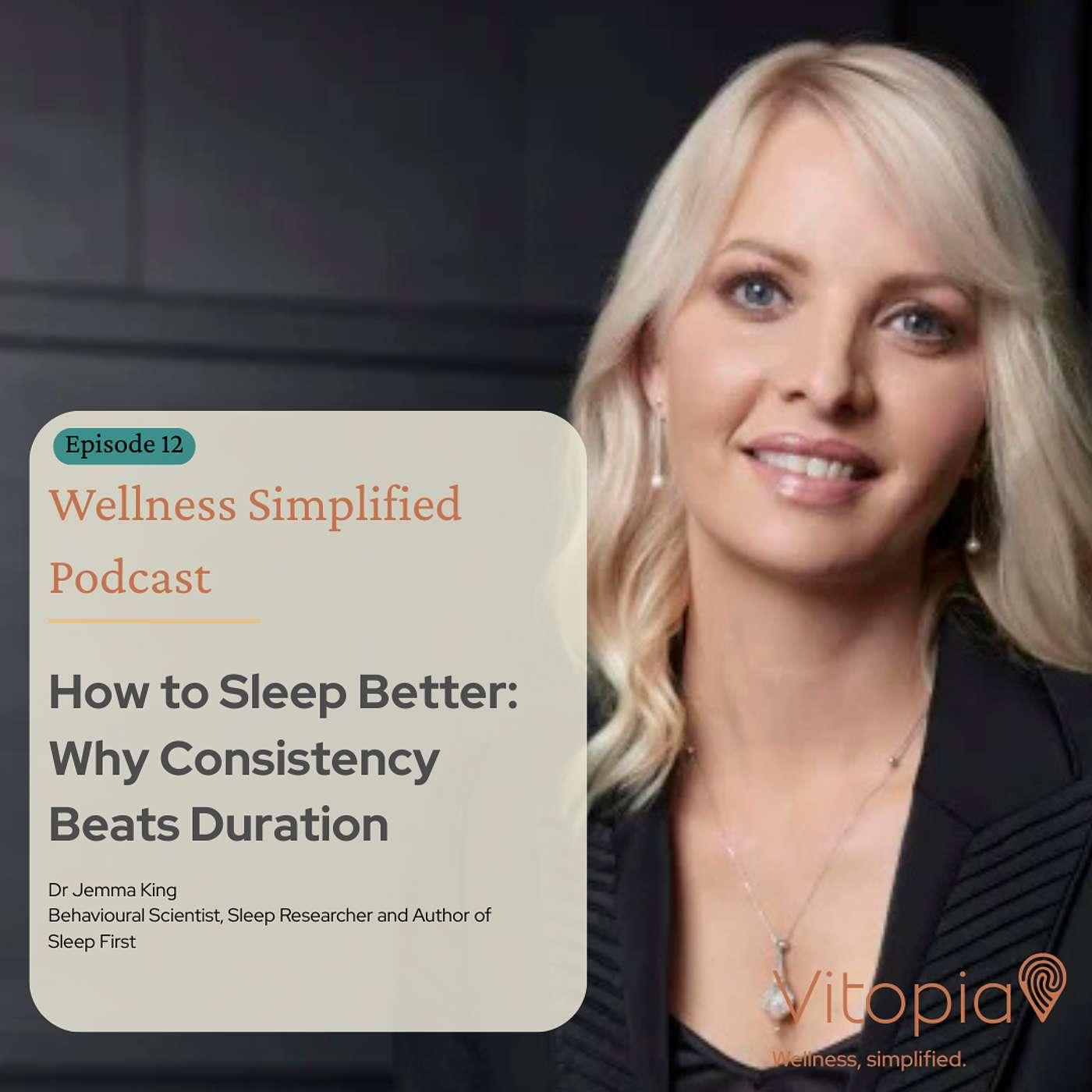
WEBVTT
00:00:00.479 --> 00:00:02.240
Welcome to Relative Simplified.
00:00:02.319 --> 00:00:11.199
I'm Kelly Nichols, and this show is for busy people who care deeply about their health, but for drowning and conflicting advice and don't know where to focus.
00:00:11.519 --> 00:00:15.119
Every episode, we simplify one area of health.
00:00:15.279 --> 00:00:21.839
One habit, one simple experiment, one clear next step that will actually fit into your life.
00:00:22.079 --> 00:00:24.640
Together, let's optimize our health.
00:00:24.879 --> 00:00:26.800
One simple step at a time.
00:00:30.000 --> 00:00:32.560
How many hours did you sleep last night?
00:00:32.960 --> 00:00:37.119
And did you go to bed and wake up around the same time you did the night before?
00:00:37.759 --> 00:00:40.159
Because here's what shocked me this week.
00:00:40.479 --> 00:00:47.439
Irregular sleepers have around a 50% higher all-cause mortality risk than people with regular sleep.
00:00:47.840 --> 00:00:51.759
Not people who sleep less, people who sleep at different times.
00:00:52.719 --> 00:00:53.840
Today I'm talking to Dr.
00:00:53.920 --> 00:01:01.280
Gemma King, who's a behavioral scientist, stress sleep, and recovery researcher and author of the new book, Sleepers.
00:01:05.120 --> 00:01:11.680
Gemma has spent her career working with Olympians, special forces soldiers, and town executives.
00:01:11.920 --> 00:01:14.159
And she keeps landing on the same answer.
00:01:17.599 --> 00:01:20.480
It's a beer that everything else depends on.
00:01:21.920 --> 00:01:28.319
In today's episode of Wellness Emplified, we get into what's actually happening in each stage of sleep and why they're important.
00:01:28.959 --> 00:01:30.959
And how to optimize each stage.
00:01:31.599 --> 00:01:33.840
Why consistency of each duration?
00:01:34.400 --> 00:01:37.200
How to tame an overactive mind at night.
00:01:37.439 --> 00:01:41.439
And one unique strategy you can use to solve problems in your sleep.
00:01:41.920 --> 00:01:47.760
And of course, by the end, the one thing that you can do this week is to start optimizing your sleep.
00:01:49.200 --> 00:01:50.560
I hope you enjoy the show.
00:01:50.719 --> 00:01:51.760
Let's get into it.
00:01:52.400 --> 00:01:55.599
Hey Gemma, thank you so much for joining us on Wellness Simplified.
00:01:55.680 --> 00:01:56.879
I really appreciate it.
00:01:57.439 --> 00:01:58.640
Thank you for having me.
00:01:59.040 --> 00:02:10.080
I was actually, I've been wanting to do an episode specifically on sleep for a while, but I like focusing on Australian experts, and obviously there's a number of great books out there, but they're all from overseas experts.
00:02:10.159 --> 00:02:13.520
And then I was uh you came across my LinkedIn feed with your book.
00:02:13.599 --> 00:02:15.840
I was like, oh, perfect, excellent.
00:02:16.159 --> 00:02:17.599
It's very serendipitous.
00:02:17.840 --> 00:02:18.319
Indeed.
00:02:18.479 --> 00:02:19.360
Good timing.
00:02:19.599 --> 00:02:25.439
Now, before we jump into sleep, I like to just let people into the lives of the guests that I'd love to hear.
00:02:25.599 --> 00:02:26.639
Like, how do you start your day?
00:02:26.879 --> 00:02:28.240
Do you have a set morning routine?
00:02:28.319 --> 00:02:30.319
How do you set yourself up for success?
00:02:30.960 --> 00:02:33.840
Well, I travel a lot, so it's pretty chaotic.
00:02:33.919 --> 00:02:36.240
And unfortunately, I don't have a really good routine.
00:02:36.400 --> 00:02:40.960
But if I if I am home, I typically get up really early.
00:02:41.039 --> 00:02:42.960
Um, my partner's an early bird.
00:02:43.039 --> 00:02:48.159
I'm not, I've changed into becoming an early bird, but naturally I'm a night owl.
00:02:48.400 --> 00:02:53.840
So I'm up at 6:30 and try and do some form of exercise.
00:02:54.159 --> 00:03:04.400
I always know that in the morning I'm a little useless cognitively, and so I like to push back all my sort of deep thinking till the afternoon, which is kind of unusual.
00:03:04.479 --> 00:03:09.680
People think like at three o'clock, they're like, oh, I can't think, but that's my best time, three, five and on.
00:03:09.759 --> 00:03:11.520
Yeah, and then later in the evening.
00:03:11.680 --> 00:03:19.280
Um, so one thing I don't do, or I try not to do, is grab my phone first thing in the morning because it'll set my cortisol off.
00:03:19.520 --> 00:03:28.560
You know, you don't have no control over who's text you, what you're going to see, who's blowing up who, what's happening in the media, what terrible catastrophes happen.
00:03:28.800 --> 00:03:32.800
So I really try and protect that, you know, first half an hour.
00:03:32.879 --> 00:03:33.039
Yeah.
00:03:33.360 --> 00:03:41.759
Um, then I have coffee, and it's usually like my probably my last coffee of the day, um, because I'm quite sensitive to it.
00:03:42.000 --> 00:03:44.319
I try to have a good protein breakfast.
00:03:44.479 --> 00:03:57.199
I find that having protein as opposed to simple carbohydrates really sort of sets my blood glucose for the day, and I don't get these sort of fluctuations, which we know are very correlated to emotional fluctuations.
00:03:57.840 --> 00:04:09.039
And yeah, and so um then I then I then I get into social media, I catch up on what's happening while I'm having coffee, and then yeah, start the day.
00:04:09.360 --> 00:04:10.159
Nice, awesome.
00:04:10.240 --> 00:04:18.240
And yeah, I really agree with you in terms of that like half an hour, like you know, not just jumping straight into it, like giving yourself that buffer time.
00:04:18.319 --> 00:04:24.480
Because especially as women, like if our cortisol spikes too quickly, then the whole day can be off.
00:04:24.959 --> 00:04:40.160
Yeah, you get really dysregulated, and I think that also like emotionally you've just got to protect how you prime your day because when you you know start the day off with catastrophe, it just really sets a lens through which you see the world.
00:04:40.399 --> 00:04:42.319
So I try to look out on green.
00:04:42.399 --> 00:04:48.720
Um, when I'm at my farm, it's like we have so many beautiful birds, and it's just really, really beautiful and quiet.
00:04:48.800 --> 00:04:56.079
So I try and sort of absorb that because usually I'm on a plane or in a city with lots of noise and chaos.
00:04:56.399 --> 00:04:57.360
Interesting.
00:04:57.600 --> 00:05:00.160
How do you just quickly a follow-up question to that?
00:05:00.240 --> 00:05:08.560
What are some of your habits to living a life like that and still, because I mean you're all about um optimal performance and so forth, moving so much.
00:05:08.639 --> 00:05:13.519
How do you do you have any little hacks that you've gained uh along the way?
00:05:14.560 --> 00:05:21.199
Um, I just try not to attend to I I kind of gaslight myself to be honest.
00:05:21.519 --> 00:05:28.720
So if I'm tired, if I'm jet lagged, I um I I think you know, I actually feel pretty good.
00:05:28.800 --> 00:05:36.879
I actually considering I like I I don't look for evidence that I'm tired and I'm should be feeling sad and overwhelmed.
00:05:36.959 --> 00:05:39.759
I look for evidence that I'm actually coping quite well.
00:05:39.839 --> 00:05:46.319
And I and I say to myself, you know what, you used to go out till all hours of the morning and not sleep for fun.
00:05:50.079 --> 00:05:58.240
And I and I always do like, you know, retrospectively I look back and I go, you know, you you've gotten through this before, and you can do it again.
00:05:58.399 --> 00:06:08.160
So, but if I if I ever do feel I I feel emotionally quite stable, so but if I ever start to feel like, oh overwhelmed, I I've got some pretty good protocols on what to do.
00:06:08.319 --> 00:06:16.879
You know, of course, is exercise, sleep, eating really well, getting off sugar, no alcohol, um, ring my mum, talk to my kids.
00:06:17.040 --> 00:06:17.680
Yeah, yeah.
00:06:17.839 --> 00:06:19.920
So yeah, I've got I've got a pretty good formula.
00:06:20.160 --> 00:06:20.399
Nice.
00:06:20.480 --> 00:06:22.800
And there's one thing that you said there that I really loved.
00:06:22.879 --> 00:06:26.879
You said, I look for evidence, like that things are doing well.
00:06:27.040 --> 00:06:33.279
And I think that's so key, like from a psychological perspective, is it's all about where we're looking for evidence, right?
00:06:34.000 --> 00:06:41.279
Yeah, I bet if people don't understand that thoughts aren't just these ephemeral constructs that just go off into the ether and mean nothing.
00:06:41.519 --> 00:06:47.519
Thoughts create chemicals, and these chemicals have biological and psychological consequences that you've got to be really aware of.
00:06:47.680 --> 00:06:51.519
So I think you've got to be really disciplined about what you let run around in your head.
00:06:51.680 --> 00:06:53.120
You think, oh, it's inside my skull.
00:06:53.199 --> 00:06:54.720
No one will know it will have no effect.
00:06:54.800 --> 00:06:56.160
It's just me and my private thoughts.
00:06:56.399 --> 00:06:57.519
But it's not true.
00:06:57.600 --> 00:07:00.720
You, you know, when you produce cortisol, it emanates out of your skin.
00:07:00.800 --> 00:07:04.480
There's chemo signaling, people can pick up your emotions.
00:07:04.639 --> 00:07:08.720
Um, you know, as I said before, it colours the lens with which you see the world.
00:07:08.879 --> 00:07:21.279
Um, you look for, um, you know, if you're looking for evidence of negativity in yourself, you you know, that that looks, you it translates into how you see negativity in the world, you become reactive, you become closed.
00:07:21.439 --> 00:07:28.319
So I think you've got to be really, really careful about you know the contents and the quality of your thoughts.
00:07:28.560 --> 00:07:30.000
Yeah, I agree so much.
00:07:30.079 --> 00:07:41.519
I mean, just as much we spend so much time thinking about what we're well, I don't know if we, but at least people, about how much we're eating or what we're putting into us and not what we're actually consuming mentally.
00:07:41.759 --> 00:07:43.120
So, yeah, I think that's key.
00:07:43.199 --> 00:07:43.759
I love that.
00:07:44.000 --> 00:07:55.839
Um, but your background is actually in stress and performance um psychology, and you've worked with all kinds of people, Olympic forces, C-suite, then the armed forces, like quite impressive.
00:07:56.079 --> 00:08:02.160
But so, what led you to focus on this deep dive into sleep for your for your book?
00:08:02.560 --> 00:08:04.399
Yeah, it was kind of accidental.
00:08:04.639 --> 00:08:07.199
I, as I said, I'm a night owl.
00:08:07.360 --> 00:08:08.319
I hated sleep.
00:08:08.399 --> 00:08:09.839
I thought it was really boring.
00:08:10.000 --> 00:08:10.959
I wouldn't do it.
00:08:11.040 --> 00:08:18.240
So, like I say my book, when people read that I'm researching and writing about stress, people would be like, from my youth, go, what?
00:08:18.480 --> 00:08:18.800
Huh?
00:08:18.959 --> 00:08:22.079
She was like, you know, I was a terrible sleeper.
00:08:22.319 --> 00:08:56.320
And but I started studying cortisol and stress and um doing big studies with, you know, thousands of people, and I started to see something in the data that I could not ignore, and that was the fact that every single person who I came across who had a mental health disruption had a sleep disruption, they didn't sleep well or normally, and then every single person who I saw that didn't sleep normally would eventually succumb to some form of mental health disruption.
00:08:56.480 --> 00:09:00.480
And I thought there's a really strong correlation here that I can't ignore.
00:09:00.720 --> 00:09:03.759
And so I started looking more and more into sleep.
00:09:03.840 --> 00:09:34.559
And you know, when you look working with athletes and special forces soldiers and people who don't have a lot of time, or you know, people who don't have resources, like Australian athletes aren't very well resourced, or if you know, if you're away and on deployment and you don't have access to a lot of resources, I was thinking, well, what is the greatest, most of you know, accessible, free, democratically available, effective performance-enhancing protocol?
00:09:34.720 --> 00:09:36.639
And it came down to sleep.
00:09:36.960 --> 00:09:54.320
Like if you really want to become faster, smarter, you know, better, quicker, stronger, more emotionally stable, just have better cognitive performance, sleep is a hundred percent the place where you should start.
00:09:54.480 --> 00:09:59.759
And it's so easy, like it, you know, it's right there every night for free.
00:10:00.080 --> 00:10:18.480
And you know, I I know there's a lot of people who have sleep issues, but I really found that if you just got that right, the second and third order effect of that was that everything else fell into place or became much easier to wrangle or to change, like behavioral change became a lot easier when you weren't tired.
00:10:18.559 --> 00:10:23.519
You felt like eating better, you feel like going to the gym, you feel like being nice to people.
00:10:23.919 --> 00:10:28.000
And so it's really hard to do all those other things if you when when you're tired.
00:10:28.240 --> 00:10:29.360
Yeah, no, totally.
00:10:29.919 --> 00:10:34.000
So, with all of my interviews, I always end them with like, what's the one habit?
00:10:34.240 --> 00:10:42.159
And so far, pretty much everybody has come back to reduce stress and optimize just like like it's so Yeah, it's so boring.
00:10:42.240 --> 00:10:45.200
I like I think I grandparents be going to be cool, right?
00:10:45.279 --> 00:10:52.879
We want the fancy and like the complicated protocol, but it's often the really simple things that make the biggest difference.
00:10:53.200 --> 00:11:05.120
Yeah, you think about all these people just spending thousands on longevity hacks and all their wellness bros and supplements this and device this and that, and like seriously, just you know, do what your grandparents said.
00:11:05.200 --> 00:11:07.039
It's like have a good night's sleep.
00:11:10.399 --> 00:11:11.120
Yeah, totally.
00:11:11.360 --> 00:11:11.600
Yeah.
00:11:11.919 --> 00:11:16.960
So I liked in your book you really went deep into the different kind of stages of sleep.
00:11:17.039 --> 00:11:25.360
Um, and if people don't have some kind of tracker, they're probably not aware of that, and even if they are, they might not really understand what's happening at each stage.
00:11:25.440 --> 00:11:27.200
So could you explain that to us?
00:11:27.759 --> 00:11:34.799
Yeah, so I know that some people really don't like trackers and they think that it's maybe a waste of money.
00:11:34.960 --> 00:11:55.120
But honestly, if you have a serious mental, physical health issue or feel like you're not coping with life, I strongly recommend just getting aware of even for six months, because if you don't know what's going on during that really imperative part of your day, sleep architecture, you just don't know.
00:11:55.279 --> 00:11:59.120
You don't you don't know how to change it or or even if you should change it.
00:11:59.440 --> 00:12:06.480
And so when you think about um the sleep cycles, all of them are equally as important and they do different things.
00:12:06.559 --> 00:12:22.320
So you start off with light sleep, so that's that really nice, you know, when you're drifting in between consciousness and and awareness, where alpha brain waves sort of they start to change, and you know, you can have insights at this time, which is quite lovely.
00:12:22.399 --> 00:12:28.720
And I think a lot of people historically have used this time for um you know creative insights.
00:12:28.879 --> 00:12:39.039
Um, that's you know, that's the part that also if you suffer from anxiety, you you see a lot of that um, you know, light sleep in people's data.
00:12:39.279 --> 00:12:44.480
Um, and then you go down to you know, because this is non-REM sleep, then you go down N1, N2.
00:12:44.720 --> 00:12:57.279
Um, during this N2 stage, you see things like uh K complexes and sleep spindles, which we are now learning are really important in terms of learning about sort of skill development.
00:12:57.360 --> 00:13:07.840
So if you're learning to ride a bike or if you're learning to play an instrument, you see a lot of these spindles and K-complexes, and these are also what we I call as the brain's uh body like bouncer.
00:13:08.000 --> 00:13:19.759
So if you're falling asleep and you hear a car door slam or a dog bark, you get this spike of brain waves, and it's basically a bouncer just checking, should I wake you up or are you okay to go to sleep?
00:13:19.919 --> 00:13:32.799
And if um you you're okay to go to sleep, these these brain waves will sort of protect you from waking up so you can get down into deep slow wave sleep, which is N3, which is I I say it's the it's the body's wellness retreat.
00:13:32.960 --> 00:13:33.360
Yeah, totally.
00:13:33.600 --> 00:13:37.120
I think it's an incredibly important part of your sleep architecture.
00:13:37.200 --> 00:13:47.679
It's when all of your brain cleaning, majority of your brain cleaning happens, it's when 70 to 80 percent of your human growth hormone gets produced.
00:13:47.919 --> 00:13:54.639
So human growth hormone people think, oh, is that just the stuff that you know kids need to grow their legs along?
00:13:54.879 --> 00:14:00.000
But adults need it, and it's you know, it's imperative for so many different metabolic processes.
00:14:00.159 --> 00:14:17.600
Um, and there's a window of opportunity in that deep slow wave sleep, primarily in the first two hours before midnight, that is super important for repair and replenishment and bone, blood, brain, you know, um re you know repairing.
00:14:17.840 --> 00:14:33.360
Then you come up into REM sleep, which is the um rapid eye movement, but this is also when you know you make sense of the emotional activities of the day, you know, any unfinished business kind of gets thought about then.
00:14:33.519 --> 00:14:36.559
It also has a very big forgetting component.
00:14:36.720 --> 00:14:40.240
So there's a lot of stuff that happens throughout your day you do not need to remember.
00:14:40.320 --> 00:14:45.440
And this is I I like to say this is your the time when your midnight librarian does his or her work.
00:14:45.600 --> 00:14:57.120
So, like imagine if you've got a bench and all these folders come in and it's all the days' happenings, and the librarian goes, Oh, but that one, put that one in that box, put that one over there, that I can chuck that one out.
00:14:57.440 --> 00:15:04.879
And then sometimes people go sometimes the librarian says, Oh my god, I don't know what this memory is, it's it's pretty contentious.
00:15:04.960 --> 00:15:11.519
I need to wake up the boss and get some executive instructions for this, and that's why a lot of people get that 2 or 3 a.m.
00:15:11.679 --> 00:15:13.200
waking at the same time of night.
00:15:14.879 --> 00:15:36.960
I think it's like your your midnight obrarian saying, Yeah, I need some help with this, and then you wake up and you go, Oh, and you get really stressed about that thing, and you produce cortisol because you know cortisol has a 30-minute half-life, and then you know, if you don't wrangle that thought or you know, you you don't have a good protocol, that's when you've you know your 90-second wake-up can turn into 90 minutes of of horror.
00:15:37.440 --> 00:15:41.759
And then that and then so but this is a 90-minute sleep cycle, you pop out.
00:15:41.919 --> 00:15:51.840
Usually we just have a micro awakening at that time and we go back down into the next sleep cycle, but some people just pop out at that end of that sleep cycle and then just can't get back to sleep.
00:15:51.919 --> 00:15:54.240
Yeah, and we see a lot of um sleep disruption.
00:15:54.399 --> 00:15:56.879
So that's you know, that's basically the sleep architecture.
00:15:57.200 --> 00:16:09.440
And do you have recommendations for like ideal, so for people who are tracking for like the ideal kind of percentage they should or numbers they should be aiming for in each of those?
00:16:09.759 --> 00:16:18.720
Yeah, so um your 50% of your sleep architecture should get made up with deep slow wave sleep and REM sleep.
00:16:18.879 --> 00:16:34.720
So depending on what you did that day, um, so if you had a very metabolically demanding day, if you've been sick, if you've been doing a lot of physical activity, you see slightly um larger percentage of deep slow wave sleep, maybe like 26%.
00:16:35.440 --> 00:16:51.759
And then if you've had a and less REM sleep, but if you've had a very intellectually demanding, emotionally demanding day, if you've had MSG, monocedium glutamate, what we see is an increase in the REM sleep and a slight decrease in deep slow wave sleep.
00:16:52.000 --> 00:17:00.639
So that that should be you know around about your your um sleep cycles of REM and deep slow wave sleep.
00:17:00.879 --> 00:17:08.319
And um hopefully you get about two hours or more of this, yeah, you know, at least, at least.
00:17:08.559 --> 00:17:11.200
Um people get up to four, which is amazing.
00:17:12.000 --> 00:17:24.079
And is there any like if people were looking and maybe perhaps, and I've seen this sometimes in my tracker, like if you have you're going well as far as deep sleep is concerned, but like lower percentage on REM or vice versa.
00:17:24.240 --> 00:17:29.759
Is there any specific recommendations like if deep sleep or REM sleep are particularly low?
00:17:30.079 --> 00:17:32.240
But the overall, you know what I mean?
00:17:33.200 --> 00:17:39.039
Yeah, so there's a lot of things that can disrupt um these parts of the sleep cycle.
00:17:39.200 --> 00:17:50.160
And you know, and as you said, tracking is incredibly important, so then you can go and sort of um decipher which which is getting affected by your behaviors and which isn't, and which we need to work on.
00:17:50.480 --> 00:17:57.119
So I think for if you're getting not enough deep slow wave sleep, uh really could be alcohol.
00:17:57.279 --> 00:18:01.680
Um, so maybe it could be you're eating heavy protein before bed.
00:18:01.839 --> 00:18:10.240
So your body will prioritize getting rid of you know decomposing um flesh meat in your stomach rather than getting to deep so wave sleep.
00:18:12.079 --> 00:18:13.359
That's really what it is.
00:18:13.519 --> 00:18:19.920
So um so your body will will push back the deep soy soap and digest food.
00:18:20.079 --> 00:18:27.920
So if you're seeing that, and you get the meat sweat, some people get that where they just have so much um you know heavy protein in their in their system.
00:18:28.400 --> 00:18:36.400
So if you're doing that, I would really recommend having your protein for uh lunch and then vegetarian for night.
00:18:36.559 --> 00:18:41.839
Um, also, what could be pushing back your deep slow sleep is that you've exercised too much.
00:18:42.000 --> 00:18:59.839
So if you've done any exercise in the four hours before sleep, that is 50% above your maximum perceived output, that will increase your cortisol, it'll increase your core body temperature, and it'll make your sleep onset be delayed.
00:19:00.079 --> 00:19:08.480
So if that's you, I would really be exercising during the day or just doing gentle exercise before bed.
00:19:08.720 --> 00:19:14.160
Another thing is if you're having alcohol, it absolutely crushes REM sleep.
00:19:14.240 --> 00:19:22.079
We know that because your body will want to get rid of the alcohol byproducts which are toxic before you go into REM sleep.
00:19:22.400 --> 00:19:32.880
Um, as I said, uh MSG will give you an extended REM sleep, but you actually wake up feeling very, very sort of uh brain-fried and thirsty.
00:19:33.039 --> 00:19:37.440
Have you ever had that experience where you've felt like you've been handle it, so I avoid it.
00:19:37.680 --> 00:19:38.160
Yeah.
00:19:38.400 --> 00:19:44.480
So you feel like you've been thinking all night and you wake up and you, and even though you've had a lot of REM, you don't feel refreshed at all.
00:19:45.039 --> 00:19:52.079
Um, so yeah, so a a really big thing is you know, getting to sleep in those two hours before midnight.
00:19:52.400 --> 00:19:58.880
Like if you if people say, Oh, you know, I sleep eight hours, but I go to bed at 12 or 1, but I you know I sleep in.
00:19:59.119 --> 00:20:03.839
Well, the big population data sets are saying that actually it's not good for you.
00:20:03.920 --> 00:20:07.279
Like eight hours sleep is not equal, it's when you have it.
00:20:07.440 --> 00:20:13.920
So you bringing your sleep cycle forward is incredibly important for getting a lot of that deep and REM sleep.
00:20:14.160 --> 00:20:19.440
It's so interesting, like a lot of this stuff you know, we've known about for centuries.
00:20:19.599 --> 00:20:31.759
Like I remember my meditation teacher when I was 20 telling me at some meditation retreat that the you know the ancients would had always said that the hours before midnight were the critical.
00:20:31.920 --> 00:20:35.839
And so it's this information that we've had, but we kind of overlook, you know.
00:20:36.319 --> 00:20:48.640
I know because we live in this attention economy where there's so many things vying for our attention that are, you know, and people from streamers and social media hire behavioral scientists like me to work out how do we capture them.
00:20:48.720 --> 00:20:52.319
And they they they openly say that sleep is their biggest competitor.
00:20:52.720 --> 00:21:02.799
So, and we it's really unfortunate because the dopamine hacked us, and we're all we've all turned into like these dopamine crackheads.
00:21:03.039 --> 00:21:24.480
And it's really, really hard for us to stop getting pulled into these algorithms that know us so well, they know how to hack our dopamine oxytocin, our adrenaline, our you know, cortisol, and you know, we're up against you know a huge multi, multi-billion, trillion dollar machine, particularly kids.
00:21:24.640 --> 00:21:36.240
You know, I say to um parents, if there's one thing you can do to be a good parent to show that you love your child and that care about their child's future, is make sure they don't have phones in their room.
00:21:36.400 --> 00:21:37.119
Just one thing.
00:21:37.279 --> 00:21:39.119
Just if you do anything, just do that.
00:21:39.279 --> 00:21:39.440
Yeah.
00:21:39.680 --> 00:21:41.200
Because they can't help themselves.
00:21:41.359 --> 00:21:47.759
And it is absolutely critical that they get deep, you know, replenishing sleep.
00:21:48.000 --> 00:21:55.279
And what we're seeing is a huge big correlation between um you know sleep deprivation and anxiety and depression.
00:21:55.440 --> 00:21:59.599
And I actually think that a lot of this epidemic of mental health is probably.
00:22:00.559 --> 00:22:01.440
Sleep deprivation.
00:22:01.839 --> 00:22:02.000
Yeah.
00:22:02.160 --> 00:22:04.559
And just overstimulation as well, I imagine.
00:22:04.799 --> 00:22:05.680
Yeah, totally.
00:22:06.000 --> 00:22:08.000
There's one thing in that section I loved.
00:22:08.079 --> 00:22:11.680
You talked about um directing your subconscious problem solver.
00:22:11.839 --> 00:22:14.079
Can you talk us through that dream incubation process?
00:22:14.160 --> 00:22:14.880
It's really cool.
00:22:14.960 --> 00:22:17.680
And if you have any examples of how you've used it.
00:22:18.240 --> 00:22:28.160
Well, I think you just sort of set an intention before you go to sleep, like you've got some kind of problem set that you want to, I suppose, explore.
00:22:28.400 --> 00:22:32.720
And what we know that when you're conscious, um, you've got all these rules.
00:22:32.799 --> 00:22:39.839
You've got rules of physics, rules of societal rules, rules that you've given yourself, belief systems.
00:22:40.000 --> 00:22:58.960
And what we see is when you go into this sleep, you know, into either when you're falling asleep or just when you're waking up from sleep, you see that these societal, behavioral, physiological constraints kind of get lifted, and then your mind can wander freely without those constraints.
00:22:59.119 --> 00:23:15.279
And so if you really deliberately try and tap into this, you can have some incredible insights and brain connectivity between you know constructs or subsets of your memory that necessarily don't you know normally talk to each other.
00:23:15.519 --> 00:23:35.200
So you know, you can dry it down on a piece of paper, sort of set an intention, and then um, depending on what you you want to do, you can um hold a spoon in your hand or a set of keys and have a metal tray underneath your chair or next to your bed and sort of sit there and sort of drift off into you know alpha brain waves into light sleep.
00:23:35.359 --> 00:23:43.039
And then when you fall asleep, your hand will relax and um you'll drop the keys or something metal and it'll clink.
00:23:43.200 --> 00:23:47.759
And then when you wake up, you try to just sit with the essence of the feeling.
00:23:47.839 --> 00:24:03.200
It's not necessarily won't be make sense or won't be logical, but just try to get the essence of what you've felt or smelt or seen or you know could be a somatic feeling and quickly jot it down, even though it doesn't make sense to you.
00:24:03.440 --> 00:24:05.839
And also you can do this when you when you're just waking up.
00:24:06.160 --> 00:24:07.119
Yeah, that's cool.
00:24:07.200 --> 00:24:08.079
I like that.
00:24:08.319 --> 00:24:13.200
Um there's another thing in your book that really actually it stopped me quite a bit.
00:24:13.279 --> 00:24:21.440
It says that irregular, it was a study that you were quoting, that irregular sleepers have around a 50% higher all-cause mortality risk than people with regular sleep.
00:24:21.599 --> 00:24:30.799
I was like, whoa! And you actually talk about how your your um it's your duration matters, yes, obviously, but consistency matters more.
00:24:30.880 --> 00:24:32.079
Can you explain that?
00:24:32.480 --> 00:24:36.480
Yeah, this was quite um confronting, I think, for a lot of people.
00:24:36.640 --> 00:24:41.839
And you think I've just got to get, as I was saying before, I've just got to get, you know, at least you know seven and a half, eight hours in.
00:24:42.000 --> 00:24:46.000
But yeah, this huge big population data set was saying, actually, no.
00:24:46.319 --> 00:24:58.400
Um, and when you really look at the biology of you know sleep and what's you know happening inside our cells, it makes sense because inside every single cell in your body, there's a tiny clock.
00:24:58.559 --> 00:25:13.279
Uh, you know, not really, but um, there is you know timekeepers, and they need to know whether they up or down regulate, whether they clean, whether they repair, whether they grow, whether they build or remain dormant.
00:25:13.440 --> 00:25:18.240
And this is all controlled by our internal timekeeper.
00:25:18.480 --> 00:25:35.039
So just imagine if you got a chopstick and rammed it into the top of your mouth and you and you hit up here, you would hit something called the supercharismic nucleus, which is SCN, which is a little tiny, like the grain of a rice piece of brain cells.
00:25:35.119 --> 00:25:43.440
And this is our internal timekeeper, and it's very much driven by light and dace, like sunlight.
00:25:43.519 --> 00:25:46.960
And so it will send a message to all the different systems in your body.
00:25:47.119 --> 00:26:03.359
It's time to upregulate or downregulate, it's time to grow, it's trying, it's time to expel metabolic byproducts, and these are very um systematic, and they need to know when that's happening.
00:26:03.440 --> 00:26:11.519
So if you're throwing yourself into bed at different times, getting up at different times, delaying your sleep at different times, your body gets really confused.
00:26:11.839 --> 00:26:21.680
And you think about from a hunter-gatherer perspective, like humans didn't have phones and in Netflix and all these, you know, everything at their fingertips, they would just go to sleep.
00:26:21.759 --> 00:26:29.200
They're often quite tired from physically tired, they're often a little bit hungry, and so they would get straight into sleep.
00:26:29.440 --> 00:26:53.759
And so, for our hunter-gatherers, which you know we're still tracking with this same hardware and software, um, being up at night with sun, like with the moonlight hitting the bottom of your retinal cells would be meaning there's something bad going on, there's something significant going on, and so that would mean your body would produce stress hormones to ramp up just in case something was going to happen.
00:26:54.000 --> 00:26:59.119
And so, if you're doing this to your body every day, your body's getting really confused, going, Why am I up?
00:26:59.200 --> 00:27:01.279
It must be there, must be something stressful.
00:27:01.440 --> 00:27:08.400
And so then when you produce stress hormones, cortisol takes, you know, 30 minutes, got a 30-minute half-life to get out of your system.
00:27:08.559 --> 00:27:16.319
And then you're lying there going, go to bed, go to bed, and then your body's like got stress hormones in it, and then half an hour later you're still not asleep, and then you get more stressed.
00:27:16.480 --> 00:27:21.440
This is a really kind of like catastrophic downward spiral to be in.
00:27:21.599 --> 00:27:32.640
And so, what you've got to do, you've got to tell yourselves, now I'm gonna go to sleep, now you can downregulate, now you can relax, don't produce any um stress hormones, produce sleepy hormones, or not.
00:27:32.960 --> 00:27:36.160
And I like to use the analogy of a cafe.
00:27:36.319 --> 00:27:48.640
So, you know, if you're running a cafe with a whole lot of waitresses and waiters, and you say, Okay, we're going to open on Tuesday, and then they your staff say, Okay, what time should we come into work and how how long's our shift?
00:27:48.720 --> 00:27:51.599
And you say, I don't know, I'll just let you know when I open the doors.
00:27:52.240 --> 00:28:00.559
Like you that would be untenable for any staff members, but we're doing this to ourselves every day.
00:28:01.200 --> 00:28:06.640
And so your cells aren't doing the jobs they're supposed to be doing because they're trying to work out what the heck is going on.
00:28:07.200 --> 00:28:09.519
And stress hormones are expensive.
00:28:09.759 --> 00:28:10.960
Yeah, absolutely.
00:28:11.119 --> 00:28:14.319
And what about I like you know, this whole idea of social jet lag?
00:28:14.640 --> 00:28:17.519
Can you explain that and then well let's start with explaining that?
00:28:18.640 --> 00:28:26.640
Yeah, so social jet lag is the time between when you um you need to go to sleep and when you actually go to sleep.
00:28:26.799 --> 00:28:34.559
And so the difference between, say, your weekday sleep times versus your weekend sleep times.
00:28:34.799 --> 00:28:47.200
So if you're going to bed sort of regularly most um weeknights, and then you have blowouts on the weekend and you're up till 2 a.m., what you're like exactly what I was talking about before, your your brain needs this consistency.
00:28:47.279 --> 00:28:54.160
So it's pretty much like you are flying, you know, three or four different time zones, but aren't but aren't actually going anywhere.
00:28:54.240 --> 00:29:01.039
You're not actually having the holiday, but your body's feeling like you're actually having a um a time zone change.
00:29:01.200 --> 00:29:15.200
And as we know, if anyone's ever had jet lag, it can last for days and you just feel completely whacked out because there's so many systems in your body that really rely on that night day wakes um sleep signal.
00:29:16.000 --> 00:29:17.680
And so in the book, I've got a formula actually.
00:29:17.759 --> 00:29:30.720
So if you work out you know your your your um your week time, bed times and wake ups versus your um weekends, and if it's a big number, you should really reassess your friends.
00:29:32.480 --> 00:29:37.920
Sounds like, yeah, people shouldn't be like it sounds like you and I used to be in too much hardcore party animals.
00:29:38.240 --> 00:29:39.519
Yeah, but yes.
00:29:40.079 --> 00:29:54.640
Um but from that perspective, just getting practical for a moment, from the do you then recommend that people maybe are not so such, you know, heroes during the week and getting up so early so they're actually more consistent?
00:29:54.880 --> 00:30:04.960
Like how like what's the level of um difference between when you go to sleep and wake up during the week and wake up at the at the night that doesn't affect your body?
00:30:05.119 --> 00:30:07.759
Like how much lean weight do you have?
00:30:08.319 --> 00:30:12.720
Well, it really is um an individual number.
00:30:12.880 --> 00:30:15.359
Um, and I think you've got to do mini experiments on yourself.
00:30:15.440 --> 00:30:20.160
You're better off getting regular sleep than lots more than lots of sleep.
00:30:20.240 --> 00:30:33.839
If you have to go go between, okay, I I know I've got a busy time or I know I've got um a lot on in the weekend, you're much better off having consistent wake sleep times rather than being all over the place.
00:30:34.079 --> 00:30:43.599
So if you know that you're going to you know be up really late on weekends, you're probably better off picking a later bedtime, but it having a consistent bedtime.
00:30:43.680 --> 00:30:43.839
Yeah.
00:30:44.160 --> 00:30:48.480
I know it's but like you there's only so long that your body can can keep up with this.
00:30:48.559 --> 00:30:53.680
And as I say in the book, Mother Nature's like the mafia, she comes and collects no matter what.
00:30:53.839 --> 00:30:55.440
Like you can't get away with this.
00:30:55.519 --> 00:31:13.599
You know, there's you might think it, oh, I'm you know, I can't lose weight, or I'm having trouble, you know, concentrating at work, or I'm starting to get you know colds all the time, and you think I must be something else, but you can probably you know follow it back to the fact that you are having inconsistent and insufficient deep slow wave sleep.
00:31:14.319 --> 00:31:14.880
Yeah.
00:31:15.200 --> 00:31:24.559
Now I I imagine listening to this will definitely be a wake-up call for some people because you know they're like, I'm getting my eight hours, but it's all over the shop different days.
00:31:24.720 --> 00:31:29.359
So that's really interesting that you say that it's the consistency is actually more important.
00:31:30.400 --> 00:31:30.880
Yeah.
00:31:31.519 --> 00:31:33.440
Okay, let's go into a few more.
00:31:33.519 --> 00:31:36.400
Like, you've got so much in the book about how to optimize sleep.
00:31:36.480 --> 00:31:38.720
We'll just go into a couple of things.
00:31:38.880 --> 00:31:44.480
Could you just talk briefly about how you set up your environment for sleep, optimal sleep?
00:31:45.039 --> 00:31:58.319
Yeah, I think if you think from like an hunter-gatherer perspective, it was very dangerous for us to be, you know, knocked out for you know seven and a half hours, eight hours with those predators and you know, we're unprotected.
00:31:58.480 --> 00:32:11.119
So for us to get into a headspace where we easily and happily fall into deep sleep, we need to feel safe, secure, the temperature's got to be right.
00:32:11.519 --> 00:32:19.599
We need to make sure that we've got sufficient time to do it, there's not pressing issues in our mind.
00:32:19.759 --> 00:32:31.359
And so there's a constellation of psychological, physical, and behavioral things that we should consider when we are looking at good, consistent, solid, deep sleep.
00:32:31.680 --> 00:32:45.759
And so in the lead up to sleep, you really should be, you know, having a at least a two-hour blockout time for anything stimulating, anything that's going to put luxe light into your eyeballs.
00:32:45.920 --> 00:32:52.240
So try to not have you know TVs going right up until the before you go to bed or do doom scrolling.
00:32:52.480 --> 00:32:53.920
I know it's really hard.
00:32:54.160 --> 00:33:02.079
Um, but you know, if you can, you know, to turn your screen down to the most the darkest uh luxe that you can.
00:33:02.319 --> 00:33:12.160
If you do have to look at your phone, I do this, I look at my phone on the side if I have to like check the time, or I have to look at my phone during night so I don't put the light straight into my eyeballs.
00:33:12.720 --> 00:33:20.000
Um, I always will turn down all the lights in my house and make them low head level orange lights.
00:33:20.160 --> 00:33:34.079
I've gone and got a whole lot of um motion-activated strip lights that I put underneath my sink in my bathroom and in hallways, just so when I'm walking around, I'm not getting these bright lights into my eyeballs.
00:33:34.400 --> 00:33:48.400
I've got a red light in my bedroom, so when I walk into my bedroom, I turn on the overhead light, I turn on this red light, and so it's got this really nice sort of emanating you know feel to it, and it does not hit your circadian rhythm in the wrong direction like other lights.
00:33:48.480 --> 00:33:51.839
Um, I'm sure my neighbours think I'm running a side hustle because it's this red.
00:33:54.799 --> 00:34:00.000
Um I I try not to um eat before bed.
00:34:00.079 --> 00:34:01.680
I don't have anything sugary.
00:34:01.839 --> 00:34:11.360
We know from whoop data that people who eat sugary snacks sleep on average about 26 minutes less than people who don't eat sugary snacks.
00:34:11.519 --> 00:34:28.719
So if I do have anything before bed, I might have a handful of uh walnuts or some you know tea, like non-caffeinated tea um or you know, a piece of cheese, something like that, something that's got tryptophan in it, which is you know, tryptophan is the precursor to melatonin.
00:34:29.440 --> 00:34:45.119
I make sure I only sleep with uh natural fibre pyjamas, and my sheets are like 100% cotton, so I've got silk or cotton pajamas because any type of synthetic, you know, um nylon can really trap heat and make you feel quite irritated.
00:34:45.280 --> 00:34:52.480
I don't use perfume, um what are they called, fabric softeners or anything like that on my sheets.
00:34:52.800 --> 00:35:03.920
Um, because because I live on a farm as well and I'm off-grid, I've got to have all the special like non-chemical uh washing powders, but that can be very irritating for people.
00:35:04.079 --> 00:35:08.239
Uh, I've got an eight sleep, which is one of the best inventions ever.
00:35:08.400 --> 00:35:23.760
It's that mattress that, yeah, honestly, if if anyone, if if anyone's perimenopausal or has really bad um dunophytes with their partner, um, has fluctuations of of their temperature, I think that's one of the the really good pieces of sleep tech.
00:35:23.840 --> 00:35:24.719
I love that.
00:35:25.280 --> 00:35:28.239
Uh, but I yeah, I try to down-regulate.
00:35:28.320 --> 00:35:33.840
I don't, you know, would never like try and have an argument or think about anything stressful before bed.
00:35:34.000 --> 00:35:42.719
Uh, if I really feel agitated, I'll name to tame brain dump, you know, just write down everything and I set a worry hour for the next day.
00:35:42.800 --> 00:35:49.119
So I'll say 11 o'clock, I'm gonna think about this, I'm gonna, you know, call the accountant, I'm gonna do this, all the things that are worrying me.
00:35:49.360 --> 00:35:51.519
Um, I love what you just said.
00:35:51.599 --> 00:35:52.239
That's so cool.
00:35:52.400 --> 00:35:58.960
I really, really like that because I do think my partner is like this that you know, he'll go, he's got such a crazy brain.
00:35:59.039 --> 00:36:08.320
Yeah, it's a compliment, like very um smart, but like we'll oh like he finds it hard to sleep because his brain just won't switch off and he'll wake up in the middle of the night thinking of something.
00:36:08.639 --> 00:36:14.000
So I love that idea of like a brain dump and then actually scheduling yeah, the worry hour.
00:36:14.159 --> 00:36:24.880
It's almost like do you know the um in uh Dumbledore where there's this thing where he empties all of his thoughts into a sieve and the sieve keeps his thoughts and then he can just pull them?
00:36:24.960 --> 00:36:25.599
I love that image.
00:36:25.679 --> 00:36:28.159
I'm like, I I want to invent something like that.
00:36:28.559 --> 00:36:30.239
Yes, well, yeah, you can do it.
00:36:30.400 --> 00:36:40.480
So I mean, this is you know, helping a midnight librarian art is just basically closing the loop of all the unfinished threads in your head and that should wake you up and say you've got to think about this.
00:36:40.800 --> 00:37:09.599
So I I think getting a nice heavy-bound book with you know heavy paper and a nice pen and then categorizing it, so you know, putting it into folders on your page for your librarian, and then another thing that's really important if you're going to have a worry hour, have it around, you know, at least when your cortisol's high, so at least 40 minutes post-waking, not too close to bed to the next day, but you just say, okay, in this hour, I'm going to do this.
00:37:09.760 --> 00:37:13.039
And it's really important to put down the time that you're going to do it.
00:37:13.280 --> 00:37:15.519
So 11:15, I'm going to make this call.
00:37:15.679 --> 00:37:21.599
So that placates the midnight librarian saying, You know, you're actually serious about dealing with this tomorrow.
00:37:21.679 --> 00:37:23.280
It's not going to be your job at 3 a.m.
00:37:23.440 --> 00:37:24.320
to sort this out.
00:37:24.719 --> 00:37:30.559
So just having that added, you know, categorization and time is really important.
00:37:30.639 --> 00:37:31.920
Or, you know, who are you going to call?
00:37:32.000 --> 00:37:38.639
Like just making it sound like you're really serious about taking over the responsibility of this thought is important.
00:37:39.119 --> 00:37:40.800
Yeah, no, that's great.
00:37:41.360 --> 00:37:47.440
And then also, if I can't go to sleep, because I've got an incredibly busy mind, I engage in cognitive shuffling.
00:37:47.840 --> 00:37:49.760
This is this really works for me.
00:37:50.000 --> 00:37:59.760
So basically, you think of a word like slumber, and you think of all the non-related words starting with S that you can picture in your mind.
00:37:59.920 --> 00:38:09.360
So shoes, salt, silver, situations, you know, slither, and then you sort of like picture, and then when you can't think of any more S words, you go on to L, then U.
00:38:09.440 --> 00:38:11.360
And I've literally never gotten to R.
00:38:11.760 --> 00:38:15.360
Um, and I'm I'm someone who has a lot of trouble going to sleep.
00:38:15.519 --> 00:38:17.920
So that's a really, really effective protocol.
00:38:18.159 --> 00:38:19.679
Wow, that's I've never heard of that.
00:38:19.760 --> 00:38:32.719
And so what's the just very quickly the science mind that it's just because your mind's literally like wouldn't your mind then be focusing on trying to think of the next word, or it's it's done, it's not engaging enough that it keeps you?
00:38:32.880 --> 00:38:41.360
Like what's the yeah, that's yeah, so it's got to be um engaging enough so you don't play mental ping-pong, but not too emotionally evoking.
00:38:41.679 --> 00:38:47.840
And so because it's like non-related words, you can't get a thread which then you can attach an emotion to.
00:38:48.000 --> 00:38:52.880
It's um and it and and you know, it's you can make it visual in your mind, you can imagine them.
00:38:53.119 --> 00:39:08.159
So um what I mean, what happens is that your brain will, and I think I've got this this theory called the resource over-allocation theory or the brain rot theory, is that as I said before, our hunter-gatherer ancestors really would go to bed quite hungry.
00:39:08.239 --> 00:39:23.360
Yeah, and so now that we're going to bed full of resources, you know, high blood sugar, our brain does what it does best is it uses whatever resources it has to think of all the bad things that can happen to us and all the things we should be worried about.
00:39:23.519 --> 00:39:30.000
And often when we just we're still and we're we're we're quiet, you know, before bed, the rest of the day we never do this.
00:39:30.079 --> 00:39:36.960
When our hunter-gatherer ancestors would have spent time in contemplation, they would have spent time just quiet thinking, just not doing anything.
00:39:37.119 --> 00:39:39.599
We never give ourselves that opportunity during the day.
00:39:39.679 --> 00:39:45.599
So when we get to bed, this is our brain's time to go roaring at us, going, all these things you should be thinking of.
00:39:45.760 --> 00:39:52.800
And because our brain's got these extra resources, this extra glucose, it'll use it and it'll use it until it depletes it.
00:39:52.880 --> 00:39:56.000
And so that's why people get super anxious before bed.
00:39:56.159 --> 00:40:10.800
So if you go to bed just a little bit hungry, and and whatever resources your brain does put it to task on something that's sort of efficient enough to you know keep you from thinking about worried things, but not too emotionally evoking.
00:40:10.880 --> 00:40:12.880
That I find that's the best combination.
00:40:13.199 --> 00:40:14.239
Nice, I like that.
00:40:14.400 --> 00:40:15.440
That's really fun.
00:40:15.840 --> 00:40:20.559
Um, and food timing, you just mentioned about not going to bed too full.
00:40:20.639 --> 00:40:22.559
Uh, can you talk about that a little bit?
00:40:22.960 --> 00:40:41.599
Yeah, so um actually a PhD student of mine did her PhD in time-restricted eating, and she found um she works for Wu and head of global performance, and she found that those people who ate their last meal when the sun went down, all of their metrics improved.
00:40:41.679 --> 00:40:51.519
So their resting heart rate, their heart rate variability, their respiration rate, sleep um duration, quality, amount of um disturbances, all these metrics improved.
00:40:51.599 --> 00:40:53.519
And in fact, I think she said 3 p.m.
00:40:53.760 --> 00:40:56.239
was was um the best time, but like who's gonna do that?
00:40:56.400 --> 00:40:56.880
No one.
00:40:57.360 --> 00:40:59.440
Maybe it's true or Brian Johnson.
00:40:59.840 --> 00:41:00.960
But apart from that, yeah.
00:41:01.039 --> 00:41:03.360
I mean, I I'm all about the middle road.
00:41:03.440 --> 00:41:10.880
Like, I think it's you know, having a good meal, laughing with your family, and having occasional wine, I think it's it's very, very good for you.
00:41:10.960 --> 00:41:13.119
And in fact, loneliness is very dangerous for you.
00:41:13.199 --> 00:41:16.159
And in fact, loneliness really affects your sleep.
00:41:16.320 --> 00:41:29.920
Um, so yeah, the good thing about um you know restricting your eating is as I said, your body is can say this is time now to repair, it's not time to digest and deal with all the things that you put into your body.
00:41:30.079 --> 00:41:31.920
And and what you eat is really important.
00:41:32.079 --> 00:41:40.880
There's a lot of research that shows that a Mediterranean diet is the best for sleep because it's low, you know, it's low sugar, it's natural, it's got lots of prebiotics.
00:41:40.960 --> 00:41:51.440
So prebiotics are the things that your butt your gut bugs love to eat, and then and it makes um a short-chain fatty acid called butyrate, which is incredibly important for sleep.
00:41:51.679 --> 00:42:20.320
It really helps the lining of your stomach, it helps that you know our um inside our stomach we've got tight junctions in between our cells, and it's got a lay layer of mucus over the top, and um the butyrate is something that helps this mucus layer, and then when you don't have that, say if you drink alcohol or you've got a bad gut biome, um, what you get is like the tight junctions come apart, and food particles can get into your bloodstream and it sets off an immune response, and immune response is terrible for sleep.
00:42:20.400 --> 00:42:30.159
You know, you get cytokines, you get increased, you know, uh you get increased blood pressure, you get increased temperature.
00:42:30.320 --> 00:42:34.800
So all these things are are probably not good for, or we know that are not good for sleep.
00:42:34.960 --> 00:42:49.039
So if you're eating a Mediterranean diet, you know, four to six hours before sleep, um all of your system, your gut biome, your blood glucose is all in the optimal stage, and you've got all the precursors you need for the sleep hormones as well.
00:42:49.280 --> 00:42:49.679
Yeah.
00:42:49.920 --> 00:42:58.320
With that study that you mentioned, I mean, I imagine I can see totally how that would work now in winter, but in Australian summer that could be quite hard, right?
00:42:58.400 --> 00:43:02.480
Because the sun doesn't go down until like sometimes eight o'clock or something.
00:43:03.519 --> 00:43:10.880
Yeah, so uh I would really strongly recommend big blackout curtains, and if you can't do that, you know, eye mask.
00:43:10.960 --> 00:43:11.280
Yeah, yeah.
00:43:11.519 --> 00:43:27.119
And um, I think you know, within reason, like we know that if you have got swings, you know, one to two hours, I mean there are evidence to show that when um when we have you know the changing of the clocks of um what's it called?
00:43:27.440 --> 00:43:29.599
Um I've got mental blank.
00:43:30.079 --> 00:43:32.960
When we change it from daylight saving, right, yeah.
00:43:33.199 --> 00:43:33.920
That's right, yeah.
00:43:34.159 --> 00:43:39.679
We see that there are more strokes, more heart attacks, and more people die.
00:43:39.840 --> 00:43:49.199
But if you're a healthy person, I think this this swing from one to two hours you can cope with as long as everything else is is is in order.
00:43:49.280 --> 00:43:52.320
So I I see mental health and physical health as levers.
00:43:52.480 --> 00:43:55.599
So sleep's being the number one, the biggest lever.
00:43:55.679 --> 00:43:55.760
Yeah.
00:43:55.840 --> 00:43:59.599
Um, but then there's exercise, there's food, there's um, you know, social.
00:44:00.239 --> 00:44:02.960
Connectedness, there's you know stress with work.
00:44:03.039 --> 00:44:11.840
So if you know that these other levers are not going to be on green, then you make sure that your sleep is 100% on green.
00:44:11.920 --> 00:44:28.639
But if you've like, you know, say you've got daylight savings and you and you can't go to bed, then make sure that you are exercising, then make sure that you are um you know eating well, make sure that you are if you are staying up, it's something healthy, it's not like binging on you know social media that's awful.
00:44:28.960 --> 00:44:41.519
So, you know, just just see it as a as a formula and that sometimes you're not going to have them all on green, but be aware of like the combined consequence of having all these aspects of your life on red.
00:44:42.079 --> 00:44:42.639
Yeah.
00:44:42.880 --> 00:44:51.199
And um, just finally, in terms of what's optimal to do, you mentioned you go through a couple of supplements in the book, and also some really interesting thing about timing with melatonin.
00:44:51.280 --> 00:44:53.760
Could you talk us just briefly touch on that?
00:44:54.079 --> 00:44:57.440
Yeah, I think people get really confused about what melatonin is.
00:44:57.519 --> 00:45:05.119
I think it's like, you know, a sleep sedative, like a sleeping tablet, and you think I'm gonna take a melatonin and I'm gonna fall asleep.
00:45:05.360 --> 00:45:11.119
It's not, it's it's a signaller, it's just basically signals to your brain that now it's time to go to sleep.
00:45:11.199 --> 00:45:16.559
So you can take melatonin at the wrong time, it will have zero effect, or it just might make you feel terrible tomorrow.
00:45:16.719 --> 00:45:24.800
And I'm I'm I'm very dubious, I think I talk about in the book about you know how much people are taking melatonin, relying on it, especially with children.
00:45:24.880 --> 00:45:33.679
Like, I don't think unless you've been um prescribed by a doctor, you should not be giving your kids melatonin gummies, particularly ones off the internet.
00:45:33.920 --> 00:45:52.800
So we've found that those from the internet can have either no melatonin in it or sometimes up to 400 times the melatonin, and we've seen a huge increase in the number of children and toddlers who are getting admitted to emergency room hospitals because they're getting poisoned by it.
00:45:53.039 --> 00:46:02.639
And there are so many systems in our body that melatonin um you know works on, and we we don't we're actually we don't know all of what it does.
00:46:02.800 --> 00:46:05.360
You know, sleep signaling is just one of the things.
00:46:05.599 --> 00:46:13.519
So if you are going to um have melatonin, what it does, it helps it can help you bring forward your sleep um cycle.
00:46:13.760 --> 00:46:24.719
So if you are like a really late night person and you know that you've got to change your sleep cycle, you can take melatonin, you know, say eight o'clock and it'll start to signal you to get sleepier earlier.
00:46:25.039 --> 00:46:33.039
And but you can't just take one at you know, you know, say in the morning or very late at night and go, this is gonna knock me out and put me to sleep.
00:46:33.119 --> 00:46:34.320
It does not work like that.
00:46:34.480 --> 00:46:35.280
Yeah, yeah.
00:46:35.599 --> 00:46:36.159
Awesome.
00:46:36.320 --> 00:46:44.719
Um, you've touched on this a little, but uh, we started with your morning routine, and I'd love to now go like what is your nighttime routine?
00:46:44.880 --> 00:46:55.760
And from and like in addition to that, is there something that you a new habit that you've taken on uh reading while you've been writing this book that surprised you by how beneficial it's been?
00:46:57.119 --> 00:47:02.400
Um so I think you know the the light has been really important for me.
00:47:02.559 --> 00:47:14.480
So um when I was researching this book, I found that there was um a strong correlation between how much daytime light you got and how much how susceptible you are to evening light.
00:47:14.639 --> 00:47:17.440
So I talk about don't sleep with Allen.
00:47:17.599 --> 00:47:20.800
So Allen is artificial light at night.
00:47:20.960 --> 00:47:29.519
And so what we see that if you do have uh exposure to Allen or artificial light at night, how much daytime light will actually be protective.
00:47:29.679 --> 00:47:47.840
So they do as an experiment, then they looked at office workers, those that sort of got you know light in the morning and those that didn't, and then they looked at how much the melatonin was pushed back of an evening, um predicated on how much light they got during the day in the office, and then how much artificial light at night.
00:47:48.079 --> 00:47:55.920
And they found that those who got some you know good daylight sunlight, morning light, they were less susceptible.
00:47:56.000 --> 00:47:58.719
And it was also like the colour of your eyes and how old you are.
00:47:58.800 --> 00:48:01.840
So if you're blue-eyed and younger, you're much more susceptible.
00:48:02.000 --> 00:48:04.960
If you've got dark eyes and you're older, you're less susceptible.
00:48:05.119 --> 00:48:14.559
So I think that now I've you know, because I've got really fair skin, so I've been really sort of avoidant of the sun, and I was like, ah, like a you know, vampire, I'm gonna melt.
00:48:14.719 --> 00:48:21.280
But now I'm I'm very much um I do try and like take off my sunglasses and get a lot more sun into my eyeballs.
00:48:21.360 --> 00:48:24.000
Well, I would always wear sunglasses no matter what.
00:48:24.079 --> 00:48:24.400
Yeah.
00:48:24.719 --> 00:48:37.199
And so I'm really, really careful about you know, the whole um turning down the lights at night, turning down my screens, and being very aware of what I put into my eyeballs in the evening.
00:48:37.440 --> 00:48:45.199
I've also, you know, alcohol too, like I love a glass of red wine, but I'm so aware of how bad it is for my sleep.
00:48:45.760 --> 00:48:48.559
And so I've really cut back, you know.
00:48:48.639 --> 00:48:54.960
I still occasionally have white red wine or you know, special occasions, you know, we'll drink cocktails and stay up late.
00:48:55.119 --> 00:49:03.920
But I just know that if I'm going to have a really important week or a big day or something going on where I've got you know, I've got to do a workshop for four hours.
00:49:04.079 --> 00:49:07.440
Um yeah, I'm really careful about alcohol.
00:49:07.920 --> 00:49:10.719
And also um the food, yeah.
00:49:10.800 --> 00:49:18.000
I'm I now I'm trying not to have heavy protein at night, and I'm trying to have you know vegetarian for for dinner.
00:49:18.079 --> 00:49:21.199
I'm really, really strict around MSG as well.
00:49:21.360 --> 00:49:22.559
It just kills me.
00:49:22.719 --> 00:49:28.239
Yeah, so yeah, so that I just think you know, combination of light food and light exposure.
00:49:28.559 --> 00:49:33.119
And with because you've got I read you have kids as well and work and so forth.
00:49:33.199 --> 00:49:43.599
And what's your timing as far as I think that's the tricky thing when you've got a family to try to eat too early because you've got to like I don't know about you, but I like get the kids home, take them to activities, get food, you know.
00:49:43.760 --> 00:49:45.440
So, how do you manage that?
00:49:46.079 --> 00:49:58.239
Well, luckily, my not luckily, but my kids have all they're big kids, they've they've grown up and moved out, but um yeah, it yeah, incredibly hard to to manage the kids.
00:49:58.480 --> 00:50:07.519
Like meal prepping was a huge thing for me because I was a single mum for a lot of it, and I was studying and working and had three kids and they all had to be in different spots and in different places.
00:50:07.679 --> 00:50:19.199
So I would um I would have no junk food, like so even when the kids would get home and they would just, you know, typically they'd snack on all this junk food, and then they wouldn't get hungry until later, and then dinner was a fight.
00:50:19.360 --> 00:50:33.840
I just was like, okay, no, um, they can eat what's in their lunch boxes when they come home, and then I would try and have dinner quite early, and because I was doing my PhD, I had to get them to bed so I could get on, you know, on my computer and finish doing my work later at night.
00:50:34.000 --> 00:50:44.639
So yeah, I would uh you'd do a lot of meal prepping on a Sunday, and I love cooking, so I would just have some you know easy basics and then I'd put a heap of green stuff on top.
00:50:44.800 --> 00:50:46.719
Yeah, yeah, nice, awesome.
00:50:47.039 --> 00:50:50.400
And I love um coming, bringing it all together now.
00:50:50.480 --> 00:50:52.079
I love you to talk about experiments.
00:50:52.159 --> 00:50:57.920
I'm a big fan, I mean, my we do it at my in my business about running like little mini health experiments.
00:50:58.079 --> 00:50:59.599
So I love your approach to that.
00:50:59.760 --> 00:51:07.199
So, what would be an experiment that the listeners could try this week if they have some kind of a wearable or even just tracking how they feel?
00:51:07.679 --> 00:51:16.239
Yeah, I think like if you've got a um a wearable like the Whoop, you can do little mini experiments inside the app and you get sent you know monthly reports.
00:51:16.400 --> 00:51:26.880
So, you know, just pick one thing that you're going to do if it is it um, you know, maybe changing your diet or changing the time or or the type of exercise.
00:51:27.199 --> 00:51:31.440
Um so I you know, I think, or if you don't have a wearable, you can do it.
00:51:31.519 --> 00:51:33.039
And I've got in the book how to do it.
00:51:33.199 --> 00:51:35.519
So pick something that's not sleep related.
00:51:35.760 --> 00:51:38.159
So how you know, do you want to lose weight?
00:51:38.400 --> 00:51:41.199
Do you want to increase your cognitive performance?
00:51:41.280 --> 00:51:46.400
And you can maybe get online or get on an app and get a reaction time app on your phone.
00:51:46.559 --> 00:51:47.679
Look, they're free.
00:51:47.920 --> 00:52:12.000
And then so what you do is you baseline yourself so you you get a scale of one to ten on whatever dimension you're looking at, whether it's your mood, whether it's your motivation level, your energy levels, your amount of times that you argue with people, how much weight you you you've got, um, or how many snack foods that you crave during the day, or even how much you know you vape, for instance.
00:52:12.239 --> 00:52:17.039
And actually have like one to ten and baseline yourself for a week where you do no behavioural intervention.
00:52:17.119 --> 00:52:29.360
You just sort of track where you're at, and then you go, okay, I'm going to go to bed and do nothing apart from this, but I'm going to be in bed asleep by 10 every night for two weeks, including weekends.
00:52:29.519 --> 00:52:29.760
Yeah.
00:52:29.920 --> 00:52:34.320
And then after these two weeks, then track it again and see where you're at.
00:52:34.480 --> 00:52:34.800
Yeah, no.
00:52:35.360 --> 00:52:40.239
And and it and it's pretty, it's free, and it's two weeks of your life.
00:52:40.320 --> 00:52:44.480
And I I I guarantee that you will see some movement in whatever you're tracking.
00:52:44.719 --> 00:52:45.199
Love it.
00:52:45.360 --> 00:52:49.360
You mentioned the cognitive um like reaction time.
00:52:49.440 --> 00:52:50.559
That's a cool idea.
00:52:50.800 --> 00:52:53.760
Looking at like doing an app before and after.
00:52:53.920 --> 00:52:54.400
That's great.
00:52:54.719 --> 00:52:56.800
Yeah, psychomotive vigilance tests they're called.
00:52:56.880 --> 00:53:00.800
Um, you know, they often use them on mine sites or if you know aeroplanes, whatever.
00:53:01.199 --> 00:53:07.360
But it's basically because um your speed of processing your reaction time is a good indicator of how your brain functioning is going.
00:53:07.519 --> 00:53:12.159
And so this is something very tangible and easy that you can you can try and get better at.
00:53:12.320 --> 00:53:16.800
And we know that if you do sleep, um your reaction times will increase.
00:53:16.960 --> 00:53:19.599
But if you're if you're tired, that's one of the first things that goes.
00:53:19.920 --> 00:53:20.480
That's awesome.
00:53:20.639 --> 00:53:21.920
I am totally gonna try that.
00:53:22.000 --> 00:53:22.639
I love that.
00:53:22.800 --> 00:53:24.880
Um, yeah, no, that's a really great idea.
00:53:25.119 --> 00:53:39.519
Oh, one question I forgot to ask, and then we will put we'll bring it to a close is how what about, and you do talk about this in the book, if like your your partner, for example, has I don't know, not great sleep, and so you get woken up and so forth.
00:53:39.599 --> 00:53:40.960
How do you deal with that?
00:53:41.360 --> 00:53:45.280
Um a lot of people are doing a sleep divorce where they just get separate beds.
00:53:45.360 --> 00:53:54.239
I I I mean, if you like your partner, I don't think it's a good idea because we know that affection, sex, oxytocin is one of the greatest cortisol antidotes.
00:53:54.320 --> 00:53:58.719
And so if you're not getting that, you you know, your your cortisol can stay high, particularly for women.
00:53:59.039 --> 00:54:02.639
And so you you you really do want to have you know sex.
00:54:02.960 --> 00:54:10.239
And I just read that um if a woman gets one hour more sleep, she's more likely to want and initiate sex the next day.
00:54:10.320 --> 00:54:13.840
So for all the guys out there, let her sleep in or go to bed early.
00:54:14.159 --> 00:54:15.280
It's also cyclical, right?
00:54:15.440 --> 00:54:17.280
Good sex that leads to better sleep.
00:54:17.360 --> 00:54:19.039
So oh, yeah, 100%.
00:54:19.360 --> 00:54:22.480
Like, you know, it's all this oxytocin cortisol interaction.
00:54:22.639 --> 00:54:28.719
So, you know, if it's one of the best ways to get rid of stress and cortisol is to engage in sex.
00:54:28.960 --> 00:54:31.360
Um, so what was the question you were saying?
00:54:31.440 --> 00:54:43.280
Uh just how like to deal with when your partners kind of have different kind of like maybe somebody really needs their deep sleep, somebody is needs less and wakes up and comes to bed at different times.
00:54:44.000 --> 00:54:51.119
Yeah, I I think we always try and make a rule, like we try to go to bed at the same time every night.
00:54:51.840 --> 00:54:57.519
Only because there's so many different friction points that happen if you don't.
00:54:57.599 --> 00:55:03.280
And like I like I I'm a night out, I will stay up, you know, really late if I could left to my own devices.
00:55:03.519 --> 00:55:12.320
But because my partner is up at six, out jumping out of the bed, just you know, cluttering around the house, I've kind of been forced into that, and it's actually been better for me.
00:55:12.480 --> 00:55:39.920
So I think if you both just make a um, you know, a promise to each other to go to sleep by 10 together, honestly, like so many other things will just dissolve, like the fight over the dishwasher or the fight over the distribution of labor or the fight over money, they might be so as catastrophic when you're not both exhausted and you've got a clean brain and you can see rationally, and you know, you and you've had sex.
00:55:40.079 --> 00:55:45.760
So I honestly like if you can do anything, try to just go to bed at the same time together.
00:55:46.079 --> 00:55:46.960
Yeah, cool.
00:55:47.199 --> 00:55:49.199
Okay, two quick final questions.
00:55:49.360 --> 00:55:52.000
One is I like to always leave people with one habit.
00:55:52.239 --> 00:55:55.280
So we've talked about a lot of ways to optimize your sleep.
00:55:55.440 --> 00:56:00.639
If they if the listeners could try just one thing this week, what would you where would you recommend they start?
00:56:00.960 --> 00:56:03.119
Oh, it'd have to be sleep consistency, yeah.
00:56:03.199 --> 00:56:10.239
So anchor your wake time, and even if like so just get up at six and it and then don't nap during the day if you just feel awful.
00:56:10.400 --> 00:56:14.320
What you're doing is you're forcing yourself into that that's um going to bed at 10.
00:56:14.400 --> 00:56:19.599
So you should be getting natural sleep pressure 16 hours after the first like light exposure.
00:56:20.000 --> 00:56:22.639
So, and get ready to get into bed at that time.
00:56:22.719 --> 00:56:26.320
So that's one thing I would do is just anchor your wait time.
00:56:26.639 --> 00:56:27.519
Perfect, amazing.
00:56:27.679 --> 00:56:30.960
And then just finally, like, how do people find this book?
00:56:31.039 --> 00:56:31.760
I've got it here.
00:56:31.840 --> 00:56:33.280
Thank you so much for sending me a copy.
00:56:33.360 --> 00:56:34.239
Oh, it's not showing up.
00:56:34.480 --> 00:56:37.760
Um there you go, you've got it, great.
00:56:37.920 --> 00:56:39.039
Yeah, it's brilliant.
00:56:39.199 --> 00:56:42.800
Um, mine is now got marks all through it and questioned.
00:56:42.880 --> 00:56:43.360
Oh, good question.
00:56:43.760 --> 00:56:48.719
Uh, where do where do people uh find you and your book and your work?
00:56:49.360 --> 00:56:52.400
Yeah, so this um book is in every bookstore.
00:56:52.559 --> 00:56:55.679
Um, it's coming out also as an Audible.
00:56:55.840 --> 00:56:59.679
So if you just Google it, it's in you know Amazon and Booktopia.
00:56:59.920 --> 00:57:06.159
And typically, if people want to find me, I I post most about my research and what I'm doing on LinkedIn actually.
00:57:06.239 --> 00:57:06.960
So Dr.
00:57:07.119 --> 00:57:08.320
Gemma King PhD.
00:57:08.400 --> 00:57:09.679
I've also got a website.
00:57:10.079 --> 00:57:11.519
If you just Google um Dr.
00:57:11.599 --> 00:57:25.679
Gemma King, and um yeah, I you know, I've I've got lots of you know, you know, tidbits on all sorts of human behaviour things and stress and sleep and uh you know behaviour on LinkedIn.
00:57:26.079 --> 00:57:27.360
Beautiful, amazing.
00:57:27.519 --> 00:57:28.559
Well, thank you so much.
00:57:28.639 --> 00:57:29.920
I've really, really enjoyed this.
00:57:30.079 --> 00:57:34.639
I am gonna go run the experiment this week and um yeah, thank you so much for your time.
00:57:34.719 --> 00:57:35.599
I appreciate it.
00:57:35.920 --> 00:57:37.199
Thanks so much for having me.
00:57:37.440 --> 00:57:38.480
Now it's your turn.
00:57:38.639 --> 00:57:41.280
Take what you've learned today and put it into action.
00:57:41.519 --> 00:57:46.000
Try the habit, run the experiment, and actually track how you go.
00:57:46.480 --> 00:57:49.760
I'll be doing it right alongside you and sharing on socials.
00:57:49.840 --> 00:57:50.960
So come find me there.
00:57:51.119 --> 00:57:52.559
Links are in the show notes.
00:57:52.800 --> 00:57:58.079
Tell me what's working, what isn't, and what questions are coming up that genuinely want to know.
00:57:58.320 --> 00:58:02.559
And if today's episode helped, share it with someone who knows needs it.
00:58:02.719 --> 00:58:07.920
And if you haven't already, hit subscribe so we can keep optimizing our health together.
00:58:08.079 --> 00:58:10.079
One simple step at a time.
00:58:10.480 --> 00:58:12.880
Take care, and I'll see you next week.
