

درباره این اپیزود
Drew Perkins welcomes Gary Schiffman and Jon Bassett of 4QM Teaching to the podcast to discuss their new US History curriculum and the principles behind their innovative Four Question Method.
Links & Resources Mentioned In This Episode
This conversation explores the gap between traditional inquiry-based learning and the need for explicit instruction in historical content and disciplinary thinking. Gary and Jon explain how their curriculum is designed to support "ordinary teachers" and build students' capacity for civil disagreement by grounding critical thinking in a robust body of knowledge.
- Key Takeaways & Discussion Points The Power of the 4QM Method: We detail why 4QM Teaching shifted from consulting to developing a full curriculum, recognizing the need for a practical vehicle to implement their teaching framework in the classroom.
- The Four Question Framework: Learn the four core questions that anchor every lesson and build specific historical thinking skills:
- Q1: What happened? (The skill of Narration and Storytelling)
- Q2: What were they thinking? (The skill of Interpretation of documents)
- Q3: Why then and there? (The skill of Explanation and causation)
- Q4: What do we think about that? (The skill of Judgment and civil discourse)
- Knowledge-Rich Inquiry: Jon and Gary firmly assert their position in the "knowledge first" camp, arguing that deep critical thinking is domain specific. They share why "structure is liberating" when students are equipped with a strong base of historical facts.
- Teaching Civil Disagreement: Discover how separating the "judgment" question (Q4) allows students to practice the art of civil disagreement in a structured, reasoned way, even when addressing controversial historical topics.
Time-Stamped Topics Key moments in the discussion:
- 06:52 - The origin story and philosophical foundation of the Four Question Method (4QM Teaching).
- 10:41 - A detailed breakdown of the four questions: Narration, Interpretation, Explanation, and Judgment.
- 14:20 - Why 4QM Teaching finally decided to write a full US History curriculum.
- 21:45 - How Question 4 teaches the "art of civil disagreement" (and the related work of Natalie Wexler).
- 36:14 - The argument that critical thinking is entirely domain-specific in advanced fields.
- 52:09 - Simplifying the curriculum to reduce cognitive load with four transparent lesson types.
انگلیسی
ایالات متحده آمریکا
رونوشت 🔗
Are you the producer of this podcast?
Add a podcast transcript
Need Audio-to-Text?
Transcribe with Listen411 in Just 60 Seconds
جستجوی اپیزودهای گذشته
اپیزودهای قبلی The ThoughtStretchers Podcast را جستجو کن.
قسمت های دیگر در این پادکست

Drew Perkins talks with Mark Enser about his Substack piece titled, A Pedagogy for Powerful Knowledge | Why dialogue, enquiry and cognitive science aren't competing answers. This episode addresses questions like: "How to combine cognitive science with inquiry-based learning", "Differences between …

Drew Perkins welcomes math teacher and author Michael Pershan to explore the history of CLT and how he thinks about applying Cognitive Load Theory in his math teaching.
Links & Resources Mentioned In This Episode
Have some feedback you'd like to share? You can email me at drew@thoughtstretch…
Drew Perkins talks with with author and educator Christian Moore to critically examine the "just tell them" model of instruction often championed by popular "science of learning" advocates. Drawing from his book, Teaching Meaning: What Works When Telling Isn't Enough, Moore introduces the framework…

In this episode Drew Perkins talks with Haili Hughes, Associate Professor at La Trobe University in Melbourne, Australia about her work and thinking on education and teaching. More specifically, this conversation touched on matters of education tribalism, research, it's lethal mutations, and how to…
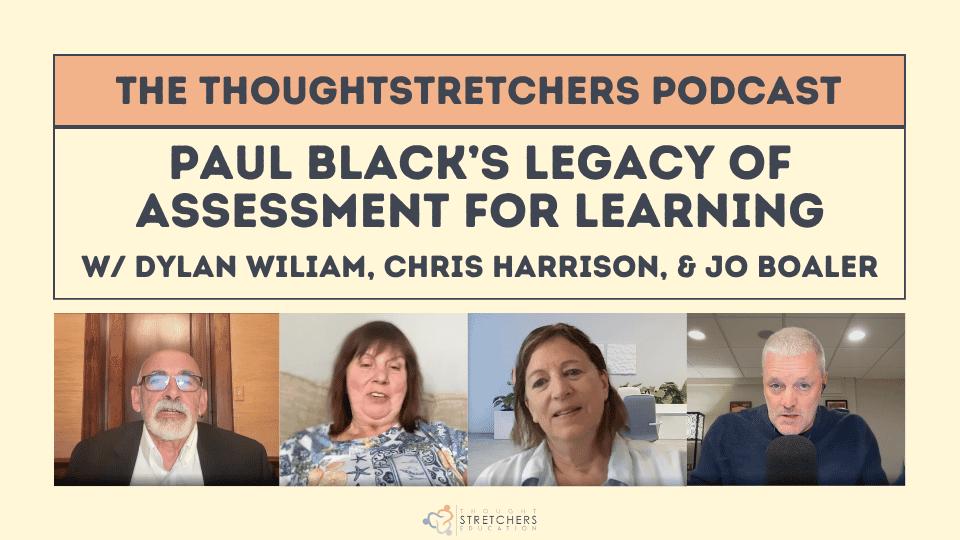
In this episode of the ThoughtStretchers Education Podcast, Drew Perkins talks with leading education thinkers Dylan Wiliam, Jo Boaler, and Chris Harrison to explore the work and life of Paul Black and his profound impact on teaching and learning, especially the concept of assessment for learning. …
سلب مسئولیت: پادکست و آثار هنری تعبیه شده در این صفحه متعلق به ThoughtStretchers Education است که متعلق به صاحب آن است و به Listen Notes، Inc وابسته یا تایید نشده است.
ویرایش
از کمک شما برای بروز نگهداشتن پایگاهدادههای پادکست سپاسگزاریم
