

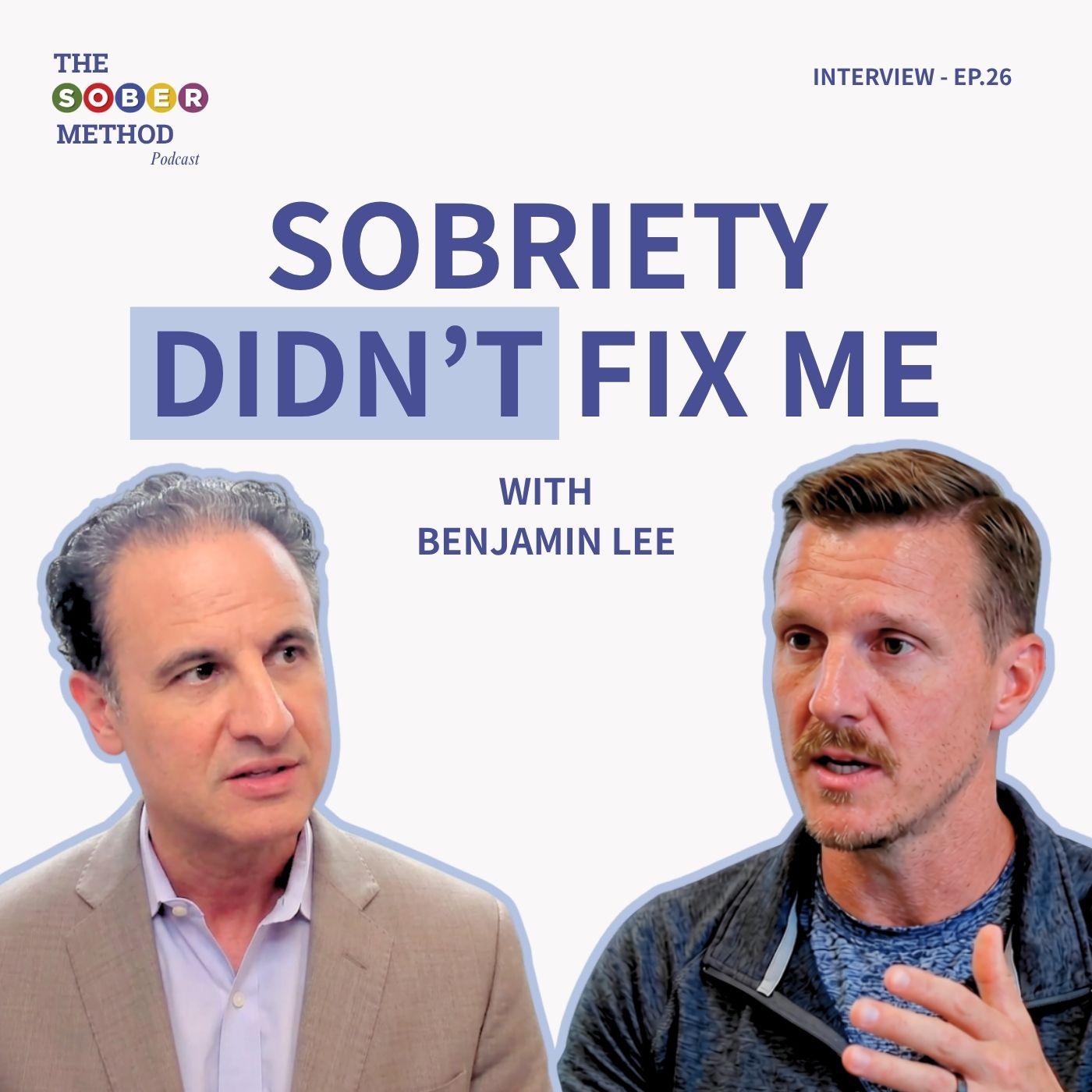
Massimo Rigotti: If you finally got sober, you may have hit something nobody warns you about: an emptiness where the old you used to be. Especially if your identity was built on a mission, a role, or a job that demanded everything. You won the fight, and now you still don't know who you are. Please welcome Benjamin Lee.
Benjamin John Lee: Thank you so much for having me, Masimo. I'm excited for this conversation.
Massimo Rigotti: Fantastic. I am as well. Benjamin, you warn about something almost nobody braces for, and that's the identity crisis that hits after you get sober. Someone finally quits and they expect to feel free, but instead they feel this emptiness and they're lost. what is actually happening in that moment and what's the first move to start forging who comes next?
Benjamin John Lee: some people will disagree with me on this, but I have learned that the addiction in and of itself isn't the cause, it's just the symptom. when we finally are able to put a substance aside, if you stick with it long enough, then learn that that substance was just a way for you to numb yourself away from feeling whatever it was that was trying to, you know, surface in the first place. Or it's become a building block of the identity that you now have for yourself, like, I'm just an anxious person, so I need X substance to alleviate that. Or I'm this, so I need that. So a lot of or at least half of that addiction or what we see as addiction is actually just a trap of identity where we think that we need these things to feel normal, when in reality it's just the withdrawal from a substance that is tricking our brain into thinking that we need the thing that is making us feel normal, when in reality it's the thing that's making us feel not normal in the first place. So there's so much of this unconscious behavior patterns. And then once you bring your sobriety to the conscious and you're living it every single day, as you said, you reach this point where it's like, crap. Getting rid of the substance wasn't the trick to stop feeling whatever it is I'm feeling. It was just the first step in the process of confronting what I need to confront.
Massimo Rigotti: Exactly. And by doing that, oftentimes people find themselves hitting a second rock bottom, which is becoming a a more popular way to refer to it. But I often think of it as more you are actually doing the hard work. You actually are recognizing what's going on. what have you found in those that you work with?
Benjamin John Lee: I think my own story is probably because I can relate to it the best because I've lived it. and it was hard too because not only did did all of the childhood trauma already exist, but then because I joined the military at 17 and then was almost immediately seeing combat for the next eight years of my life. For a while I thought the spool that I was unraveling was, I feel this way because of my military service. So the first thing I had to do was get rid of the addiction to be able to sit still with what it was that I was feeling. Then I had to peel back everything that had to do with my military service until I reached the end of it and realized, wait a minute, this wasn't the reason that I was feeling like crap in the first place. Now I need to go back even further. So then you get all of the military stuff out of the way, or all the adult stuff out of the way. And then you realize that all the demons that you've been so scared of your entire life is just your inner child with a flashlight making shadow puppets on the wall. And what once I saw those signals from my inner child or those unmet needs that I had as a child, of course. Now I realize all the maladaptive ways that I have developed to try to achieve that sense of connection that I was longing for as a kid and never got. So it is for me at least, it essentially just boiled down to not being able to face the loneliness of the disconnection that I felt with the world around me. And that drove me to substance use.
Massimo Rigotti: I gotcha. So you just kinda used a term there that I think you actually work on quite a bit, which is shadow work. the battles as you put it that aren't fought with bombs and bullets. And in plain terms, could you further break down what shadow work is and why does it remove the substance without facing the parts of yourself that you, could fall right back into?
Benjamin John Lee: the shadow gets misinterpreted a lot. It has this very like woo-woo spiritual sound to it when we talk about the shadow. But when I'm referring to the shadow, I'm just talking about the fundamentals of Jungian psychology. So if we look at each individual human being, we have the capacity for humanity's greatest evil and greatest altruism inside of us. Like the Anybody who thinks that a certain characteristic of humanity isn't inside of them is going to cast a bigger shadow because that's what the shadow is, is the parts is it's the expression of the parts of ourselves that we refuse to admit are a part of ourselves. And that doesn't have to be things that we view as negative. They can also be positive characteristics. Jung talked about the golden shadow as well, or the parts of ourselves. That we don't let shine because somebody somewhere in our life told us that we had to tune or tone down our light because it was overshadowing them, or whatever the reason was that we were taught to fear these parts of ourselves. So the shadow is just the parts of our own human nature that we shove down into a deep dark basement and try to pretend don't exist. The problem is that anything that we shove into the unconscious will manifest itself in our day-to-day lives. And we think that this I'm just unlucky, or this keeps happening to me, or this I see this cycle happening, but I don't know why I'm in it. It's like, well, you need to address the shadow. You need to drag all that stuff out of the basement into the light. And then once you can see it, then you can see all of the ways that your life is being navigated by this darkness that you have inside of you. So it you don't have to be afraid of it. You just bring it into the light. And it's like, okay, here's the deck of cards I'm playing with. Now I can understand the game that I'm playing.
Massimo Rigotti: that's a really good analogy. I really like that. So you did bomb disposal, which is calm and precision in in a place where a mistake is fatal. And then the mission ends, and that wiring has really nowhere to go. So how does someone who is built for that kind of pressure end up using a substance as the off-switch? And what do high-pressure achievers most misunderstand about their own coping?
Benjamin John Lee: No, that's a great question. I I think the thing with people who are geared towards higher achievement is like that is that innate sense of perfectionism. So that the very thing that they think is their greatest asset is actually in disguise their greatest enemy because it's this drive towards being needed to be viewed as in a particular way, like I'm the guy who has all the answers, or I know how to get things done, or like I'm not lazy, or the all these things that we build as part of our identity. Well when we create a gap in between our actual selves and our ideal selves. So that essentially means is this is who I think I should be. This is how I'm actually showing up. The Greater the distance between those two versions of ourselves, we're going to start experiencing resistance and friction in our day-to-day lives because how we think, how we're acting, and what we believe are in alignment with one another. And anytime that there's misalignment in those three categories, you're going to experience resistance. And to me, my my addiction's born out of rebellion. it I've come to realize throughout the years is the root of it was I started drinking and smoking cigarettes and using substances well into my early teens. And I realized now it was in an attempt to get my parents' attention and say, Hey, stop me from doing this thing I know I shouldn't be doing, because if you do, it would mean that you care about me. And that maladaptive strategy has just carried over into my adult life. Where it's like I'm feeling stressed out, I'm out of control, I'm going to just self-destruct until somebody steps out of the shadows and is there to be my savior. And it wasn't until I got a little bit older and I realized nobody's coming to save you other than yourself that you go, I need to probably figure out how to stop doing this to myself.
Massimo Rigotti: Yeah. Wow, that's that's definitely a interesting path to walk. your whole message though is that a meaningful life isn't found, it's forged. And consciously redesigning who you are rather than just quitting. Now, for the listener that's ready to do that, I want to start. What does forging a new identity actually look like and how would they take a first step?
Benjamin John Lee: If they're even asking themselves that question, they're already in a really good place because the first step in identity transformation is realizing that you are living an identity that no longer serves you. Because if you can't acknowledge the fact that somehow you are acting against your own best interests, then there's really no amount of work you can do because if you're not willing to acknowledge the problem, you're not able to fix the problem. In fact, even When you are aware of what the problem is, your ego likes to stand in the way in between you and becoming the person that you want, because your I your ego is constructed to keep you safe. And holding on to those known patterns or that known identity is in the ego's best interest to maintain its place in the world. So b being able to consciously acknowledge that how you are acting is against your own best interest is is the paramount step in being able to sit with your ego and be like, Hey, you know, we're showing up in ways that are not good for either of us and we need to figure out what we how we need to move forward from here.
Massimo Rigotti: Is that just something that you just naturally work to push out of the way or do you have any tips that you would say, This is how you push your ego out of the way and it will listen to you?
Benjamin John Lee: it's a long time of learning how to show yourself grace in your mistakes. Because I found for myself anyway that when I was deep in the shame cycle that we find so often in addiction, because really shame is just perpetuating that disconnection that the addiction is seeking to relieve in the first place. So as as long as we are in that shame spiral, it's very hard to recognize the actions that we're doing as our inner child's cry for help or us like seeking some sort of unmet need. But over time, once you can start giving yourself grace and instead of getting upset with yourself out of these maladaptive behaviors, you can Start to identify, hey, this is what I was trying to secure for myself through this action. And over time of differentiating between what is being driven by the ego and what is being driven by my higher self. And I have learned that the ego is typically driven through a voice of fear, like it likes being pushed instead of pulled towards something. Whereas the higher self will be more, it's more of like, You're being drawn to something. Like this feels like it's in alignment with me. I feel drawn to this cause. And there really won't be much resistance in between you and that path when it's coming from your higher self. But learning, learning,
Massimo Rigotti: Exactly. It's that calling. Yeah.
Benjamin John Lee: yes. Like so you're being pulled towards something instead of pushed away from something. And it's a very like it's a very hard thing to learn to do, to tap into like your inner intuition, be like, no, even though everything is telling me this is what I want, like. starting to to operate from a base of logic instead of emotion. Because while emotions are useful in orienting ourselves in the world, they can be detrimental to our day-to-day progress because the emotions are fickle. They come and go. They ebb and flow. And so to count on motivation and emotion to get us to where we need to go is sort of a a failing recipe from the start.
Massimo Rigotti: Absolutely, completely agree. So could you take us back to when you were in uniform and what did that world give you that made losing it so destabilizing?
Benjamin John Lee: I at the time I wish I would have known, although even if somebody told me at the time, I probably wouldn't have believed them, but the sense of belonging that I was searching for my entire childhood. And it's it's weird too because we're I was raised very conservative. And so we have like family values are a large part of the core of what you're raised on. But there's this hypocrisy that comes about from when you're like you're told that you're part of a family unit and that like, they're blood. And so you have to be there for those people. And then you feel all of this friction in your life with these people who are supposed to be there for you. And then you get stationed with a group of people who are, you know, doing the same job as you and you finally find that team that you've been looking for the entire time. Like, this really is A mutually beneficial situation. I watch your back, you watch mine. We're in this together. We're completing a mission together. It's like that was what I was looking for. People who showed up for the people around them because they wanted to and not because they were obligated to. And having experienced that for the first few years of my career, and then I faced my first change in duty station. So that was like my first taste of it. Was I lived, I was stationed over in Italy for a few years. And I really found a family there. I did a few tours to Iraq with that with that squadron and like developed these bonds. And then I changed duty stations from Italy to California. And that was the first time that I had to go, okay, wait a minute. Something here is off. Like I feel like I just lost something. And because in my identity transformation process, I haven't I have made grieving A large part of that transformation process because you can't you can't ready yourself to move on to the next thing without grieving the thing that you've just lost. And in the military, you're I don't want to say you're encouraged not to grieve, but it's it's kind of counterintuitive to the job you're trying to perform. It's like, no, we're always on, we're go, go, go, go, go, get the job done. You don't really stop and think about that sort of stuff. So I had these mini things that I needed to start grieving that over time just started piling up and piling up and piling up. And then once I was medically retired after my third tour, then I was forced to sit with it. And then it all just came crashing back into me. And that was the loss of purpose and then the loss of community because I didn't realize how much of those two things I was getting out of that identity of bomb squad technicians. Like I I saved lives for a living and I did it with a group of people who I respected as my equals. I really haven't been able to replicate that here in the civilian world, at least not yet. So that in large part is where a my isolation and my addictive tendencies came from was that that loss of community and connection.
Massimo Rigotti: I think that would be very destabilizing. It would really tip you off and create that loss of identity had to be huge. if you would, could you walk us through what that rock bottom stretch looked like for you and how did you turn it?
Benjamin John Lee: it started with one very, very large rock bottom. Although I've had multiple rock bottoms, if I'm being honest. Like when they when they say that sobriety or progress isn't linear, it's so true. And so you'll hit like additional they feel just as deep, but they're not if you look at the grand scheme of things. And so like I came out of the military completely unaware of. I mean of any concept of psychology or shadow work or spirituality or anything. Like I was a cold, logical atheist. I thought I knew how the world worked. I like I thought I knew everything. And then once you hit that first rock bottom with substances, once you can look yourself in the mirror and say, like, I don't got this. Like I I thought I had this, but I don't got this. And you're forced to. Re humbly reach out for the first time in your life for support or assistance from somebody because that's something that didn't come easily to me. And that that was probably the trademark of that first rock bottom was, shit, I put myself into a position that I thought I could get myself out of, but there's no way I can do this by myself. And then reaching out for help. But that first rock bottom only leads Cause mine was with like I drank very heavily when I was in the military, because that was in large part the culture of how we decompressed. And then so I already had that tendency of numbing myself. And then when I got out and I had I was having nerve surgeries because I have a spinal stenosis in my cervical spine that took away the feeling in my right arm. Just getting a taste. Well, I already had already had a taste for opiates before that, but like getting that consistent feel for how good it felt to just forget about the world for a while. that led me into that deep place. And then once I realized how deep in I was, then the shame took over. Like I was this military hero who just now became like one of those statistics.
Massimo Rigotti: I totally get where you're at. but then you start to climb out and that recovery starts to look possible and becomes possible. then you reach a point where you're saying, okay. This isn't enough. And you started doing something that's really cool, which is you started reinventing yourself. And you turned that fight against addiction into building the initiation source, writing Sincerely America, and helping others forge themselves back. why did you go that direction? A lot of people will just get sober and carry on about their lives.
Benjamin John Lee: I will admit that in large part it is selfish on my account. Be well, once you once I understood that community and connection were the cornerstones of maintaining a sober lifestyle, and that sobriety in and of itself is the foundation of the identity that I'm trying to build for myself, it became a no-brainer to. Like if what I struggle with is connecting with others, then I want to be the one who learns how to meet other people more than halfway, because that's really all that's missing in this equation. we need more and more people who are willing to meet people where they're at and then pull them a little bit closer to the center. when I felt that I had done enough work to start turning around and helping those behind me, it To me, that was just a no-brainer decision. And if like I could find a way to make a livelihood while also helping others through situations that I had to figure out on my own, then like what I couldn't ask for anything more than that. So, but the book was a little bit different because that was me of Therapeutically working through some of the issues that I had with our government at large. so that book is a lot about national identity. And then my work in coaching is more about what I only do one-on-one coaching. So just but identity. Identity is the foundation of where all of our thoughts and behaviors and subconscious routines come from. So identity work became big to me because I realized it was the only way out of what had me trapped was to like completely overhaul the way that I viewed myself.
Massimo Rigotti: I mean it was foundational. Well, Benjamin, the thing that sets the SOBER method apart is that it's not a one and done fix and it's a continuous self improvement cycle. So you keep returning to this first stoic step and doing that honest self-re-examination to forge the next version of yourself and you do it again and again and you're constantly improving yourself. And so your your idea that a meaningful life isn't found, it's forged is kind of the same loop but in a different language. my question for you is why does the person who says I quit I'm done tend to stall out in their sobriety while the person who keeps returning for this self-examination keeps becoming someone new and greater?
Benjamin John Lee: From a psychological perspective, when we try to white knuckle something, essentially what we're doing is packaging that up and then stuffing it down into the basement, which is the exact thing that led us to be in that situation in the first place.
Massimo Rigotti: Yeah.
Benjamin John Lee: So it's only through Jung referred to it as individuation, but you can also refer to it as integration. And that is. Understanding that those bad behavior strategies that we exhibited in the past actually served us at the time that we developed those coping strategies. They they kept us safe from whatever it was that we weren't ready to acknowledge or face at that point in time. I mean, even being in the military and drinking and starting that self-destructive loop. was a counterbalance to the things that no human be being should really experience when they're 18, 19 years old. So it's only through that process of identifying those behaviors and then being able to love them instead of hate them. Because when we hate something, we want to shove it out of the way and not want to look at it because we feel like it's a stain on us. But when we can hold those things out into the light and be like, okay, here was a strategy that I developed because I was in some really hairy situations, but I don't want this to rule me anymore. So the way to get rid of it is not to box it up and shove it out of the way. It's to acknowledge it and show it the love that it was trying to receive when you first developed that maladaptive strategy. So it's that the white-knuckle approach can work short term. And there's people who are even able to white-knuckle it to the point where it becomes habitual. But I would argue that even habitual sobriety takes a level of energy from you on a day-to-day basis because. you're still suppressing whatever that that core thread that was leading you to that behavior in the first place. that's why I see so many people stuck in this cycle.
Massimo Rigotti: you're still not truly yourself and you haven't been honest with yourself, so you really haven't made any changes. You're just in a fit of suppression. I'd be interested in what you found in your own evolution to surprise you most. What did you not expect to discover when you were reforging yourself?
Benjamin John Lee: Probably that ninety nine percent of everything that drove me was in an attempt to receive validation. that led to like it almost led to like a mini rock bottom. I mean, I had already have had the discipline fundamentals to not like let my old habits take over. But even now I'll notice that like I will still go into like mini binges, but now it's with things that people wouldn't consider so like food. I have a pretty strict diet and I know when I start. getting off of that diet and I start over it's like, my my nervous system is trying to do the same thing that it used to do with chemicals, but now it's just doing it with food and cheap dopamine.
Massimo Rigotti: the thing that surprised you most that you discovered and to discover that y 99% of what drove you was validation. That's that's a lot of work. That's a heavy load. I can't even imagine carrying it. So in everything that you were doing every day, you were seeking out validation for even the smallest thing.
Benjamin John Lee: Trying to feel worthy of the love that I want to receive. That's at the end of the day that was driving everything that I was doing. It my healthy eating, my fitness routine, my job, my like everything that I had built for myself. I had to take a step back and go, wait a minute, you're doing this just because you want somebody to tell you, you're handsome enough or you're attractive enough or you're fit enough or you're successful enough or whatever it is. I was just sitting there with that anxious energy of being like, somebody tell me that I'm good enough. And it wasn't until being able to recognize that and bring that into the light that I'm like, wait a minute, I don't have I don't have to show up in the world this way anymore. I can start acting in ways that harmonize with who I am at at my core. It wasn't until I started reading a good amount of Aristotle and like really separating the difference between the hedonic sorts of love and happiness and then the Eudaimonia that he describes, where it's like, okay, my happiness can be derived from me living in accordance with my highest virtue. having that internal why versus that externally focused why was so important for me getting out of my own way because now I had this driving force inside of me that wasn't dictated by any of the fickleness of the exterior world.
Massimo Rigotti: And there are a lot of stoics listening right now that are smiling ear to ear to hear a guest talk about just that. So everyone listening, before we go, here is your sober move this week, inspired by Benjamin, and it starts at the Stoic step. That emptiness after you quit is a vacuum. And a vacuum pulls you backward if you leave it empty. So don't leave it empty. Start forging. Write the first draft of who you're becoming. the values you want to be known for and the person you are genuinely excited to be and one purpose bigger than yourself to aim at. Then pick one thing inside your control and act on it this week. Just one concrete step toward that person. Journal what shifts. This is the cycle and you don't quit being your old self. You have to forge the next one and you keep coming back to do it again. Now, Benjamin, we have a tradition on this podcast where each guest answers a question left by my last guest. Nathan Graham left you this question. What is the single most important thing for you to be curious about in your life right now?
Benjamin John Lee: Something that I have been realizing has been foundational to the self-development work I've been doing is understanding that the way The trauma that my parents were facing became the trauma that I have to face. Except it's a weird mix of both of their situations put together and put into me. And really analyzing the ways that I show up in the world as my parents has been fundamental to acknowledging the parts of myself that I still need to heal. So like When I'm behind the driver's wheel of my car and I'm getting upset with people for being horrible drivers, like that's me turning into my father. And that's a part, that's a part of myself I now know I need to show love to. So really paying attention to the ways that the world activates me because that's how I can view the parts of my own shadow that still need a little bit of love and light shine shown onto them.
Massimo Rigotti: That's really powerful. to everyone listening, I want you to keep observing and journaling your own behaviors daily. My new book, Digital Sober Method, is available anywhere books are sold. If putting down your phone is the fight you're in, this is your solution. I'm Massimo Rigotti This is the Sober Method Podcast. Please follow, like, subscribe, leave a review, and share this episode with anyone who needs to hear it. Remember, everyone, your future is sober.
