
درباره این اپیزود

I left Black Rock City, Nevada, on September 8, just about 3 weeks ago. Each time I have gone to Burning Man over the past 3 years, it has been a challenge to adjust back to normal life after experiencing 9 days of sensory overload out in the desert. (If you don’t know, Black Rock City is the official name of the city that is constructed at the event called Burning Man.)
The first year I went to Burning Man, I did not go with a critical eye, but just with a desire to see and understand. One of the first rules of missions is that in order to reach people with the love of Christ, you must understand the heart and culture of the people. This means you must understand their desires, hopes, dreams, motivations, and their view of the world.
So let me take you back to when we moved to the Philippines 20 years ago to work with indigenous people there. At that time, we did the same thing. We were moving into an indigenous ethnic group in one of the remote parts of the Philippines that did not have a Christian base. A lot of times people are surprised to hear that in the Philippines there are still people that have not been exposed to Christianity, because in the cities there are churches everywhere, and have been there for more than a century. While that is certainly true, in rural areas 20 years ago, there were still a substantial number of remote indigenous areas that had little to no exposure to Christianity (and there are still some areas even today that fall into that description). So when we moved into the tribal area, we were faced with people who at times were violent, had an extremely high rate of child mortality, and had widespread sexual abuse through institutionalized child marriage, which from their perspective was not immoral at all. In their culture, child-brides had always been something they had practiced.
In evaluating the culture, we had to discern what was good about their culture and what was not, and look to strategize for their future development what would be healthy for them in the long run and what would not be. We did not speak out against things early during our culture studies unless we saw some kind of imminent danger. Instead, we kept in mind that those practices which would harm them in the long run and which did not line up with God’s established order of right and wrong would be addressed at the proper time – after they became followers of Christ. We also recognized that not everyone was going to become a follower of Christ, so we did not make any future plans to impose Christian morality on the entire community. We knew that at some point in the future there would come a time when it would be appropriate to teach believers how they were to behave as part of church instruction. However, we did not intend to dictate rules of behavior to non-believers, except (again) in the sense of protecting people from danger. The goal of the Christian life is walking in a relationship with our loving heavenly Father. The goal is not to establish any particular order of outward behavior. In missions, systematic instruction on good and bad behavior is really only warranted once there are believers and a church is born. And it should always be taught in the context of growing in a relationship with a loving heavenly Father.
There is one thing we kept in mind through this process of culture investigation in the tribal area. In order to be fully objective, we chose not to make a judgment call on any one aspect of their culture until we fully understood it. This method of evaluating their culture was not formally codified or discussed on our team; it was simply something we recognized as the right way to do things.
So keeping those missional principles in mind, when we first went to Burning Man in August of 2024, we resolved not to stand in judgment on the culture, but to evaluate everything objectively. Granted, we knew that we would find some things objectionable (e.g. the orgy dome, excess nudity, drug abuse, etc.). However, after studying the culture of the event, and watching the people that participate in it, we came to the conclusion that like any other culture made up of human beings, there are good things and bad things in it. To that end, when Christianity is discouraged at the foundational level, it may (and usually does) allow more objectionable behavior to come to the surface and become more visible in the community. There is no denying this, but it is not the only thing that we saw. We saw both positive things as well as objectionable things.
Now I’m going to pause here and highlight something that I have become acutely aware of over the past few years, and I hope that this will be well received. I hear people talking and see social media comments talking about Burning Man as a manifestation of Satan’s kingdom, “a modern day Sodom and Gomorrah”, “the devil’s territory,” or something like that. The problem with characterizing it in such terms is two-fold. First, in order to be consistent, you would have to use the same terminology to characterize just about any public university in the USA, any mall that has a Victoria’s Secret store, any restaurant that serves alcohol, any professional football or basketball game, any city hosting a New Year’s Eve party, or just about any public gathering that is not a Christian event. The difference is that in most of those other places, the sinful side is just kept a little more hidden. At Burning Man it is out in the open.
The second problem looking at things this way follows from the first. As Christians, none of us actually live that way and completely isolate ourselves from what might be “the devil’s territory.” How many of us went to a university as a Christian? How many of us send our kids there? Do you completely avoid going to malls or restaurants? Have you never watched a professional sports event or college sports event? Do you go to New Year’s Eve parties where there might be unbelievers doing things that unbelievers do? Do you dance at a festival or at a friend’s wedding? Is it even wrong to dance? How do you measure what is acceptable music and what isn’t for a Christian to dance to?
Then also, is the only acceptable reason for going to Burning Man in order to witness to people there? Again, let’s take that to the other areas we live. Do you only go to university or send your kids there in order to share the gospel with others? Is that the only justifiable reason for attending a sporting event? How about restaurants – is the only justifiable reason for going to a restaurant that serves alcohol in order to share the gospel with a waitress or someone at the table next to you? Is the only reason for dancing in order to be a dancing witness to other people at the party?
We can get so caught up in the minutiae of trying to determine what we should and shouldn’t do it can get ridiculous. That doesn’t mean we justify sin. So how do we handle this? I believe the answer is that we are called to follow the discernment of the Holy Spirit that lives inside of each of us. That is what we try and do at Burning Man. I don’t go to the orgy dome or take psychedelic drugs at Burning Man. I don’t walk around with no clothes. Nobody in our camp does any of those things. There are a lot of things you can learn at Burning Man by just going around, observing, and listening to people talk. I will share more of those here in a minute. Are we there to share the gospel? Yes, absolutely. Are we also there to learn and understand the culture? Yes, that is the other reason we are there, and it requires LISTENING. Do we try and walk with humility at the event when we converse with people and hear them tell us what they believe? I don’t see how it can be effectively done any other way. Are we trying to shut down the culture? No, that is not our goal.
The same sin that exists in our communities back home is just manifestly out in the open at Burning Man. Yes, that is problematic, because openness to sin encourages more people to participate in it. When this becomes a cultural value, like at Burning Man, it has the potential to spread very rapidly, like wildfire. But ironically, it doesn’t. It just doesn’t spread nearly as quickly as you might imagine. Why? The Burning Man culture would tell you that is because it is really hard for people to get past their social conditioning, the social conditioning that tells them something is sinful. They don’t believe that sin really exists. In fact, I was once in a lecture at Burning Man where one of the thought leaders loudly proclaimed “there is no sin” to thunderous rejoicing. This is where the Burning Man culture is wrong and has completely missed the mark.
So what is it that restrains sin from rapidly spreading like wildfire at Burning Man? I mean, sin does spread, probably more than in our communities back home, but just not as much as you might imagine, and not as much as it is portrayed in social media.
Here is the truth about sin. Sin is real, it really does separate us from God, and people everywhere inherently know this, no matter what they are told for 9 days on the Playa. This foundational understanding embedded in the human heart is the first element that restrains sin from spreading like wildfire, even at Burning Man. The second element is our Christian presence – that we are there. I don’t mean only us at our camp, but there are other Christian camps there as well. Our presence, with the Holy Spirit living inside of us, has the effect of reminding people that maybe the doctrine that they are being fed for 9 days of sensory overload on the Playa might not be right. We don’t have to speak any words to anyone for this effect to take place. It just happens.
I have seen this in action. I was once sitting in a group of people and we were all having a conversation. I was a newcomer to the group, so I received the query of questions. When it became evident that I was a follower of Christ, unwavering in my belief, but also not condemning in demeanor towards anyone, there was a palpable shift in the spirit of the group. While I was explaining why I believe in God and have so much confidence in that, there was a young lady sitting across from me in the circle. She quietly got up, went around to her tent behind us, changed out of her scantily revealing clothes into something more modest, and came and sat back down. It was a subtle shift, but I knew what was happening because I have noticed this sort of thing in other contexts where I have ministered in the past. All of a sudden the sense of fun exciting worldly sensuality in the way she dresses starts to reveal itself (to herself) for the reality of what it truly is – something dirty and unpleasant, that needs to be shaken off. I didn’t mention a single word about sin in that conversation. I didn’t say anything about the way anybody dresses; I didn’t make a single comment about any of the nudity that is prevalent at Burning Man or any of the sinful activity there. I didn’t even discuss any common social sins outside of Burning Man or talk about what is wrong with the world. All I expressed at the time was the reality of who God is, and why I believe, and don’t have any doubts.
You see, when people are faced with the truth that God is real, they come under conviction. It’s not just the women who experience this, of course. We have seen men come under this conviction as well. It is in those moments that we have the opportunity to share how the love of Christ on the cross has made available God’s cleansing of sin – something that simply changing clothes is unable to do. And the rejoicing that follows, when someone yields himself or herself to truth, is unparalleled and amazing. We have seen this happen multiple times. No experience from the zeitgeist of the Playa can match that.
The only reason we are able to do this is because we are there.
Now some may say that Burning Man is starting to force Christians out, like they did to the Christian camp that got expelled this year. However, this also is not true. The camp that was expelled was not kicked out for being Christians or for sharing the gospel. There were other reasons, things that I know about from things we heard on the inside and from our interactions with their camp. I won’t comment any more on this at this time.
A conversation with a skeptic
This year while we were at the event, we had a conversation with someone there who arrived in the middle of the week and had only been there for about 3 days. He was a Christian, like us, but had not studied anything about the culture and he did not understand the people. In seeing all the visible hedonistic activity that he saw in his 3 days, he was shocked and confused, but also angry and disturbed. At one point he expressed the idea that the entire culture of Burning Man should be wiped off the map or “completely shut down.” He also seemed to indicate that he was unwilling to consider looking at it from any other point of view other than his own, even though he had only been there for 3 days and knew nothing about the culture before coming. He did not indicate that he had any compassion on the people there, and said that he could not see any redeeming quality about anything at the event. But he did admit that he was uncertain of the right way to think about things.
I understand the shock that a Christian may feel the first time he or she goes to Burning Man and is exposed to the exceedingly visible manifestations of lostness out in the open. However, shutting down the event, even if that were even possible, would do absolutely nothing to stop the culture that formed Burning Man from continuing its highly influential and relentless expansion that is happening all around us. Imagine, if you will, a train that is chugging along with hundreds of cars full of people and cargo. The train is the culture and worldview that formed Burning Man. A main station, perhaps the Grand Central Station, is the Burning Man event, but Burning Man is not the train itself. The train is the culture, and it has momentum. It is going somewhere, and it will not be easily stopped. Closing one train station, even the largest station (i.e. Burning Man) is not going to stop the train from continuing to its final destination, whatever that may be.
What are the elements of the culture that this train represents? They are all the things I already talked about – creativity, art, sensuality, the illusion of unity, the removal of restraints, innovation, etc. A whole host of elements – some good, some bad, and many that are morally neutral.
The fact that there are bad elements, and that these are highly visible, tends to get the attention of the world. So this brings up something that I would like to address that had a significant effect on people that we talked to and reached out to. I am talking about the publicity that came out from Christian influencers on social media in the past year leading up to Burning Man.
A discussion on Christian influencers and their impact
Here is an example. There is this one popular Christian influencer, a young man, who has become very well known for saying things like “Burning Man is the darkest place” he has ever been to, even “darker than the Satanic temple” that he had once visited. This kind of talk may get a lot of clicks and rapid sharing, but I believe it is an inaccurate description by someone who has not taken the time to study the culture and understand the people. Furthermore, you must understand that a lot of people put a tremendous amount of effort to create Burning Man and turn it into something that they believe is beautiful, especially in the artistic displays. Since that is the case, it is insulting for them to hear Christian influencers talking about the event that they cherish as the most evil and dark place that exists on earth. As Christians, we would be wise to be more respectful of the thoughts and feelings of people around us.
This is one of the reasons why Christianity has a bad reputation among many of the people at Burning Man. They feel disrespected by Christians. To many people that attend Burning Man, it is a sacred space for them. Take for example someone who is not a believer in Christ, who may have gone to church, but was unsatisfied and therefore sought spiritual connections elsewhere. To him or her, if they find the connection they are looking for at Burning Man, the event becomes a sacred space. After the event, they go back home and return back to normal life. At some point over the year, they will login to the same the same social media platforms that the Christian influencers are on. When that happens, the algorithm (knowing they went to Burning Man) will connect them to a video about Burning Man by a Christian influencer, and they will see this Christian talking about the Burning Man sacred space that they cherish as if it is the most evil thing in the world. They will then feel greatly insulted and disrespected, and perceive that Christian people lack understanding, lack compassion, and lack grace. It reinforces, in their own mind, their earlier reason for rejecting Christianity. Or alternatively, they may just get more lost and confused, not understanding why they felt so good about something that a Christian influencer says is so evil. None of this is healthy.
So, what has driven the activity of Christian influencers? Probably the biggest driver is just the allure of becoming a social media influencer. Social media makes a platform available to anyone, as long as you look and sound good on camera. Naturally young people look better on camera than old people. There are many, many young people that gain a large following because of their good looks, but lack wisdom and understanding. This then becomes an aggregate mass of the blind leading the blind. We have all noticed this happening in the secular world of social media. Unfortunately, it happens in the Christian social media ecosystem as well.
If you were a Christian and knew nothing about the culture of Burning Man, but decided to attend without any guidance, you might experience something like this. You might happen to land in an area of Black Rock City where there is a concentration of some of those things we as Christians would never get involved with. For example, you might end up near the orgy dome, and you might see some nudity. Then you might go to a discussion on meditation or the environment, and find yourself sitting in a lecture on shamanic rituals, homosexual advancement, or the equality of mosquitoes with human beings. In this case, putting everything you saw and heard together, you might imagine you actually had stepped off the bus into a modern day Sodom and Gomorrah.
However, if you drew your conclusion only at this point, and didn’t take time to find out more about other things happening at Burning Man, you would have missed more than half the culture. If you really wanted to understand the culture, there are many other things you could have done. Here are some examples:
* You could have gone to the Temple area and conversed with people who had lost loved ones over the past year and were there to say good-bye. You could have listened to their stories, and heard their heart-cry.
* You could have heard the fears of an Israeli Defense Force reservist who knew that as soon as he returned to Israel after Burning Man, he was going to be placed into a combat unit and sent somewhere to fight, and maybe to die.
* You could have visited art pieces, met the artists, and heard them tell you, with gratitude, how their art reflected the history of their ancestral culture coming from Africa to the Carribbean to the UK.
* You could have gone to a lecture by a Republican insider on how creating certain legal and legislative structures can enhance limited government and improve prospects of liberty for everyone.
* You could have had a conversation, after a lecture or over coffee, with someone who was deeply struggling to find a spiritual connection to God, but could not understand why God would send someone to hell. You would have had an opportunity to give an answer, with grace, to this question about Christianity.
* You could have heard the results of the latest medical studies on how using limited amounts of psychedelics has effectively treated soldiers, firemen, and policemen from the long term devastating effects of PTSD.
* You could have listened to a seminar on the dangers of Artificial Intelligence, what is being done to prevent it from growing out of control, and how to harness its capability for the benefit of human beings.
* You could have heard actual stories from doctors in Israel on how some psychedelic therapy initiatives are bridging cultural gaps between Jews and Muslims in Israel, Palestine, and Lebanon, creating real possible future opportunities for peace and hope.
* You could have talked to 2 young Ukrainian men who greatly desire to return to their country, but cannot because they have now reached the age of being drafted (which is 25 and older for Ukraine).
* You could have heard from a Silicon Valley tech executive who had just explained how all of the top creative minds in the world come to Burning Man every year and brainstorm on innovations they would like to implement for the benefit of the entire world.
Every single instance above is an actual experience or interaction I have personally had at Burning Man over the last 3 years. In many of those cases, we were drawn into a spiritual discussion that led to talking about Christ, and allowed me to present Him as He truly is, not in the way most people there think He is. And I am not the only one. Almost everyone in our camp has had similar interactions.
The list above contains both morally neutral and morally good things. So this begs the question, because there are also good things happening at Burning Man, does that justify the morally objectionable behavior that also happens there? The answer is no, of course not. I am not suggesting it does. But I am suggesting that with this many good things happening, it is not possible that Burning Man is the most “evil and dark place” that exists, as the influencers have described.
A conversation with a seeker
Now I want to connect this to my earlier discussion about the Christian influencers. I had one conversation along these lines that really pulled these ideas together. I was in a workshop where they were talking about some kind of breathing meditation. While there, they asked us to lay back and close our eyes, etc., and practice this form of meditation, guiding us through the activity. When the exercise was over, they queried the participants as to what they saw. One lady on the other side of the pavilion said that she had a vision of Yeshua (Jesus). I don’t remember exactly what she said about Him. The moderator said the vision was beautiful. Interesting.
After the workshop, I approached the lady and asked her to tell me more about her vision of Jesus. This led to a conversation of who Jesus really is, me explaining why I am there at Burning Man, and a long discussion about the whole thing. She said that she was seeking a connection to God, that she had recently come back to going to church in her home town, but was having some doubts about certain things in the Christian faith in general.
Then she asked me point blank, “Do you think Burning Man is evil?” She wasn’t asking in a skeptical way or in an accusatory way. It was a genuine question coming from someone who believes in God, has some doubts, sensed a pastoral concern in me, and saw me as someone she could trust with a question of faith. It was also a question that likely resulted from all the buzz that has been happening on social media with Christian influencers claiming that Burning Man is a horrible, evil place.
I answered her something similar to what I wrote above. That no, Burning Man is not evil, but that doesn’t mean everything there is good. It is better to think of it as a city, full of people, with all of the good and the bad that naturally go with a large group of people. It is far better to try and understand it than to dismissively judge the entire event as either good or evil.
She then expressed thanks that I was there, and thanks that there were Christians like me in our camp, and that she thought we were doing a good thing to tell people about Jesus at Burning Man.
You see, this is pastoral and it is missional. If Burning Man really were an incredibly dark and evil place like Sodom and Gomorrah, Jesus would not be there. But it is not like Sodom and Gomorrah (see the addendum below for my reasons on this). It is more like any of the cities in the Roman Empire world where the Apostle Paul visited and preached the gospel as recorded in the book of Acts (In particular read Acts 17:16-34 to understand this). In our work that we do at the event, we try to follow Paul’s pattern of reaching people for Christ. We treat it like a city full of people, many of whom are lost, and many of whom are seeking.
However, if our activity at Burning Man consisted going out and trying to get numbers written down of how many people we saved, or proclaiming that this place is as evil as the Satanic Temple, well, that might get us social media followers on YouTube and Instagram, but it would be neither pastoral nor missional. If Jesus ate with tax collectors and sinners, why would we not do the same? It is not as if we are justifying their sin. We don’t do that. We simply approach people from a pastoral and missional way of thinking. We are Christ’s ambassadors. We are not looking for social media affirmation. We want to point people to Him, because He is the one who saves.
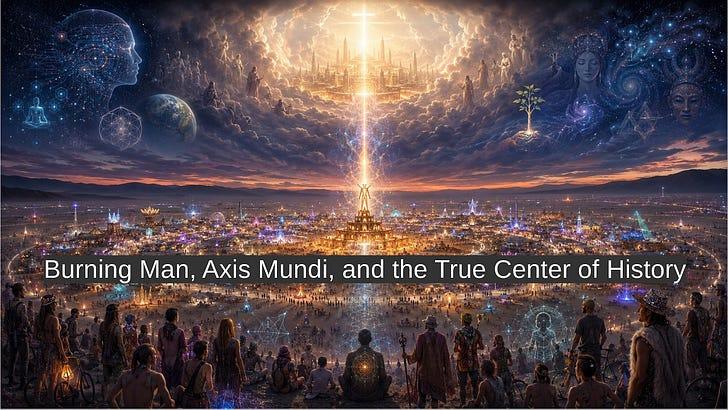
Now in my final thought, I want to back up a little and look at the broad spiritual picture. There is something very important we should understand about Burning Man, because it really is a reflection of the trajectory of all of Western culture. In this day and age, while the West has partially turned away from Christianity, it has also largely rejected empirically based atheism, in the school of Richard Dawkins and his colleagues. In its place there is a spiritual hunger, a religious hunger, that is especially strong at events like Burning Man. In the Augustinian framework, this hunger is a hunger for transcendence, belonging, ritual, sacrifice, and sacred space. It is a hunger for faith, a connection to God, and meaning. The people pursuing this are hoping that these things can be found along a separate path from Christianity, which is what creates some of the driving impulses we see at Burning Man.
Our purpose, as researchers and followers of Christ, is not to try and stop the train (i.e. the culture), but to understand why people went to Grand Central Station (i.e. Burning Man) and got on the train. When we understand that, we can effectively minister to them. In so doing, we shine the light of Christ to a lost and dying world, and are able to show them the truth – that Jesus truly is the only way. And also in so doing, we develop a better understanding of how this changing worldview is rapidly becoming the biggest challenge that biblical Christianity may ever face. And that is something worth pausing to think about.
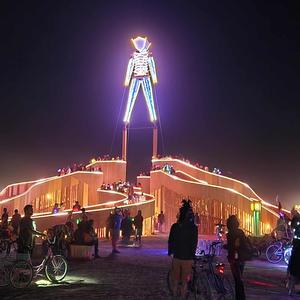
So it is with that understanding I will finish my message for today. We saw lots of things at Burning Man this year. We heard fascinating things in lectures, things we agreed with and things we disagreed with. We saw some incredible art. Some of the pictures you see will show that. We heard some incredible music. We weathered fierce dust storms and waited for mud to dry after the rain. And we talked to lots and lots of people. The opportunities to share abounded, even though by the numbers I had less conversations this year than last year. But it is not the numbers that matter. We are very thankful that this thing, this event, created by people seeking a connection to something unknown to them, has given us the opportunity to share the message of Christ, in order to make him known.
We will have more to share coming from Orbis Sentry as we continue to press on, so please stay tuned.
May God bless you all where ever you are.
Serving Him,
George Olson
Director of Geopolitical and Economic Research
Orbis Sentry
Addendum
Let’s consider just a little deeper what has been suggested by comparing Burning Man with some cities in the Bible. We could look at Babel, Jerusalem, Nineveh, Babylon, Athens, or Rome. However, the cities of Sodom and Gomorrah seem to come to mind based on discussions I have had, so let’s focus on those. Are there differences, or is Burning Man just a modern day Sodom and Gomorrah? Having been there in a Christian camp for the past 3 years, I am able to recognize the differences, and they are very big, but it does require a nuanced understanding. I am not trying to justify everything at Burning Man, but I am also not able to condemn the entire event. It is a city, so let’s make the comparison, and maybe in so doing, we can eliminate some of the confusion of how to think about the event.
I will focus on 3 points of comparison between Black Rock City and Sodom & Gomorrah. First, the people of Sodom & Gomorrah were so completely given over to wickedness that God could not find even 10 righteous people there (Genesis 18:16-33). Second, the rulers of the cities of Sodom and Gomorrah were themselves exceedingly wicked (Genesis 19:9). Third, there was an outward cultural manifestation of their evil that gloried in victimizing the innocent (Genesis 19:3-5).
None of those things match in any way what we see at Burning Man. On the first point, we have met lots and lots of good, moral people there. Many hold to basic Christian beliefs. Many are not very religious, but some are. The majority of people in this category just go to see the art and the music without indulging in sinful behavior. So that is not like Sodom, where everyone was wicked.
On the 2nd point, the leaders of Burning Man are not bad people. They are mostly idealists, as far as I can tell. Anyone who has been a missionary in a foreign land understands this principle – you end up making friends with people, often leaders, who do not share your faith, and maybe are even strong adherents of another faith. Yet being part of another faith does not disqualify them from being considered basically good people, in the sense of their relationships in their communities. I am not at all suggesting this qualifies them to share in Christ’s inheritance. They are still part of the unbelieving world and do not know Christ. But in regard to their own community, they can still be considered “good” people. This is not about theology; it is about how we as Christians should relate to unbelievers.
In reference to the 3rd point of comparison, there is no part of Burning Man that glories in causing harm to others. We just don’t see it. Support structures exist with medical services, law enforcement, and counseling services for people that need them. There is no compulsion on anyone to cause harm to others, from anything that I have observed. There may be cultural pressure to give in to certain sins of indulgence, but not to cause harm. That doesn’t mean bad things don’t happen – things like violence, sexual abuse, or abandonment. But those things happen everywhere, and Burning Man, just like other places, tries to stop those things from happening. In Sodom, they encouraged it.
So I would not at all say that Burning Man is just like Sodom & Gomorrah. It is just a city, filled with people, without a Christian base. As a result, there are both good and bad elements, just as there are at every secular institution throughout the Western world. In particular, you could probably most closely compare Burning Man to secular universities. All of the same things happen in both places. When I was in university, if I had gone to certain wild parties that I heard about, I might have come to the conclusion that those parties were like Sodom and Gomorrah, but I would not have come to the conclusion that the entire university was like Sodom and Gomorrah.
In the same way, I believe it is inaccurate to call the entire Burning Man event a modern day Sodom and Gomorrah.
If we want to frame Burning Man after a city in the Bible, we could look at both Babylon in the Old Testament and Rome in the New Testament.
Babylon was described as God’s instrument of discipline against God’s covenant people Israel (Jeremiah 25:8-14). Babylon became powerful because Israel had forsaken the covenant and left a spiritual vacuum in the ancient Near East that needed to be filled. Also, Babylon represented an instrument of change in the trajectory of what was happening in the world. In the sense that Babylon was filling a spiritual void left by Israel’s compromise with the world around her, Burning Man is filling a spiritual void left by the church’s compromise with the secular ideas of the world around her.
Rome was the last great power of the ancient world. In its early days, it was a republic filled with manifestations civic virtue. But in its latter days, it was the seat of an empire that came to represent war, vice, luxury, and no restraint on sin. Alongside its transition from republic to empire were great technological advancements. During the time period when Rome was transitioning, from around 200 BC to around 140 AD, the Jewish nation was struggling to find its identity under their Roman masters. Jesus Christ, the Jewish Messiah, was born, lived, died, and rose from the dead in the middle of that period. His extension of the grace of God to non-Jewish people in the Roman Empire drew out a new set of people divided from the pagans. The pagans were characterized by living in slavery to hedonistic excess – “When in Rome, do as Romans do.” The new people, the Christians, were different. While secular Rome careened after the pattern of more vice and licentiousness, God’s people living under the administration of secular Rome became more set apart by their holy lives, good works, and steadfastness under persecution. Yet the divided people of Rome – the Christians and the pagans – continued to live together for about 3 centuries, until the system finally found an equilibrium.
There are some very interesting parallels between Burning Man and the worldview it represents, with ancient Rome and the worldview it represents. But that is a very long and drawn out discussion for another time.
If you want to develop a deeper understanding of this, I recommend both subscribing to our podcast and substack here, checking out our website, and also reading Carl Teichrib’s book, “Game of Gods”, which you can order on Amazon here.
This is a public episode. If you would like to discuss this with other subscribers or get access to bonus episodes, visit schinaseatribe.substack.com