
درباره این اپیزود
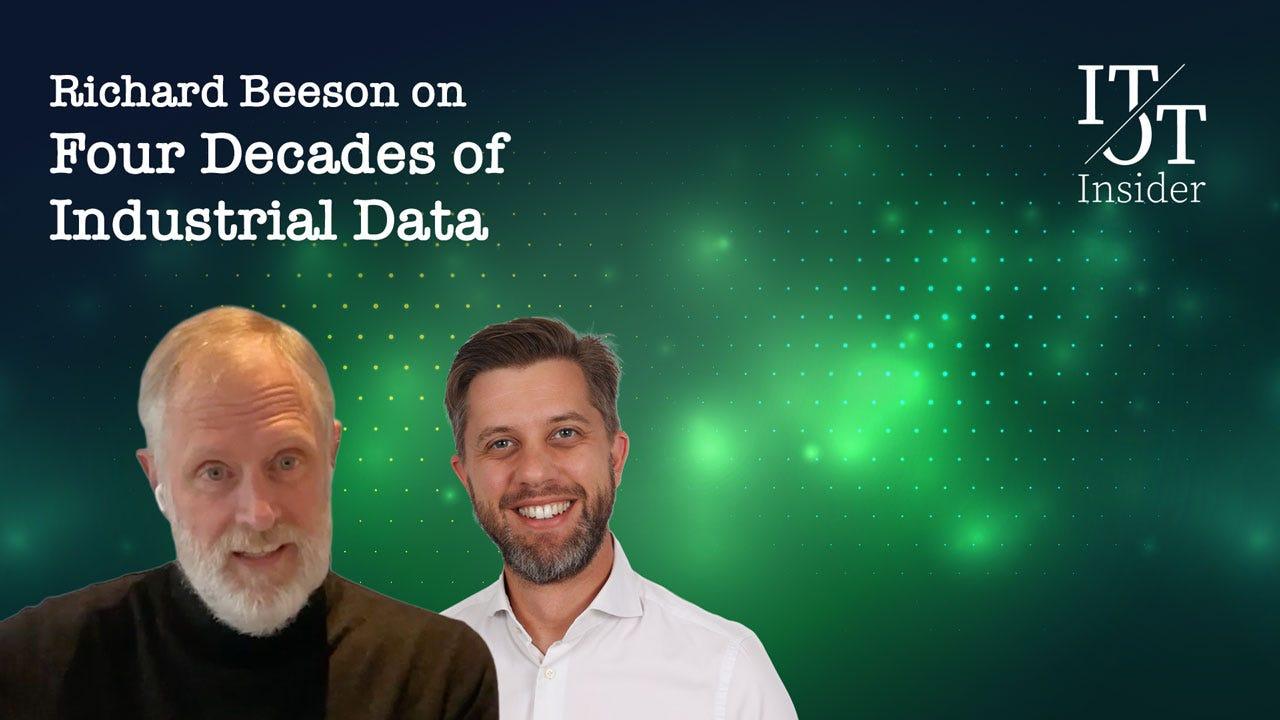
Richard Beeson wrote one of the two forewords to our IT/OT Handbook. Our book launches on 6 October, so having him on the podcast now felt like the right way to close the loop.
What makes the pairing work is that our two foreword writers came at it from opposite ends. Richard brought the OT-first perspective, John Smart the IT-first one. Different starting points, different vocabulary, but… they end up in more or less the same place.
Richard describes himself as “a chemical engineer gone bad”. In 1990 he joined a company called Oil Systems Incorporated (yes, that is indeed OSIsoft). About ten people at the time. He’d spend the next three decades there, eventually as CTO, watching the PI System absorb every technology transition the industry threw at it.
The origin story of PI is a customer who wasn’t paying attention
Before PI was a product, OSIsoft sold optimisation consulting to refineries. A customer asked them to prove the before and the after. So the team captured all the data, went back, and presented how much better things were running.
Thanks for reading The IT/OT Insider! Subscribe for free to receive new posts and support our work.
The customer barely looked at the slides. They were staring at the data. The history. The comparison.
“That’s what they are valuing here,” Pat Kennedy realised. And the business pivoted. Richard’s summary is the kind of thing that sounds trite until you notice how rarely it happens: “It’s amazing. If you just listen to customers, it’s amazing.”
The bet on seven platforms nobody ended up wanting
By 1991, PI 2 ran on VMS and the business world had decided that open systems were the future. Which in practice meant Sun’s Unix, IBM’s Unix, HP’s Unix and Digital’s Unix — “which were not compatible in any way, shape or form.”
So they built PI 3 for seven platforms. Then Bill Gates came to San Francisco, Windows NT joined the stack, and within a couple of years nobody was asking for the Unix versions at all.
Wasted effort? Not quite.
“We couldn’t have even gone to the table and had that discussion and let that unfold if we weren’t able to bring those other things to the table. They wouldn’t have been allowed to sit down with us.”
Worth sitting with that one, because we’re watching the same film again. After two decades of Windows monoculture in OT, the first question on new installations now is: can it run on Linux? Can we containerise it? Can we move it across hardware?
Every model you build creates the next barrier
Let’s go to context!
Asset Framework, Richard explained, was never really about hierarchies. It was designed as an abstraction to enable model-driven analytics: how do you write a yield calculation, a material balance, an energy balance that works on a plant you’ve never seen? To do that, you need a model of the plant rich enough for the analysis to interrogate.
The graph-like and process-modelling capabilities were in there early on. Most of it didn’t survive contact with the market. “The parts that survived were the parts that were approachable,” he said, “and where you could maybe drive some quick wins, some quick value.”
Too early? Badly sold? Or simply too heavy a lift for the number of problems that justified it? Probably all three. Richard calls it the activation energy problem: as long as there’s a big climb before the first point of value, it’s a hard sell. Really, really hard.
And the problem doesn’t go away by modelling harder. It recurses. “Every single time that you define the thing, you’re creating the new barrier, the next barrier, the next impasse, because there’s always going to be some other way to conceive of it or shape it or label it or reference it.”
David has a story from exactly this. Trying to build the business case for a basic asset hierarchy at BASF, he pitched a plant manager, who was unmoved: name any location in my plant and my operator will reel off the five nearest flow meters from memory. Which was true — and which was the signal that a big top-down contextualisation project was the wrong shape entirely.
AI hell
Richard has these ongoing flashbacks to spreadsheet hell. Not as an insult: spreadsheets solved real problems for real engineers who had no appetite for building a governance system first. That’s precisely why they metastasised.
“I think you give AI to OT and you are defining, creating the next version of spreadsheet hell. It’s AI hell.”
Who governs it? Who manages it? What happens when that person leaves? We’ve all met the spreadsheet with the button nobody can explain, still pressed every morning, its author three jobs gone. (The modern twist: you can now ask an LLM to reverse-engineer what the button does. Progress, of a sort.)
The stakes shift when the output isn’t a report but PLC or DCS code. Confident, plausible, and wrong is survivable in a weekend app. Less so when it runs a plant.
Richard’s closing frame is one we use ourselves: the arrival of electricity in factories. For years, plants simply swapped the steam or diesel engine driving the central shaft for an electric motor (same shaft, same belts, same layout) and wondered where the productivity gains were. It took a generation to realise you could put a small motor on every machine and rethink the whole floor.
“I think the transformation we’re going to see in OT is going to be a fundamental shift in not just how you do things, but even what you do. I think it’s going to be that disruptive — if we can survive getting there.”
Which brings us to the line that nearly became the episode title, and that David talked himself out of using:
“You can do dumb things a whole lot faster.”
We’re holding Richard to a follow-up session on AI and OT. If that’s a conversation you want to be in the room for, it’s exactly the sort of thing our new IT/OT Deep Dives are built for.
Stay Tuned for More!
🙋 Join the ITOT.Academy (2027 cohorts now online) →📘 Pre-order the IT/OT Handbook (+ claim the bonuses!) →
Subscribe to our podcast and blog to stay updated on the latest trends in Industrial Data, AI, and IT/OT convergence.
🚀 See you in the next episode!
Youtube: https://www.youtube.com/@TheITOTInsider Apple Podcasts:
Spotify Podcasts:
Disclaimer: The views and opinions expressed in this interview are those of the interviewee and do not necessarily reflect the official policy or position of The IT/OT Insider. This content is provided for informational purposes only and should not be seen as an endorsement by The IT/OT Insider of any products, services, or strategies discussed. We encourage our readers and listeners to consider the information presented and make their own informed decisions.
This is a public episode. If you would like to discuss this with other subscribers or get access to bonus episodes, visit itotinsider.substack.com