


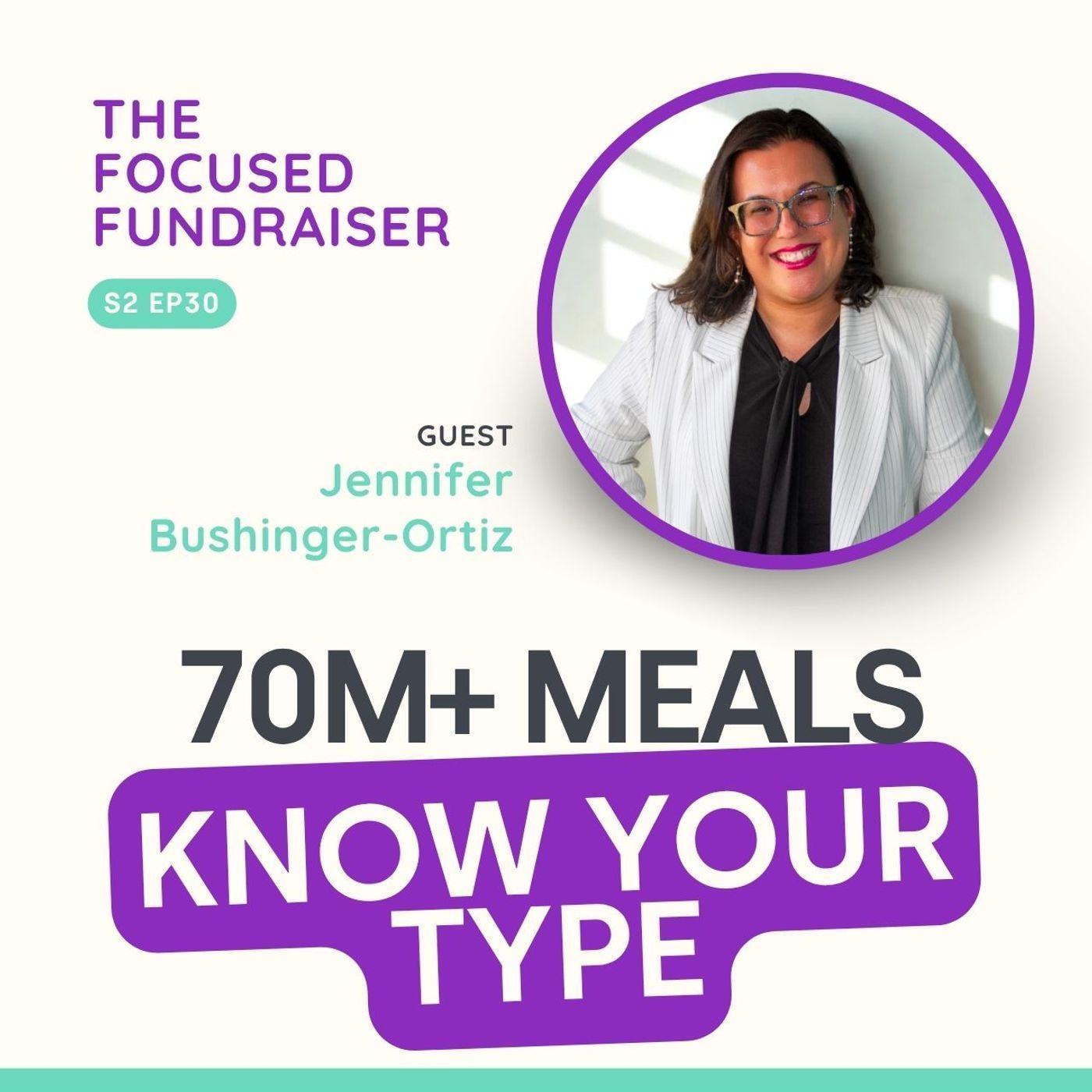
Rob Burke: Welcome to the Focused Fundraiser. This is where we spend time with seasoned fundraisers discussing what they've learned and giving you their hard-earned wisdom on what moves a mission forward. Because something that we believe is doing more doesn't always lead to success, but focusing on what matters most does. And today I am talking with Jennifer Bushinger Oritz. I I Ortz. Okay, let's pause there. I'm gonna I'm gonna
Jennifer Bushinger-Ortiz: Okay.
Rob Burke: record the or like edit this recording. How do you say your last name? I forgot to ask you.
Jennifer Bushinger-Ortiz: Pushing her or tease.
Rob Burke: Bushinger Ortiz. Okay. Awesome. And today I'm talking with Jennifer Bushinger-Ortiz, Director of Development at Move for Hunger, and her organization built one of the most creative food rescue models in the sector that I've seen. And it's capturing food people would otherwise toss when they move and turning it into Over 70 million meals already. So Jennifer has spent nearly two decades raising money for missions like this. And we're going to dig into what actually works when you're funding a cause that most donors have never heard framed quite this way. So Jennifer, welcome. Start us off by sharing a bit about yourself and your path into the nonprofit sector.
Jennifer Bushinger-Ortiz: Thank you so much, Rob, for having me. I'm super excited to be here. I think when you meet anyone in the development world, none of us ⁓ took the traditional path. Very few of us actually went to the Lily School of Philanthropy and grew up wanting to be fundraisers, and we all came here through a variety of paths. I fell into it just like so many, but really my career started in theater. And I didn't even realize that what I was doing over two decades ago was actually fundraising. Right. While I was in college in Bloomsburg University of Pennsylvania, my friends and I wanted to mount our own productions in the summer. And we had to fundraise enough to be able to rent out the back of the coffee shop that had the little ⁓ thrust stage. We had to raise enough for rights and costumes and props and hopefully break even to, you know, go out. To eat after the run was closed and I didn't even realize that that would have set me up for where I am on this career journey today.
Rob Burke: That's amazing. So w you've been you've worked across ⁓ multiple areas in this sector. Tell me a little bit about your history.
Jennifer Bushinger-Ortiz: Yeah, so like I mentioned how I started in theater ⁓ on and off stage and then teaching children's theater. ⁓ toured the country with a traveling educational theater company and spent two years on the road and did 42 out of the 50 states. And then that was exhausting, right? You already kind of live a thousand lives there. So from on stage and offstage, kind of transitioned into educational theater and then kind of administrative side. And then Kind of started making my way through the nonprofit world. ⁓ spent a little over six years with a developmental disabilities nonprofit. I've spent time with Parkinson's, and here I am two and a half years now in the food insecurity and food recovery space here at Move for Hunger. So for me, I can get behind a mission that I truly believe in. ⁓ the work is the same. We are chief storytellers and connecting donors' passions to our missions and helping fuel those overall objectives. ⁓ and I absolutely love what I get to do every single day.
Rob Burke: Yeah, let's you mentioned storytelling. We're gonna I'm gonna ask you about that ⁓ here in a little bit, but tell us more about Move for Hunger. So that you guys fund work mostly through corporate partners, moving companies, multifamily properties, is that correct? Instead of leaning in individual donors. So I I'm curious to know ⁓ fundraisers who hear corporate partnerships, who maybe lean into the individual donor pool more. ⁓ what does relationship actually?
Jennifer Bushinger-Ortiz: Yeah. You know, it's it's so interesting, and I think ⁓ a lot of this is gonna like hearken back to like my my theater days, but one of the first lessons that I learned is know your type, right? And I know for a fact I am not gonna be the ingenue, I'm the quirky best friend. So you enter into these relationships knowing your strengths and playing those up. Move for Hunger was born on the back of a moving truck. ⁓ our founder and executive director, Adam Lowy, his family owns a hundred-year-old moving company. So he grew up watching people throw out the contents of their pantries as they're packing up their lives. It's the last thing, the tedious, the heaviest. You just kind of want to close the proverbial pantry door on that chapter and leave. And it was the first space that you can kind of see. Inability to recover food and minimize that food waste. So he started asking people, can I donate that food when you move? And in one month, collected over 300 pounds of food. That was 2009. Here we are in 2026, 17 years later, and it is our most impactful year to date, and we're only seven months in, and our team has transported more than 17 million pounds of food to food banks and pantries across the US and Canada. So to kind of answer your question of how do you kind of invest in corporate when individuals is traditionally where it is at other nonprofits, we were always people powered. We have a tremendous network and that is our strength, right? So that is very much knowing your type. When we were founded, Adam said we're one moving company, but we're friends with all these other moving companies. And then all of those moving companies are traditionally a part of a van line, which is a larger network, and then a larger network, and it kind of just grows from there. So really, Move for Hunger mobilized a movement where we started with this donate your food when you move model and working our way across countless moving and transportation companies. Now we're over more than 1,400 moving in transportation companies that are helping with those food recovery efforts every single day. I mentioned 17 million pounds of food, and we don't own or operate a single truck. We purely are people powered and rely on the commitment and belief and generosity of that network. So for us, it is really playing up to our strengths of having kind of a ⁓ corporate first model and the individual giving more traditional philanthropy. Not that it's an afterthought, but now we have a captive audience of companies and their team members. members and how do we leverage that into supporting our mission and fueling it forward.
Rob Burke: So you you threw out some big numbers there of pounds of food. We talk I I mentioned 70 million meals. big numbers are rarely connecting points for humans because we can't really ⁓ quantify them in our brains of like what does this actually mean from an impact standpoint. I'm curious to know your thoughts on how do you break that down into ⁓ stories and statistics that really move people to drive them to donate and be a part of this.
Jennifer Bushinger-Ortiz: I think that's a fantastic question. And ⁓ honestly, I still think two and a half years in is still my personal largest Achilles heel in where I kind of beat down my own ability to achieve success, right? our impact is not like others. We're moving things that are large tractor trailer loads of food, and you're like Great, you just moved 50,000 pounds of potatoes. What does that mean? What am I doing with that? And people can't also conceptualize what that is. So, and we are not then distributing it out. So I don't have the firsthand accounts of Sally, the single mom, struggling to make ends meet, or Mark, the Dad, who is working three jobs and having to make a really difficult choice between rent and groceries to support the family. ⁓ we don't have those stories that comes from the food bank. So, Move for Hunger, we've really put the food at the center of it as the hero of our stories. ⁓ we actually did ⁓ this really exciting campaign last year called Operation Fruit Cup. And it was telling the story of how our team recovered and transported more than 35,000 pounds of fruit cups. But again, where we sit in the food recovery and kind of food ecosystem is this bridge. We are the bridge between an opportunity of food that exists, needing to find a home. And then the food banks and pantries who have the ability to get that out to communities in need. And then we have that transportation to be able to bridge that gap and get it to them. ⁓ but we've kind of found success in talking about the food waste and putting the food at the hero. Of the story, as well as ⁓ our partners that move that food day in and day out. Because again, we don't own or operate a single truck. We couldn't do what we do if it wasn't for them, and so many of those loads are actually donated transports. last year it was a little over 74 percent of. All of the 15 million pounds of food we moved in 2025 was donated. This year, with the rise in fuel prices and the kind of volatility that is surrounding that, ⁓ we're seeing it at about more of 60 percent, but still, 60% of donated loads for the 17 million pounds of food is no small feat and is a testament to that kind of culture of philanthropy that we've built within our corporate network.
Rob Burke: Yeah, ⁓ you mentioned something I think that's interesting to talk about too, which is you guys food f ⁓ move for hunger's ⁓ pitch depends on two ideas really, fighting hunger, but also cutting food waste. So ⁓ there's two there's two in some ways competing missions here. And a lot of nonprofits struggle to hold more than one message. Or not not competing missions, messages. How do you keep a dual message sharp instead of confusing? How do you bring those two together?
Jennifer Bushinger-Ortiz: And I think to just kind of add even more complicated layers to that, I think it's going to even depend what industry we're talking to because it's going to have different different things are gonna resonate with those industries. we have some that are in the let's say moving and transportation space, they very much care about the environmental impact. So they care about the food waste. How many loads are they ensuring? How many loads are they transporting? What's the poundage? What are the CO2 emissions that by them saving it and bringing it to that food bank on our behalf it's now not going to a landfill because the reality is in the US we don't have a food ⁓ creation problem. We have an access and waste problem where 38% of perfectly good food winds up in landfills. So you have some that really care about that environmental impact and you're gonna talk to them a little differently when you take those stages and you're in those rooms. And then you have others that very much care about data. And impact and how is this helping me? And I think another challenge, too, because we are a national nonprofit. ⁓ and a lot of people care about how you are helping and impacting my backyard. But the reality is we are one human community, and as much as we can help every single one of those neighborhoods, some may get a little more attention than others, and that has to be okay because at the end of the day, we need to make sure that that food is reaching people in need and not being diverted to landfills, further impacting our kind of climate and global crisis.
Rob Burke: So donor doc as a CRM, you're speaking my love language of segmentation, right? You're talk you're talking about segmenting your message to the right audience at the right time. How do you guys go about that? How do you know when you're walking into a room which story you're supposed to be telling? Do you guys use data really heavily to segment and know beforehand? Yeah.
Jennifer Bushinger-Ortiz: Yes. ⁓ so I think it'd be two different things. I think if we're in person and we are in their space 'cause we do a lot of travel. We are fully remote and national so Our model is we go to where you are because we're not bringing you all together for your kind of annual gala. We're putting on roughly close to a hundred galas throughout the year. We're coming to you. So when we're coming to you, our team already is doing that research before entering the space. We know that audience, we know what they're going to care about. ⁓ and then we kind of find that alignment based on that pitch of who's in that room. If it's a more generalized appeal. So, like we just wrapped our largest matching gift campaign in Moo for Hunger's history. ⁓ shout out and special thanks to the Albertsons companies. We were ⁓ one of about 11 nonprofits in the food and security space that had an opportunity to match gifts up to $250,000 in a one-week window for their Nourish the American Dream campaign. So in an appeal like that where we're using segments a little differently, ⁓ I'm speaking very differently to a laps donor versus C suite of a particular industry. So collaboration between develop it development and marketing to be able to look at all of those lists, who we want. in each of those lists. There's also exclusions that you have to think about too. I already have an upcoming campaign with XYZ. We don't want to add to donor fatigue in any way. So I think it's a mix of research, conversations, and collaboration. Collaboration.
Rob Burke: That's good. I love that. So ⁓ you just mentioned a really big campaign that you guys did. You also have done a campaign tied to Guinness World Record with a huge number of meals and and money raised. ⁓ fundraisers are told to make asks concrete, which those sound very concrete. But an event like those, those large events, they can carry risk. How do you decide when to make a big attention grabbing campaign like that worth the effort versus straightforward, ongoing smaller campaigns like your ⁓ Yeah.
Jennifer Bushinger-Ortiz: Yeah, I think it's a balance and it's gonna kind of come down to your annual development plan and making sure that you're doing everything that you're doing is moving that needle towards your annual goals. ⁓ what I'll say though is Move for Hunger loves the big risky events because it allows us to raise awareness at a scale that you wouldn't be able to achieve. even with the most amount of marketing dollars behind a traditional appeal. ⁓ and it comes to having leadership that is w willing to invest in risk and say, let's take that opportunity. ⁓ and then we're always constantly checking in on those goals and and things across the board. So we definitely do things that would scare others. So you mentioned the Guinness World Record. ⁓ We set that world record. I was two weeks on the job. when I got offered to join the team at Move for Hunger, it was very much we're gonna have to already book your flight. You'll be joining us in Detroit. And it was learn as we go, but it was the most tremendous experience. What I what I loved most about it was I didn't know. We were talking earlier about big numbers and things like that. And you don't know what 15,000 boxes of cereal looks like. Until you see it fill up the entire Detroit Pistons practice arena. And it's getting unloaded out of palette by palette by palette out of multiple trucks. And you're like, please, no more cereal. ⁓ and then when you see it at scale, the fact that it took our team plus an army of close to a hundred volunteers ⁓ to set up the domino run to set the Guinness World Record and then clean it all up. And then the next morning to have the privilege to take it to two different food banks in the Detroit area. That was mission in action. But even in all the data, all the research I done before even joining the team, I could not conceptualize what 15,000 boxes of cereal would look like. So I think that we have found our niche of these big splashy events because it is a way to raise awareness. ⁓ And funds, but awareness and grow our network at a scale that you may not traditionally achieve by a typical gala or a five K or a charity golf tournament.
Rob Burke: Hmm. That's ⁓ fantastic advice, right? Is leadership needs to be bought in for these high risk pieces. Otherwise, if I I would imagine you guys do some that may not be as successful. And when those happen, you still need to be able to pivot and move to the next one. ⁓ so let's get controversial on this. What's a fundraising tactic that everyone in the sector swears by that you think is overrated or flat out doesn't work anymore?
Jennifer Bushinger-Ortiz: you know, especially because ⁓ you know, I'm I'm remote now. I'm not in living rooms anymore, right? So it's not the same. ⁓ so I think that we as fundraisers need to know our organization and what makes our organization tick and move and our supporters tick and move. And not necessarily what makes us comfortable because we grew up as the traditional philanthropist. And don't get me wrong, I in many ways I am that traditional fundraiser. I'm bringing some of those data points consistently to the team. We're we're looking, you know, we're still doing appeals, we're still doing some of those pieces, but I think willing to step outside of your comfort zone is something that Most not even in development, I think in any industry are not gonna be comfortable with. So I think COVID, if COVID taught us anything that we have to adapt and we have to adapt quickly, and then we have to analyze while the train is moving at full speed, right? ⁓ whether your major fundraising event gets canceled for whatever reason, you lose the building, there's an emergency, ⁓ whether you lose very large gift for any reason whatsoever. Funders and grantors change priorities, but I think there is no more one size model to meet your revenue goals sustainably. Even with the most robust individual giving base or grant pipeline. ⁓ If you are not diversifying and willing to try things and learn from them and get creative, ⁓ you're gonna hit your ceiling.
Rob Burke: That is fantastic advice. I couldn't agree more. Diversification on for profit and non profit is a huge piece. When too much of ⁓ your revenue and your sustainability is in one bucket, if that bucket disappears, then you're you know, you're up the creek a little bit. So
Jennifer Bushinger-Ortiz: Mm-hmm.
Rob Burke: Jennifer, I always end with ⁓ what I call the tactical takeaway question, something very pragmatic, practical that a fundraiser can do today to move the needle for them and their org. So, but the question is to you, what is one thing that every fundraiser should do today that you believe matters most?
Jennifer Bushinger-Ortiz: Okay, can I answer that in two parts? I feel like the first thing you should do personally is make sure that you are constantly learning. You are constantly seeking out new information, new resources, new trainings, new webinars. If you're not a member of your local AFP chapter ⁓ or charitable gift planners or any of those membership associations, Not only are they providing you the tools to the castle for success to hit your goals, but it's also going to give you a network of professional colleagues that you can go to for very particular things. So that would be on the personal side. And then I think on the professional side, ⁓ listen to your gut. And even when the answer will be no from others across the team or your board or you know a a fundraising committee or anything of that sort, ⁓ you should be able to back up your why and that I think is the most important piece of it. But to do that, you have to have looked at a problem from every side, poked the holes in every way that you can, make sure that that boat is not taking on water. And then you've got an airtight case.
Rob Burke: Fantastic advice. I think the takeaway from this conversation with you, Jennifer, is to stop living in the scarcity mindset and to step out boldly with big ideas and give y give it your all and have a really solid foundation, like you said. Make sure that you know your numbers and that there is a a solid boat below you, but to step out boldly. I love that. Thank you. And if those listening want to connect with you, how can they do that?
Jennifer Bushinger-Ortiz: ⁓ definitely connect with me on LinkedIn, but please also Move for Hunger is on all of the social channels. So follow us at Move for Hunger or visit our website. But I'd love to connect and even set up a virtual coffee with anyone on LinkedIn.
Rob Burke: fantastic. And if you are those that are listening are curious about how DonorDock can help you find clarity, build retention through what we call smart stewardship, you can visit us at donordock.com to learn more. And we will see you next week.
Jennifer Bushinger-Ortiz: Awesome. Thank you so much for having me, Rob.
Jennifer Bushinger-Ortiz: Okay.
Rob Burke: record the or like edit this recording. How do you say your last name? I forgot to ask you.
Jennifer Bushinger-Ortiz: Pushing her or tease.
Rob Burke: Bushinger Ortiz. Okay. Awesome. And today I'm talking with Jennifer Bushinger-Ortiz, Director of Development at Move for Hunger, and her organization built one of the most creative food rescue models in the sector that I've seen. And it's capturing food people would otherwise toss when they move and turning it into Over 70 million meals already. So Jennifer has spent nearly two decades raising money for missions like this. And we're going to dig into what actually works when you're funding a cause that most donors have never heard framed quite this way. So Jennifer, welcome. Start us off by sharing a bit about yourself and your path into the nonprofit sector.
Jennifer Bushinger-Ortiz: Thank you so much, Rob, for having me. I'm super excited to be here. I think when you meet anyone in the development world, none of us ⁓ took the traditional path. Very few of us actually went to the Lily School of Philanthropy and grew up wanting to be fundraisers, and we all came here through a variety of paths. I fell into it just like so many, but really my career started in theater. And I didn't even realize that what I was doing over two decades ago was actually fundraising. Right. While I was in college in Bloomsburg University of Pennsylvania, my friends and I wanted to mount our own productions in the summer. And we had to fundraise enough to be able to rent out the back of the coffee shop that had the little ⁓ thrust stage. We had to raise enough for rights and costumes and props and hopefully break even to, you know, go out. To eat after the run was closed and I didn't even realize that that would have set me up for where I am on this career journey today.
Rob Burke: That's amazing. So w you've been you've worked across ⁓ multiple areas in this sector. Tell me a little bit about your history.
Jennifer Bushinger-Ortiz: Yeah, so like I mentioned how I started in theater ⁓ on and off stage and then teaching children's theater. ⁓ toured the country with a traveling educational theater company and spent two years on the road and did 42 out of the 50 states. And then that was exhausting, right? You already kind of live a thousand lives there. So from on stage and offstage, kind of transitioned into educational theater and then kind of administrative side. And then Kind of started making my way through the nonprofit world. ⁓ spent a little over six years with a developmental disabilities nonprofit. I've spent time with Parkinson's, and here I am two and a half years now in the food insecurity and food recovery space here at Move for Hunger. So for me, I can get behind a mission that I truly believe in. ⁓ the work is the same. We are chief storytellers and connecting donors' passions to our missions and helping fuel those overall objectives. ⁓ and I absolutely love what I get to do every single day.
Rob Burke: Yeah, let's you mentioned storytelling. We're gonna I'm gonna ask you about that ⁓ here in a little bit, but tell us more about Move for Hunger. So that you guys fund work mostly through corporate partners, moving companies, multifamily properties, is that correct? Instead of leaning in individual donors. So I I'm curious to know ⁓ fundraisers who hear corporate partnerships, who maybe lean into the individual donor pool more. ⁓ what does relationship actually?
Jennifer Bushinger-Ortiz: Yeah. You know, it's it's so interesting, and I think ⁓ a lot of this is gonna like hearken back to like my my theater days, but one of the first lessons that I learned is know your type, right? And I know for a fact I am not gonna be the ingenue, I'm the quirky best friend. So you enter into these relationships knowing your strengths and playing those up. Move for Hunger was born on the back of a moving truck. ⁓ our founder and executive director, Adam Lowy, his family owns a hundred-year-old moving company. So he grew up watching people throw out the contents of their pantries as they're packing up their lives. It's the last thing, the tedious, the heaviest. You just kind of want to close the proverbial pantry door on that chapter and leave. And it was the first space that you can kind of see. Inability to recover food and minimize that food waste. So he started asking people, can I donate that food when you move? And in one month, collected over 300 pounds of food. That was 2009. Here we are in 2026, 17 years later, and it is our most impactful year to date, and we're only seven months in, and our team has transported more than 17 million pounds of food to food banks and pantries across the US and Canada. So to kind of answer your question of how do you kind of invest in corporate when individuals is traditionally where it is at other nonprofits, we were always people powered. We have a tremendous network and that is our strength, right? So that is very much knowing your type. When we were founded, Adam said we're one moving company, but we're friends with all these other moving companies. And then all of those moving companies are traditionally a part of a van line, which is a larger network, and then a larger network, and it kind of just grows from there. So really, Move for Hunger mobilized a movement where we started with this donate your food when you move model and working our way across countless moving and transportation companies. Now we're over more than 1,400 moving in transportation companies that are helping with those food recovery efforts every single day. I mentioned 17 million pounds of food, and we don't own or operate a single truck. We purely are people powered and rely on the commitment and belief and generosity of that network. So for us, it is really playing up to our strengths of having kind of a ⁓ corporate first model and the individual giving more traditional philanthropy. Not that it's an afterthought, but now we have a captive audience of companies and their team members. members and how do we leverage that into supporting our mission and fueling it forward.
Rob Burke: So you you threw out some big numbers there of pounds of food. We talk I I mentioned 70 million meals. big numbers are rarely connecting points for humans because we can't really ⁓ quantify them in our brains of like what does this actually mean from an impact standpoint. I'm curious to know your thoughts on how do you break that down into ⁓ stories and statistics that really move people to drive them to donate and be a part of this.
Jennifer Bushinger-Ortiz: I think that's a fantastic question. And ⁓ honestly, I still think two and a half years in is still my personal largest Achilles heel in where I kind of beat down my own ability to achieve success, right? our impact is not like others. We're moving things that are large tractor trailer loads of food, and you're like Great, you just moved 50,000 pounds of potatoes. What does that mean? What am I doing with that? And people can't also conceptualize what that is. So, and we are not then distributing it out. So I don't have the firsthand accounts of Sally, the single mom, struggling to make ends meet, or Mark, the Dad, who is working three jobs and having to make a really difficult choice between rent and groceries to support the family. ⁓ we don't have those stories that comes from the food bank. So, Move for Hunger, we've really put the food at the center of it as the hero of our stories. ⁓ we actually did ⁓ this really exciting campaign last year called Operation Fruit Cup. And it was telling the story of how our team recovered and transported more than 35,000 pounds of fruit cups. But again, where we sit in the food recovery and kind of food ecosystem is this bridge. We are the bridge between an opportunity of food that exists, needing to find a home. And then the food banks and pantries who have the ability to get that out to communities in need. And then we have that transportation to be able to bridge that gap and get it to them. ⁓ but we've kind of found success in talking about the food waste and putting the food at the hero. Of the story, as well as ⁓ our partners that move that food day in and day out. Because again, we don't own or operate a single truck. We couldn't do what we do if it wasn't for them, and so many of those loads are actually donated transports. last year it was a little over 74 percent of. All of the 15 million pounds of food we moved in 2025 was donated. This year, with the rise in fuel prices and the kind of volatility that is surrounding that, ⁓ we're seeing it at about more of 60 percent, but still, 60% of donated loads for the 17 million pounds of food is no small feat and is a testament to that kind of culture of philanthropy that we've built within our corporate network.
Rob Burke: Yeah, ⁓ you mentioned something I think that's interesting to talk about too, which is you guys food f ⁓ move for hunger's ⁓ pitch depends on two ideas really, fighting hunger, but also cutting food waste. So ⁓ there's two there's two in some ways competing missions here. And a lot of nonprofits struggle to hold more than one message. Or not not competing missions, messages. How do you keep a dual message sharp instead of confusing? How do you bring those two together?
Jennifer Bushinger-Ortiz: And I think to just kind of add even more complicated layers to that, I think it's going to even depend what industry we're talking to because it's going to have different different things are gonna resonate with those industries. we have some that are in the let's say moving and transportation space, they very much care about the environmental impact. So they care about the food waste. How many loads are they ensuring? How many loads are they transporting? What's the poundage? What are the CO2 emissions that by them saving it and bringing it to that food bank on our behalf it's now not going to a landfill because the reality is in the US we don't have a food ⁓ creation problem. We have an access and waste problem where 38% of perfectly good food winds up in landfills. So you have some that really care about that environmental impact and you're gonna talk to them a little differently when you take those stages and you're in those rooms. And then you have others that very much care about data. And impact and how is this helping me? And I think another challenge, too, because we are a national nonprofit. ⁓ and a lot of people care about how you are helping and impacting my backyard. But the reality is we are one human community, and as much as we can help every single one of those neighborhoods, some may get a little more attention than others, and that has to be okay because at the end of the day, we need to make sure that that food is reaching people in need and not being diverted to landfills, further impacting our kind of climate and global crisis.
Rob Burke: So donor doc as a CRM, you're speaking my love language of segmentation, right? You're talk you're talking about segmenting your message to the right audience at the right time. How do you guys go about that? How do you know when you're walking into a room which story you're supposed to be telling? Do you guys use data really heavily to segment and know beforehand? Yeah.
Jennifer Bushinger-Ortiz: Yes. ⁓ so I think it'd be two different things. I think if we're in person and we are in their space 'cause we do a lot of travel. We are fully remote and national so Our model is we go to where you are because we're not bringing you all together for your kind of annual gala. We're putting on roughly close to a hundred galas throughout the year. We're coming to you. So when we're coming to you, our team already is doing that research before entering the space. We know that audience, we know what they're going to care about. ⁓ and then we kind of find that alignment based on that pitch of who's in that room. If it's a more generalized appeal. So, like we just wrapped our largest matching gift campaign in Moo for Hunger's history. ⁓ shout out and special thanks to the Albertsons companies. We were ⁓ one of about 11 nonprofits in the food and security space that had an opportunity to match gifts up to $250,000 in a one-week window for their Nourish the American Dream campaign. So in an appeal like that where we're using segments a little differently, ⁓ I'm speaking very differently to a laps donor versus C suite of a particular industry. So collaboration between develop it development and marketing to be able to look at all of those lists, who we want. in each of those lists. There's also exclusions that you have to think about too. I already have an upcoming campaign with XYZ. We don't want to add to donor fatigue in any way. So I think it's a mix of research, conversations, and collaboration. Collaboration.
Rob Burke: That's good. I love that. So ⁓ you just mentioned a really big campaign that you guys did. You also have done a campaign tied to Guinness World Record with a huge number of meals and and money raised. ⁓ fundraisers are told to make asks concrete, which those sound very concrete. But an event like those, those large events, they can carry risk. How do you decide when to make a big attention grabbing campaign like that worth the effort versus straightforward, ongoing smaller campaigns like your ⁓ Yeah.
Jennifer Bushinger-Ortiz: Yeah, I think it's a balance and it's gonna kind of come down to your annual development plan and making sure that you're doing everything that you're doing is moving that needle towards your annual goals. ⁓ what I'll say though is Move for Hunger loves the big risky events because it allows us to raise awareness at a scale that you wouldn't be able to achieve. even with the most amount of marketing dollars behind a traditional appeal. ⁓ and it comes to having leadership that is w willing to invest in risk and say, let's take that opportunity. ⁓ and then we're always constantly checking in on those goals and and things across the board. So we definitely do things that would scare others. So you mentioned the Guinness World Record. ⁓ We set that world record. I was two weeks on the job. when I got offered to join the team at Move for Hunger, it was very much we're gonna have to already book your flight. You'll be joining us in Detroit. And it was learn as we go, but it was the most tremendous experience. What I what I loved most about it was I didn't know. We were talking earlier about big numbers and things like that. And you don't know what 15,000 boxes of cereal looks like. Until you see it fill up the entire Detroit Pistons practice arena. And it's getting unloaded out of palette by palette by palette out of multiple trucks. And you're like, please, no more cereal. ⁓ and then when you see it at scale, the fact that it took our team plus an army of close to a hundred volunteers ⁓ to set up the domino run to set the Guinness World Record and then clean it all up. And then the next morning to have the privilege to take it to two different food banks in the Detroit area. That was mission in action. But even in all the data, all the research I done before even joining the team, I could not conceptualize what 15,000 boxes of cereal would look like. So I think that we have found our niche of these big splashy events because it is a way to raise awareness. ⁓ And funds, but awareness and grow our network at a scale that you may not traditionally achieve by a typical gala or a five K or a charity golf tournament.
Rob Burke: Hmm. That's ⁓ fantastic advice, right? Is leadership needs to be bought in for these high risk pieces. Otherwise, if I I would imagine you guys do some that may not be as successful. And when those happen, you still need to be able to pivot and move to the next one. ⁓ so let's get controversial on this. What's a fundraising tactic that everyone in the sector swears by that you think is overrated or flat out doesn't work anymore?
Jennifer Bushinger-Ortiz: you know, especially because ⁓ you know, I'm I'm remote now. I'm not in living rooms anymore, right? So it's not the same. ⁓ so I think that we as fundraisers need to know our organization and what makes our organization tick and move and our supporters tick and move. And not necessarily what makes us comfortable because we grew up as the traditional philanthropist. And don't get me wrong, I in many ways I am that traditional fundraiser. I'm bringing some of those data points consistently to the team. We're we're looking, you know, we're still doing appeals, we're still doing some of those pieces, but I think willing to step outside of your comfort zone is something that Most not even in development, I think in any industry are not gonna be comfortable with. So I think COVID, if COVID taught us anything that we have to adapt and we have to adapt quickly, and then we have to analyze while the train is moving at full speed, right? ⁓ whether your major fundraising event gets canceled for whatever reason, you lose the building, there's an emergency, ⁓ whether you lose very large gift for any reason whatsoever. Funders and grantors change priorities, but I think there is no more one size model to meet your revenue goals sustainably. Even with the most robust individual giving base or grant pipeline. ⁓ If you are not diversifying and willing to try things and learn from them and get creative, ⁓ you're gonna hit your ceiling.
Rob Burke: That is fantastic advice. I couldn't agree more. Diversification on for profit and non profit is a huge piece. When too much of ⁓ your revenue and your sustainability is in one bucket, if that bucket disappears, then you're you know, you're up the creek a little bit. So
Jennifer Bushinger-Ortiz: Mm-hmm.
Rob Burke: Jennifer, I always end with ⁓ what I call the tactical takeaway question, something very pragmatic, practical that a fundraiser can do today to move the needle for them and their org. So, but the question is to you, what is one thing that every fundraiser should do today that you believe matters most?
Jennifer Bushinger-Ortiz: Okay, can I answer that in two parts? I feel like the first thing you should do personally is make sure that you are constantly learning. You are constantly seeking out new information, new resources, new trainings, new webinars. If you're not a member of your local AFP chapter ⁓ or charitable gift planners or any of those membership associations, Not only are they providing you the tools to the castle for success to hit your goals, but it's also going to give you a network of professional colleagues that you can go to for very particular things. So that would be on the personal side. And then I think on the professional side, ⁓ listen to your gut. And even when the answer will be no from others across the team or your board or you know a a fundraising committee or anything of that sort, ⁓ you should be able to back up your why and that I think is the most important piece of it. But to do that, you have to have looked at a problem from every side, poked the holes in every way that you can, make sure that that boat is not taking on water. And then you've got an airtight case.
Rob Burke: Fantastic advice. I think the takeaway from this conversation with you, Jennifer, is to stop living in the scarcity mindset and to step out boldly with big ideas and give y give it your all and have a really solid foundation, like you said. Make sure that you know your numbers and that there is a a solid boat below you, but to step out boldly. I love that. Thank you. And if those listening want to connect with you, how can they do that?
Jennifer Bushinger-Ortiz: ⁓ definitely connect with me on LinkedIn, but please also Move for Hunger is on all of the social channels. So follow us at Move for Hunger or visit our website. But I'd love to connect and even set up a virtual coffee with anyone on LinkedIn.
Rob Burke: fantastic. And if you are those that are listening are curious about how DonorDock can help you find clarity, build retention through what we call smart stewardship, you can visit us at donordock.com to learn more. And we will see you next week.
Jennifer Bushinger-Ortiz: Awesome. Thank you so much for having me, Rob.
