
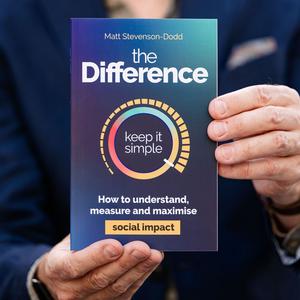

Matt: Welcome to The Difference, the podcast. I'm Matt Stevenson Dodd.
Helen: I'm Helen Gregg.
Matt: This podcast is all about taking a deeper dive into the stories and case studies contained in my book, The Difference, How to Understand, Measure and Maximise Social Impact. We want to get behind each of the case studies in the book, meet the people involved and find out about how amazing these organisations are and how they set out to understand, measure and maximise the difference they make in the world. And I should say, the difference is available to order in all good bookshops right now. So I am delighted to welcome our guest today, someone who's had a fantastic career in both the charity sector and the public sector and is deeply committed to social impact. James Blake, welcome.
James Blake: Good morning, Matt, and morning, Helen.
Matt: Good morning. James, thank you so much for joining us on the podcast and for providing a brilliant case study for the book. It's been a really important part of the book and I know we would like to get into that today.
Helen: we would like to start with our little game, which is Two Truths and a Lie. So over to you. Could you tell us your two truths and a lie, please?
James Blake: It's very exciting. It's a bit like being on Would I Lie to You? And I've always wanted
Matt: Thank
James Blake: to do that. But it's quite hard as well. OK, so here are three things then. First, I've been a roadie for a student rock band. The second is I've ice climbed, but I've never skied. And the third is I finished the Scottish Munroes on my 50th birthday and celebrated by hiring out a whole youth hostel.
Matt: you
Helen: Can I just clarify the first one? When you say you've been a roadie
James Blake: Yeah.
Helen: for a student rock band, does that mean you were also a student at the time or the rock band was students and this is something you could have done last week?
James Blake: It's something I could have done last week.
Matt: So James, just to maybe help our listeners slightly, could you give us a sort of 30 second background on your
James Blake: Yeah.
Matt: career and who you are?
James Blake: so I'm James. I've been Chief Executive of White Chain now since 2017. So just over eight years, incredible kind of period to do it. And I'm sure we'll come on to that. Before that, I had a career that was mainly in central government and local government. I actually started as a geographer. think I mean, that theme around people and places, probably something that's always kind of been part of my, my career. In fact, think the last three Chief Execs of White Chain have all been geographers one way or another. But so I did I did a bit of post grad research on basically the environmental values and the extent to which people how people express those and to what extent that then gets translated into pro environmental behavior. A few years later, it kind of got a bit absorbed into nudge theory, actually, for those listeners who know about that.
Matt: just
James Blake: But so I did that for a bit, but that wasn't going to pay the bills. So I went into central government on the graduate scheme and ended up in the Department of the Environment, but nothing to do with what I've been doing my research on. So I started off in water regulation, which actually has become quite topical now, but at the time was all about introduction of water metering. I did that for a bit, but then I moved into really focusing in two areas, neighbourhood renewal and social exclusion, mainly in the Blair and Brown government time. Really interesting period looking at how you deliver public services. for people who had the most need. And that for about 10 years. And then I went into local government initially as a kind of chief policy officer, but then as deputy chief exec and then chief exec of St. Albans Council, which is a district council in kind of Hertfordshire, it's where I lived. had a young family at the time. And again, that was really interesting because that was about how some of those bigger picture things you could deliver in place. And it was also about how you balance trying to deliver public benefit impact effectively, but also be more commercial at a time of austerity when a lot of the funding streams are running out. And I guess that was then something I've also taken into to IHA too. So yeah, I've been really fortunate, had a really interesting and diverse career.
Matt: That is really diverse, isn't it? There's a lot in there, but this theme of the environment and the theme of people, can see how it's come together in your YHA role.
Helen: So once you started at YHA then James, what was the pivotal moment that you felt we're not really doing enough on impact here? We're not getting to the nub of it. Was it a lightning bolt? Was it a gradual seeping?
James Blake: So there are really two points that I wanted to highlight, I guess, if I'm allowed to. mean, the first is actually really in my interview for the job, because one of the things I realized about YHA was it had the most fantastic impact. But when I joined, there'd been a lot of focus on YHA sorting itself out as a commercial businesses and a budget hospitality provider. And that was necessary to do, but we'd almost forgotten about the impact that we made. And about 40 % of our members, I think, didn't even know we were a charity at all. And that was true of partners and it was true of staff. for me, part of the attraction of coming to YHA was how do we put the Y back into YHA? How do we get that kind of social impact that really to the fore of what we were doing as a charity and as a social enterprise? that was really the... So that was the kind of first... point and I had a phase for two or three years where we were working on that with the board, this was before Covid, and we developed at that stage quite an expansionary strategy about putting YHA back on the map as a leading youth charity, leading national youth charity, and that was brilliant and of course we then got to publish that strategy on the 1st of March 2020 and actually I think this is in the book, Matt, because I then met you literally about a week, I think, before that. It about the last meeting I had, I think, before we went into lockdown, because the issue then was, well, how do you, how are we going to measure this wonderful new strategy? And we were starting to talk about the dimensions of our vision and mission that we might work on. And then about three weeks later, the world fell apart. And so it was some years before we could get back to it. And I guess, I mean, a of things are interesting there. I the first thing to say is that strategy was really helpful. The fact that we had it, we kept the board very quickly made a decision to keep that strategy in in Covid. So we still had that long-term focus on impact and that was really helpful when we were making decisions about you whether to turn left or right in Covid. Perhaps the best example is we had to make a decision, I remember it sitting in this room actually in our national office in Matlock, we had to make a decision about whether to refund people who booked school trips with us.
Matt: Yeah.
James Blake: I mean, I look back, I that was probably a 10 million pound decision. I don't think I realized it at the time, but we had a strategy that talked about the impact that we had on young people and families, on parents. And so that became an easy decision to make. We did that refund. mean, other organizations didn't, you know, so I think, yeah. So the strategy itself was really helpful, but we didn't at that point really get into the measurement of it. Or if we did, we only did so in terms of outputs, in terms of reach, how many young people were you affecting, how many trips did we have? And even there we were struggling to measure it well. And it was a sort of strategy which had a wonderful set of 10 priorities, but there were 10 priorities. And I think even if we haven't had COVID, we would have struggled to kind of to be able to deliver all of those priorities at once. And it was things like health and wellbeing and education and recreation and all of these amazing things. But I guess, you we weren't, as we then found out later, we perhaps weren't as specific about those as we as we might have been. And I guess that takes me to probably like the second point of realization, which was actually a board meeting we had in Oakhampton, which we have a partner hostel down in Oakhampton activity centre, we had a board meeting there. And this was really one of the first board meetings where we had everyone back face to face after Covid. So we must be sort of late 2022, I think, by now, around about then. And actually one of our board members who comes from a financial background, actually, but he said, so how do we know whether we're achieving our mission or not post Covid? And I thought, that's a good question. So I wanted to answer that as the chief executive of organisation. And I found I couldn't answer it really. I said, well, I can tell you how many people we've got coming. And it's fewer than before COVID, but it was like, well, but, you know, are we doing better or worse than we were before COVID? And I couldn't say. So actually that was the moment I thought we really ought to be able to answer that question. And I guess that combined at that point with a sense that we, you know, we needed to look again at as we came out of COVID at the strategy that we developed, not because the overall vision and ambition, long-term ambition was wrong. but because it wasn't clear enough. In a time where we suddenly had far less money, we'd actually had some success with government programmes and so on. But actually that sense of, okay, how do we navigate through this in a clearer way? And how can I actually answer that question to the board? We weren't able to do that in the way I would have liked. And so it was about that time that myself and one of my senior team at the time started to re-engage Matt with you. and the rest kind of took it on from there I think.
Matt: Yeah, I remember the initial conversation that we had. I mean, think, you faced as an organisation a particularly difficult set of circumstances in Covid, hadn't you? There was quite a lot of sort of things all coming at you at once, which then, you know, it was a good moment to sort of reassess, you know, what is the North Star? What are we trying to do? What is our purpose? And I remember coming along to the, with the board, wasn't it?
James Blake: That's right.
Matt: I think it was in Wales, in Conwy, Yes, beautiful view out of the window there. It's
James Blake: In Conway, yeah, in fact, yeah. A stunning view, yeah,
Matt: I remember being in that room and really asking the board whether you felt you were a social tourism business. a wellbeing charity or a youth charity. And there's lots of debate, isn't there, about which of those you might be and what combination. Can you remember that conversation?
James Blake: Yeah, I do. And I think you asked that question, I think, to the exec team, to our staff team. And it was really interesting question, actually, and stimulated a lot of discussion. And of course, probably we would have answered all of those things up to a point. And of course, we are. But that wasn't actually helpful then in terms of actually where do we focus our limited resources coming out of COVID? And what is then that kind of North Star that guides the decisions that we made. But up until that point, probably all of, everyone was quite happy with whatever their definition was. So there would have been a part of the organisation that would have definitely said we're in tourism and hospitality and there would be a part of the organisation that would have very much said that we're about well-being and then there might be another part that said we're about education or whatever it might be. So I think actually asking those questions was a sort key part to actually make us reflect on, know, well what really are we as an organisation?
Matt: Yeah. Yeah.
Helen: And it's interesting because having limited resources and trying to do too much is one of the most common themes we come across with the people we work with. got exercises that we can do with our clients around it. I'm interested because it's not in the book and it's not in the case study specifically, but where did you land on that question?
James Blake: Well, I guess we landed, that's an interesting one, we landed neither of, well, in none of those three places, but in a specific place that kind of cut across them, I would say. so we kind of, ended up in not in one single place, but in a way that kind of connected them. And I suppose the key point for me, and what I will talk about a lot when I talk about our strategy is that, you know, before we were, we would talk to a lot about the contribution we made to kind of health, wellbeing and life skills. And of course we do make a contribution to all of those, but we weren't. wasn't nearly specific enough about what is the thing that the YHA specifically, I suppose to every single organisation that largely contributes to health, wellbeing and life skills does. And that was about connection really, fundamentally between people, within people themselves, but also then to nature and to heritage. And I suppose the role that we had in our youth hostels in making that connection happen often for the first time and I suppose so you know there is a bit of social in there there is a bit of well-being in there etc but it's that it was the way in which we connect that and the role the youth hostel plays in connecting that I think there was the sort of eureka moment as we went through the process.
Matt: Yeah, I really distinctly remember that moment as well. we were trying to sort of work out, can we actually measure the impact of somebody being in a youth hostel and then going off and hanging off a viaduct or going to visit a castle or going for a lovely walk, you know, and those are activities that are delivered by your partners. You know, should we be asking those partners to share their impact with you? But then we had this sort of light bulb moment, didn't we? It was like, let's take it back. what is actually initiated inside the youth hostel? is that? And
James Blake: and
Matt: like you say, often for the first time, particularly with young people, particularly
James Blake: Yeah.
Matt: young people who've never been to the countryside, what
James Blake: Yeah, yeah.
Matt: is that thing that you do inside the YHA itself? And then there was a lovely moment about being purposeful about that. We were all sort of thinking, well, actually we could then do more to
James Blake: Yeah.
Matt: make the connections happen.
James Blake: Yeah, think that and that point is yeah that intentionality about about it was really really interesting, really helpful and actually that really helped the organisation come together because we clearly had, it wasn't that people, weren't delivering impact before, we were. Young people were coming away having an amazing time and having lives that were transformed as a result of staying with us, but we hadn't quite worked out what the magic was that was happening in a way and therefore how do we kind of replicate and repeat that and I think it was that sense of, well it is the work we do in our spaces and with our people. you know there aren't, if you're staying in a Premier Inn, you might have a great time, but you're not meeting people in a self-catering kitchen or in a lounge or in a games room, your kids aren't connecting with each other, you're not then having a conversation with others around what they did and how they enjoyed their day, you all of those sorts of things. you know, so there was a, there was a, way in which our spaces were and could be designed and enhanced was key to both facilitating connection within people in the hostel, but also then connection between people in the hostel and the outside environment, which is particularly the nature and the countryside, which is why YHA was set up in the first place, but also the heritage of cities as well. And I suppose what that's led us to be able to do is say, okay, well, look, this isn't rocket science, nor is it incredibly expensive. There are some really easy things that our staff can really get behind. that make a difference here. So, you know, what is the conversation we might have with someone when they check in, which might not be about just here's the key and here's the menu for the food. It might be about, well, why are you here? And actually, well, you know, what do you want to do? And here's some things that you can do. So it might be, you know, right start there. Then it can be about, you know, our staff coming into our self catering kitchens and just initiating a few conversations so to get people talking to each other. It might be people pointing out to families that other families are doing similar sorts of things. It might simply be, we've got a program now with Sport England on this, might be having very clearly marked different walking routes for a whole range of different people that are clearly in every hostel and that's a key intervention that we can make that we know has that impact on connecting to nature, et cetera. And these are things at a time when we were financially really strapped, One of the issues for us was I think a sense in the organisation from the operations side, my goodness, if we're to deliver impact, it's going to be some huge programme that's going to cost hundreds of thousands of pounds and we need to fund it. Not, we can do this with the people that we have every day in our hostels and I think that was a very powerful recommendation and it really helped the organisation come together because people realised, okay, we can do this, we can just build this onto the youth hostel operating model without needing a huge expense. So I think that was really helpful and powerful. And then it kind of led to a sense of, okay, right, I get this, that we can all kind of coalesce around this particular purpose. And I think one thing that's really interesting was when we were talking in our strategy about kind of health and wellbeing, mean, as well as it potentially meaning all things to all people, it just felt so intangible, I think, to people. So how do I help health and wellbeing? And people sort of thought, goodness, know, what do I need to do? Some kind of major sort of health and wellbeing program and actually I think what the work, I'm sure we might want to come onto this, but what the exercise really helped us with was, I think there are seven dimensions of wellbeing. We worked out what are the three dimensions of wellbeing that we particularly have an impact on, which were connection, confidence and belonging and those three things. And once you start talking about those, that's a connection to nature, as I was just saying, connection between people, the confidence, for people to do something different as a result of their stay in a hostel and belonging, which, you when we did the work, we particularly focused on feeling belonging inside the YHA. Actually, we've also expanded that a little to be about belonging in the environment within which the hostels are, because I think that's just kind of really interesting one for us. And that whole concept of belonging, I think, is kind of interesting one generally in society at the moment. and then again, people again could get their heads around that concept and they could get, they could make the connection. between whatever your role might be, whether it's in a head office role or whether it's in a hostel role, and those things in a way that people couldn't when the topic was just health or wellbeing or skills.
Matt: yeah. impact doesn't need to be... complicated and therefore doesn't need to cost a lot of money to
James Blake: Yeah.
Matt: implement we often say impact is strategy, you know, for organizations that trying to make change in the world. And I think that's such a great example of that strategy just becoming this is the difference we want to make. And then everybody does, you know, does get behind it and believes it. And that does flow through, doesn't it?
James Blake: the first thing we did actually after finishing the work with Trust Impact was we refreshed our long-term strategy. that was a key outcome of that process. And I think at the start, I might have realised, you know, that the focus on the theory of change. thought, yeah, I know what a theory of change is. I've worked in the sector. mean, you know, well, actually, I want to get onto the strategy. But it was only really after we'd gone through that process as I realised that was central to strategy. actually that then became the heart of the strategy. It was very easy to write the strategy after that. But if we hadn't have done that piece of work, I don't think we'd have been able to refresh the strategy. And the key thing we wanted to do there was we didn't want to change our overall long-term vision, which was adventure for the first time in a lifetime. And that stayed the same. But our mission changed and was much sharper and had that point about connection. right at the heart of it. And then obviously are the outcomes that and the priorities changed in the way that we've been discussing. And we've got went from 10 priorities to five, three really clear impact priorities and two enabling priorities, which is absolutely still at the heart of what we're doing now. And everyone with five priorities, everyone can remember what they are. So nobody needs to look at the documents. I think that's pretty helpful. mean, the only other point I was gonna make actually, which was, famous quote of Peter Druckner is it that strategy, sorry, culture each strategy for breakfast. I suppose just going linking back to the point that I was making a minute ago, you know, it wasn't what was perhaps an unexpected benefit was, yeah, we got the strategy, but actually the cultural side has come more organically to so it's, you know, it's, it's had that, yes, you need that long term strategy, but and then it's starting to really embed in the culture. And I don't think our, you know, our original strategy, did that in the same way actually. that's been and I didn't you know that wasn't part of the brief that we gave you nor necessarily our scopes but that's happened I think over the last couple of years since we did the work.
Helen: Fantastic. And we do see that often if people take the time to do a theory of change, if they treat it as a process as opposed to a just let's get something on a page, that can have such a difference. So we've talked quite a lot about the positives, James. Let's flip it a little bit. What was the hardest part for you or the organization in the impact journey?
James Blake: Yeah, I think two things probably, you know, first of all, prioritisation, you know, I do remember some really hard sessions where I wasn't sure whether we were making any progress because we seemed to go around in circles, you know, we'd get to a sort of, right, I think it's this and then somebody would go, oh, no, but that means my work over here is not going to be included in it. I remember it really vividly. And I have to say, think, you know, both yourself, man, Hannah in particular did a lot of work just to sort of between the sessions, just to sort of helpfully say, no, no, we haven't, you know, we have moved on here and this is the way we have moved on. But also, think, keeping us on the task. So it's very easy at that point, isn't it? To say, yeah, yeah, well, that's okay. Let's just bring that bit back in. And I think there was a sort of... I think for me as Chief Exec wanting to try and kind of keep the organization all together and it's very easy to say, yeah, okay, well, that's okay. We can draft around that. We can bring that bit in. So I think there were kind of two hard bits, but the first, the most hard bit was that kind of that initial prioritization where we had to work with everybody in the room to get to that set of priorities. And I think particularly as chief exec, it's very easy for you to say, well, yeah, we'll just include that bit because obviously that's people work and that's people's posts and so I think you know the actually both The work in which Matt and Hannah did, I think, between the sessions, just to refine that and to regroup was helpful. But also the challenge back to us sometimes, which was, OK, well, you might be able to make that change because that's in line with where we've got to. But if you do that, then that's going to reintroduce this whole new area again. I mean, that was hard, but it was necessary. Ultimately, that became liberating for us.
Matt: Yeah, I think what you're talking about is something that's very, very important with theory of change, is that often... they become just a kind of an exercise in putting everything onto one page that the organisation does. And there is no challenge and no decision-making to say, you know, as you say, that some of those roles, some of those activities, some of those things might need to change to be more in line with the purpose. And the best theories of change for me are the ones that are really clear, focused and have been through a lot of challenge to get there.
James Blake: Yeah, yeah, yeah. And we did it sometimes, think, think we didn't, you we were worried about whether we were actually making progress, but we were. And even, I think there was one session where I'm not sure we actually changed a whole lot between the start and the end, but the process of people going round and understanding it was actually really valuable. So you sometimes need almost to... follow the process and have confidence that you will get there in the end. Obviously, I think
Helen: Yeah.
James Blake: you've seen a lot of these, so you probably know how that works.
Helen: Every single theory of change we've done has that point where somebody says, isn't working. So you are
James Blake: You
Helen: in very good company, James.
Matt: But it also speaks to your earlier point, James, about the importance of having the board in the room, the chair in the room,
Helen: Yeah.
James Blake: Yeah.
Matt: the CEO, but also members of the team, know, the people on the front line, and just having that representation. It means that you can make those choices and decisions together. And they stick because you don't then have to go back to a board and say, by the way, you know, this working
James Blake: Yeah.
Matt: group have decided this, or why have they done that? You you've actually gone through it together.
James Blake: Yeah. Yeah, and I think that was quite powerful because we did go back to the board and there were some board members who obviously hadn't been involved in the detailed workshops and who would ask questions, but nearly always those questions would have come up in our sessions. So we could say, well, that's really interesting because Hostile Manager X said that or the head of operations said that and the way in which we discussed it was this and the conclusion we arrived at was this and people went, yeah, okay, now I can see that. So I think that was helpful again. It looked like we had properly tested challenged it in the sessions.
Matt: Yeah.
Helen: You said there were two parts that were quite challenging.
James Blake: Yeah, well. The second one was measurement. obviously we kind of moved on to looking more at measurement. I think the, I mean, we struggled a bit with measurement before. We struggled a lot with measurement before. We had all sorts of key performance indicators. We didn't know how to measure them. And, you know, and it was hard, I think, because there's what, you know, you would do in a perfectly pure sense, you know, if you really wanted the best possible data. And then there was then, well, what's pragmatic to be able to do in the organization? And, you know, we had to take a kind of view on that ultimately. But I think what was really helpful was it's easier to be able to measure, you know, the specific things that we had. So confidence, connection and belonging, because they're concepts that kind of resonate with people. You can find ways of asking those questions to, you know, to people in our post-sales surveys. We're now actually you don't know this actually, Matt, but we've actually started now to do activities with the kids on some of our trips. So one of the sessions is a session on these issues because it's actually a really interesting discussion for people to have. So that's one of ways we've been starting to expand that measurement into young people, which was the challenge we didn't fix immediately, but we wanted to get into. it's a lot easier to have a conversation about, feel at home at this hostel than it is to say to a six-year-old, how's your well-being improved as a result of being here? So again, I think the specifics of that theory of change then kind of helped us into that conversation. I should say that's work in progress, we're still kind of developing that. But fundamentally now we've just in fact As of Saturday, we've had one year's worth of data. we'll find that's the baseline year will be complete. So we'll be analyzing that over the next couple of months. And that'd be really interesting because for the first time we have that data on connection, confidence and belonging. You know, we can, it's really rich the conversations that you can start to have. You know, well, what's the difference between young people and older people? What's the difference between members of YHA and non-members of the YHA? hostels are we finding particularly have higher scores on those things and why is that and what are they doing and how can we replicate that? We used to be able to do this for how clean the hostel was and know whether the showers were working or whether the stuff needed fixing but we've never been able to have that conversation about impact and you know our teams really find that interesting and then that starts to sense of that's hostels doing really well on that what are they doing you know what are we not doing and then so I think you know there's a whole rich kind area here that we can start to get into, which we haven't yet because we haven't had that kind of stable bass line, but I think we do now have that.
Matt: And that's such an interesting point, James, because you don't need lots and lots of metrics. to really understand the change that you're making. You've got three that are really clear. But then you can apply lenses to those three impact
James Blake: Yeah. Yeah.
Matt: measures, as you're saying demographics and all sorts of things that you can say to actually see whether you are having the same impact in every area with every hostel. was very, very similar when I was at Street League. We did an internal dashboard showing all the sort of changes and outcomes that the teams were making across the country. And rather than me having to make those connections, they were asking each other, how did you do that? How are you getting that score there? And that sort of sharing of data and sharing of something very simple and straightforward allows people to have those conversations, which makes it so much more powerful.
James Blake: Yep. You know, and we've now we've integrated that into our sort of Power BI dashboard. know, whereas they used to go people are used to interrogating that and for how satisfied their guests are, or, as I say, know, stamp hospitality standards. But now they get the same dashboards, but around impact on those kind of key metrics. And I think that is it changes again, the conversations that people have. And then that sort of helps to reinforce the intent of the actions that people can do within the hostels. The other really interesting thing actually is I've been over the last year chairing an international group. So we're part of Hosteling International, which is a kind of federation of all the sort of not-for-profit hosteling organizations all around the world. And one of things that they've been looking to do is to get better at both their purpose, but also measuring impact across the world. And actually, so one of the things that I've I've talked about is our journey in Whitechain and Wales. And so now we're recommending that, you know, as many of those associations as possible might adopt those kind of metrics if they're relevant to their association, but one or two others if they're slightly, if they've got a slightly different purpose, of course. But, and that actually starts then to get us into a sort of international benchmarking place, which is quite interesting actually, because hostiling is quite unique. So it's been, it's been quite hard to do that. there could be some really interesting work done there. So what are Australia doing in their, or America doing in their hostels, and to what extent is that showing higher or lower schools and why? So all of that, I think, is another interesting development which we could be going to.
Helen: I remember staying in a youth hostel in New Zealand in 2004, so many, many years ago. Where did you stay for your 50th, James?
James Blake: I stayed in Roward Denham hostel, it's a big hostel in up the shores of Lough Lomond.
Helen: I'll add that to my list of places to stay because the other one I really want to go to is at Whitby. The
James Blake: yeah.
Helen: Whitby one is meant to be fantastic. I don't know if you've stayed there.
James Blake: Yeah. Absolutely. So Whitby is wonderful because it's in an old, big old kind of house right next to the Abbey up on the up on the top front there. We've got a tea room and all sorts of things looking over the town. But also if you just walk a few miles down the coast, even, can I say even better, equally as good is Bogle Hole Youth Hostel, which is in a, it's an old pirate, it's got pirate themed hostels, it's in a smug Cough. It's all about actually giving young people, again many of whom have never kind of been to a hostel, been to the coast before, that sense of being in a pirate cove and it's a great example of how you can take that kind of connection theme and really develop it in a way that fits within the hostel space and the environment we're in.
Matt: I have wonderful memories of Boggle Hall. used to go there as a youth worker with loads of young people.
James Blake: Fantastic.
Matt: In fact, my enduring memory is we'd go for a weekend and on a Friday night, because the kids would stay up all night and I would take them on a night hike with the guides. And one night hike, we ended up walking down this long, long, long road and it ended in this river. And the guide sort of looked at his map and went, yep. and just set off straight into this river. These young people all looked at me like, we're not going in the river are we? I was like, we're not going back up the hill, so we're following the guide. like this river,
James Blake: That's it. Yep. Yep, that's kind of how you have to do it.
Matt: full of river. We got them back to the hostel and I thought, let them all get settled. And I went in to read the riot act and say, you've all got to go to sleep tonight. And they were snoring, just completely.
James Blake: it.
Helen: need to add this to my list of ones together. Fantastic. Thank you.
Matt: It's a brilliant place. Blacksail, I mentioned for Blacksail as well, which is my favourite youth hostel.
James Blake: It's one of the very few youth hostels you can't get to by public transport. You know, have to walk in and it's in the most spectacular location. Actually, this time last year, actually, my wife and I went on a trip to Lake District hostels on foot. So we went to, I mean, I'd done this trip before, but she never had. And it's really interesting because people think of the Lake District as a really busy visitor destination. And we went there, it was the last week of March. We set off from Estale Hostel, which is another great hostel. We walked. over Skalford Pike actually and down into Blacksail. We stayed the night at Blacksail. We then walked up and down into Ennerdale Hostel, another beautiful hostel. Then we went over the pass and down to Wuzzdale, so four wonderful Lake District hostels. I think we only passed one road and saw no cars in four days. And you think about people thinking that the Lake District is very busy. So, you know, there are still places you can kind of have these amazing wilderness experiences even And again, I guess for us, I'm lucky to have had lots of opportunity to get out into nature and the countryside, but that was still a really brilliant experience and a very good example of actually what we're trying to achieve in our places. And actually you'll be interested, Matt, I think at the moment, the social impact scores in Blacksail are kind of off the scale. think average is 100 and I think Blacksail has got 140 at the moment, something like that.
Helen: This feels like the best undercover boss operation you could do, Every
James Blake: You
Helen: holiday just pitch up at one of your youth hostels.
James Blake: That's great.
Helen: Anyway, we'll bring us back on track. One of the things that I'm fascinated in is culture. You mentioned it earlier.
James Blake: Mm. Mm.
Helen: an upside to taking risks in pursuit of impact. Because actually, like you mentioned, there were so many times when people were like, this is really difficult or, we're not sure about this and so So it can be tricky. You do need to be able to have confidence in that process. So what have you managed to do? Because it sounded like maybe it was just the summary, but it sounded quite straightforward for YHA.
James Blake: you can't build a culture top down. A culture has to form. I suppose it's about what's the facilitative building blocks, if you like, that that allow that to form. And I've kind of learned that the hard way, I think, because you sort of sit there as chief exec thinking, right, so my plan, I'm going to do the strategy and then I'm going to do the business plan with the KPIs and then, you know, I'll do the values and the behaviors and then bingo, you know, and we'll make sure we have the right people. but it's not as straightforward as that. think an interesting, as I said earlier, I think it was the lesson of this work that kind of taught me that, which is... If you get the strategy and the process of alignment right, then actually the culture will follow. You just need to be patient. So think part of it is probably just do that. Having said that, as I say, we have, there are the harder bits of sort of organizational design. have kind of built or tried to run what we've done with the theory of change through those. So we've completely refreshed our KPIs so that, you know, simplified them in the way I was describing in terms of bringing connection, confidence and belonging into those KPIs. You know, we haven't changed, we had our set of heart values before, we haven't changed those heart values, but we have tweaked the language and the behaviors associated with those values, but to reflect the new theory of change. But again, that wasn't something that I kind of said we needed to do. The people team got that immediately and went off and and kind of work with the team on that. There is something around in YHA and maybe for any social enterprise, and I mentioned earlier, how do you align impact and income? I've always felt that these two things are synergistic. And the very first chief exec of YHA, was a Quaker, Jack Catchwell, he said, to do good, you need to do well. And I think that's a kind of key principle in a social enterprise. So we've always had that kind of and most charities now will have that. But I think in YHA before, and I remember Matt presenting this back to me, there was a real sense that you either do impact or you do commercial and you don't do those two things together. And I suppose I think what was, you know, and therefore what that meant was people thought that it was hugely risky to do impact because that was going to take money you would otherwise be making and put it into this nebulous stuff, you know. So, and I guess what the The advantage therefore of the process we went through was it de-risked that because people could see those two things aligned with each other. A really specific example of that is we now use our various bits of fundraising that we do. We raise money through our members, we have statutory fundraising and trust in foundations like many charities. We've kind of simplified the nature of the programs that we offer and basically you know there is one that's about they're all about connection to nature and heritage one is for children and families which we largely fundraise for trusts and foundations and one is for school kids who might otherwise miss out which we raise money from our members and you know we've so that we've into those funding streams is our theory of change which gives us a kind of consistency and a clarity around what you know what we're asking for but also you know what that does is it effectively allows schools or allows families who wouldn't otherwise be able to afford to come to come and that means effectively maybe a school trip that wouldn't have happened happens and that's great for the kids but it's also great for us because commercially that wouldn't have been viable for that school but now it is viable for that school so we've kind of aligned that and we can then think about the time of year that those bookings happen which might be a time when we might otherwise not have as many bookings coming in so you know think it's, so we've been sort of trying to align, you like, using a more, having a simpler, fewer priority strategy to focus on just having one set of priorities that allows us to align what we're doing commercially with what we're doing on impact. So they become one thing effectively, and we don't have to even think about it in those terms because we know that in built in the trip will be activities that connect with nature, connect with people and connect with heritage. So therefore it's easy then for us to say to that's what we're doing, you know, the whole thing then starts to sort of, you know, align in that way. So, I mean, were there some risks in doing that? I mean, perhaps, but in a certain way, I feel it's almost the opposite. It's kind of helped, you know, the process has helped to sort of de-risk in a way doing that. You know, and I suppose, you know, it's dealing with that cultural stuff that almost that kind of fear around world is, you know, for people who might have seen themselves more on the kind of impact side of the organization before, you know, they don't have to worry about the commercial, you know, this commercial stuff being somewhere how different, because actually it's aligned and likewise the other way around. So folks in
Helen: Yeah.
James Blake: the commercial side, you don't have to worry about, you know, all that hard earned money going off on something that's nebulous, no, it's all part of the same thing, you know. And I think that is probably the most culturally difficult thing for YHA. I remember it being a big, you know, I challenged it a bit, Matt. when you first said it to me, but I think you were right that that was coming out of your conversations in a greater extent than I'd realised, because I think I'd rationalised it in my head, because I think that's really interesting about YHA, but I don't think that had in the organisation in the way that perhaps I'd hoped, and the process did help with that.
Matt: Yeah, it's a really interesting reflection, isn't it? That different people in the organisation have different views of what's going on. And it comes back to that point about the North Star being really clear that everybody knows what we're trying to do and their role in it. That's really, for me, what your case study, your organisation really does bring out
James Blake: Yeah.
Matt: really clearly is the power of that. We're asking everybody this question about the sort of work of the organisation and when it might be complete. I know
James Blake: Thank
Matt: YHA has such a long and esteemed history. Do you think there's a time when the work of YHA would be complete?
James Blake: It's an interesting question, isn't it? Particularly for a
Matt: Good.
James Blake: delivery charity, actually, because I mean, guess if you're a campaigning charity, then, you know, if what you're campaigning for is achieved, then potentially you say, well, our work's completed, we either need to be something else or not. I mean, I guess for YHA, I mean, I could say, well, look, if 100 per cent, if every person, and particularly every young person, you know, had access to nature, culture, you know, is our work complete? And then I was reflecting on it that, even at that point, well, we would then be measuring the impact on confidence, and belonging and I think it's very unlikely that every young person's score will be 100 % so there is always I think work to do there. But, and this is an interesting point actually because we did have this conversation. when we first did our strategy about, well, look, we had the big picture conversation. We've got assets, would we be better not running a network of hostels, but putting our value of our assets, 100 million or whatever it is, into an endowment fund and using that fund to fund stays for young people to access
Helen: Bye.
James Blake: nature, culture. The reason we didn't do that was we are a really important part of the capacity that delivers that. And if we're not there, and there are lots of other organizations that are closing this sort of facilities, then we can fund it all we like, but there aren't the actual places for people to go. So we're kind of an important part of that capacity too. That's been quite an important driver of the sort of overall strategic and almost existential choices that we've made. So it feels like every year there are new young people being born, if you like, who will need that capacity. So I think it's hard to see a time when we and indeed other partners in the same space wouldn't be part of trying to achieve that.
Helen: Have you visited all the YHAs?
James Blake: When I arrived, remember on the first day, I came up here and I was talking to the team and I said, well, one of the I'm going to do as you do, and you arrive at the organization, said, one of things I'm going to do is I'm going to visit every hostel during my first year. Anyway, talk finished and I asked some questions and then somebody in my team said, James, have you done the maths? At that stage, we had like 153 hostels. They're scattered all the way around the country. 210 working days and there were days I couldn't be visiting youth hostels and so it was quite a challenge. I cheated a little bit which was that we have a network of hostels that we own and manage ourselves and we have a network of partner or kind of franchise hostels and in the end I managed to get to all of the ones we own and manage in my first year and then I had to just extend the visiting our partner hostels into the second year but no absolutely I haven't stayed the night in every hostel. So that's still a challenge that I'm trying to get to. Because I mean, to our, I suppose there's something about me experiencing what our young people are experiencing. And I find it incredibly rejuvenating getting out into our sites. There's nothing better after, I don't know, a couple of weeks of board papers to get out into our hostile network and just see for yourself I can sort of see what are the hostels doing now with
Helen: Yeah.
James Blake: our new strategy, with our new theory of change. Oh, that's interesting. That's a good idea. Yeah. And I can sort of start to, you know, hope facilitate some connections there as well. I'm a youth host to live by background as well. So it's a huge pleasure to be able to do that.
Helen: Well, and it feels like the connection element has gone even further than with your visitors, actually. It feels like the connection element that you've been aiming for from an impact perspective has actually connected the organization as well, which is, again, just feels like such an added bonus to the work that you've done.
James Blake: Yeah,
Matt: Yeah.
James Blake: I think I said earlier, but I maybe I'll kind of always just develop the points a little bit, that I mean, I think that connection. confidence and belonging apply to us as an organization as well. We have used them in that way. So, you know, how do we connect people from different parts of the organization? And I've touched on the, you know, what might've been seen as more commercial or operations parts of the more charitable
Helen: Yes, yeah.
James Blake: part. there's that bit, but there's also, as in any delivery charity, you know, head office and in the network. So there's connection across the, you know, there. And we did that actually within the workshop work initially. and that we've tried to keep those connections going. There's confidence in the workplace. So how can people feel confident to do new things and to develop new skills, whatever it might be. And there's belonging. Do you feel like you're at home in this organization? So all of those things work for the organization as well
Helen: Yeah.
James Blake: as for the guests, which is really nice. I think our teams have picked up on that, actually.
Matt: I really, really like that, James. One of my board members when I was at Streetleaf once said, know, if you've got that united message inside and outside,
James Blake: Yeah.
Matt: it's so, so powerful. And the fact that you've been able to coalesce around those three outcomes, both internally, you know, and outward looking and measuring your impact just feels really, really strong.
James Blake: .
Matt: James, thank you so much. It's been a really fascinating conversation. It's just great to get behind your thoughts
James Blake: you
Matt: on the process and just how it's impacted the organisation.
James Blake: Yeah, well, a big thanks to you, Matt, to Helen and obviously to Hannah, who was involved a lot and the rest of the team, Ryan and others, because, you know, it has been a really good process. And it's an ongoing kind of journey of learning and discovery, I think. And actually, there are some things you've asked me about today that I've just thought, that's really interesting. I hadn't kind of thought about that before in quite that way. So even a session like this is kind of helpful in developing your own thinking too.
Helen: Well, we will now revisit the two truths and a lie. So just as a reminder, had, paraphrased these by the way, James, so correct me if I get anything quite wrong. You've been a roadie for a student rock band. You have ice climbed but never skied. And you finished the Scottish Monroes on your 50th birthday and celebrated by hiring a whole youth hostel. think we may be able to put the third one out of scope. So Matt, what do you think was the lie?
Matt: Well, I agree with you, Helen. think, you know, James, in your position, you would have definitely done something in a youth hostel on your 50th, right? And
James Blake: Hahaha.
Matt: knowing you as I do, you're an outdoor guy. I think the Monroes are definitely the, that's the truth. I think you are a roadie for a student rock band. on that clarification of Helen's point later. But on the ice climbing thing, I could believe that you're an ice climber. And I wonder if you've swapped those around, that you're a skier but not an ice climber. So I'm gonna go on to is the lie.
Helen: So was mine as well, but I was working on the basis that you are a nice climber and you have also skied rather than that you've not skied. So there you go. That's our guesses, James. Over to you.
James Blake: Yeah, pretty good. So you're on the right one. And I'd say Helen is closer than Matt. So I've done, I've only really been skiing properly once and it was in the Indian Himalayas. So I'm not really a skier, but, and I think maybe I've tried it in Scotland in a blizzard perhaps as well, but I'm not really a skier. I've done more ice climbing, although not so much recently. So that was my slightly little sneaky lie there, but I'm more of an ice climber than a skier, which most people wouldn't say. But yes, my son is a really keen drummer in both rock, jazz and other bands. And because when he's a drummer, you do a lot of following people around, putting kit into vans, moving stuff around. So I find myself doing that at different points in time. And as you say, yes, it would have been, yeah, I did indeed finish the monorows on Ben Lomond and hired out the whole hostel to do that, which was great.
Helen: something. What an amazing place to say, well, I've only skied once, but it was in the Indian Himalayas. That is, that's impressive.
Matt: Yeah.
James Blake: With the Indian Army actually, so we came from your own hike and we came across them and they were bored and just making cups of tea and they said, do you want to go skiing? So there we were, so we had a go. I think I've got loads of illegal pictures of Indian Army buildings that I'm not supposed to take with my wife on some skis in the foreground.
Helen: That's fantastic. James, thank you so
Matt: It's a great story.
Helen: much. I've had such a lovely time talking to you and I really appreciate all your insights. and supported yourselves at YHA. And I look forward to the next chapter and how things develop from your perspective.
James Blake: Thanks very much, I've really enjoyed it.
Matt: state.
