
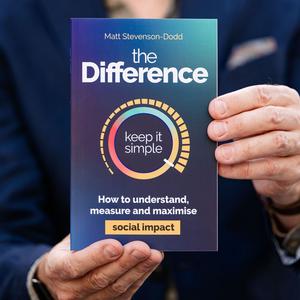

Matt: Welcome to the Difference, the podcast. I'm Matt Stevenson Dodd.
Helen: And I'm Helen Gregg.
Matt: And this podcast is all about taking a deeper dive into the stories and case studies contained in my book, The Difference, How to Understand, Measure and Maximize Social Impact. We want to get behind each of the case studies in the book, meet the people involved, and find out more about how these amazing organizations set out to understand, measure, and maximize the difference they make in the world.
Helen: And I should just say that The Difference by Matt Stevenson Dodd is available to order in all good bookshops now and as of recording is number one in the Amazon best seller list.
Matt: Thank you. Our guest today is Kate Lee, Chief Executive of NCVO. I've known Kate for years, and anyone who's worked with her will tell you the same thing. She's one of the warmest, brightest, and exceptional leaders our sector has. Prior to NCVO, Kate led the Alzheimer's Society and Young Lives versus Cancer and has a well deserved OBE to show for it. She's now leading NCVO, shaping what the voluntary sector needs for the decade ahead. Kate, welcome. It's great to have you here.
Kate Lee: Hi, welcome. Thank you for asking me.
Helen: Nice to see you, Kate. ⁓ and you may well be aware that we like to start the podcast by asking all of our guests to give us three statements, two of which are true and one is a lie. Then Matt and I will cleverly try and find out the lie throughout the podcast. I say cleverly, I should really do inverted commas around that. Sometimes it's smoother than others, or subtler than others.
Kate Lee: Thank
Helen: ⁓ but at the end we'll both have a guess and then you can reveal the truth to us. So, Kate, over to you. Could you tell us your two truths and a lie, please?
Kate Lee: thinking of making them impact related because then I thought at least you could weave them in but then I thought that was far too easy so I'm not going down that route. I was once asked to be an advisor to a BBC drama about charities. ⁓ This weekend I kicked a hornet's nest whilst gardening an elderly friend of mine is so ⁓ that I keep my OB in the downstairs toilet she refuses to use the downstairs toilet she feels it's very disrespectful
Helen: Okay, so just clarity, you once asked to be an advisor ⁓ to a BBC drama on charities. ⁓ You ⁓ recently, this weekend fact, kicked a nest. ⁓ And ⁓ I need to just check on that one deliberately or accidentally.
Kate Lee: Accidentally, accidentally, behind the gardening bin.
Helen: A an elderly friend of yours is so cross that you keep your OB in the downstairs toilet that she refuses to use the downstairs toilet. I absolut I really want that one to be true. Excellent. Okay. And I will ⁓ allow the s more serious element of the podcast to begin at this point.
Matt: Mm-hmm. Dude.
Kate Lee: Thank
Matt: Thanks, Kate. They're brilliant three. I love those. so can you could you just help us out and give us a sort of thirty second background on you?
Kate Lee: Yeah, so I joined the sector straight out of university, studying in Sheffield and joined the sector. I went to work for Red Cross in 1994, long time ago, and was at Red Cross for 16, nearly 17 years. Then left there to become Chief Executive of Might and Hospice Group, which is a palliative care group up here in Warwickshire, which is where I live in Coventry. And ⁓ then was there for five years when I went to Young I was persuaded by the recruiters to put my hat in the ring and I'm so incredibly glad they did. And then left there in just in March 2020 to start a brand new job four days before lockdown at Alzheimer's Society. My mom has dementia. So for me, that felt like a bit of a vocational move. And then left there ⁓ late last year ⁓ to join NCVO which is where I've been now for kind of six months or so.
Matt: Six months already. Wow.
Helen: Fantastic. ⁓ I just have to without fangirling, I am such a big fan ⁓ of the good, the bad and the ugly, was your, course, your annual report from 2019. ⁓
Kate Lee: Aww, thank you.
Helen: Was there a pivotal moment for you when you realised that things could just be a little bit more transparent? ⁓ and and I think because that obviously came through really well in the good, the bad and the ugly. I just love it. I talk to people about it all the time as a really good example. ⁓ but there must have been a moment for you, almost a light bulb, where you were sort of like, hang on a minute, why are we as as you quoted in your in your report, hiding behind the sofa here?
Kate Lee: Yes. Yeah, absolutely. I think a few things kind of coalesced at once to me around that time, maybe a year or so before. So when I was at Miton Hospice, I was asked ⁓ by Alan Gostchuk and others to be part of something called the Impact Coalition, which was a coalition of different kind of charity leaders set up to really look at what impact was about and how did we drive kind of moving on from outcomes into impact. And was relatively still relatively new thinking at the time that was probably a good 12 years or so ago now. maybe even more. as part of that work it kind of sparked a really interesting me in impact. But I think the key issue for me has always been about impact reporting and accountability and how do you really be accountable to both donors and beneficiaries for what it is that we're there to do. So I've had this slight feeling probably most of my life that charities act almost like an agent. between the beneficiary and the donor, I always say no one gives directly to any charity. They give to the donors they're wanting to help. And if we're gonna play a really valuable role in that agency space, we need to be able to demonstrate our value. And by demonstrating our value, what's really, really important is that we are accountable to both parties. So I think that kind of sparked an interest in me about thinking about our reporting being about our accountability rather than just our marketing or our sales are trying to chase the next bid. And as soon as I had that shift in thinking around that time, I met Matt, saw the fantastic stuff Street League were doing, heard about 15, the Jamie Oliver reporting about being really challenging, lots of stuff that's in the book. But I think my shift was much more about this issue about like being accountable and what does that really mean in that space? And if people are going to carry on donating to you, how do you really be accountable?
Matt: Yeah, I think that's it it's it makes a lot of sense. And I really remember that conversation and then ⁓ it led to what was an amazing report, The Good, the and the Ugly. I thought it was a really good, good take on it. But I loved I love your sort of sense accountability about that. ⁓ Because y a lot of annual reports just tend to talk about everything went well, everything was brilliant, we did this great stuff. But the accountability really does require the other side of it as well, doesn't it?
Kate Lee: Yeah, and I think for me, like I've always been really fascinated by the sector, even more so now as Chief Executive of NCBO, and I'm in this very privileged position of kind of either kind of in a helicopter over the sector or in the foundations underneath and depending it, whichever your take on where I'm sitting is. But it's really given me a lot of insight into and the challenge of how we describe how we're different, right? what makes us different as a sector? We're not very good at talking confidently about what makes us unique as a sector and invaluable as a sector. And I think that affects our confidence. then because I think sometimes as a sector, we're lowering confidence, that's why we're not sat around the important tables or in the right rooms. So I've been thinking a lot about and have always thought a lot about The fact that we're in this position, that we've been able, up until maybe recently, we can explore that further, but to be able to be really honest about what's working or not, I think that makes us really quite unique. You we don't have political masters in the same way government do, which means that often their messages are contrived into like the best possible impact. Businesses have no desire to do it as long as the product works and they're selling, it's all about marketing. So what makes us unique in our space? And I think there's something for me about accountability that really works.
Helen: what the ⁓ response to to report and and did it lead to any ⁓ developments your end in terms of learnings i in itself?
Kate Lee: I mean, we got very positive response to it, which was great. And I have to say, like as an organization, Young Lives Versus Cancer is in a great place ⁓ as an organization to that report. And I've spoken to lots of chief executives since, I was talking to someone only a week or so ago in the migration sector, who was like, we just couldn't do it. We're just too under attack ⁓ to do that level honesty. And ⁓ here I was with very ambitious organization that had had good year but with young people who were up for us taking challenges, know, they were more vocal. The brand of the organisation was very much about transparency. was quite a kind of, you know, we wanted a kick-ass feel as an organisation. So we were in a really good place to do it and we got a brilliant, brilliant response to it. There was some unintended positive that came out of it as well. So one of the things that we did was that by publishing everything we thought we'd got had gone wrong. Some things got traction and people wanted to talk about where they'd gone wrong and others didn't and it was really interesting talking to some of our donors about some of the pub stuff we'd published that went wrong both in that and subsequent reports and then being like we're not really that bothered about that. Whereas we'd been internally kind of eating ourselves alive worrying about a mistake we'd made. Actually once we published it other people were like yeah well yeah whatever. I was like, oh, that's quite interesting. So it really helps self level the organization. The other thing I think it did, which was a great, a great thing. And, uh, and it makes me still remain very committed to this is that to publicly say externally, these are the things we got wrong sets a very strong internal culture about the confidence around failure in the organization. If I'm prepared to tell people externally, what's gone wrong, you can't really say we have an internal culture where you're not allowed to fail because I happy to discuss our failings externally. So again I think it created a really incredible internal culture.
Matt: Yeah. I I've got so many questions about this case. So it's it's so interesting. ⁓ just just to help people out, I think, could you just talk us through the process? I know I talk about it a bit in the book as you re you recounted it to me, but I just think it'd be good to sort of hear a bit more about that. Particularly, you know, your sort of whiteboard exercise. How did you sort of bring that up with the team? How did you even sort of broach that with them as as a way to go forward?
Kate Lee: Thanks. We were launching and we just designed our new brand. So we just kind of published a new kind of brand. So we'd moved to the Young Lives branding. was a strapline originally. We were still Click Sargent as the charity name. And we'd had this great exercise that we'd done with. children and young people of all ages where we'd had four mood boards about what the look and feel of Young Lives vs Cancer should be. Should it be like, ⁓ should it be like Kath Kitson and bicycles and soft and you know ⁓ kind of ⁓ country quaint. Should it be like Mr Tumble so bright kind of you know candy crush kind of colours. Should it be very radical so should it be like graffiti and skateboarders or should it be call like James Bond and Ferraris and we just got the kids to run around saying when your social worker comes to the organization from the organization arrives at your front door to speak to mom or dad about your cancer diagnosis which of these four should she be and The overwhelming response was uber cool. So it was James Bond and Ferraris. And one of the things that came out of that discussion from young people themselves is saying, we have a sense that this, this organization is confident enough to tell my mum what's really going on or my dad, what's really going on. You know, they were, it's not too gonna, not gonna smother us, you know, gonna come in, sort out the problem, leave and be honest. And so even from children and young people, this word honesty kept coming up all the time. So it was really easy as an organisation to absorb that into the discussions we were having about what we wanted our external look and feel to be like. So I think internally there wasn't a job to be done to win people over to report in this way. And the good was everything that had gone well. So there was still loads of opportunity to talk about the fabulous stuff we'd done. The bad was things that we hadn't quite got right. So there was stuff in there about kind of our... some of our work on equality, diversity and inclusion wasn't as good as we wanted it to be. There was a mixture of things in there that hadn't quite hit the box for IMPACT during that year and then the ugly was a section that was just very much about the external environment. One of the things with IMPACT reporting is I think you can't often report it pure so you can't just say you know ⁓ confidence in X was at 12 % and We've done a huge amount of work and now it's at 9%, which was nothing to do with us, but there was a change in the external environment that took away people's agency, know, maybe a government change, a funding cut, closure of somebody else's service. This took away government agency because actually if you try to peer report, it looks like all your intervention has dropped the impact level. So the ugly was very much about things in the external environment that we couldn't control that had affected our impact.
Matt: So one of one of the things I found when I was at Street League was that there were sort of levels of transparency. And in the case of good, the bad and the ugly, you you are talking about young your accountability to young people, and also the external environment. I wonder if you could reflect on that sort of types of transparency and what the sector might be comfortable with hearing from a charity.
Kate Lee: Yeah, I think that's changing. think that is changing. think social media particularly is changing some of those issues around transparency and we can get into that shortly. One of the things I did at Outside My Society, Matt, And I was really conscious of not only selecting the kind of nice things to get wrong. So particularly the things where we've got a plan already and actually I know I'm already making progress in them. So I know when I report next year, I'm not going to have for two years at this going completely kind of. wrong. I asked a group of people with dementia to audit the report and to put an audit statement at the start of the report saying is this a true and honest reflection of how Alzheimer's Society has fought for them over the course of the year. One of the members of that group was very upset about the closure of a local service which wasn't referenced in the report because we hadn't gone into that level of detail but he felt the report was disingenuous because we hadn't mentioned that we closed a service in Sheffield and I actually allowed those comments to go into that Audited Front Statement so that Audited Front Statement actually says in it this report should, you know, for me I like this report and I love the stories and I love the case studies but this report should have reflected the fact that there's also been service closures. So you know it's it's a constantly evolving piece as to how you do that transparency, how you get checks and balances on that. You know sometimes there's checking with donors about you know we didn't get this as well as we'd want but some of your funding paid for this how do you feel about us reporting that way? I think people are far far far more up for it than we think. ⁓ Genuinely the most feedback we got on Good, Bad and the Ugly particularly was people saying I believe what you said in the Good because of the sections about the band. So it just, the whole thing read more honestly because you were honest about what had gone wrong. So I felt I could believe what you said had gone right. It didn't read like a marketing report.
Helen: And and Matt, you had that with your Street League experience, didn't you, as well? It's it's so interesting. Kate, well do you have any tips for other chief execs listening to this about how to manage that transparency for both your board and for your your teams? Because
Matt: Yeah. Yeah.
Helen: we all know that ⁓ change can be good and bad, but people are always going to react differently to it. And it is a a changing culture as well.
Kate Lee: Yeah, I'd say... There's a few things about getting the organisation ready for being able to do this. So, you know, it's hard to do it in a culture internally if people feel it's a very critical culture or everyone's under the car, sure that as chief executive or the board is only looking for the negative actions within an organisation. So there's something really important about ensuring you also have a culture that is very celebratory of success. That's kind of the only way it works is that if you have ⁓ if you have both in place. So I would say get in your organization internally ready, which might be one year of saying, right, if we could put anything we want in this, and I've done this, we're doing this at NCBO at the moment, if we could write our TRA and write anything in it, right. let's not worry about publishing it at the moment or the sectors reaction to it or anything else. Let's just say we could put anything in it. What would you put under the good, the bad and the ugly sections? And like just getting people comfortable in articulating stuff that didn't go well is the first step of this. The publishing it and the transparency and the accountability is a journey that you're trying to go on. But the starting step is the internal comfort. Then talking to the and saying, you know, the team raised 12 things that didn't go well, three of them I think we're not going to probably put in the public domain, you know, maybe they involved individuals. ⁓ But the other thing for me is just constantly saying like, we're not MI5, there's not that many secrets here, right? It's just, it's just not that secretive, it's not that exciting. And you know, we're trying to do a fabulous job for people with dementia, other folks are paying for that. Let's just kind of...
Matt: Yeah.
Kate Lee: debate how we could have done that better this year. And so I think there's something about starting a journey for your organization. This isn't on day one, right, in a TRA that just, you know, outs all your dirty laundry.
Matt: Yeah, yeah, I t I totally totally agree. ⁓ it? You mentioned before, you know, organizations that would probably be a bit more sort of scrutiny in the in the sector that would find this quite hard. ⁓ But you know, for me, I'm probably a bit radical here, but I think every organization should be this open and transparent. actually it is just taking steps to do that. I wonder what advice you might give to a To a a listener who's probably thinking this is the last thing my board would agree to because we are so under scrutiny all the time.
Kate Lee: I think it's quite challenging. Again, I can't stress strongly enough how it's about really starting a journey of this kind of more radical transparency, probably two years before you do it. So the first thing is also, or another step, I know, it's the first thing, but it's having a conversation with the board about this is the journey you want to go on and see what their reaction is to that. Some boards that are heavily commercially weighted, you know, just have... trust board members, the trustees around the table, like why would you ever tell anybody something your organisation did wrong? Like you are mad to put that out in the public domain. You often find people who work in crisis comms really, really good in this space because they're like, no, we should tell people before they find out. Because then it's like when they say like, ta-da, we've discovered that your whatever gender pay gap has got significantly worse. You can be like, yeah, we told you that it was in our trustee report account ⁓ or it was in that blog we published or because you don't have to only do it in your accounts, right? You could do it in the style of a blogs you write. It can be what you decide to do about your social media posts, how you use LinkedIn, it can be in any place that you decide to take some of these steps towards more transparency. So my view is just to start this journey before, you know, get the board used to it, you know, get the board discussing what's worked and what hasn't. You don't have to leap straight to publishing it.
Helen: Okay. And and was that the the storyline of the B B C drama that you were advising on? Something about transparency.
Kate Lee: That was very clever Helen but no sadly it wasn't.
Helen: Yeah. I ⁓ I didn't get her math.
Matt: ⁓ Good try. ⁓
Kate Lee: You
Helen: Thank you. I'm conscious we've a lot time ⁓ on the report and so on. ⁓ around all of that, ⁓ presumably you were also going on an impact in terms of understanding ⁓ kind of the difference you were making and on. ⁓ Was that a new thing? Were you setting ⁓ on a new journey for ⁓ ClickSargent, Stroke Lives versus Cancer or Alzheimer's society? ⁓
Kate Lee: Yeah, mean, I was very lucky in my final years at Red Cross to be director of strategy and did a lot of work both in the UK but also globally and that's quite a complicated organisation to pin down the impacts of and partly because what they do is so broad, both work in the UK, work internationally ⁓ and I remember absolutely trying to do that thing that many of us have been in a position of doing, which is writing a strategy which really retrofits everything you're currently doing into it and trying to find a silver thread of making a whole series of slightly random but very impactful activities make sense as one story. And sometimes that's not possible and I remember thinking at the time, what am I doing here? Like I'm thinking about closing a service that I know is really impactful because it doesn't make sense as a strategic story. like what what really matters what am I doing what what is the impact then is that because the impact doesn't fit with my tidy strategic story and the impact I'm trying to create as an organization and I think in the book it references about organizations like I think it's one of your worst case scenarios Matt where like every team's allowed a different theory of change and every team's allowed a different set of impact measures and that's what has happened in that organization so so I think what I have done subsequently young
Matt: Yeah.
Kate Lee: Al-Syme Society and now NCBO is really, really honed a conversation in to a very tight set of impact measures that then can be interpreted and explored and tested and really rigorous kind of testing. People can argue the toss about definitions of those, but that they create a common framework. So for me, that probably experience at Red Cross was the most... influential in my thinking, the most seminal moment for me thinking actually strategically you need to set a North Star for an organisation with a very small set of impact measures, even just one or two things that you say this is what we're trying to move the dial on. And for Young Lives vs Cancer we agreed that by 40 people who'd had cancer as a child shouldn't be disadvantaged to their peers at 40. So that effectively, although that time was awful, what we were trying to work towards were things that negated their long-term. ⁓ you know, or the family, not just the young person, but the family, sadly, obviously, children didn't make it through that journey. But how did we normalise that journey into kind of a way of being that meant by the time you're 40, you'd still have the same career opportunities, you'd have had the same educational experience. And so we really took that as our one impact measure, and then we're able to test everything we were doing by will this really change the long-term dial for this family?
Matt: Yeah, yeah. Yeah, exactly that. What what's your reflection on the hardest things about trying to implement impact as the h at the heart of strategy? What what what's your sort of takeaways on that?
Kate Lee: So I think lots of them are touched on in the book, Matt. think there's a temptation to overcomplicate them. And I think that comes from a number of sources you articulate lots. think another one is where people want to overly conflate these measures in order to get their thing in. So I think sometimes, you know, there's a pushback on, well, I haven't defined the word resilience as that I've defined it as this. And that's why my project fits. And I think there's a moment at which this is subjective. And I do always say my own mantra is being about evidence informed, not necessarily evidence led. I know there's a big debate about which of those you should be as a leader. Mine is to be evidence informed because I don't think at the end of the day, all the facts and figures in the world, all the measures in the world, all the dashboards in the world, all the brilliant evidence in the world will ever make the decision for you about what's actually right for your charity in this moment. What it does is really inform an ethical, well-based, solid decision that you can only make in the real-time moment with the evidence you've got. But you can look back on it and think, I couldn't have made a better decision because I didn't know anything else. So I think one of the things that's quite tough is there are moments that you do all this work and you've got this great impact measures and you're still running out of money and got to choose between two services. And now you can actually see that both services are delivering fantastic impact and nothing's going to make that decision for you. And I think, you know, I think sometimes that can feel quite frustrating. My answer is always, how much harder would it be if you had absolutely no clue how to compare what was going on?
Helen: I think one of the things ⁓ we've seen ⁓ people becoming more comfortable with is this idea that ⁓ if you try and be all things to all people, you up being to anyone a lot of the time. So actually better to ⁓ to almost have be clear that you are having an impact than having none at all by trying to do too much. Does that Does that resonate?
Kate Lee: Yeah, I think so. I think being able to demonstrate impact is really important because it can feel very subjective. And, ⁓ you know, I've had debates over the years with very, very, very passionate volunteers and members of staff, particularly around things like service closures and, know, and to say you're not having the impact that I use this triangle all the time. many people have heard me rant on about this but it's ⁓ yeah how many people you reach, how much resource you spend and how much impact you're having. You could have huge impact but if it's with 10 people for millions of pounds is that proportional for what the donor thought they were funding? Is that the best route for that group of beneficiaries? And so sometimes I've been talking to people about saying you know yeah you are having huge impact and you're really enjoying it but you know 900,000 people have dementia in the UK and this service reached the needs of 11. We've got to talk about that balance between this incredible impact measure. No one's denying these impact measures are great, but the shift is too small proportionally for the cohort. So they're always tough discussions, and this impact data sits alongside the resourcing data and the reach, if that's the nature of your organization.
Matt: I've always said something very similar to CEOs that I've worked with is rather than having this gut feeling, you'd really just want to know, right? And then you can then plug in all of those things. And that but you're right, you say right, it's about judgment at the end of the day. You've got to make the judgment on the end of that. Just just sort of coming to your n current role, your new role at N C V O, and ⁓ you know, you're things now across the sector more, I guess, ⁓ rather than from an individual charity perspective. ⁓ What what's your your sort of feeling about where the sector is on impact and and transparency at the moment.
Kate Lee: think transparency is tough because I think this whole... kind of polarization in society, you know, is creeping into the sector. There's definitely increasing polarization. There's less space for a nuanced discussion and that makes transparency quite hard. We also need a fun day. is becoming tighter and tighter and tighter and who really knows how foundations and philanthropists feel about reading that something hasn't gone well. I think 10 years ago they were really up for that, they felt that that was really innovative, they felt that gave an impression of an organization that was really up for challenge and debate. The pressure on funding, the number of applications, trusts and foundations are getting, how do we really know now that that isn't just a quick way to rule someone out like feel a bit high risk. ⁓ And the other thing is I think there's a rise in back across the sector in the value of relationship and network and we are I'm seeing increasingly going back to who you know and what you know particularly for the connections and joining the dots. and where is the space for the debate about the impact of different organisations in that when actually what we've got is individuals building strong relationships, strong discussions, maybe being invited onto things because of who they are and how they're known, rather than the impact of their work and the difference that they're making, particularly with lived experience communities. So I think it's a difficult time at the moment to navigate as a sector quite where impact sits. The other thing that I think is really fascinating and it's something that I've had an insight to since going to NCBO that I'm not sure how much we're talking about but I think this is really fascinating and it is something that's only occurred to me very recently. This sector holds evidence of everybody else's impact. And because we don't have one consistent way of collecting data and evidence across the sector, we can't draw out the obvious massive wealth, massive wealth of impact data that sits out there through the use of AI or through better tech technology about each other's work. And I'll give you an example. I went to visit one of our members who works with young people who are not education, employment or training but works that are very much a pre-stage. This is with very vulnerable young people with very chaotic lives that wouldn't really even be able to go through a NEET program. They wouldn't stay on the program, they wouldn't be able to access it. Some of the stuff ⁓ Matt you had at Street League. And then it was really interesting in the afternoon I went on to visit a training establishment for people who are on NEET courses and ⁓ one of them said, ⁓ I love it when we get a referral from them because they're young people always stay on our course longer. And I was thinking, ⁓ my goodness, you I went to see a brilliant organization. It's a national organization. It's got a big army in Coventry And I was thinking how much information they hold about what has and hasn't worked by charities that work on the prison experience. So, you know, they can absolutely see which people are coming out better placed, more resilient, more able to cope in a community setting, despite maybe severe mental health, learning disability, cognitive impairment, because they've worked with certain charities in a prison environment. And I was like, ⁓ you hold the impact measure.
Matt: Yeah.
Kate Lee: those prison-based charities. So I'm really fascinated by this. I think we hold the answers ourselves just up our own chains. know, we work in, if you think about working from Sure Start, probably even earlier than that, National Child Birth Trust to Sure Start to Young Education to reading programs, you know. what's the longitudinal study of a young person who's touched the sector time in and time out and the experience that they've had maybe into adulthood. for me, this is all about joining the dots of data and evidence that this sector holds. We have phenomenal amounts of data, ⁓ not just within the sector, but think tanks, research, academic organisations, ⁓ globally, know, sectors globally. There is a ⁓ huge huge amount of data and evidence about what already works. Charities publish a lot of that in research reports and we can do lots of, you know, skimming it from that. We can do lots of scraping from charity commission website, many, many other websites that we can look at to work out kind of. core evidence and information about the sector as a whole. But wouldn't it be great? NCBO has 17,000 members. I really want to grow the size of that membership. If those members were contributing data... into a central place, a central data bank, a central evidence, a data store. This, using AI, using those tools, this should be absolutely possible in a relatively short period of time to start to be able to draw out some of those impact journeys. We should be able to track individuals through our impact journeys, not necessarily named, but certainly personas of individuals through our impact journeys. So, you know, what does ⁓ young person with care experience or care leaver experience, what charities are they likely to have touched and if we can then map those charities to look at the impact data of those charities, what is that telling us about our wholesale impact as an entire sector, which would prove we cannot be ignored by government, by key decision makers, by philanthropists, because we should be able to evidence our total sector impact, not just our spend, not just our size.
Matt: Kate, I I I totally agree with you. I mean, there's so much more we can do. I think ⁓ I think we've been in in the past of having these attempts at joint measurement frameworks for the sector, which just grind into complexity as soon as they're kind of could as soon as they're released and then nobody wants to take part in them. But what I think you're talking about is this idea that data is already there and it ⁓ is that it needs to just more accessible and more linked together to tell that tell that story.
Kate Lee: I'm better verified. mean, one of the things that I'm keen on thinking about NCBO's role being is also about like verification of data. What are the data ethical, like what are the standards by which we would agree somebody's impact is good quality impact
Matt: Yeah, I t I totally agree. ⁓ I just wanted to go back to something you said just before about ⁓ when we're talking about transparency, ⁓ about the danger for charities for feeling a bit exposed and perhaps them n you know, not feeling that they'll be considered for funding or be ruled out for funding on that basis. ⁓ which, you know, I can absolutely see that that is the society that we're starting to live in, but is that an argument not to be transparent?
Kate Lee: It's not an argument to not be transparent, but it is a growing risk, right? Because money in the sector, we know, in lots of places, is reducing. So 1.4 billion off the total income into the sector last year, according to CAF's figures, we know that the sector is contracting. And in a period of contraction, what I think we don't understand yet is, properly, is the rules the unwritten rules that people funding the sector are using, we don't properly understand. So I give a really good example. I was asking the other day, if you give five pound a month and you've stopped it because of cost of living increases, I could completely understand that. Many families are really, really struggling. Do we understand the rules, the unwritten rules of what made somebody stop? They're making three charity payments, they stop one. Which one did they stop and why? What are the real rules underpinning this? So I think for me, all I would say is that there's a bit of a... We're in a bit of a period of unknown information of which I can understand why that makes people anxious about their level of transparency because it's like, well, what if it was because we did get picked up by the Guardian for saying that we delivered a program that didn't deliver.
Helen: this that's really interesting actually, because in the book Matt talks about why aren't always able to take the risks that they might need to create more social impact. ⁓ and of course, the ⁓ relatively unknown funding environment is a huge one. ⁓ Do you think ⁓ there are ways to navigate that or or ways to build that culture when where risk taking ⁓ in the pursuit of impact is actually more acceptable or more palatable for people?
Kate Lee: I have huge optimism on the ability of this sector to regenerate to the environment that it's in. I think we've done that. you know, for hundreds of years, we've been able to, you know, I think we do reach a point at which we're kind of clinging on to the past, clinging on to the past, then we let go and say, no, this is not going to work, do something different. We get innovators, we get forward looking. I think what's going to change is some of the work around things like the impact economy, which is about the sector building closer, meaningful relationships with other providers, whether that's with government, whether that's with different types of commercial organizations. I think we'll start to change some of our traditional charity models. I'm loving some of the stuff coming out of social enterprise at the moment, who are not struggling in the same way that a lot of traditional charities are for background costs. So I think what will probably happen is that as we build those relationships, the sector becomes more exposed to different groups, organizations, types of organizations. I've been spending lots of time with ⁓ some private equity firms recently exploring the models that they use in private equity to restart failing businesses and seeing whether there's any learning in that that we can bring to the sector about how do we restart Pump Prime, some of the charities that are struggling or, you know, when do you make a decision about acquisition? When do you make a decision about merger? How does a team go in and kind of turn a charity round and really strengthen the team to then be independent again? Like what are the models we could use? So for me, think as we more of this exposure to different sectors that are more used to taking risk than we are, much more used to taking risk than we are, genuinely have had many many many more years than we have at kind of failing and failing fast even though we say it. ⁓ I think it will kind of strengthen that muscle within the sector so I'm quite optimistic that that's gonna naturally grow.
Matt: Do you think there's a bigger role for funders in trying to encourage that? I mean, we talked about funders perhaps being, you know, a little bit negative about people being transparent, but do you think funders have a have a role here to encourage that sort of risk taking? Because at the moment it feels like it's very much, you know, we'll give you money, you give us success. Whereas I think a better equation might be we give you money, you give us learning, and we all learn together how to improve social impact.
Kate Lee: Yeah Some really innovative funders are starting to be in this space already. I'm a big fan of people like Postcode Lottery, which I think, you know, give unrestricted funding. They trust that the charity knows how to run itself. They don't try to micromanage their charities. And in that space, what we know is that having a reasonable sized unrestricted gift coming in year in, year out, because it's long term unrestricted funding, creates the environment why which the charity can take risks. So, you know, those charities that have been with Postcode Lottery a long time have probably, you know, had the space to be innovative, to re-invest, you know, to trial new things,
Helen: do do follow the veracity index, Kate? ⁓ This is that Matt introduced me to a few years ⁓ Ipsos do a survey every year ⁓ and they ask average on the street how much do trust ⁓ the following job titles? ⁓ and interestingly, charity chief execs is relatively low. ⁓ So ⁓ 2025, which is the latest one we've got, it was down again at 45%. So the average person on the street trusts a charity chief exec actually less than bankers, which is which is quite interesting. So linked to that conversation about being transparent and then having the confidence to take the risks and the f confidence from funders to give money to that environment. What do you think we can do ⁓ from a charity perspective to drive that confidence up?
Kate Lee: Well, I don't think those things are linked, actually. So I'm just going to kind of be challenging back to say, I think you could have a charity chief exec who could run an incredible charity, do a massive turnaround, be delivering to significantly more people on the ground, you know, really financially doing well. their trust level will still be low. And that's because it's based on a different set of metrics. We don't play on the same playing field. The general public still morally disagree or morally wrestle with charity chief execs being paid. If you ask them, you think charity chief execs are doing a good job? I think you'd get a different answer to whether you trust them. The issue becomes, it's one about a kind of moral underpinning. There's loads of good stuff on this. The Regair Institute has produced some really interesting stuff ⁓ doing some links to some work in Canada, which is saying every time charity chief execs get challenged, we put out more and more data as to why we're doing a good job. But that's kind of pointless arguing like why we need to fundraise because this isn't a logical argument. This is a moral argument with the public about the importance of paying staff well, about why all our charities aren't run by volunteers, about why some of our charities need to operate to commercial models about how you drive down inequality by bringing the brightest brains to deal with the trickiest problems. That issue with our public in the UK is one that's underpinned by a moral issue, like a moral disagreement or a moral misunderstanding, trying to argue it with logic, demonstrating more and more of our impact. We won't actually ever win that issue. people don't want our charity chief execs to be paid or don't believe we should be paid kind of significant salaries.
Matt: So how how how do we change that, Kate?
Kate Lee: ⁓ I think we need to have a conversation with them that is on the same kind of moral grounds. One, I don't know we can, so should we stop thinking we can and you know stop trying to be so liked? Like politicians seem to have got their head around this 10-20 years ago, they're just not going to be liked. Charity chief execs seem to really struggle with that. ⁓ And it's partly because the way we're funded, it's not just because we all want to be loved, we're all people pleasers. ⁓ Me obviously. But ⁓ I think like, this is a really important debate that we need to either come to terms with the fact that morally people struggle with the fact charities pay their chief execs, pay their staff, have backroom costs. Either we just say that is how it is, how do we do the best job we can given that that is public perception. If we want to change that public perception, it is not going to change by just keep constantly hammering out more more statistics about why people give, why people don't give, the complexities of running our charities. I think it needs a different level of debate with the public.
Helen: Fantastic. That's so interesting. Thank you. ⁓ So when is the work of NCVO complete, Kate? ⁓ Because that is big ⁓ There are lot of charities underneath it. ⁓ When do it's sorry, it's something we do everybody, but when do you feel like your work here is done? You can you can pop your feet up and ⁓ and go on that nice holiday.
Kate Lee: whether it's ⁓ my work at NCBO the work of NCBA, I mean, let's hope the work of NCBO is never done because whilst there is a voluntary sector in the UK, whilst there is amazing provision by civil society, ⁓ you know, think there's always going to be the need and a place for a well positioned organisation to corral it and give it one single voice to government to speak truth to power. ⁓ And so may it it and the sector continue. For me, in our new strategy, we've talked about our kind of vision of what we're trying to achieve is a world where it would be really impossible for a charity to fail. Like if I, through NCVO, if we can create and operate an infrastructure in the UK where government policy is made early with a voice of lived experience brought to the table by the sector, you know, that we have money flowing into the sector through, you know, whether that's through public service commissioning, donors, philanthropy, companies, businesses understanding the need to support the sector for economic growth. When we've created an environment by which it's really really hard to fail as a charity then maybe NCBO staff can have an afternoon off but not till then.
Helen: And any ⁓ just a th th a thought, but any messages for our likely new Prime Minister, Andy Burnham, when he ⁓ he takes up the reins? I'm sure he listens to the
Kate Lee: that ⁓
Helen: podcast. ⁓
Kate Lee: keep the civil covenant keep going with it it was the right commitment to say you know however much ⁓ work that's going to take, and it is going to take a lot of work, a closer working relationship between government and civil society, one built on mutual respect and understanding between civil servants and civil society leaders, is better for this country. A stronger civil society means stronger society. I think hopefully he will get that, but I really hope he keeps a high level of commitment to the covenant. We've only just started work on it. There's so much more to be achieved. ⁓ those organisations that are out there waving it about and driving change at a local level absolutely have my heart at the moment ⁓ and I think that really needs to continue this society, civil society needs to stay strong to protect us and future generations so ⁓ I think long may it continue.
Matt: Brilliant. Well said. Thank you, Kate. Well, let's ⁓ let's go back to where we started, to your ⁓ your two truths and a lie. ⁓ so Helen and I, ⁓ we're a bit competitive, Helen and I. We're we're not sure what the score is yet, but but we think Helen's in the lead. Helen thinks she's Yeah, that is true. That's true. So
Helen: Amazing.
Kate Lee: Thank
Helen: I'm winning. ⁓ if Matt was winning he'd know the score.
Kate Lee: That's not very impressive from people who do measurement professionally that you don't know quite where you're up to. Honestly, you two.
Matt: ⁓ no, yeah shouldn't we we should have a visualization for this, shouldn't we? Running live. That's ⁓ yeah. ⁓ so I ⁓ I'll just read back through them then Helen's gonna have a guess and I'm gonna have a guess. And if you can stay poker faced throughout that and then tell us the ⁓ tell us the truth. Okay, so ⁓ your first one was that you were once asked to be an advisor to a BBC drama about charities.
Kate Lee: Okay.
Matt: ⁓ your second one was at the weekend you accidentally kicked a hornet's nest. I mean there's a there's a story there, I'm sure. ⁓ and ⁓ number three, your friend refuses to use your downstairs toilet because that's where you keep your OBE. Helen, what do you reckon?
Helen: Right, so I am convinced the Hornet's nest is correct because ⁓ you mentioned it was behind the bin when we talked about it earlier. and you seemed incredibly comfortable with the idea of your friend and the OBE. So I'm gonna go that the BBC advisor one is the lie, but I suspect there's an element of truth there that either it was an ITV drama or something. I really want it to be, I really want it to be
Kate Lee: I'm sorry.
Helen: AC ⁓ what's it called? Yeah, line I really want to line of duty, by the way. ⁓
Kate Lee: line of duty.
Matt: Right.
Kate Lee: That's the line of duty.
Helen: I know it's not a charity one, but I just really wanted it to be.
Kate Lee: ⁓ shoot, shoot.
Matt: Yeah. I well I I have to say I'm in exactly the same place. I think I think number one is the lie, but I think it's probably quite close to the truth in a way. Go on then, Kate. Put it out of Amazon.
Helen: Yeah.
Kate Lee: You're both right. It is number one. So I did kick a hornet's nest at the weekend and got quite badly bitten and was conscious that I've been scratching my bites the entire time I've been on the podcast. But yes, so I have never advised on a charity drama, but my family think I should because if anything to do with charities ever comes on any drama or documentary, I rant about how that isn't true. That isn't the case. That charity would never volunteer running it. So I think maybe that's what I'd like to do.
Helen: A great
Matt: And ⁓ not enough dramas about charities, right? I mean, there's th we need more, therefore you could be invited to advise.
Kate Lee: Exactly, I think so. ⁓ I could do a corker.
Helen: You should you should write one, Kate. Be the change.
Kate Lee: It's like when about eight policemen turn up because someone's had their charity box nicked off their bar in their park. It's like, yeah, like that had happened. Exactly. And then they accidentally found a serial killer while they were in the bar. It's like, what? ⁓
Matt: Okay.
Helen: I wish ⁓ I wish they took it that seriously. Well, let me tell you about no, I'm just That's a whole other podcast as well, isn't it? So Kate, thank you so much for your time. It's been honestly such a joy to talk to you. ⁓ thank you so much for sharing your wisdom, your insights, your experience, ⁓ and good luck for the launch of the new strategy
Helen: And I'm Helen Gregg.
Matt: And this podcast is all about taking a deeper dive into the stories and case studies contained in my book, The Difference, How to Understand, Measure and Maximize Social Impact. We want to get behind each of the case studies in the book, meet the people involved, and find out more about how these amazing organizations set out to understand, measure, and maximize the difference they make in the world.
Helen: And I should just say that The Difference by Matt Stevenson Dodd is available to order in all good bookshops now and as of recording is number one in the Amazon best seller list.
Matt: Thank you. Our guest today is Kate Lee, Chief Executive of NCVO. I've known Kate for years, and anyone who's worked with her will tell you the same thing. She's one of the warmest, brightest, and exceptional leaders our sector has. Prior to NCVO, Kate led the Alzheimer's Society and Young Lives versus Cancer and has a well deserved OBE to show for it. She's now leading NCVO, shaping what the voluntary sector needs for the decade ahead. Kate, welcome. It's great to have you here.
Kate Lee: Hi, welcome. Thank you for asking me.
Helen: Nice to see you, Kate. ⁓ and you may well be aware that we like to start the podcast by asking all of our guests to give us three statements, two of which are true and one is a lie. Then Matt and I will cleverly try and find out the lie throughout the podcast. I say cleverly, I should really do inverted commas around that. Sometimes it's smoother than others, or subtler than others.
Kate Lee: Thank
Helen: ⁓ but at the end we'll both have a guess and then you can reveal the truth to us. So, Kate, over to you. Could you tell us your two truths and a lie, please?
Kate Lee: thinking of making them impact related because then I thought at least you could weave them in but then I thought that was far too easy so I'm not going down that route. I was once asked to be an advisor to a BBC drama about charities. ⁓ This weekend I kicked a hornet's nest whilst gardening an elderly friend of mine is so ⁓ that I keep my OB in the downstairs toilet she refuses to use the downstairs toilet she feels it's very disrespectful
Helen: Okay, so just clarity, you once asked to be an advisor ⁓ to a BBC drama on charities. ⁓ You ⁓ recently, this weekend fact, kicked a nest. ⁓ And ⁓ I need to just check on that one deliberately or accidentally.
Kate Lee: Accidentally, accidentally, behind the gardening bin.
Helen: A an elderly friend of yours is so cross that you keep your OB in the downstairs toilet that she refuses to use the downstairs toilet. I absolut I really want that one to be true. Excellent. Okay. And I will ⁓ allow the s more serious element of the podcast to begin at this point.
Matt: Mm-hmm. Dude.
Kate Lee: Thank
Matt: Thanks, Kate. They're brilliant three. I love those. so can you could you just help us out and give us a sort of thirty second background on you?
Kate Lee: Yeah, so I joined the sector straight out of university, studying in Sheffield and joined the sector. I went to work for Red Cross in 1994, long time ago, and was at Red Cross for 16, nearly 17 years. Then left there to become Chief Executive of Might and Hospice Group, which is a palliative care group up here in Warwickshire, which is where I live in Coventry. And ⁓ then was there for five years when I went to Young I was persuaded by the recruiters to put my hat in the ring and I'm so incredibly glad they did. And then left there in just in March 2020 to start a brand new job four days before lockdown at Alzheimer's Society. My mom has dementia. So for me, that felt like a bit of a vocational move. And then left there ⁓ late last year ⁓ to join NCVO which is where I've been now for kind of six months or so.
Matt: Six months already. Wow.
Helen: Fantastic. ⁓ I just have to without fangirling, I am such a big fan ⁓ of the good, the bad and the ugly, was your, course, your annual report from 2019. ⁓
Kate Lee: Aww, thank you.
Helen: Was there a pivotal moment for you when you realised that things could just be a little bit more transparent? ⁓ and and I think because that obviously came through really well in the good, the bad and the ugly. I just love it. I talk to people about it all the time as a really good example. ⁓ but there must have been a moment for you, almost a light bulb, where you were sort of like, hang on a minute, why are we as as you quoted in your in your report, hiding behind the sofa here?
Kate Lee: Yes. Yeah, absolutely. I think a few things kind of coalesced at once to me around that time, maybe a year or so before. So when I was at Miton Hospice, I was asked ⁓ by Alan Gostchuk and others to be part of something called the Impact Coalition, which was a coalition of different kind of charity leaders set up to really look at what impact was about and how did we drive kind of moving on from outcomes into impact. And was relatively still relatively new thinking at the time that was probably a good 12 years or so ago now. maybe even more. as part of that work it kind of sparked a really interesting me in impact. But I think the key issue for me has always been about impact reporting and accountability and how do you really be accountable to both donors and beneficiaries for what it is that we're there to do. So I've had this slight feeling probably most of my life that charities act almost like an agent. between the beneficiary and the donor, I always say no one gives directly to any charity. They give to the donors they're wanting to help. And if we're gonna play a really valuable role in that agency space, we need to be able to demonstrate our value. And by demonstrating our value, what's really, really important is that we are accountable to both parties. So I think that kind of sparked an interest in me about thinking about our reporting being about our accountability rather than just our marketing or our sales are trying to chase the next bid. And as soon as I had that shift in thinking around that time, I met Matt, saw the fantastic stuff Street League were doing, heard about 15, the Jamie Oliver reporting about being really challenging, lots of stuff that's in the book. But I think my shift was much more about this issue about like being accountable and what does that really mean in that space? And if people are going to carry on donating to you, how do you really be accountable?
Matt: Yeah, I think that's it it's it makes a lot of sense. And I really remember that conversation and then ⁓ it led to what was an amazing report, The Good, the and the Ugly. I thought it was a really good, good take on it. But I loved I love your sort of sense accountability about that. ⁓ Because y a lot of annual reports just tend to talk about everything went well, everything was brilliant, we did this great stuff. But the accountability really does require the other side of it as well, doesn't it?
Kate Lee: Yeah, and I think for me, like I've always been really fascinated by the sector, even more so now as Chief Executive of NCBO, and I'm in this very privileged position of kind of either kind of in a helicopter over the sector or in the foundations underneath and depending it, whichever your take on where I'm sitting is. But it's really given me a lot of insight into and the challenge of how we describe how we're different, right? what makes us different as a sector? We're not very good at talking confidently about what makes us unique as a sector and invaluable as a sector. And I think that affects our confidence. then because I think sometimes as a sector, we're lowering confidence, that's why we're not sat around the important tables or in the right rooms. So I've been thinking a lot about and have always thought a lot about The fact that we're in this position, that we've been able, up until maybe recently, we can explore that further, but to be able to be really honest about what's working or not, I think that makes us really quite unique. You we don't have political masters in the same way government do, which means that often their messages are contrived into like the best possible impact. Businesses have no desire to do it as long as the product works and they're selling, it's all about marketing. So what makes us unique in our space? And I think there's something for me about accountability that really works.
Helen: what the ⁓ response to to report and and did it lead to any ⁓ developments your end in terms of learnings i in itself?
Kate Lee: I mean, we got very positive response to it, which was great. And I have to say, like as an organization, Young Lives Versus Cancer is in a great place ⁓ as an organization to that report. And I've spoken to lots of chief executives since, I was talking to someone only a week or so ago in the migration sector, who was like, we just couldn't do it. We're just too under attack ⁓ to do that level honesty. And ⁓ here I was with very ambitious organization that had had good year but with young people who were up for us taking challenges, know, they were more vocal. The brand of the organisation was very much about transparency. was quite a kind of, you know, we wanted a kick-ass feel as an organisation. So we were in a really good place to do it and we got a brilliant, brilliant response to it. There was some unintended positive that came out of it as well. So one of the things that we did was that by publishing everything we thought we'd got had gone wrong. Some things got traction and people wanted to talk about where they'd gone wrong and others didn't and it was really interesting talking to some of our donors about some of the pub stuff we'd published that went wrong both in that and subsequent reports and then being like we're not really that bothered about that. Whereas we'd been internally kind of eating ourselves alive worrying about a mistake we'd made. Actually once we published it other people were like yeah well yeah whatever. I was like, oh, that's quite interesting. So it really helps self level the organization. The other thing I think it did, which was a great, a great thing. And, uh, and it makes me still remain very committed to this is that to publicly say externally, these are the things we got wrong sets a very strong internal culture about the confidence around failure in the organization. If I'm prepared to tell people externally, what's gone wrong, you can't really say we have an internal culture where you're not allowed to fail because I happy to discuss our failings externally. So again I think it created a really incredible internal culture.
Matt: Yeah. I I've got so many questions about this case. So it's it's so interesting. ⁓ just just to help people out, I think, could you just talk us through the process? I know I talk about it a bit in the book as you re you recounted it to me, but I just think it'd be good to sort of hear a bit more about that. Particularly, you know, your sort of whiteboard exercise. How did you sort of bring that up with the team? How did you even sort of broach that with them as as a way to go forward?
Kate Lee: Thanks. We were launching and we just designed our new brand. So we just kind of published a new kind of brand. So we'd moved to the Young Lives branding. was a strapline originally. We were still Click Sargent as the charity name. And we'd had this great exercise that we'd done with. children and young people of all ages where we'd had four mood boards about what the look and feel of Young Lives vs Cancer should be. Should it be like, ⁓ should it be like Kath Kitson and bicycles and soft and you know ⁓ kind of ⁓ country quaint. Should it be like Mr Tumble so bright kind of you know candy crush kind of colours. Should it be very radical so should it be like graffiti and skateboarders or should it be call like James Bond and Ferraris and we just got the kids to run around saying when your social worker comes to the organization from the organization arrives at your front door to speak to mom or dad about your cancer diagnosis which of these four should she be and The overwhelming response was uber cool. So it was James Bond and Ferraris. And one of the things that came out of that discussion from young people themselves is saying, we have a sense that this, this organization is confident enough to tell my mum what's really going on or my dad, what's really going on. You know, they were, it's not too gonna, not gonna smother us, you know, gonna come in, sort out the problem, leave and be honest. And so even from children and young people, this word honesty kept coming up all the time. So it was really easy as an organisation to absorb that into the discussions we were having about what we wanted our external look and feel to be like. So I think internally there wasn't a job to be done to win people over to report in this way. And the good was everything that had gone well. So there was still loads of opportunity to talk about the fabulous stuff we'd done. The bad was things that we hadn't quite got right. So there was stuff in there about kind of our... some of our work on equality, diversity and inclusion wasn't as good as we wanted it to be. There was a mixture of things in there that hadn't quite hit the box for IMPACT during that year and then the ugly was a section that was just very much about the external environment. One of the things with IMPACT reporting is I think you can't often report it pure so you can't just say you know ⁓ confidence in X was at 12 % and We've done a huge amount of work and now it's at 9%, which was nothing to do with us, but there was a change in the external environment that took away people's agency, know, maybe a government change, a funding cut, closure of somebody else's service. This took away government agency because actually if you try to peer report, it looks like all your intervention has dropped the impact level. So the ugly was very much about things in the external environment that we couldn't control that had affected our impact.
Matt: So one of one of the things I found when I was at Street League was that there were sort of levels of transparency. And in the case of good, the bad and the ugly, you you are talking about young your accountability to young people, and also the external environment. I wonder if you could reflect on that sort of types of transparency and what the sector might be comfortable with hearing from a charity.
Kate Lee: Yeah, I think that's changing. think that is changing. think social media particularly is changing some of those issues around transparency and we can get into that shortly. One of the things I did at Outside My Society, Matt, And I was really conscious of not only selecting the kind of nice things to get wrong. So particularly the things where we've got a plan already and actually I know I'm already making progress in them. So I know when I report next year, I'm not going to have for two years at this going completely kind of. wrong. I asked a group of people with dementia to audit the report and to put an audit statement at the start of the report saying is this a true and honest reflection of how Alzheimer's Society has fought for them over the course of the year. One of the members of that group was very upset about the closure of a local service which wasn't referenced in the report because we hadn't gone into that level of detail but he felt the report was disingenuous because we hadn't mentioned that we closed a service in Sheffield and I actually allowed those comments to go into that Audited Front Statement so that Audited Front Statement actually says in it this report should, you know, for me I like this report and I love the stories and I love the case studies but this report should have reflected the fact that there's also been service closures. So you know it's it's a constantly evolving piece as to how you do that transparency, how you get checks and balances on that. You know sometimes there's checking with donors about you know we didn't get this as well as we'd want but some of your funding paid for this how do you feel about us reporting that way? I think people are far far far more up for it than we think. ⁓ Genuinely the most feedback we got on Good, Bad and the Ugly particularly was people saying I believe what you said in the Good because of the sections about the band. So it just, the whole thing read more honestly because you were honest about what had gone wrong. So I felt I could believe what you said had gone right. It didn't read like a marketing report.
Helen: And and Matt, you had that with your Street League experience, didn't you, as well? It's it's so interesting. Kate, well do you have any tips for other chief execs listening to this about how to manage that transparency for both your board and for your your teams? Because
Matt: Yeah. Yeah.
Helen: we all know that ⁓ change can be good and bad, but people are always going to react differently to it. And it is a a changing culture as well.
Kate Lee: Yeah, I'd say... There's a few things about getting the organisation ready for being able to do this. So, you know, it's hard to do it in a culture internally if people feel it's a very critical culture or everyone's under the car, sure that as chief executive or the board is only looking for the negative actions within an organisation. So there's something really important about ensuring you also have a culture that is very celebratory of success. That's kind of the only way it works is that if you have ⁓ if you have both in place. So I would say get in your organization internally ready, which might be one year of saying, right, if we could put anything we want in this, and I've done this, we're doing this at NCBO at the moment, if we could write our TRA and write anything in it, right. let's not worry about publishing it at the moment or the sectors reaction to it or anything else. Let's just say we could put anything in it. What would you put under the good, the bad and the ugly sections? And like just getting people comfortable in articulating stuff that didn't go well is the first step of this. The publishing it and the transparency and the accountability is a journey that you're trying to go on. But the starting step is the internal comfort. Then talking to the and saying, you know, the team raised 12 things that didn't go well, three of them I think we're not going to probably put in the public domain, you know, maybe they involved individuals. ⁓ But the other thing for me is just constantly saying like, we're not MI5, there's not that many secrets here, right? It's just, it's just not that secretive, it's not that exciting. And you know, we're trying to do a fabulous job for people with dementia, other folks are paying for that. Let's just kind of...
Matt: Yeah.
Kate Lee: debate how we could have done that better this year. And so I think there's something about starting a journey for your organization. This isn't on day one, right, in a TRA that just, you know, outs all your dirty laundry.
Matt: Yeah, yeah, I t I totally totally agree. ⁓ it? You mentioned before, you know, organizations that would probably be a bit more sort of scrutiny in the in the sector that would find this quite hard. ⁓ But you know, for me, I'm probably a bit radical here, but I think every organization should be this open and transparent. actually it is just taking steps to do that. I wonder what advice you might give to a To a a listener who's probably thinking this is the last thing my board would agree to because we are so under scrutiny all the time.
Kate Lee: I think it's quite challenging. Again, I can't stress strongly enough how it's about really starting a journey of this kind of more radical transparency, probably two years before you do it. So the first thing is also, or another step, I know, it's the first thing, but it's having a conversation with the board about this is the journey you want to go on and see what their reaction is to that. Some boards that are heavily commercially weighted, you know, just have... trust board members, the trustees around the table, like why would you ever tell anybody something your organisation did wrong? Like you are mad to put that out in the public domain. You often find people who work in crisis comms really, really good in this space because they're like, no, we should tell people before they find out. Because then it's like when they say like, ta-da, we've discovered that your whatever gender pay gap has got significantly worse. You can be like, yeah, we told you that it was in our trustee report account ⁓ or it was in that blog we published or because you don't have to only do it in your accounts, right? You could do it in the style of a blogs you write. It can be what you decide to do about your social media posts, how you use LinkedIn, it can be in any place that you decide to take some of these steps towards more transparency. So my view is just to start this journey before, you know, get the board used to it, you know, get the board discussing what's worked and what hasn't. You don't have to leap straight to publishing it.
Helen: Okay. And and was that the the storyline of the B B C drama that you were advising on? Something about transparency.
Kate Lee: That was very clever Helen but no sadly it wasn't.
Helen: Yeah. I ⁓ I didn't get her math.
Matt: ⁓ Good try. ⁓
Kate Lee: You
Helen: Thank you. I'm conscious we've a lot time ⁓ on the report and so on. ⁓ around all of that, ⁓ presumably you were also going on an impact in terms of understanding ⁓ kind of the difference you were making and on. ⁓ Was that a new thing? Were you setting ⁓ on a new journey for ⁓ ClickSargent, Stroke Lives versus Cancer or Alzheimer's society? ⁓
Kate Lee: Yeah, mean, I was very lucky in my final years at Red Cross to be director of strategy and did a lot of work both in the UK but also globally and that's quite a complicated organisation to pin down the impacts of and partly because what they do is so broad, both work in the UK, work internationally ⁓ and I remember absolutely trying to do that thing that many of us have been in a position of doing, which is writing a strategy which really retrofits everything you're currently doing into it and trying to find a silver thread of making a whole series of slightly random but very impactful activities make sense as one story. And sometimes that's not possible and I remember thinking at the time, what am I doing here? Like I'm thinking about closing a service that I know is really impactful because it doesn't make sense as a strategic story. like what what really matters what am I doing what what is the impact then is that because the impact doesn't fit with my tidy strategic story and the impact I'm trying to create as an organization and I think in the book it references about organizations like I think it's one of your worst case scenarios Matt where like every team's allowed a different theory of change and every team's allowed a different set of impact measures and that's what has happened in that organization so so I think what I have done subsequently young
Matt: Yeah.
Kate Lee: Al-Syme Society and now NCBO is really, really honed a conversation in to a very tight set of impact measures that then can be interpreted and explored and tested and really rigorous kind of testing. People can argue the toss about definitions of those, but that they create a common framework. So for me, that probably experience at Red Cross was the most... influential in my thinking, the most seminal moment for me thinking actually strategically you need to set a North Star for an organisation with a very small set of impact measures, even just one or two things that you say this is what we're trying to move the dial on. And for Young Lives vs Cancer we agreed that by 40 people who'd had cancer as a child shouldn't be disadvantaged to their peers at 40. So that effectively, although that time was awful, what we were trying to work towards were things that negated their long-term. ⁓ you know, or the family, not just the young person, but the family, sadly, obviously, children didn't make it through that journey. But how did we normalise that journey into kind of a way of being that meant by the time you're 40, you'd still have the same career opportunities, you'd have had the same educational experience. And so we really took that as our one impact measure, and then we're able to test everything we were doing by will this really change the long-term dial for this family?
Matt: Yeah, yeah. Yeah, exactly that. What what's your reflection on the hardest things about trying to implement impact as the h at the heart of strategy? What what what's your sort of takeaways on that?
Kate Lee: So I think lots of them are touched on in the book, Matt. think there's a temptation to overcomplicate them. And I think that comes from a number of sources you articulate lots. think another one is where people want to overly conflate these measures in order to get their thing in. So I think sometimes, you know, there's a pushback on, well, I haven't defined the word resilience as that I've defined it as this. And that's why my project fits. And I think there's a moment at which this is subjective. And I do always say my own mantra is being about evidence informed, not necessarily evidence led. I know there's a big debate about which of those you should be as a leader. Mine is to be evidence informed because I don't think at the end of the day, all the facts and figures in the world, all the measures in the world, all the dashboards in the world, all the brilliant evidence in the world will ever make the decision for you about what's actually right for your charity in this moment. What it does is really inform an ethical, well-based, solid decision that you can only make in the real-time moment with the evidence you've got. But you can look back on it and think, I couldn't have made a better decision because I didn't know anything else. So I think one of the things that's quite tough is there are moments that you do all this work and you've got this great impact measures and you're still running out of money and got to choose between two services. And now you can actually see that both services are delivering fantastic impact and nothing's going to make that decision for you. And I think, you know, I think sometimes that can feel quite frustrating. My answer is always, how much harder would it be if you had absolutely no clue how to compare what was going on?
Helen: I think one of the things ⁓ we've seen ⁓ people becoming more comfortable with is this idea that ⁓ if you try and be all things to all people, you up being to anyone a lot of the time. So actually better to ⁓ to almost have be clear that you are having an impact than having none at all by trying to do too much. Does that Does that resonate?
Kate Lee: Yeah, I think so. I think being able to demonstrate impact is really important because it can feel very subjective. And, ⁓ you know, I've had debates over the years with very, very, very passionate volunteers and members of staff, particularly around things like service closures and, know, and to say you're not having the impact that I use this triangle all the time. many people have heard me rant on about this but it's ⁓ yeah how many people you reach, how much resource you spend and how much impact you're having. You could have huge impact but if it's with 10 people for millions of pounds is that proportional for what the donor thought they were funding? Is that the best route for that group of beneficiaries? And so sometimes I've been talking to people about saying you know yeah you are having huge impact and you're really enjoying it but you know 900,000 people have dementia in the UK and this service reached the needs of 11. We've got to talk about that balance between this incredible impact measure. No one's denying these impact measures are great, but the shift is too small proportionally for the cohort. So they're always tough discussions, and this impact data sits alongside the resourcing data and the reach, if that's the nature of your organization.
Matt: I've always said something very similar to CEOs that I've worked with is rather than having this gut feeling, you'd really just want to know, right? And then you can then plug in all of those things. And that but you're right, you say right, it's about judgment at the end of the day. You've got to make the judgment on the end of that. Just just sort of coming to your n current role, your new role at N C V O, and ⁓ you know, you're things now across the sector more, I guess, ⁓ rather than from an individual charity perspective. ⁓ What what's your your sort of feeling about where the sector is on impact and and transparency at the moment.
Kate Lee: think transparency is tough because I think this whole... kind of polarization in society, you know, is creeping into the sector. There's definitely increasing polarization. There's less space for a nuanced discussion and that makes transparency quite hard. We also need a fun day. is becoming tighter and tighter and tighter and who really knows how foundations and philanthropists feel about reading that something hasn't gone well. I think 10 years ago they were really up for that, they felt that that was really innovative, they felt that gave an impression of an organization that was really up for challenge and debate. The pressure on funding, the number of applications, trusts and foundations are getting, how do we really know now that that isn't just a quick way to rule someone out like feel a bit high risk. ⁓ And the other thing is I think there's a rise in back across the sector in the value of relationship and network and we are I'm seeing increasingly going back to who you know and what you know particularly for the connections and joining the dots. and where is the space for the debate about the impact of different organisations in that when actually what we've got is individuals building strong relationships, strong discussions, maybe being invited onto things because of who they are and how they're known, rather than the impact of their work and the difference that they're making, particularly with lived experience communities. So I think it's a difficult time at the moment to navigate as a sector quite where impact sits. The other thing that I think is really fascinating and it's something that I've had an insight to since going to NCBO that I'm not sure how much we're talking about but I think this is really fascinating and it is something that's only occurred to me very recently. This sector holds evidence of everybody else's impact. And because we don't have one consistent way of collecting data and evidence across the sector, we can't draw out the obvious massive wealth, massive wealth of impact data that sits out there through the use of AI or through better tech technology about each other's work. And I'll give you an example. I went to visit one of our members who works with young people who are not education, employment or training but works that are very much a pre-stage. This is with very vulnerable young people with very chaotic lives that wouldn't really even be able to go through a NEET program. They wouldn't stay on the program, they wouldn't be able to access it. Some of the stuff ⁓ Matt you had at Street League. And then it was really interesting in the afternoon I went on to visit a training establishment for people who are on NEET courses and ⁓ one of them said, ⁓ I love it when we get a referral from them because they're young people always stay on our course longer. And I was thinking, ⁓ my goodness, you I went to see a brilliant organization. It's a national organization. It's got a big army in Coventry And I was thinking how much information they hold about what has and hasn't worked by charities that work on the prison experience. So, you know, they can absolutely see which people are coming out better placed, more resilient, more able to cope in a community setting, despite maybe severe mental health, learning disability, cognitive impairment, because they've worked with certain charities in a prison environment. And I was like, ⁓ you hold the impact measure.
Matt: Yeah.
Kate Lee: those prison-based charities. So I'm really fascinated by this. I think we hold the answers ourselves just up our own chains. know, we work in, if you think about working from Sure Start, probably even earlier than that, National Child Birth Trust to Sure Start to Young Education to reading programs, you know. what's the longitudinal study of a young person who's touched the sector time in and time out and the experience that they've had maybe into adulthood. for me, this is all about joining the dots of data and evidence that this sector holds. We have phenomenal amounts of data, ⁓ not just within the sector, but think tanks, research, academic organisations, ⁓ globally, know, sectors globally. There is a ⁓ huge huge amount of data and evidence about what already works. Charities publish a lot of that in research reports and we can do lots of, you know, skimming it from that. We can do lots of scraping from charity commission website, many, many other websites that we can look at to work out kind of. core evidence and information about the sector as a whole. But wouldn't it be great? NCBO has 17,000 members. I really want to grow the size of that membership. If those members were contributing data... into a central place, a central data bank, a central evidence, a data store. This, using AI, using those tools, this should be absolutely possible in a relatively short period of time to start to be able to draw out some of those impact journeys. We should be able to track individuals through our impact journeys, not necessarily named, but certainly personas of individuals through our impact journeys. So, you know, what does ⁓ young person with care experience or care leaver experience, what charities are they likely to have touched and if we can then map those charities to look at the impact data of those charities, what is that telling us about our wholesale impact as an entire sector, which would prove we cannot be ignored by government, by key decision makers, by philanthropists, because we should be able to evidence our total sector impact, not just our spend, not just our size.
Matt: Kate, I I I totally agree with you. I mean, there's so much more we can do. I think ⁓ I think we've been in in the past of having these attempts at joint measurement frameworks for the sector, which just grind into complexity as soon as they're kind of could as soon as they're released and then nobody wants to take part in them. But what I think you're talking about is this idea that data is already there and it ⁓ is that it needs to just more accessible and more linked together to tell that tell that story.
Kate Lee: I'm better verified. mean, one of the things that I'm keen on thinking about NCBO's role being is also about like verification of data. What are the data ethical, like what are the standards by which we would agree somebody's impact is good quality impact
Matt: Yeah, I t I totally agree. ⁓ I just wanted to go back to something you said just before about ⁓ when we're talking about transparency, ⁓ about the danger for charities for feeling a bit exposed and perhaps them n you know, not feeling that they'll be considered for funding or be ruled out for funding on that basis. ⁓ which, you know, I can absolutely see that that is the society that we're starting to live in, but is that an argument not to be transparent?
Kate Lee: It's not an argument to not be transparent, but it is a growing risk, right? Because money in the sector, we know, in lots of places, is reducing. So 1.4 billion off the total income into the sector last year, according to CAF's figures, we know that the sector is contracting. And in a period of contraction, what I think we don't understand yet is, properly, is the rules the unwritten rules that people funding the sector are using, we don't properly understand. So I give a really good example. I was asking the other day, if you give five pound a month and you've stopped it because of cost of living increases, I could completely understand that. Many families are really, really struggling. Do we understand the rules, the unwritten rules of what made somebody stop? They're making three charity payments, they stop one. Which one did they stop and why? What are the real rules underpinning this? So I think for me, all I would say is that there's a bit of a... We're in a bit of a period of unknown information of which I can understand why that makes people anxious about their level of transparency because it's like, well, what if it was because we did get picked up by the Guardian for saying that we delivered a program that didn't deliver.
Helen: this that's really interesting actually, because in the book Matt talks about why aren't always able to take the risks that they might need to create more social impact. ⁓ and of course, the ⁓ relatively unknown funding environment is a huge one. ⁓ Do you think ⁓ there are ways to navigate that or or ways to build that culture when where risk taking ⁓ in the pursuit of impact is actually more acceptable or more palatable for people?
Kate Lee: I have huge optimism on the ability of this sector to regenerate to the environment that it's in. I think we've done that. you know, for hundreds of years, we've been able to, you know, I think we do reach a point at which we're kind of clinging on to the past, clinging on to the past, then we let go and say, no, this is not going to work, do something different. We get innovators, we get forward looking. I think what's going to change is some of the work around things like the impact economy, which is about the sector building closer, meaningful relationships with other providers, whether that's with government, whether that's with different types of commercial organizations. I think we'll start to change some of our traditional charity models. I'm loving some of the stuff coming out of social enterprise at the moment, who are not struggling in the same way that a lot of traditional charities are for background costs. So I think what will probably happen is that as we build those relationships, the sector becomes more exposed to different groups, organizations, types of organizations. I've been spending lots of time with ⁓ some private equity firms recently exploring the models that they use in private equity to restart failing businesses and seeing whether there's any learning in that that we can bring to the sector about how do we restart Pump Prime, some of the charities that are struggling or, you know, when do you make a decision about acquisition? When do you make a decision about merger? How does a team go in and kind of turn a charity round and really strengthen the team to then be independent again? Like what are the models we could use? So for me, think as we more of this exposure to different sectors that are more used to taking risk than we are, much more used to taking risk than we are, genuinely have had many many many more years than we have at kind of failing and failing fast even though we say it. ⁓ I think it will kind of strengthen that muscle within the sector so I'm quite optimistic that that's gonna naturally grow.
Matt: Do you think there's a bigger role for funders in trying to encourage that? I mean, we talked about funders perhaps being, you know, a little bit negative about people being transparent, but do you think funders have a have a role here to encourage that sort of risk taking? Because at the moment it feels like it's very much, you know, we'll give you money, you give us success. Whereas I think a better equation might be we give you money, you give us learning, and we all learn together how to improve social impact.
Kate Lee: Yeah Some really innovative funders are starting to be in this space already. I'm a big fan of people like Postcode Lottery, which I think, you know, give unrestricted funding. They trust that the charity knows how to run itself. They don't try to micromanage their charities. And in that space, what we know is that having a reasonable sized unrestricted gift coming in year in, year out, because it's long term unrestricted funding, creates the environment why which the charity can take risks. So, you know, those charities that have been with Postcode Lottery a long time have probably, you know, had the space to be innovative, to re-invest, you know, to trial new things,
Helen: do do follow the veracity index, Kate? ⁓ This is that Matt introduced me to a few years ⁓ Ipsos do a survey every year ⁓ and they ask average on the street how much do trust ⁓ the following job titles? ⁓ and interestingly, charity chief execs is relatively low. ⁓ So ⁓ 2025, which is the latest one we've got, it was down again at 45%. So the average person on the street trusts a charity chief exec actually less than bankers, which is which is quite interesting. So linked to that conversation about being transparent and then having the confidence to take the risks and the f confidence from funders to give money to that environment. What do you think we can do ⁓ from a charity perspective to drive that confidence up?
Kate Lee: Well, I don't think those things are linked, actually. So I'm just going to kind of be challenging back to say, I think you could have a charity chief exec who could run an incredible charity, do a massive turnaround, be delivering to significantly more people on the ground, you know, really financially doing well. their trust level will still be low. And that's because it's based on a different set of metrics. We don't play on the same playing field. The general public still morally disagree or morally wrestle with charity chief execs being paid. If you ask them, you think charity chief execs are doing a good job? I think you'd get a different answer to whether you trust them. The issue becomes, it's one about a kind of moral underpinning. There's loads of good stuff on this. The Regair Institute has produced some really interesting stuff ⁓ doing some links to some work in Canada, which is saying every time charity chief execs get challenged, we put out more and more data as to why we're doing a good job. But that's kind of pointless arguing like why we need to fundraise because this isn't a logical argument. This is a moral argument with the public about the importance of paying staff well, about why all our charities aren't run by volunteers, about why some of our charities need to operate to commercial models about how you drive down inequality by bringing the brightest brains to deal with the trickiest problems. That issue with our public in the UK is one that's underpinned by a moral issue, like a moral disagreement or a moral misunderstanding, trying to argue it with logic, demonstrating more and more of our impact. We won't actually ever win that issue. people don't want our charity chief execs to be paid or don't believe we should be paid kind of significant salaries.
Matt: So how how how do we change that, Kate?
Kate Lee: ⁓ I think we need to have a conversation with them that is on the same kind of moral grounds. One, I don't know we can, so should we stop thinking we can and you know stop trying to be so liked? Like politicians seem to have got their head around this 10-20 years ago, they're just not going to be liked. Charity chief execs seem to really struggle with that. ⁓ And it's partly because the way we're funded, it's not just because we all want to be loved, we're all people pleasers. ⁓ Me obviously. But ⁓ I think like, this is a really important debate that we need to either come to terms with the fact that morally people struggle with the fact charities pay their chief execs, pay their staff, have backroom costs. Either we just say that is how it is, how do we do the best job we can given that that is public perception. If we want to change that public perception, it is not going to change by just keep constantly hammering out more more statistics about why people give, why people don't give, the complexities of running our charities. I think it needs a different level of debate with the public.
Helen: Fantastic. That's so interesting. Thank you. ⁓ So when is the work of NCVO complete, Kate? ⁓ Because that is big ⁓ There are lot of charities underneath it. ⁓ When do it's sorry, it's something we do everybody, but when do you feel like your work here is done? You can you can pop your feet up and ⁓ and go on that nice holiday.
Kate Lee: whether it's ⁓ my work at NCBO the work of NCBA, I mean, let's hope the work of NCBO is never done because whilst there is a voluntary sector in the UK, whilst there is amazing provision by civil society, ⁓ you know, think there's always going to be the need and a place for a well positioned organisation to corral it and give it one single voice to government to speak truth to power. ⁓ And so may it it and the sector continue. For me, in our new strategy, we've talked about our kind of vision of what we're trying to achieve is a world where it would be really impossible for a charity to fail. Like if I, through NCVO, if we can create and operate an infrastructure in the UK where government policy is made early with a voice of lived experience brought to the table by the sector, you know, that we have money flowing into the sector through, you know, whether that's through public service commissioning, donors, philanthropy, companies, businesses understanding the need to support the sector for economic growth. When we've created an environment by which it's really really hard to fail as a charity then maybe NCBO staff can have an afternoon off but not till then.
Helen: And any ⁓ just a th th a thought, but any messages for our likely new Prime Minister, Andy Burnham, when he ⁓ he takes up the reins? I'm sure he listens to the
Kate Lee: that ⁓
Helen: podcast. ⁓
Kate Lee: keep the civil covenant keep going with it it was the right commitment to say you know however much ⁓ work that's going to take, and it is going to take a lot of work, a closer working relationship between government and civil society, one built on mutual respect and understanding between civil servants and civil society leaders, is better for this country. A stronger civil society means stronger society. I think hopefully he will get that, but I really hope he keeps a high level of commitment to the covenant. We've only just started work on it. There's so much more to be achieved. ⁓ those organisations that are out there waving it about and driving change at a local level absolutely have my heart at the moment ⁓ and I think that really needs to continue this society, civil society needs to stay strong to protect us and future generations so ⁓ I think long may it continue.
Matt: Brilliant. Well said. Thank you, Kate. Well, let's ⁓ let's go back to where we started, to your ⁓ your two truths and a lie. ⁓ so Helen and I, ⁓ we're a bit competitive, Helen and I. We're we're not sure what the score is yet, but but we think Helen's in the lead. Helen thinks she's Yeah, that is true. That's true. So
Helen: Amazing.
Kate Lee: Thank
Helen: I'm winning. ⁓ if Matt was winning he'd know the score.
Kate Lee: That's not very impressive from people who do measurement professionally that you don't know quite where you're up to. Honestly, you two.
Matt: ⁓ no, yeah shouldn't we we should have a visualization for this, shouldn't we? Running live. That's ⁓ yeah. ⁓ so I ⁓ I'll just read back through them then Helen's gonna have a guess and I'm gonna have a guess. And if you can stay poker faced throughout that and then tell us the ⁓ tell us the truth. Okay, so ⁓ your first one was that you were once asked to be an advisor to a BBC drama about charities.
Kate Lee: Okay.
Matt: ⁓ your second one was at the weekend you accidentally kicked a hornet's nest. I mean there's a there's a story there, I'm sure. ⁓ and ⁓ number three, your friend refuses to use your downstairs toilet because that's where you keep your OBE. Helen, what do you reckon?
Helen: Right, so I am convinced the Hornet's nest is correct because ⁓ you mentioned it was behind the bin when we talked about it earlier. and you seemed incredibly comfortable with the idea of your friend and the OBE. So I'm gonna go that the BBC advisor one is the lie, but I suspect there's an element of truth there that either it was an ITV drama or something. I really want it to be, I really want it to be
Kate Lee: I'm sorry.
Helen: AC ⁓ what's it called? Yeah, line I really want to line of duty, by the way. ⁓
Kate Lee: line of duty.
Matt: Right.
Kate Lee: That's the line of duty.
Helen: I know it's not a charity one, but I just really wanted it to be.
Kate Lee: ⁓ shoot, shoot.
Matt: Yeah. I well I I have to say I'm in exactly the same place. I think I think number one is the lie, but I think it's probably quite close to the truth in a way. Go on then, Kate. Put it out of Amazon.
Helen: Yeah.
Kate Lee: You're both right. It is number one. So I did kick a hornet's nest at the weekend and got quite badly bitten and was conscious that I've been scratching my bites the entire time I've been on the podcast. But yes, so I have never advised on a charity drama, but my family think I should because if anything to do with charities ever comes on any drama or documentary, I rant about how that isn't true. That isn't the case. That charity would never volunteer running it. So I think maybe that's what I'd like to do.
Helen: A great
Matt: And ⁓ not enough dramas about charities, right? I mean, there's th we need more, therefore you could be invited to advise.
Kate Lee: Exactly, I think so. ⁓ I could do a corker.
Helen: You should you should write one, Kate. Be the change.
Kate Lee: It's like when about eight policemen turn up because someone's had their charity box nicked off their bar in their park. It's like, yeah, like that had happened. Exactly. And then they accidentally found a serial killer while they were in the bar. It's like, what? ⁓
Matt: Okay.
Helen: I wish ⁓ I wish they took it that seriously. Well, let me tell you about no, I'm just That's a whole other podcast as well, isn't it? So Kate, thank you so much for your time. It's been honestly such a joy to talk to you. ⁓ thank you so much for sharing your wisdom, your insights, your experience, ⁓ and good luck for the launch of the new strategy
