
درباره این اپیزود
AI is a formidable automation and labor-saving tool, so the going assumption is that it will wipe out millions of knowledge workers’ jobs. Automation always kills jobs because it changes the nature of work, but it doesn’t always result in fewer jobs when the dust has settled. That’s what we care about when we’re deciding whether to study accounting, or computer science, or become an actuary. Should you go to law school or medical school — or is it better to wait and see what AI does next?
Even though AI creates huge efficiencies, I think it is likely to increase employment in many knowledge-intensive industries. Whether this happens in any given field will depend on whether we are capable of consuming more of whatever that industry produces. This is because automations like AI make things a lot cheaper, and we buy more things when they’re cheap. The result is that “job-killing” automations sometimes end up creating more jobs. This is called the Jevons Paradox, named for the economist who first noticed the phenomenon.
Why Automation Sometimes Creates Jobs Instead of Killing Them
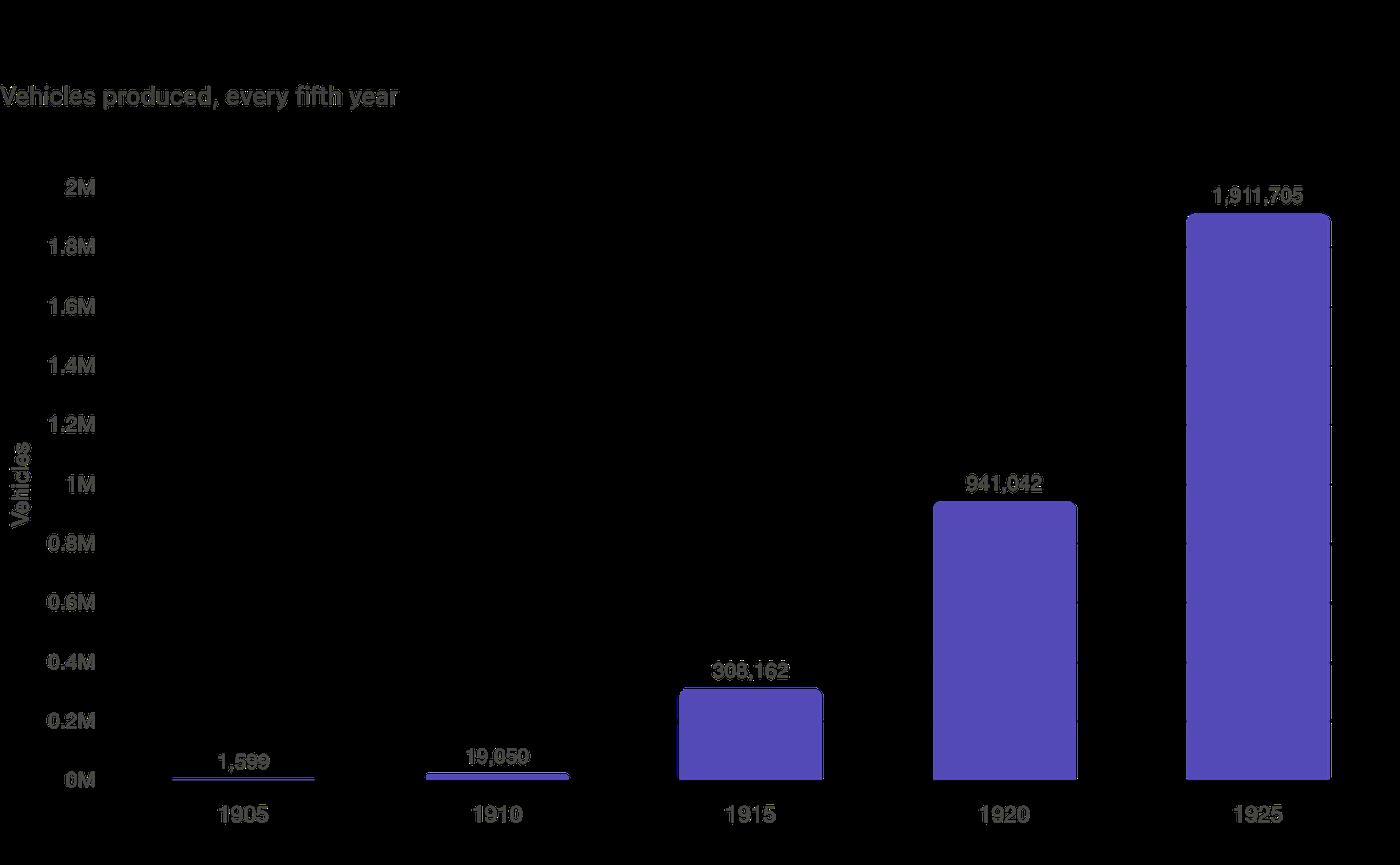
I think the best example of the Jevons Paradox is cars. The earliest cars were hand-made, one by one, so buying a car in 1900 cost about twice what most people made in a year. Because of this, very few cars were sold, and hardly anyone could earn a living by making them. Then in 1913 Henry Ford introduced the assembly line and reduced the labor necessary to make his Model T by almost 90%. By then the Model T had been assembled by hand for five years, so the workers at his factory likely thought their jobs were toast. In a sense they were right: assembly line work was very different than what they had learned to do, and in many ways it was worse. But they couldn’t have imagined what would come next. Here’s how many cars Ford sold from 1905 to 1925:
Ford’s plant employed 12,000 people in 1910; by 1920 it employed 40,000. But look at the bars for 1910 and 1920 above: Ford increased employment by 400% … and increased production by 4,500%. Our ability to consume more and more cars — which is to say, our ability to consume more and more transportation — meant that millions of people would earn their livelihoods in the automotive industry, including much of my family throughout the 20th century. Those millions of jobs only existed because “job-killing” technologies made cars affordable.
This doesn’t always happen when job-killing innovations come along. Sometimes they just kill jobs. Agriculture is a good example, because we produce food much more efficiently than in the past, but the agricultural labor force didn’t grow - it did this instead:
So in the case of cars, labor-saving tech created jobs, but in the case of food, labor-saving tech killed them. Why the difference?
In short, there’s only so much we can eat. (I contest that point whenever an Oreo McFlurry comes through the driver’s-side window – but even I have a tiny bit of shame, so it’s embarrassing to order more than two when it’s just you and the dog in the car.) When food gets cheaper, we eat a bit more than before – but consumption doesn’t multiply tenfold, or a hundred-fold. But cars? We can buy as many as we want. Here’s how many cars we owned per person from 1900 to 2000:
So whether a new technology will kill or create jobs depends mainly on how much we can increase our consumption of whatever it makes. If some blessed soul invents a $1 McFlurry, I will — with regret — cap my consumption at something like two a day. Three on Sundays and holidays.
All that said, it’s usually quite hard to predict whether demand for a product will rise or fall. Ten years ago, Impossible Burgers seemed ready to take the world by storm – then they didn’t. But if you told someone in 1905 that Ford would make 1.9 million cars in 1925, they couldn’t have conceived of it. This is partly because they would have had to imagine a different society, one where people didn’t need to live close to work and could go nearly anywhere for the weekend - not just where the trains ran. Whole cities were built around these changes, and broad social transformations like this are nearly impossible for most of us to envison before they happen.
Will AI Make IT Jobs Scarce?
Let me take two examples of fields where I think jobs will be steady or even increase: IT and law.
Computer science graduates have had a very hard time getting jobs lately, and some tech CEOs have talked openly about AI-driven hiring freezes and even layoffs. The ones who are singing this tune are, of course, selling AI-powered tools to corporate customers, so their hiring freezes and layoffs are part of the sales pitch: Our AI product will reduce your biggest cost – people. Other tech companies are doing business as usual, and some are taking the opportunity to hire top graduates in a soft market. Overall, the market is in a rough transitional period on the back end of an explosion of computer science majors:
The computer science wave seems to have crested, which is probably good. Official data isn’t out yet, but programs started reporting steady to lower enrollment in the Fall of 2025. I think studying computer science comes with AI risk, but so does studying a lot of other things right now. If incorporeal robots are the future of work, getting close to them might be a pretty good move.
To be clear, coding has been transformed in just the last year. Software engineers commonly don’t write their own code any more; they orchestrate code delivered by AI tools. That orchestration still requires an enormous amount of human expertise, and like the assembly line, it’s at least ten times more productive than the previous method.
So it comes to this: can we consume at least ten times more software? When I ask it that way, it seems like the answer could be no. But let me ask it this way: does the software you use at work suck? Or, is there software you only pretend to use … because it sucks? If I say this describes most corporate IT platforms, the only people who will deny it are the ones who sell corporate IT platforms. It also describes the still-terrible checkout experience at every online retailer except Amazon, and much other bad software that we simply take for granted.
On the Good Leadership Podcast a few weeks ago, Dan Mallin, a long-time corporate hand and software entrepreneur, said that the typical corporate IT department has about five years of “technical debt.” That’s the amount of work you have to do to make the software you currently have work properly. Forget about the software you should have. And by the way, making your ERP or CRM systems work properly won’t cause people to actually use them. Solving that is yet more work. (If you don’t know what an ERP or CRM system is, you should stop right now, say a prayer of thanksgiving to God, and forget about them forever.)
All of this is to say that we have a lot of very productive work left to do in software – making it better, and making better stuff. For the first decades of the computer era, we’ve been typing code with our fingers, something that will seem as absurd to the next generation of software developers as hand-making each Model T seemed by 1920.
Will AI Kill Legal Jobs?
My second example is law, and I can shorthand it this way:
* After decades of legal technology development, most legal work is still hand-crafted.
* If you ask the general counsel of a big company how much legal and compliance work doesn’t get done in her organization, she’ll tell you – well - we’re all right.
* Then she’ll close her office door and tell you the truth. You have no idea.
This is one of my principal fields of work, and I can attest that the “legal debt” in every big company is at least as formidable as the technical debt Dan Mallin described above. Organizations are simply too big and complex, and too fast-moving, for the lawyers to handle every question or review and tailor every contract. Not even close. And the cost of hiring more lawyers - forget it. They’re already some of the most expensive people in most companies.
Another example: when a big company like Netflix buys another big company like Warner Brothers, they are really acquiring tens of thousands of contracts. That’s what a corporation is — a nexus of contracts. The research Netflix’s lawyers do before the final purchase – called due diligence – usually involves looking at a just sample of those zillions of contracts, since it’s not humanly possible to look at them all. In other words, they’re buying a black box the contents of which are largely unknown - but they have an idea.
This could be done better, and AI will make it so. Most acquisitions destroy shareholder value, and it’s basically because their scale and complexity is far beyond any person’s ability to comprehend. It’s not just the contracts - it’s everything. We’ve been assembling increasingly complex corporate structures with duct tape and pliers. Now that it will be far cheaper to do the work thoroughly and well, I expect lawyers to remain very busy. And like IT engineers, they will increasingly be in the business of orchestration, not hand-crafting.
Law will be transformed at the consumer level, too. Over half of Americans have no will. Over fifty percent of people show up in court with no lawyer — they’re too expensive. Entrepreneurs regularly start businesses without incorporating them or papering their contracts. Small business owners rarely consult lawyers, and the same goes for management advisors and even accountants, not because they don’t need the advice, but because they can’t afford it. When did you last consult a lawyer? And I don’t mean your friend who went to law school.
AI will make legal services accessible, just as it will make big IT projects affordable and maybe even on time. I expect jobs in these fields to change, and I expect there will be lots of jobs in these fields going forward.
A Final Depressing Note About Suicide, Sort Of
It’s going to be painful. The French sociologist Emile Durkheim famously observed that the rate of suicide rises when the stock market falls, which is natural. But he also observed that the rate of suicide rises when the stock market rises. His point was that we are deeply shaken by big changes to economy and society, even if they seem like good changes. He called this anomie, because the French can make even suicide seem a bit stylish. I think AI will shake the world of white collar work at least as powerfully as blue collar work was shaken by the manufacturing boom of the early 20th century and its later decimation by robotics and offshoring. There were big winners and big losers in those moves. AI will be just as fearsome a transformation, and it will happen a lot faster. The pace of change in the AI era is what worries many experts, and I certainly agree. It’s not whether we can digest the technology, but whether our society can handle the torrid pace of change. To do that, we need America’s greatest generation to be in the future, not the past.
This is a public episode. If you'd like to discuss this with other subscribers or get access to bonus episodes, visit thecollegequestion.substack.com/subscribe