


درباره این اپیزود
What happened
RawStory, citing The Hill, reports that President Donald Trump’s friendly meetings with Chinese President Xi Jinping and New York City Mayor Zohran Mamdani unsettled Republicans four weeks before the midterm elections. Trump welcomed Xi to the White House shortly after U.S. officials said China had helped Iran target American troops, prompting Republican senators Roger Wicker and John Kennedy to criticize or caution against the outreach.
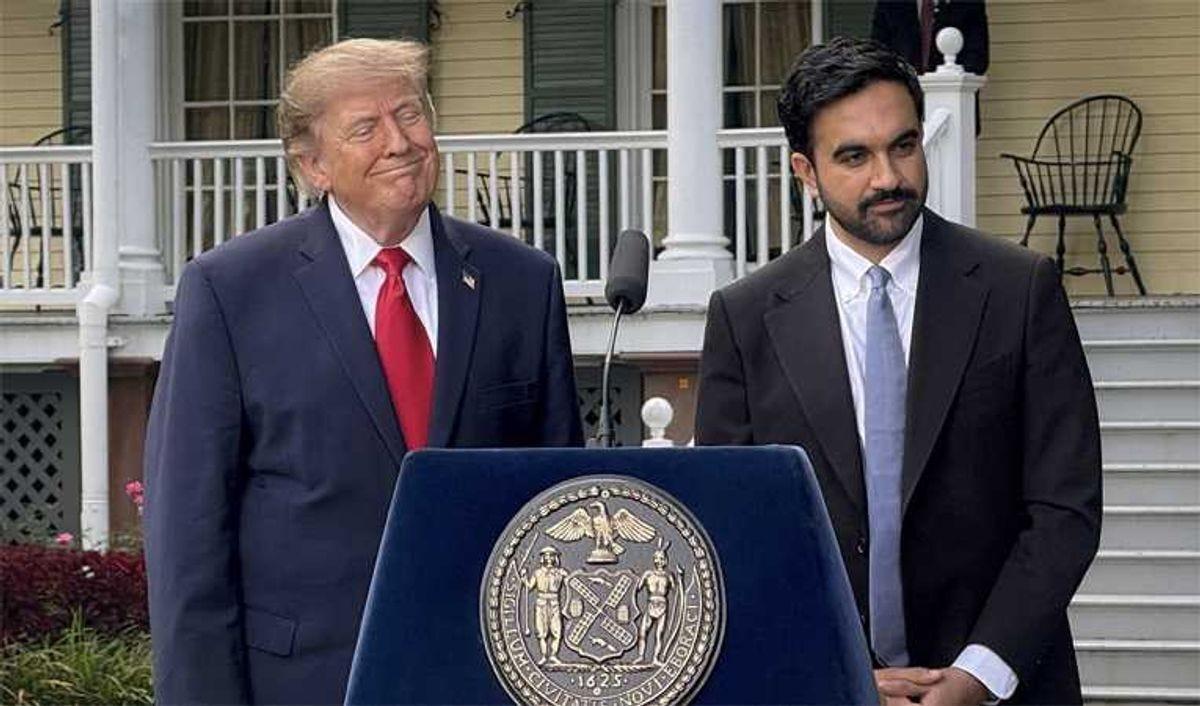
Trump also praised Mamdani after months of attacking him, calling the democratic socialist mayor “a very rational person” and saying he would cheer for him to improve New York. Asked whether Mamdani was a “jihadist,” as outgoing Republican Rep. Elise Stefanik had called him, Trump said no.
An unnamed Republican strategist described the shift as “inexplicable,” arguing that cordial treatment of two figures portrayed as enemies could depress Republican enthusiasm before the election. The reporting does not establish that Trump’s conduct has actually reduced turnout or cost Republicans congressional support; it documents Republican fear that it might.
The power belongs to Trump
The bewildered-strategist framing obscures the simplest explanation: Trump can change the party’s enemies because he commands the party’s political center. Republican lawmakers and operatives may dislike the reversal, but they are reacting to it, not controlling it.
Wicker can say Xi should never have received the invitation. Kennedy can warn that Beijing remains untrustworthy. Neither senator made the decision. Trump did. The same hierarchy governs the Mamdani meeting: Republicans spent months intensifying Trump’s attacks, only to discover that their designated villain could be rehabilitated the moment Trump found praise more useful.
Yesterday’s menace, today’s guest
The Mamdani episode exposes how disposable Republican threat language has become. Stefanik used “jihadist,” a smear designed to place a Muslim political opponent outside legitimate civic life. Trump discarded it with a single word after meeting the man it targeted.
That reversal does not erase the earlier attacks. It reveals their function. If Mamdani can move from supposed menace to “very rational person” without any reported ideological conversion, then the fevered language was never a stable assessment. It was political equipment: useful for mobilization until the party’s dominant figure chose another posture.
Xi presents a different and more consequential case. U.S. officials had reportedly linked China to Iranian targeting of American troops, yet Trump supplied the ceremonial legitimacy of a White House welcome. Republican objections may be substantive, electoral, or both. But the contradiction belongs to the president who authorized the reception, not to voters who fail to decode his shifting signals.
The base is treated as equipment
The unnamed strategist’s complaint is revealing. The concern is not principally that Trump’s policy is incoherent or that Republican descriptions of Mamdani were reckless. It is that the party had cultivated hostility toward Xi and Mamdani to produce votes, and Trump may have interrupted the emotional machinery four weeks before an election.
That is an admission about how the coalition is managed. Enemies are selected, simplified and repeated until outrage becomes a turnout strategy. When Trump suddenly offers warmth, Republican operatives call it inexplicable because they are counting on supporters to retain the hostility he taught them.
The insult is directed downward. Party leaders manufacture absolutist narratives, reverse them without explanation, and then worry that voters might become insufficiently energized. The base is expected to experience every new position as conviction and every contradiction as strategy.
Confusion is not the central story
RawStory’s “charm offensive” framing risks turning an exercise of presidential power into a personality puzzle. The consequential questions are not whether Trump has become unusually charming or whether Republicans understand him. They are what he chose to authorize, what his allies previously told voters, and how little power those allies possess to enforce their own rhetoric.
The reported congressional anxiety also should not be mistaken for resistance. The senators quoted objected to or qualified Trump’s outreach, while the strategist worried about electoral consequences. The article supplies no evidence that Republican officials imposed a cost, changed policy or withdrew support. Their discomfort demonstrates dependence more clearly than independence.
A coalition built on permission
This episode reveals a party in which hostility is centrally licensed. Trump can elevate an adversary, withdraw a slur or welcome a foreign leader, and Republicans must rapidly reconcile the new posture with yesterday’s claims.
That system produces more than hypocrisy. It makes policy contingent on one leader’s shifting permissions and turns propaganda into a renewable resource. The villains can change overnight; the institutional hierarchy does not. Republicans are reeling because Trump reminded them that even their outrage belongs to him.
Thanks to Raw Story
Source: Trump’s ‘inexplicable’ charm offensive toward his own enemies leaves GOP reeling
This is a public episode. If you'd like to discuss this with other subscribers or get access to bonus episodes, visit paulstsmith.substack.com/subscribe


