


درباره این اپیزود
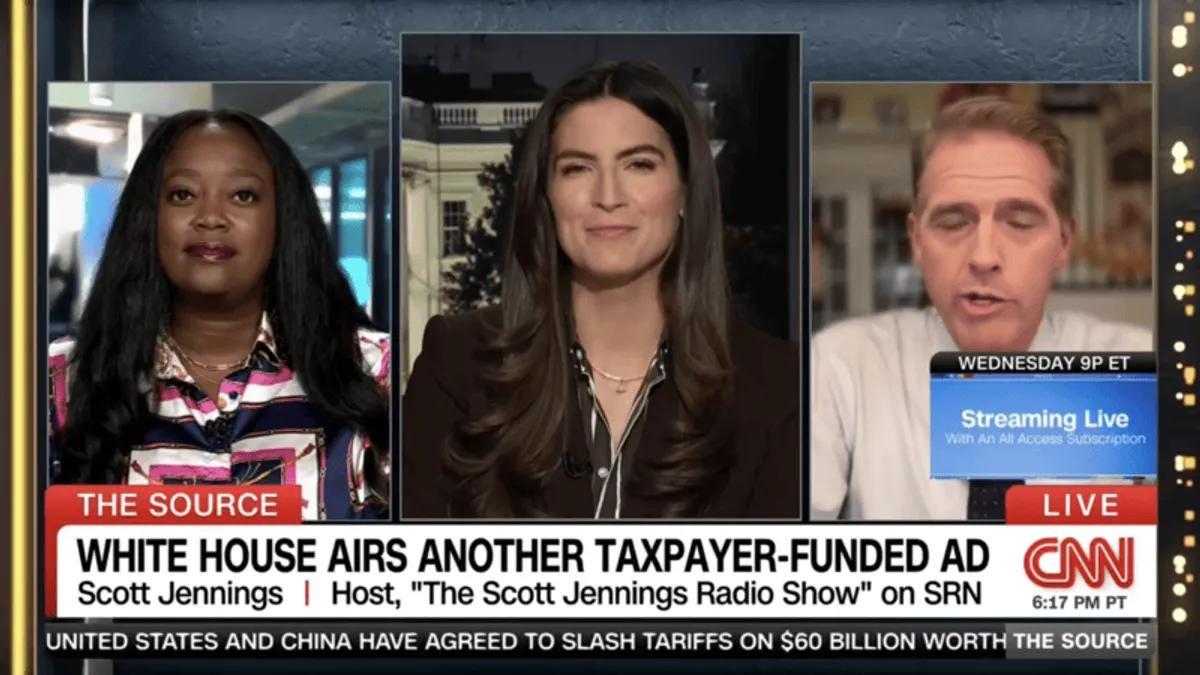
Conservative commentator Scott Jennings on CNN’s “The Arena.” (CNN screenshot)
What happened
RawStory reports that President Donald Trump played a leading role in creating two overtly political videos produced by the White House communications office and labeled “paid for by the U.S. Government.” The ads promoted Republicans ahead of the midterms; legal experts cited by the outlet said they clearly violated federal law.
On CNN, conservative strategist Scott Jennings defended the videos as public-service announcements, while conceding that campaign material may have been reused. Asked what public service they provided, he recast Trump’s attacks on “communism” as the message. CNN host Kaitlan Collins and Democratic strategist Ashley Allison challenged that explanation, pointing respectively to Trump’s reception of Chinese leader Xi Jinping and to the administration’s exclusion of disfavored press.
Help fuel the work. Independent analysis doesn’t fund itself:☕ Buy us a coffee
The power behind the ads
The decisive actor was not Jennings, and the important event was not his failed television defense. The president reportedly helped shape the ads. The White House communications office produced them. Federal money paid for them. That is the power structure: an incumbent administration using public resources to manufacture electoral messaging for the party it leads.
Jennings had no authority over that machinery. His function was reputational cleanup—offering viewers a softer label for conduct attributed to the White House. Calling partisan advertising a public-service announcement does not change who commissioned it, who benefited or who paid.
Euphemism as permission
“Public service announcement” is not an explanation here. It is an attempt to move the dispute from the government’s conduct to the audience’s vocabulary. Collins exposed the weakness by asking what service the videos actually provided. The reported answer amounted to this: warning voters about “communism” justified the expenditure.
That defense collapses government communication into partisan mobilization. If electing Republicans becomes a public service merely because the president supplies an ideological insult, then virtually any campaign advertisement can be charged to the public. The euphemism is consequential because it normalizes the underlying appropriation instead of contesting the reported facts.
The decoy argument
The segment’s theatrical question was whether Jennings had been “cornered.” That is television’s preferred scale: the clash, the laugh, the awkward pivot. But the institutional question is whether the White House used taxpayer-funded communications to advance Republican electoral interests and, as the cited experts concluded, violated federal law.
Focusing on whether a surrogate performed badly misdirects attention toward the weaker actor in the room. Jennings did not control the Treasury or the White House production apparatus. Trump and his administration reportedly controlled the decision. The pundit’s embarrassment is incidental; executive misuse of public resources is the material issue.
Anticommunism without principle
Jennings’s invocation of “communism” did not answer the funding question. It substituted ideological branding for a defense of government conduct. Collins’s reference to Trump welcoming Xi Jinping underscored the selectivity: the label was deployed against domestic opponents while practical engagement with China’s leader proceeded on different terms.
Allison’s broader point was sharper. Taxpayer-funded personal promotion and exclusion of hostile press are exercises of state power, not evidence against an opponent’s ideology. Her comparison was political rhetoric, not proof that the administration is communist. But it exposed how the accusation functions: as a distraction from specific conduct by the people currently controlling government institutions.
The system behind the spectacle
This story reveals a familiar cycle. Officials use public machinery for partisan advantage; allies rename the conduct; cable television stages the renaming as a debate; and the enforcement question recedes behind the performance. Even a forceful rebuttal can leave that structure intact if the story ends with a surrogate losing an argument.
The central consequence is not hypocrisy. It is the erosion of the boundary between state communication and party propaganda. When those holding executive power can treat the federal government as an incumbent campaign asset, language becomes the first enforcement mechanism to fail. Calling the product a public service does not make it one. It merely tests whether institutions—and journalists—will accept the label instead of following the money and naming the decision-makers.
Thanks to Raw Story
Source: Scott Jennings cornered on CNN over Trump’s ‘communist’ political ads: ‘What is this?’
Systemic Error is a reader-supported publication. To receive new posts and support my work, consider becoming a free or paid subscriber.
We warned them.We told them.We shouted from the rooftops.We plead.We begged.They didn’t listen.Now, we all will suffer.Y’all know what to do, right?VOTE BLUE! 💙Vote as if your life — nay, our country — depend on it.Because, this time, and every time, it does.
This is a public episode. If you'd like to discuss this with other subscribers or get access to bonus episodes, visit paulstsmith.substack.com/subscribe


