

Eboni: [00:00:00] Welcome to Spotlight on Community Colleges, the official podcast of the Council for the Study of Community Colleges. Here, we center the meaningful work conducted by administrators, researchers, faculty, staff, community members, and additional stakeholders, all in the means of elevating our community colleges.
Now, here are your hosts, Drs. Erin Doran, Carrie B. Kisker, and Brett Ranon Nachman.
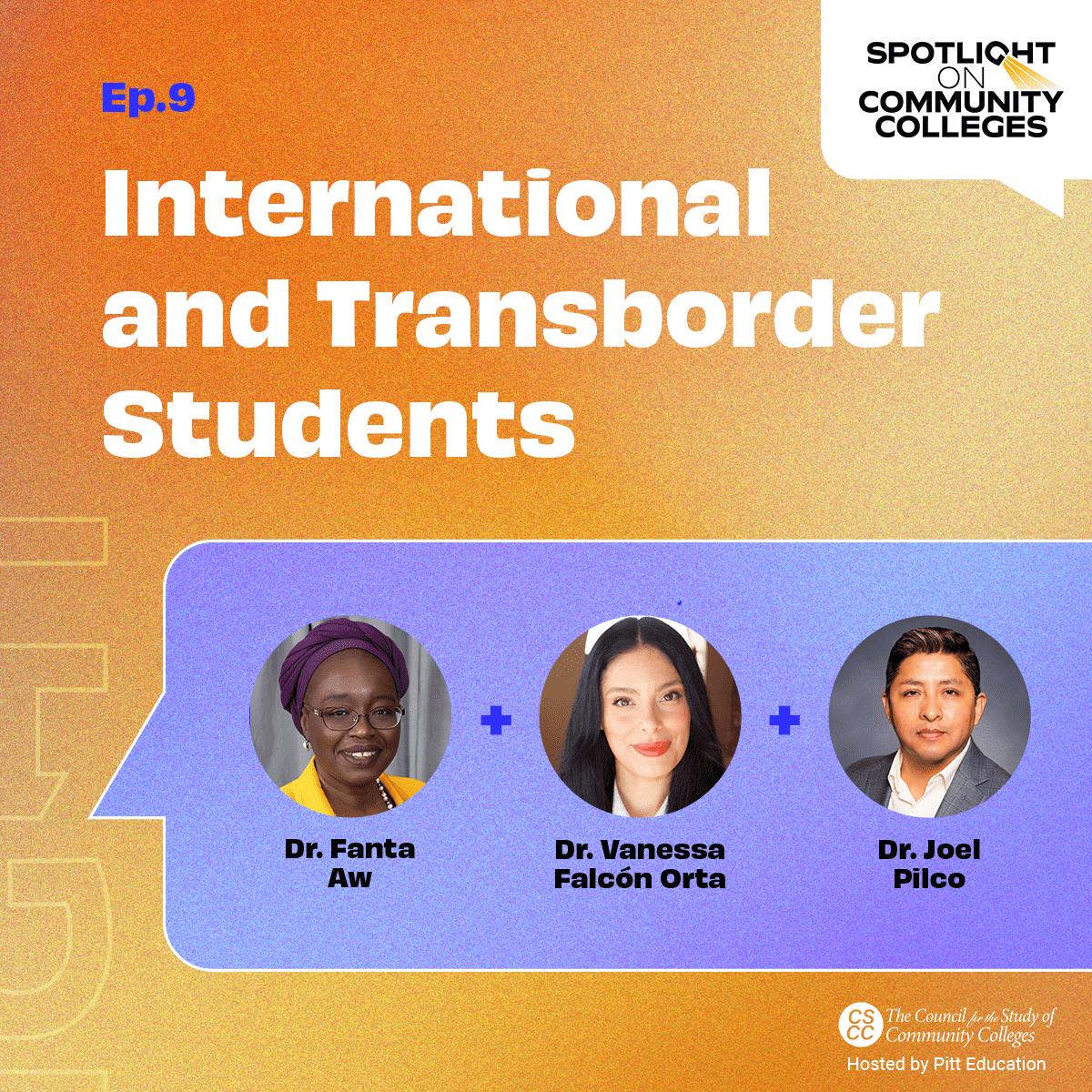
Carrie: Welcome to Spotlight on Community Colleges. I'm Carrie Kisker, and I'm joined today by fellow co-host Dr. Erin Doran, as well as three fantastic guests to talk about the experiences of international and transborder students attending. Or hoping to attend community colleges this fall, as well as how the colleges themselves are working to [00:01:00] support international students in what feels like a very fraught political and immigration landscape.
So this may not be news to many of our listeners, but a lot of people who don't live and breathe community colleges may be surprised to learn that these institutions enroll. 60,000 international students each year, which is somewhere between five to 10% of all international students in America, depending on the year.
Not surprisingly, these international and transborder students are concentrated in states such as California and Texas. At a large handful of institutions, or I should say a handful of large institutions such as Santa Monica College, De Anza and Houston Community Colleges international students make up between seven and 10% of the entire student body.
So if you are a longtime listener to spotlight on community colleges, you know that we typically start these episodes, with a little bit of [00:02:00] background and context for the topic of the day, and then we introduce our guests and get the conversation rolling. We're gonna do this a little bit differently today because I think with the incredible guests we have joining us , they will do a much better job of giving us some background and context for our current situation. So I would like to start by introducing our first guest who will tell us a little bit about what international students in America may be experiencing in summer and early fall of 2025. As they either begin attending post-secondary study, continue their post-secondary study in America, or maybe sitting around hoping that they can start, , at one of our colleges this fall.
So Dr. Fanta Aw is the former Vice President of undergraduate in Enrollment Campus Life and Inclusive Excellence at American University in Washington. DC and she is currently the CEO of NAFSA Association of [00:03:00] International Educators. NAFSA, which is N-A-F-S-A, is the world's largest and most comprehensive international education.
Association with more than 10,000 members at more than 4,000 institutions in over 140 countries. NAFSA is dedicated to the advancement of international education and exchange. So Dr. Aw, welcome to the podcast. I want to get to a recent report that NAFSA just published that projected a 30 to 40% decline in international student enrollment this fall.
But before we get into those. Quite frankly, astounding numbers and what they might mean for community colleges and other institutions of higher education. Could you just give us a sense of the policy and maybe political context that is contributing to this estimated drop in international student enrollment?
Dr. Fanta Aw: first of all, thank you Carrie, and thanks to all of our other guests for hAwing me. It's really a pleasure to be with you, [00:04:00] this afternoon. yes, so as an organization we get to work with professionals at various institutions around the United States and overseas, who really are dedicated to internationalization of their campus.
And so we get to hear firsthand what are the experiences that they're seeing on their campuses, what they're hearing from students from different parts of the world as they're trying to make their way, to our campuses. And it's no secret that since March we've seen an onslaught of Policy and regulatory changes that have really directly impacted international students and their full experiences here in the United States. Everything from Visa revocation to SEVIS record terminations to the detention of some international students. And then we saw in May this pause that took place with the Department of State whereby the decision was made that they were going to pause on Visa interviews for what was at the time, an [00:05:00] INDETERMINED period of time because they were implementing social media vetting.
And all of that has had direct impact on international students. Current students who are here in the US, who have felt really as a result of this, unsettled and frankly, I would say, to a large extent panicked by what has taken place. As well as prospective students who've been asking themselves the big question: should I be looking to the United States as a potential destination given all of the uncertainty, and frankly, what many would characterize as a very unwelcoming signal from the administration as far as international students are concerned. And so as a result, we have seen, campuses trying to, in many ways support their students in the best way that they could to make sure that students felt welcome on their campuses, while at the same time we're hAwing this very disjointed message.
From the administration, that continued to really create a lot of uncertainty for students. So we're still in that phase. we are now September 2nd, [00:06:00] and there are still many students who have yet to get their visas to be able to enter the United States. In some parts of the world, it is still not possible to get visa appointments.
Just for example, Japan, where we've had so many students from Japan over the decades that have come to the US to study when they're looking at, visa appointments. The earliest, perhaps they can have a Visa appointment is September 15th. This is for Japan. Then you can literally do the, look at around the world, whether it's India, China, look at most parts of Africa, and then you begin to see the puzzle that we're confronted with.
Luckily, for those students who were able to get their interviews before the pause, those students were able to proceed accordingly. And in proceedings, some have made it to campuses. We've heard from our colleagues that they've been able to welcome their students for orientation, but the uncertainty still remains.
So it's still too early to know where we're gonna fully land with the fall incoming class, knowing that we have some quarter systems that have [00:07:00] not yet started, where some of our other semester sort of base institutions have already started with their semester. Lots of uncertainty. Frankly, what I would say is for a lot of the international students feeling very, unsettled about the current situation.
Carrie: Yeah, I bet, uncertainty, certainly breeds chaos. And I heard you mention panic earlier too, and I can see why for students who've planned their lives around attending college in the United States and all of a sudden that is uncertain. So when I first introduced you, Dr. Aw, I mentioned NAFSA's recent report, which is based on SEVIS and state department data.
and in that report you projected a 30 to 40% decline in international enrollment this fall. Can you give us, a brief overview of your. Findings in that report, including the projected number of students affected, and then also talk a little bit about how the drop in enrollment translates into [00:08:00] lost jobs and lost revenue for states and localities and colleges and universities.
Dr. Fanta Aw: No, thank you for that. Yes. So we did our preliminary analysis that we released on July 29th. The analysis was based on data from the Student Exchange Visitor Information System, as well as the Department of State Visa issuance data. And based on that preliminary estimate. We have estimated a 30 to 40% drop in new enrollments of international students for this coming fall, which would then lead to a 15% total drop in total enrollment of international students.
And for anyone who's on a campus. We know that the fall has the largest intake of students generally, and so to have a fall intake and to have a 30 to 40% drop in new enrollment is significant. It is Awsolutely significant. That was a preliminary analysis and we caution that with that preliminary analysis, it would perhaps improve or it could get worse if the July or August [00:09:00] numbers of Visa issuance did not really materialize at the level that it should and, could.
And right now we are still waiting to get the data from the Department of State July and August, data, and we don't have any indication that things have improved significantly. In terms of job loss, it would amount to 60,000 job lost in overall numbers. It would mean a drop of 150,000 new students who would not be making it to the United States for this coming fall.
And in addition, it would come to about seven, $7 billion in loss. And with our analysis, we're able to determine what that looks like per state. And we often have talked about the loss is not only in terms of tuition and fees. The loss is really at the level of communities, at the level of cities, at the level of towns, rural or urban, because international students, as we know, are enrolled in all of our different states and in different counties and in urban and rural areas as well.
So [00:10:00] this will have impact for not only universities, but it will have impact for local communities because these are students who rent. These are students who purchase goods. These are students who get insurance. Who use medical services with their insurance and all of that. And so to have this level of loss at a time when there's economic uncertainty just is another sort of perfect storm, is how I would describe this.
Carrie: Thank you for that. Let me ask you to speak. On a more personal level, and I apologize in advance, I didn't give you this question in advance, but it's been percolating in my brain. And, the NAFSA report to me really drives home what I think is a fundamental misunderstanding of why the United States invites so many fantastic international students to come study with us every year.
and in particular, it not only does it overlook the contributions both. to our communities and in [00:11:00] terms of, monetary revenue. but it also just completely disregards the idea that I personally would love every student in our colleges and universities to be able to study Awroad for at least a couple weeks, just to expose to a different culture, to a different way of life.
But I also recognize that many of our college students can't afford that or don't have the opportunity to do that. By bringing in students from other cultures and countries, and with different experiences from around the world, it is one way of globalizing our own citizenry, too. So it seems to me that not only are we overlooking the fiscal impact and the community impact of these visa, revocations, and crackdowns and so on.
but we're also doing our own domestic students a huge disservice. Maybe you agree with me, maybe you don't, Can you, share your thoughts on that. [00:12:00]
Dr. Fanta Aw: Yeah, no, thank you for raising this because, we've talked about the economic impact.
But this is so beyond the economic impact because one of the key things, particularly with international education. Is the fact that it's about people to people connection, and we cannot understate how critical and how vital that is in an interdependent world. The United States is not an island unto itself.
It's part of the larger global world that we're part of. And so it's incredibly important. For the Awerage American and for everyone, for that matter, to stay connected to the rest of the world. And international students in many ways constitute that bridge with the world. Yeah. So by hAwing students from different nationalities, different background, different religious background and so forth, coming in for different fields of study at our institutions makes us stronger and it makes us more really, when we know how to leverage that, it makes us more interculturally competent in a world.
That's right. That really requires that I think of anyone. That is incredibly important. And as you said, our American students don't always have [00:13:00] the opportunity to be able to go overseas to study for a myriad of reasons. So this really gives them a window into the world in a way that is so important. So by denying these students the ability to come and study in the United States really impacts us on lots of level culturally, socially, and economically.
And I think that is the story that often is not told. We have less than 10% of US students who have the ability to study overseas, and we hear consistently from students that among the reasons they're unable to study overseas are due to finances. By hAwing international students here, we're able to help bridge that gap to a large level, and this would mean that we're gonna have more students coming through our institutions who will not have those opportunities and that will have a long-term effect and impact for the United States because it means that our students will not be as competitive in what is a global economy. And that, to me, would've been self-inflicted from [00:14:00] our government because our students, for the most part, really do deserve to get the best education, and part of that education needs to be a global education.
That is not something that should be given to folks based on your socioeconomic status or where you choose to study, it should be considered part of what a 21st century education is, by and large. And that to me is also really the tragedy of this whole thing, is that we are closing our doors to folks who will be our future leaders in different parts of the world.
We're closing our doors to folks who we could bring businesses to the United States down the road, but more importantly, we're closing doors. What could potentially be lifelong friendships that could be forged, that would benefit all of us in the long run. Because after all, we're talking about the next generation of leaders in this country and outside of this country.
Carrie: Yeah. Thank you. I really, I got goosebumps listening to you talk just now, Dr. Aw, because I think that it is, [00:15:00] especially in this period, where we don't know what kind of. Jobs and impact AI will have and other technology will have that there's a sort of a renewed focus on the 21st century skills that all of us and all of our students need in order to be able to, not only contribute, but lead our countries in a global, interconnected system in the future, and this is a huge part of it. I just have, one quick question for you and then I, wanna pivot a little bit. You mentioned in your report that. about 1.2 million international students studied in American colleges and universities in the last academic year.
and you also mentioned that you're looking at least probAwly 150,000, student enrollment drop This fall. So we talk for the most part about community colleges on this podcast. And I know you cannot, prize [00:16:00] apart how many of those might be lost at community colleges as opposed to universities, and other institutions.
But we also know that a huge proportion of these are graduate students too, coming to the US Yes. To continue their study. That is correct. I know you have no. precise figures, but can you give us a sense of what the community college sector might be experiencing or if it's experiencing everything along with the university sector?
Dr. Fanta Aw: Yeah, no, thank you for that. I do think that, when we think about the impact, will be felt in the entire ecosystem, and community colleges will feel that impact as well. As you said earlier, when you first introduced the segment, the proportion of international students in community colleges is not negligible by any means.
Community colleges I think occupy a very, what I would say, a very unique sort of, niche within us higher education. It is something that is prized around the world because there are not many countries that [00:17:00] have what we have here in the US that happens to be with community colleges.
And what I think is so unique about community colleges is how they're so intertwined with community. And the importance of that. And so for international students who in particular find themselves at community colleges, they get a unique experience that often really engages them much more deeply with the community.
And also community colleges are very, focused on workforce development. So there are all of these different sort of that community colleges bring that are very attractive to international students. So what I would see is community colleges will be impacted proportionally to their size because unfortunately with this visa sort of suspension and the difficulties of getting interviews, it's affecting the entire sector.
It is not privileging any sector, vis-a-vis other sectors. So for example, it's not that private elite institutions are hAwing a better shot at getting visas than community colleges or four year publics. Everyone is being impacted [00:18:00] accordingly, and that I think is the, hardest part of this.
The other part of it is that community colleges have often been one that have also been so focused on equity. Access. And so particularly for international students who are not from the elite of the elite in terms of socioeconomically, this has afforded them a quality education in the United States.
And they disproportionately, I think, often confront more challenges in trying to make it to the US because of all of the biases that you can imagine. And so they really, in many ways are disproportionately, I think, affected. Whether it's students from the Middle East, whether it's students from the Caribbean, from Africa, and from literally all over, community colleges attract from all over the world.
And that to me is one of the things that we cannot lose sight of is really the access and affordability that community colleges provide that is so unique and that is necessary and needed if there's gonna be an even level playing field for students. So [00:19:00] they're gonna be affected by these numbers, in a way that I think, again, is unfortunate.
It's quite unfortunate. Especially also because international students who often come to community colleges because of the transfer process that exists with four years, 99% of the time they come to get an associate degree to then progress. Two, four year institutions to earn bachelor's degree.
And certainly there are community colleges that also issue bachelor's degrees as well. But that progression is really a natural course of action given the articulation agreements that exist with community colleges and four year institutions throughout this country. And that is an incredibly attractive feature of community colleges in addition to the excellent education that they provide.
So yes, they're gonna be impacted. We don't know the exact numbers. But I think it's safe to say it's gonna be proportional to their size as well.
Erin: Thank you so much for that context. And just as a reminder of the work that community colleges do in serving all of the students find themselves at their [00:20:00] doors.
we're gonna pivot a little bit. We're gonna talk a little bit more about international students at community colleges, like who they are, where they come from. But before we get deeper into that conversation, I'd like to introduce our second guest, Dr. Vanessa Falcon Orta. Dr. Falcon, is an assistant professor in the School of Education at San Diego State University, and a founding director of the Trans Border Scholars Thriving Institute.
Dr. Falcon's work centers on social justice for Transborder students and the preparation of critically conscious border educators, specifically in the San Diego Tijuana Borderlands, where many students pass over the US Mexico border each day to study in California community colleges and other post-secondary spaces.
I would even like to give a shout out to my local community college, El Paso Community College and my, my university utep, knowing that there are thousands of students who cross the border, and the bridges every day [00:21:00] to pursue their education. Dr. Falcon, thank you for being here. Oftentimes when we talk about international students, we tend to overlook trans border students, either because we don't know a lot about them or because many of them exist in a sort of immigration gray area.
It seems to me that transborder transborder students may be even more affected by the current political context as they must not only contend with visa slowdowns and revocations, but also the huge rise in immigration and customs enforcement raids and detention. I know as an educator on the border, we've received, notifications, for instance, about possible ICE activities in and around our communities.
can you give us a sense of who transborder students are and what they have always had to contend with to pursue their post-secondary education? And then maybe speak a little bit about the added challenges, this summer and this [00:22:00] fall of 2025.
Dr. Vanessa Falcon Orta: Yes, Awsolutely. thank you for hAwing me. So who are transborder students?
transborder students are a diverse heterogeneous population, but in, in a nutshell, some commonalities about transborder students is that most transborder students are US born or naturalized citizens. Who due to various reasons have been, led to live transborder lives. So what is a transborder life?
living a transborder life means that you cross the border often, maybe even daily. You are significantly involved on both sides of the border, linguistically, culturally, socially. The factors that lead transborder students to live these lives, again, are many, but some of the.
The prevalent, factors that I [00:23:00] found in my research and my work are three. the first is, due to economic hardship. hAwing immigrated migrated to the United States, their families being, first generation, second generation. But due to economic hardship, families, seek, stable living arrangements, and humane living arrangements in, Mexico, but yet cross the border daily to continue their studies, in native, homeland. That was the case for me. I've, been a trans border student my entire life, and the only reason why I'm no longer a trans transborder student is because now I'm a transborder professor.
and so economic hardship is one of the reasons. the second is, forming part of mixed immigration status families. So due to, deportation maybe mom, dad, or, family overall, they opt to cross the border daily. One to practice their [00:24:00] human right to an education in the us. but at the same time, they crossed the border to stay together with their loved ones, to st still be able to, be with mom, be with dad in spite of, facing deportation, but at the same time crossing to, to continue to attend, education.
the, third, most prevalent reason why transborder students, end up living these, transbordered lives, are because they were born into transborder families. Grandma, grandpa, great-grandpa, are zos transborder and, they're born into that lifestyle. And, it's the, border cross them and their families, not them crossing the border.
Those are just a few of the reasons. There are many, but those are the most prevalent that I've found in my research. Also about transborder students. As I mentioned, they are a diverse. [00:25:00] Heterogeneous population, they are prevalent along the US Mexico borderlands. Also, it is a global phenomena. So you don't only have, trans border students in the US Mexico Borderlands, you have trans border students all over the world, but specifically for us, trans border students are prevalent along the US Mexico Borderlands and throughout the education pipeline from, Kindergarten, all the way to doctoral studies also, when they begin to live transborder lives. very, so like I mentioned, some of them are born into, these transborder families and already start, living, Lives where they cross borders and they cross the border often and daily, since a very, young age.
Others, maybe a little bit older in high school community college, I've even had, participants in my research, live, begin to live transborder lives. In doctoral studies as well. [00:26:00] So they definitely vary. However, what are some commonalities, and realities that they've lived?
Currently we are, the political context is, is. Very, tense and difficult really for all our students of color. and in including transborder students. So some of those realities look like, You know of highly policed, environment, militarized environment, which is the environment of the US Mexico border to understand trans border students, we really do have to also understand the nature of the US Mexico border, which is a highly policed and militarized environment.
It's an interdependent border that. Kept open to achieve, political, agendas between both nations and, yes, you have the crossing of goods. You have the crossing of, of, money, of things. And you also have [00:27:00] the, crossing of people. And as people cross, they are in this, highly policed and militarized environment, specifically for transborder students.
This is an environment that they are faced with. Daily.
Erin: Thank you. my next question is for both of you. We've been talking about numbers of international students and transbordering students whose education and training is being disrupted by current immigration policies and disruptions to the student visa process. Let's take a minute and humanize these students, both those who are hoping to come to the US on a student visa and those who may be crossing the border to attend college in the United States.
Who are these students who are getting turned away from American colleges? How are they coping? Are they looking to attend college elsewhere, or are their dreams deferred for now? we'll start with you, Dr. Aw. You, you've sort of already talked about this particularly in, [00:28:00] in terms of these are not only students, these are potential friends, potential classmates, potential collAworators.
but would you like to start with those questions?
Dr. Fanta Aw: Yeah, no, thank you for, this important question. I would say every single student is not a number, right? have, they have a story and, as was mentioned before when Carrie talked about the international student journey, in order to make a decision to leAwe your home, your, home country to go far away to get an education has to requires for you to plan well ahead.
And it's a commitment not just on the part of the student. It's a commitment on the part of an entire family. And so this is about the dreams and aspirations of not only the students, but the dreams and aspirations of their families and their communities. On many levels. And that preparation easily takes two, sometimes three, sometimes four years before you actually get, to the United States, because you first have to identify where am I gonna go study?[00:29:00]
What am I gonna go study? Then you go through the whole application process and if English is not your first language, you have to go through English testing and the list goes on and on for them to make it here. And I think what is the common story for the international students is the story of resilience.
And the story of courage is really what is the consistent story that I have. I've seen with students throughout the decades that I've been working with international students. you're gonna leAwe your family behind. You know you're gonna leAwe what is so familiar for you behind. And in order to start a new, to start a new place, a place where no one knows you and why you're starting all over again.
But students will, make those decisions. At the end of the day, they put their education first and believe in the value of education, and they're willing to make it happen, whatever it takes to make that happen. And their families are relying on them, to make that happen. And I think that's part of the story of international students.
And then once they're here, they go through culture shock and [00:30:00] cultural adjustment, and all the things that we know students go through when we're on campuses. Except that for them it often tends to be much more amplified. Because you have sometimes the language barrier, you have the cultural barriers, you have the educational systems that are very different educational systems that you need to adapt to and so forth.
But they make it happen. And they make it happen because they're willing to work very hard and they make it happen because the va, the belief that education is that social mobility that can afford you perhaps a better life, not only for you, but for your family. That I think is the common story of international students.
There are those who come who may be from families that can afford it easily, and there are those who've literally been sAwing for years and have put all of their resources toward this lifetime investment. But they feel like it was, it's the right investment to make because there is no substitute for that education.
I think that's the story, but every single international student has a name and every single international student has a story. [00:31:00] And that's what I think we should all be able to hold onto.
Erin: Dr. Falcon. what might you add to that about transborder students?
Dr. Vanessa Falcon Orta: Yes. I think. The dream deferred is definitely the reality of not hAwing access to community college for transborder students. like many students of color in the us, their access to higher education is the community college.
I wouldn't be here today talking with all of you in this podcast interview if it weren't for the community college system. I began higher education in the community college. So that is the, difficult reality of, not hAwing access to community colleges. What are some obstacles, some challenges that, cause that dream to be deferred?
definitely the gray area of not understanding, who transborder students are and, and [00:32:00] falling in between the cracks. as US citizens transborder students. Don't, they're not international students, but also, as they nAwigate borderlands and nations and states, in their nature of being trans border people, they, are well in, in the morning.
they start their day, in, for example. In my ca, California, Baja, California Borderlands, they start the day in, in Tijuana in me. And then, they're the, in a few hours they are in, the US and they spend, whether it's in, in, in Calex or in San Diego, and their entire day is, In those cities, in those in, those regions.
And, and they are from here and they are from there. Home is California, home is, Baja, California. home is the US home is Mexico. But however, we haven't [00:33:00] quite. developed, the vocAwulary and the policies and the practices to, capture those realities as is the history of higher education.
we're slowly, but surely catching up to our diverse student populations. and transborder students is definitely one of those populations that we need to catch up to, to develop policies and practices that best, fit their realities. one. One, policy that I do wanna point out is the assembly bill.
it's, 91. So AB 91, does provide, that, access to community colleges in spite of the reality of being transborder students and being, calling, home both sides or maybe calling home Baha, California. and for. And the challenge about Aw 91 is that it's very new.
it's just, been into place about a, about [00:34:00] a year. And, so community colleges are beginning to catch up to, understanding the assembly bill, how to best implement it. I do wanna do, shameless plug to shout out to, Mitzi Salgado, the policy scholar organizer behind this assembly bill. so she has.
The, what is called Transborderista Institute, who is dedicated to supporting, community colleges and educating, them, to best understand how to, enroll their students, but also helping, students nAwigate, higher education, and community college specifically. in light of, the policy and the fact that, Their, this is their human right. and access to education under, Homeland is, something that shouldn't have been an obstacle since the beginning. But now with, AB 91 working towards ameliorating, that challenge to, lastly to add, I do wanna, echo, Dr. Aw's point on [00:35:00] the how we. To deny access to, whether it's our international students or our transborder students.
access to community college. We're also denying, an enriching opportunity for all our students, specifically for transborder students. hAwing lived the borderlands and crossing the border daily, they see the disparities and the, Just the oppression that exists at the border every day, because of that understanding and, realities that they, see daily, about the oppression dehumanization of the border and border enforcing policies.
They're very dedicated to civic leadership on both sides of the border as well as. Activism on both sides of the border to support communities who are affected by the border and border enforcing policies, like refugees, asylum seekers, immigrant [00:36:00] migrants, and yes, also, their very own community, transborder students.
to deny access to education anywhere in the pipeline and specifically for community colleges. We're denying this, very rich opportunity of leadership that is not only, leadership by students, but also leadership that is shaping our borders and really the future of our borderlands regions.
Carrie: Thank you so much Dr. Falcon. I have one quick follow up question and then a, a final question for both of you. You said that transborder students, while they are. US citizens or dual citizens are used to, to some extent the, police, activity that exists at the border.
but I know here in Los Angeles where I live, we've seen not only increased police activity, but increased militarization of, anything related [00:37:00] to, immigration. whether it's legal or illegal. Sometimes it feels like it, it doesn't, Make a difference. And so I wonder in that environment of increased militarization at the US Mexico border, are you seeing that deterring some of these transborder students from coming each day or each week for their education, is that.
contributing in the same way to the fear and some of the panic that our international students are experiencing, or is that just, occurring as normal, but with a few more complications? How would you describe what's happening today for those students?
Dr. Vanessa Falcon Orta: I would say occurring as normal with a lot of complications.
Dr. Aw mentioned, international students are resilient and courageous, so are transborder students. And what are the, what are the consequences or realities of being resilient and [00:38:00] courageous? just because we are resilient and courageous doesn't mean that. these obstacles are any less challenging.
They're still difficult. So what happens is that in facing these, highly policed and militarized environments, which have been amplified since the, the, initial, MAGA era, 2016, 2017, and then now currently, once again, it has been amplified with a third. Border wall. It has been amplified with literal, barbed wire in, ports of entry.
where you don't only see it, you almost sometimes with maybe if you're however you're crossing, you might almost even feel it if you are crossing with a motorcycle. To even like tear gas demonstrations and, even attacks in 2018, unfortunately from u US customs agents [00:39:00] into Tijuana, Mexico.
so this, hostile militarized environment has been certainly amplified, which creates psychosocial stressors for our transborder students. Anxiety. Depression. Exhaustion, because the borders are, the border wait times at times are longer. Malnutrition, not being, not being able to access a, meal.
'Cause you wake up at four in the morning, you cross the border, you get to school, there's just no time. Sometimes economic hardship is also a factor. And then you get home at 10 to do it all over again the next day. So those psychosocial stressors, that, they are resilient and courageous.
They push through, but at the same time, there, there, is a price to pay for that resilience. and which no student, no matter who, student, no matter who they are, who should have to pay that price to have an access to the human right [00:40:00] to an education. So I do have one piece of advice on how to ameliorate.
as a professor, what I try to do is I always try to think, outside the box, what can I do? How can I best support, my students? And one thing that I do try to do is use technology nowadays. There is no reason why a student should miss class if maybe their little one gets sick or, if they close the border or they, They're afraid to cross too late because, femicide is a reality at the borderlands, and they're afraid to cross to leAwe class at nine, at, 9:45 PM and to cross and to get home at 11 or 12. It's okay, I understand. no problem. We can make adjustments. We can, make class accessible, be it zoom there.
With, nowadays with technology, there's Awsolutely no reason why any student should be missing [00:41:00] out on their education. That's one. Method that I've applied. But I would love to see, this, method applied more, more through the encouragement by, let's say administration, to allow that flexibility. I haven't seen it too much yet, but I would love to see it because again, no students should have to miss out on their education.
and this is really for all students. You mentioned, undocumented students also, face this, Hostile environment and sometimes are afraid, to go through to campus because maybe there is a checkpoint near home. And also they shouldn't have to miss out. And, you know, we do have to think outside the box to best serve our, students.
Carrie: Thank you. I really appreciate that. and I also appreciate that you brought undocumented students back into the picture too, because in many ways, they're facing a lot of the same. Complications challenges. [00:42:00] you actually started to answer my next question for you, Dr. Falcon, which is what advice would you have for community college faculty and staff who are doing their best to try to support international and transborder students?
So thank you for, giving us the perfect segue there. But maybe I'll turn the question to you, Dr. Aw. What advice would you have for community college administrators and faculty about how they can work with their transborder and international and perhaps even undocumented students right now? to make them feel welcome and to communicate that they will be there with them, through every step of this now, much longer and more complicated process.
Dr. Fanta Aw: Yeah, no, I think Dr. Falcon touched on some really important insights here, that I would, move forward with. One is, first and foremost, we have to remember that these are students first, and as students coming to our campuses, have the, they have the, need for belonging is incredibly important.[00:43:00]
Knowing that is actually quite important for campuses to make sure that they're equipped with services that are culturally responsive. And I think it's really important. As Dr. Falcon said, we should not mistake resilience. For the fact that these are students who will not need support.
I think it's incredibly important for us to remember that. And so the ability to humanize and the ability to understand sort of the human experience here and the, the age group that these students are coming in, is incredibly important. And so making sure that the support services are present is key.
And I would say institution needs to be proactive. They really have to be proactive in terms of the mental health support that is needed, the social support, the social safety net that students really need in order to be able to thrive and to ensure that those are in place and that we don't just take that for granted, I think is incredibly important.
More than anything else, I do not believe that universities today can over communicate. Students need to be hearing from leadership. They need to be hearing from all corners of the [00:44:00] campus that they're truly welcome here, and not just in soundbites, but in our everyday acts that are taking place. And I think that's really important because what we're currently facing right now is a massive trust deficit because of this administration and for all the reasons you can imagine, there's major trust deficit.
Students need to know that they can trust their institutions, that they can trust the leadership of their institutions, and that they're looking out for the student's interest and more importantly, that they're all committed to student success and outcomes I think that is quite important and there's this sort of, notion that we have in many of our cultures, and it's really the notion of La Familia.
People need to know that this is their family, that this is an extended family for them. They've left a lot of things behind, and it's really important to know that community is truly your community, and that they see you, they hear you, and that you're valued. I think that is quite important for every one of our institutions to be able to reiterate that to our students on an everyday [00:45:00] basis.
Carrie: Yeah. Thank you. I couldn't say it any better than that. I would like to thank you both, Dr. Falcon and Dr. Aw for joining us today and sharing your insights and your understanding of what is probAwly changing very rapidly on the ground, at our community colleges and universities every day.
Dr. Fanta Aw: Thank you for hAwing us truly, thank you.
Dr. Vanessa Falcon Orta: Thank you so much.
Carrie: I'd like to turn now to Dr. Joel Pilco. Dr. Pilco, or Joel as he has asked us to call him. Is it the Director of Binational and International programs at Southwestern College in Chula Vista, California? Dr. Pilco, welcome to the podcast.
Dr. Joel Pilco: Thank you for the invitation. It's a pleasure to be here with you.
Carrie: thanks so much. We appreciate your time. Tell us a little bit about Southwestern College and the work you do to support international and transborder students, and if you would like to also give us just a little bit of a sense of who you are and what your background is [00:46:00] leading you to this current position as well, that would be wonderful.
Dr. Joel Pilco: Sure. Thank you. Let's start with my background. I am a graduate of the community college system. In fact, I attended Southwestern College where again, my associate's degree back in the nineties. And, as an immigrant I have that, firsthand experience of how difficult it could be to adjust to the US education system, ESL, all the.
different options, but sometimes confusing options, that, we, have here in higher education. And after that I was fortunate enough to get a full scholarship to a private university also in San Diego, where I did my bachelor's and move on to the Master's and then, continue my, my work, in higher education and, then my doctorate.
I came back to Southwestern College, after more than 20 years. since I graduated and, came back with, the intention to [00:47:00] support students. The way I was supported when I was a student here, but also with the intention to really identify the areas that are still barriers and obstacles for, for them to attain their education.
And it's been fantastic to work at this institution where we have, close to, 29,000 students in our system, five different centers in Southern California, and we are the only educational institution. In this part of the city, and that's very unique. What also makes us quite unique is that we are so close to the border, the, Choula Vista campus where I am.
it's probably about 15 minutes from the. San Ysidro border and the other two campuses that we have, they're probably minutes away from the border itself. So California, Arizona, and Texas. We share, very unique perspectives on education and, [00:48:00] binational education. What I do is I serve students from the Binational International Program Office.
This is probably the only community college. That has a department fully dedicated to supporting these student populations. it's, it's really an honor to, to do what we do here because, we have, another, very important element of uniqueness and that is that 69% of our same population identify and as Hispanic Latino.
Of course due to the proximity of, to the border and such, but what we do here is to create opportunities, programs to remove the barriers for both by national and international students. And I'll be glad to share some examples, some of the challenges that we face and of course, give you, firsthand, account onto, what it is that we do here at Southwestern College
Erin: Thank you for that. [00:49:00] Earlier in the podcast, we heard about the visa disruptions in immigration policies that are leading to huge projected drop in international transborder students. Can you tell us what it looks like at Southwestern College and how you and your colleagues are responding?
Dr. Joel Pilco: We've been really affected by the delay on visa issuance, especially because of that time of the years when students are making their final decisions. So stopping the Visas at that time was detrimental to our recruitment efforts and enrollment. on the international student side, we welcome less than 50%.
Of the number of students we typically welcome in numbers, we welcome about 18 students compared to 40 45 that we typically welcome in fall, in the fall semester. So that tells you right away that students, are really, considering other options in the world besides the US and that, with such delay of more than four, I think five weeks, [00:50:00] visa interviews. They either decided to stay home. Or look for other options. So that is for international students, for our binational programs. we do also have students who are Mexican citizens who, attend school here, using the F1 motor commuter visa, which is the visa that allows 'em to cross the border every day.
They have classes, right? Similarly, we seen a decrease of more than 50% in the number of enrolled students this semester. So all in all, I think we share the, Challenge, but also, we are, we're trying to figure out. How we can better support these students. And what we did was, of course, provide more training on how to prepare for the Visa interviews, the documentation.
We, did a lot of work reaching out to our binational students and their families and speaking to them in Spanish to help them understand how the process works. And, to our international students the [00:51:00] same. We provide a lot of Zoom support. Preorientation. typically we had one or two preorientation this year we had maybe four and five.
So all in all, I think we are trying to adapt to the new reality, but the new reality is quite concerning.
Carrie: So I have a bunch of follow up questions for that. Because I agree that this is. This is incredibly concerning and heartbreaking. so maybe I'll give you both questions now and you can choose to answer them in whatever order. Makes sense. What is the effect on the institution on Southwestern College to lose 50% of your international and binational student populations?
Question A, what does that mean for. Revenue for, for faculty and staff for the future of the institution. And then maybe you can pivot also to, what does this mean [00:52:00] for both the students whose dreams are being deferred, and those students who have been able to make it to campus and attend classes, but are now, in a population of fellow international or binational students that is cut in half.
Dr. Joel Pilco: those are great questions. So I want to clarify that. in terms of new students, we welcome 50% less than usual. this is the second, week of classes. We are going to determine the total of number of current students now, and have a better idea as to the impact, right? I believe that overall in our international student population, we're probably gonna see a decrease by about 10 15%.
Now, how is that going to financially impact the institution? the program is not that large yet in college compared to the total number of students, enrolled. So I believe that it's gonna take a [00:53:00] little bit more time to really assess how this is going to financially impact our budget. However, what is real is that this is not gonna get better soon.
So the question would be how is this gonna affect next year's budget? How is this going to affect our ability to recruit overseas? And more than anything, how is this going to affect the, countries where we typically recruit from the community college, as an as, an offering to international students, has specific areas where students come from that is changing completely.
Many of my colleagues will say that, I thought I had a, a wonderful, opportunity in Bangladesh, Pakistan, Vietnam. But now we don't know. So I believe that in the next, few months, all of us in the industry are gonna be able to assess where the new markets will be. And now take [00:54:00] into account political.
Issues and many other issues that really affect, what we're doing as an example, we typically do very well in Vietnam because of the weather here in San Diego and that we have a large Vietnamese community. However, students don't want a camera right now because the relationships to the two countries, although they're not negative, they're not positive the way they used to be.
So that's one example.
Erin: That's so interesting 'cause you don't, I don't normally think about the ways that community colleges are intentionally recruiting internationally. we just think of something that is done maybe in the local service area, maybe outreach to, to area high schools that are identified as feeder schools.
You don't necessarily think about community colleges having these comprehensive recruitment plans that, that take place internationally.
Dr. Joel Pilco: that's a great comment. we are very, glad to say that we've been recruiting outside the us. [00:55:00] Vietnam, Philippines. We went to the Middle East, Brazil, Mexico.
we also went to Europe, intentionally of recruiting students. And more than anything, to be honest with you, presenting the idea of what a community college is. The benefits of attending a community college, I feel that we still have a lot to do in that area internationally and even domestically.
A lot of people still don't know what a community college is, so it's been, it's been a lot of work and we were, about to see great results. In fact, the indications in the last couple semesters led us to believe that yeah, more students are coming and they benefit from this experience. However, at this point we are in unknown territory because.
I dunno what's gonna happen. thank you for that follow up question. when it comes to like binational students, I think, [00:56:00] although we were affected by the Visa issuance delay, I think because of our proximity to Mexico, we continue the relationships with the students and their families. I visit, Mexico at least once a week.
And we work very closely with the Department of Education in the state of Baja California, and also with the US Consulate in Tijuana. therefore, we, we can manage the information better, and I will say to some extent the situation, but, same situation. We, just don't know what's gonna happen.
Carrie: Thank you. and I'll remind you of the second part of that question because I know I dropped two on you at the same time, which is how are students coping, both the students who you may be in touch with, who are delayed or having to defer. Their education, journeys and those who may be on campus, but dealing with added complications or pressures or lack of community?
Dr. Joel Pilco: I'll start with the current students who are the [00:57:00] ones who are on campus, right? I think that for the last six months or more, we have seen a lot of distress. Anxiety. Students, wondering whether or not they should go visit home at the end of the year because they're afraid to, be sent to secondary inspection on the way back.
I think that a lot of the students, last semester were sent to secondary inspection for no apparent reason. It was just to check documentation, which we understand it's part of what, needs to happen, but at the end of the day when you see so many students with the same, experiences, you really wondering, what else can we do to prepare the students for these secondary inspections?
I think that. Also, we saw a lot of students, wondering whether or not they should continue their studies in the us. And I can tell you that we had a few students, at least a few students who decided to go back home. I recall, a case of a student from the Philippines whose family said, that's too dangerous for you to be in the US just [00:58:00] come home.
And the student had to make the hard decision to go home. when it comes to new students enrolling this semester, I feel that. the stress was all about getting the visa and once the, visa interview dates, were available, what does it mean to provide my social media? information. How's, how long is that going to take?
And, nobody knew how to support the students, right? We didn't, we, we didn't have guidance, other than, Hey, you have to pro provide this information and, just wait to see the results. part of that also included the timing, right? How long is it gonna take for my visa? To be review compared to previous years.
And we saw, in many cases, students who had to wait a few additional days to learn of the results from the Visa interview. I'll summarize the situation by saying that it was quite [00:59:00] stressful for students. very stressful for us, as administrators as well. 'cause we didn't have more information.
And I think that overall, as I mentioned earlier. Having less than 50% the usual number of new students. This, semester reflects all the anxiety and decisions that were made by those students and their families not to come to the us.
Carrie: Yeah, I can imagine. so earlier in the show, we asked the question of our two other guests.
Who approach this more from, either a scholarly or a national association angle. but I'd like to pose the same question to you. And so we asked, them, do they have any advice for community college faculty and staff for how they can better reach out to. Either aspiring or current international and transborder students at the moment, or how they [01:00:00] can work to make their campuses more welcoming or provide this services and support, that these students are needing at the moment.
And so I'll ask you what, have you learned, through your experiences at Southwestern College and what advice might you have for your colleagues around the country?
Dr. Joel Pilco: I really appreciate that question. I'm gonna answer as a practitioner, right? So for binational trans border students, the first thing to do is have presence be available.
In Mexico, and that's what we do through our partnerships with the Department of Education and the other organizations. We even have office hours in Tijuana. Therefore we have family members who talk about parents, grandparents coming to speak with us, to understand what is the US education system, what are general education courses, so on so forth.
So I think that goes a long way in building that trust. As we know, students, from outside the US typically make this [01:01:00] decision in a family setting, right? The parents are very involved in what school you go to and what major perhaps you're going to pursue. So that was, a big, element for us. And, we do have a lot of presence in Mexico for our international students.
We did something similar, via Zoom. So we had, as I mentioned earlier, a lot of pre-orientation. The first one was, how do I access my student portal and how do I do this? How do I register? Really, I'm holding the students to the process. I would say that most schools, we do that in orientation, but I'll say that we took orientation, to the 10th flag, just to make sure the students were feeling comfortable.
The results were fantastic. Most of the students were registering classes before they came to the us. That was also useful when they had to go through immigration, right? Not only they were able to show their documents that proved they were eligible, but also they show proof that they were [01:02:00] already registering classes.
Now, to create a more welcoming environment, what we did was to support students initiatives and to, help students, new students get connected with current students. Here at Southwestern College, we have an international student club. That it's really active. They have about 120 students, registered and our new students are getting, that welcome.
We have activities, come here, we can answer any questions. Similarly, for our binational transborder students, we have the binational frontierista Student Club. They have over 180 students in, in, in, in, their activities. So we get to connect with them. alongside all these efforts, I think we made, we made it possible and we are lucky that we have a staff member that speak multiple languages.
To connect with the students and their families [01:03:00] in Spanish, in Portuguese, in Vietnamese, in the languages that we can right here in the office. So that was, a big difference here. Now, we continue our activities in welcoming these students. we have a dedicated counselor here who helps both student populations, but, we also are creating a lot more activities for the students to feel engaged.
To reduce that sense of fear. Am I doing something right? Can I do this? Should I go out, carrying my passport? All those little questions, we are reinforcing the information and making ourselves available more than ever. Any little question, come and see us. And I think that's been, a huge difference.
And when it comes to the collateral experience, I feel that the uniqueness of our students having to cross the border. Makes it so that sometimes, we have to reach out to faculty members to let 'em know students might be late for class today because there was a huge delay at the border. [01:04:00] Now most schools don't have to do that, right?
So we try to find ways to better communicate with faculty members and the school as a whole, the district, to make sure they understand why students might be delayed to class.
Carrie: Yeah, that's really useful. Gosh, it's just a whole new set of considerations on top of everything else that community colleges and their faculty and staff already do.
Yeah. to support other students. is there anything that we haven't directly asked about Dr. Picco that you would like to make sure that, we're aware of as we're. trying to understand what the situation is for international and transborder or binational students.
Dr. Joel Pilco: Yes. I would like to emphasize the ongoing support services that we created and we continue to offer. I think they're very unique and I would like to give you two examples. knowing that. Our students cross the border. We, were able to partner with US Customs and [01:05:00] Border Protection for the last three to four semesters.
In doing so, our students, were able to apply for a global entry century pass. And through this partnership, their applications were reviewed in three to four months, and even the global entry interview was conducted at our campus. So I think we, supported That sounds
Carrie: easier than my global entry interview.
That's fantastic. Fantastic. Indeed.
Dr. Joel Pilco: Indeed. I think the general, public has waited about a year and a half or so, right? So that was monumental for our ation. So we really are trying to understand what do they need? we're not gonna change the border, right? But we can create, opportunities for, that to be easier for them.
And I think in the last, two years, we service up to 450 students, faculty, and staff to obtain the global entry center pass. So that was fantastic. Another thing that we do for our [01:06:00] Binational transborder students is that we host, binational graduation in Tijuana. We've been doing that for three years already, and it's been a wonderful experience for the students who have family members who cannot cross the border and otherwise, of course wouldn't be able to attend, the event here, in Chula Vista.
And, we have taken these initiatives to the next level by starting to, have. Academic partnerships with universities in Tijuana whereby we can offer one class, to our students with our professor, at that campus in Tijuana so they can eliminate one day of crossing the border, which creates extreme, anxiety for them.
So those are some of the examples of the ongoing programs that we have available for, by national and transborder students. But again, I feel that all of us are adjusting. Learning how to navigate, these waters. I was, [01:07:00] working with international students during nine 11, and I can tell you that, it was very dramatic.
this time around there's a lot more uncertainty somehow, and, in my experience, I was able to probably say, okay, maybe we need to peel two those markets. But right now we're finding it very difficult to identify. Where should we go to put students, for the next, semesters?
Carrie: Yeah, that's, an interesting point. I hadn't thought about that, as both a parallel and a departure from what we've experienced in the past. Thank you so much, Joel, for joining us and sharing a little bit about your work, and I'm hoping that. The many thousands of community college faculty and staff members, especially at colleges near the border, get the chance to listen to this episode and get some [01:08:00] inspiration from you and what your colleagues are doing at Southwestern College to support these students, because I have to imagine that uncertainty, leads to a lot of sleepless nights and fear and worry, and questions about whether it's worth it to continue their.
Education and training. So I'm just so thankful for all the intentionality and compassion that you and your colleagues bring to your work. I would like to also thank all three of our guests for sharing their insights and experiences with us today. And also thank you listeners for joining us for this episode of Spotlight on Community Colleges.
.
Carrie: Join us for our next episode, which will air on Wednesday, October 15th. Until then, keep up the good work that you all do to help strengthen community colleges and support the incredible students who attend them. This is Spotlight on Community Colleges. [01:09:00] Thanks for listening.
