

Eboni: [00:00:00] Welcome to Spotlight on Community Colleges, the official podcast of the Council for the Study of Community Colleges. Here, we center the meaningful work conducted by administrators, researchers, faculty, staff, community members, and additional stakeholders, all in the means of elevating our community colleges.
Now, here are your hosts, Drs. Erin Doran, Carrie B. Kisker, and Brett Ranon Nachman.
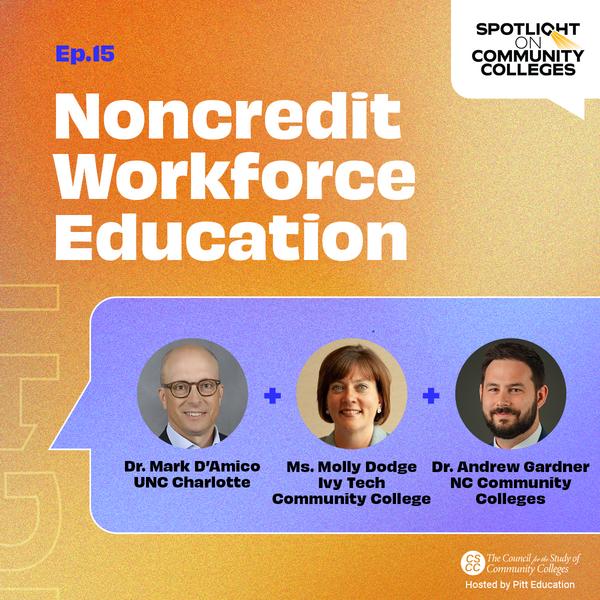
Carrie: Welcome to Spotlight on Community Colleges. I'm Carrie Kisker and I'm joined today by fellow co-host Dr. Erin Doran, as well as
three wonderful guests
to talk about non-credit workforce education in community colleges. To set the context for this conversation, I wanna share one statistic and one quote.
The American Association of Community [00:01:00] Colleges estimates that about 40% of headcount enrollment at community colleges is in non-credit bearing courses and programs. That's about 4.2 million non-credit students each year. However, as one of our guests has written so much, is unknown about non-credit education, that it is often referred to as the hidden college.
Indeed, much of what we know about non-credit community college education today at a national level has been the result of a huge collaborative effort between one of our guests today, Dr. Mark D'Amico, and a number of his colleagues, including, especially Dr. Michelle Van Noy from Rutgers University.
As Dr. D'Amico has extensively documented, there are four main types of non-credit education in community colleges. First and what we'll be talking about today is what we call occupational training, which is typically paid for by individual students on a tuition or fee basis. [00:02:00] Non-credit occupational training can often look very similar to credit-based courses leading to occupational certification or degrees, but they're typically shorter in duration and offered in specific career-focused areas.
Second, we have sponsored occupational or what some call contract training, which is when employers pay for the training for the benefit of their employees. On top of that, we have non-credit courses for personal interest. We've all heard about the age old underwater basket weaving courses. I suppose they would fall in that category if they existed.
And we also have pre-college programs such as basic skills training and English as a second language. For the purposes of today's discussion, we're gonna focus primarily on the first of those categories, the occupational training or non-credit workforce development. In particular, we're gonna talk about what we know about non-credit occupational training and community colleges and what we still [00:03:00] don't know.
We're gonna hear from our colleagues in the colleges about where they are putting their occupational training efforts, and we will ask about the major challenges and opportunities they're experiencing in that. Finally, we are gonna talk about how everything may or may not be expanded or upended by the implementation of workforce Pell.
Later this year. So let's get into it. I'd like to introduce you first to Erin's and my colleague and very good friend, Dr. Mark D'Amico. Mark is a professor of higher education at the University of North Carolina, Charlotte, where he has taught since 2009. Prior to joining UNC Charlotte's faculty, mark spent about 15 years working in various community college administrative positions.
In addition to publishing more than 60 scholarly articles and book chapters on community college transfer and non-credit education, mark is one of the founders of the non-credit research collaborative, a group of scholars [00:04:00] seeking to conduct and share methodologically rigorous research on non-credit programs and student outcomes to inform policy and practice.
I'd also like to introduce two incredible voices from the colleges, including Ms. Molly Dodge, senior Vice President for Workforce and Careers at Ivy Tech Community College in Indiana. And Dr. Andrew Gardner, associate Vice President for Workforce Strategies for the North Carolina Community Colleges.
Welcome to the program, mark, Molly and Andrew, thank you for making time to talk with us today.
Mark: Thank you.
Andrew: Pleasure.
Carrie: We're very glad you're here. mark, let's start with you. You are considered an expert in non-credit education, but you've also argued that non-credit training still very much occurs in a black box.
Can you tell us a little bit about what we know and still don't know about non-credit workforce education on a national scale?
Mark: Carrie, thanks. Thanks for the question and thanks again [00:05:00] for the invitation. Really appreciate you and Erin having, having me, and, and excited to be on with two, colleagues, Andrew and Molly.
So what do we know? you already mentioned that, we know around 4 million students a year. Participate in a community college non-credit education. We know that more and more adults are really looking for shorter term educational options in today's economy, especially those that are leading to credentials.
we know from our research. State level funding for non-credit is highly variable through a variety of mechanisms. Some states might, might have non-credit, or shorter term training as a part of funding formulas. Other states might have special workforce funding, and some states might have no funding at all.
that goes toward these types of programs. We know that community colleges use these non-credit, this non-credit function, which is [00:06:00] highly adaptable to really meet the unique needs of their service areas. there probably isn't a more adaptable, higher education mechanism than non-credit to do what's needed in a local area.
Today. so I, think that's really important, but we also know that non-credit data collection hasn't been nearly as robust as on the credit side, and that leaves unknowns, as we work with, with data sets, whether it's institution or state data sets. There are a lot of missing demographic information.
What seems like really basic information on the credit side might be missing for non-credit. we know that more work needs to be done on academic and labor market outcomes. Some of that has to do with not having, great data, and this lack of data really led to the project that you mentioned.
Carrie, the state non-credit data project that I work on with Michelle Van Noy and, her colleagues at the [00:07:00] Rutgers Education and employment research center. and I think over time there is more and more attention to building out these data to try to tackle some of these unknowns. So maybe I'd argue that these days the black box is becoming a little bit more transparent than it has and, and I think that trend will continue over time.
Carrie: That's, fantastic news. And, do in no small part to your, and Michelle's and others' efforts on that front. So thank you for that. I'm probably not alone in being especially interested in the value of non-credit workforce training programs. What do we know about the extent to which they lead to substantial wage gains or employment prospects, for the students going through them?
Mark: Yeah. So there, there is not a huge body of research, I think largely because of the, lack of data availability when it comes to, especially the labor market outcomes. However, we are seeing more and more [00:08:00] research in this area. And, I'd just point you to a couple of recent studies from colleagues that are a part of the non-credit research collaborative that you mentioned.
Peter Barr, who's at Strada and his colleague Rooney Columbus. They just released, a study looking at Texas data in 2025, and they found some modest quarterly earnings gains, from students who are in these non-credit occupational programs. Then another colleague, di ju and, she and their team, they looked at Virginia and, and Virginia's non-credit workforce training.
And they also found modest, both earnings and employment gains. And I'd encourage folks to go look at their studies and they can find 'em on our, on the, collaborative website, noncredit research.org. But I think one of the things to think about is that. These findings and the positive outcomes are highly variable by program [00:09:00] area.
could be also by program configuration. you wouldn't expect that, that a program that lasts for 10 hours to have the same impacts as one that lasts for a hundred, contact hours. So, I think we really need to consider the context and quality of programs when it comes to, to these outcomes as well.
Carrie: Yeah, I thank you for pointing that out. I was gonna say, modest wage gains doesn't sound like much, but when you consider that a lot of these programs maybe are as few as 10 hours, but are often eight weeks, 16 weeks, quite short term programs. A modest wage increase is actually no laughing matter.
Like that. That's actually potentially a very good sign.
Mark: Yeah, I agree. I think that's the key is thinking about, thinking about both wage and employment gains as well. 'cause for some it might be gaining employment and, that's a, that's a real, that's a [00:10:00] real important outcome too.
Erin: And Mark, just as a point of clarification, these sort of non-credit, programs can provide both initial training for someone trying to get into a field, but also retraining or upskilling as well, correct. Like they can serve a variety of purpose.
Mark: That's absolutely right.
and I think, if you were to talk with, folks and we, will be here in, in a little bit, folks who are overseeing these programs, students are enrolling for a variety of purposes, different points in their career. everything from initial employment training to incumbent worker training.
I think the key is, quality and the connection to, To those, improved, outcomes for individuals.
Andrew: I know we'll talk about it later, but I can attest to, the community colleges are certainly in the lifelong learner, space and we're here to serve and we're excited about [00:11:00] what we can do in this space.
Carrie: Yeah, I'm wondering if to some extent, these non-credit skills training programs are the community colleges, community college, right?
That they are the most open to people of all ages and all backgrounds and all levels of training coming back, for all kinds of purposes. Molly and Andrew, I wanna hear from each of you about. The non-credit skills training that you're doing at your own institutions and across your states, but before we get to that.
I'm hoping you'll address a bit of an elephant in the room. and that is the term non-credit. I used it throughout the opening of this show because I think to date it is still the most recognizable term for training that does not necessarily accrue toward a college degree. And Mark has used it extensively in his research as well, but there are many who argue that the term non-credit is itself deficit based and that it defines this type of training.
And potentially the students in these [00:12:00] programs as what they are not as opposed to what they are. do the two or three of you have a strong opinion about this term and whether and how it should be used? Molly, maybe I'll start with you.
Molly: Carrie, thank you for bringing up this topic.
I'm, quite passionate about it, and you and Mark are forgiven for using the term non-credit, but. About three years ago, Ivy Tech completely, eliminated that word from our vocabulary and we now refer to it as skills training. And with the goal that at Ivy Tech, what we are building is an integrated system of, breaking down the silos between academic affairs and our workforce training.
And so by doing so, we're creating on-ramps for students. Through skills training that lead into an academic stackable degree pathway, if that's what a learner, is interested in and aligns [00:13:00] with their career goal. So if we don't want a student coming in through a door that starts with non, these are very valuable trainings as Mark just attested to.
And, you said in your opening and honestly, in the eyes of the employer, these trainings are, the technical skills that they are. They are looking for as they interview our students. And when our students can demonstrate skill mastery, they, find themselves a very valuable, opportunities in the job market.
Carrie: Thank you, Molly. I thought you might have an opinion on that.
Andrew: Yeah, I'll chime in and say we're certainly at a crossroads. We're going through identity crisis. We're more popular than ever, but we need to have a strong name that embodies who we are and what we do. in North Carolina, we currently have the name Workforce Continuing Education, but, I, I believe in probably the near future, we're going to, get an [00:14:00] upgrade in the name there to really represent what we're doing.
In the past, we've hosted, things such as the Career Credit Leadership Institute, where we. Extensively left out the word non-credit, and we focus on this being a career credit. So we've made sure we've lifted up that terminology. But again, we need to go into a brand recognition phase as workforce Pell is around the corner.
And, at the end of the day, this is accelerated training that gets folks into the workforce. So we need a term that embodies that and everybody can get on board with and get excited about.
Carrie: That sounds like an assignment for you, mark.
Mark: I, love this conversation. I, think what's so great about this conversation is that it's one that's talking about the value of this education and, and, and, non.
Definitely has a, negative connotation. Carrie, in your intro remarks, you talked about the typology that I created now more than 15 years ago, and yes, it's a non-credit typology, but really the [00:15:00] focus are those four different functions within this umbrella, and you don't see non in any of those.
Terms, it really is descriptive to what it is. So I do still use non-credit as the, the umbrella, but I'm a huge fan of removing the nons, especially in student and community facing communication. I think that's where it's most important. So if we need to for now until a, new term comes, talk about non-credit.
'cause it's what everybody understands the national level. I'm okay with that for now. but I do love, like what Molly and Andrew are talking about in initiatives within their institutions and states, to communicate, this education for what it is, which is high value training. With one caveat though, and I love that Molly talked about the pathways and the on-ramps to more education.
We do need to be transparent with students about what the education is and what it leads [00:16:00] to, so there isn't confusion. If a, course or program does not lead to something that's credit based, they need to know that upfront. we can see that in, in several places within education. If we're not transparent upfront, that doesn't mean we need to call it a non, but we need to definitely communicate exactly what we're offering.
Erin: Yeah, we see the way that we have to move away from different terms. So for me, in developmental education, we don't say remedial anymore, and we shouldn't say remedial anymore. We don't talk about traditional students anymore because we shouldn't be talking about that in, in, these sort of normative ways.
So that's, a great thing. So Molly and Andrew, I'm interested in how each of your colleges or your states is thinking or prioritizing skills education. I'm gonna stick with skills education since Molly told me to. so Molly, what type of skills or occupational training programs has Ivy Tech invested in the most?
and, [00:17:00] how have you made those decisions about where to invest in those resources?
Molly: Yeah, thanks for that question, Erin. And now you're my favorite because you're calling it skills education. I, Ivy Tech, has been doing. The skills training work for decades and traditionally, we were offering sort of standard plug and play courses like CPR, osha and those have some value in the labor market, but we actually, hired a firm called Economy Partners in 2024 to actually, help us understand the skills gaps in Indiana and where, those gaps were and where, and what we found were, opportunities to really shift our skills training focus to Indiana's higher wage sectors like advanced manufacturing, healthcare, and IT, and leadership. we, see those gaps showing up, [00:18:00] especially in upskill pathways across our state as.
As Indiana is, a highly manufacturing state and we begin to con or we continue to automate across our state. those, skills are critically important. so that study really helped us, understand where to put our focus. And as part of that study we did. Numerous interviews with employers and intermediaries across the state to get not only quantitative data, to direct our focus, but also qualitative data about skills and trainings that were needed.
Erin: Excellent. Thank you. And Andrew, the same question to you. I know you're talking more at a state or system level. where has North Carolina prioritized its skills? Education in terms of resources and investments?
Andrew: Yeah, so I'm proud to say that North Carolina has invested in this space for a long time. [00:19:00] there's a lot of state funding that goes towards these programs and even additional funding that goes at our colleges where they have courses that align to a credentials of value.
as far as credentials of value, the way we label it and categorize it is we have in North Carolina what's called a North Carolina Workforce Credential list, and that was create co-created between multiple stakeholders. The community college system, my future NC Department of Public Instruction, North Carolina Commerce, and of course, most importantly, business and industry had input on how they valued these credentials.
we had a value system that had at a foundation level, essential career in advance. So that kind of gave us our rank and order as far as the level of credentials. And the great thing about having a list like that is once we rolled out a state. Financial aid, opportunity for folks in these short-term training programs.
We're able to link it to this list. If it's on this list, these students can get these resources. [00:20:00] As we are mature, our model, we're moving forward with a business model called Propel NC where we equal the level playing field for those. Careers and programs that leap to these high wage, high demand workforce sectors.
Whether you're pursuing this pathway for a degree program or it's a short term training program, we're valuing more so those industry and workforce sectors. And some of those include healthcare, public safety, it, and advanced manufacturing skilled trades. So we're really putting a lot of additional funding towards those efforts and we're really, excited about where we're going in the skills-based era Wonderful. So I'm interested Andrew and Molly with, both Ivy Tech and the North Carolina system has been doing this for many, years now. What have been some of the major challenges that, that your institutions or your states or the students in these skills training programs have experienced?
Carrie: and then what [00:21:00] are, some of the, major. Opportunities or real milestone achievements that you've experienced along the way as well. And maybe Andrew, we'll start with you this time.
Andrew: Yeah. Ha, happy to jump in there. I think in our earlier conversation we talked about transparency and stackability and showing the student pathway forward.
I think we have done some work in North Carolina to try to create these pathways and be, transparent as far as. What this course can translate to and what it cannot, but there's so much room for improvement there with increase in our policies, maybe just clearly documenting what those crosswalks are there, and also having strong articulation agreements, not only between the community college two year level.
But we're seeing folks that are continuing on to the bachelor's degree. So we're even engaging in conversations on how we take the stair step, not just for community college, but to the university level. And I think with workforce Pell, it's just forcing the issue even more so. we're excited [00:22:00] about the economic mobility opportunities for our students with this.
Carrie: Yeah. Thank you.
Molly: I think some of the challenges will not be surprising, as it relates to student participation in, our skills training. our state is not as, as generous, on, providing funding to support our non-credit programs as, we are with funding to support. Short term academic programs, but we are very interested in, workforce Pell, which we'll talk about in a little bit.
So, often we lack consistent funding to offer this training on a regular basis. And so, we need to balance, affordability for our students to participate with, good quality training that, that leads to a credential and, A valuable skill. also a limiting factor is always instructor, capacity.
So Especially in CTE [00:23:00] areas, which are booming across our campuses, our 19 campuses in Indiana, it's always, difficult to find additional instructors for, the non-credit. but one bright spot that I'll highlight is. data and outcome tracking also has its limitations.
But we are excited to have a partnership with Credlands. and Credlands is, aspires to be the National Data Trust for third party certifications. And we are working alongside them as they, build their infrastructure, to collect that third party data so that we can have true insights. about our students', success in, our skills training programs leading to certifications.
So I'm excited about what the future holds in terms of the black box that Mark talks about. and we're [00:24:00] really pleased to have that partnership with Credlin.
Carrie: Wonderful. Thank you. So it seems like, there are probably some of the same challenges that, that we all encounter across the community college enterprise, and then there are some that are pretty specific to this type of short-term skills training.
Mark, did you have a thought you wanted to share?
Mark: Yeah, I, think what Andrew and Molly shared, I think is right on. maybe something else I'd bring up though too is that, the great thing about non-credit is that it's not really bound by tradition because it's not historically credit based.
At the same time, so much of higher education is bound by tradition, like hundreds of years of what higher education is and is supposed to be. So even. some of the limitations on the non-credit or skills training side, moving into credit is bound by some barriers related to the traditional credit hour mindset.
and that has played out and [00:25:00] there's been writing on this. it plays out even in terms of the way community colleges are organized. When there is, say, a continuing education division and an academic division and the two are not the same, or if the data, and this goes to, our project, if, the data for non-credit are housed in one data system and the credit are housed in another, the way I always think about it is it's really tough to articulate if you can't even track.
And so, there need to be these connections and in terms of the, or the way this can be done organizationally. I think there's a movement, I know in North Carolina and other states, toward a quote unquote one college model that really works to integrate the, non-credit and, the credit sides of the house, if you will.
It's not a great way to put it, but it's the way it's talked about, like bringing these together organizationally to [00:26:00] try to overcome some of those barriers and to bring, these shorter term training options. Within mainstream higher education. I, think there are lots of challenges because of, of how, the, this non-credit, shorter term training space just is not the overall higher ed norm.
Carrie: Yeah. that's an interesting point, mark and I've seen some of that work. Maybe it's what you're referencing at, at Pima Community College where they're trying to reorganize. Under the belief that all education is at its heart preparation for careers and all training is also preparation for further education.
And so trying to reorganize departments to be inclusive of both continuing ed skills, training and the more traditional academic degree pathways, sounds like an organizational challenge. Not impossible, but, as you noted. There's 400 years of [00:27:00] history getting in the way of, some of those things too.
despite all of these challenges, it seems to me, and maybe the three of you will affirm this, that non-credit programs are, perhaps because they've developed outside of this. norm, are easier to get off the grounds or, perhaps, more easy to adapt or evolve and to response to workforce demands than, these credit bearing programs.
maybe that has to do with the faculty and who's teaching them and the credentials, and governance expectations attached to that. Maybe it's due to, the close. Connection to workforce. Can you all speak to, some of the opportunities that are presented through these type of skills training programs?
Molly: Yeah, I'm happy to take that one and I'll connect it to the comment that you made about structure and that Mark made about structure. So at Ivy Tech, we are structured very [00:28:00] uniquely, as senior Vice president of workforce and careers. I am a cabinet level person, a peer to the provost, and actually in my division I have vice presidents who oversee eight academic schools, and I also have a vice president who oversees the, skills training function as well as the apprenticeship and career coaching functions of, the college.
And I think what makes this structure. Able to generate non-credit easier is because we're constantly, evaluating our academic curriculum with employers and we're finding opportunities where maybe a particular skill isn't needed by the entire industry. So maybe it doesn't fit in, our academic curriculum.
And we spin that out as skills training. It gives us the opportunity to pilot, courses [00:29:00] to, Introduce new certifications, for example. And then as the industry becomes, more interested in that particular skill, we bring it back into the academic program. our work really focuses on the voice of the customer, which, you know, in terms of our students and our employers.
So we are constantly listening for those. Those gaps in the labor market that we can fill through skills training.
Carrie: Yeah. Thank you.
Andrew: Yeah, I, think the name of the game is just being able to be nimble. So, I wear different hats, full-time. I'm wearing my system office hat where I have to represent our 58 unique colleges across the state.
But then I also understand and know local operations because I came from a local community college, but the name of the game is about being nimble and being able to adapt to that workforce need because. There might be something hot and heavy for a year or two. [00:30:00] Let's take for example, clean energy. We need to do everything we need to do possible to ramp up clean energy training.
policies change and it's maybe we go a little more broad instead of specific. So we're trying to build up the, work base opportunity for electricians instead of this one particular segment. So again, it's all about being nimble and just being able to create, what the industry needs at that time.
And, that's bode well for us across the state.
Carrie: Yeah. Thank you. We'll be right back.
Spotlight on Community Colleges is sponsored by the Lumina Foundation, an independent, private foundation committed to making opportunities for learning beyond high school available for all.
Erin: Welcome back.
As most of our listeners likely know, when the one beautiful bill was passed in summer 2025, it authorized what we call Workforce Pell, essentially extending Pell Grant eligibility to students in programs as short as 150 hours [00:31:00] or eight weeks in length, starting in July, 2026. Mark, what are the restrictions or guidelines for workforce Pell and what effect will it have on skills or occupational training in community colleges?
Mark: Erin, that's not an easy question. there's a lot. There's a lot to it for sure. I, guess one thing, I'll just start with is that, I think it's pretty exciting that, That workforce, Pell is going to bring short-term training within a need needs-based context like nationwide.
I think it's a, I think it's a good move. I, think that, the guardrails as they've been described, are going to be really important. So we know, the, general parameter is 150 to 599 hours. Eight to 14 weeks in duration. In terms of the programs, that's the general requirement, but it's really the other requirements that, [00:32:00] are truly guiding, what programs will be permitted to, to, to have students receive this funding.
and they will speak to quality in, in many cases. first of all of the programs to be approved need to meet definitions for high skill, high wage, or in demand. A lot of that mirrors Perkins legislation, language. So shouldn't be new to states to be thinking in that way. the programs as they're approved, need to be associated with credentials.
They need to articulate to credit. So building off something we talked about before, and that's a real game changer. in terms of labor market metrics, and academic outcomes. There needs to be a completion rate of 70% for these programs. And all these programs need to meet these guardrails for a 12 month period of time before approval, a post-completion job rate.
Of [00:33:00] 70% needs to be documented. and then here's a nuance for you after a three year runway. so starting in 20 29, 20 30. 70% must not only be employed, but they must be employed in related occupations. That brings up all kinds of other data implications and enhanced wage records that the majority of states don't have right now.
Carrie: I was just gonna say, I don't think that exists in a lot of places.
Mark: It does not exist in a lot of places, which makes the data infrastructure, piece to this work absolutely critical. And our, I know our LA National Learning community attracts, professionals from all over the country who are looking to, identify programs that meet these workforce Pell guardrails and work on the, non-credit data infrastructure overall.
and then also costs, tuition and fees can't [00:34:00] exceed a value added earnings calculation. that will, that will be done, here in time. so the guardrails are, are pretty rigorous. I think the immediate concern when this passed was that all of a sudden. All non-credit programs or skills-based programs would, would be approved and, and it would open the floodgates and, regardless of outcomes.
But I, I just don't think that's the case. from what we're hearing from states, and certainly, Andrew and Molly will have their perspectives on it from their states. we're going to see some programs. Approved, those that meet the guardrails that are seen as meeting these quality standards.
I think I see. A potential opportunity to provide greater access to higher education through a different mechanism, especially this one that now will be required to have a pathway. I see a true national movement to improve the [00:35:00] non-credit data infrastructure. And also to match data with labor market outcomes.
And right now there are gaps in those data, in many states. And I think maybe the greatest value proposition is the focus on quality and access in, in this access to short term training that leads to credentials and positive employment and wage outcomes and these connections to credit.
I think that is a real mindset. Shift that's bringing these shorter term programs into a true Pathways conversation. I'm a big fan of there being no dead ends in, any type of workforce education. And, and I think this promotes some, real principles toward, toward that idea.
Erin: Yeah, it seems that the news of workforce Pell, there's a lot to think about, but also was something that was long fought for so hard won and, something that is, worth paying [00:36:00] attention to.
Andrew and Molly, how are the community colleges in your states preparing for the advent of Workforce Pell and relatedly, what are your expectations for how workforce Pell will impact students as well as. The workforce training efforts in your states.
Andrew: Yeah, I'm, happy to jump in first to talk about from a system level.
So when, the big news happened, we'll use a southern expression that we were the dog that caught the bus. oh. Workforce Pell finally arrived. So now what are we gonna do with it? as all this information was coming out, we tried to work together, within our unit to develop a workforce Pell Toolkit to lay out the facts and then also to lean into the data that we did have.
Access to, to showcase the colleges, using these guardrails in these formula, what could be potentially eligible programs so they could lay out the information and see locally what may work for them as we're developing this eligible trainer provider list [00:37:00] in coordination with. Our partners such as Commerce.
And so we just wanna make sure that there's alignment there. We're getting out good and correct information as it's coming out. And then the next step is developing our workflows. 'cause beyond any technology enhancement, we wanna ensure our workflows are there to ensure the student has a. Solid experience, when they apply for these programs.
Then on the backend, our staff is well prepared on how they could do these workflows, and it's gonna be a bit of a culture shift because a lot of times in these programs, it's just in time. They're used to, Getting a class up and running and having students sign up a couple weeks before, if not sometimes the day of.
And so it's gonna be a bit of a cultural shift, in that sense, but it also leads us to really promoting everybody, fill out a fafsa no matter what you're thinking about your next step in your next journey. Fill out that FAFSA so we can help guide you along in that journey. And then we're also so excited about, we talked about access.
There's gonna be a great [00:38:00] market and opportunity about this, program, for folks to get into, the workforce and take this pathway forward. And, as we phase into the 2.0 version of this, we really think apprenticeships can benefit from this program. 'cause we talked about how nimble continuing education programs are.
So we think we can really meet that employer need, and if there's a learn and earn component to it, this Pell, as we know that there's a maximum Pell amount, we're hoping that with these good jobs that they earn through an apprenticeship, that they'll be able to elevate and it will not be an issue whether they're Pell eligible or not, because they're gonna be making a sustainable wage that'll work for them.
So those are some things we have done and we're excited about.
Molly: Mark and Andrew are tough acts to follow on this question, and especially the dog catching the bus. I'm gonna use that, Andrew. so Ivy Tech is, doing all of these things, that Mark and Andrew described. I think the one ad I would say is [00:39:00] we're, talking with our, commerce and, education verticals.
because our programs actually, that, we choose for workforce Pell actually have to be approved by our governor. that's, an important piece to think through, as, you're thinking about. Implementation of workforce Pell is, what is your state strategy and how does your state want to leverage this funding source amid, other funding sources that might be available for short term programs even on the credit side?
Ivy Tech is, we've scratched out about five or six programs that we want to, think through, CDL being one of them. maintenance and, skilled trades, or others. these, opportunities for students to really, have, options whether to enter the [00:40:00] workforce right after the training or continue on an academic degree path here at Ivy Tech.
Mark: and just to add, and I'm glad Molly mentioned this too, the important role of, of governors in this and, it's not just governors, it's, and the governor is mentioned in both the draft regulations that, we'll, we should see a final version coming out here before too long, but also in the legislation because there is this integration with.
with workforce systems and gubernatorial approval, even before these programs can be ultimately approved by the US Department of Education, for students to, to be able to apply funding. so there is a real coordinated effort that has to happen. Among leaders. This is not just, any institution that has accreditation can, can be el, have eligible programs.
that is one criterion, but [00:41:00] there's all this coordination to happen across the state to make this happen.
Carrie: Yeah. Thank you, mark. I've got a question for all three of you, so feel free to jump in whatever order you are so inspired. But, I read a recent article in Inside Higher Ed, which said that.
Nearly half of all the FIPSE or fund for the improvement of post-secondary education grants awarded for short-term programs that are now eligible for workforce Pell or soon to be eligible went to four year colleges and universities. What does this competition mean, from the four year sector? What does that mean for community colleges?
and can you make the case that, more of these dollars or more of the workforce Pell dollars should be going to community colleges as opposed to other types of institutions?
Andrew: I'll start off with a few comments. I'm gonna brag. The community colleges have been doing this for so long. I don't really view this as competition. they're looking at our playbook. They, see how we do it. But I think with scarce [00:42:00] resources out there, I think it really opens up the door for potential collaboration. do we need to start having conversations about sharing instructors lab space equipment?
Maybe how we can work hand in glove together to serve those students. Is there, potential alumni networks that they need to get into the. Programs. Say for example, they, received a bachelor's degree and they were working for the federal government, but they were laid off and they need to quickly get back to the workforce.
They could be potentially workforce Pell eligible. 'cause that's unique that a bachelor's degree holder can take these short-term training programs. So again, I think it's opportunity for us to collaborate more so on code delivery as well as maybe, stackability in the programs we, talked about that being a major component of workforce Pell so I think it is just gonna force us to work more closely together.
Carrie: Yeah. Thank you for that.
Mark: Andrew did mention one of the nuances in this legislation, and that is that baccalaureate [00:43:00] degree holders are eligible for workforce Pell. that is, that's not, it's different than typical Pell Grant, awards and maybe speaks to that, that conversation that we had earlier about.
Lifelong learning and how these short-term training programs can potentially be important to people throughout their careers. one other thing though that I, wanna mention, Carrie, and, maybe this gets to your question about where these federal dollars are flowing. I, will share, and, maybe everyone listening already knows this, but the Department of Labor has since announced $65 million for the sixth round of their Strengthening Community College's training grants.
These grants are expressly focused on community colleges, developing pathways and data infrastructure to support short-term training and workforce Pell specifically. So that's a $65 million pot that is set [00:44:00] aside just for community colleges in this space.
Carrie: As we come to the close of the show, I maybe will leave you with one final open-ended, question, which is what haven't we yet had time to talk about? What is, an important, piece of information or perspective about these types of skills training, short-term skills, training programs that you would like to make sure anyone listening to this show takes away?
Molly: I think Carrie hit the nail on the head in the intro when she's talked about skills training, non-credit, being the new community college. we are seeing these programs be.
Much, much more successful, for some populations of students and, as an open access institution, obviously we serve everyone, but, in terms of working adults, males, young, these, [00:45:00] programs are skewing to younger ages. th this is a, this is an opportunity, I think, to build some confidence.
In certain students, that didn't think they could do college Yeah, frankly, or maybe had a bad experience, in post-secondary or in high school. And, more than just teaching the skill, I've watched these students really gain the confidence that they can be successful and they can make a life for themselves.
And what I'm most excited about is. I, really think that the door is wide open at community colleges, but, the expansion of skills, training, non-credit courses, really pushes the door open even wider.
Carrie: Yeah. Hear here, Molly,
Andrew: and I'll just amplify and add. It's gonna force a solution with all our data woes.
again, we [00:46:00] wanted, we know that short term training is a good thing, but let's have the data to back it up and connect to really tell that story and amplify the good work that transforms lives. And so really looking forward to that. Getting out of the shadow of the Hidden College to the premier part of the college.
So looking forward to that.
Mark: I couldn't agree more with what Andrew said on the, the data. and we certainly hope that the state non-credit data project can help with that over time. And I love where Molly, started off here too, and thinking about. Students, the, we're doing all of this sure.
To, to serve economies in local areas. But at the heart of all of this is preparing individuals, to have better lives. And, a big part of doing that is a mindset within community colleges and community college systems that students who are enrolled in these shorter term non-credit [00:47:00] programs are students.
Who should be able to, have access to important pathways that lead them to good jobs and careers and back to education seamlessly. And also take advantage of the great services that are offered by community colleges to help them get there. So this focus on students and data, I my two favorite things.
So I, I just couldn't agree with Molly and Andrew more on this.
Carrie: I would like to thank all of you, one last time, Dr. Mark D'Amico, Molly Dodge, and Andrew Gardner for sharing your insights and experiences with us today but also for bringing it back to why we do this work, right? We do it because we get the chance to impact the lives of students and to improve communities.
Thank you, Carrie. Thanks for having us.
And thank you for listening to this episode of Spotlight on Community Colleges. Our next episode [00:48:00] will be a deep dive, pun intended, into the world of community college athletics. We'll be speaking with three wonderful guests to learn all about how athletics can set student athletes up for success in life, sport in their careers.
Until then, keep up the good work that you do every day to strengthen community colleges and to support the incredible students who attend them. This is Spotlight on Community Colleges.
Now, here are your hosts, Drs. Erin Doran, Carrie B. Kisker, and Brett Ranon Nachman.
Carrie: Welcome to Spotlight on Community Colleges. I'm Carrie Kisker and I'm joined today by fellow co-host Dr. Erin Doran, as well as
three wonderful guests
to talk about non-credit workforce education in community colleges. To set the context for this conversation, I wanna share one statistic and one quote.
The American Association of Community [00:01:00] Colleges estimates that about 40% of headcount enrollment at community colleges is in non-credit bearing courses and programs. That's about 4.2 million non-credit students each year. However, as one of our guests has written so much, is unknown about non-credit education, that it is often referred to as the hidden college.
Indeed, much of what we know about non-credit community college education today at a national level has been the result of a huge collaborative effort between one of our guests today, Dr. Mark D'Amico, and a number of his colleagues, including, especially Dr. Michelle Van Noy from Rutgers University.
As Dr. D'Amico has extensively documented, there are four main types of non-credit education in community colleges. First and what we'll be talking about today is what we call occupational training, which is typically paid for by individual students on a tuition or fee basis. [00:02:00] Non-credit occupational training can often look very similar to credit-based courses leading to occupational certification or degrees, but they're typically shorter in duration and offered in specific career-focused areas.
Second, we have sponsored occupational or what some call contract training, which is when employers pay for the training for the benefit of their employees. On top of that, we have non-credit courses for personal interest. We've all heard about the age old underwater basket weaving courses. I suppose they would fall in that category if they existed.
And we also have pre-college programs such as basic skills training and English as a second language. For the purposes of today's discussion, we're gonna focus primarily on the first of those categories, the occupational training or non-credit workforce development. In particular, we're gonna talk about what we know about non-credit occupational training and community colleges and what we still [00:03:00] don't know.
We're gonna hear from our colleagues in the colleges about where they are putting their occupational training efforts, and we will ask about the major challenges and opportunities they're experiencing in that. Finally, we are gonna talk about how everything may or may not be expanded or upended by the implementation of workforce Pell.
Later this year. So let's get into it. I'd like to introduce you first to Erin's and my colleague and very good friend, Dr. Mark D'Amico. Mark is a professor of higher education at the University of North Carolina, Charlotte, where he has taught since 2009. Prior to joining UNC Charlotte's faculty, mark spent about 15 years working in various community college administrative positions.
In addition to publishing more than 60 scholarly articles and book chapters on community college transfer and non-credit education, mark is one of the founders of the non-credit research collaborative, a group of scholars [00:04:00] seeking to conduct and share methodologically rigorous research on non-credit programs and student outcomes to inform policy and practice.
I'd also like to introduce two incredible voices from the colleges, including Ms. Molly Dodge, senior Vice President for Workforce and Careers at Ivy Tech Community College in Indiana. And Dr. Andrew Gardner, associate Vice President for Workforce Strategies for the North Carolina Community Colleges.
Welcome to the program, mark, Molly and Andrew, thank you for making time to talk with us today.
Mark: Thank you.
Andrew: Pleasure.
Carrie: We're very glad you're here. mark, let's start with you. You are considered an expert in non-credit education, but you've also argued that non-credit training still very much occurs in a black box.
Can you tell us a little bit about what we know and still don't know about non-credit workforce education on a national scale?
Mark: Carrie, thanks. Thanks for the question and thanks again [00:05:00] for the invitation. Really appreciate you and Erin having, having me, and, and excited to be on with two, colleagues, Andrew and Molly.
So what do we know? you already mentioned that, we know around 4 million students a year. Participate in a community college non-credit education. We know that more and more adults are really looking for shorter term educational options in today's economy, especially those that are leading to credentials.
we know from our research. State level funding for non-credit is highly variable through a variety of mechanisms. Some states might, might have non-credit, or shorter term training as a part of funding formulas. Other states might have special workforce funding, and some states might have no funding at all.
that goes toward these types of programs. We know that community colleges use these non-credit, this non-credit function, which is [00:06:00] highly adaptable to really meet the unique needs of their service areas. there probably isn't a more adaptable, higher education mechanism than non-credit to do what's needed in a local area.
Today. so I, think that's really important, but we also know that non-credit data collection hasn't been nearly as robust as on the credit side, and that leaves unknowns, as we work with, with data sets, whether it's institution or state data sets. There are a lot of missing demographic information.
What seems like really basic information on the credit side might be missing for non-credit. we know that more work needs to be done on academic and labor market outcomes. Some of that has to do with not having, great data, and this lack of data really led to the project that you mentioned.
Carrie, the state non-credit data project that I work on with Michelle Van Noy and, her colleagues at the [00:07:00] Rutgers Education and employment research center. and I think over time there is more and more attention to building out these data to try to tackle some of these unknowns. So maybe I'd argue that these days the black box is becoming a little bit more transparent than it has and, and I think that trend will continue over time.
Carrie: That's, fantastic news. And, do in no small part to your, and Michelle's and others' efforts on that front. So thank you for that. I'm probably not alone in being especially interested in the value of non-credit workforce training programs. What do we know about the extent to which they lead to substantial wage gains or employment prospects, for the students going through them?
Mark: Yeah. So there, there is not a huge body of research, I think largely because of the, lack of data availability when it comes to, especially the labor market outcomes. However, we are seeing more and more [00:08:00] research in this area. And, I'd just point you to a couple of recent studies from colleagues that are a part of the non-credit research collaborative that you mentioned.
Peter Barr, who's at Strada and his colleague Rooney Columbus. They just released, a study looking at Texas data in 2025, and they found some modest quarterly earnings gains, from students who are in these non-credit occupational programs. Then another colleague, di ju and, she and their team, they looked at Virginia and, and Virginia's non-credit workforce training.
And they also found modest, both earnings and employment gains. And I'd encourage folks to go look at their studies and they can find 'em on our, on the, collaborative website, noncredit research.org. But I think one of the things to think about is that. These findings and the positive outcomes are highly variable by program [00:09:00] area.
could be also by program configuration. you wouldn't expect that, that a program that lasts for 10 hours to have the same impacts as one that lasts for a hundred, contact hours. So, I think we really need to consider the context and quality of programs when it comes to, to these outcomes as well.
Carrie: Yeah, I thank you for pointing that out. I was gonna say, modest wage gains doesn't sound like much, but when you consider that a lot of these programs maybe are as few as 10 hours, but are often eight weeks, 16 weeks, quite short term programs. A modest wage increase is actually no laughing matter.
Like that. That's actually potentially a very good sign.
Mark: Yeah, I agree. I think that's the key is thinking about, thinking about both wage and employment gains as well. 'cause for some it might be gaining employment and, that's a, that's a real, that's a [00:10:00] real important outcome too.
Erin: And Mark, just as a point of clarification, these sort of non-credit, programs can provide both initial training for someone trying to get into a field, but also retraining or upskilling as well, correct. Like they can serve a variety of purpose.
Mark: That's absolutely right.
and I think, if you were to talk with, folks and we, will be here in, in a little bit, folks who are overseeing these programs, students are enrolling for a variety of purposes, different points in their career. everything from initial employment training to incumbent worker training.
I think the key is, quality and the connection to, To those, improved, outcomes for individuals.
Andrew: I know we'll talk about it later, but I can attest to, the community colleges are certainly in the lifelong learner, space and we're here to serve and we're excited about [00:11:00] what we can do in this space.
Carrie: Yeah, I'm wondering if to some extent, these non-credit skills training programs are the community colleges, community college, right?
That they are the most open to people of all ages and all backgrounds and all levels of training coming back, for all kinds of purposes. Molly and Andrew, I wanna hear from each of you about. The non-credit skills training that you're doing at your own institutions and across your states, but before we get to that.
I'm hoping you'll address a bit of an elephant in the room. and that is the term non-credit. I used it throughout the opening of this show because I think to date it is still the most recognizable term for training that does not necessarily accrue toward a college degree. And Mark has used it extensively in his research as well, but there are many who argue that the term non-credit is itself deficit based and that it defines this type of training.
And potentially the students in these [00:12:00] programs as what they are not as opposed to what they are. do the two or three of you have a strong opinion about this term and whether and how it should be used? Molly, maybe I'll start with you.
Molly: Carrie, thank you for bringing up this topic.
I'm, quite passionate about it, and you and Mark are forgiven for using the term non-credit, but. About three years ago, Ivy Tech completely, eliminated that word from our vocabulary and we now refer to it as skills training. And with the goal that at Ivy Tech, what we are building is an integrated system of, breaking down the silos between academic affairs and our workforce training.
And so by doing so, we're creating on-ramps for students. Through skills training that lead into an academic stackable degree pathway, if that's what a learner, is interested in and aligns [00:13:00] with their career goal. So if we don't want a student coming in through a door that starts with non, these are very valuable trainings as Mark just attested to.
And, you said in your opening and honestly, in the eyes of the employer, these trainings are, the technical skills that they are. They are looking for as they interview our students. And when our students can demonstrate skill mastery, they, find themselves a very valuable, opportunities in the job market.
Carrie: Thank you, Molly. I thought you might have an opinion on that.
Andrew: Yeah, I'll chime in and say we're certainly at a crossroads. We're going through identity crisis. We're more popular than ever, but we need to have a strong name that embodies who we are and what we do. in North Carolina, we currently have the name Workforce Continuing Education, but, I, I believe in probably the near future, we're going to, get an [00:14:00] upgrade in the name there to really represent what we're doing.
In the past, we've hosted, things such as the Career Credit Leadership Institute, where we. Extensively left out the word non-credit, and we focus on this being a career credit. So we've made sure we've lifted up that terminology. But again, we need to go into a brand recognition phase as workforce Pell is around the corner.
And, at the end of the day, this is accelerated training that gets folks into the workforce. So we need a term that embodies that and everybody can get on board with and get excited about.
Carrie: That sounds like an assignment for you, mark.
Mark: I, love this conversation. I, think what's so great about this conversation is that it's one that's talking about the value of this education and, and, and, non.
Definitely has a, negative connotation. Carrie, in your intro remarks, you talked about the typology that I created now more than 15 years ago, and yes, it's a non-credit typology, but really the [00:15:00] focus are those four different functions within this umbrella, and you don't see non in any of those.
Terms, it really is descriptive to what it is. So I do still use non-credit as the, the umbrella, but I'm a huge fan of removing the nons, especially in student and community facing communication. I think that's where it's most important. So if we need to for now until a, new term comes, talk about non-credit.
'cause it's what everybody understands the national level. I'm okay with that for now. but I do love, like what Molly and Andrew are talking about in initiatives within their institutions and states, to communicate, this education for what it is, which is high value training. With one caveat though, and I love that Molly talked about the pathways and the on-ramps to more education.
We do need to be transparent with students about what the education is and what it leads [00:16:00] to, so there isn't confusion. If a, course or program does not lead to something that's credit based, they need to know that upfront. we can see that in, in several places within education. If we're not transparent upfront, that doesn't mean we need to call it a non, but we need to definitely communicate exactly what we're offering.
Erin: Yeah, we see the way that we have to move away from different terms. So for me, in developmental education, we don't say remedial anymore, and we shouldn't say remedial anymore. We don't talk about traditional students anymore because we shouldn't be talking about that in, in, these sort of normative ways.
So that's, a great thing. So Molly and Andrew, I'm interested in how each of your colleges or your states is thinking or prioritizing skills education. I'm gonna stick with skills education since Molly told me to. so Molly, what type of skills or occupational training programs has Ivy Tech invested in the most?
and, [00:17:00] how have you made those decisions about where to invest in those resources?
Molly: Yeah, thanks for that question, Erin. And now you're my favorite because you're calling it skills education. I, Ivy Tech, has been doing. The skills training work for decades and traditionally, we were offering sort of standard plug and play courses like CPR, osha and those have some value in the labor market, but we actually, hired a firm called Economy Partners in 2024 to actually, help us understand the skills gaps in Indiana and where, those gaps were and where, and what we found were, opportunities to really shift our skills training focus to Indiana's higher wage sectors like advanced manufacturing, healthcare, and IT, and leadership. we, see those gaps showing up, [00:18:00] especially in upskill pathways across our state as.
As Indiana is, a highly manufacturing state and we begin to con or we continue to automate across our state. those, skills are critically important. so that study really helped us, understand where to put our focus. And as part of that study we did. Numerous interviews with employers and intermediaries across the state to get not only quantitative data, to direct our focus, but also qualitative data about skills and trainings that were needed.
Erin: Excellent. Thank you. And Andrew, the same question to you. I know you're talking more at a state or system level. where has North Carolina prioritized its skills? Education in terms of resources and investments?
Andrew: Yeah, so I'm proud to say that North Carolina has invested in this space for a long time. [00:19:00] there's a lot of state funding that goes towards these programs and even additional funding that goes at our colleges where they have courses that align to a credentials of value.
as far as credentials of value, the way we label it and categorize it is we have in North Carolina what's called a North Carolina Workforce Credential list, and that was create co-created between multiple stakeholders. The community college system, my future NC Department of Public Instruction, North Carolina Commerce, and of course, most importantly, business and industry had input on how they valued these credentials.
we had a value system that had at a foundation level, essential career in advance. So that kind of gave us our rank and order as far as the level of credentials. And the great thing about having a list like that is once we rolled out a state. Financial aid, opportunity for folks in these short-term training programs.
We're able to link it to this list. If it's on this list, these students can get these resources. [00:20:00] As we are mature, our model, we're moving forward with a business model called Propel NC where we equal the level playing field for those. Careers and programs that leap to these high wage, high demand workforce sectors.
Whether you're pursuing this pathway for a degree program or it's a short term training program, we're valuing more so those industry and workforce sectors. And some of those include healthcare, public safety, it, and advanced manufacturing skilled trades. So we're really putting a lot of additional funding towards those efforts and we're really, excited about where we're going in the skills-based era Wonderful. So I'm interested Andrew and Molly with, both Ivy Tech and the North Carolina system has been doing this for many, years now. What have been some of the major challenges that, that your institutions or your states or the students in these skills training programs have experienced?
Carrie: and then what [00:21:00] are, some of the, major. Opportunities or real milestone achievements that you've experienced along the way as well. And maybe Andrew, we'll start with you this time.
Andrew: Yeah. Ha, happy to jump in there. I think in our earlier conversation we talked about transparency and stackability and showing the student pathway forward.
I think we have done some work in North Carolina to try to create these pathways and be, transparent as far as. What this course can translate to and what it cannot, but there's so much room for improvement there with increase in our policies, maybe just clearly documenting what those crosswalks are there, and also having strong articulation agreements, not only between the community college two year level.
But we're seeing folks that are continuing on to the bachelor's degree. So we're even engaging in conversations on how we take the stair step, not just for community college, but to the university level. And I think with workforce Pell, it's just forcing the issue even more so. we're excited [00:22:00] about the economic mobility opportunities for our students with this.
Carrie: Yeah. Thank you.
Molly: I think some of the challenges will not be surprising, as it relates to student participation in, our skills training. our state is not as, as generous, on, providing funding to support our non-credit programs as, we are with funding to support. Short term academic programs, but we are very interested in, workforce Pell, which we'll talk about in a little bit.
So, often we lack consistent funding to offer this training on a regular basis. And so, we need to balance, affordability for our students to participate with, good quality training that, that leads to a credential and, A valuable skill. also a limiting factor is always instructor, capacity.
So Especially in CTE [00:23:00] areas, which are booming across our campuses, our 19 campuses in Indiana, it's always, difficult to find additional instructors for, the non-credit. but one bright spot that I'll highlight is. data and outcome tracking also has its limitations.
But we are excited to have a partnership with Credlands. and Credlands is, aspires to be the National Data Trust for third party certifications. And we are working alongside them as they, build their infrastructure, to collect that third party data so that we can have true insights. about our students', success in, our skills training programs leading to certifications.
So I'm excited about what the future holds in terms of the black box that Mark talks about. and we're [00:24:00] really pleased to have that partnership with Credlin.
Carrie: Wonderful. Thank you. So it seems like, there are probably some of the same challenges that, that we all encounter across the community college enterprise, and then there are some that are pretty specific to this type of short-term skills training.
Mark, did you have a thought you wanted to share?
Mark: Yeah, I, think what Andrew and Molly shared, I think is right on. maybe something else I'd bring up though too is that, the great thing about non-credit is that it's not really bound by tradition because it's not historically credit based.
At the same time, so much of higher education is bound by tradition, like hundreds of years of what higher education is and is supposed to be. So even. some of the limitations on the non-credit or skills training side, moving into credit is bound by some barriers related to the traditional credit hour mindset.
and that has played out and [00:25:00] there's been writing on this. it plays out even in terms of the way community colleges are organized. When there is, say, a continuing education division and an academic division and the two are not the same, or if the data, and this goes to, our project, if, the data for non-credit are housed in one data system and the credit are housed in another, the way I always think about it is it's really tough to articulate if you can't even track.
And so, there need to be these connections and in terms of the, or the way this can be done organizationally. I think there's a movement, I know in North Carolina and other states, toward a quote unquote one college model that really works to integrate the, non-credit and, the credit sides of the house, if you will.
It's not a great way to put it, but it's the way it's talked about, like bringing these together organizationally to [00:26:00] try to overcome some of those barriers and to bring, these shorter term training options. Within mainstream higher education. I, think there are lots of challenges because of, of how, the, this non-credit, shorter term training space just is not the overall higher ed norm.
Carrie: Yeah. that's an interesting point, mark and I've seen some of that work. Maybe it's what you're referencing at, at Pima Community College where they're trying to reorganize. Under the belief that all education is at its heart preparation for careers and all training is also preparation for further education.
And so trying to reorganize departments to be inclusive of both continuing ed skills, training and the more traditional academic degree pathways, sounds like an organizational challenge. Not impossible, but, as you noted. There's 400 years of [00:27:00] history getting in the way of, some of those things too.
despite all of these challenges, it seems to me, and maybe the three of you will affirm this, that non-credit programs are, perhaps because they've developed outside of this. norm, are easier to get off the grounds or, perhaps, more easy to adapt or evolve and to response to workforce demands than, these credit bearing programs.
maybe that has to do with the faculty and who's teaching them and the credentials, and governance expectations attached to that. Maybe it's due to, the close. Connection to workforce. Can you all speak to, some of the opportunities that are presented through these type of skills training programs?
Molly: Yeah, I'm happy to take that one and I'll connect it to the comment that you made about structure and that Mark made about structure. So at Ivy Tech, we are structured very [00:28:00] uniquely, as senior Vice president of workforce and careers. I am a cabinet level person, a peer to the provost, and actually in my division I have vice presidents who oversee eight academic schools, and I also have a vice president who oversees the, skills training function as well as the apprenticeship and career coaching functions of, the college.
And I think what makes this structure. Able to generate non-credit easier is because we're constantly, evaluating our academic curriculum with employers and we're finding opportunities where maybe a particular skill isn't needed by the entire industry. So maybe it doesn't fit in, our academic curriculum.
And we spin that out as skills training. It gives us the opportunity to pilot, courses [00:29:00] to, Introduce new certifications, for example. And then as the industry becomes, more interested in that particular skill, we bring it back into the academic program. our work really focuses on the voice of the customer, which, you know, in terms of our students and our employers.
So we are constantly listening for those. Those gaps in the labor market that we can fill through skills training.
Carrie: Yeah. Thank you.
Andrew: Yeah, I, think the name of the game is just being able to be nimble. So, I wear different hats, full-time. I'm wearing my system office hat where I have to represent our 58 unique colleges across the state.
But then I also understand and know local operations because I came from a local community college, but the name of the game is about being nimble and being able to adapt to that workforce need because. There might be something hot and heavy for a year or two. [00:30:00] Let's take for example, clean energy. We need to do everything we need to do possible to ramp up clean energy training.
policies change and it's maybe we go a little more broad instead of specific. So we're trying to build up the, work base opportunity for electricians instead of this one particular segment. So again, it's all about being nimble and just being able to create, what the industry needs at that time.
And, that's bode well for us across the state.
Carrie: Yeah. Thank you. We'll be right back.
Spotlight on Community Colleges is sponsored by the Lumina Foundation, an independent, private foundation committed to making opportunities for learning beyond high school available for all.
Erin: Welcome back.
As most of our listeners likely know, when the one beautiful bill was passed in summer 2025, it authorized what we call Workforce Pell, essentially extending Pell Grant eligibility to students in programs as short as 150 hours [00:31:00] or eight weeks in length, starting in July, 2026. Mark, what are the restrictions or guidelines for workforce Pell and what effect will it have on skills or occupational training in community colleges?
Mark: Erin, that's not an easy question. there's a lot. There's a lot to it for sure. I, guess one thing, I'll just start with is that, I think it's pretty exciting that, That workforce, Pell is going to bring short-term training within a need needs-based context like nationwide.
I think it's a, I think it's a good move. I, think that, the guardrails as they've been described, are going to be really important. So we know, the, general parameter is 150 to 599 hours. Eight to 14 weeks in duration. In terms of the programs, that's the general requirement, but it's really the other requirements that, [00:32:00] are truly guiding, what programs will be permitted to, to, to have students receive this funding.
and they will speak to quality in, in many cases. first of all of the programs to be approved need to meet definitions for high skill, high wage, or in demand. A lot of that mirrors Perkins legislation, language. So shouldn't be new to states to be thinking in that way. the programs as they're approved, need to be associated with credentials.
They need to articulate to credit. So building off something we talked about before, and that's a real game changer. in terms of labor market metrics, and academic outcomes. There needs to be a completion rate of 70% for these programs. And all these programs need to meet these guardrails for a 12 month period of time before approval, a post-completion job rate.
Of [00:33:00] 70% needs to be documented. and then here's a nuance for you after a three year runway. so starting in 20 29, 20 30. 70% must not only be employed, but they must be employed in related occupations. That brings up all kinds of other data implications and enhanced wage records that the majority of states don't have right now.
Carrie: I was just gonna say, I don't think that exists in a lot of places.
Mark: It does not exist in a lot of places, which makes the data infrastructure, piece to this work absolutely critical. And our, I know our LA National Learning community attracts, professionals from all over the country who are looking to, identify programs that meet these workforce Pell guardrails and work on the, non-credit data infrastructure overall.
and then also costs, tuition and fees can't [00:34:00] exceed a value added earnings calculation. that will, that will be done, here in time. so the guardrails are, are pretty rigorous. I think the immediate concern when this passed was that all of a sudden. All non-credit programs or skills-based programs would, would be approved and, and it would open the floodgates and, regardless of outcomes.
But I, I just don't think that's the case. from what we're hearing from states, and certainly, Andrew and Molly will have their perspectives on it from their states. we're going to see some programs. Approved, those that meet the guardrails that are seen as meeting these quality standards.
I think I see. A potential opportunity to provide greater access to higher education through a different mechanism, especially this one that now will be required to have a pathway. I see a true national movement to improve the [00:35:00] non-credit data infrastructure. And also to match data with labor market outcomes.
And right now there are gaps in those data, in many states. And I think maybe the greatest value proposition is the focus on quality and access in, in this access to short term training that leads to credentials and positive employment and wage outcomes and these connections to credit.
I think that is a real mindset. Shift that's bringing these shorter term programs into a true Pathways conversation. I'm a big fan of there being no dead ends in, any type of workforce education. And, and I think this promotes some, real principles toward, toward that idea.
Erin: Yeah, it seems that the news of workforce Pell, there's a lot to think about, but also was something that was long fought for so hard won and, something that is, worth paying [00:36:00] attention to.
Andrew and Molly, how are the community colleges in your states preparing for the advent of Workforce Pell and relatedly, what are your expectations for how workforce Pell will impact students as well as. The workforce training efforts in your states.
Andrew: Yeah, I'm, happy to jump in first to talk about from a system level.
So when, the big news happened, we'll use a southern expression that we were the dog that caught the bus. oh. Workforce Pell finally arrived. So now what are we gonna do with it? as all this information was coming out, we tried to work together, within our unit to develop a workforce Pell Toolkit to lay out the facts and then also to lean into the data that we did have.
Access to, to showcase the colleges, using these guardrails in these formula, what could be potentially eligible programs so they could lay out the information and see locally what may work for them as we're developing this eligible trainer provider list [00:37:00] in coordination with. Our partners such as Commerce.
And so we just wanna make sure that there's alignment there. We're getting out good and correct information as it's coming out. And then the next step is developing our workflows. 'cause beyond any technology enhancement, we wanna ensure our workflows are there to ensure the student has a. Solid experience, when they apply for these programs.
Then on the backend, our staff is well prepared on how they could do these workflows, and it's gonna be a bit of a culture shift because a lot of times in these programs, it's just in time. They're used to, Getting a class up and running and having students sign up a couple weeks before, if not sometimes the day of.
And so it's gonna be a bit of a cultural shift, in that sense, but it also leads us to really promoting everybody, fill out a fafsa no matter what you're thinking about your next step in your next journey. Fill out that FAFSA so we can help guide you along in that journey. And then we're also so excited about, we talked about access.
There's gonna be a great [00:38:00] market and opportunity about this, program, for folks to get into, the workforce and take this pathway forward. And, as we phase into the 2.0 version of this, we really think apprenticeships can benefit from this program. 'cause we talked about how nimble continuing education programs are.
So we think we can really meet that employer need, and if there's a learn and earn component to it, this Pell, as we know that there's a maximum Pell amount, we're hoping that with these good jobs that they earn through an apprenticeship, that they'll be able to elevate and it will not be an issue whether they're Pell eligible or not, because they're gonna be making a sustainable wage that'll work for them.
So those are some things we have done and we're excited about.
Molly: Mark and Andrew are tough acts to follow on this question, and especially the dog catching the bus. I'm gonna use that, Andrew. so Ivy Tech is, doing all of these things, that Mark and Andrew described. I think the one ad I would say is [00:39:00] we're, talking with our, commerce and, education verticals.
because our programs actually, that, we choose for workforce Pell actually have to be approved by our governor. that's, an important piece to think through, as, you're thinking about. Implementation of workforce Pell is, what is your state strategy and how does your state want to leverage this funding source amid, other funding sources that might be available for short term programs even on the credit side?
Ivy Tech is, we've scratched out about five or six programs that we want to, think through, CDL being one of them. maintenance and, skilled trades, or others. these, opportunities for students to really, have, options whether to enter the [00:40:00] workforce right after the training or continue on an academic degree path here at Ivy Tech.
Mark: and just to add, and I'm glad Molly mentioned this too, the important role of, of governors in this and, it's not just governors, it's, and the governor is mentioned in both the draft regulations that, we'll, we should see a final version coming out here before too long, but also in the legislation because there is this integration with.
with workforce systems and gubernatorial approval, even before these programs can be ultimately approved by the US Department of Education, for students to, to be able to apply funding. so there is a real coordinated effort that has to happen. Among leaders. This is not just, any institution that has accreditation can, can be el, have eligible programs.
that is one criterion, but [00:41:00] there's all this coordination to happen across the state to make this happen.
Carrie: Yeah. Thank you, mark. I've got a question for all three of you, so feel free to jump in whatever order you are so inspired. But, I read a recent article in Inside Higher Ed, which said that.
Nearly half of all the FIPSE or fund for the improvement of post-secondary education grants awarded for short-term programs that are now eligible for workforce Pell or soon to be eligible went to four year colleges and universities. What does this competition mean, from the four year sector? What does that mean for community colleges?
and can you make the case that, more of these dollars or more of the workforce Pell dollars should be going to community colleges as opposed to other types of institutions?
Andrew: I'll start off with a few comments. I'm gonna brag. The community colleges have been doing this for so long. I don't really view this as competition. they're looking at our playbook. They, see how we do it. But I think with scarce [00:42:00] resources out there, I think it really opens up the door for potential collaboration. do we need to start having conversations about sharing instructors lab space equipment?
Maybe how we can work hand in glove together to serve those students. Is there, potential alumni networks that they need to get into the. Programs. Say for example, they, received a bachelor's degree and they were working for the federal government, but they were laid off and they need to quickly get back to the workforce.
They could be potentially workforce Pell eligible. 'cause that's unique that a bachelor's degree holder can take these short-term training programs. So again, I think it's opportunity for us to collaborate more so on code delivery as well as maybe, stackability in the programs we, talked about that being a major component of workforce Pell so I think it is just gonna force us to work more closely together.
Carrie: Yeah. Thank you for that.
Mark: Andrew did mention one of the nuances in this legislation, and that is that baccalaureate [00:43:00] degree holders are eligible for workforce Pell. that is, that's not, it's different than typical Pell Grant, awards and maybe speaks to that, that conversation that we had earlier about.
Lifelong learning and how these short-term training programs can potentially be important to people throughout their careers. one other thing though that I, wanna mention, Carrie, and, maybe this gets to your question about where these federal dollars are flowing. I, will share, and, maybe everyone listening already knows this, but the Department of Labor has since announced $65 million for the sixth round of their Strengthening Community College's training grants.
These grants are expressly focused on community colleges, developing pathways and data infrastructure to support short-term training and workforce Pell specifically. So that's a $65 million pot that is set [00:44:00] aside just for community colleges in this space.
Carrie: As we come to the close of the show, I maybe will leave you with one final open-ended, question, which is what haven't we yet had time to talk about? What is, an important, piece of information or perspective about these types of skills training, short-term skills, training programs that you would like to make sure anyone listening to this show takes away?
Molly: I think Carrie hit the nail on the head in the intro when she's talked about skills training, non-credit, being the new community college. we are seeing these programs be.
Much, much more successful, for some populations of students and, as an open access institution, obviously we serve everyone, but, in terms of working adults, males, young, these, [00:45:00] programs are skewing to younger ages. th this is a, this is an opportunity, I think, to build some confidence.
In certain students, that didn't think they could do college Yeah, frankly, or maybe had a bad experience, in post-secondary or in high school. And, more than just teaching the skill, I've watched these students really gain the confidence that they can be successful and they can make a life for themselves.
And what I'm most excited about is. I, really think that the door is wide open at community colleges, but, the expansion of skills, training, non-credit courses, really pushes the door open even wider.
Carrie: Yeah. Hear here, Molly,
Andrew: and I'll just amplify and add. It's gonna force a solution with all our data woes.
again, we [00:46:00] wanted, we know that short term training is a good thing, but let's have the data to back it up and connect to really tell that story and amplify the good work that transforms lives. And so really looking forward to that. Getting out of the shadow of the Hidden College to the premier part of the college.
So looking forward to that.
Mark: I couldn't agree more with what Andrew said on the, the data. and we certainly hope that the state non-credit data project can help with that over time. And I love where Molly, started off here too, and thinking about. Students, the, we're doing all of this sure.
To, to serve economies in local areas. But at the heart of all of this is preparing individuals, to have better lives. And, a big part of doing that is a mindset within community colleges and community college systems that students who are enrolled in these shorter term non-credit [00:47:00] programs are students.
Who should be able to, have access to important pathways that lead them to good jobs and careers and back to education seamlessly. And also take advantage of the great services that are offered by community colleges to help them get there. So this focus on students and data, I my two favorite things.
So I, I just couldn't agree with Molly and Andrew more on this.
Carrie: I would like to thank all of you, one last time, Dr. Mark D'Amico, Molly Dodge, and Andrew Gardner for sharing your insights and experiences with us today but also for bringing it back to why we do this work, right? We do it because we get the chance to impact the lives of students and to improve communities.
Thank you, Carrie. Thanks for having us.
And thank you for listening to this episode of Spotlight on Community Colleges. Our next episode [00:48:00] will be a deep dive, pun intended, into the world of community college athletics. We'll be speaking with three wonderful guests to learn all about how athletics can set student athletes up for success in life, sport in their careers.
Until then, keep up the good work that you do every day to strengthen community colleges and to support the incredible students who attend them. This is Spotlight on Community Colleges.
